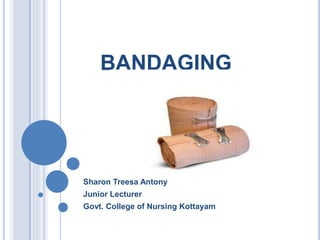
BANDAGING
Sharon Treesa Antony
Junior Lecturer
Govt. College of Nursing Kottayam
USES
 Secure dressings
 Control bleeding
 Support and immobilise limbs
 Reduce swelling in an injured arm
TYPES
 Roller bandage
 Triangular bandage
 Tailed bandage
PRINCIPLES OF BANDAGING
 Before applying a bandage, reassure the casualty
and explain clearly what you are going to do.
 Make the casualty comfortable, in a suitable
sitting or lying position
 Keep the injured part supported while you are
working on it. Ask the casualty or a helper to do
this.
 Always work at the front of the casualty and from
the injured side where possible.
 Apply bandages firmly, but not so tightly that they
interfere with circulation to the area beyond the
bandage
 Leave the fingers, or toe on a bandaged limb
exposed, if possible, so that you can check the
circulation, afterwards.
 Use reef knots to tie bandages, ensure that the
knots do not cause discomfort, and do not tie the
knot over a bony area/ injured part as it causes
discomfort and pressure. Tuck the loose ends
under a knot if possible.
 Regularly check the circulation in the area
beyond the bandage. If necessary unroll the
bandage until the blood supply returns and reapply
it more loosely
 Face the casualty except for capelin and eye
bandage
 Hold the head of the bandage in left hand while
bandaging the right limb
 Begin and end the bandaging with 2 circular turns
 A bandage should never be applied over a wound;
it should be used only to hold in place the dressing
which covers a wound
 Bandage from distal to proximal ( below to upward
part of the limb)
 Bandage from inner side to outer side ( medial to
lateral)
 While taking turns, cover 2/3rd of the previous turn
leaving 1/3rd of the bandage uncovered
 Take turns parallel with one another
APPLICATION OF TRIANGULAR BANDAGE
PARTS OF A TRIANGULAR BANDAGE
Base
Apex/Point
Extremity
Extremity
 Triangle bandage of forehead / scalp
 Arm sling : 2 types
 Elevation sling
 Triangle bandage of chest or back
 Triangle bandage of foot
APPLICATION OF ROLLER BANDAGE
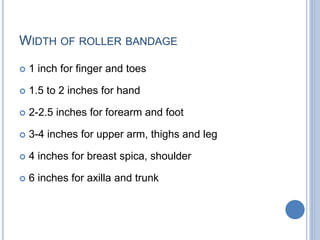
WIDTH OF ROLLER BANDAGE
 1 inch for finger and toes
 1.5 to 2 inches for hand
 2-2.5 inches for forearm and foot
 3-4 inches for upper arm, thighs and leg
 4 inches for breast spica, shoulder
 6 inches for axilla and trunk
PARTS
 Head: the portion that is rolled
 Tail: unrolled portion
 Borders: 2
DIFFERENT TURNS USED
 CIRCULAR TURN:
 To fix the bandage at the beginning and at the end.
 Can be used bandage head and trunk.
SPIRAL TURN
 To bandage a part with slightly increasing width or a
cylindrical part ( forearm, leg, fingers)
REVERSE SPIRAL
 To bandage a part that has uneven width.(forearm,
calf, thigh)
 After taking a simple spiral, apply a reverse turn
when the part increases in size
FIGURE OF EIGHT
 It is done in the shape of figure ‘8’
 Mainly used for ankle, foot, elbow
 Bandage is applied obliquely up and down
alternatively
SPICA
 Used for joints where one part is at an angle with
the other it is modified figure of ‘8’
 Used for shoulder, thigh, groin, hip etc
 Divergent spica: for flexed joints
 Recurrent turn: used to cover an extremity or stump
completely
APPLICATION
 Recurrent bandage of head
 One eye bandage
 Bandage of both eyes
 Bandage of jaw
 Spica of shoulder
 Figure of eight of foot
 Finger bandage
 Recurrent bandage of stump
 Bandage of hand
 Spica of foot
T- BANDAGE
 T shaped
 A vertical strip of material sewn or pinned to the
centre of a horizontal strip
 Used for bandaging perineum, scalp, ear, eye
DOUBLE T BANDAGE
 Made by sewing 2 vertical strips of material to the
centre of a horizontal strip about 4 inches apart.
 Used to hold dressings on the chest, back and
perineum
FOUR TAILED BANDAGE
 Made of a piece of material 4 to 6 inches wide and
about 30 inches long.
 Cut each end about 12 or 14 inches down its
middle, leaving the centre piece about 12 0r 14
inches in length
 Used to hold dressings on the jaw, nose, and back
of the head.
MANY TAILED BANDAGE/ BINDER
 Similar to 4 tailed bandages
 Ends are cut into desired number of tails about 16
inches in length and the middle portion which is not
cut is about 20 inches in length
 Used to support abdomen after delivery
THANK YOU