MEASUREMENT
    S OF
 MORTALITY
 Easy   to obtain.

 Obtained   information is accurate

 Provides
         starting point for many
 epidemiological studies-major resource for
 epidemiologist.
2   parts

 Part
     1-immediate cause, underlying
 cause which started the whole trend of
 events leading to death.

 Part2-any significant associated
 disease that contributed to the death
 but did not directly lead to it.
Defined as
 Disease or injury that initiated the train of
  morbid events leading directly to death.

 Circumstancesof the accident or violence
 which produced the fatal injury.
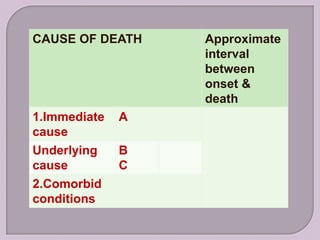
CAUSE OF DEATH    Approximate
                  interval
                  between
                  onset &
                  death
1.Immediate   A
cause
Underlying    B
cause         C
2.Comorbid
conditions
 Setof questions are added to the basic
 structure

 In
  order to improve the quality of maternal
 mortality and infant mortality data.

 To
   provide method of collecting data on
 deaths during pregnancy and infancy.
 Incomplete   reporting of deaths

 Lack of accuracy-age , cause of death-lack
 of diagnostic evidence , inexperience of
 the certifying doctor , absence of
 postmortem.

 Lack of uniformity-hampers national and
 international comparability
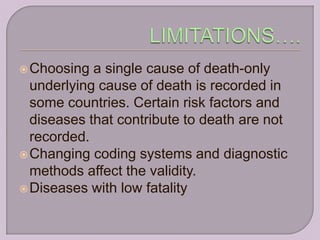
 Choosing  a single cause of death-only
  underlying cause of death is recorded in
  some countries. Certain risk factors and
  diseases that contribute to death are not
  recorded.
 Changing coding systems and diagnostic
  methods affect the validity.
 Diseases with low fatality
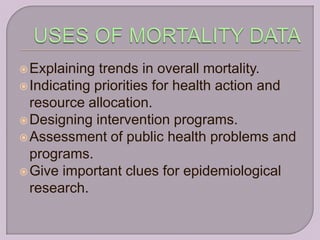
 Explaining  trends in overall mortality.
 Indicating priorities for health action and
  resource allocation.
 Designing intervention programs.
 Assessment of public health problems and
  programs.
 Give important clues for epidemiological
  research.
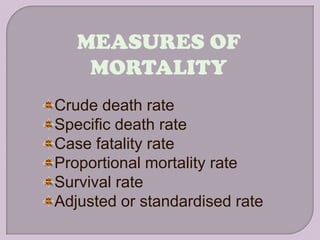
MEASURES OF
    MORTALITY
Crude death rate
Specific death rate
Case fatality rate
Proportional mortality rate
Survival rate
Adjusted or standardised rate
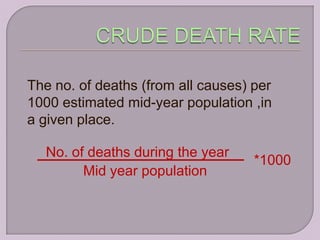
The no. of deaths (from all causes) per
1000 estimated mid-year population ,in
a given place.

  No. of deaths during the year
                                    *1000
        Mid year population
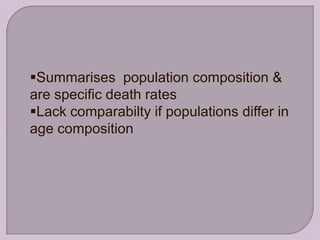
Summarises population composition &
are specific death rates
Lack comparabilty if populations differ in
age composition
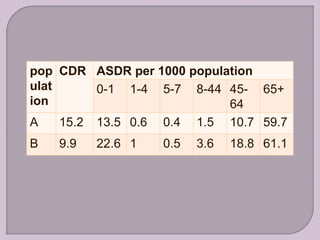
pop CDR ASDR per 1000 population
ulat    0-1 1-4 5-7 8-44 45- 65+
ion                         64
A   15.2   13.5 0.6   0.4   1.5   10.7 59.7
B   9.9    22.6 1     0.5   3.6   18.8 61.1
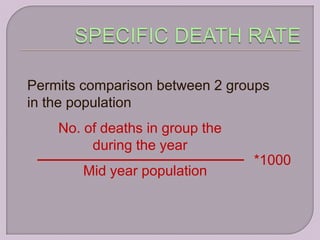
Permits comparison between 2 groups
in the population
    No. of deaths in group the
         during the year
                                 *1000
        Mid year population
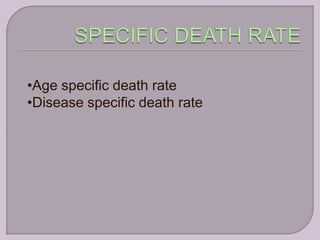
•Age specific death rate
•Disease specific death rate
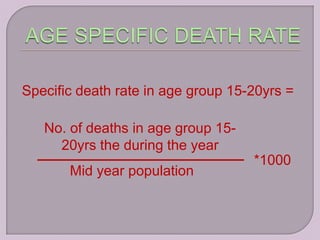
Specific death rate in age group 15-20yrs =

   No. of deaths in age group 15-
     20yrs the during the year
                                    *1000
       Mid year population
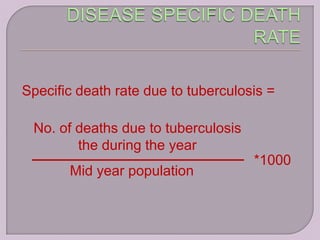
Specific death rate due to tuberculosis =

 No. of deaths due to tuberculosis
        the during the year
                                     *1000
       Mid year population
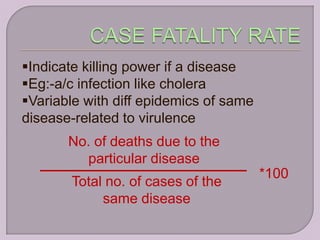
Indicate killing power if a disease
Eg:-a/c infection like cholera
Variable with diff epidemics of same
disease-related to virulence
       No. of deaths due to the
         particular disease
                                        *100
       Total no. of cases of the
            same disease
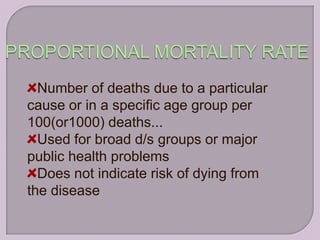
Number of deaths due to a particular
cause or in a specific age group per
100(or1000) deaths...
  Used for broad d/s groups or major
public health problems
  Does not indicate risk of dying from
the disease
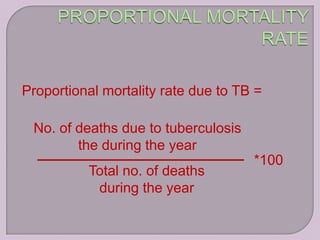
Proportional mortality rate due to TB =

 No. of deaths due to tuberculosis
        the during the year
                                     *100
          Total no. of deaths
           during the year
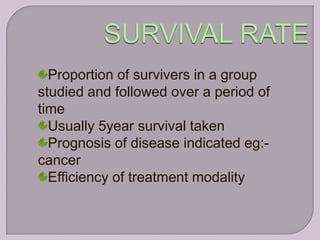
Proportion of survivers in a group
studied and followed over a period of
time
  Usually 5year survival taken
  Prognosis of disease indicated eg:-
cancer
  Efficiency of treatment modality
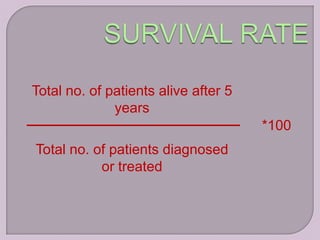
Total no. of patients alive after 5
              years
                                      *100
Total no. of patients diagnosed
           or treated
•Direct standardisation
•Indirect standardisation
                         SMR
                         OTHERS
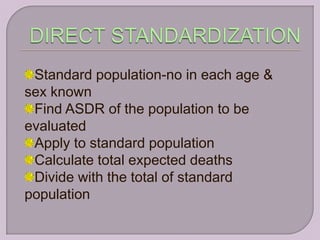
Standard population-no in each age &
sex known
 Find ASDR of the population to be
evaluated
 Apply to standard population
 Calculate total expected deaths
 Divide with the total of standard
population
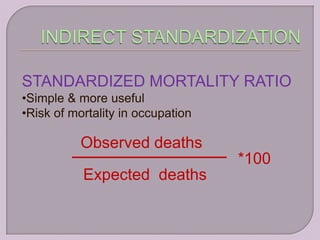
STANDARDIZED MORTALITY RATIO
•Simple & more useful
•Risk of mortality in occupation

           Observed deaths
                                   *100
           Expected deaths
Mortality measurement

Mortality measurement

  • 1.
    MEASUREMENT S OF MORTALITY
  • 2.
     Easy to obtain.  Obtained information is accurate  Provides starting point for many epidemiological studies-major resource for epidemiologist.
  • 3.
    2 parts  Part 1-immediate cause, underlying cause which started the whole trend of events leading to death.  Part2-any significant associated disease that contributed to the death but did not directly lead to it.
  • 4.
    Defined as  Diseaseor injury that initiated the train of morbid events leading directly to death.  Circumstancesof the accident or violence which produced the fatal injury.
  • 5.
    CAUSE OF DEATH Approximate interval between onset & death 1.Immediate A cause Underlying B cause C 2.Comorbid conditions
  • 6.
     Setof questionsare added to the basic structure  In order to improve the quality of maternal mortality and infant mortality data.  To provide method of collecting data on deaths during pregnancy and infancy.
  • 7.
     Incomplete reporting of deaths  Lack of accuracy-age , cause of death-lack of diagnostic evidence , inexperience of the certifying doctor , absence of postmortem.  Lack of uniformity-hampers national and international comparability
  • 8.
     Choosing a single cause of death-only underlying cause of death is recorded in some countries. Certain risk factors and diseases that contribute to death are not recorded.  Changing coding systems and diagnostic methods affect the validity.  Diseases with low fatality
  • 9.
     Explaining trends in overall mortality.  Indicating priorities for health action and resource allocation.  Designing intervention programs.  Assessment of public health problems and programs.  Give important clues for epidemiological research.
  • 10.
    MEASURES OF MORTALITY Crude death rate Specific death rate Case fatality rate Proportional mortality rate Survival rate Adjusted or standardised rate
  • 11.
    The no. ofdeaths (from all causes) per 1000 estimated mid-year population ,in a given place. No. of deaths during the year *1000 Mid year population
  • 12.
    Summarises population composition& are specific death rates Lack comparabilty if populations differ in age composition
  • 13.
    pop CDR ASDRper 1000 population ulat 0-1 1-4 5-7 8-44 45- 65+ ion 64 A 15.2 13.5 0.6 0.4 1.5 10.7 59.7 B 9.9 22.6 1 0.5 3.6 18.8 61.1
  • 14.
    Permits comparison between2 groups in the population No. of deaths in group the during the year *1000 Mid year population
  • 15.
    •Age specific deathrate •Disease specific death rate
  • 16.
    Specific death ratein age group 15-20yrs = No. of deaths in age group 15- 20yrs the during the year *1000 Mid year population
  • 17.
    Specific death ratedue to tuberculosis = No. of deaths due to tuberculosis the during the year *1000 Mid year population
  • 18.
    Indicate killing powerif a disease Eg:-a/c infection like cholera Variable with diff epidemics of same disease-related to virulence No. of deaths due to the particular disease *100 Total no. of cases of the same disease
  • 19.
    Number of deathsdue to a particular cause or in a specific age group per 100(or1000) deaths... Used for broad d/s groups or major public health problems Does not indicate risk of dying from the disease
  • 20.
    Proportional mortality ratedue to TB = No. of deaths due to tuberculosis the during the year *100 Total no. of deaths during the year
  • 21.
    Proportion of surviversin a group studied and followed over a period of time Usually 5year survival taken Prognosis of disease indicated eg:- cancer Efficiency of treatment modality
  • 22.
    Total no. ofpatients alive after 5 years *100 Total no. of patients diagnosed or treated
  • 23.
  • 24.
    Standard population-no ineach age & sex known Find ASDR of the population to be evaluated Apply to standard population Calculate total expected deaths Divide with the total of standard population
  • 25.
    STANDARDIZED MORTALITY RATIO •Simple& more useful •Risk of mortality in occupation Observed deaths *100 Expected deaths