Modern Definition Of Census:
A census of population is the total process of
• Collecting
• Compiling,
• Evaluating ,
• Analyzing and Publishing
Demographic, Economic and Social data
At a specific time, to all persons in a country.
                        OR
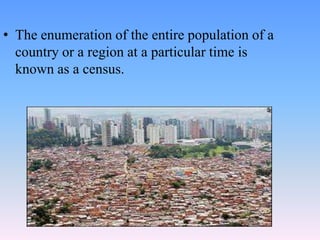
• The enumeration of the entire population of a
  country or a region at a particular time is
  known as a census.
Salient features of a Population
              Census:
1. Individual enumeration,

2. Universality within a defined territory,

3. Simultaneity &

4. Defined periodicity
Individual Enumeration
• A census implies that each individual is
  separately, but only once, enumerated and that
  some important characteristics of each person
  are separately recorded.
  These include :-
                                    Marital
           sex           age
                                    status

         Religion                  Educational
                       literacy
                                   attainment


         Economic                      Etc.
                      occupation
          activity
Universality within a defined
               territory
• Ideally, a national census should cover the
  country’s entire territory and all people
  resident places.
Simultaneity
• Ideally, census is taken of a given day. To
  avoid omissions and duplications in census, it
  should be taken in a given day but it is not
  possible particularly in case of de jure census.
• eg: in case of residence ,when a person is
  living for more than 5 years at a particular
  place and income in the preceding calendar
  year.
DEFINIED PERIODICITY
• “Census should be taken at regular
  intervals, so that comparable information is
  made available in a fixed sequence.”
• A series of censuses make it possible to :-
                    Appraise the past

            Accurately describe the present &

                   Estimate the future
USES OF THE CENSUS
• Population census is the primary source of
  basic national population data;

• Required for administrative purpose &

• For many aspects of economic and social
  planning and research.
• It provides us with information on
Trends in population growth,
Change in the age and sex structure of the
  population,
The course of mortality and fertility, migration
  and urbanization etc.
HOUSE LISTING

• Houselisting operations are prerequisite to the population
  enumeration for conducting census in India.

OBJECTIVE:
• Is to number and list out all the building, census houses
  and households so as to serve as an inventory for
  organising the population enumeration.
Office of Registrar General and Census
            Commissioner
 • Under the Ministry of Home Affair , GOI.

 • Headed by Registrar general & Census
   commissioner.

 • Appointed by central government.

 • Responsibility of conducting census all over the
   country.
• In each state and union territory ,census operation are under
  Director of Census Operation.

• In Tamilnadu , Commissioner of Revenue Administration is
  responsible for Census Operation.

• At district level , collector is designated as Principal Census
  Officers.

• In ten municipal corporation areas Commissioners of Corporations
  have been designated as the Principal Census Officers.

• In Chennai, Commissioners of Corporations is designated as
  principal census officer.
• A number of officers are designated as Census
  Officers at various sub-district levels to assist the
  Principal Census Officers in the conduct of Census.
Census act 1948
The legislature has enacted certain provision in the
India under Census Act, 1948. These provision are

Asking of questions and obligation to answer
Occupier to permit access and affixing of numbers
Records of Census not open to inspection nor
admissible in evidence.
Protection of service interests of members of
Census staff.
Protection of action taken in good faith.
Continue……….
Penalties
Any person who refuses to cooperate may be fined
with Rs. 1000 or/and imprisoned for 3 years.
Census house
  A 'census house' is a building or part of a building used or
  recognised as a separate unit because of having a separate main
  entrance from the road or common courtyard or staircase, etc.
• It may be occupied or vacant.
• It may be used for a residential or non- residential purpose or
  both.

  Houselisting block
   It means a specific area allotted to a specific enumerator for the
   purpose of carrying out census operations relating to house
   numbering and house listing.
Houselisting operation

It includes
• preparation of maps
• Preparation of houselists and
• house numbering.

Map: it includes
•National map
•layout sketch

Natinol Map is prepared for entire village or urban block and it
shows the location of each enumeration block within a village or
town.
Layout sketch is a detailed map of the block assigned to the
enumerator showing streets and buildings on the street.
House-numberig:
Each building or house is numbered in series.

Houselist:
Identification particulars of the numeration block and the details of
the building, census houses, names of the head of the house hold etc
are furnished.
 For listing of these units/households, enumerator has to visit all the
houses/households/units of the village/UFS blocks.

On the basis of houselist, enumeration blocks are carved out and each
such enumeration block is allotted to an enumerator during the actual
census.
All the enumerators are thoroughly trained and they receive all the
relevant Schedules and other materials as :
• Village/ Ward Map showing the boundaries of the HLB
• Enumerator’s kit
• Sheets for preparing Layout Map
• State List of Scheduled Castes/Scheduled Tribes
• Instruction Manual for House listing and Housing Census
• Instruction Manual for NPR Household Schedule
• House listing and Housing Census Schedules
• NPR Schedules
• House list Abstract forms
• NPR Working sheets
• NPR Enumerator’s Abstract
• Acknowledgement Slip Booklet(s)
TRAINERS CAN BE CLASSIFIED AS:


               NATIONAL
             TRAINERS(MTs)


           MASTER TRAINER
            FACILITATORS
                MTFs


           MASTER TRAINERS
                 MT


     ENUMERATORS AND SUPERVISORS
Training plan for house listing
  Training is conducted at three levels:
• State level training
• District level training
• Charge level training
STATE LEVEL TRAINING

State level training is conducted at state headquarter
by the Directorate in which
 Municipal Commissioners & Principal Census officers of
municipal
Corporations,
Divisional Census Officers,
District Census Officers,
additional District census officers and,
City Census Officers participates.


Training is imparted by expert faculty of trained NTs
DISTRICT LEVEL TRAINING


District level training is held at district headquarters for
Charge Officers and for Master Trainers (MTs).
In this training of three days duration,
two days are reserved for House Listing Operation and one day for
National Population Register.

Collector & Principal Census Officers, District Census
Officers, additional district census officer, city census
officers, charge officers and master trainers are trained in this way.
Training is conducted by faculty of trained national trainers (NTs)
and MTFs.
CHARGE LEVEL TRAINING

Charge level trainings for enumerators and supervisors is
organised at charge headquarters.
The three days training is given by the MTs which
 includes two days for the House Listing Operation and one
day for NPR.
Unique Identification
           `
Authority of India(UIDAI)
• The Unique Identification Authority of
  India (UIDAI) is an agency of the
  Government of India responsible for
  implementing the AADHAAR scheme, a
  unique identification project.
• The authority aims is to provide a unique id
  number to all Indians.
• The authority will maintain a database of
  residents containing biometric and other data.
• The UIDAI is part of the Planning
  Commission of India

• Annual Budget 3000 crore (US$608.4
  million)

• Established in February 2009
FEATURES

• Aadhaar is a 12-digit unique number.
• The number will be stored in a centralized
  database.
• It is easily verifiable in an online, cost-
  effective way.
• The first resident to receive an AADHAAR
  was Rajana Sonawane of Tembhli
  village, Maharashtra.
NECESSARY INFORMATION

• Photograph
• Finger print scan
• Retina scan
• Address with Pin Code


• Photocopy of a document like (Driving
  licence, voter id card, PAN card)
BENEFITS
• Single source of identity verification

• Facilitate entry for poor and the opportunity to
  avail services provided by the government and
  the private sector.
population census

population census

  • 3.
    Modern Definition OfCensus: A census of population is the total process of • Collecting • Compiling, • Evaluating , • Analyzing and Publishing Demographic, Economic and Social data At a specific time, to all persons in a country. OR
  • 4.
    • The enumerationof the entire population of a country or a region at a particular time is known as a census.
  • 5.
    Salient features ofa Population Census: 1. Individual enumeration, 2. Universality within a defined territory, 3. Simultaneity & 4. Defined periodicity
  • 6.
    Individual Enumeration • Acensus implies that each individual is separately, but only once, enumerated and that some important characteristics of each person are separately recorded. These include :- Marital sex age status Religion Educational literacy attainment Economic Etc. occupation activity
  • 7.
    Universality within adefined territory • Ideally, a national census should cover the country’s entire territory and all people resident places.
  • 8.
    Simultaneity • Ideally, censusis taken of a given day. To avoid omissions and duplications in census, it should be taken in a given day but it is not possible particularly in case of de jure census. • eg: in case of residence ,when a person is living for more than 5 years at a particular place and income in the preceding calendar year.
  • 9.
    DEFINIED PERIODICITY • “Censusshould be taken at regular intervals, so that comparable information is made available in a fixed sequence.” • A series of censuses make it possible to :- Appraise the past Accurately describe the present & Estimate the future
  • 10.
    USES OF THECENSUS • Population census is the primary source of basic national population data; • Required for administrative purpose & • For many aspects of economic and social planning and research.
  • 11.
    • It providesus with information on Trends in population growth, Change in the age and sex structure of the population, The course of mortality and fertility, migration and urbanization etc.
  • 13.
    HOUSE LISTING • Houselistingoperations are prerequisite to the population enumeration for conducting census in India. OBJECTIVE: • Is to number and list out all the building, census houses and households so as to serve as an inventory for organising the population enumeration.
  • 15.
    Office of RegistrarGeneral and Census Commissioner • Under the Ministry of Home Affair , GOI. • Headed by Registrar general & Census commissioner. • Appointed by central government. • Responsibility of conducting census all over the country.
  • 16.
    • In eachstate and union territory ,census operation are under Director of Census Operation. • In Tamilnadu , Commissioner of Revenue Administration is responsible for Census Operation. • At district level , collector is designated as Principal Census Officers. • In ten municipal corporation areas Commissioners of Corporations have been designated as the Principal Census Officers. • In Chennai, Commissioners of Corporations is designated as principal census officer.
  • 17.
    • A numberof officers are designated as Census Officers at various sub-district levels to assist the Principal Census Officers in the conduct of Census.
  • 18.
    Census act 1948 Thelegislature has enacted certain provision in the India under Census Act, 1948. These provision are Asking of questions and obligation to answer Occupier to permit access and affixing of numbers Records of Census not open to inspection nor admissible in evidence. Protection of service interests of members of Census staff. Protection of action taken in good faith.
  • 19.
    Continue………. Penalties Any person whorefuses to cooperate may be fined with Rs. 1000 or/and imprisoned for 3 years.
  • 20.
    Census house A 'census house' is a building or part of a building used or recognised as a separate unit because of having a separate main entrance from the road or common courtyard or staircase, etc. • It may be occupied or vacant. • It may be used for a residential or non- residential purpose or both. Houselisting block It means a specific area allotted to a specific enumerator for the purpose of carrying out census operations relating to house numbering and house listing.
  • 21.
    Houselisting operation It includes •preparation of maps • Preparation of houselists and • house numbering. Map: it includes •National map •layout sketch Natinol Map is prepared for entire village or urban block and it shows the location of each enumeration block within a village or town. Layout sketch is a detailed map of the block assigned to the enumerator showing streets and buildings on the street.
  • 22.
    House-numberig: Each building orhouse is numbered in series. Houselist: Identification particulars of the numeration block and the details of the building, census houses, names of the head of the house hold etc are furnished. For listing of these units/households, enumerator has to visit all the houses/households/units of the village/UFS blocks. On the basis of houselist, enumeration blocks are carved out and each such enumeration block is allotted to an enumerator during the actual census.
  • 23.
    All the enumeratorsare thoroughly trained and they receive all the relevant Schedules and other materials as : • Village/ Ward Map showing the boundaries of the HLB • Enumerator’s kit • Sheets for preparing Layout Map • State List of Scheduled Castes/Scheduled Tribes • Instruction Manual for House listing and Housing Census • Instruction Manual for NPR Household Schedule • House listing and Housing Census Schedules • NPR Schedules • House list Abstract forms • NPR Working sheets • NPR Enumerator’s Abstract • Acknowledgement Slip Booklet(s)
  • 24.
    TRAINERS CAN BECLASSIFIED AS: NATIONAL TRAINERS(MTs) MASTER TRAINER FACILITATORS MTFs MASTER TRAINERS MT ENUMERATORS AND SUPERVISORS
  • 25.
    Training plan forhouse listing Training is conducted at three levels: • State level training • District level training • Charge level training
  • 26.
    STATE LEVEL TRAINING Statelevel training is conducted at state headquarter by the Directorate in which Municipal Commissioners & Principal Census officers of municipal Corporations, Divisional Census Officers, District Census Officers, additional District census officers and, City Census Officers participates. Training is imparted by expert faculty of trained NTs
  • 27.
    DISTRICT LEVEL TRAINING Districtlevel training is held at district headquarters for Charge Officers and for Master Trainers (MTs). In this training of three days duration, two days are reserved for House Listing Operation and one day for National Population Register. Collector & Principal Census Officers, District Census Officers, additional district census officer, city census officers, charge officers and master trainers are trained in this way. Training is conducted by faculty of trained national trainers (NTs) and MTFs.
  • 28.
    CHARGE LEVEL TRAINING Chargelevel trainings for enumerators and supervisors is organised at charge headquarters. The three days training is given by the MTs which includes two days for the House Listing Operation and one day for NPR.
  • 29.
    Unique Identification ` Authority of India(UIDAI)
  • 30.
    • The UniqueIdentification Authority of India (UIDAI) is an agency of the Government of India responsible for implementing the AADHAAR scheme, a unique identification project. • The authority aims is to provide a unique id number to all Indians. • The authority will maintain a database of residents containing biometric and other data.
  • 31.
    • The UIDAIis part of the Planning Commission of India • Annual Budget 3000 crore (US$608.4 million) • Established in February 2009
  • 32.
    FEATURES • Aadhaar isa 12-digit unique number. • The number will be stored in a centralized database. • It is easily verifiable in an online, cost- effective way. • The first resident to receive an AADHAAR was Rajana Sonawane of Tembhli village, Maharashtra.
  • 33.
  • 34.
  • 35.
  • 36.
    • Address withPin Code • Photocopy of a document like (Driving licence, voter id card, PAN card)
  • 37.
    BENEFITS • Single sourceof identity verification • Facilitate entry for poor and the opportunity to avail services provided by the government and the private sector.