DEGENERATIVE DISEASES
DR M SHOAIB SHAFI
DEGENERATIVE DISEASES
•
•
•
•
•
•
•
•
•
•

Alzheimers disease
Motor neuron disease
Wernickes- korsakoff disease
Parkinsonism
Multiple system atrophy
Progressive supranuclear palsy
Wilsons disease
Huntingtons disease
Hereditary ataxias
spinal muscular atrophies
ALZHEIMERS DISEASE
• Most common cause of dementia, occuring

mostly in patients over 45 years.
• 15% cases are familial divided into 2 groups ie
1)Early onset: autosomal dominant
2)Later-onset: inheritance not so clear
• Genetic abnormalities on several different
chromosomes have been identified.
PATHOLOGY
• MACROSCOPICALLY; brain is atrophic
•
•
•

particularly cerebral cortex & hippocampus.
MICROSCOPY reveals senile plaques and
neurofibrillary tangles in cerebral cortex.
There is significant quantity of AMYLOID in the
plaques.
There are different neurotransmitter
abnormalities especially in cholinergic
transmission.
CLINICAL FEATURES
• The key clinical feature is impairment of delayed
•
•
•
•

recall ie inability to retrieve information acquired
in the past.
Both short term & long term memory are
affected especially short term.
Later apraxia, visuospatial impairment and
aphasia develop.
Anosogonosia
depression
Investigations
• No diagnostic lab test
• Investigations can be done to rule out other
•
•
•
•
•
•

causes
Baseline labs
CT / MRI brain
TFTs
Vitamin B12 levels
EEG
ANA / anti- ds DNA
TREATMENT
•
•
•
•

•

Conservative treatment
Psychosocial support
Antidepressants
Anticholinestrases:
Donepezil
Rivastigmine
Galantamine
NMDA receptor antagonist MEMANTINE
DEFINITION
• This is a progressive disorder of unknown cause
in which there is degeneration of motor neurons
in the spinal cord & cranial nerve nuclei, and of
pyramidal neurons in the motor cortex.

• French neurologist Jean Martin Charcot first
described the term of MND in 1869. so also
called as Maladie de charcot in France.
Description
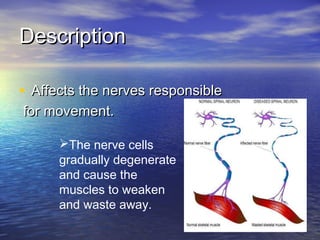
• Affects the nerves responsible
for movement.

The nerve cells
gradually degenerate
and cause the
muscles to weaken
and waste away.
PATHOLOLOGY
• > 90% of the cases are sporadic.

• 5 to 10 % are familial showing autosomal
•

dominant inheritance.
The genetic defect lies on chromosome 21 and
the enzyme involved is superoxide dismutase
(SOD1) in about 20% of familial cases.
EPIDEMIOLOGY
• The incidence of MND is approximately 1–5 out
•
•
•
•

of 100,000 people.
Men have a slightly higher incidence rate than
women.
Mostly presents in 4th or 5th decade.
Cases under the age of 50 years are called
"young onset MND“.
Tentative environmental risk factors identified so
far include: exposure to severe electrical shock
leading to coma, having served in the first
Gulf War, and playing professional
football (soccer).
HOT-SPOTS OF MND
•
•
•
•
•

There are three "hot spots" of MND in the world.
One is in the Kii peninsula of Japan,
one amongst a tribal population in
Papua New Guinea.
Chamorro inhabitants from the island of Guam in
the Pacific Ocean have an increased risk of
developing a form of MND known as Guamanian
ALS-PD-dementia complex or "lytico bodig“.
Putative theories involve neurotoxins in the
traditional diet including cycad nut flour and bats
that have eaten cycad nuts.
PATHOPHYSIOLOGY
• . On macroscopic pathology, there is a degeneration of
•
•

the ventral horns of the spinal cord, as well as atrophy of
the ventral roots. In the brain, atrophy may be present in
the frontal and temporal lobes.
On microscopic examination, neurones may show
spongiosis, the presence of astrocytes, and a number of
inclusions including characteristic "skein-like" inclusions,
bunina bodies, and vacuolisation.
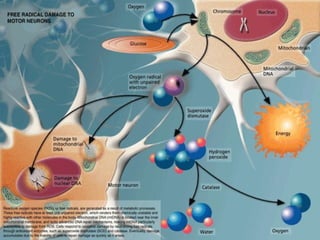
There is a role in excitotoxicity and oxidative stress,
presumably secondary to mitochondrial dysfunction. In
animal models, death by apoptosis has also been
identified.
CLINICAL FEATURES
•
•

Usually there is a combination of upper & lower
motor neuron features without sensory
involvement.
The presence of brisk reflexes in wasted
fasciculating muscles is typical.
SYMPTOMS
•
•
•
•
•
•

Limb muscle weakness
Cramps
Ataxia
Difficulty in holding the objects
Difficulty in speaking
Difficulty in eating
SIGNS
• Wasting & fasciculation of muscles

• Weakness of muscles of limb, tongue, face and
•
•
•

palate
Spasticity, exaggerated reflexes and extensor
plantar response (pyramidal tract involvement)
No sensory deficitextraocular muscles &
sphincters remain intact till very late stages.
No intellectual impairment or depression in most
of the cases.
COURSE

Symptoms usually begin focally in one
part and spread gradually but relentlessly
to become widespread.
VARIANTS OF MND
•

Forms of motor neuron disease include:
amyotrophic lateral sclerosis (ALS) (sometimes
called Lou Gehrig's disease)

• primary lateral sclerosis (PLS)
• progressive muscular atrophy (PMA)
• Bulbar:
– pseudobulbar palsy - spastic

– progressive bulbar palsy - spastic and flaccid
• MND in the presence of both upper and lower
•
•
•
•

motor neuron degeneration is ALS.
Where the illness affects only the upper motor
neurons it is PLS.
Where the illness affects only the lower motor
neurons it is PMA.
Progressive bulbar palsy is degeneration of the
lower motor neurons innervating the bulbar
region (mouth, face, and throat).
Pseudobulbar palsy refers to degeneration of the
upper motor neurons to the same region.
PROGRESSIVE MUSCULAR
ATROPHY
• Predominantly spinal motor neurons affected
• Weakness and wasting of distal limb muscles at
•
•

first
Fasciculation in muscles
Tendon reflexes may be absent
PRIMARY LATERAL SCLEROSIS

• This form presents with weaknessof limbs.
O/E there are all the features of UMN
lesion ie spasticity, brisk reflexes and
upgoing plantars.
• It is purely an UMN variant.
AMYOTROPHIC LATERAL
SCLEROSIS
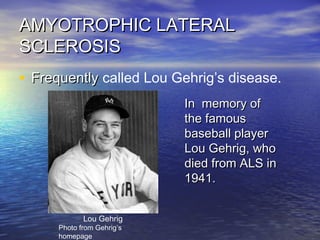
• Frequently called Lou Gehrig’s disease.
In memory of
the famous
baseball player
Lou Gehrig, who
died from ALS in
1941.
Lou Gehrig

Photo from Gehrig’s
homepage
AMYOTROPHIC LATERAL
SCLEROSIS
• Amyotrophic comes from the Greek language: A- means
•
•
•

"no", myo refers to "muscle",
trophic means "nourishment";
amyotrophic means "no muscle nourishment," which
describes the characteristic atrophication of the sufferer's
disused muscle tissue.
Lateral identifies the areas in a person's spinal cord
where portions of the nerve cells that are affected are
located. As this area degenerates it leads to scarring or
hardening ("sclerosis") in the region.
BULBAR LESIONS
• There is involvement of tongue, palate and
pharyngeal muscles leading to dysarthria
and dysphagia.
• There may be bulbar palsy (LMN lesion)
• Or pseudobulbar palsy ie UMN lesion.
DIFFERENCES BETWEEN BULBAR &
PSEUDOBULBAR PALSY
• BULBAR PALSY
• Tongue is flaccid &
•
•

fasciculating
Jaw jerk is normal or
absent
Speech is nasal or
hoarse

• PSEUDOBULBAR
• Tongue is spastic
• Jaw jerk is increased
• Speech is like Donald
Duck
DIAGNOSIS
• Diagnosis is clinical.
• Investigations are done only to rule out
other diseases.
INVESTIGATIONS
•
•
•
•

CT / MRI brain
EMG
NCS
SPINAL IMAGING
MANAGEMENT
•NON-PHARMACOLOGICAL MEASURES

• PHARMACOLOGICAL MEASURES
GENERAL MEASURES
•
•
•
•
•
•
•
•

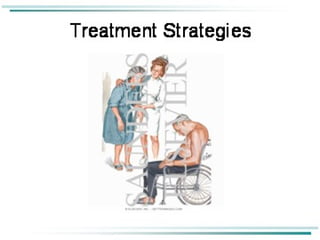
Physiotherapy
Psychotherapy
Speech therapy & communication devices
Occupational assisstance
Splints, walking aids
Wheelchairs
Percutaneous gastrostomy
Non-invasive ventilatory support
DRUGS
• Riluzole ;a glutamine receptor antagonist;
100 mg/ day is modestly effective in
prolonging life by upto 2 months.
• Nerve growth factor
• Insulin like growth factor 1 (IGF-1)
RESEARCH WORK
• The search for a drug that will slow MND

•

progression is under way. For example, recent
research using mouse models suggests that
minocycline, a common antibiotic, may also be
effective in extending the lifespan of MND
sufferers.
Minocycline extends the lifespan of MND mice
with SOD1 mutations, but it does not prevent
their eventual death. Other agents that are
currently in trials include ceftriaxone,
arimoclomol and coenzyme Q10.
PROGNOSIS
•
•
•
•
•

It is a progressive disease.
Mean time from diagnosis to death is 1 year.
Most patients die within 3 to 5 years of onset of
illness.
Younger patients & those with bulbar symptoms
show a more rapid course.
Death is usually from respiratory infections &
complications of immobility.
FAMOUS PERSONS WITH MND

• JASON BECKER
• PROF STEPHEN HAWKING
Degenerative diseases

Degenerative diseases

  • 1.
  • 2.
    DEGENERATIVE DISEASES • • • • • • • • • • Alzheimers disease Motorneuron disease Wernickes- korsakoff disease Parkinsonism Multiple system atrophy Progressive supranuclear palsy Wilsons disease Huntingtons disease Hereditary ataxias spinal muscular atrophies
  • 3.
    ALZHEIMERS DISEASE • Mostcommon cause of dementia, occuring mostly in patients over 45 years. • 15% cases are familial divided into 2 groups ie 1)Early onset: autosomal dominant 2)Later-onset: inheritance not so clear • Genetic abnormalities on several different chromosomes have been identified.
  • 4.
    PATHOLOGY • MACROSCOPICALLY; brainis atrophic • • • particularly cerebral cortex & hippocampus. MICROSCOPY reveals senile plaques and neurofibrillary tangles in cerebral cortex. There is significant quantity of AMYLOID in the plaques. There are different neurotransmitter abnormalities especially in cholinergic transmission.
  • 5.
    CLINICAL FEATURES • Thekey clinical feature is impairment of delayed • • • • recall ie inability to retrieve information acquired in the past. Both short term & long term memory are affected especially short term. Later apraxia, visuospatial impairment and aphasia develop. Anosogonosia depression
  • 6.
    Investigations • No diagnosticlab test • Investigations can be done to rule out other • • • • • • causes Baseline labs CT / MRI brain TFTs Vitamin B12 levels EEG ANA / anti- ds DNA
  • 7.
  • 10.
    DEFINITION • This isa progressive disorder of unknown cause in which there is degeneration of motor neurons in the spinal cord & cranial nerve nuclei, and of pyramidal neurons in the motor cortex. • French neurologist Jean Martin Charcot first described the term of MND in 1869. so also called as Maladie de charcot in France.
  • 11.
    Description • Affects thenerves responsible for movement. The nerve cells gradually degenerate and cause the muscles to weaken and waste away.
  • 12.
    PATHOLOLOGY • > 90%of the cases are sporadic. • 5 to 10 % are familial showing autosomal • dominant inheritance. The genetic defect lies on chromosome 21 and the enzyme involved is superoxide dismutase (SOD1) in about 20% of familial cases.
  • 13.
    EPIDEMIOLOGY • The incidenceof MND is approximately 1–5 out • • • • of 100,000 people. Men have a slightly higher incidence rate than women. Mostly presents in 4th or 5th decade. Cases under the age of 50 years are called "young onset MND“. Tentative environmental risk factors identified so far include: exposure to severe electrical shock leading to coma, having served in the first Gulf War, and playing professional football (soccer).
  • 14.
    HOT-SPOTS OF MND • • • • • Thereare three "hot spots" of MND in the world. One is in the Kii peninsula of Japan, one amongst a tribal population in Papua New Guinea. Chamorro inhabitants from the island of Guam in the Pacific Ocean have an increased risk of developing a form of MND known as Guamanian ALS-PD-dementia complex or "lytico bodig“. Putative theories involve neurotoxins in the traditional diet including cycad nut flour and bats that have eaten cycad nuts.
  • 15.
    PATHOPHYSIOLOGY • . Onmacroscopic pathology, there is a degeneration of • • the ventral horns of the spinal cord, as well as atrophy of the ventral roots. In the brain, atrophy may be present in the frontal and temporal lobes. On microscopic examination, neurones may show spongiosis, the presence of astrocytes, and a number of inclusions including characteristic "skein-like" inclusions, bunina bodies, and vacuolisation. There is a role in excitotoxicity and oxidative stress, presumably secondary to mitochondrial dysfunction. In animal models, death by apoptosis has also been identified.
  • 17.
    CLINICAL FEATURES • • Usually thereis a combination of upper & lower motor neuron features without sensory involvement. The presence of brisk reflexes in wasted fasciculating muscles is typical.
  • 18.
    SYMPTOMS • • • • • • Limb muscle weakness Cramps Ataxia Difficultyin holding the objects Difficulty in speaking Difficulty in eating
  • 19.
    SIGNS • Wasting &fasciculation of muscles • Weakness of muscles of limb, tongue, face and • • • palate Spasticity, exaggerated reflexes and extensor plantar response (pyramidal tract involvement) No sensory deficitextraocular muscles & sphincters remain intact till very late stages. No intellectual impairment or depression in most of the cases.
  • 20.
    COURSE Symptoms usually beginfocally in one part and spread gradually but relentlessly to become widespread.
  • 21.
    VARIANTS OF MND • Formsof motor neuron disease include: amyotrophic lateral sclerosis (ALS) (sometimes called Lou Gehrig's disease) • primary lateral sclerosis (PLS) • progressive muscular atrophy (PMA) • Bulbar: – pseudobulbar palsy - spastic – progressive bulbar palsy - spastic and flaccid
  • 22.
    • MND inthe presence of both upper and lower • • • • motor neuron degeneration is ALS. Where the illness affects only the upper motor neurons it is PLS. Where the illness affects only the lower motor neurons it is PMA. Progressive bulbar palsy is degeneration of the lower motor neurons innervating the bulbar region (mouth, face, and throat). Pseudobulbar palsy refers to degeneration of the upper motor neurons to the same region.
  • 23.
    PROGRESSIVE MUSCULAR ATROPHY • Predominantlyspinal motor neurons affected • Weakness and wasting of distal limb muscles at • • first Fasciculation in muscles Tendon reflexes may be absent
  • 24.
    PRIMARY LATERAL SCLEROSIS •This form presents with weaknessof limbs. O/E there are all the features of UMN lesion ie spasticity, brisk reflexes and upgoing plantars. • It is purely an UMN variant.
  • 25.
    AMYOTROPHIC LATERAL SCLEROSIS • Frequentlycalled Lou Gehrig’s disease. In memory of the famous baseball player Lou Gehrig, who died from ALS in 1941. Lou Gehrig Photo from Gehrig’s homepage
  • 26.
    AMYOTROPHIC LATERAL SCLEROSIS • Amyotrophiccomes from the Greek language: A- means • • • "no", myo refers to "muscle", trophic means "nourishment"; amyotrophic means "no muscle nourishment," which describes the characteristic atrophication of the sufferer's disused muscle tissue. Lateral identifies the areas in a person's spinal cord where portions of the nerve cells that are affected are located. As this area degenerates it leads to scarring or hardening ("sclerosis") in the region.


  • 27.
    BULBAR LESIONS • Thereis involvement of tongue, palate and pharyngeal muscles leading to dysarthria and dysphagia. • There may be bulbar palsy (LMN lesion) • Or pseudobulbar palsy ie UMN lesion.
  • 28.
    DIFFERENCES BETWEEN BULBAR& PSEUDOBULBAR PALSY • BULBAR PALSY • Tongue is flaccid & • • fasciculating Jaw jerk is normal or absent Speech is nasal or hoarse • PSEUDOBULBAR • Tongue is spastic • Jaw jerk is increased • Speech is like Donald Duck
  • 29.
    DIAGNOSIS • Diagnosis isclinical. • Investigations are done only to rule out other diseases.
  • 30.
    INVESTIGATIONS • • • • CT / MRIbrain EMG NCS SPINAL IMAGING
  • 31.
  • 32.
    GENERAL MEASURES • • • • • • • • Physiotherapy Psychotherapy Speech therapy& communication devices Occupational assisstance Splints, walking aids Wheelchairs Percutaneous gastrostomy Non-invasive ventilatory support
  • 34.
    DRUGS • Riluzole ;aglutamine receptor antagonist; 100 mg/ day is modestly effective in prolonging life by upto 2 months. • Nerve growth factor • Insulin like growth factor 1 (IGF-1)
  • 35.
    RESEARCH WORK • Thesearch for a drug that will slow MND • progression is under way. For example, recent research using mouse models suggests that minocycline, a common antibiotic, may also be effective in extending the lifespan of MND sufferers. Minocycline extends the lifespan of MND mice with SOD1 mutations, but it does not prevent their eventual death. Other agents that are currently in trials include ceftriaxone, arimoclomol and coenzyme Q10.
  • 36.
    PROGNOSIS • • • • • It is aprogressive disease. Mean time from diagnosis to death is 1 year. Most patients die within 3 to 5 years of onset of illness. Younger patients & those with bulbar symptoms show a more rapid course. Death is usually from respiratory infections & complications of immobility.
  • 37.
    FAMOUS PERSONS WITHMND • JASON BECKER • PROF STEPHEN HAWKING