Motor Neuron Diseases
Presented by
Riwaj bhandari
Definition
Motor Neuron Diseases
– group of diseases which include progressive degeneration and loss of
motor neurons with or without similar lesion of the motor nuclei of the
brain
– replacement of lost cells with gliosis
– Motor neuron diseases are a group of neurodegenerative disorders that
affects the nerves in the spine and brain to progressively lose its
function. They are a rare but serious and incurable form of
progressive neurodegeneration. It is a condition that selectively affects
the motor system, the cells which control voluntary muscles of the
body
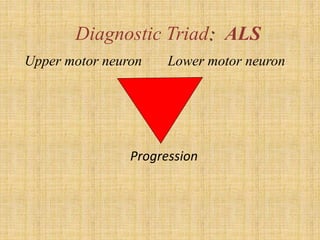
Diagnostic Triad: ALS
Upper motor neuron Lower motor neuron
Progression
Incidence
Motor neuron disease (MND) occur in adults and children.
It can appear at any age, but most patients are over 40 years old at
diagnosis.
It affects men more than women.
WHAT ARE MOTOR NEURONS?
They are a type of nerve cell, that send messages to the
body(muscle) from the brain so helps to move.
Two kinds includes:
UPPER MOTOR NEURONS:
LOWER MOTOR NEURONS:
Normally, messages from nerve cells in the brain (called upper
motor neurons) are transmitted to nerve cells in the brain stem
and spinal cord (called lower motor neurons) and from them to
particular muscles.
CONT…
As nerve cells die when pt have a motor neuron disease, electrical
messages can't get from the brain to muscles. Over time, muscles
waste away, known as “atrophy.”
When this happens, it leads to lose control over movements. It gets
harder to walk, talk, swallow, and breathe.
Each kind of motor neuron disease affects different types of nerve cells
or has a different cause. ALS is the most common of these diseases
in adults.
Here's a look at some of the types of motor neuron diseases.
TYPES OF MND:
MNDs are classified according to whether they are
inherited or sporadic(i.e-anyone can get it), and to
whether degeneration affects upper motor neurons,
lower motor neurons, or both. In adults, the most
common MND is Amyotrophic Lateral Sclerosis
(ALS).
CONT….
ALS, or Lou Gehrig's disease, is the most common type, affects both
the UMN and LMN. It can affect the muscles of the arms, legs,
mouth, and respiratory system. Mean survival time is 3 to 5 years,
but some people live 10 years or more beyond diagnosis with
supportive care. Progressive bulbar palsy (PBP) involves the brain
stem(LMN). People with ALS often have PBP too. The condition
causes frequent choking spells, difficulty speaking, eating, and
swallowing.
CONT.
Pseudobulbar Palsy: This is similar to progressive bulbar palsy. It affects
motor neurons that control the ability to talk, chew, and swallow.
Pseudobulbar palsy causes people to laugh or cry with no control.
Progressive muscular atrophy (PMA): It only affects the LMN in the
spinal cord. Affects slowly but progressively causes muscle wasting,
especially in the arms, legs, and mouth. It may be a variation of ALS.
Primary lateral sclerosis (PLS): It is a disease of UMN. It is the rare form
of MND that advances more slowly than ALS. It is not fatal, but it
can affect the quality of life. In children, it is known as juvenile
primary lateral sclerosis.
CONT.
Spinal muscular atrophy (SMA) is an inherited MND
that affects children. There are three types, all
caused by an abnormal gene known as
SMA1(This gene makes a protein that protects
the motor neurons. Without it, they die.). It tends
to affect the trunk, legs, and arms. Long-term
outlook varies according to type.
The different types of MND share similar
symptoms, but they progress at different speeds
and vary in severity
Causes
The exact causes are unclear. Some MNDs are inherited, but
the causes of most MNDs are not known. About 5% of
people with motor neurone disease have a close family
relative with the condition or a related condition known as
fronto temporal dementia. This is called familial motor
neurone disease which can be hereditary or linked to a
problem with genes that can cause problems at a younger
age. In sporadic or non inherited MNDs,
environmental,
toxic,
viral,
or genetic factors likely play a role.
Risk Factors
HEREDITARY
AGE
SEX
Some experts have linked military experience to a higher
chance of developing the disease. Studies have found
that professional footballers are more likely to die from
ALS, Alzheimer's disease, and other neurodegenerative
diseases, compared with other people. This implies a
possible link with recurrent head trauma and
neurological disease.
Symptoms
MND can be divided into three stages; early,
middle, and advanced.
Early stage signs and symptoms:
Symptoms develop slowly and can be confused with
symptoms of some other unrelated neurological
conditions.
Early symptoms depend upon which body system is
affected first. Typical symptoms begin in one of
three areas: the arms and legs, the mouth
(bulbar), or the respiratory system.
They include
• a weakening grip, making it hard to pick up and
hold things
• Fatigue, difficulty swallowing
•muscle pains, cramps, and twitches
• slurred and sometimes garbled speech
• weakness in the arms and legs
• increased clumsiness and stumbling
• trouble breathing or shortness of breath
Middle stage signs and symptoms:
• As the condition progresses, symptoms become more
severe.
• Muscle pain and weakness increase, and spasms and
twinges worsen.
• Limbs become progressively weaker.
• Limb muscles start to shrink.
• Movement in affected limbs becomes more difficult.
• Limb muscles may become abnormally stiff.
• Joint pain grows.
• Eating, drinking, and swallowing become harder
CONT.
•Drooling occurs, due to problems controlling
saliva.
• Yawning occurs, sometimes in uncontrollable
bouts
•Jaw pain may result from excessive yawning.
•Speech problems worsen, as muscles in the
throat and mouth become weaker. The person
may show changes in personality and emotional
state, with bouts of uncontrollable crying or
laughing.
• Secondary symptoms include insomnia, anxiety,
and depression.
Advanced stage signs and symptoms
Eventually, the patient will be unable to move,
eat, or breathe without assistance. Without
supportive care, an individual will pass away.
Despite the best of care currently available,
complications of the respiratory system are
the most common causes of death.
DIAGNOSIS:
In the early stage, MND can be hard to diagnose,
because the signs and symptoms are common to
other conditions, such as multiple sclerosis (MS),
an inflamed nerve, or Parkinson's disease.
Blood test.
Urine test.
Mri. Emg(electromyography).
Nerve conduction study. Lumbar puncture or
spinal tap.
Muscle biopsy.
Transcranial magnetic stimulation
CONT.
• After tests, a doctor will normally monitor the
patient for some time before confirming that they
have MND.
• Criteria known as El Escorial criteria can help a
doctor check for distinctive neurological signs,
that may aid in the diagnosis of ALS.
• These include: muscle shrinking, weakness or
twitching muscle stiffness or abnormal reflexes
symptoms spreading into new muscle groups
• having no other factors that explain the
symptoms
TREATMENT:
There is no cure for MND, so treatments focus on
relieving the symptoms, slowing the progression
and maximizing patient independence and
comfort.
This can include the use of breathing, feeding,
mobility and communication appliances and
devices.
Rehabilitation therapy may include physical,
occupational and speech therapy
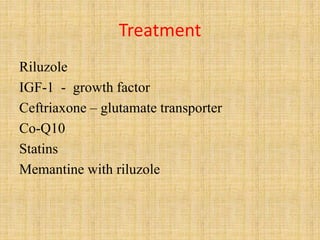
Treatment
Riluzole
IGF-1 - growth factor
Ceftriaxone – glutamate transporter
Co-Q10
Statins
Memantine with riluzole
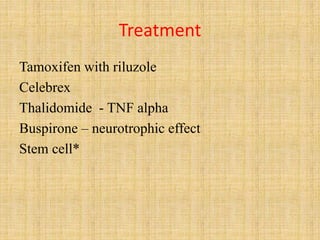
Treatment
Tamoxifen with riluzole
Celebrex
Thalidomide - TNF alpha
Buspirone – neurotrophic effect
Stem cell*

Motor neuron diseases. ppt.

  • 1.
  • 2.
    Definition Motor Neuron Diseases –group of diseases which include progressive degeneration and loss of motor neurons with or without similar lesion of the motor nuclei of the brain – replacement of lost cells with gliosis – Motor neuron diseases are a group of neurodegenerative disorders that affects the nerves in the spine and brain to progressively lose its function. They are a rare but serious and incurable form of progressive neurodegeneration. It is a condition that selectively affects the motor system, the cells which control voluntary muscles of the body
  • 3.
    Diagnostic Triad: ALS Uppermotor neuron Lower motor neuron Progression
  • 4.
    Incidence Motor neuron disease(MND) occur in adults and children. It can appear at any age, but most patients are over 40 years old at diagnosis. It affects men more than women.
  • 5.
    WHAT ARE MOTORNEURONS? They are a type of nerve cell, that send messages to the body(muscle) from the brain so helps to move. Two kinds includes: UPPER MOTOR NEURONS: LOWER MOTOR NEURONS: Normally, messages from nerve cells in the brain (called upper motor neurons) are transmitted to nerve cells in the brain stem and spinal cord (called lower motor neurons) and from them to particular muscles.
  • 6.
    CONT… As nerve cellsdie when pt have a motor neuron disease, electrical messages can't get from the brain to muscles. Over time, muscles waste away, known as “atrophy.” When this happens, it leads to lose control over movements. It gets harder to walk, talk, swallow, and breathe. Each kind of motor neuron disease affects different types of nerve cells or has a different cause. ALS is the most common of these diseases in adults. Here's a look at some of the types of motor neuron diseases.
  • 7.
    TYPES OF MND: MNDsare classified according to whether they are inherited or sporadic(i.e-anyone can get it), and to whether degeneration affects upper motor neurons, lower motor neurons, or both. In adults, the most common MND is Amyotrophic Lateral Sclerosis (ALS).
  • 8.
    CONT…. ALS, or LouGehrig's disease, is the most common type, affects both the UMN and LMN. It can affect the muscles of the arms, legs, mouth, and respiratory system. Mean survival time is 3 to 5 years, but some people live 10 years or more beyond diagnosis with supportive care. Progressive bulbar palsy (PBP) involves the brain stem(LMN). People with ALS often have PBP too. The condition causes frequent choking spells, difficulty speaking, eating, and swallowing.
  • 9.
    CONT. Pseudobulbar Palsy: Thisis similar to progressive bulbar palsy. It affects motor neurons that control the ability to talk, chew, and swallow. Pseudobulbar palsy causes people to laugh or cry with no control. Progressive muscular atrophy (PMA): It only affects the LMN in the spinal cord. Affects slowly but progressively causes muscle wasting, especially in the arms, legs, and mouth. It may be a variation of ALS. Primary lateral sclerosis (PLS): It is a disease of UMN. It is the rare form of MND that advances more slowly than ALS. It is not fatal, but it can affect the quality of life. In children, it is known as juvenile primary lateral sclerosis.
  • 10.
    CONT. Spinal muscular atrophy(SMA) is an inherited MND that affects children. There are three types, all caused by an abnormal gene known as SMA1(This gene makes a protein that protects the motor neurons. Without it, they die.). It tends to affect the trunk, legs, and arms. Long-term outlook varies according to type. The different types of MND share similar symptoms, but they progress at different speeds and vary in severity
  • 11.
    Causes The exact causesare unclear. Some MNDs are inherited, but the causes of most MNDs are not known. About 5% of people with motor neurone disease have a close family relative with the condition or a related condition known as fronto temporal dementia. This is called familial motor neurone disease which can be hereditary or linked to a problem with genes that can cause problems at a younger age. In sporadic or non inherited MNDs, environmental, toxic, viral, or genetic factors likely play a role.
  • 12.
    Risk Factors HEREDITARY AGE SEX Some expertshave linked military experience to a higher chance of developing the disease. Studies have found that professional footballers are more likely to die from ALS, Alzheimer's disease, and other neurodegenerative diseases, compared with other people. This implies a possible link with recurrent head trauma and neurological disease.
  • 13.
    Symptoms MND can bedivided into three stages; early, middle, and advanced. Early stage signs and symptoms: Symptoms develop slowly and can be confused with symptoms of some other unrelated neurological conditions. Early symptoms depend upon which body system is affected first. Typical symptoms begin in one of three areas: the arms and legs, the mouth (bulbar), or the respiratory system.
  • 14.
    They include • aweakening grip, making it hard to pick up and hold things • Fatigue, difficulty swallowing •muscle pains, cramps, and twitches • slurred and sometimes garbled speech • weakness in the arms and legs • increased clumsiness and stumbling • trouble breathing or shortness of breath
  • 15.
    Middle stage signsand symptoms: • As the condition progresses, symptoms become more severe. • Muscle pain and weakness increase, and spasms and twinges worsen. • Limbs become progressively weaker. • Limb muscles start to shrink. • Movement in affected limbs becomes more difficult. • Limb muscles may become abnormally stiff. • Joint pain grows. • Eating, drinking, and swallowing become harder
  • 16.
    CONT. •Drooling occurs, dueto problems controlling saliva. • Yawning occurs, sometimes in uncontrollable bouts •Jaw pain may result from excessive yawning. •Speech problems worsen, as muscles in the throat and mouth become weaker. The person may show changes in personality and emotional state, with bouts of uncontrollable crying or laughing. • Secondary symptoms include insomnia, anxiety, and depression.
  • 17.
    Advanced stage signsand symptoms Eventually, the patient will be unable to move, eat, or breathe without assistance. Without supportive care, an individual will pass away. Despite the best of care currently available, complications of the respiratory system are the most common causes of death.
  • 18.
    DIAGNOSIS: In the earlystage, MND can be hard to diagnose, because the signs and symptoms are common to other conditions, such as multiple sclerosis (MS), an inflamed nerve, or Parkinson's disease. Blood test. Urine test. Mri. Emg(electromyography). Nerve conduction study. Lumbar puncture or spinal tap. Muscle biopsy. Transcranial magnetic stimulation
  • 19.
    CONT. • After tests,a doctor will normally monitor the patient for some time before confirming that they have MND. • Criteria known as El Escorial criteria can help a doctor check for distinctive neurological signs, that may aid in the diagnosis of ALS. • These include: muscle shrinking, weakness or twitching muscle stiffness or abnormal reflexes symptoms spreading into new muscle groups • having no other factors that explain the symptoms
  • 20.
    TREATMENT: There is nocure for MND, so treatments focus on relieving the symptoms, slowing the progression and maximizing patient independence and comfort. This can include the use of breathing, feeding, mobility and communication appliances and devices. Rehabilitation therapy may include physical, occupational and speech therapy
  • 21.
    Treatment Riluzole IGF-1 - growthfactor Ceftriaxone – glutamate transporter Co-Q10 Statins Memantine with riluzole
  • 22.
    Treatment Tamoxifen with riluzole Celebrex Thalidomide- TNF alpha Buspirone – neurotrophic effect Stem cell*