Peripheral
Neuropathy
Nurses' Manual
CONTENTS
• Introduction
• Types
• Causes
• Sign and symptoms
• Diagnosis
• Treatment/management
Nurses' Manual
Introduction
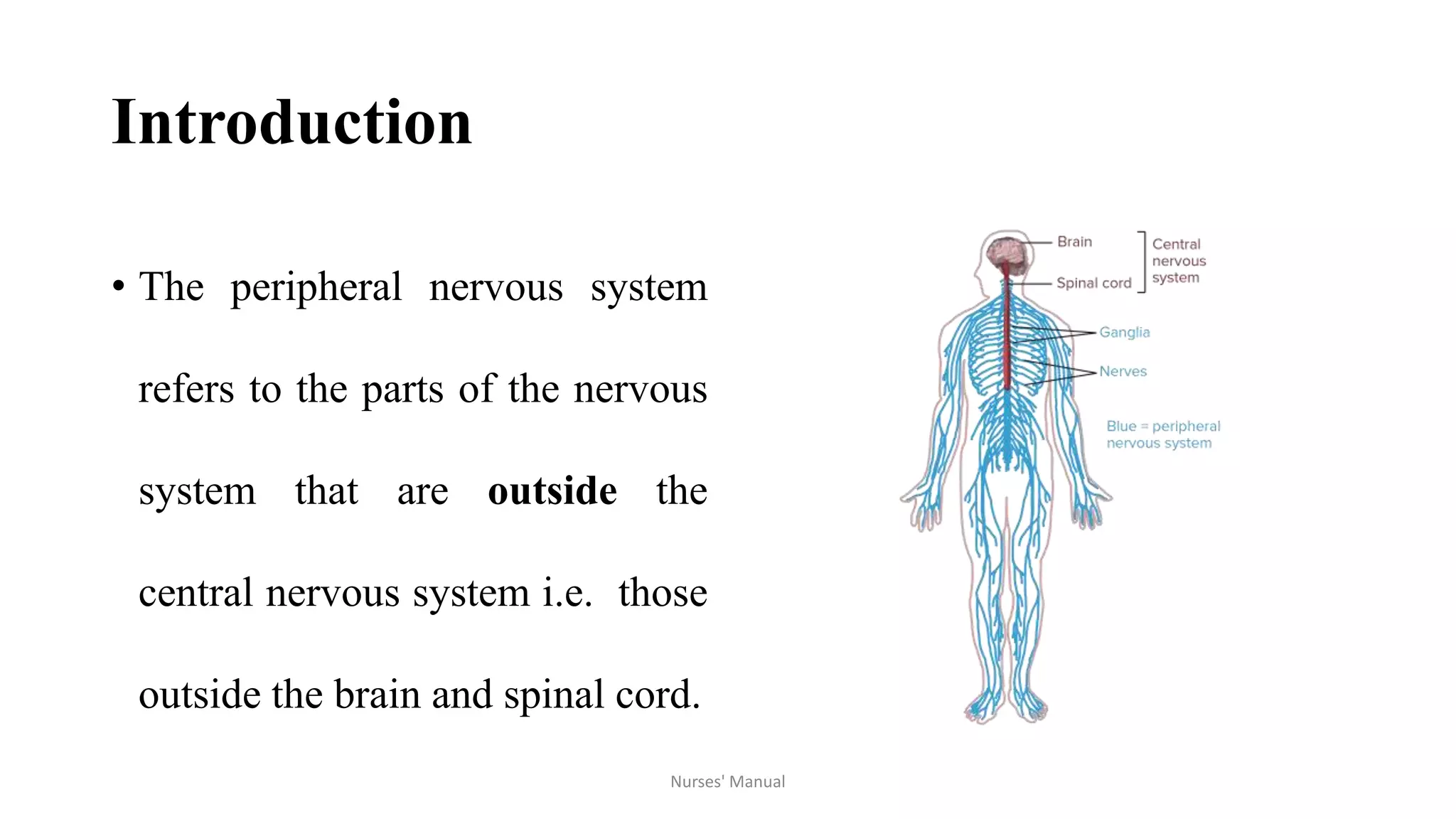
• The peripheral nervous system
refers to the parts of the nervous
system that are outside the
central nervous system i.e. those
outside the brain and spinal cord.
Nurses' Manual
Thus, the peripheral nervous system includes:
• The nerves that connect the head, face, eyes, nose, muscles, and ears
to the brain – 12 pairs of Cranial Nerves
• The nerves that connect the spinal cord to the rest of the body,
including the 31 pairs of Spinal Nerves
• More than 100 billion nerve cells that run throughout the body
Nurses' Manual
• Peripheral nerves, by connecting the spinal cord and brain to all other
body organs, transmit motor impulses outward and rely back sensory
impulses to encode sensation in the brain.
• Damage to these nerves interrupts communication between the brain and
other parts of the body and can impair muscle movement, prevent normal
sensation in the arms and legs, and cause pain.
Nurses' Manual
Peripheral neuropathy is a disorder affecting motor, sensory or
autonomic nerves.
Nurses' Manual
Types
Neuropathies are classified according to the problems they cause. They
are:
a)Mono neuropathy
b)Poly neuropathies
Nurses' Manual
a. Mononeuropathy
• Damage to a single peripheral nerve is known to as mononeuropathy.
• Mononeuropathy occurs when myelin sheath or part of the nerve cell is
damaged. The damage prevents nerves from spreading signals.
Nurses' Manual
• The most common cause is physical injury or trauma from an
accident.
• Common complains are:
-loss of feeling in the affected area
-weakness in the affected area
-pain or burning
-feeling of “pins and needles” etc
Nurses' Manual
Types of mononeuropathies
1. Carpel tunnel syndrome
2. Ulnar nerve palsy
3. Radial nerve palsy
4. Tarsal tunnel syndrome
5. Peroneal nerve palsy
Nurses' Manual
1. Carpel tunnel syndrome
• AKA overuse strain injury
• Common type of
mononeuropathy
• Occurs due to compression of
median nerve at wrist .
• Risk: people whose work
requires repeated motions with
the wrist
Nurses' Manual
2. Ulnar nerve palsy
• Occurs when ulnar
nerve is damaged.
• Numbness is noted
in the 4th and 5th
digit of the hand.
Nurses' Manual
3. Radial nerve palsy
• Caused by injury to the radial
nerve
• Occcurs when humerus bone is
fractured.
Nurses' Manual
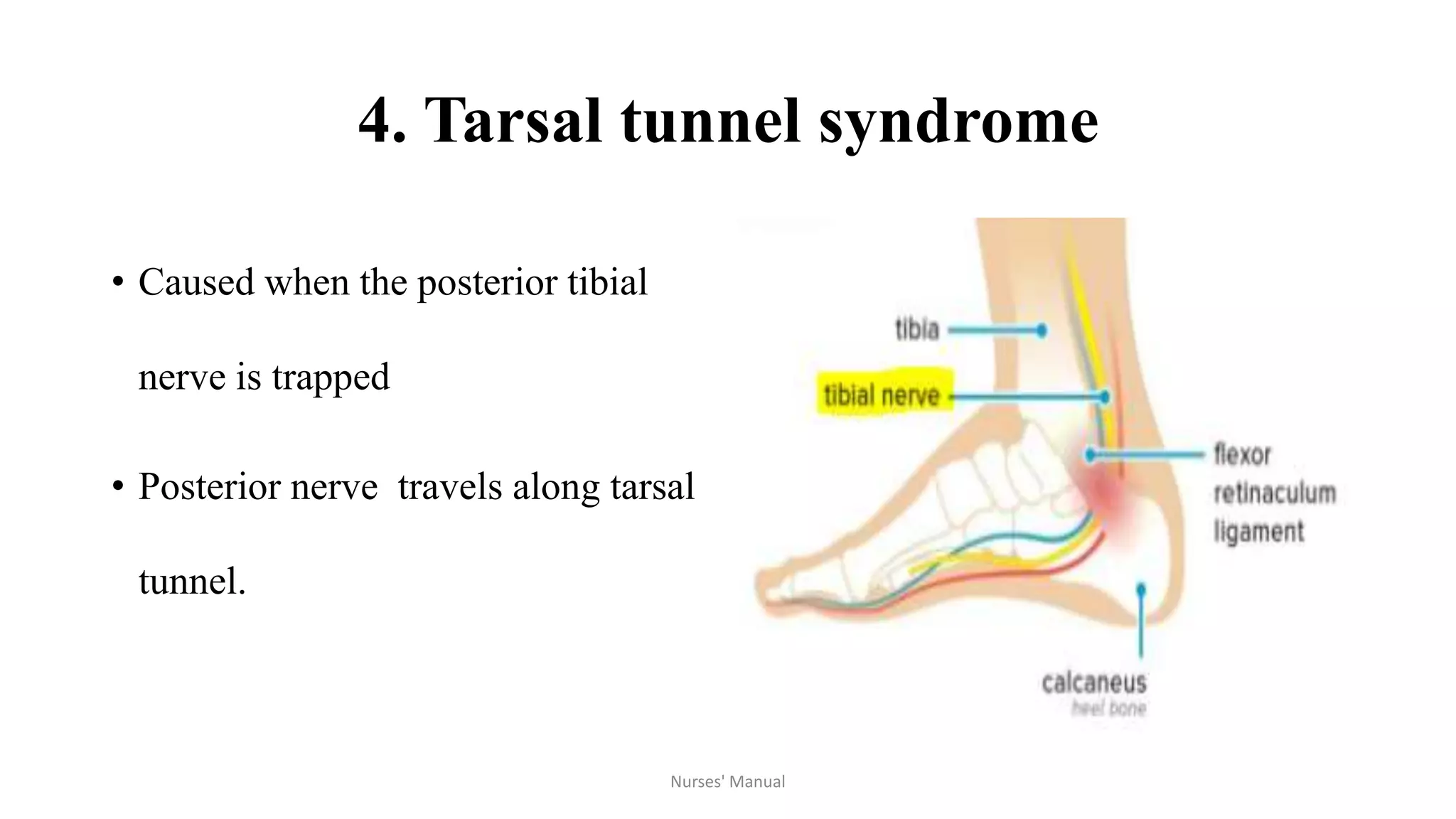
4. Tarsal tunnel syndrome
• Caused when the posterior tibial
nerve is trapped
• Posterior nerve travels along tarsal
tunnel.
Nurses' Manual
5. Peroneal nerve palsy
• Occurs when
peroneal nerve is
compressed.
• This leads to a
condition called
“ foot drop”.
Nurses' Manual
b. Polyneuropathy
• Accounts for the greatest number of peripheral neuropathy cases.
• It occurs when multiple peripheral nerves throughout the body
malfunctioned at the same time causing weakness ,numbness and burning
pain in roughly the same side of the body.
• One of the most common forms of chronic polyneuropathy is diabetic
neuropathy.
Nurses' Manual
Causes
• Idiopathic causes
• Age: over 40
• Acquired causes: environmental factors such as illness,trauma,toxins etc.
• Other causes are diabetes,alcoholism, under nutrition(especially vitamin
B), cancer and chemotherapy, different medications, etc
• Hereditary : are not so common. most common of these is Charcot-Marie
tooth disease type 1.
Nurses' Manual
Sign And Symptoms
Depends upon the type of nerve is affected.
• When sensory nerve is affected:
-Gradual onset of numbness
-Prickling or tingling in feet or hands, which can spread upward into
legs and arms .
-Sharp, throbbing or burning pain
-Extreme sensitivity to touch
-Pain during activities that shouldn't cause pain.
Nurses' Manual
S/S Cont’d…
• When motor nerve is affected: lack of coordination, falling, muscle
atrophy, diminished reflex ,etc.
• When autonomic nerve is affected: heat intolerance, excessive
sweating or no sweating, changes in blood pressure causing dizziness,
etc
Nurses' Manual
Diagnosis
• History taking
• Physical examination
• Blood test
• CT/MRI
• Nerve biopsy
• Electromyography
Nurses' Manual
Treatment
1.Medical Management
2. Nursing management
Nurses' Manual
1.Medical Management
a. Pharmacological treatment
• Treatment of peripheral neuropathy depends upon the cause. Eg if
diabetes is the cause, then it is important to control blood sugar level.
• Analgesics: acetaminophen and other NSAIDS like ibuprofen,aspirin
• Other medications: cyclo oxygenase 2 inhibitor, serotonin nor
epinephrine reuptake inhibitor-cymbalta, etc
Nurses' Manual
b. Plasmapheresis can be done in
case of polyneuritis.
• AKA plasma exchange.
• Works by ridding plasma off
certain antibodies that
contributes immune system to
attack on peripheral nerves
Nurses' Manual
c.Transcutaneous nerve stimulation:
The goal of is to disrupt nerves from
transmitting pain signals to the brain.
• It uses low voltage electrical current to
provide pain relief
• A battery-powered device delivers
electrical impulses through electrodes
placed on the surface of skin at or near
nerves where the pain is located or at
trigger points.
Nurses' Manual
d. Use of splints:
• casts provide support for the part of
body that is uncomfortable.
• This can relieve pain.
• For example, a cast or splint that holds
wrists in a proper position while sleeping
can relieve the discomfort of carpal
tunnel syndrome.
Nurses' Manual
e. Self care:
• Acupuncture
• Massage,
• Yoga, meditations, exercises etc
• Avoiding alcohol and smoking
• Controlling blood sugar level
Nurses' Manual
f.Precaution at home:
• Always wear shoes
• Keep floor clean
• Check temperature before bathing with elbow
• Don’t stay in one position for long period, etc
Nurses' Manual
2.Nursing management:
• History taking
• Complete physical assessment.
• Assess level of patients understanding.
• Provide prescribed medications on time ,assess side effects and ,manage them
efficiently.
• Instruct about good foot care including proper use of good shoes.
• If overweight, advise to reduce weight.
Nurses' Manual
• Assist in choosing walking aids for those with severe leg weakness
• Maintain safe environment, assist with ambulation.
• Explain the effectiveness of using braces/splints in case of foot drops.
• Physiotherapy is very effective, so provide and teach the patient and family
members.
• Counseling is must and focus on the underlying causes, self care and
precautions to be taken at home. Also focus for immediate follow up when the
symptoms got worsen.
Nurses' Manual

Peripheral Neuropathy

  • 1.
  • 2.
    CONTENTS • Introduction • Types •Causes • Sign and symptoms • Diagnosis • Treatment/management Nurses' Manual
  • 3.
    Introduction • The peripheralnervous system refers to the parts of the nervous system that are outside the central nervous system i.e. those outside the brain and spinal cord. Nurses' Manual
  • 4.
    Thus, the peripheralnervous system includes: • The nerves that connect the head, face, eyes, nose, muscles, and ears to the brain – 12 pairs of Cranial Nerves • The nerves that connect the spinal cord to the rest of the body, including the 31 pairs of Spinal Nerves • More than 100 billion nerve cells that run throughout the body Nurses' Manual
  • 5.
    • Peripheral nerves,by connecting the spinal cord and brain to all other body organs, transmit motor impulses outward and rely back sensory impulses to encode sensation in the brain. • Damage to these nerves interrupts communication between the brain and other parts of the body and can impair muscle movement, prevent normal sensation in the arms and legs, and cause pain. Nurses' Manual
  • 6.
    Peripheral neuropathy isa disorder affecting motor, sensory or autonomic nerves. Nurses' Manual
  • 7.
    Types Neuropathies are classifiedaccording to the problems they cause. They are: a)Mono neuropathy b)Poly neuropathies Nurses' Manual
  • 8.
    a. Mononeuropathy • Damageto a single peripheral nerve is known to as mononeuropathy. • Mononeuropathy occurs when myelin sheath or part of the nerve cell is damaged. The damage prevents nerves from spreading signals. Nurses' Manual
  • 9.
    • The mostcommon cause is physical injury or trauma from an accident. • Common complains are: -loss of feeling in the affected area -weakness in the affected area -pain or burning -feeling of “pins and needles” etc Nurses' Manual
  • 10.
    Types of mononeuropathies 1.Carpel tunnel syndrome 2. Ulnar nerve palsy 3. Radial nerve palsy 4. Tarsal tunnel syndrome 5. Peroneal nerve palsy Nurses' Manual
  • 11.
    1. Carpel tunnelsyndrome • AKA overuse strain injury • Common type of mononeuropathy • Occurs due to compression of median nerve at wrist . • Risk: people whose work requires repeated motions with the wrist Nurses' Manual
  • 12.
    2. Ulnar nervepalsy • Occurs when ulnar nerve is damaged. • Numbness is noted in the 4th and 5th digit of the hand. Nurses' Manual
  • 13.
    3. Radial nervepalsy • Caused by injury to the radial nerve • Occcurs when humerus bone is fractured. Nurses' Manual
  • 14.
    4. Tarsal tunnelsyndrome • Caused when the posterior tibial nerve is trapped • Posterior nerve travels along tarsal tunnel. Nurses' Manual
  • 15.
    5. Peroneal nervepalsy • Occurs when peroneal nerve is compressed. • This leads to a condition called “ foot drop”. Nurses' Manual
  • 16.
    b. Polyneuropathy • Accountsfor the greatest number of peripheral neuropathy cases. • It occurs when multiple peripheral nerves throughout the body malfunctioned at the same time causing weakness ,numbness and burning pain in roughly the same side of the body. • One of the most common forms of chronic polyneuropathy is diabetic neuropathy. Nurses' Manual
  • 17.
    Causes • Idiopathic causes •Age: over 40 • Acquired causes: environmental factors such as illness,trauma,toxins etc. • Other causes are diabetes,alcoholism, under nutrition(especially vitamin B), cancer and chemotherapy, different medications, etc • Hereditary : are not so common. most common of these is Charcot-Marie tooth disease type 1. Nurses' Manual
  • 18.
    Sign And Symptoms Dependsupon the type of nerve is affected. • When sensory nerve is affected: -Gradual onset of numbness -Prickling or tingling in feet or hands, which can spread upward into legs and arms . -Sharp, throbbing or burning pain -Extreme sensitivity to touch -Pain during activities that shouldn't cause pain. Nurses' Manual
  • 19.
    S/S Cont’d… • Whenmotor nerve is affected: lack of coordination, falling, muscle atrophy, diminished reflex ,etc. • When autonomic nerve is affected: heat intolerance, excessive sweating or no sweating, changes in blood pressure causing dizziness, etc Nurses' Manual
  • 20.
    Diagnosis • History taking •Physical examination • Blood test • CT/MRI • Nerve biopsy • Electromyography Nurses' Manual
  • 21.
  • 22.
    1.Medical Management a. Pharmacologicaltreatment • Treatment of peripheral neuropathy depends upon the cause. Eg if diabetes is the cause, then it is important to control blood sugar level. • Analgesics: acetaminophen and other NSAIDS like ibuprofen,aspirin • Other medications: cyclo oxygenase 2 inhibitor, serotonin nor epinephrine reuptake inhibitor-cymbalta, etc Nurses' Manual
  • 23.
    b. Plasmapheresis canbe done in case of polyneuritis. • AKA plasma exchange. • Works by ridding plasma off certain antibodies that contributes immune system to attack on peripheral nerves Nurses' Manual
  • 24.
    c.Transcutaneous nerve stimulation: Thegoal of is to disrupt nerves from transmitting pain signals to the brain. • It uses low voltage electrical current to provide pain relief • A battery-powered device delivers electrical impulses through electrodes placed on the surface of skin at or near nerves where the pain is located or at trigger points. Nurses' Manual
  • 25.
    d. Use ofsplints: • casts provide support for the part of body that is uncomfortable. • This can relieve pain. • For example, a cast or splint that holds wrists in a proper position while sleeping can relieve the discomfort of carpal tunnel syndrome. Nurses' Manual
  • 26.
    e. Self care: •Acupuncture • Massage, • Yoga, meditations, exercises etc • Avoiding alcohol and smoking • Controlling blood sugar level Nurses' Manual
  • 27.
    f.Precaution at home: •Always wear shoes • Keep floor clean • Check temperature before bathing with elbow • Don’t stay in one position for long period, etc Nurses' Manual
  • 28.
    2.Nursing management: • Historytaking • Complete physical assessment. • Assess level of patients understanding. • Provide prescribed medications on time ,assess side effects and ,manage them efficiently. • Instruct about good foot care including proper use of good shoes. • If overweight, advise to reduce weight. Nurses' Manual
  • 29.
    • Assist inchoosing walking aids for those with severe leg weakness • Maintain safe environment, assist with ambulation. • Explain the effectiveness of using braces/splints in case of foot drops. • Physiotherapy is very effective, so provide and teach the patient and family members. • Counseling is must and focus on the underlying causes, self care and precautions to be taken at home. Also focus for immediate follow up when the symptoms got worsen. Nurses' Manual