MULTIPLE SCLEROSIS
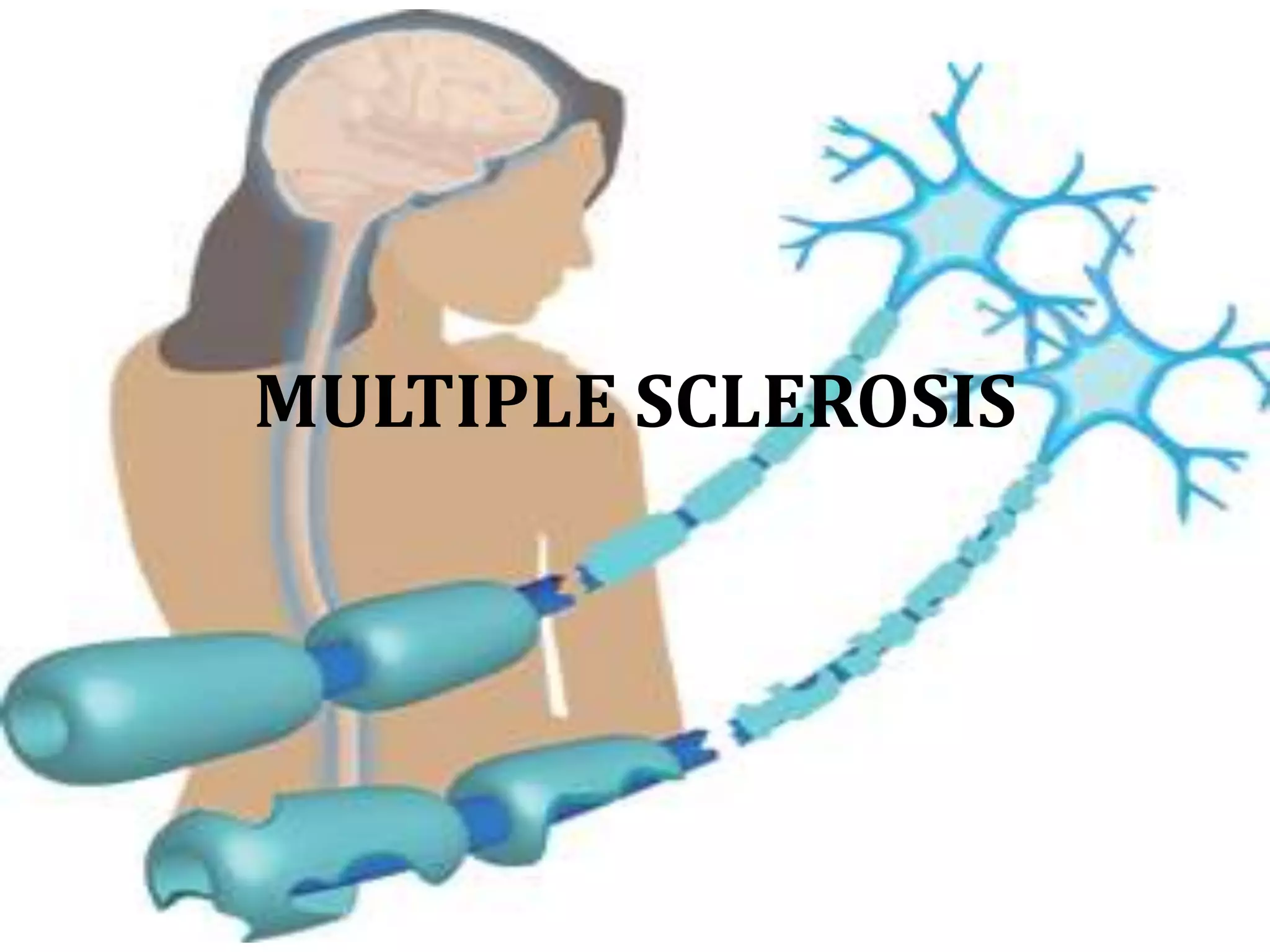
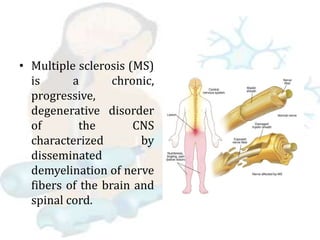
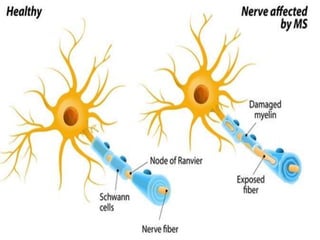
• Multiple sclerosis (MS)
is a chronic,
progressive,
degenerative disorder
of the CNS
characterized by
disseminated
demyelination of nerve
fibers of the brain and
spinal cord.
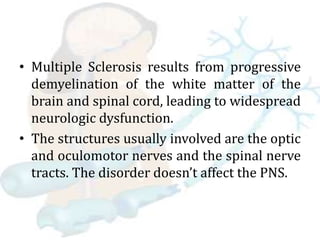
• Multiple Sclerosis results from progressive
demyelination of the white matter of the
brain and spinal cord, leading to widespread
neurologic dysfunction.
• The structures usually involved are the optic
and oculomotor nerves and the spinal nerve
tracts. The disorder doesn’t affect the PNS.
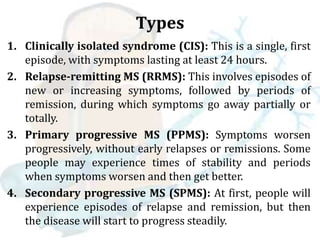
Types
1. Clinically isolated syndrome (CIS): This is a single, first
episode, with symptoms lasting at least 24 hours.
2. Relapse-remitting MS (RRMS): This involves episodes of
new or increasing symptoms, followed by periods of
remission, during which symptoms go away partially or
totally.
3. Primary progressive MS (PPMS): Symptoms worsen
progressively, without early relapses or remissions. Some
people may experience times of stability and periods
when symptoms worsen and then get better.
4. Secondary progressive MS (SPMS): At first, people will
experience episodes of relapse and remission, but then
the disease will start to progress steadily.
Etiology
• Age
• Sex
• Genetic factors
• Smoking: They tend to have more lesions and brain
shrinkage than non-smokers.
• Infections: Exposure to viruses, such as Epstein-Barr
virus (EBV), or mononucleosis, human herpes virus
type 6 (HHV6) and mycoplasma pneumonia.
• Vitamin D deficiency
• Vitamin B12 deficiency
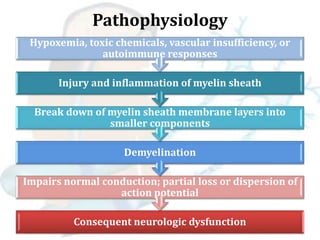
Pathophysiology
Consequent neurologic dysfunction
Impairs normal conduction; partial loss or dispersion of
action potential
Demyelination
Break down of myelin sheath membrane layers into
smaller components
Injury and inflammation of myelin sheath
Hypoxemia, toxic chemicals, vascular insufficiency, or
autoimmune responses
Clinical Manifestations
• Muscle weakness: lack of use or
stimulation and nerve damage.
• Numbness and tingling: A pins
and needles-type sensation in
the face, body, or arms and legs.
• Lhermitte’s sign: an electric
shock like sensation when they
move their neck,
• Bladder problems: difficulty to
emptying their bladder or need
to urinate frequently or
suddenly. Loss of bladder
control.
• Bowel problems: Constipation
can cause fecal impaction, which
can lead to bowel incontinence.
• Fatigue
• Dizziness and vertigo
• Sexual dysfunction: Both
males and females may lose
interest in sex.
• Spasticity and muscle
spasms: Damaged nerve
fibers in the spinal cord and
brain can cause painful
muscle spasms, particularly
in the legs.
• Tremor: involuntary
quivering movements.
• Vision problems: double or
blurred vision, a partial or
total loss of vision, or red-
green color distortion.
• Gait and mobility changes:
MS can change the way
people walk, because of
muscle weakness and
problems with balance,
dizziness, and fatigue.
• Emotional changes and
depression: Demyelination
and nerve-fiber damage in
the brain can trigger
emotional changes.
• Learning and memory
problems: These can make it
difficult to concentrate, plan,
learn, prioritize, and
multitask.
• Pain: Neuropathic pain is
directly due to MS. Other
types of pain occur
because of weakness or
stiffness of muscles.
• Less common symptoms
include:
– Headache
– Hearing loss
– Itching
– Respiratory or
breathing problems
– Seizures
– Speech disorders
– Swallowing problems
Diagnosis
• MRI scans of the brain and spinal cord may
reveal lesions
• Cerebrospinal Fluid analysis
• An evoked potential test, which measures
electrical activity in response to stimuli
• EEG
Medical Management
• Corticosteroids
– To reduce edema and inflammation of myelin sheath
– Eg. Corticotropin, Prednisone, Dexamethasone
• Interferon beta-1a or interferon beta-1b
– to decrease the frequency of relapses.
• Chlordiazepoxide
– to mitigate mood swings,
• Baclofen or dantrolene
– to relieve spasticity, and
• Bethanechol or oxybutynin
– to relieve urine retention and minimize urinary
frequency and urgency.
Symptomatic treatment
For constipation:
• Psyllium hydrophilic mucilloid, suppositories.
For tremor:
• Phenobarbital .
• Nutritional therapy:- Megavitamin therapy
(cobalamin/vit. B12 and vit. C )
• Low fat diet.
• High roughage diet (to relieve constipation)
• Other therapies:- (to improve neurological
functioning)
• Physical and speech therapies.
• Exercise.
• Water exercise.
Surgical Management
• Deep brain stimulation: if other options
have failed then a device is implanted that
stimulates an area of brain. (in case of
severe tremor in limbs).
• Implantation of a drug catheter or pump: a
catheter is placed in lower spinal area to
deliver a constant flow of drug like baclofen.
(in case of severe pain or spasticity).
Nursing diagnosis
• Nursing diagnosis: 1
• Impaired urinary elimination pattern related to
bladder dysfunction
• Intervention:
– Assess the skin for incontinence associated
dermatitis with each voiding.
– Maintain fluid intake of 2000ml /day.
– Toilet every 2 hour .
– Scan bladder for post void residual volume.
– If PVR is more than 100ml , then catheterize.
• Nursing diagnosis: 2
• Impaired elimination pattern related to
immobility and demyelination
• Intervention:
– Assess for normal bowel movement .
– Teach client to consume high fiber diet and
2000 ml of fluid.
– Administer suppository as advised by physician.
• Nursing diagnosis: 3
• Fatigue related to increased energy needs as
evidenced by facial expression of client.
• Intervention:
– Keep the environment cool.
– Provide mental support.
– Plan for rest periods during the day.
– Facilitate sleep by reducing night time
interruption, noise, and light.
• Nursing diagnosis: 4
• Impaired physical mobility related to
weakness, contractures, spasticity and ataxia
• Intervention:
– Assess the degree of muscle spasticity.
– Stretch muscles & perform ROM exercise.
– Administer anti-spasmotics as ordered.
– Position in neutral alignment.
– Consult with doctor for splints.
• Nursing diagnosis: 5
• Situational self esteem, related to loss of
independence and fear of disability
Intervention:
– Assess for depression and any related treatment.
– Assess for client’s problem solving strategies.
– Evaluate client’s support system.
– Provide experience that increase the client’
autonomy.
THANK YOU

Multiple Sclerosis

  • 1.
  • 2.
    • Multiple sclerosis(MS) is a chronic, progressive, degenerative disorder of the CNS characterized by disseminated demyelination of nerve fibers of the brain and spinal cord.
  • 3.
    • Multiple Sclerosisresults from progressive demyelination of the white matter of the brain and spinal cord, leading to widespread neurologic dysfunction. • The structures usually involved are the optic and oculomotor nerves and the spinal nerve tracts. The disorder doesn’t affect the PNS.
  • 5.
    Types 1. Clinically isolatedsyndrome (CIS): This is a single, first episode, with symptoms lasting at least 24 hours. 2. Relapse-remitting MS (RRMS): This involves episodes of new or increasing symptoms, followed by periods of remission, during which symptoms go away partially or totally. 3. Primary progressive MS (PPMS): Symptoms worsen progressively, without early relapses or remissions. Some people may experience times of stability and periods when symptoms worsen and then get better. 4. Secondary progressive MS (SPMS): At first, people will experience episodes of relapse and remission, but then the disease will start to progress steadily.
  • 6.
    Etiology • Age • Sex •Genetic factors • Smoking: They tend to have more lesions and brain shrinkage than non-smokers. • Infections: Exposure to viruses, such as Epstein-Barr virus (EBV), or mononucleosis, human herpes virus type 6 (HHV6) and mycoplasma pneumonia. • Vitamin D deficiency • Vitamin B12 deficiency
  • 7.
    Pathophysiology Consequent neurologic dysfunction Impairsnormal conduction; partial loss or dispersion of action potential Demyelination Break down of myelin sheath membrane layers into smaller components Injury and inflammation of myelin sheath Hypoxemia, toxic chemicals, vascular insufficiency, or autoimmune responses
  • 8.
    Clinical Manifestations • Muscleweakness: lack of use or stimulation and nerve damage. • Numbness and tingling: A pins and needles-type sensation in the face, body, or arms and legs. • Lhermitte’s sign: an electric shock like sensation when they move their neck, • Bladder problems: difficulty to emptying their bladder or need to urinate frequently or suddenly. Loss of bladder control. • Bowel problems: Constipation can cause fecal impaction, which can lead to bowel incontinence. • Fatigue • Dizziness and vertigo • Sexual dysfunction: Both males and females may lose interest in sex. • Spasticity and muscle spasms: Damaged nerve fibers in the spinal cord and brain can cause painful muscle spasms, particularly in the legs. • Tremor: involuntary quivering movements. • Vision problems: double or blurred vision, a partial or total loss of vision, or red- green color distortion.
  • 9.
    • Gait andmobility changes: MS can change the way people walk, because of muscle weakness and problems with balance, dizziness, and fatigue. • Emotional changes and depression: Demyelination and nerve-fiber damage in the brain can trigger emotional changes. • Learning and memory problems: These can make it difficult to concentrate, plan, learn, prioritize, and multitask. • Pain: Neuropathic pain is directly due to MS. Other types of pain occur because of weakness or stiffness of muscles. • Less common symptoms include: – Headache – Hearing loss – Itching – Respiratory or breathing problems – Seizures – Speech disorders – Swallowing problems
  • 10.
    Diagnosis • MRI scansof the brain and spinal cord may reveal lesions • Cerebrospinal Fluid analysis • An evoked potential test, which measures electrical activity in response to stimuli • EEG
  • 11.
    Medical Management • Corticosteroids –To reduce edema and inflammation of myelin sheath – Eg. Corticotropin, Prednisone, Dexamethasone • Interferon beta-1a or interferon beta-1b – to decrease the frequency of relapses. • Chlordiazepoxide – to mitigate mood swings, • Baclofen or dantrolene – to relieve spasticity, and • Bethanechol or oxybutynin – to relieve urine retention and minimize urinary frequency and urgency.
  • 12.
    Symptomatic treatment For constipation: •Psyllium hydrophilic mucilloid, suppositories. For tremor: • Phenobarbital .
  • 13.
    • Nutritional therapy:-Megavitamin therapy (cobalamin/vit. B12 and vit. C ) • Low fat diet. • High roughage diet (to relieve constipation) • Other therapies:- (to improve neurological functioning) • Physical and speech therapies. • Exercise. • Water exercise.
  • 14.
    Surgical Management • Deepbrain stimulation: if other options have failed then a device is implanted that stimulates an area of brain. (in case of severe tremor in limbs). • Implantation of a drug catheter or pump: a catheter is placed in lower spinal area to deliver a constant flow of drug like baclofen. (in case of severe pain or spasticity).
  • 15.
    Nursing diagnosis • Nursingdiagnosis: 1 • Impaired urinary elimination pattern related to bladder dysfunction • Intervention: – Assess the skin for incontinence associated dermatitis with each voiding. – Maintain fluid intake of 2000ml /day. – Toilet every 2 hour . – Scan bladder for post void residual volume. – If PVR is more than 100ml , then catheterize.
  • 16.
    • Nursing diagnosis:2 • Impaired elimination pattern related to immobility and demyelination • Intervention: – Assess for normal bowel movement . – Teach client to consume high fiber diet and 2000 ml of fluid. – Administer suppository as advised by physician.
  • 17.
    • Nursing diagnosis:3 • Fatigue related to increased energy needs as evidenced by facial expression of client. • Intervention: – Keep the environment cool. – Provide mental support. – Plan for rest periods during the day. – Facilitate sleep by reducing night time interruption, noise, and light.
  • 18.
    • Nursing diagnosis:4 • Impaired physical mobility related to weakness, contractures, spasticity and ataxia • Intervention: – Assess the degree of muscle spasticity. – Stretch muscles & perform ROM exercise. – Administer anti-spasmotics as ordered. – Position in neutral alignment. – Consult with doctor for splints.
  • 19.
    • Nursing diagnosis:5 • Situational self esteem, related to loss of independence and fear of disability Intervention: – Assess for depression and any related treatment. – Assess for client’s problem solving strategies. – Evaluate client’s support system. – Provide experience that increase the client’ autonomy.
  • 20.