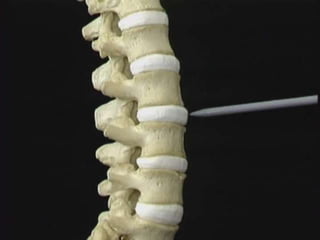
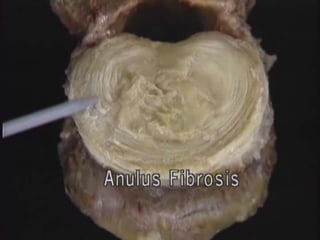
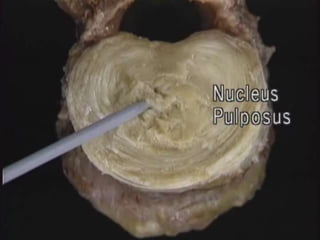
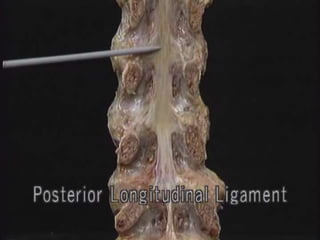
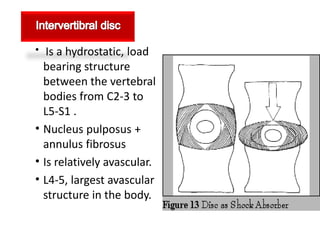
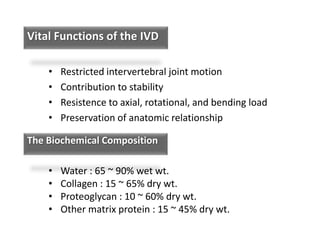
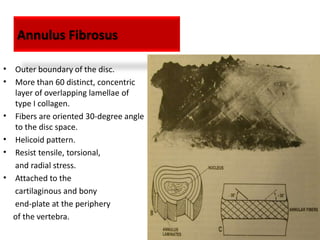
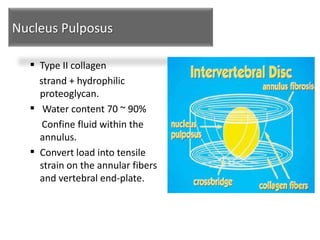
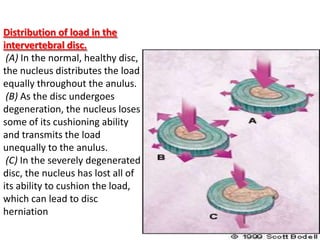
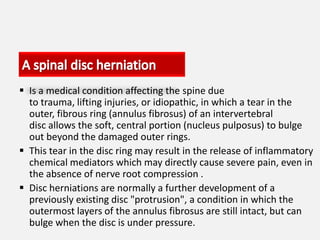
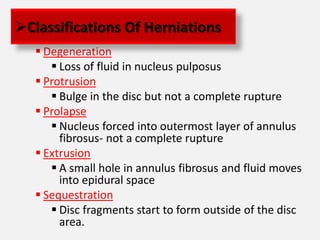
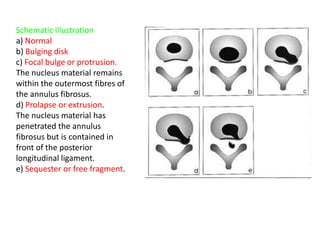
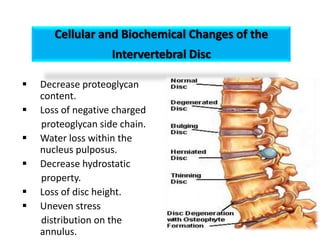
1. The document discusses the anatomy, physiology, and clinical presentation of herniated intervertebral discs. It describes the composition and functions of the nucleus pulposus and annulus fibrosus.
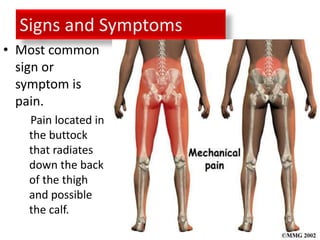
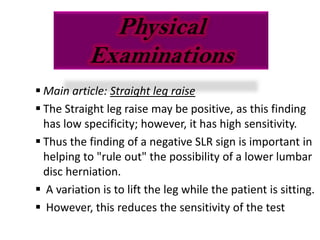
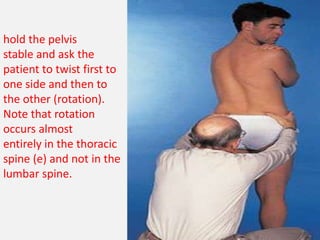
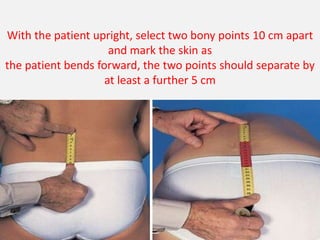
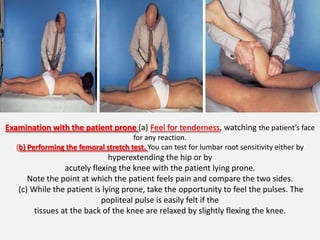
2. Signs and symptoms of herniated discs vary depending on location but commonly include back pain radiating into the buttock and leg. Physical examination involves testing for limited range of motion and tenderness as well as straight leg raise.
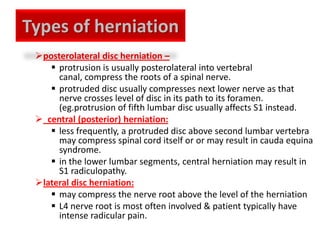
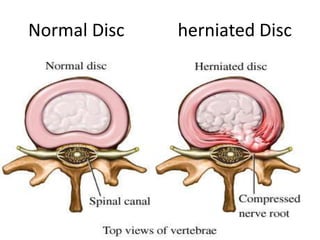
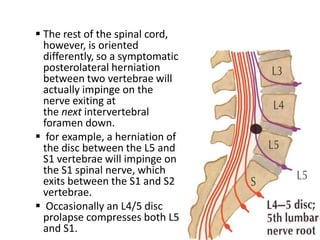
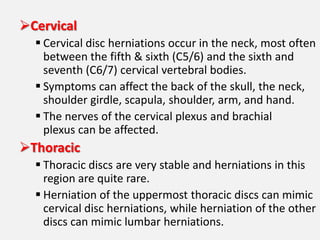
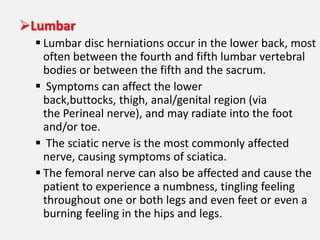
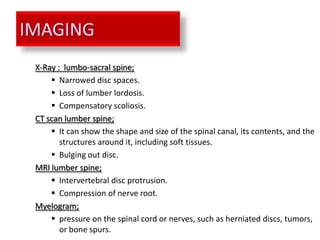
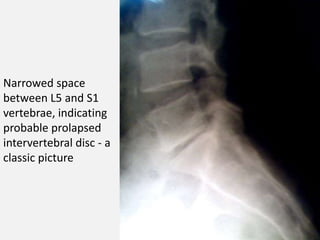
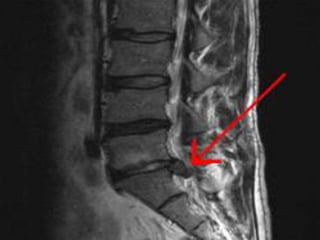
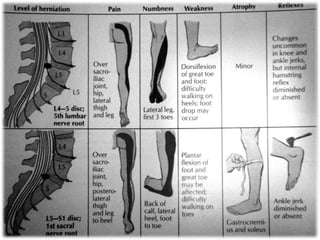
3. Diagnosis involves assessing patient history, symptoms on physical exam, and sometimes imaging tests. Herniated discs most often occur in the lumbar spine and can impinge on lumbar or sacral nerve roots.



![Chemonucleolysis-
• Chemonucleolysis is the term
used to denote chemical
destruction of nucleus pulposus
[Cehmo+nucleo+lysis].
• This involves intradiscal injection
ofchymopapain which causes
hydrolysis of he cementing
protein of the nucleus pulposus.
• This causes decrease in water
binding capacity leading to
reduction in size and drying the
disc.
• Chemonucleolysis is one of the
methods to treat disc herniation
not responding to conservative
therapy](https://image.slidesharecdn.com/intervertibraldiscprolapse-120519035849-phpapp02/85/Intervertibral-disc-prolapse-69-320.jpg)
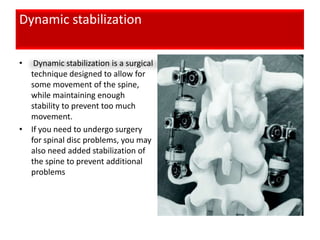
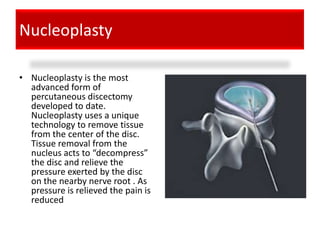
![[Lumbar
epidural steroid injection: Is the success rate predictable?].
Department of Orthopedics and Traumatology, Başkent University, Adana Medical Center, Ankara, Turkey.
aderincek@hotmail.com
Abstract
• OBJECTIVES:
• The aim of this study was to determine the relation between the percent of canal compromise and success rate
of epidural steroid injection (ESI) in patients with symptomatic lumbar herniated intervertebral discs.
• METHODS:
• Patients with lumbar herniated intervertebral disc suffering from leg pain and treated with ESI were selected.
The axial magnetic resonance (MR) image showing the largest canal compromise by the herniated disc was
selected for measurements. The canal area and discherniation area measurements were calculated from the
total number of pixels per cross-sectional area, multiplied by a scan correction factor, mm2/pixel. The percent
canal compromise was obtained by the disc herniation area divided by the canal cross-section area, multiplied
by 100. For pain assessment, visual analog scale (VAS) was used before (pre-injection VAS) and a month after
ESI (post-injection VAS). Demographic data, duration of symptoms, and location and type of herniation were
also noted.
• RESULTS:
• 39 patients (14 male, 25 female) were included in this study. The mean age was 50.2±11.6 years (27-76).
Twenty-one cases (51%) also had back pain. The mean percent canal compromise ratio was 36.1±2.4%. The
mean duration of symptoms was 19.4±6.6 months. The post-injection VAS was significantly decreased when
compared with pre-injection VAS (p<0.0001), and this significance was related with the duration of symptoms
being <3 months (p=0.021). There was also a significant negative correlation between percent canal
compromise and post-injection VAS (p=0.042). However, there was no correlation between post-injection VAS
and age, sex, or location or type of herniation (p>0.05).
• CONCLUSION:
• It has been demonstrated that higher benefits of ESI were achieved in patients with short duration of
symptoms and high percent of canal compromise.](https://image.slidesharecdn.com/intervertibraldiscprolapse-120519035849-phpapp02/85/Intervertibral-disc-prolapse-86-320.jpg)