INTERVERTEBRAL DISC
PROLAPSE
HARI CHANDAN
Disc anatomy
ď‚§ -Intervertebral disc lies between adjacent vertebrae in the the vertebral
column forming a fibrocartillagenous joint allowing movement of the
vertebra
â–  -Development of disc starts from third week of intrauterine life until
â–  third decade of life.
â–  -23 discs through out the spine, absent only atlanto-axial articulation.
â–  -Thinnest in thoracic region ; thickest in lumbar region
â–  -Avascular
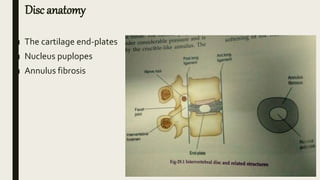
Disc anatomy
â–  The cartilage end-plates
â–  Nucleus puplopes
â–  Annulus fibrosis
â–  Disc gives spine the mobility
â–  Disc acts as shock absorber
â–  Disc increases height of spine by 25%
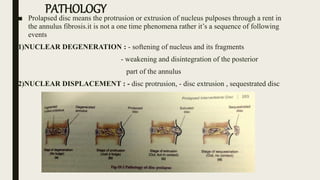
PATHOLOGY
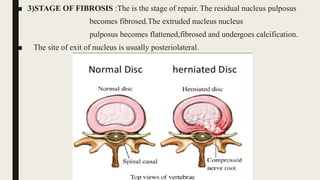
â–  Prolapsed disc means the protrusion or extrusion of nucleus pulposes through a rent in
the annulus fibrosis.it is not a one time phenomena rather it’s a sequence of following
events
1)NUCLEAR DEGENERATION : - softening of nucleus and its fragments
- weakening and disintegration of the posterior
part of the annulus
2)NUCLEAR DISPLACEMENT : - disc protrusion, - disc extrusion , sequestrated disc
â–  3)STAGE OF FIBROSIS :The is the stage of repair. The residual nucleus pulposus
becomes fibrosed.The extruded nucleus nucleus
pulposus becomes flattened,fibrosed and undergoes calcification.
â–  The site of exit of nucleus is usually posteriolateral.
ETIOLOGY OF DISC PROLAPSE
â–  Heavy and repetitive weightlifting
â–  Cigarette smoking and tobacco consumers
â–  Anxiety and depression
â–  Women with greater number of pregnancies
â–  Obesity
â–  Improper postural habits
â–  Occupations as auto drivers .
Clinical features
■ Low backache – repetitive , radiating to the buttocks and decreased by rest .pain
aggrevated when coughing,sneezing,straining,sitting.
■ Radiculopathy – pain in the distribution of sciatic nerve ,invariably due to disc
herniation. Leg pain equal to or more than back pain evidence the racdiculopathy may
be due to disc herniation.
â–  Nerve root compression.
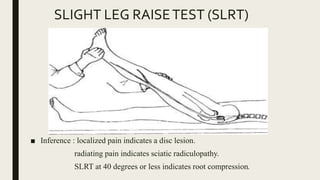
SLIGHT LEG RAISETEST (SLRT)
â–  Inference : localized pain indicates a disc lesion.
radiating pain indicates sciatic radiculopathy.
SLRT at 40 degrees or less indicates root compression.
Investigations
■ Ct scan – posterior border of disc appears flat or convex
which is normally concave.
■MRI– very usefull. Shows prolapsed disc, theca, nerve roots
clearly.
â–  Myelography : Radiopaque die is injected into spinal
canal and radiographs are taken. not in use now.
â–  Radiography : Not reliable . 7-46% cases are missed .
Differential diagnosis
â–  Spondylitis
â–  Vascular insufficiency
â–  Extra dural tumour
â–  Spinal tuberculosis
Treatment
â–  Conservative: Rest
Drugs – analgesics and muscle relaxants
Physiotherapy
Lumbar traction
Transcutaneous electrical nerve stimulation ( tens)
Operative treatment
â–  Indications :
1. Failure of conservative treatment
2. Severe sciatic pain
3. Severe sciatic tilt
â–  Fenestration : Ligamentum flavum is excised and the spinal
canal at the affected region is exposed.no longer done as it
makes spine unstable
â–  Hemi-laminectomy :The whole of the lamina on one side is
removed.
â–  Fenistration : Requires mri and radiographic studies. Spine is
approached unilaterally, only the margin of upper and lower
lamina are removed.
CHEMONUCLEOLYSIS
â–  Chymopapain with the property of dissolving fibrous and
cartilaginous tissue is injected into the disc,under X-ray
control
Endoscopic lumbar discectomy
â–  Using a operative endoscope,through a small incision with
minimal damage and blood loss
â–  Less invasive ,minimal damage,minimal blood loss,
excellent results
â–  Come today, go tomorrow surgery.
THANKYOU

Intervertebral disc prolapse

  • 1.
  • 2.
    Disc anatomy ď‚§ -Intervertebraldisc lies between adjacent vertebrae in the the vertebral column forming a fibrocartillagenous joint allowing movement of the vertebra â–  -Development of disc starts from third week of intrauterine life until â–  third decade of life. â–  -23 discs through out the spine, absent only atlanto-axial articulation. â–  -Thinnest in thoracic region ; thickest in lumbar region â–  -Avascular
  • 3.
    Disc anatomy â–  Thecartilage end-plates â–  Nucleus puplopes â–  Annulus fibrosis
  • 4.
    â–  Disc givesspine the mobility â–  Disc acts as shock absorber â–  Disc increases height of spine by 25%
  • 5.
    PATHOLOGY ■ Prolapsed discmeans the protrusion or extrusion of nucleus pulposes through a rent in the annulus fibrosis.it is not a one time phenomena rather it’s a sequence of following events 1)NUCLEAR DEGENERATION : - softening of nucleus and its fragments - weakening and disintegration of the posterior part of the annulus 2)NUCLEAR DISPLACEMENT : - disc protrusion, - disc extrusion , sequestrated disc
  • 6.
    â–  3)STAGE OFFIBROSIS :The is the stage of repair. The residual nucleus pulposus becomes fibrosed.The extruded nucleus nucleus pulposus becomes flattened,fibrosed and undergoes calcification. â–  The site of exit of nucleus is usually posteriolateral.
  • 7.
    ETIOLOGY OF DISCPROLAPSE â–  Heavy and repetitive weightlifting â–  Cigarette smoking and tobacco consumers â–  Anxiety and depression â–  Women with greater number of pregnancies â–  Obesity â–  Improper postural habits â–  Occupations as auto drivers .
  • 8.
    Clinical features ■ Lowbackache – repetitive , radiating to the buttocks and decreased by rest .pain aggrevated when coughing,sneezing,straining,sitting. ■ Radiculopathy – pain in the distribution of sciatic nerve ,invariably due to disc herniation. Leg pain equal to or more than back pain evidence the racdiculopathy may be due to disc herniation. ■ Nerve root compression.
  • 11.
    SLIGHT LEG RAISETEST(SLRT) â–  Inference : localized pain indicates a disc lesion. radiating pain indicates sciatic radiculopathy. SLRT at 40 degrees or less indicates root compression.
  • 12.
    Investigations ■ Ct scan– posterior border of disc appears flat or convex which is normally concave.
  • 13.
    ■MRI– very usefull.Shows prolapsed disc, theca, nerve roots clearly.
  • 14.
    â–  Myelography :Radiopaque die is injected into spinal canal and radiographs are taken. not in use now. â–  Radiography : Not reliable . 7-46% cases are missed .
  • 15.
    Differential diagnosis â–  Spondylitis â– Vascular insufficiency â–  Extra dural tumour â–  Spinal tuberculosis
  • 16.
    Treatment ■ Conservative: Rest Drugs– analgesics and muscle relaxants Physiotherapy Lumbar traction Transcutaneous electrical nerve stimulation ( tens)
  • 17.
    Operative treatment â–  Indications: 1. Failure of conservative treatment 2. Severe sciatic pain 3. Severe sciatic tilt
  • 18.
    â–  Fenestration :Ligamentum flavum is excised and the spinal canal at the affected region is exposed.no longer done as it makes spine unstable â–  Hemi-laminectomy :The whole of the lamina on one side is removed. â–  Fenistration : Requires mri and radiographic studies. Spine is approached unilaterally, only the margin of upper and lower lamina are removed.
  • 19.
    CHEMONUCLEOLYSIS â–  Chymopapain withthe property of dissolving fibrous and cartilaginous tissue is injected into the disc,under X-ray control
  • 20.
    Endoscopic lumbar discectomy â– Using a operative endoscope,through a small incision with minimal damage and blood loss â–  Less invasive ,minimal damage,minimal blood loss, excellent results â–  Come today, go tomorrow surgery.
  • 21.

Editor's Notes

  • #4 Cartilagenous end plates are thin layers of hyaline cartilages between adjacent vertebral bodies and disc proper. Nucleus pulposes is a gelatinous material present little posterior to central axis of veretebrae Annulus fibrosis is a fibro gelatinous material surrounding nucleus pulposes. Ligaments -2
  • #12 Patient in supine position,raise his or her legs to the point of pain or 90 degrees which ever comes first.