Presented By: Major Rehana
CMH BWP
INTRODUCTION:
⚫Motor neuron diseases are a group of
neurodegenerative disorders that affects the nerves
in the spine and brain to progressively lose its
function.
⚫They are a rare but serious and incurable
form of progressive neurodegeneration.
⚫It is a condition that selectively affects the motor
system, the cells which control voluntary muscles of
the body.
CAUSES:
⚫ The exact causes are unclear.
⚫ Some MNDs are inherited, but the causes of most MNDs are not known.
⚫ About 5% of people with motor neurone disease have a close family
relative with the condition or a related condition known as fronto
temporal dementia.
This is called familial motor neurone disease which can be hereditary
or linked to a problem with genes that can cause problems at a younger
age.
⚫ In sporadic or non inherited MNDs,
⚫ environmental,
⚫ toxic,
⚫ viral, or
⚫ genetic factors likely play a role.
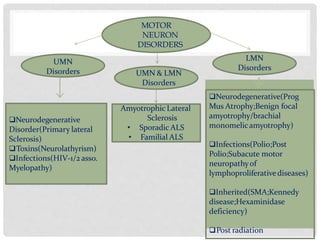
MOTOR
NEURON
DISORDERS
UMN
Disorders UMN & LMN
Disorders
LMN
Disorders
Neurodegenerative
Disorder(Primary lateral
Sclerosis)
Toxins(Neurolathyrism)
Infections(HIV-1/2 asso.
Myelopathy)
Amyotrophic Lateral
Sclerosis
• Sporadic ALS
• Familial ALS
Neurodegenerative(Prog
Mus Atrophy;Benign focal
amyotrophy/brachial
monomelicamyotrophy)
Infections(Polio;Post
Polio;Subacute motor
neuropathyof
lymphoproliferativediseases)
Inherited(SMA;Kennedy
disease;Hexaminidase
deficiency)
Post radiation
⚫Upper motor neurons (UMN) are responsible for
conveying impulses forvoluntary motoractivity
⚫UMN send fibers to the LMN, and thatexertdirector
indirect supranuclearcontrol overthe LMN.
⚫Lowermotor neurons (LMN) directly innervate the
skeletal muscle
1.primary lateral sclerosis
⚫ Sporadic
⚫ No fasciculations
⚫ Nodenervation
⚫ Selective l oss of pyramidal cells
2.familial spasticparaplegia
⚫ AD
⚫ Respiratory function spared
⚫ The LMNs -Located in the brainstemand spinal cord
⚫ The spinal LMNs are also known as anterior horn cell. The
neuronsareclustered in nuclei, forming longitudinal columns.
⚫ Dorsal anterior horncells -Innervatedistal muscles,
⚫ Ventral located cells- Proximal muscles,
⚫ Medially located neurons- Truncal and axial muscles.
⚫ Markedlyenlarged lateral partsof thecervical and lumbar (lower
thoracic) anterior horns innervatearm, hand, and leg muscles.
⚫ Largespinal cord LMNs arecalled alpha neurons.
LOWER MOTOR NEURON
Spinalcord ventral horn (Cervical spinal cord cross section)
1. KENNEDY DISEASE—X LINKED SPINOBULBAR
MUSCLE ATROPHY
⚫ Males
⚫ Androgen receptor insensitivity
⚫ Gynaecomastia
⚫ Absenceof pyramidal tract signs
⚫ Sensory symptomspresent
⚫ CAG
2.TAY SACHS—hexosaminidase
⚫ Cerebellaratrophy
⚫ Absentspasticity
⚫ Dysarthria
3.SMA-5q
⚫ Floppy infant
⚫ Infantile—werding hoffmandisease
4.MMNCB—
⚫ Improved on immunoglobulins,chemotherapy.
• Loss of Dexterity
• Loss of muscle strength (mild weakness)
• Spasticity
• Pathological Hyperreflexia
• Pathological Reflexes (Babinski, Hoffman sign, loss of
Abdominal reflexes)
• Increased reflexes in an atrophied limb(Probable UMN
sign)
• Pseudobulbar palsy (emotional lability, brisk jaw jerk,
hypeactive gag, forced yawning, snout reflex, suck
reflex, slow tongue movements, spastic dysarthria)
SIGNS & SYMPTOMS OF UMN
INVOLVEMENT
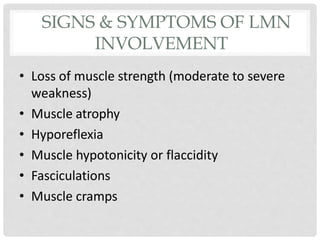
SIGNS & SYMPTOMS OF LMN
INVOLVEMENT
• Loss of muscle strength (moderate to severe
weakness)
• Muscle atrophy
• Hyporeflexia
• Muscle hypotonicity or flaccidity
• Fasciculations
• Muscle cramps
TYPES OF MND:
⚫MNDs are classified according to whether they
are inherited or sporadic(i.e-anyone can get it),
and to whether degeneration affects upper
motor neurons, lower motor neurons, or both.
⚫In adults, the most common MND is
Amyotrophic Lateral Sclerosis (ALS).
JeanMartin Charcot
⚫Named by Jean Martin Charcot in 19th century
⚫Also known as Lou Gehrig’s diseaseafterthe famous baseball
playerdiagnosed of ALS in 1930.
⚫Degeneration of the motor neuron(UMN & LMN) in motor
cortex,brainstem & spinal cord.
⚫Amyotrophy-Atrophyof muscle fibres consequentof
denervation due toanterior horn cell degeneration
⚫Lateral sclerosis-Sclerosis of the anterior and lateral
corticospinal tractswhich are replaced by progressivegliosis.
⚫ Undetermined aetiology.
⚫ Complex genetic-environmental interaction for neuronal degenration.
⚫ 90-95% aresporadic.
⚫ Proposed hypothesis of degeneration isviral infection,immune
activation & hormonal dysfunctions.
⚫ Sporadic ALS with predominantlyautosomal dominant inheritance
⚫ Molecularpathway proposed aredue toexcitotoxicity,oxidative
stress,mitochondrial dysfunction,impaired axonal
transport,neurafilamentaggregation.
⚫ Geneticsusceptibility include APOE,SMN,peripherin,VEGF,paraoxonase
genealteration
⚫ Western Pacific ALS(ALS parkinsonism dementia complex)-
Exposure to toxin β-N-methylamino-l-alanine, which is present in
seeds of theCycas circinalis in people of Chamorro natives of
Guam & Kii Peninsula of Japan.
⚫ Familial ALS(FALS)-(Type 1-10)(Type 2 & 5 have AR,rest have AD
inheritance)
i) Cu/Zn superoxidedismutase 1 (SOD1) in 20% of FALS
cases(autosomal recessive inheritance)
ii) Expansions of a GGGGCC hexanucleotide repeat in a
noncoding region of chromosome 9 is present in 37% to 46% of
FALS and 6% to 20% of sporadicALS of European descent
iii) Mutations in two RNA binding proteins, TAR DNA-binding
protein-43 (TDP-43) and fused in sarcoma (FUS)
⚫ 2/3rd -Typical/Spinal form of ALS with focal motorweakness
of distal or proximal upperor lower limbs. Spread of weaknes to
contiguous muscles in thesame region beforeanotherregion is
involved.
⚫ Pseudoneuriticpattern-Involvementof muscles in the
apparentdistribution of a peripheral nerve
⚫ Monomelic-Involvementof one limb
⚫ Pseudopolyneuritic-Weakness in the both distal lower limbs
⚫ Mill’s Hemiplegicvariant-Weakness restricted toone half of
the body
⚫ Bulbar/pseudobulbar palsy
⚫ 1-2% -Weakness of respiratorygroupof muscles
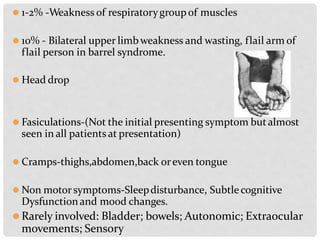
⚫ 10% - Bilateral upper limbweakness and wasting, flail arm of
flail person in barrel syndrome.
⚫ Head drop
⚫ Fasiculations-(Not the initial presenting symptom butalmost
seen in all patients at presentation)
⚫ Cramps-thighs,abdomen,back oreven tongue
⚫ Non motorsymptoms-Sleepdisturbance, Subtle cognitive
Dysfunctionand mood changes.
⚫Rarely involved: Bladder; bowels; Autonomic; Extraocular
movements; Sensory
⚫ Morecommon in older females: 50% with bulbar
presentation
⚫ Bulbaronset in 20% to 30% of all ALS cases
⚫ Features
⚫ Dysarthria
⚫Speech rate: Slow
⚫Voice quality: Reduced
⚫ Dysphagia
•Coticobulbar tracts involvement
•Spasticdysarthria,dysphonia,dysphagia
•Emotional lability(forced crying or laughter)
•Brisk jaw jerk
•Hyperactivegag ref lex
TYPES
⚫ALS, or Lou Gehrig's disease, is the most common
type, affects both the UMN and LMN. It can affect the
muscles of the arms, legs, mouth, and respiratory
system. Mean survival time is 3 to 5 years, but some
people live 10 years or more beyond diagnosis with
supportive care.
⚫Progressive bulbar palsy (PBP) involves the brain
stem(LMN). People with ALS often have PBP too.
The condition causes frequent choking spells,
difficulty speaking, eating, and swallowing.
⚫Diagnosisof exclusion
⚫Account for 2-4% of ALS
⚫Absenceof LMN Invovement
⚫Presentation in early 50’s
⚫Slowlyevolving spastic paresis after involving upper
limbs.
⚫Median diseaseduration:19yrs
⚫Fasiculation,cramps,bladderdysfunction,cognitive
deficits & abnormal voluntaryeye movement
⚫Striking loss of Betz cells in layer 5 of frontal and
prefrontal cortex with laminargliosis of layers 3 & 5 and
degeneration corticospinal tract
TYPES
⚫Pseudobulbar Palsy: This is similar to progressive bulbar
palsy. It affects motor neurons that control the ability to
talk, chew, and swallow. Pseudobulbar palsy causes people
to laugh or cry with no control.
⚫Progressive muscular atrophy (PMA): It only affects
the LMN in the spinal cord. Affects slowly but
progressively causes muscle wasting, especially in the
arms, legs, and mouth. It may be a variation ofALS.
⚫Primary lateral sclerosis (PLS): It is a disease of UMN. It
is the rare form of MND that advances more slowly than
ALS. It is not fatal, but it can affect the quality of life. In
children, it is known as juvenile primary lateral sclerosis.
TYPES
⚫Spinal muscular atrophy (SMA) is an inherited MND that
affects children. There are three types, all caused by an
abnormal gene known as SMA1(This gene makes a protein
that protects the motor neurons. Without it, they die.). It
tends to affect the trunk, legs, and arms. Long-term outlook
varies according to type.
⚫The different types of MND share similar symptoms,
but they progress at different speeds and vary in
severity.
DIAGNOSIS
• No biological marker has been identified yet.
• Series of clinical and neurological exams.
• MRI
• Myelogram of cervical spine (an x-ray analysis that allows the
detection of lesions in selected area of the spinal cord)
• Muscle and/or nerve biopsy
• Electromyography (EMG) and nerve conduction velocity (NCV)
to measure muscle response to nervous stimulation.
⚫After tests, a doctor will normally monitor the patient
for some time before confirming that they have MND.
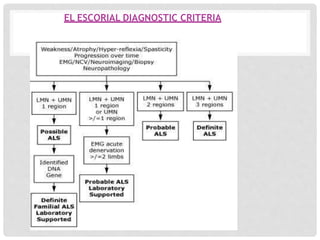
⚫Criteria known as El Escorial criteria can help a doctor
check for distinctive neurological signs, that may aid in
the diagnosis ofALS.
⚫These include:
⚫muscle shrinking, weakness or twitching
⚫muscle stiffness or abnormal reflexes
⚫symptoms spreading into new muscle groups
⚫having no other factors that explain the symptoms
EL ESCORIAL DIAGNOSTIC CRITERIA
⦿ Other Motor Neuron Diseases
◾ Primary lateral sclerosis (UMN only)
◾ Progressive muscular atrophy (LMN
only)
◾ Progressive bulbar palsy
⦿ Structural lesions
◾ cervical spondylosis
◾ parasaggital/foramen magnum
tumor
◾ spinal cord AV malformation
⦿ Neuropathies
◾ CIDP
⦿ Myopathies
◾ PM, inclusion body myositis
⦿ NM Junction
◾ Myasthenia gravis
⦿ NEURODEGENERATIVE DISEASES
◾ Parkinson’s, Progressive Supranuclear
Palsy, Multiple sclerosis.
⦿ Malignancy
◾ Primary/metastasis to CNS
◾ Motor neuron syndromes with MM,
Lymphoma, lung, breast.
⦿ Toxic Exposure
◾ alcohol, heavy metals.
⦿ Endocrine
 hyperthyroidism
 hyperparathyroidism.
⦿ Infectious
◾ HIV
, CMV
Differential Diagnosis
TREATMENT:
⚫There is no cure for MND, so treatments focus
on relieving the symptoms, slowing the
progression and maximizing patient
independence and comfort.
⚫This can include the use of breathing,
feeding, mobility and communication
appliances and devices.
⚫Rehabilitation therapy may include physical,
occupational and speech therapy.
MEDICAL MANAGEMENT:
⚫ Two drugs are currently approved by the U.S. Food and Drug
Administration (FDA) forALS.
⚫ Riluzole or Rilutek lowers the amount of glutamate in the body.
It appears most effective in the early stages ofALS and in older
individuals. It has been given to improve survival.
⚫ In early 2017, the drug Radicava (Endaravone) was approved
by the FDAfor the treatment ofALS.
⚫ How it works is not well understood, but it may delay disease
progression by working against tissue damage.
⚫ Scientists are currently exploring a possible role for stem cells in
the treatment ofALS.
⚫Muscle cramps and stiffness can be treated with
physical therapy and medications, such botulinum toxin
(BTA) injections. BTAblocks the signals from the brain
to the stiff muscles for about 3 months.
⚫Scopolamine, a drug for motion sickness, may help
control symptoms of drooling. It is worn as a patch
behind the ear.
⚫Antidepressants, called serotonin reuptake inhibitors
(SSRIs), may help with episodes of uncontrollable
laughter or crying, known as emotional lability.
⚫Advice from a speech and language therapist.
⚫Advice from a dietitian about diet and eating.
PROGNOSIS:
⚫Prognosis varies depending on the type of MND
and the age of onset.
⚫Some MNDs, such as PLS are not fatal and
progress slowly.
⚫People with SMAmay appear to be stable for
long periods, but improvement should not be
expected.
⚫Some MNDs, such asALS and some forms of
SMA, are fatal.

motor neuron disease.pptx

  • 1.
    Presented By: MajorRehana CMH BWP
  • 2.
    INTRODUCTION: ⚫Motor neuron diseasesare a group of neurodegenerative disorders that affects the nerves in the spine and brain to progressively lose its function. ⚫They are a rare but serious and incurable form of progressive neurodegeneration. ⚫It is a condition that selectively affects the motor system, the cells which control voluntary muscles of the body.
  • 3.
    CAUSES: ⚫ The exactcauses are unclear. ⚫ Some MNDs are inherited, but the causes of most MNDs are not known. ⚫ About 5% of people with motor neurone disease have a close family relative with the condition or a related condition known as fronto temporal dementia. This is called familial motor neurone disease which can be hereditary or linked to a problem with genes that can cause problems at a younger age. ⚫ In sporadic or non inherited MNDs, ⚫ environmental, ⚫ toxic, ⚫ viral, or ⚫ genetic factors likely play a role.
  • 4.
    MOTOR NEURON DISORDERS UMN Disorders UMN &LMN Disorders LMN Disorders Neurodegenerative Disorder(Primary lateral Sclerosis) Toxins(Neurolathyrism) Infections(HIV-1/2 asso. Myelopathy) Amyotrophic Lateral Sclerosis • Sporadic ALS • Familial ALS Neurodegenerative(Prog Mus Atrophy;Benign focal amyotrophy/brachial monomelicamyotrophy) Infections(Polio;Post Polio;Subacute motor neuropathyof lymphoproliferativediseases) Inherited(SMA;Kennedy disease;Hexaminidase deficiency) Post radiation
  • 6.
    ⚫Upper motor neurons(UMN) are responsible for conveying impulses forvoluntary motoractivity ⚫UMN send fibers to the LMN, and thatexertdirector indirect supranuclearcontrol overthe LMN. ⚫Lowermotor neurons (LMN) directly innervate the skeletal muscle
  • 8.
    1.primary lateral sclerosis ⚫Sporadic ⚫ No fasciculations ⚫ Nodenervation ⚫ Selective l oss of pyramidal cells 2.familial spasticparaplegia ⚫ AD ⚫ Respiratory function spared
  • 9.
    ⚫ The LMNs-Located in the brainstemand spinal cord ⚫ The spinal LMNs are also known as anterior horn cell. The neuronsareclustered in nuclei, forming longitudinal columns. ⚫ Dorsal anterior horncells -Innervatedistal muscles, ⚫ Ventral located cells- Proximal muscles, ⚫ Medially located neurons- Truncal and axial muscles. ⚫ Markedlyenlarged lateral partsof thecervical and lumbar (lower thoracic) anterior horns innervatearm, hand, and leg muscles. ⚫ Largespinal cord LMNs arecalled alpha neurons.
  • 10.
    LOWER MOTOR NEURON Spinalcordventral horn (Cervical spinal cord cross section)
  • 11.
    1. KENNEDY DISEASE—XLINKED SPINOBULBAR MUSCLE ATROPHY ⚫ Males ⚫ Androgen receptor insensitivity ⚫ Gynaecomastia ⚫ Absenceof pyramidal tract signs ⚫ Sensory symptomspresent ⚫ CAG
  • 12.
    2.TAY SACHS—hexosaminidase ⚫ Cerebellaratrophy ⚫Absentspasticity ⚫ Dysarthria 3.SMA-5q ⚫ Floppy infant ⚫ Infantile—werding hoffmandisease 4.MMNCB— ⚫ Improved on immunoglobulins,chemotherapy.
  • 13.
    • Loss ofDexterity • Loss of muscle strength (mild weakness) • Spasticity • Pathological Hyperreflexia • Pathological Reflexes (Babinski, Hoffman sign, loss of Abdominal reflexes) • Increased reflexes in an atrophied limb(Probable UMN sign) • Pseudobulbar palsy (emotional lability, brisk jaw jerk, hypeactive gag, forced yawning, snout reflex, suck reflex, slow tongue movements, spastic dysarthria) SIGNS & SYMPTOMS OF UMN INVOLVEMENT
  • 14.
    SIGNS & SYMPTOMSOF LMN INVOLVEMENT • Loss of muscle strength (moderate to severe weakness) • Muscle atrophy • Hyporeflexia • Muscle hypotonicity or flaccidity • Fasciculations • Muscle cramps
  • 16.
    TYPES OF MND: ⚫MNDsare classified according to whether they are inherited or sporadic(i.e-anyone can get it), and to whether degeneration affects upper motor neurons, lower motor neurons, or both. ⚫In adults, the most common MND is Amyotrophic Lateral Sclerosis (ALS).
  • 17.
    JeanMartin Charcot ⚫Named byJean Martin Charcot in 19th century ⚫Also known as Lou Gehrig’s diseaseafterthe famous baseball playerdiagnosed of ALS in 1930. ⚫Degeneration of the motor neuron(UMN & LMN) in motor cortex,brainstem & spinal cord. ⚫Amyotrophy-Atrophyof muscle fibres consequentof denervation due toanterior horn cell degeneration ⚫Lateral sclerosis-Sclerosis of the anterior and lateral corticospinal tractswhich are replaced by progressivegliosis.
  • 19.
    ⚫ Undetermined aetiology. ⚫Complex genetic-environmental interaction for neuronal degenration. ⚫ 90-95% aresporadic. ⚫ Proposed hypothesis of degeneration isviral infection,immune activation & hormonal dysfunctions. ⚫ Sporadic ALS with predominantlyautosomal dominant inheritance ⚫ Molecularpathway proposed aredue toexcitotoxicity,oxidative stress,mitochondrial dysfunction,impaired axonal transport,neurafilamentaggregation. ⚫ Geneticsusceptibility include APOE,SMN,peripherin,VEGF,paraoxonase genealteration
  • 20.
    ⚫ Western PacificALS(ALS parkinsonism dementia complex)- Exposure to toxin β-N-methylamino-l-alanine, which is present in seeds of theCycas circinalis in people of Chamorro natives of Guam & Kii Peninsula of Japan. ⚫ Familial ALS(FALS)-(Type 1-10)(Type 2 & 5 have AR,rest have AD inheritance) i) Cu/Zn superoxidedismutase 1 (SOD1) in 20% of FALS cases(autosomal recessive inheritance) ii) Expansions of a GGGGCC hexanucleotide repeat in a noncoding region of chromosome 9 is present in 37% to 46% of FALS and 6% to 20% of sporadicALS of European descent iii) Mutations in two RNA binding proteins, TAR DNA-binding protein-43 (TDP-43) and fused in sarcoma (FUS)
  • 21.
    ⚫ 2/3rd -Typical/Spinalform of ALS with focal motorweakness of distal or proximal upperor lower limbs. Spread of weaknes to contiguous muscles in thesame region beforeanotherregion is involved. ⚫ Pseudoneuriticpattern-Involvementof muscles in the apparentdistribution of a peripheral nerve ⚫ Monomelic-Involvementof one limb ⚫ Pseudopolyneuritic-Weakness in the both distal lower limbs ⚫ Mill’s Hemiplegicvariant-Weakness restricted toone half of the body ⚫ Bulbar/pseudobulbar palsy
  • 22.
    ⚫ 1-2% -Weaknessof respiratorygroupof muscles ⚫ 10% - Bilateral upper limbweakness and wasting, flail arm of flail person in barrel syndrome. ⚫ Head drop ⚫ Fasiculations-(Not the initial presenting symptom butalmost seen in all patients at presentation) ⚫ Cramps-thighs,abdomen,back oreven tongue ⚫ Non motorsymptoms-Sleepdisturbance, Subtle cognitive Dysfunctionand mood changes. ⚫Rarely involved: Bladder; bowels; Autonomic; Extraocular movements; Sensory
  • 23.
    ⚫ Morecommon inolder females: 50% with bulbar presentation ⚫ Bulbaronset in 20% to 30% of all ALS cases ⚫ Features ⚫ Dysarthria ⚫Speech rate: Slow ⚫Voice quality: Reduced ⚫ Dysphagia •Coticobulbar tracts involvement •Spasticdysarthria,dysphonia,dysphagia •Emotional lability(forced crying or laughter) •Brisk jaw jerk •Hyperactivegag ref lex
  • 24.
    TYPES ⚫ALS, or LouGehrig's disease, is the most common type, affects both the UMN and LMN. It can affect the muscles of the arms, legs, mouth, and respiratory system. Mean survival time is 3 to 5 years, but some people live 10 years or more beyond diagnosis with supportive care. ⚫Progressive bulbar palsy (PBP) involves the brain stem(LMN). People with ALS often have PBP too. The condition causes frequent choking spells, difficulty speaking, eating, and swallowing.
  • 25.
    ⚫Diagnosisof exclusion ⚫Account for2-4% of ALS ⚫Absenceof LMN Invovement ⚫Presentation in early 50’s ⚫Slowlyevolving spastic paresis after involving upper limbs. ⚫Median diseaseduration:19yrs ⚫Fasiculation,cramps,bladderdysfunction,cognitive deficits & abnormal voluntaryeye movement ⚫Striking loss of Betz cells in layer 5 of frontal and prefrontal cortex with laminargliosis of layers 3 & 5 and degeneration corticospinal tract
  • 26.
    TYPES ⚫Pseudobulbar Palsy: Thisis similar to progressive bulbar palsy. It affects motor neurons that control the ability to talk, chew, and swallow. Pseudobulbar palsy causes people to laugh or cry with no control. ⚫Progressive muscular atrophy (PMA): It only affects the LMN in the spinal cord. Affects slowly but progressively causes muscle wasting, especially in the arms, legs, and mouth. It may be a variation ofALS. ⚫Primary lateral sclerosis (PLS): It is a disease of UMN. It is the rare form of MND that advances more slowly than ALS. It is not fatal, but it can affect the quality of life. In children, it is known as juvenile primary lateral sclerosis.
  • 27.
    TYPES ⚫Spinal muscular atrophy(SMA) is an inherited MND that affects children. There are three types, all caused by an abnormal gene known as SMA1(This gene makes a protein that protects the motor neurons. Without it, they die.). It tends to affect the trunk, legs, and arms. Long-term outlook varies according to type. ⚫The different types of MND share similar symptoms, but they progress at different speeds and vary in severity.
  • 28.
    DIAGNOSIS • No biologicalmarker has been identified yet. • Series of clinical and neurological exams. • MRI • Myelogram of cervical spine (an x-ray analysis that allows the detection of lesions in selected area of the spinal cord) • Muscle and/or nerve biopsy • Electromyography (EMG) and nerve conduction velocity (NCV) to measure muscle response to nervous stimulation.
  • 29.
    ⚫After tests, adoctor will normally monitor the patient for some time before confirming that they have MND. ⚫Criteria known as El Escorial criteria can help a doctor check for distinctive neurological signs, that may aid in the diagnosis ofALS. ⚫These include: ⚫muscle shrinking, weakness or twitching ⚫muscle stiffness or abnormal reflexes ⚫symptoms spreading into new muscle groups ⚫having no other factors that explain the symptoms
  • 31.
  • 32.
    ⦿ Other MotorNeuron Diseases ◾ Primary lateral sclerosis (UMN only) ◾ Progressive muscular atrophy (LMN only) ◾ Progressive bulbar palsy ⦿ Structural lesions ◾ cervical spondylosis ◾ parasaggital/foramen magnum tumor ◾ spinal cord AV malformation ⦿ Neuropathies ◾ CIDP ⦿ Myopathies ◾ PM, inclusion body myositis ⦿ NM Junction ◾ Myasthenia gravis ⦿ NEURODEGENERATIVE DISEASES ◾ Parkinson’s, Progressive Supranuclear Palsy, Multiple sclerosis. ⦿ Malignancy ◾ Primary/metastasis to CNS ◾ Motor neuron syndromes with MM, Lymphoma, lung, breast. ⦿ Toxic Exposure ◾ alcohol, heavy metals. ⦿ Endocrine  hyperthyroidism  hyperparathyroidism. ⦿ Infectious ◾ HIV , CMV Differential Diagnosis
  • 33.
    TREATMENT: ⚫There is nocure for MND, so treatments focus on relieving the symptoms, slowing the progression and maximizing patient independence and comfort. ⚫This can include the use of breathing, feeding, mobility and communication appliances and devices. ⚫Rehabilitation therapy may include physical, occupational and speech therapy.
  • 34.
    MEDICAL MANAGEMENT: ⚫ Twodrugs are currently approved by the U.S. Food and Drug Administration (FDA) forALS. ⚫ Riluzole or Rilutek lowers the amount of glutamate in the body. It appears most effective in the early stages ofALS and in older individuals. It has been given to improve survival. ⚫ In early 2017, the drug Radicava (Endaravone) was approved by the FDAfor the treatment ofALS. ⚫ How it works is not well understood, but it may delay disease progression by working against tissue damage. ⚫ Scientists are currently exploring a possible role for stem cells in the treatment ofALS.
  • 35.
    ⚫Muscle cramps andstiffness can be treated with physical therapy and medications, such botulinum toxin (BTA) injections. BTAblocks the signals from the brain to the stiff muscles for about 3 months. ⚫Scopolamine, a drug for motion sickness, may help control symptoms of drooling. It is worn as a patch behind the ear. ⚫Antidepressants, called serotonin reuptake inhibitors (SSRIs), may help with episodes of uncontrollable laughter or crying, known as emotional lability. ⚫Advice from a speech and language therapist. ⚫Advice from a dietitian about diet and eating.
  • 36.
    PROGNOSIS: ⚫Prognosis varies dependingon the type of MND and the age of onset. ⚫Some MNDs, such as PLS are not fatal and progress slowly. ⚫People with SMAmay appear to be stable for long periods, but improvement should not be expected. ⚫Some MNDs, such asALS and some forms of SMA, are fatal.