INTERVERTEBRAL DISC
PROLAPSE(IVDP)

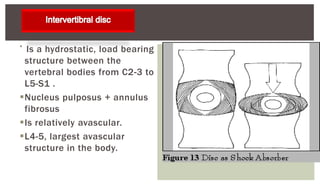
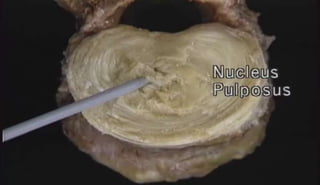
Is a hydrostatic, load bearing
structure between the
vertebral bodies from C2-3 to
L5-S1 .
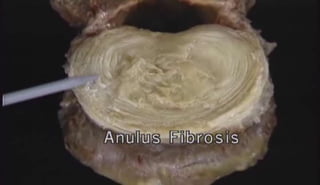
Nucleus pulposus + annulus
fibrosus
Is relatively avascular.
L4-5, largest avascular
structure in the body.
U
.
.
Vital Functions of the IVD
 Restricted intervertebral joint motion
 Contribution to stability
 Resistance to axial, rotational, and bending load
 Preservation of anatomic relationship
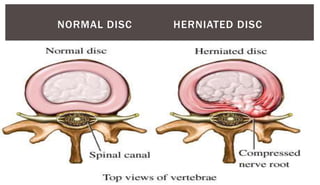
Is a medical condition affecting the spine in
which a tear in the outer, fibrous ring (annulus
fibrosus) of an intervertebral disc allows the
soft, central portion (nucleus pulposus) to bulge
out beyond the damaged outer rings.
posterolateral disc herniation –
protrusion is usually posterolateral into vertebral canal, compress the roots
of a spinal nerve.
protruded disc usually compresses next lower nerve as that nerve crosses
level of disc in its path to its foramen. (eg.protrusion of fifth lumbar disc
usually affects S1 instead.
 central (posterior) herniation:
less frequently, a protruded disc above second lumbar vertebra may
compress spinal cord itself or or may result in cauda equina syndrome.
lateral disc herniation:
may compress the nerve root above the level of the herniation
L4 nerve root is most often involved & patient typically have intense
radicular pain.
TYPES OF HERNIATION
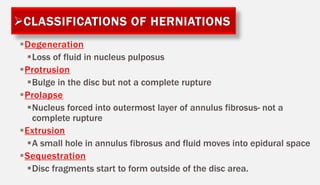
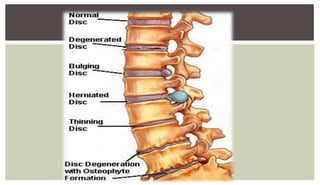
Degeneration
Loss of fluid in nucleus pulposus
Protrusion
Bulge in the disc but not a complete rupture
Prolapse
Nucleus forced into outermost layer of annulus fibrosus- not a
complete rupture
Extrusion
A small hole in annulus fibrosus and fluid moves into epidural space
Sequestration
Disc fragments start to form outside of the disc area.
CLASSIFICATIONS OF HERNIATIONS
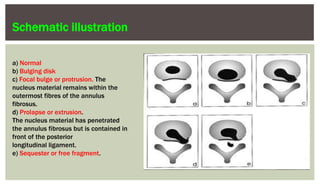
Schematic illustration
a) Normal
b) Bulging disk
c) Focal bulge or protrusion. The
nucleus material remains within the
outermost fibres of the annulus
fibrosus.
d) Prolapse or extrusion.
The nucleus material has penetrated
the annulus fibrosus but is contained in
front of the posterior
longitudinal ligament.
e) Sequester or free fragment.
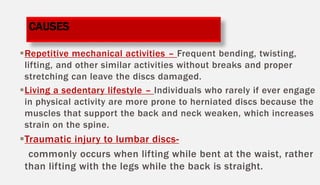
Repetitive mechanical activities – Frequent bending, twisting,
lifting, and other similar activities without breaks and proper
stretching can leave the discs damaged.
Living a sedentary lifestyle – Individuals who rarely if ever engage
in physical activity are more prone to herniated discs because the
muscles that support the back and neck weaken, which increases
strain on the spine.
Traumatic injury to lumbar discs-
commonly occurs when lifting while bent at the waist, rather
than lifting with the legs while the back is straight.
CAUSES
Obesity – Spinal degeneration can be quickened as a result of the
burden of supporting excess body fat.
Practicing poor posture – Improper spinal alignment while sitting,
standing, or lying down strains the back and neck.
Tobacco abuse – The chemicals commonly found in cigarettes can
interfere with the disc’s ability to absorb nutrients, which results
in the weakening of the disc.
CAUSES
NORMAL DISC HERNIATED DISC
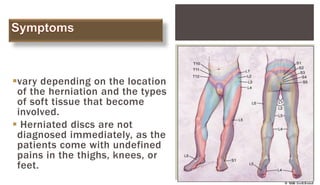
 symptoms of a herniated disc can
vary depending on the location
of the herniation and the types
of soft tissue that become
involved.
 Herniated discs are not
diagnosed immediately, as the
patients come with undefined
pains in the thighs, knees, or
feet.
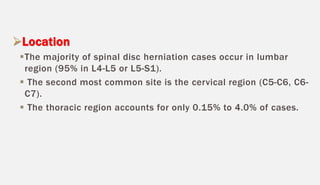
Location
The majority of spinal disc herniation cases occur in lumbar
region (95% in L4-L5 or L5-S1).
 The second most common site is the cervical region (C5-C6, C6-
C7).
 The thoracic region accounts for only 0.15% to 4.0% of cases.
Diagnosis is based on the history, symptoms, and physical
examination.
DIAGNOSIS
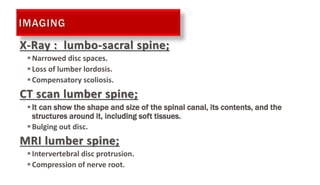
X-Ray : lumbo-sacral spine;
Narrowed disc spaces.
Loss of lumber lordosis.
Compensatory scoliosis.
CT scan lumber spine;
It can show the shape and size of the spinal canal, its contents, and the
structures around it, including soft tissues.
Bulging out disc.
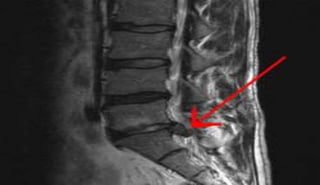
MRI lumber spine;
Intervertebral disc protrusion.
Compression of nerve root.
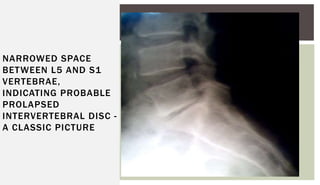
NARROWED SPACE
BETWEEN L5 AND S1
VERTEBRAE,
INDICATING PROBABLE
PROLAPSED
INTERVERTEBRAL DISC -
A CLASSIC PICTURE
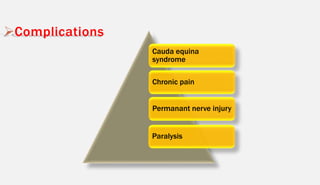
Complications
Cauda equina
syndrome
Chronic pain
Permanant nerve injury
Paralysis
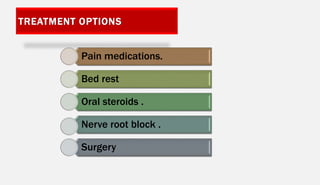
TREATMENT OPTIONS
Pain medications.
Bed rest
Oral steroids .
Nerve root block .
Surgery
Non-steroidal anti-inflammatory
drugs (NSAIDs).
Eg- Aspirin, Ibuprofen
Oral steroids
(e.g. prednisone or methylprednisolone).
Benzodiazepines( lowerdose)
Epidural cortisone injection.
Indicated treatment.
Physical therapy include modalities to
temporarily relieve pain (i.e. traction, electrical
stimulation massage).
Patient education on proper body mechanics.
Weight control.
Tobacco cessation.
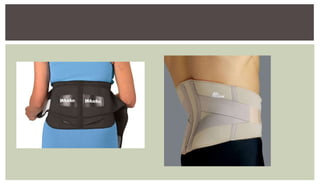
Lumbosacral back support.
TREATMENT
surgery
Surgery is generally considered only as a last resort,
or if a patient has a significant neurological deficit.
The presence of cauda equina syndrome is
considered a medical emergency requiring
immediate attention and possibly surgical
decompression.
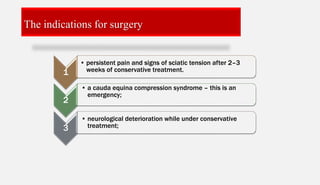
The indications for surgery
1
• persistent pain and signs of sciatic tension after 2–3
weeks of conservative treatment.
2
• a cauda equina compression syndrome – this is an
emergency;
3
• neurological deterioration while under conservative
treatment;
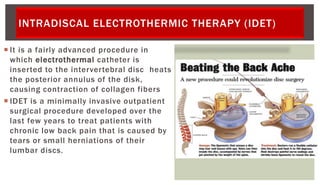
INTRADISCAL ELECTROTHERMIC THERAPY (IDET)
 It is a fairly advanced procedure in
which electrothermal catheter is
inserted to the intervertebral disc heats
the posterior annulus of the disk,
causing contraction of collagen fibers
 IDET is a minimally invasive outpatient
surgical procedure developed over the
last few years to treat patients with
chronic low back pain that is caused by
tears or small herniations of their
lumbar discs.
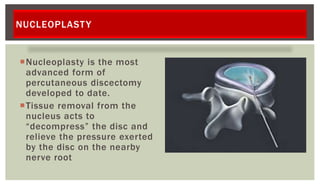
NUCLEOPLASTY
Nucleoplasty is the most
advanced form of
percutaneous discectomy
developed to date.
Tissue removal from the
nucleus acts to
“decompress” the disc and
relieve the pressure exerted
by the disc on the nearby
nerve root
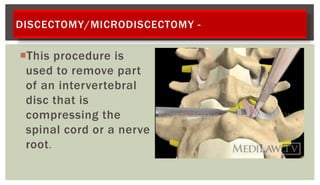
DISCECTOMY/MICRODISCECTOMY -
This procedure is
used to remove part
of an intervertebral
disc that is
compressing the
spinal cord or a nerve
root.
CHEMONUCLEOLYSIS-
 Chemonucleolysis is the term
used to denote chemical
destruction of nucleus pulposus
[Chemo+nucleo+lysis].
 This involves intradiscal
injection of
chymopapain which causes
hydrolysis of he cementing
protein of the nucleus pulposus.
 This causes decrease in water
binding capacity leading to
reduction in size and drying the
disc.
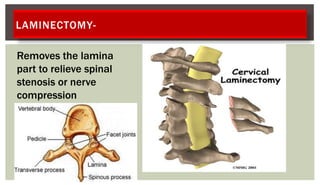
LAMINECTOMY-
Removes the lamina
part to relieve spinal
stenosis or nerve
compression
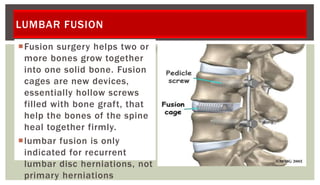
LUMBAR FUSION
Fusion surgery helps two or
more bones grow together
into one solid bone. Fusion
cages are new devices,
essentially hollow screws
filled with bone graft, that
help the bones of the spine
heal together firmly.
lumbar fusion is only
indicated for recurrent
lumbar disc herniations, not
primary herniations
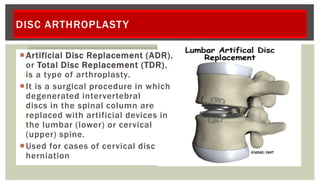
DISC ARTHROPLASTY
Artificial Disc Replacement (ADR),
or Total Disc Replacement (TDR),
is a type of arthroplasty.
It is a surgical procedure in which
degenerated intervertebral
discs in the spinal column are
replaced with artificial devices in
the lumbar (lower) or cervical
(upper) spine.
Used for cases of cervical disc
herniation
Assessment
determining the onset,
location, and radiation of pain,
paresthesias, limited movement,
diminished function of the neck, shoulders, and
upper extremities
NURSING MANAGEMENT
explanations about the surgery and reassurance that surgery
will not weaken the back.
Preoperative assessment also includes an evaluation of
movement of the extremities as well as bladder and bowel
function
To facilitate the postoperative turning procedure, the patient
is taught to turn as a unit (called logrolling)
Encouraged to take deep breaths, cough
PROVIDING PREOPERATIVE CARE
Vital signs are checked frequently and the wound is
inspected for hemorrhage
IV morphine -24-48
Sensation and motor strength of the lower extremities
are evaluated at specified intervals, along with the
color and temperature of the legs and sensation
of the toes.
Assess for CSF leakage
ASSESSING THE PATIENT AFTER SURGERY
Assess for paralytic ileus
Assess for urinary retention
Acute pain related to the surgical procedure
Nursing Interventions
 The patient may be kept flat in bed for 12 to 24 hours in cervical
surgery
 Pillow is placed under the head and the knee rest is elevated slightly
to relax the back muscles( cervical surgery)
 Extreme knee flexion must be avoided
 Administering the prescribed postoperative analgesic agent,
positioning for comfort, and reassuring the patient that the pain can
be relieved.
NURSING DIAGNOSIS
Impaired physical mobility related to the postoperative
surgical regimen
Nursing interventions
 provide cervical collar cervical collar
 provide L-S binders
The neck should be kept in a neutral(midline) position
Patients are assisted during position changes(log rolling)
Deficient knowledge about the postoperative course and home
care management
INTERVENTIONS
 A cervical collar is usually worn for about 6 weeks.
 Instructed about strategies for pain management and about signs
and symptoms of complications
 The nurse assesses the patient’s understanding of these management
strategies
 advised to avoid heavy work for 2 to 3 months after surgery.
 Exercises are prescribed to strengthen the abdominal and erector
spinal muscles
Avoid sitting/standing for prolonged periods
Avoid twisting movements
Regular follow up

Intervertebral disc prolapse(ivdp)

  • 1.
  • 2.
     Is a hydrostatic,load bearing structure between the vertebral bodies from C2-3 to L5-S1 . Nucleus pulposus + annulus fibrosus Is relatively avascular. L4-5, largest avascular structure in the body.
  • 3.
  • 4.
  • 5.
  • 6.
    Vital Functions ofthe IVD  Restricted intervertebral joint motion  Contribution to stability  Resistance to axial, rotational, and bending load  Preservation of anatomic relationship
  • 7.
    Is a medicalcondition affecting the spine in which a tear in the outer, fibrous ring (annulus fibrosus) of an intervertebral disc allows the soft, central portion (nucleus pulposus) to bulge out beyond the damaged outer rings.
  • 8.
    posterolateral disc herniation– protrusion is usually posterolateral into vertebral canal, compress the roots of a spinal nerve. protruded disc usually compresses next lower nerve as that nerve crosses level of disc in its path to its foramen. (eg.protrusion of fifth lumbar disc usually affects S1 instead.  central (posterior) herniation: less frequently, a protruded disc above second lumbar vertebra may compress spinal cord itself or or may result in cauda equina syndrome. lateral disc herniation: may compress the nerve root above the level of the herniation L4 nerve root is most often involved & patient typically have intense radicular pain. TYPES OF HERNIATION
  • 9.
    Degeneration Loss of fluidin nucleus pulposus Protrusion Bulge in the disc but not a complete rupture Prolapse Nucleus forced into outermost layer of annulus fibrosus- not a complete rupture Extrusion A small hole in annulus fibrosus and fluid moves into epidural space Sequestration Disc fragments start to form outside of the disc area. CLASSIFICATIONS OF HERNIATIONS
  • 10.
    Schematic illustration a) Normal b)Bulging disk c) Focal bulge or protrusion. The nucleus material remains within the outermost fibres of the annulus fibrosus. d) Prolapse or extrusion. The nucleus material has penetrated the annulus fibrosus but is contained in front of the posterior longitudinal ligament. e) Sequester or free fragment.
  • 12.
    Repetitive mechanical activities– Frequent bending, twisting, lifting, and other similar activities without breaks and proper stretching can leave the discs damaged. Living a sedentary lifestyle – Individuals who rarely if ever engage in physical activity are more prone to herniated discs because the muscles that support the back and neck weaken, which increases strain on the spine. Traumatic injury to lumbar discs- commonly occurs when lifting while bent at the waist, rather than lifting with the legs while the back is straight. CAUSES
  • 13.
    Obesity – Spinaldegeneration can be quickened as a result of the burden of supporting excess body fat. Practicing poor posture – Improper spinal alignment while sitting, standing, or lying down strains the back and neck. Tobacco abuse – The chemicals commonly found in cigarettes can interfere with the disc’s ability to absorb nutrients, which results in the weakening of the disc. CAUSES
  • 14.
  • 15.
     symptoms ofa herniated disc can vary depending on the location of the herniation and the types of soft tissue that become involved.  Herniated discs are not diagnosed immediately, as the patients come with undefined pains in the thighs, knees, or feet.
  • 16.
    Location The majority ofspinal disc herniation cases occur in lumbar region (95% in L4-L5 or L5-S1).  The second most common site is the cervical region (C5-C6, C6- C7).  The thoracic region accounts for only 0.15% to 4.0% of cases.
  • 17.
    Diagnosis is basedon the history, symptoms, and physical examination. DIAGNOSIS
  • 18.
    X-Ray : lumbo-sacralspine; Narrowed disc spaces. Loss of lumber lordosis. Compensatory scoliosis. CT scan lumber spine; It can show the shape and size of the spinal canal, its contents, and the structures around it, including soft tissues. Bulging out disc. MRI lumber spine; Intervertebral disc protrusion. Compression of nerve root.
  • 19.
    NARROWED SPACE BETWEEN L5AND S1 VERTEBRAE, INDICATING PROBABLE PROLAPSED INTERVERTEBRAL DISC - A CLASSIC PICTURE
  • 21.
  • 22.
    TREATMENT OPTIONS Pain medications. Bedrest Oral steroids . Nerve root block . Surgery
  • 23.
    Non-steroidal anti-inflammatory drugs (NSAIDs). Eg-Aspirin, Ibuprofen Oral steroids (e.g. prednisone or methylprednisolone). Benzodiazepines( lowerdose) Epidural cortisone injection. Indicated treatment.
  • 24.
    Physical therapy includemodalities to temporarily relieve pain (i.e. traction, electrical stimulation massage). Patient education on proper body mechanics. Weight control. Tobacco cessation. Lumbosacral back support. TREATMENT
  • 26.
    surgery Surgery is generallyconsidered only as a last resort, or if a patient has a significant neurological deficit. The presence of cauda equina syndrome is considered a medical emergency requiring immediate attention and possibly surgical decompression.
  • 27.
    The indications forsurgery 1 • persistent pain and signs of sciatic tension after 2–3 weeks of conservative treatment. 2 • a cauda equina compression syndrome – this is an emergency; 3 • neurological deterioration while under conservative treatment;
  • 28.
    INTRADISCAL ELECTROTHERMIC THERAPY(IDET)  It is a fairly advanced procedure in which electrothermal catheter is inserted to the intervertebral disc heats the posterior annulus of the disk, causing contraction of collagen fibers  IDET is a minimally invasive outpatient surgical procedure developed over the last few years to treat patients with chronic low back pain that is caused by tears or small herniations of their lumbar discs.
  • 29.
    NUCLEOPLASTY Nucleoplasty is themost advanced form of percutaneous discectomy developed to date. Tissue removal from the nucleus acts to “decompress” the disc and relieve the pressure exerted by the disc on the nearby nerve root
  • 30.
    DISCECTOMY/MICRODISCECTOMY - This procedureis used to remove part of an intervertebral disc that is compressing the spinal cord or a nerve root.
  • 31.
    CHEMONUCLEOLYSIS-  Chemonucleolysis isthe term used to denote chemical destruction of nucleus pulposus [Chemo+nucleo+lysis].  This involves intradiscal injection of chymopapain which causes hydrolysis of he cementing protein of the nucleus pulposus.  This causes decrease in water binding capacity leading to reduction in size and drying the disc.
  • 32.
    LAMINECTOMY- Removes the lamina partto relieve spinal stenosis or nerve compression
  • 33.
    LUMBAR FUSION Fusion surgeryhelps two or more bones grow together into one solid bone. Fusion cages are new devices, essentially hollow screws filled with bone graft, that help the bones of the spine heal together firmly. lumbar fusion is only indicated for recurrent lumbar disc herniations, not primary herniations
  • 34.
    DISC ARTHROPLASTY Artificial DiscReplacement (ADR), or Total Disc Replacement (TDR), is a type of arthroplasty. It is a surgical procedure in which degenerated intervertebral discs in the spinal column are replaced with artificial devices in the lumbar (lower) or cervical (upper) spine. Used for cases of cervical disc herniation
  • 35.
    Assessment determining the onset, location,and radiation of pain, paresthesias, limited movement, diminished function of the neck, shoulders, and upper extremities NURSING MANAGEMENT
  • 36.
    explanations about thesurgery and reassurance that surgery will not weaken the back. Preoperative assessment also includes an evaluation of movement of the extremities as well as bladder and bowel function To facilitate the postoperative turning procedure, the patient is taught to turn as a unit (called logrolling) Encouraged to take deep breaths, cough PROVIDING PREOPERATIVE CARE
  • 37.
    Vital signs arechecked frequently and the wound is inspected for hemorrhage IV morphine -24-48 Sensation and motor strength of the lower extremities are evaluated at specified intervals, along with the color and temperature of the legs and sensation of the toes. Assess for CSF leakage ASSESSING THE PATIENT AFTER SURGERY
  • 38.
    Assess for paralyticileus Assess for urinary retention
  • 39.
    Acute pain relatedto the surgical procedure Nursing Interventions  The patient may be kept flat in bed for 12 to 24 hours in cervical surgery  Pillow is placed under the head and the knee rest is elevated slightly to relax the back muscles( cervical surgery)  Extreme knee flexion must be avoided  Administering the prescribed postoperative analgesic agent, positioning for comfort, and reassuring the patient that the pain can be relieved. NURSING DIAGNOSIS
  • 40.
    Impaired physical mobilityrelated to the postoperative surgical regimen Nursing interventions  provide cervical collar cervical collar  provide L-S binders The neck should be kept in a neutral(midline) position Patients are assisted during position changes(log rolling)
  • 41.
    Deficient knowledge aboutthe postoperative course and home care management INTERVENTIONS  A cervical collar is usually worn for about 6 weeks.  Instructed about strategies for pain management and about signs and symptoms of complications  The nurse assesses the patient’s understanding of these management strategies  advised to avoid heavy work for 2 to 3 months after surgery.  Exercises are prescribed to strengthen the abdominal and erector spinal muscles
  • 42.
    Avoid sitting/standing forprolonged periods Avoid twisting movements Regular follow up