Day 4 Lecture 5
Medical Imaging
Elisa Sayrol
elisa.sayrol@upc.edu
[course site]
2
Medical Imaging
Interest in this area in Deep Learning:
DeepDeep Deep LearningDeep Learning Deep Learning ApplicationsDeep Learning Applications Deep Learning
Applications toDeep Learning Applications to Medical Deep Learning Applications to Medical ImageDeep Learning
Applications to Medical Image Deep Learning Applications to Medical Image Analysis, Prof. Dinggang Shen, Univ.
of North Carolina, USA
From DBNs to Deep ConvNets: Pushing the State of the Art in Medical Image Analysis, Prof. Gustavo Carneiro,
University Adelaide, Australia
3
Medical Imaging
Interest in this area in Deep Learning (MICCAI):
• Image description by means of deep learning techniques;
• Medical imaging-based diagnosis using deep learning;
• Medical signal-based diagnosis using deep learning;
• Medical image reconstruction using deep learning;
• Deep learning model selection;
• Meta-heuristic techniques for fine-tuning parameter in deep learning-based architectures;
• Deep learning-oriented applications.
Applications:
Breast cancer detection; skin lesion detection; organs recognition; image-based disease
identification; Chest Radiograph Categorization with Deep Feature Selection; Cell Detection and
recognition; Brain segmentation of tumor, stroke lesions and injuries
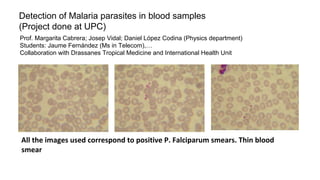
Detection of Malaria parasites in blood samples
(Project done at UPC)
Prof. Margarita Cabrera; Josep Vidal; Daniel López Codina (Physics department)
Students: Jaume Fernández (Ms in Telecom),…
Collaboration with Drassanes Tropical Medicine and International Health Unit
Detection of Malaria parasites in blood samples
(Project done at UPC)
▪
▪
▪
▪
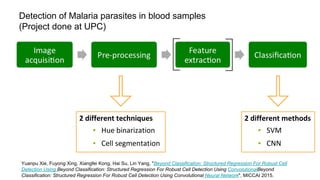
Yuanpu Xie, Fuyong Xing, Xiangfei Kong, Hai Su, Lin Yang, "Beyond Classification: Structured Regression For Robust Cell
Detection Using Beyond Classification: Structured Regression For Robust Cell Detection Using ConvolutionalBeyond
Classification: Structured Regression For Robust Cell Detection Using Convolutional Neural Network", MICCAI 2015.
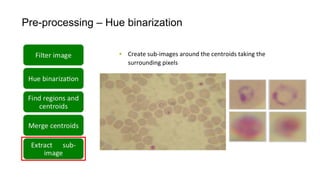
Pre-processing – Hue binarization
▪
▪
▪
▪
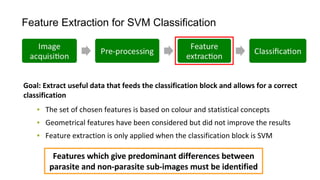
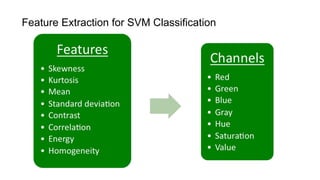
Feature Extraction for SVM Classification
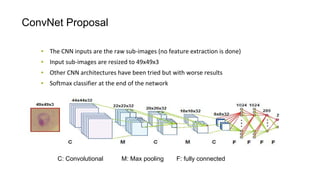
ConvNet Proposal
▪
▪
▪
▪
C: Convolutional M: Max pooling F: fully connected
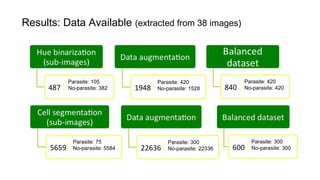
Parasite: 420
No-parasite: 420
Parasite: 420
No-parasite: 1528
Parasite: 105
No-parasite: 382
Parasite: 300
No-parasite: 300
Parasite: 300
No-parasite: 22336
Parasite: 75
No-parasite: 5584
Results: Data Available (extracted from 38 images)
▪
▪
34
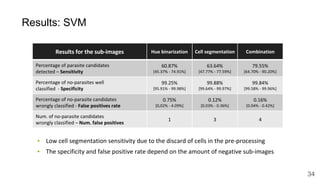
Results: SVM
▪
37
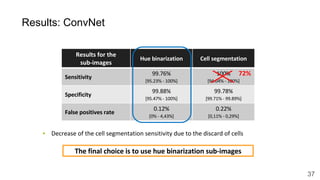
Results: ConvNet
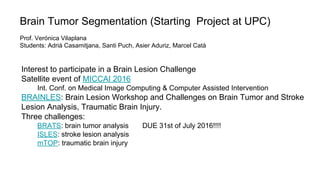
Brain Tumor Segmentation (Starting Project at UPC)
Prof. Verónica Vilaplana
Students: Adrià Casamitjana, Santi Puch, Asier Aduriz, Marcel Catà
Interest to participate in a Brain Lesion Challenge
Satellite event of MICCAI 2016
Int. Conf. on Medical Image Computing & Computer Assisted Intervention
BRAINLES: Brain Lesion Workshop and Challenges on Brain Tumor and Stroke
Lesion Analysis, Traumatic Brain Injury.
Three challenges:
BRATS: brain tumor analysis DUE 31st of July 2016!!!!
ISLES: stroke lesion analysis
mTOP: traumatic brain injury
Brats: multimodal brain tumor segmentation Challenge
Preprocessing: All data sets have been aligned to the same anatomical template and
interpolated to 1mm3
voxel resolution.
Data: The data set contains about 300 high- and low- grade glioma cases. Each data set
has T1 MRI, T1 contrast-enhanced MRI, T2 MRI, and T2 FLAIR MRI volumes.
Annotations comprise the whole tumor, the tumor core (including cystic areas), and the
Gd-enhanced tumor core
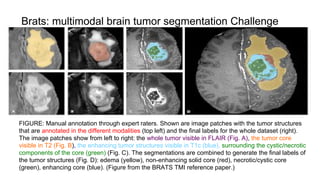
FIGURE: Manual annotation through expert raters. Shown are image patches with the tumor structures
that are annotated in the different modalities (top left) and the final labels for the whole dataset (right).
The image patches show from left to right: the whole tumor visible in FLAIR (Fig. A), the tumor core
visible in T2 (Fig. B), the enhancing tumor structures visible in T1c (blue), surrounding the cystic/necrotic
components of the core (green) (Fig. C). The segmentations are combined to generate the final labels of
the tumor structures (Fig. D): edema (yellow), non-enhancing solid core (red), necrotic/cystic core
(green), enhancing core (blue). (Figure from the BRATS TMI reference paper.)
Brats: multimodal brain tumor segmentation Challenge
Example: “DeepMedic”
Efficient Multi-Scale 3D CNN with fully connected CRF for Accurate Brain Lesion
Segmentation, Konstantinos Kamnitsas, et al. 2016
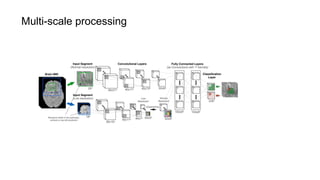
• Efficient hybrid training shceme
• Use of 3D deeper networks
• Parallel convolutional pathways for multi-scale processing
• Results on BRATS 2015
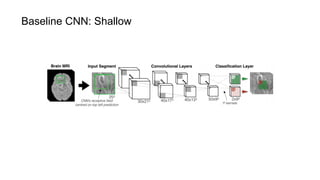
Baseline CNN: Shallow
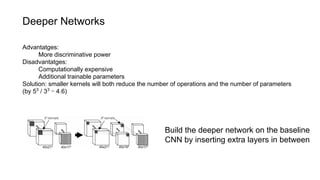
Deeper Networks
Advantatges:
More discriminative power
Disadvantatges:
Computationally expensive
Additional trainable parameters
Solution: smaller kernels will both reduce the number of operations and the number of parameters
(by 53
/ 33
⋍ 4.6)
Build the deeper network on the baseline
CNN by inserting extra layers in between
Multi-scale processing
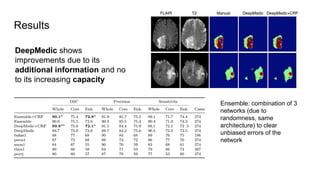
Results
DeepMedic shows
improvements due to its
additional information and no
to its increasing capacity
Ensemble: combination of 3
networks (due to
randomness, same
architecture) to clear
unbiased errors of the
network
21
Medical Imaging Summary
•Interest in the Area of Medical Imaging in Deep Learning:
•ISBI 2016. MICCAI Tutorials 2015:
Deep Learning Applications to Medical Image Analysis, Prof. Dinggang Shen, Univ. of North
Carolina, USA
From DBNs to Deep ConvNets: Pushing the State of the Art in Medical Image Analysis, Prof.
Gustavo Carneiro, University Adelaide, Australia
•Example 1:
•Malaria Parasite Detection in Blood Samples using ConvNets (UPC)
•Yuanpu Xie, Fuyong Xing, Xiangfei Kong, Hai Su, Lin Yang, "Beyond Classification: Structured
Regression For Robust Cell Detection Using Convolutional Neural Network", MICCAI 2015
•Example 2:
•Brats: Challenge in brain tumor analysis
•Efficient Multi-Scale 3D CNN with fully connected CRF for Accurate Brain Lesion
Segmentation, Konstantinos Kamnitsas, et al. 2016

Deep Learning for Computer Vision: Medical Imaging (UPC 2016)

  • 1.
    Day 4 Lecture5 Medical Imaging Elisa Sayrol elisa.sayrol@upc.edu [course site]
  • 2.
    2 Medical Imaging Interest inthis area in Deep Learning: DeepDeep Deep LearningDeep Learning Deep Learning ApplicationsDeep Learning Applications Deep Learning Applications toDeep Learning Applications to Medical Deep Learning Applications to Medical ImageDeep Learning Applications to Medical Image Deep Learning Applications to Medical Image Analysis, Prof. Dinggang Shen, Univ. of North Carolina, USA From DBNs to Deep ConvNets: Pushing the State of the Art in Medical Image Analysis, Prof. Gustavo Carneiro, University Adelaide, Australia
  • 3.
    3 Medical Imaging Interest inthis area in Deep Learning (MICCAI): • Image description by means of deep learning techniques; • Medical imaging-based diagnosis using deep learning; • Medical signal-based diagnosis using deep learning; • Medical image reconstruction using deep learning; • Deep learning model selection; • Meta-heuristic techniques for fine-tuning parameter in deep learning-based architectures; • Deep learning-oriented applications. Applications: Breast cancer detection; skin lesion detection; organs recognition; image-based disease identification; Chest Radiograph Categorization with Deep Feature Selection; Cell Detection and recognition; Brain segmentation of tumor, stroke lesions and injuries
  • 4.
    Detection of Malariaparasites in blood samples (Project done at UPC) Prof. Margarita Cabrera; Josep Vidal; Daniel López Codina (Physics department) Students: Jaume Fernández (Ms in Telecom),… Collaboration with Drassanes Tropical Medicine and International Health Unit
  • 5.
    Detection of Malariaparasites in blood samples (Project done at UPC) ▪ ▪ ▪ ▪ Yuanpu Xie, Fuyong Xing, Xiangfei Kong, Hai Su, Lin Yang, "Beyond Classification: Structured Regression For Robust Cell Detection Using Beyond Classification: Structured Regression For Robust Cell Detection Using ConvolutionalBeyond Classification: Structured Regression For Robust Cell Detection Using Convolutional Neural Network", MICCAI 2015.
  • 6.
    Pre-processing – Huebinarization ▪
  • 7.
  • 8.
    Feature Extraction forSVM Classification
  • 9.
    ConvNet Proposal ▪ ▪ ▪ ▪ C: ConvolutionalM: Max pooling F: fully connected
  • 10.
    Parasite: 420 No-parasite: 420 Parasite:420 No-parasite: 1528 Parasite: 105 No-parasite: 382 Parasite: 300 No-parasite: 300 Parasite: 300 No-parasite: 22336 Parasite: 75 No-parasite: 5584 Results: Data Available (extracted from 38 images)
  • 11.
  • 12.
  • 13.
    Brain Tumor Segmentation(Starting Project at UPC) Prof. Verónica Vilaplana Students: Adrià Casamitjana, Santi Puch, Asier Aduriz, Marcel Catà Interest to participate in a Brain Lesion Challenge Satellite event of MICCAI 2016 Int. Conf. on Medical Image Computing & Computer Assisted Intervention BRAINLES: Brain Lesion Workshop and Challenges on Brain Tumor and Stroke Lesion Analysis, Traumatic Brain Injury. Three challenges: BRATS: brain tumor analysis DUE 31st of July 2016!!!! ISLES: stroke lesion analysis mTOP: traumatic brain injury
  • 14.
    Brats: multimodal braintumor segmentation Challenge Preprocessing: All data sets have been aligned to the same anatomical template and interpolated to 1mm3 voxel resolution. Data: The data set contains about 300 high- and low- grade glioma cases. Each data set has T1 MRI, T1 contrast-enhanced MRI, T2 MRI, and T2 FLAIR MRI volumes. Annotations comprise the whole tumor, the tumor core (including cystic areas), and the Gd-enhanced tumor core
  • 15.
    FIGURE: Manual annotationthrough expert raters. Shown are image patches with the tumor structures that are annotated in the different modalities (top left) and the final labels for the whole dataset (right). The image patches show from left to right: the whole tumor visible in FLAIR (Fig. A), the tumor core visible in T2 (Fig. B), the enhancing tumor structures visible in T1c (blue), surrounding the cystic/necrotic components of the core (green) (Fig. C). The segmentations are combined to generate the final labels of the tumor structures (Fig. D): edema (yellow), non-enhancing solid core (red), necrotic/cystic core (green), enhancing core (blue). (Figure from the BRATS TMI reference paper.) Brats: multimodal brain tumor segmentation Challenge
  • 16.
    Example: “DeepMedic” Efficient Multi-Scale3D CNN with fully connected CRF for Accurate Brain Lesion Segmentation, Konstantinos Kamnitsas, et al. 2016 • Efficient hybrid training shceme • Use of 3D deeper networks • Parallel convolutional pathways for multi-scale processing • Results on BRATS 2015
  • 17.
  • 18.
    Deeper Networks Advantatges: More discriminativepower Disadvantatges: Computationally expensive Additional trainable parameters Solution: smaller kernels will both reduce the number of operations and the number of parameters (by 53 / 33 ⋍ 4.6) Build the deeper network on the baseline CNN by inserting extra layers in between
  • 19.
  • 20.
    Results DeepMedic shows improvements dueto its additional information and no to its increasing capacity Ensemble: combination of 3 networks (due to randomness, same architecture) to clear unbiased errors of the network
  • 21.
    21 Medical Imaging Summary •Interestin the Area of Medical Imaging in Deep Learning: •ISBI 2016. MICCAI Tutorials 2015: Deep Learning Applications to Medical Image Analysis, Prof. Dinggang Shen, Univ. of North Carolina, USA From DBNs to Deep ConvNets: Pushing the State of the Art in Medical Image Analysis, Prof. Gustavo Carneiro, University Adelaide, Australia •Example 1: •Malaria Parasite Detection in Blood Samples using ConvNets (UPC) •Yuanpu Xie, Fuyong Xing, Xiangfei Kong, Hai Su, Lin Yang, "Beyond Classification: Structured Regression For Robust Cell Detection Using Convolutional Neural Network", MICCAI 2015 •Example 2: •Brats: Challenge in brain tumor analysis •Efficient Multi-Scale 3D CNN with fully connected CRF for Accurate Brain Lesion Segmentation, Konstantinos Kamnitsas, et al. 2016