[course site]
Generative models
and adversarial
training
Day 4 Lecture 1
Kevin McGuinness
kevin.mcguinness@dcu.ie
Research Fellow
Insight Centre for Data Analytics
Dublin City University
What is a generative model?
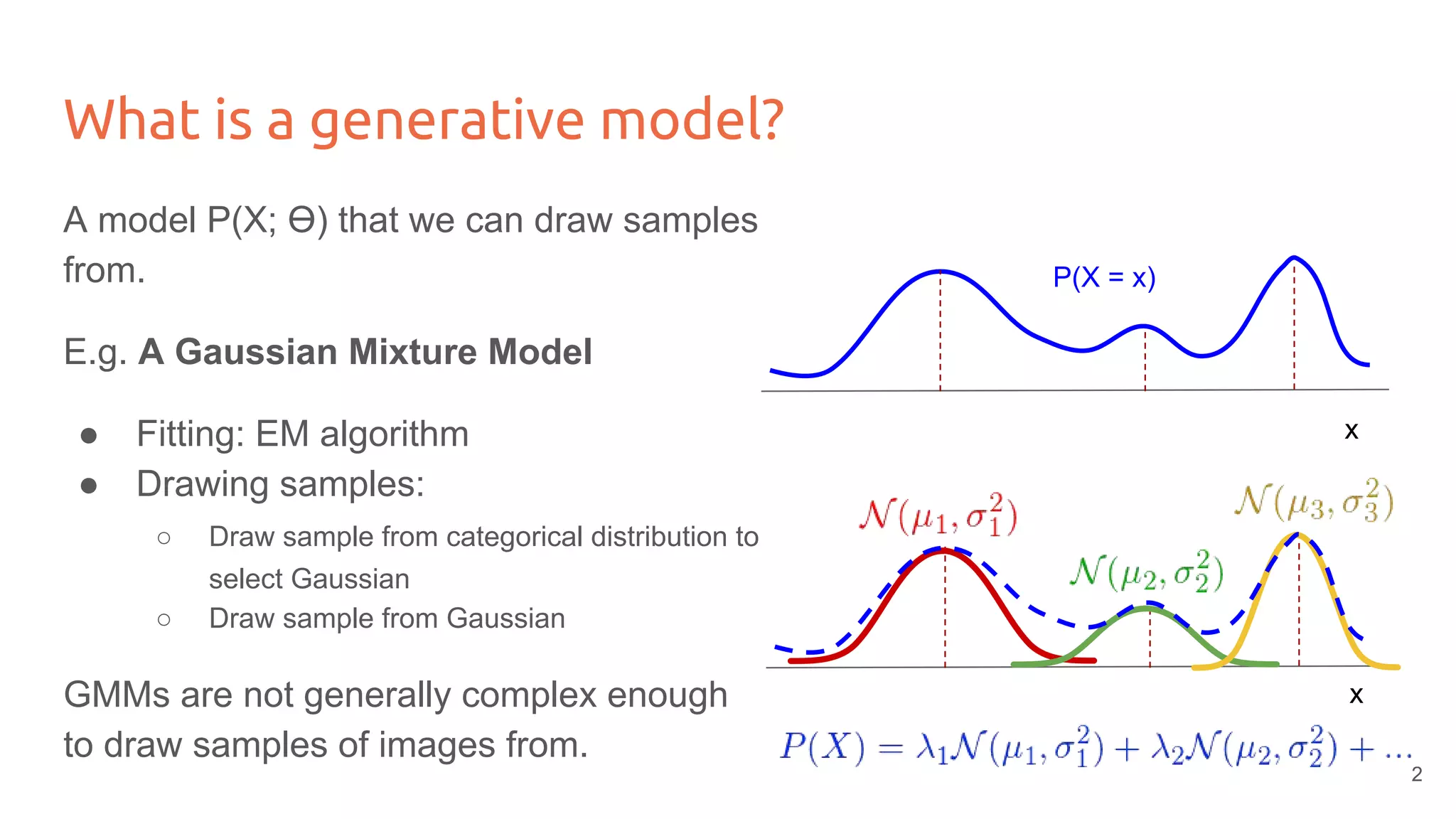
A model P(X; ϴ) that we can draw samples
from.
E.g. A Gaussian Mixture Model
● Fitting: EM algorithm
● Drawing samples:
○ Draw sample from categorical distribution to
select Gaussian
○ Draw sample from Gaussian
GMMs are not generally complex enough
to draw samples of images from.
P(X = x)
x
x
2
Why are generative models important?
● Model the probability density of images
● Understanding P(X) may help us understand P(Y | X)
● Generate novel content
● Generate training data for discriminative networks
● Artistic applications
● Image completion
● Monte-carlo estimators
3
Generative adversarial networks
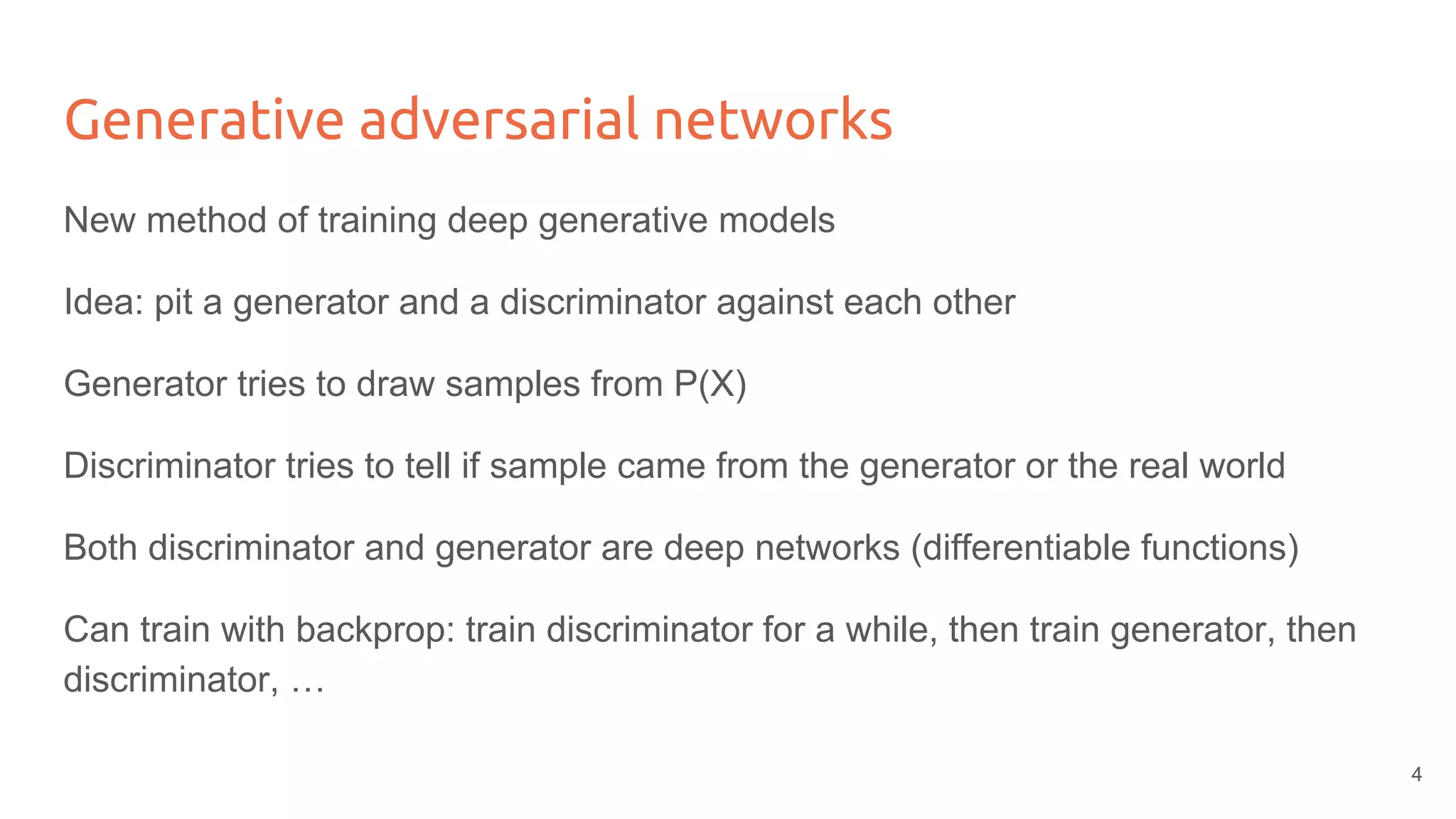
New method of training deep generative models
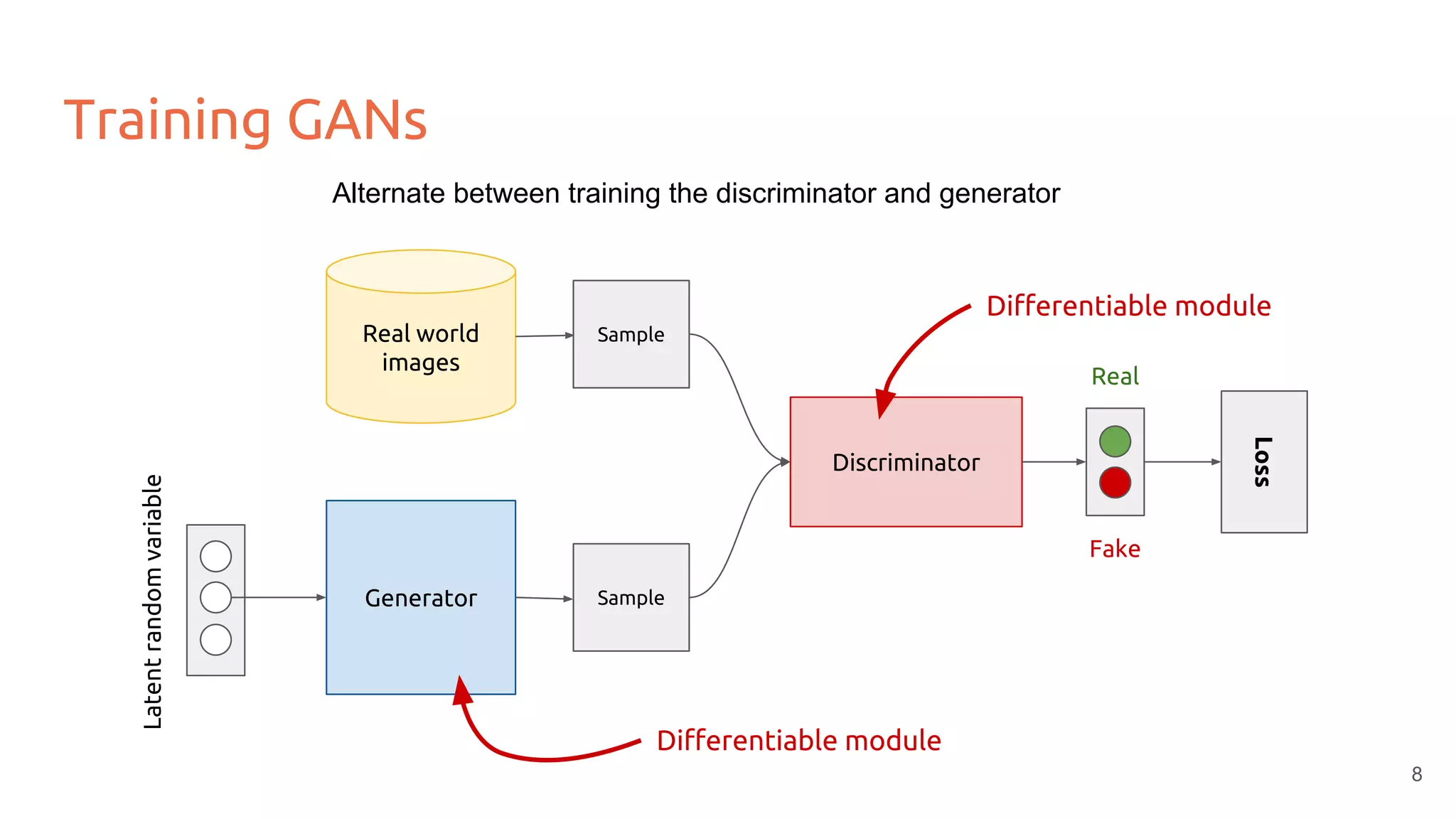
Idea: pit a generator and a discriminator against each other
Generator tries to draw samples from P(X)
Discriminator tries to tell if sample came from the generator or the real world
Both discriminator and generator are deep networks (differentiable functions)
Can train with backprop: train discriminator for a while, then train generator, then
discriminator, …
4
Generative adversarial networks (conceptual)
Generator
Real world
images
Discriminator
Real
Loss
Latentrandomvariable
Sample
Sample
Fake
5
The generator
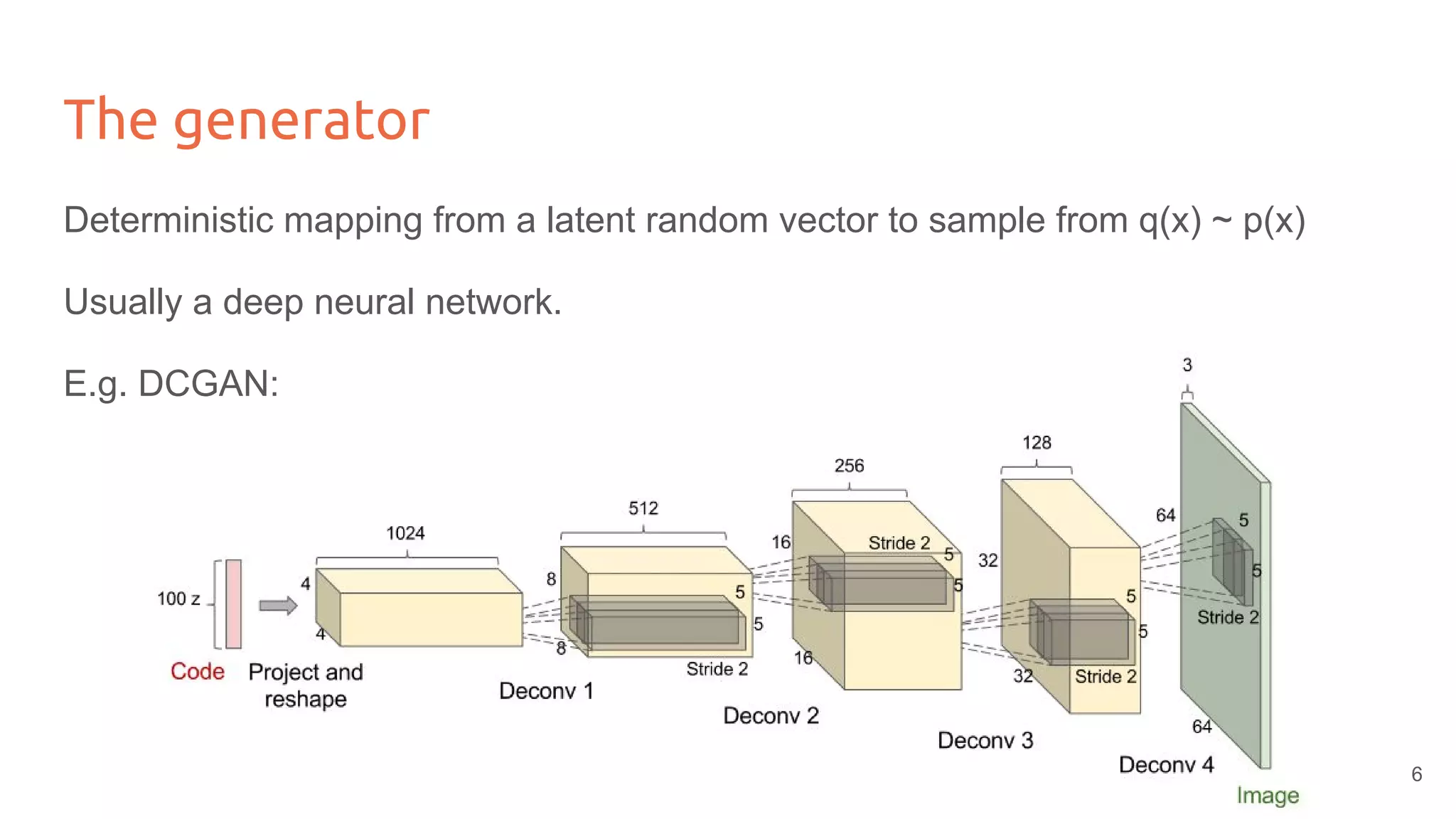
Deterministic mapping from a latent random vector to sample from q(x) ~ p(x)
Usually a deep neural network.
E.g. DCGAN:
6
The discriminator
Parameterised function that tries to distinguish between samples from real images
p(x) and generated ones q(x).
Usually a deep convolutional neural network.
conv
conv
...
F F
7
Training GANs
Generator
Real world
images
Discriminator
Real
Loss
Latentrandomvariable
Sample
Sample
Fake
Alternate between training the discriminator and generator
Differentiable module
8
Generator
Real world
images
Discriminator
Real
Loss
Latentrandomvariable
Sample
Sample
Fake
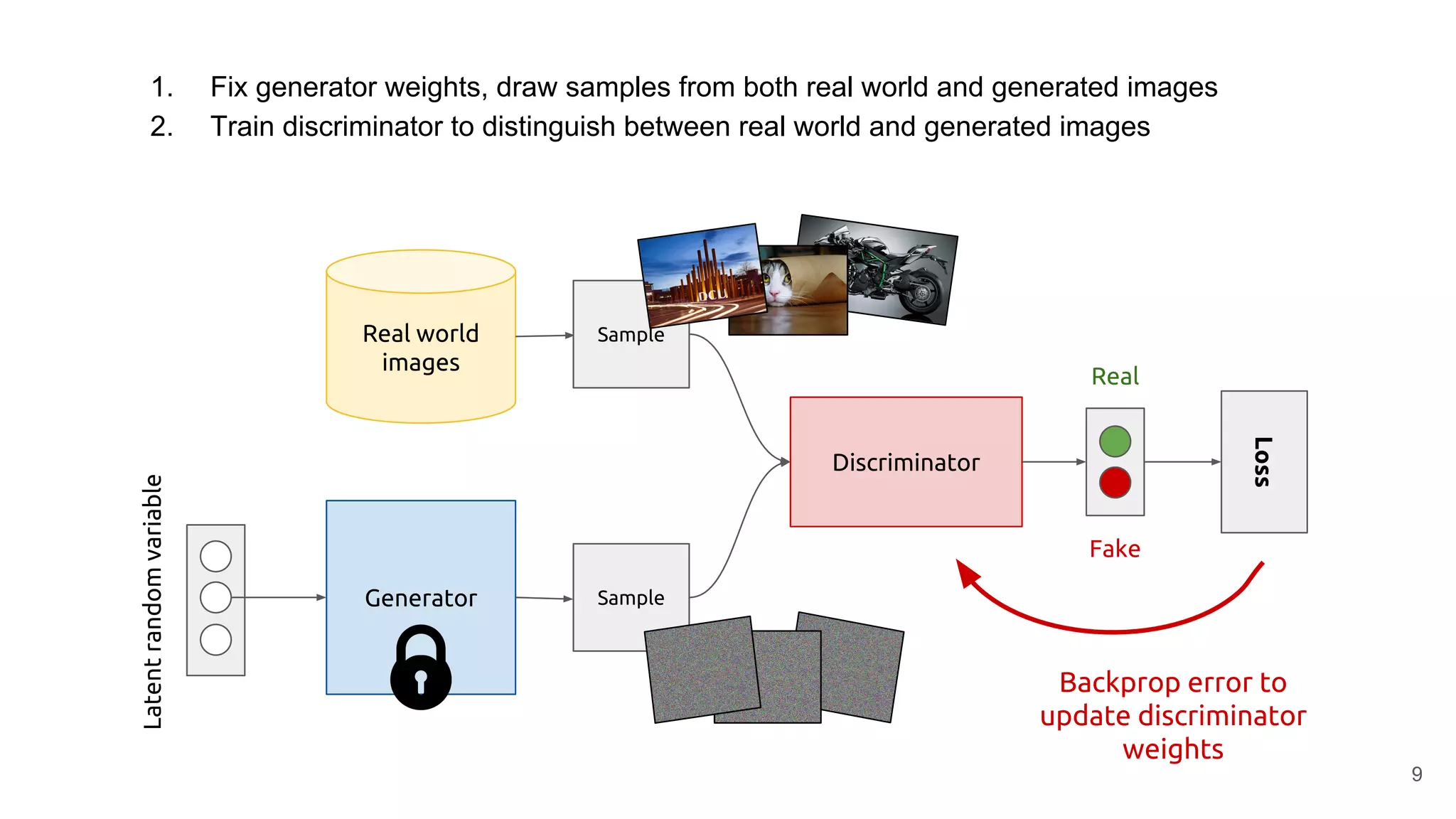
1. Fix generator weights, draw samples from both real world and generated images
2. Train discriminator to distinguish between real world and generated images
Backprop error to
update discriminator
weights
9
Generator
Real world
images
Discriminator
Real
Loss
Latentrandomvariable
Sample
Sample
Fake
1. Fix discriminator weights
2. Sample from generator
3. Backprop error through discriminator to update generator weights
Backprop error to
update generator
weights
10
Training GANs
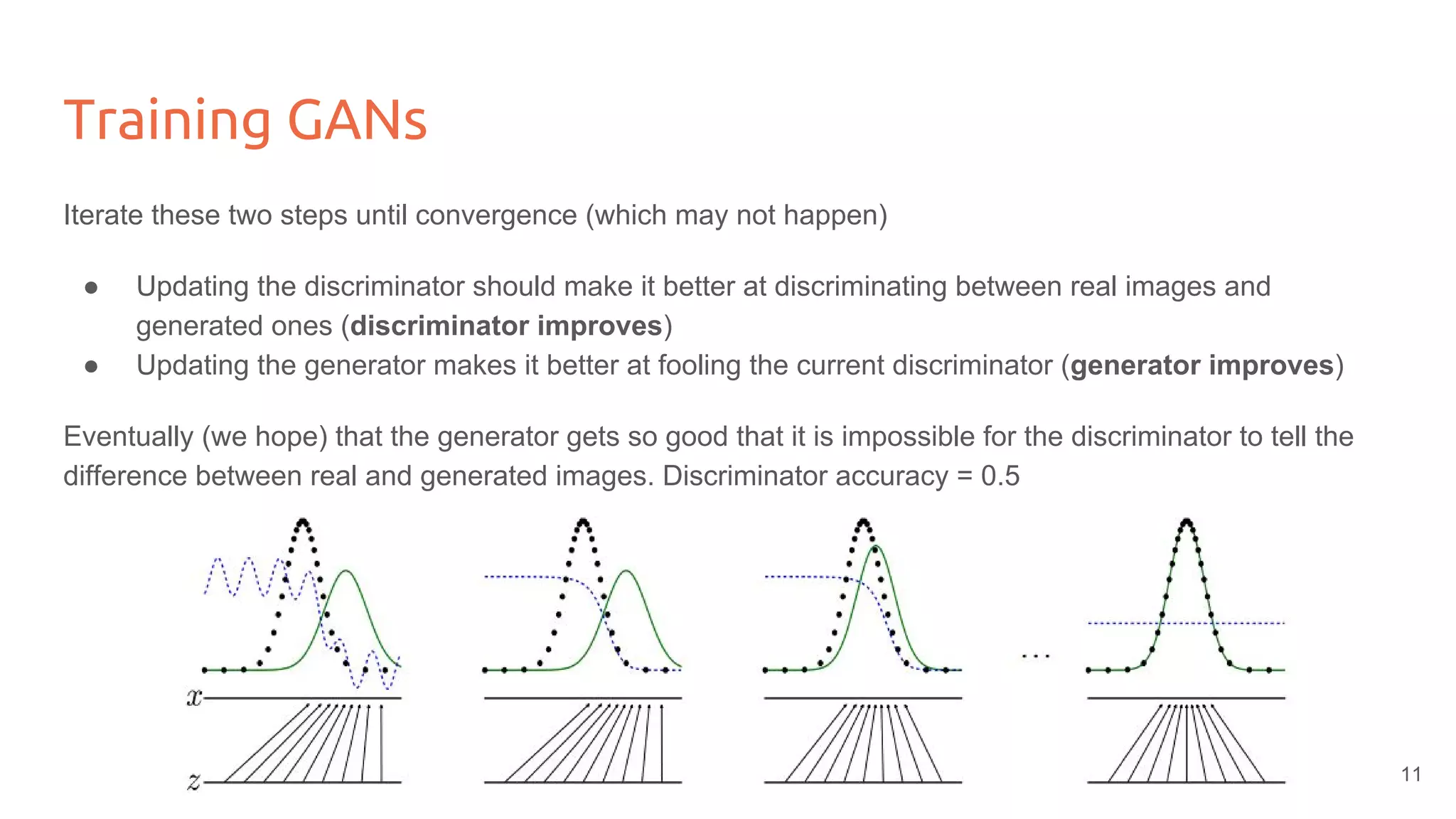
Iterate these two steps until convergence (which may not happen)
● Updating the discriminator should make it better at discriminating between real images and
generated ones (discriminator improves)
● Updating the generator makes it better at fooling the current discriminator (generator improves)
Eventually (we hope) that the generator gets so good that it is impossible for the discriminator to tell the
difference between real and generated images. Discriminator accuracy = 0.5
11
Some examples…
12
ImageNet
Source:
https://openai.com/blog/generative-models/
13
CIFAR-10
Source:
https://openai.com/blog/generative-models/
14
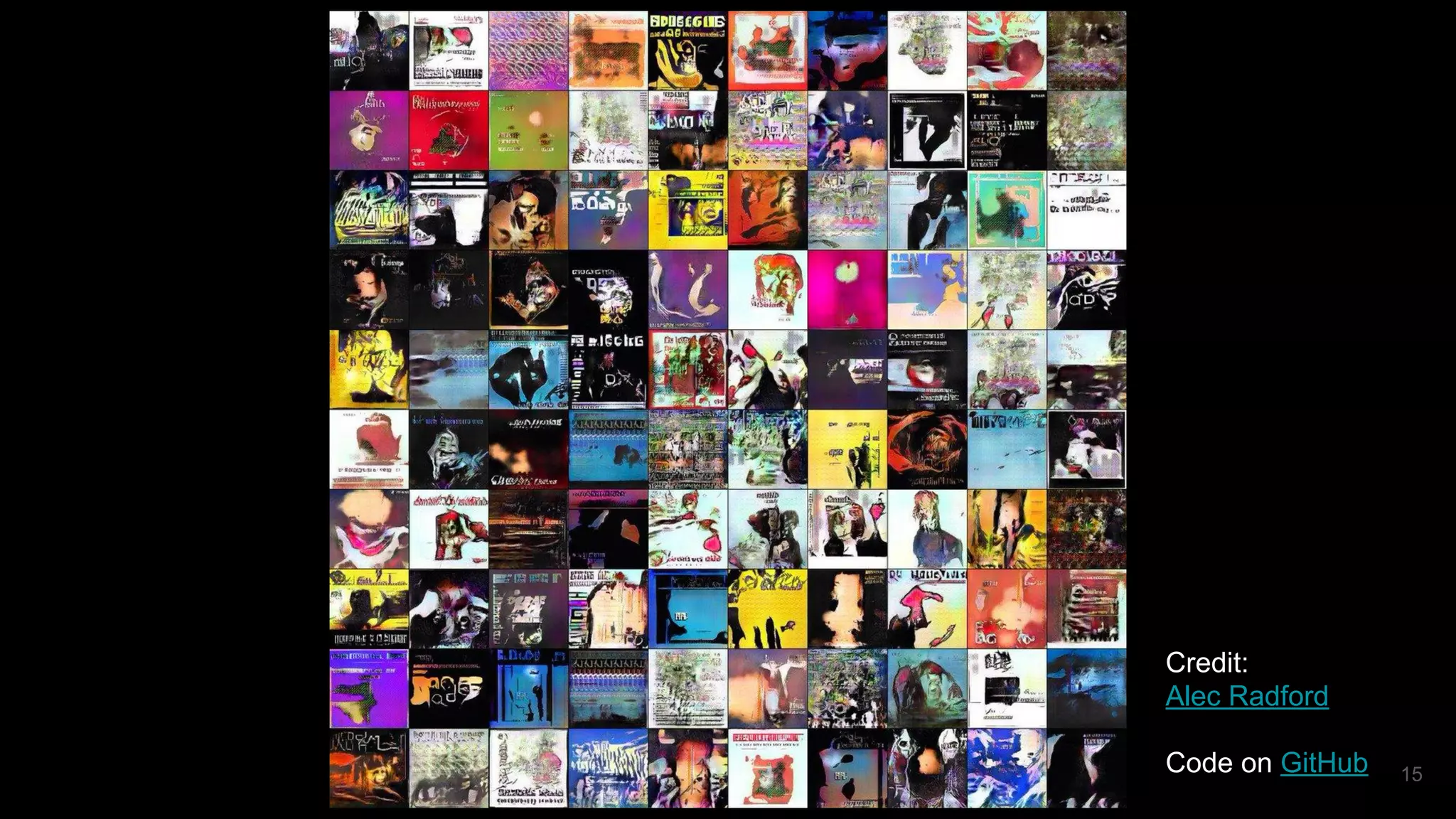
Credit:
Alec Radford
Code on GitHub 15
Credit: Alec Radford Code on GitHub 16
Issues
Known to be very difficult to train:
● Formulated as a “game” between two networks
● Unstable dynamics: hard to keep generator and discriminator in balance
● Optimization can oscillate between solutions
● Generator can collapse
Possible to use supervised labels to help prevent this:
https://arxiv.org/abs/1606.03498
17
Predicting the future with adversarial training
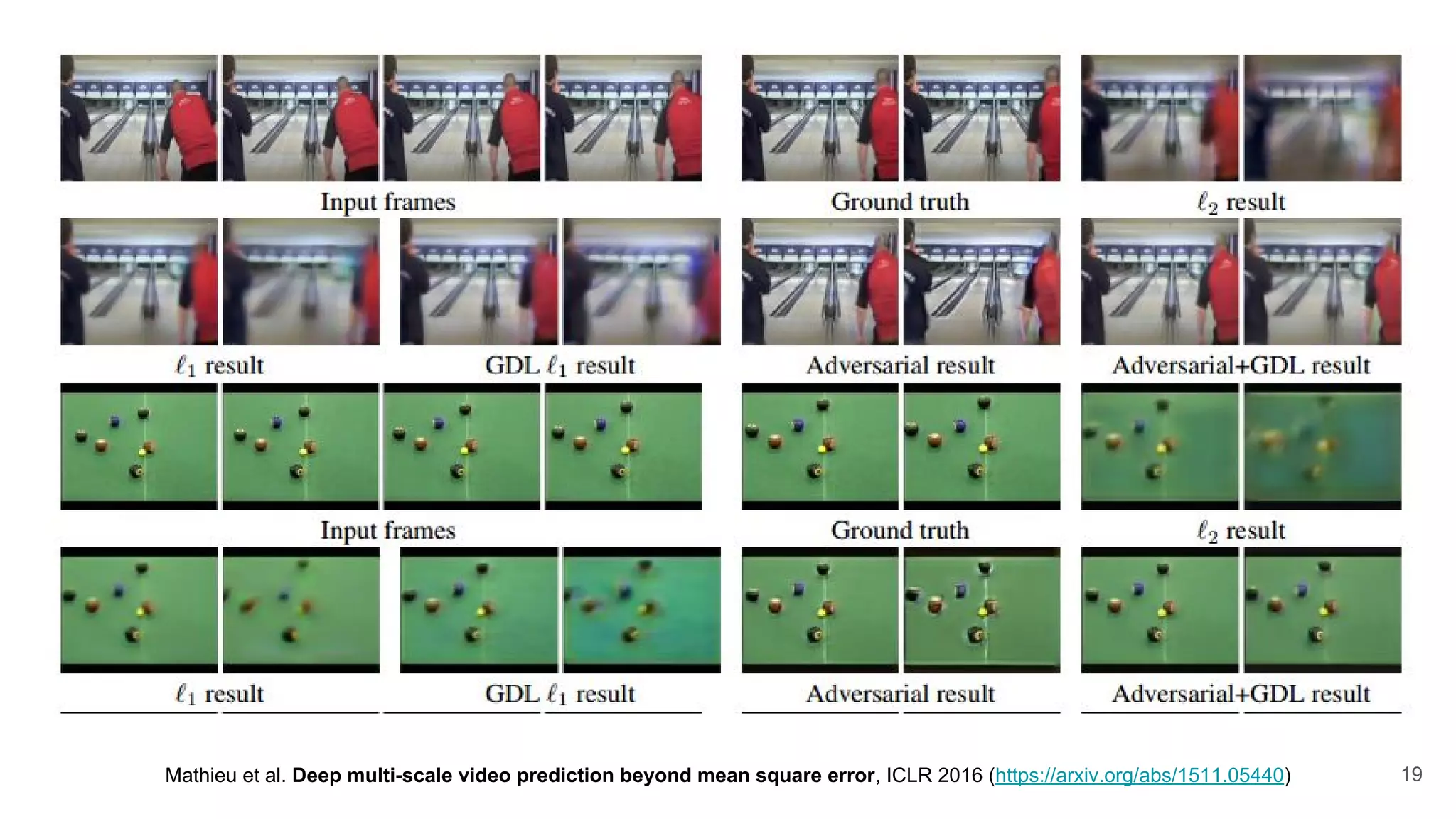
Want to train a classifier to predict the pixels in frame (t+K) from pixels in frame t.
Many possible futures for same frame
Using supervised classification results in blurry solutions: loss if minimized if
classifier averages over possibilities when predicting.
We really want a sample, not the mean
Adversarial training can solve this: easy for an adversary to detect blurry frames
Mathieu et al. Deep multi-scale video prediction beyond mean square error, ICLR 2016 (https://arxiv.org/abs/1511.05440) 18
Mathieu et al. Deep multi-scale video prediction beyond mean square error, ICLR 2016 (https://arxiv.org/abs/1511.05440) 19
Summary
Adversarial networks pit a generator network against a discriminator (adversary)
Can be trained to draw realistic sharp samples
Training can be difficult: can oscillate or generator can collapse
20