[course site]
Segmentation
Day 4 Lecture 2
Amaia Salvador
amaia.salvador@upc.edu
Segmentation
Segmentation
Define the accurate boundaries of all objects in an image
Segmentation: Datasets
Pascal Visual Object Classes
20 Classes
~ 5.000 images
Microsoft COCO
80 Classes
~ 300.000 images
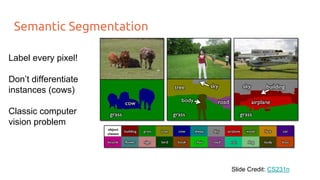
Semantic Segmentation
Label every pixel!
Don’t differentiate
instances (cows)
Classic computer
vision problem
Slide Credit: CS231n
Instance Segmentation
Detect instances,
give category, label
pixels
“simultaneous
detection and
segmentation” (SDS)
Slide Credit: CS231n
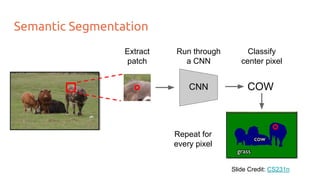
Semantic Segmentation
Slide Credit: CS231n
CNN COW
Extract
patch
Run through
a CNN
Classify
center pixel
Repeat for
every pixel
Semantic Segmentation
Slide Credit: CS231n
CNN
Run “fully convolutional” network
to get all pixels at once
Smaller
output
due to pooling
Semantic Segmentation
Long et al. Fully Convolutional Networks for Semantic Segmentation. CVPR 2015
Learnable upsampling!
Slide Credit: CS231n
Convolutional Layer
Slide Credit: CS231n
Typical 3 x 3 convolution, stride 1 pad 1
Input: 4 x 4 Output: 4 x 4
Convolutional Layer
Slide Credit: CS231n
Typical 3 x 3 convolution, stride 1 pad 1
Input: 4 x 4 Output: 4 x 4
Dot product
between filter
and input
Convolutional Layer
Slide Credit: CS231n
Typical 3 x 3 convolution, stride 1 pad 1
Input: 4 x 4 Output: 4 x 4
Dot product
between filter
and input
Convolutional Layer
Slide Credit: CS231n
Typical 3 x 3 convolution, stride 2 pad 1
Input: 4 x 4 Output: 2 x 2
Convolutional Layer
Slide Credit: CS231n
Typical 3 x 3 convolution, stride 2 pad 1
Input: 4 x 4 Output: 2 x 2
Dot product
between filter
and input
Convolutional Layer
Slide Credit: CS231n
Typical 3 x 3 convolution, stride 2 pad 1
Input: 4 x 4 Output: 2 x 2
Dot product
between filter
and input
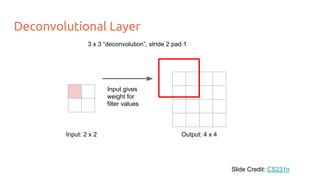
Deconvolutional Layer
Slide Credit: CS231n
3 x 3 “deconvolution”, stride 2 pad 1
Input: 2 x 2 Output: 4 x 4
Deconvolutional Layer
Slide Credit: CS231n
3 x 3 “deconvolution”, stride 2 pad 1
Input: 2 x 2 Output: 4 x 4
Input gives
weight for
filter values
Deconvolutional Layer
Slide Credit: CS231n
3 x 3 “deconvolution”, stride 2 pad 1
Input: 2 x 2 Output: 4 x 4
Input gives
weight for
filter
Sum where
output overlaps
Same as backward pass for
normal convolution!
Deconvolutional Layer
Slide Credit: CS231n
“Deconvolution” is a bad name, already defined as “inverse of convolution”
Better names:
convolution transpose,
backward strided convolution,
1/2 strided convolution, upconvolution
Im et al. Generating images with recurrent adversarial networks. arXiv 2016
Radford et al. Unsupervised Representation Learning with Deep Convolutional Generative Adversarial Networks. ICLR 2016
Skip Connections
Slide Credit: CS231n
Skip connections = Better results
“skip
connections”
Long et al. Fully Convolutional Networks for Semantic Segmentation. CVPR 2015
Semantic Segmentation
Slide Credit: CS231n
Noh et al. Learning Deconvolution Network for Semantic Segmentation. ICCV 2015
Normal VGG “Upside down” VGG
Instance Segmentation
Detect instances,
give category, label
pixels
“simultaneous
detection and
segmentation” (SDS)
Slide Credit: CS231n
Instance Segmentation
Slide Credit: CS231nHariharan et al. Simultaneous Detection and Segmentation. ECCV 2014
External
Segment
proposals
Mask out background
with mean image
Similar to R-CNN, but with segments
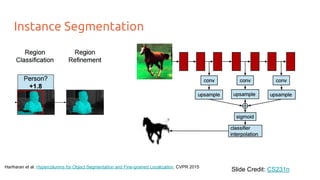
Instance Segmentation
Slide Credit: CS231nHariharan et al. Hypercolumns for Object Segmentation and Fine-grained Localization. CVPR 2015
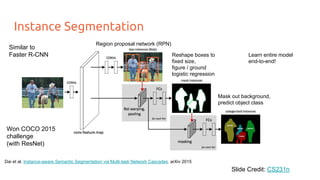
Instance Segmentation
Slide Credit: CS231n
Dai et al. Instance-aware Semantic Segmentation via Multi-task Network Cascades. arXiv 2015
Similar to
Faster R-CNN
Won COCO 2015
challenge
(with ResNet)
Region proposal network (RPN)
Reshape boxes to
fixed size,
figure / ground
logistic regression
Mask out background,
predict object class
Learn entire model
end-to-end!
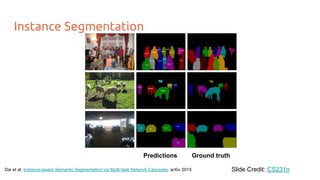
Instance Segmentation
Slide Credit: CS231nDai et al. Instance-aware Semantic Segmentation via Multi-task Network Cascades. arXiv 2015
Predictions Ground truth
Resources
● CS231n Lecture @ Stanford [slides][video]
● Code for Semantic Segmentation
○ FCN (Caffe)
● Code for Instance Segmentation
○ SDS (Caffe)
○ SDS using Hypercolumns & sharing conv computations (Caffe)
○ Instance-aware Semantic Segmentation via Multi-task Network Cascades (Caffe)

Deep Learning for Computer Vision: Segmentation (UPC 2016)