International Research Journal of Engineering and Technology (IRJET) e-ISSN: 2395-0056
Volume: 09 Issue: 12 | Dec 2022 www.irjet.net p-ISSN: 2395-0072
© 2022, IRJET | Impact Factor value: 7.529 | ISO 9001:2008 Certified Journal | Page 1451
Using Deep Learning and Transfer Learning for Pneumonia Detection
Rajasri Dhonikena1, Miryala Hasini2, Devavarapu Sreenivasarao3, Shaik Nazma4
1,2,4B. Tech Scholars, Department of Computer Science and Engineering, Sreenidhi Institute of Science and
Technology Hyderabad, Telangana, India
3Assistant Professor, Department of Computer Science and Engineering, Sreenidhi Institute of Science and
Technology Hyderabad, Telangana, India
---------------------------------------------------------------------***---------------------------------------------------------------------
Abstract - The biggest cause of death in children under five
years old worldwide is pneumonia. Radiologists with the
necessary training examine chest X-rays to identify
pneumonia. But it is time-consuming and exhausting. Medical
image analysis has a lot of potential applications for
biomedical image diagnostics techniques. This study suggests
a model for diagnosing pneumonia that is trained on chest X-
ray pictures. Finding a large enough dataset for detection
tasks was extremely difficult, hence data augmentation
techniques were utilized to expand the training dataset. The
models are additionally trained via transfer learning. The
proposed approach might help radiologists' clinical judgment
and assist in the early diagnosis of illnesses. The model was
statistically validated after being checked for overfitting and
generalization errors. To evaluate the effectiveness of the
suggested model, various metrics including testing accuracy,
F1, recall, precision, and AUC score were constructed.
Key Words: Pneumonia; Chest X-ray images; Convolution
Neural Network (CNN); ResNet50; Transfer Learning
1. INTRODUCTION
Elderly and young children are more likelythanotherstodie
from pneumonia. Since few people are aware of it politically
and socially, it is known as "the silent killer" in comparison
to other diseases. Children's pneumonia is an illness with
roots in poverty. Its primary causes include a lack of access
to basic healthcare, inadequate education, and inadequate
childcare. Adult pneumonia maybeviewedasa publichealth
problem that needs more proactive treatment. Two major
factors driving academics to increase learning rates are the
availability of vast datasets and the development of more
potent GPUs. For a variety of medical imaging tasks, such as
the diagnosis of pneumonia, the detection of arrhythmias,
the classification of skin cancer, the detection of diabetic
retinopathy, and the identification of bleeding, resource-
intensive models are now feasible with performance
superior to that of human experts. Deep learning methods
akin to CNN are hence the researchers' chosen technology
for disease categorization and diagnosis from medical
imaging.
2. SCOPE
For example, chest X-rays, chest MRIs, chest ultrasounds,
lung needle biopsies, computed tomography of the lungs,
and chest X-rays are all techniques that can be used to
diagnose pneumonia. X-rays are the most widely used
diagnostic imaging tool. Radiotherapists find it difficult to
examine chest X-rays. Pneumonia on the patient's X-ray
might occasionally be challenging to diagnose. Disease
prediction becomes tough since it is difficult to identify the
traits that identify the presence of the disease. The X-ray
pictures in the dataset were wrongly categorized mostlydue
to this. It has been demonstrated in thepastthatseveral CAD
systems are beneficial in the medical field,particularlyinthe
identification of lung nodules and breast cancer.
The most effective and popular Machine Learning (ML)
method for disease diagnosis in general and radiography, in
particular, continues to be deep learning. The accuracy of
disease prediction using deep learning algorithms has
already been demonstrated to beonparwiththatofa typical
radiologist. At this time, trained physicians cannot be
replaced by deep learning-based algorithms in medical
evaluation. Therefore, deep learning-based computer-aided
diagnosis techniques can be employed as an addition to
clinical decision-making.
3. RELATED WORK
Several authors have already presented various biomedical
image detection methods. Authors in [1] talked about
diagnosing pneumonia.The difficulties withmedical imaging
technologies were discussed by Razaak et al. [2]. Various
approaches were put forth by numerous writers for the
identification of numerous diseases [3]. For instance, Andre
presented a deep CNN-based Inceptionv3architecturein his
paper for the classification of skin cancer [4], Milletari also
worked on a method for CNN-based prostate detection in
MRI volumes [5], Grewal applied deep learning to CT scans
to identify brain hemorrhages [6], and Varun developed a
method for the detection of diabetic retinopathy [7]. In
comparison to DNN, CNN is a lot superior breakthrough
since it can easily work with 2-D and 3-D images and extract
the features needed to categorize the disease. Because the
max-pooling layer in CNN is so effective and because it is
International Research Journal of Engineering and Technology (IRJET) e-ISSN: 2395-0056
Volume: 09 Issue: 12 | Dec 2022 www.irjet.net p-ISSN: 2395-0072
© 2022, IRJET | Impact Factor value: 7.529 | ISO 9001:2008 Certified Journal | Page 1452
coupled with some weights, this is conceivable. As they use
gradient-based learning while they are being trained, CNNs
also deal with the serious issue of the declining gradient.
CNN's identify different chest X-rays and accurately classify
them using the information retrieved by the various layers.
Some algorithms were devised earlier in the papers of Shin
for data mining [10,11] and the paper of Boussaid also
proposed that labels are predicted by the extraction of
features and application of segmentation techniques from
radiology images of chest X-rays [12]. The studies by Shin
[10,11] and Boussaid [12] both provided certain algorithms
for data mining, and Boussaid's work also suggested that
labels are predicted by the extraction of features and
application of segmentation techniques from radiology
pictures of chest X-rays.
4. DATASET
The initial dataset from the Guangzhou Women and
Children's Medical Center had 5836 images altogether. Both
healthy individuals and pneumonia patients were depicted
in the pictures. There were 1583 photographs of healthy
chest X-rays and 4273 images of chest X-rays with
pneumonia. A training set with 5136 images and a test set
with 700 images were created from the entire dataset. The
figure shows the first two example images from the dataset.
Figure 1: Chest X-ray of a healthy person (a) and a person
suffering from pneumonia (b).
5. PROPOSED METHODOLOGY
This research suggests an ideal strategy for detecting
pneumonia from chest X-rays. To expand the small dataset,
data augmentation techniques were used.
5.1 PRE-PROCESSING AND DATA AUGMENTATION
The input photos were first reduced in size to 224*224 and
used to train the model. A sizable dataset is necessary for
efficient neural network training.Becausethedeepnetworks
cannot generalize when trained on a smaller dataset, testing
accuracy suffers. One approach to solving this issue is data
augmentation, which extends and effectively makes use of
the current dataset. There were 1283 healthy chest X-ray
images and 3873 pneumonia-infected chest X-ray case
images in the training dataset used in this study. Since the
dataset alreadycontainedadequatephotosofthepneumonia
case, just the images of the normal case needed to be
enhanced twice. There were 3849 normal picturesand3873
photos of pneumonia following augmentation. Images from
the test set were not enhanced.
Figure 2: Resultant images after using augmentation
techniques.
5.2 METHODS USED
1) CONVOLUTIONAL NEURAL NETWORK
Undoubtedly, the most well-known deep learning
architecture is CNNs. They fall under the heading of feed-
forward networks. CNN's ability to take localityintoaccount
is by far its greatest benefit. The CNN's convolutional layer,
which gives the network its name, is itscorecomponent.The
convolutional layerextractsthecharacteristicsfromaninput
image. Each input map's dimensionality is decreased via the
pooling layer while critical data is kept. The network
architecture is represented in Figure 1 as a sequence of
various convolutional and pooling layers. The softmax layer
is utilized for picture classification at the network'send.The
main drawback of deeper CNNs is of vanishing gradients.
Figure 3: Architecture of the CNN.
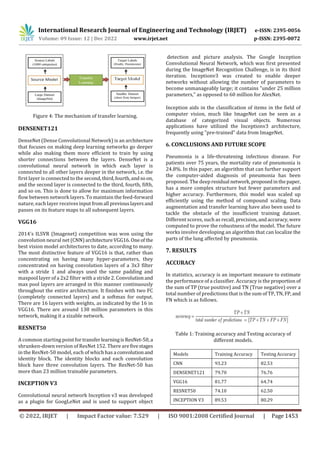
2) TRANSFER LEARNING
In general, larger datasets are needed to train CNNs. CNN
performs badly in generalization when trained on smaller
datasets. In these situations, transfer learning is an option.
The process of transfer learning is depicted in Figure where
knowledge gathered by the model while resolving one
problem is applied to resolve another.
International Research Journal of Engineering and Technology (IRJET) e-ISSN: 2395-0056
Volume: 09 Issue: 12 | Dec 2022 www.irjet.net p-ISSN: 2395-0072
© 2022, IRJET | Impact Factor value: 7.529 | ISO 9001:2008 Certified Journal | Page 1453
DENSENET121
DenseNet (Dense Convolutional Network) is an architecture
that focuses on making deep learning networks go deeper
while also making them more efficient to train by using
shorter connections between the layers. DenseNet is a
convolutional neural network in which each layer is
connected to all other layers deeper in the network, i.e. the
first layer is connected to the second, third,fourth,andso on,
and the second layer is connected to the third, fourth, fifth,
and so on. This is done to allow for maximum information
flow between network layers. To maintain the feed-forward
nature, each layer receivesinputfromall previouslayersand
passes on its feature maps to all subsequent layers.
VGG16
2014's ILSVR (Imagenet) competition was won using the
convolution neural net (CNN)architectureVGG16.Oneof the
best vision model architectures to date, according to many.
The most distinctive feature of VGG16 is that, rather than
concentrating on having many hyper-parameters, they
concentrated on having convolution layers of a 3x3 filter
with a stride 1 and always used the same padding and
maxpool layer of a 2x2 filter with a stride 2. Convolutionand
max pool layers are arranged in this manner continuously
throughout the entire architecture. It finishes with two FC
(completely connected layers) and a softmax for output.
There are 16 layers with weights, as indicated by the 16 in
VGG16. There are around 138 million parameters in this
network, making it a sizable network.
RESNET50
A common starting pointfor transferlearningisResNet-50,a
shrunken-down version of ResNet 152. There arefivestages
in the ResNet-50 model, each of which has a convolutionand
identity block. The identity blocks and each convolution
block have three convolution layers. The ResNet-50 has
more than 23 million trainable parameters.
INCEPTION V3
Inception aids in the classification of items in the field of
computer vision, much like ImageNet can be seen as a
database of categorized visual objects. Numerous
applications have utilized the Inceptionv3 architecture,
frequently using "pre-trained" data from ImageNet.
6. CONCLUSIONS AND FUTURE SCOPE
Pneumonia is a life-threatening infectious disease. For
patients over 75 years, the mortality rate of pneumonia is
24.8%. In this paper, an algorithm that can further support
the computer-aided diagnosis of pneumonia has been
proposed. The deepresidual network,proposedinthepaper,
has a more complex structure but fewer parameters and
higher accuracy. Furthermore, this model was scaled up
efficiently using the method of compound scaling. Data
augmentation and transfer learning have also been used to
tackle the obstacle of the insufficient training dataset.
Different scores, such as recall,precision,andaccuracy,were
computed to prove the robustness of the model. The future
works involve developing an algorithm that can localize the
parts of the lung affected by pneumonia.
7. RESULTS
ACCURACY
In statistics, accuracy is an important measure to estimate
the performance of a classifier. Accuracy is the proportion of
the sum of TP (true positive) and TN (True negative) over a
total number of predictions that is the sum of TP,TN,FP,and
FN which is as follows.
Table 1: Training accuracy and Testing accuracy of
different models.
Models Training Accuracy Testing Accuracy
CNN 93.23 82.53
DENSENET121 79.70 76.76
VGG16 81.77 64.74
RESNET50 74.10 62.50
INCEPTION V3 89.53 80.29
Convolutional neural network Inception v3 was developed
as a plugin for GoogLeNet and is used to support object
detection and picture analysis. The Google Inception
Convolutional Neural Network, which was first presented
during the ImageNet Recognition Challenge, is in its third
iteration. Inceptionv3 was created to enable deeper
networks without allowing the number of parameters to
become unmanageably large; it contains "under 25 million
parameters," as opposed to 60 million for AlexNet.
Figure 4: The mechanism of transfer learning.
International Research Journal of Engineering and Technology (IRJET) e-ISSN: 2395-0056
Volume: 09 Issue: 12 | Dec 2022 www.irjet.net p-ISSN: 2395-0072
© 2022, IRJET | Impact Factor value: 7.529 | ISO 9001:2008 Certified Journal | Page 1454
Comparing different models
Figure 5: Comparing testing accuracy of different models
References
1. Gonçalves-
Pereira J, Conceição C, Póvoa P. Community-
acquired pneumonia: identification and evaluation
of nonresponders.TherAdvInfectDis. 2013;1(1):5–
17. [Crossref], [Google Scholar]
2. Razzak MI, Naz S, Zaib A. Deep learning for medical
image processing: overview, challenges, and the
future. 2017. [Crossref], [Google Scholar]
3. Shen D, Wu G, Suk HI. Deep learning in medical
image analysis. Annual review of biomedical
engineering. 2017;19:221–
248. doi:10.1146/annurev-bioeng-071516-
044442. [Crossref], [Web of Science ®], [Google
Scholar]
4. Andre E, Brett K, Roberto A, et al. Dermatologist-
level classification of skin cancer with deep neural
networks. Nature. 2017;542(7639):115–
118. [Crossref], [Web of Science ®], [Google
Scholar]
5. Milletari F, Navab N, Ahmadi S. V-net: fully
convolutional neural networks for volumetric
medical image segmentation. 2016 fourth
International Conference on 3D Vision (3DV);
Stanford, CA; 2016:565–571.
doi:10.1109/3DV.2016.79. [Crossref], [Google
Scholar]
6. Grewal M, Srivastava MM, Kumar P, et al. 2017.
Radiologist level accuracy using deep learning for
hemorrhage detection in CT scans. arXiv preprint
arXiv:1710.04934. [Crossref], [Google Scholar]
7. Varun G, Lily P, Marc C, et al. Development and
validation of a deep learning algorithmfordetection
of diabetic retinopathy in retinal fundus
photographs. JAMA. 2017;316(22):2402–
2410. [Web of Science ®], [Google Scholar]
8. Lakhani P, Sundaram B. Deep learning at chest
radiography: automatedclassificationofpulmonary
tuberculosis by using convolutional neural
networks. Radiology. 2017;284(2):574–
582. [Crossref], [Web of Science ®], [Google
Scholar]
9. Bar Y, Diamant I, Wolf L, et al. Chest pathology
detection using deep learning with non-medical
training. 2015 IEEE 12th International Symposium
on Biomedical Imaging (ISBI); New York (NY);
2015:294–297.
doi:10.1109/ISBI.2015.7163871. [Crossref], [Google
Scholar]
10. Shin HC, Lu L, Kim L, et al. Interleaved text/image
deep mining on a very large-scale radiology
database. Proceedings of the Conference on
Computer Vision and Pattern Recognition (CVPR);
Boston (MA); June 2015. [Crossref], [Google
Scholar]
11. Shin HC, Lu L, Kim L, et al. Interleaved text/image
deep mining on a large-scale radiology databasefor
automated image interpretation. J Mach Learn
Res. 2016;17(40):1–31. [Google Scholar]
12. Boussaid H, Kokkinos I. Fast and exact: ADMM-
based discriminative shape segmentation with
loopy part models. Proceedings of Conference on
Computer Vision and Pattern Recognition (CVPR);
Columbus (OH); June 2014. [Crossref], [Google
Scholar]

Using Deep Learning and Transfer Learning for Pneumonia Detection

  • 1.
    International Research Journalof Engineering and Technology (IRJET) e-ISSN: 2395-0056 Volume: 09 Issue: 12 | Dec 2022 www.irjet.net p-ISSN: 2395-0072 © 2022, IRJET | Impact Factor value: 7.529 | ISO 9001:2008 Certified Journal | Page 1451 Using Deep Learning and Transfer Learning for Pneumonia Detection Rajasri Dhonikena1, Miryala Hasini2, Devavarapu Sreenivasarao3, Shaik Nazma4 1,2,4B. Tech Scholars, Department of Computer Science and Engineering, Sreenidhi Institute of Science and Technology Hyderabad, Telangana, India 3Assistant Professor, Department of Computer Science and Engineering, Sreenidhi Institute of Science and Technology Hyderabad, Telangana, India ---------------------------------------------------------------------***--------------------------------------------------------------------- Abstract - The biggest cause of death in children under five years old worldwide is pneumonia. Radiologists with the necessary training examine chest X-rays to identify pneumonia. But it is time-consuming and exhausting. Medical image analysis has a lot of potential applications for biomedical image diagnostics techniques. This study suggests a model for diagnosing pneumonia that is trained on chest X- ray pictures. Finding a large enough dataset for detection tasks was extremely difficult, hence data augmentation techniques were utilized to expand the training dataset. The models are additionally trained via transfer learning. The proposed approach might help radiologists' clinical judgment and assist in the early diagnosis of illnesses. The model was statistically validated after being checked for overfitting and generalization errors. To evaluate the effectiveness of the suggested model, various metrics including testing accuracy, F1, recall, precision, and AUC score were constructed. Key Words: Pneumonia; Chest X-ray images; Convolution Neural Network (CNN); ResNet50; Transfer Learning 1. INTRODUCTION Elderly and young children are more likelythanotherstodie from pneumonia. Since few people are aware of it politically and socially, it is known as "the silent killer" in comparison to other diseases. Children's pneumonia is an illness with roots in poverty. Its primary causes include a lack of access to basic healthcare, inadequate education, and inadequate childcare. Adult pneumonia maybeviewedasa publichealth problem that needs more proactive treatment. Two major factors driving academics to increase learning rates are the availability of vast datasets and the development of more potent GPUs. For a variety of medical imaging tasks, such as the diagnosis of pneumonia, the detection of arrhythmias, the classification of skin cancer, the detection of diabetic retinopathy, and the identification of bleeding, resource- intensive models are now feasible with performance superior to that of human experts. Deep learning methods akin to CNN are hence the researchers' chosen technology for disease categorization and diagnosis from medical imaging. 2. SCOPE For example, chest X-rays, chest MRIs, chest ultrasounds, lung needle biopsies, computed tomography of the lungs, and chest X-rays are all techniques that can be used to diagnose pneumonia. X-rays are the most widely used diagnostic imaging tool. Radiotherapists find it difficult to examine chest X-rays. Pneumonia on the patient's X-ray might occasionally be challenging to diagnose. Disease prediction becomes tough since it is difficult to identify the traits that identify the presence of the disease. The X-ray pictures in the dataset were wrongly categorized mostlydue to this. It has been demonstrated in thepastthatseveral CAD systems are beneficial in the medical field,particularlyinthe identification of lung nodules and breast cancer. The most effective and popular Machine Learning (ML) method for disease diagnosis in general and radiography, in particular, continues to be deep learning. The accuracy of disease prediction using deep learning algorithms has already been demonstrated to beonparwiththatofa typical radiologist. At this time, trained physicians cannot be replaced by deep learning-based algorithms in medical evaluation. Therefore, deep learning-based computer-aided diagnosis techniques can be employed as an addition to clinical decision-making. 3. RELATED WORK Several authors have already presented various biomedical image detection methods. Authors in [1] talked about diagnosing pneumonia.The difficulties withmedical imaging technologies were discussed by Razaak et al. [2]. Various approaches were put forth by numerous writers for the identification of numerous diseases [3]. For instance, Andre presented a deep CNN-based Inceptionv3architecturein his paper for the classification of skin cancer [4], Milletari also worked on a method for CNN-based prostate detection in MRI volumes [5], Grewal applied deep learning to CT scans to identify brain hemorrhages [6], and Varun developed a method for the detection of diabetic retinopathy [7]. In comparison to DNN, CNN is a lot superior breakthrough since it can easily work with 2-D and 3-D images and extract the features needed to categorize the disease. Because the max-pooling layer in CNN is so effective and because it is
  • 2.
    International Research Journalof Engineering and Technology (IRJET) e-ISSN: 2395-0056 Volume: 09 Issue: 12 | Dec 2022 www.irjet.net p-ISSN: 2395-0072 © 2022, IRJET | Impact Factor value: 7.529 | ISO 9001:2008 Certified Journal | Page 1452 coupled with some weights, this is conceivable. As they use gradient-based learning while they are being trained, CNNs also deal with the serious issue of the declining gradient. CNN's identify different chest X-rays and accurately classify them using the information retrieved by the various layers. Some algorithms were devised earlier in the papers of Shin for data mining [10,11] and the paper of Boussaid also proposed that labels are predicted by the extraction of features and application of segmentation techniques from radiology images of chest X-rays [12]. The studies by Shin [10,11] and Boussaid [12] both provided certain algorithms for data mining, and Boussaid's work also suggested that labels are predicted by the extraction of features and application of segmentation techniques from radiology pictures of chest X-rays. 4. DATASET The initial dataset from the Guangzhou Women and Children's Medical Center had 5836 images altogether. Both healthy individuals and pneumonia patients were depicted in the pictures. There were 1583 photographs of healthy chest X-rays and 4273 images of chest X-rays with pneumonia. A training set with 5136 images and a test set with 700 images were created from the entire dataset. The figure shows the first two example images from the dataset. Figure 1: Chest X-ray of a healthy person (a) and a person suffering from pneumonia (b). 5. PROPOSED METHODOLOGY This research suggests an ideal strategy for detecting pneumonia from chest X-rays. To expand the small dataset, data augmentation techniques were used. 5.1 PRE-PROCESSING AND DATA AUGMENTATION The input photos were first reduced in size to 224*224 and used to train the model. A sizable dataset is necessary for efficient neural network training.Becausethedeepnetworks cannot generalize when trained on a smaller dataset, testing accuracy suffers. One approach to solving this issue is data augmentation, which extends and effectively makes use of the current dataset. There were 1283 healthy chest X-ray images and 3873 pneumonia-infected chest X-ray case images in the training dataset used in this study. Since the dataset alreadycontainedadequatephotosofthepneumonia case, just the images of the normal case needed to be enhanced twice. There were 3849 normal picturesand3873 photos of pneumonia following augmentation. Images from the test set were not enhanced. Figure 2: Resultant images after using augmentation techniques. 5.2 METHODS USED 1) CONVOLUTIONAL NEURAL NETWORK Undoubtedly, the most well-known deep learning architecture is CNNs. They fall under the heading of feed- forward networks. CNN's ability to take localityintoaccount is by far its greatest benefit. The CNN's convolutional layer, which gives the network its name, is itscorecomponent.The convolutional layerextractsthecharacteristicsfromaninput image. Each input map's dimensionality is decreased via the pooling layer while critical data is kept. The network architecture is represented in Figure 1 as a sequence of various convolutional and pooling layers. The softmax layer is utilized for picture classification at the network'send.The main drawback of deeper CNNs is of vanishing gradients. Figure 3: Architecture of the CNN. 2) TRANSFER LEARNING In general, larger datasets are needed to train CNNs. CNN performs badly in generalization when trained on smaller datasets. In these situations, transfer learning is an option. The process of transfer learning is depicted in Figure where knowledge gathered by the model while resolving one problem is applied to resolve another.
  • 3.
    International Research Journalof Engineering and Technology (IRJET) e-ISSN: 2395-0056 Volume: 09 Issue: 12 | Dec 2022 www.irjet.net p-ISSN: 2395-0072 © 2022, IRJET | Impact Factor value: 7.529 | ISO 9001:2008 Certified Journal | Page 1453 DENSENET121 DenseNet (Dense Convolutional Network) is an architecture that focuses on making deep learning networks go deeper while also making them more efficient to train by using shorter connections between the layers. DenseNet is a convolutional neural network in which each layer is connected to all other layers deeper in the network, i.e. the first layer is connected to the second, third,fourth,andso on, and the second layer is connected to the third, fourth, fifth, and so on. This is done to allow for maximum information flow between network layers. To maintain the feed-forward nature, each layer receivesinputfromall previouslayersand passes on its feature maps to all subsequent layers. VGG16 2014's ILSVR (Imagenet) competition was won using the convolution neural net (CNN)architectureVGG16.Oneof the best vision model architectures to date, according to many. The most distinctive feature of VGG16 is that, rather than concentrating on having many hyper-parameters, they concentrated on having convolution layers of a 3x3 filter with a stride 1 and always used the same padding and maxpool layer of a 2x2 filter with a stride 2. Convolutionand max pool layers are arranged in this manner continuously throughout the entire architecture. It finishes with two FC (completely connected layers) and a softmax for output. There are 16 layers with weights, as indicated by the 16 in VGG16. There are around 138 million parameters in this network, making it a sizable network. RESNET50 A common starting pointfor transferlearningisResNet-50,a shrunken-down version of ResNet 152. There arefivestages in the ResNet-50 model, each of which has a convolutionand identity block. The identity blocks and each convolution block have three convolution layers. The ResNet-50 has more than 23 million trainable parameters. INCEPTION V3 Inception aids in the classification of items in the field of computer vision, much like ImageNet can be seen as a database of categorized visual objects. Numerous applications have utilized the Inceptionv3 architecture, frequently using "pre-trained" data from ImageNet. 6. CONCLUSIONS AND FUTURE SCOPE Pneumonia is a life-threatening infectious disease. For patients over 75 years, the mortality rate of pneumonia is 24.8%. In this paper, an algorithm that can further support the computer-aided diagnosis of pneumonia has been proposed. The deepresidual network,proposedinthepaper, has a more complex structure but fewer parameters and higher accuracy. Furthermore, this model was scaled up efficiently using the method of compound scaling. Data augmentation and transfer learning have also been used to tackle the obstacle of the insufficient training dataset. Different scores, such as recall,precision,andaccuracy,were computed to prove the robustness of the model. The future works involve developing an algorithm that can localize the parts of the lung affected by pneumonia. 7. RESULTS ACCURACY In statistics, accuracy is an important measure to estimate the performance of a classifier. Accuracy is the proportion of the sum of TP (true positive) and TN (True negative) over a total number of predictions that is the sum of TP,TN,FP,and FN which is as follows. Table 1: Training accuracy and Testing accuracy of different models. Models Training Accuracy Testing Accuracy CNN 93.23 82.53 DENSENET121 79.70 76.76 VGG16 81.77 64.74 RESNET50 74.10 62.50 INCEPTION V3 89.53 80.29 Convolutional neural network Inception v3 was developed as a plugin for GoogLeNet and is used to support object detection and picture analysis. The Google Inception Convolutional Neural Network, which was first presented during the ImageNet Recognition Challenge, is in its third iteration. Inceptionv3 was created to enable deeper networks without allowing the number of parameters to become unmanageably large; it contains "under 25 million parameters," as opposed to 60 million for AlexNet. Figure 4: The mechanism of transfer learning.
  • 4.
    International Research Journalof Engineering and Technology (IRJET) e-ISSN: 2395-0056 Volume: 09 Issue: 12 | Dec 2022 www.irjet.net p-ISSN: 2395-0072 © 2022, IRJET | Impact Factor value: 7.529 | ISO 9001:2008 Certified Journal | Page 1454 Comparing different models Figure 5: Comparing testing accuracy of different models References 1. Gonçalves- Pereira J, Conceição C, Póvoa P. Community- acquired pneumonia: identification and evaluation of nonresponders.TherAdvInfectDis. 2013;1(1):5– 17. [Crossref], [Google Scholar] 2. Razzak MI, Naz S, Zaib A. Deep learning for medical image processing: overview, challenges, and the future. 2017. [Crossref], [Google Scholar] 3. Shen D, Wu G, Suk HI. Deep learning in medical image analysis. Annual review of biomedical engineering. 2017;19:221– 248. doi:10.1146/annurev-bioeng-071516- 044442. [Crossref], [Web of Science ®], [Google Scholar] 4. Andre E, Brett K, Roberto A, et al. Dermatologist- level classification of skin cancer with deep neural networks. Nature. 2017;542(7639):115– 118. [Crossref], [Web of Science ®], [Google Scholar] 5. Milletari F, Navab N, Ahmadi S. V-net: fully convolutional neural networks for volumetric medical image segmentation. 2016 fourth International Conference on 3D Vision (3DV); Stanford, CA; 2016:565–571. doi:10.1109/3DV.2016.79. [Crossref], [Google Scholar] 6. Grewal M, Srivastava MM, Kumar P, et al. 2017. Radiologist level accuracy using deep learning for hemorrhage detection in CT scans. arXiv preprint arXiv:1710.04934. [Crossref], [Google Scholar] 7. Varun G, Lily P, Marc C, et al. Development and validation of a deep learning algorithmfordetection of diabetic retinopathy in retinal fundus photographs. JAMA. 2017;316(22):2402– 2410. [Web of Science ®], [Google Scholar] 8. Lakhani P, Sundaram B. Deep learning at chest radiography: automatedclassificationofpulmonary tuberculosis by using convolutional neural networks. Radiology. 2017;284(2):574– 582. [Crossref], [Web of Science ®], [Google Scholar] 9. Bar Y, Diamant I, Wolf L, et al. Chest pathology detection using deep learning with non-medical training. 2015 IEEE 12th International Symposium on Biomedical Imaging (ISBI); New York (NY); 2015:294–297. doi:10.1109/ISBI.2015.7163871. [Crossref], [Google Scholar] 10. Shin HC, Lu L, Kim L, et al. Interleaved text/image deep mining on a very large-scale radiology database. Proceedings of the Conference on Computer Vision and Pattern Recognition (CVPR); Boston (MA); June 2015. [Crossref], [Google Scholar] 11. Shin HC, Lu L, Kim L, et al. Interleaved text/image deep mining on a large-scale radiology databasefor automated image interpretation. J Mach Learn Res. 2016;17(40):1–31. [Google Scholar] 12. Boussaid H, Kokkinos I. Fast and exact: ADMM- based discriminative shape segmentation with loopy part models. Proceedings of Conference on Computer Vision and Pattern Recognition (CVPR); Columbus (OH); June 2014. [Crossref], [Google Scholar]