
Artificial intelligence in medical
imaging
Eng. Nancy Gertrudiz
March 2019
Mexico
INCMNSZ
CUDI
2
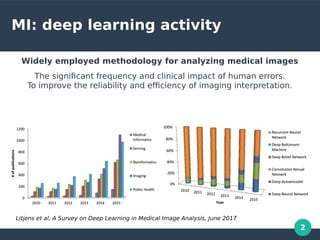
MI: deep learning activity
Widely employed methodology for analyzing medical images
The significant frequency and clinical impact of human errors.
To improve the reliability and efficiency of imaging interpretation.
Litjens et al, A Survey on Deep Learning in Medical Image Analysis, June 2017
3
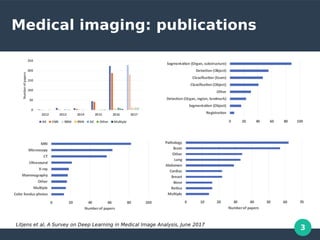
Medical imaging: publications
Litjens et al, A Survey on Deep Learning in Medical Image Analysis, June 2017
4
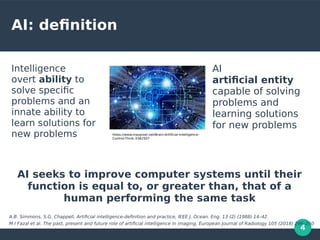
AI: definition
Intelligence
overt ability to
solve specific
problems and an
innate ability to
learn solutions for
new problems
AI
artificial entity
capable of solving
problems and
learning solutions
for new problems
AI seeks to improve computer systems until their
function is equal to, or greater than, that of a
human performing the same task
A.B. Simmons, S.G. Chappell, Artificial intelligence-definition and practice, IEEE J. Ocean. Eng. 13 (2) (1988) 14–42.
M I Fazal et al. The past, present and future role of artificial intelligence in imaging, European Journal of Radiology 105 (2018) 246–250
https://www.maxpixel.net/Brain-Artificial-Intelligence-
Control-Think-3382507
5
●
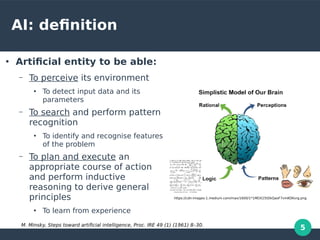
Artificial entity to be able:
– To perceive its environment
●
To detect input data and its
parameters
– To search and perform pattern
recognition
●
To identify and recognise features
of the problem
– To plan and execute an
appropriate course of action
and perform inductive
reasoning to derive general
principles
●
To learn from experience
AI: definition
M. Minsky, Steps toward artificial intelligence, Proc. IRE 49 (1) (1961) 8–30.
https://cdn-images-1.medium.com/max/1600/1*1MDX25tDkQaoF7vmKOKxrg.png
6
Medical imaging & AI: the roots
●
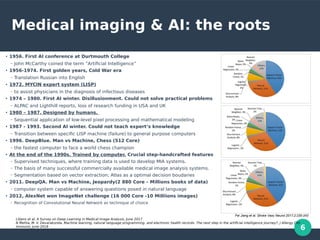
1956. First AI conference at Durtmouth College
– John McCarthy coined the term ”Artificial Intelligence”
●
1956-1974. First golden years, Cold War era
– Translation Russian into English
●
1972. MYCIN expert system (LISP)
– to assist physicians in the diagnosis of infectious diseases
●
1974 – 1980. First AI winter. Disillusionment. Could not solve practical problems
– ALPAC and Lighthill reports, loss of research funding in USA and UK
●
1980 – 1987. Designed by humans.
– Sequential application of low-level pixel processing and mathematical modeling
●
1987 - 1993. Second AI winter. Could not teach expert’s knowledge
– Transition between specific LISP machine (failure) to general purpose computers
●
1996. DeepBlue. Man vs Machine, Chess (512 Core)
– the fastest computer to face a world chess champion
●
At the end of the 1990s. Trained by computer. Crucial step-handcrafted features
– Supervised techniques, where training data is used to develop MIA systems.
– The basis of many successful commercially available medical image analysis systems.
– Segmentation based on vector extraction; Atlas as a optimal decision boudaries
●
2011. DeepQA. Man vs Machine, Jeopardy(2 880 Core – Millions books of data)
– computer system capable of answering questions posed in natural language
●
2012, AlexNet won ImageNet challenge (16 000 Core -10 Milliions images)
– Recognition of Convolutional Neural Network as technique of choice
Litjens et al, A Survey on Deep Learning in Medical Image Analysis, June 2017
N Mehta, M. V. Devarakonda, Machine learning, natural language programming, and electronic health records: The next step in the artificial intelligence journey?, J Allergy Clin
Immunol, June 2018
Fei Jiang et al. Stroke Vasc Neurol 2017;2:230-243
7
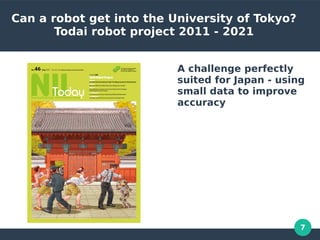
Can a robot get into the University of Tokyo?
Todai robot project 2011 - 2021
A challenge perfectly
suited for Japan - using
small data to improve
accuracy
8
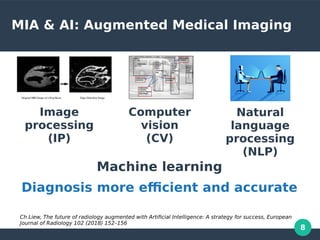
MIA & AI: Augmented Medical Imaging
Image
processing
(IP)
Computer
vision
(CV)
Natural
language
processing
(NLP)
Machine learning
Diagnosis more efficient and accurate
Ch Liew, The future of radiology augmented with Artificial Intelligence: A strategy for success, European
Journal of Radiology 102 (2018) 152–156
9
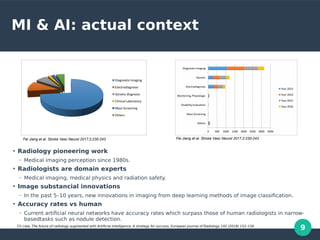
MI & AI: actual context
Ch Liew, The future of radiology augmented with Artificial Intelligence: A strategy for success, European Journal of Radiology 102 (2018) 152–156
Fei Jiang et al. Stroke Vasc Neurol 2017;2:230-243
●
Radiology pioneering work
– Medical imaging perception since 1980s.
●
Radiologists are domain experts
– Medical imaging, medical physics and radiation safety.
●
Image substancial innovations
– In the past 5–10 years, new innovations in imaging from deep learning methods of image classification.
●
Accuracy rates vs human
– Current artificial neural networks have accuracy rates which surpass those of human radiologists in narrow-
basedtasks such as nodule detection.
Fei Jiang et al. Stroke Vasc Neurol 2017;2:230-243
10
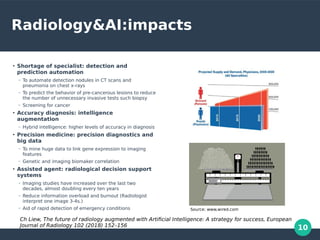
Radiology&AI:impacts
●
Shortage of specialist: detection and
prediction automation
– To automate detection nodules in CT scans and
pneumonia on chest x-rays
– To predict the behavior of pre-cancerous lesions to reduce
the number of unnecessary invasive tests such biopsy
– Screening for cancer
●
Accuracy diagnosis: intelligence
augmentation
– Hybrid intelligence: higher levels of accuracy in diagnosis
●
Precision medicine: precision diagnostics and
big data
– To mine huge data to link gene expression to imaging
features
– Genetic and imaging biomaker correlation
●
Assisted agent: radiological decision support
systems
– Imaging studies have increased over the last two
decades, almost doubling every ten years
– Reduce information overload and burnout (Radiologist
interpret one image 3-4s.)
– Aid of rapid detection of emergency conditions
Ch Liew, The future of radiology augmented with Artificial Intelligence: A strategy for success, European
Journal of Radiology 102 (2018) 152–156
Source: www.wired.com
11
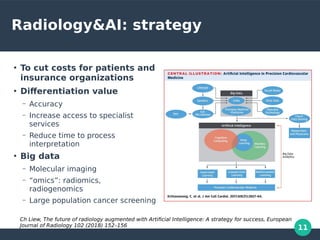
Radiology&AI: strategy
●
To cut costs for patients and
insurance organizations
●
Differentiation value
– Accuracy
– Increase access to specialist
services
– Reduce time to process
interpretation
●
Big data
– Molecular imaging
– “omics”: radiomics,
radiogenomics
– Large population cancer screening
Ch Liew, The future of radiology augmented with Artificial Intelligence: A strategy for success, European
Journal of Radiology 102 (2018) 152–156
12
Medical imaging &AI: responsabilities
●
Chief information Officer (CIO)
– Safely and effective implementation
– Patient safety and privacy
– Systems interoperability (EHR,PACS, RIS ...)
– Define frameworks and guidelines to
implement AI systems
– Set standards to validate technology
●
Chief data officer
– safeguard the use of data for validation
and training of machine learning systems
– data governance issues
●
Medical imaging specialist
– To generate valid data sets to training ML
models
– To define ML use cases
– To perform beta tests
– To be trained
Ch Liew, The future of radiology augmented with Artificial Intelligence: A strategy for success, European
Journal of Radiology 102 (2018) 152–156
13
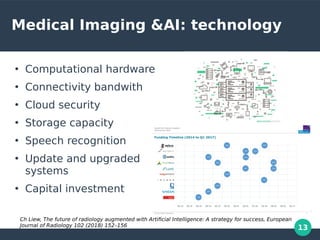
Medical Imaging &AI: technology
●
Computational hardware
●
Connectivity bandwith
●
Cloud security
●
Storage capacity
●
Speech recognition
●
Update and upgraded
systems
●
Capital investment
Ch Liew, The future of radiology augmented with Artificial Intelligence: A strategy for success, European
Journal of Radiology 102 (2018) 152–156
14
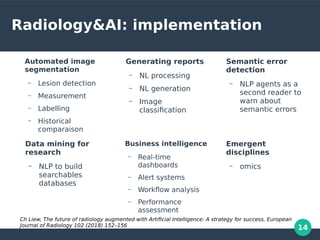
Radiology&AI: implementation
Automated image
segmentation
– Lesion detection
– Measurement
– Labelling
– Historical
comparaison
Generating reports
– NL processing
– NL generation
– Image
classification
Semantic error
detection
– NLP agents as a
second reader to
warn about
semantic errors
Data mining for
research
– NLP to build
searchables
databases
Business intelligence
– Real-time
dashboards
– Alert systems
– Workflow analysis
– Performance
assessment
Emergent
disciplines
– omics
Ch Liew, The future of radiology augmented with Artificial Intelligence: A strategy for success, European
Journal of Radiology 102 (2018) 152–156
15
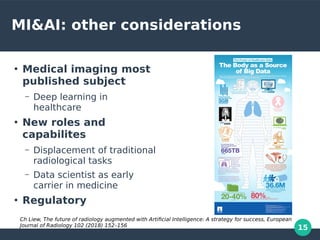
MI&AI: other considerations
●
Medical imaging most
published subject
– Deep learning in
healthcare
●
New roles and
capabilites
– Displacement of traditional
radiological tasks
– Data scientist as early
carrier in medicine
●
Regulatory
Ch Liew, The future of radiology augmented with Artificial Intelligence: A strategy for success, European
Journal of Radiology 102 (2018) 152–156
16
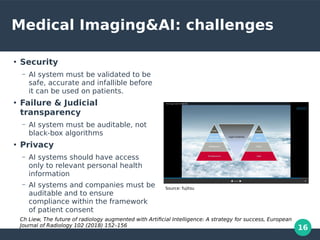
Medical Imaging&AI: challenges
●
Security
– AI system must be validated to be
safe, accurate and infallible before
it can be used on patients.
●
Failure & Judicial
transparency
– AI system must be auditable, not
black-box algorithms
●
Privacy
– AI systems should have access
only to relevant personal health
information
– AI systems and companies must be
auditable and to ensure
compliance within the framework
of patient consent
Ch Liew, The future of radiology augmented with Artificial Intelligence: A strategy for success, European
Journal of Radiology 102 (2018) 152–156
Source: fujitsu
17
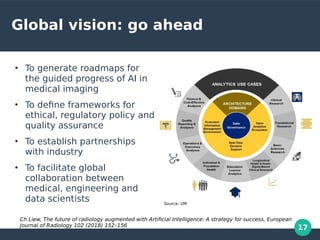
Global vision: go ahead
●
To generate roadmaps for
the guided progress of AI in
medical imaging
●
To define frameworks for
ethical, regulatory policy and
quality assurance
●
To establish partnerships
with industry
●
To facilitate global
collaboration between
medical, engineering and
data scientists
Ch Liew, The future of radiology augmented with Artificial Intelligence: A strategy for success, European
Journal of Radiology 102 (2018) 152–156
Source: UM
18
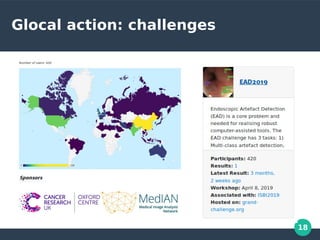
Glocal action: challenges
19
Thank you
Arigato Gozaimasu
ありがとうございます
Obrigada
Gracias

Artificial Intelligence in Medicine

  • 1.
    Artificial intelligence inmedical imaging Eng. Nancy Gertrudiz March 2019 Mexico INCMNSZ CUDI
  • 2.
    2 MI: deep learningactivity Widely employed methodology for analyzing medical images The significant frequency and clinical impact of human errors. To improve the reliability and efficiency of imaging interpretation. Litjens et al, A Survey on Deep Learning in Medical Image Analysis, June 2017
  • 3.
    3 Medical imaging: publications Litjenset al, A Survey on Deep Learning in Medical Image Analysis, June 2017
  • 4.
    4 AI: definition Intelligence overt abilityto solve specific problems and an innate ability to learn solutions for new problems AI artificial entity capable of solving problems and learning solutions for new problems AI seeks to improve computer systems until their function is equal to, or greater than, that of a human performing the same task A.B. Simmons, S.G. Chappell, Artificial intelligence-definition and practice, IEEE J. Ocean. Eng. 13 (2) (1988) 14–42. M I Fazal et al. The past, present and future role of artificial intelligence in imaging, European Journal of Radiology 105 (2018) 246–250 https://www.maxpixel.net/Brain-Artificial-Intelligence- Control-Think-3382507
  • 5.
    5 ● Artificial entity tobe able: – To perceive its environment ● To detect input data and its parameters – To search and perform pattern recognition ● To identify and recognise features of the problem – To plan and execute an appropriate course of action and perform inductive reasoning to derive general principles ● To learn from experience AI: definition M. Minsky, Steps toward artificial intelligence, Proc. IRE 49 (1) (1961) 8–30. https://cdn-images-1.medium.com/max/1600/1*1MDX25tDkQaoF7vmKOKxrg.png
  • 6.
    6 Medical imaging &AI: the roots ● 1956. First AI conference at Durtmouth College – John McCarthy coined the term ”Artificial Intelligence” ● 1956-1974. First golden years, Cold War era – Translation Russian into English ● 1972. MYCIN expert system (LISP) – to assist physicians in the diagnosis of infectious diseases ● 1974 – 1980. First AI winter. Disillusionment. Could not solve practical problems – ALPAC and Lighthill reports, loss of research funding in USA and UK ● 1980 – 1987. Designed by humans. – Sequential application of low-level pixel processing and mathematical modeling ● 1987 - 1993. Second AI winter. Could not teach expert’s knowledge – Transition between specific LISP machine (failure) to general purpose computers ● 1996. DeepBlue. Man vs Machine, Chess (512 Core) – the fastest computer to face a world chess champion ● At the end of the 1990s. Trained by computer. Crucial step-handcrafted features – Supervised techniques, where training data is used to develop MIA systems. – The basis of many successful commercially available medical image analysis systems. – Segmentation based on vector extraction; Atlas as a optimal decision boudaries ● 2011. DeepQA. Man vs Machine, Jeopardy(2 880 Core – Millions books of data) – computer system capable of answering questions posed in natural language ● 2012, AlexNet won ImageNet challenge (16 000 Core -10 Milliions images) – Recognition of Convolutional Neural Network as technique of choice Litjens et al, A Survey on Deep Learning in Medical Image Analysis, June 2017 N Mehta, M. V. Devarakonda, Machine learning, natural language programming, and electronic health records: The next step in the artificial intelligence journey?, J Allergy Clin Immunol, June 2018 Fei Jiang et al. Stroke Vasc Neurol 2017;2:230-243
  • 7.
    7 Can a robotget into the University of Tokyo? Todai robot project 2011 - 2021 A challenge perfectly suited for Japan - using small data to improve accuracy
  • 8.
    8 MIA & AI:Augmented Medical Imaging Image processing (IP) Computer vision (CV) Natural language processing (NLP) Machine learning Diagnosis more efficient and accurate Ch Liew, The future of radiology augmented with Artificial Intelligence: A strategy for success, European Journal of Radiology 102 (2018) 152–156
  • 9.
    9 MI & AI:actual context Ch Liew, The future of radiology augmented with Artificial Intelligence: A strategy for success, European Journal of Radiology 102 (2018) 152–156 Fei Jiang et al. Stroke Vasc Neurol 2017;2:230-243 ● Radiology pioneering work – Medical imaging perception since 1980s. ● Radiologists are domain experts – Medical imaging, medical physics and radiation safety. ● Image substancial innovations – In the past 5–10 years, new innovations in imaging from deep learning methods of image classification. ● Accuracy rates vs human – Current artificial neural networks have accuracy rates which surpass those of human radiologists in narrow- basedtasks such as nodule detection. Fei Jiang et al. Stroke Vasc Neurol 2017;2:230-243
  • 10.
    10 Radiology&AI:impacts ● Shortage of specialist:detection and prediction automation – To automate detection nodules in CT scans and pneumonia on chest x-rays – To predict the behavior of pre-cancerous lesions to reduce the number of unnecessary invasive tests such biopsy – Screening for cancer ● Accuracy diagnosis: intelligence augmentation – Hybrid intelligence: higher levels of accuracy in diagnosis ● Precision medicine: precision diagnostics and big data – To mine huge data to link gene expression to imaging features – Genetic and imaging biomaker correlation ● Assisted agent: radiological decision support systems – Imaging studies have increased over the last two decades, almost doubling every ten years – Reduce information overload and burnout (Radiologist interpret one image 3-4s.) – Aid of rapid detection of emergency conditions Ch Liew, The future of radiology augmented with Artificial Intelligence: A strategy for success, European Journal of Radiology 102 (2018) 152–156 Source: www.wired.com
  • 11.
    11 Radiology&AI: strategy ● To cutcosts for patients and insurance organizations ● Differentiation value – Accuracy – Increase access to specialist services – Reduce time to process interpretation ● Big data – Molecular imaging – “omics”: radiomics, radiogenomics – Large population cancer screening Ch Liew, The future of radiology augmented with Artificial Intelligence: A strategy for success, European Journal of Radiology 102 (2018) 152–156
  • 12.
    12 Medical imaging &AI:responsabilities ● Chief information Officer (CIO) – Safely and effective implementation – Patient safety and privacy – Systems interoperability (EHR,PACS, RIS ...) – Define frameworks and guidelines to implement AI systems – Set standards to validate technology ● Chief data officer – safeguard the use of data for validation and training of machine learning systems – data governance issues ● Medical imaging specialist – To generate valid data sets to training ML models – To define ML use cases – To perform beta tests – To be trained Ch Liew, The future of radiology augmented with Artificial Intelligence: A strategy for success, European Journal of Radiology 102 (2018) 152–156
  • 13.
    13 Medical Imaging &AI:technology ● Computational hardware ● Connectivity bandwith ● Cloud security ● Storage capacity ● Speech recognition ● Update and upgraded systems ● Capital investment Ch Liew, The future of radiology augmented with Artificial Intelligence: A strategy for success, European Journal of Radiology 102 (2018) 152–156
  • 14.
    14 Radiology&AI: implementation Automated image segmentation –Lesion detection – Measurement – Labelling – Historical comparaison Generating reports – NL processing – NL generation – Image classification Semantic error detection – NLP agents as a second reader to warn about semantic errors Data mining for research – NLP to build searchables databases Business intelligence – Real-time dashboards – Alert systems – Workflow analysis – Performance assessment Emergent disciplines – omics Ch Liew, The future of radiology augmented with Artificial Intelligence: A strategy for success, European Journal of Radiology 102 (2018) 152–156
  • 15.
    15 MI&AI: other considerations ● Medicalimaging most published subject – Deep learning in healthcare ● New roles and capabilites – Displacement of traditional radiological tasks – Data scientist as early carrier in medicine ● Regulatory Ch Liew, The future of radiology augmented with Artificial Intelligence: A strategy for success, European Journal of Radiology 102 (2018) 152–156
  • 16.
    16 Medical Imaging&AI: challenges ● Security –AI system must be validated to be safe, accurate and infallible before it can be used on patients. ● Failure & Judicial transparency – AI system must be auditable, not black-box algorithms ● Privacy – AI systems should have access only to relevant personal health information – AI systems and companies must be auditable and to ensure compliance within the framework of patient consent Ch Liew, The future of radiology augmented with Artificial Intelligence: A strategy for success, European Journal of Radiology 102 (2018) 152–156 Source: fujitsu
  • 17.
    17 Global vision: goahead ● To generate roadmaps for the guided progress of AI in medical imaging ● To define frameworks for ethical, regulatory policy and quality assurance ● To establish partnerships with industry ● To facilitate global collaboration between medical, engineering and data scientists Ch Liew, The future of radiology augmented with Artificial Intelligence: A strategy for success, European Journal of Radiology 102 (2018) 152–156 Source: UM
  • 18.
  • 19.