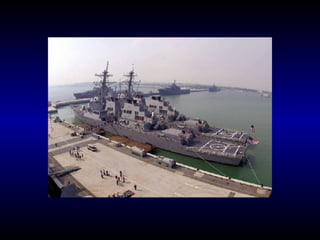
NS100 Fundamentals of Naval Science  Deck Equipment  and  Marlinespike Seamanship
 
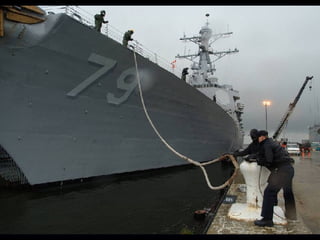
Mooring Lines Mooring lines  are the lines used to secure the ship to a wharf, pier or another ship.  Definition of lines : Breast lines  - Run at right angles from the ship, control distance of ship from pier Aft spring lines  - Tend aft from ship, control  forward movement. Forward spring lines  - Tend forward from the  ship, control aft movement
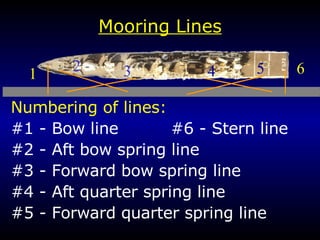
Mooring Lines 1 3 4 5 6 2 Numbering of lines: #1 - Bow line  #6 - Stern line #2 - Aft bow spring line #3 - Forward bow spring line #4 - Aft quarter spring line #5 - Forward quarter spring line
Mooring Lines DO NOT MIX MOORING LINE Never mix lines of different constructions or material . Each type of rope exhibits different elongation characteristics and mixing will result in an unequal load sharing
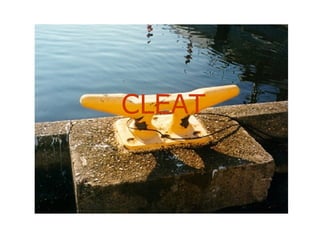
CLEAT
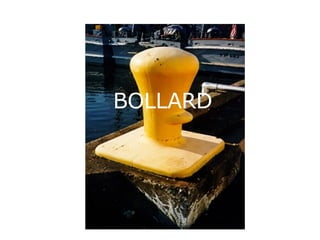
BOLLARD
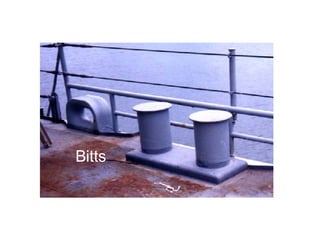
BOLLARD Bitts
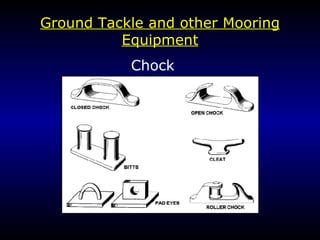
Ground Tackle and other Mooring Equipment Chock
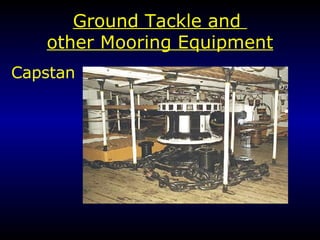
Ground Tackle and  other Mooring Equipment Capstan
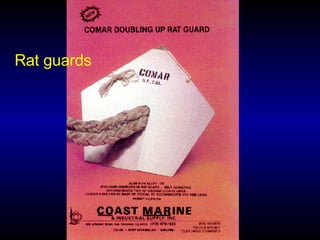
Rat guards
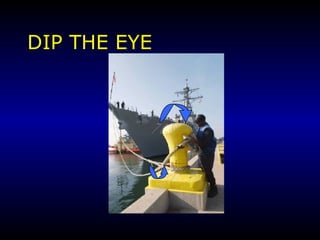
DIP THE EYE
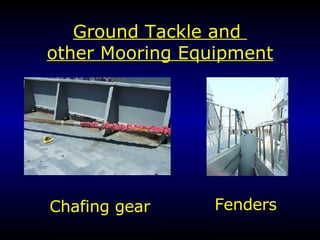
Ground Tackle and  other Mooring Equipment Chafing gear Fenders
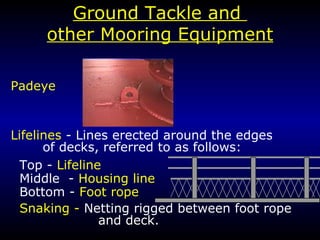
Ground Tackle and  other Mooring Equipment Padeye Lifelines  - Lines erected around the edges  of decks, referred to as follows:  Top   -  Lifeline   Middle   -  Housing line   Bottom -  Foot rope Snaking -  Netting rigged between foot rope  and deck.
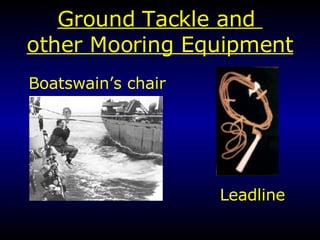
Ground Tackle and  other Mooring Equipment Boatswain’s chair  Leadline
 
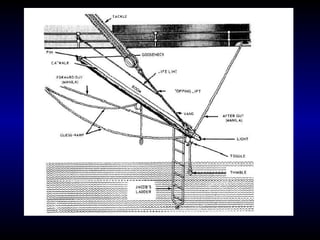
Ground Tackle and other Mooring Equipment Pilot’s ladder  Accommodation ladder   Sea ladder
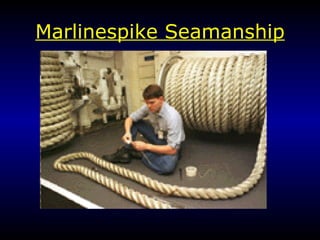
Marlinespike Seamanship
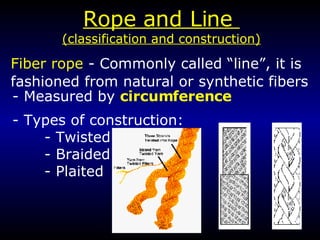
Rope and Line  (classification and construction) Fiber rope  - Commonly called “line”, it is fashioned from natural or synthetic fibers - Measured by  circumference - Types of construction: - Twisted - Braided - Plaited
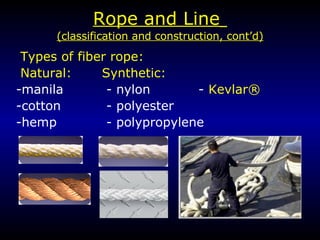
Rope and Line   (classification and construction, cont’d) Types of fiber rope: Natural:     Synthetic:   manila   - nylon  -  Kevlar® cotton    - polyester -hemp   - polypropylene
Natural vs Synthetic (cont’d) Important differences : Synthetic fiber lines slip more easily. Synthetic line has higher breaking strength. Synthetic line has poor knot-holding characteristics. Synthetic lines stretch under load.
Rope and Line  (classification and construction, cont’d) Wire rope  - basic unit of construction is the    metal wire.  -   Measured by  diameter . -  Construction : individual wires are laid together to form  strands , and strands are laid together to form the wire rope.
Rope and Line  (classification and construction, cont’d) Wire rope (cont’d) - Designated by  - number of strands per rope, and - number of wires per strand. - example:  6 x 19 6  strands per rope 19  wires per strand
Rope and Line  (classification and construction, cont’d) Wire Rope (cont’d) -   - large number of small wires produces high flexibility but low abrasion resistance. - a small number of large wires would stiffer, but more resistant to abrasion.
Rope and Line  (classification and construction, cont’d) Combination -   - measured by diameter  - six main strands of fiber and wire rope interwoven, laid around a fiber core. - used as mooring lines for extra strength  - fiber rope adds great flexibility and elasticity
Small Stuff Circumference less than 1 3/4 inches.  ID’d by the number of yarns (threads) rather than its size. Marline  - Two-strand, tarred hemp, used for “serving” a line.  (Serving a line means to wrap it with marline to protect it from weather or to make it look neater.  Most commonly used on natural fiber lines) Houseline  - Three-strand, left laid tarred hemp for light seizing, light rigging, and work exposed to weather.
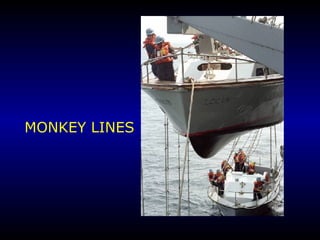
MONKEY LINES
Small Stuff  (cont’d) Seizing stuff  - Very small, used for fancier jobs that marline can accomplish.  Ratline stuff  - Dark brown and coarse, it is primarily used for snaking Tattletale
Marlin e spike Seamanship Terms Hawser  - Heavy line over five inches in  circumference. Used for towing or mooring. Bight  - A loop of line or chain. Bitter End  - Free end of a length of line, wire chain or cable.
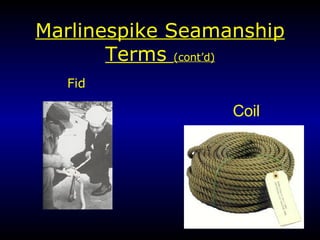
Marlin e spike Seamanship Terms  (cont’d) Fid Coil
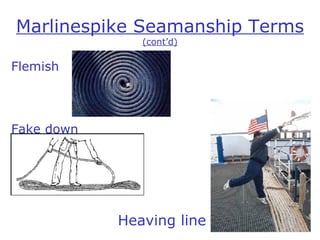
Marlin e spike Seamanship Terms  (cont’d) Flemish Fake down Heaving line
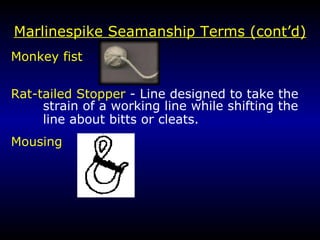
Marlin e spike Seamanship Terms (cont’d) Monkey fist  Rat-tailed Stopper  - Line designed to take the strain of a working line while shifting the  line about bitts or cleats. Mousing
Marlin e spike Seamanship Terms (cont’d) Shot line  - Light nylon line used in a  line throwing gun Bolo  - Nylon line with a lead weight in canvas or leather, thrown from ship to ship or  from a ship to a pier.
 

Deck Equipment And Marlinespike Seamanship

  • 1.
    NS100 Fundamentals ofNaval Science Deck Equipment and Marlinespike Seamanship
  • 2.
  • 3.
    Mooring Lines Mooringlines are the lines used to secure the ship to a wharf, pier or another ship. Definition of lines : Breast lines - Run at right angles from the ship, control distance of ship from pier Aft spring lines - Tend aft from ship, control forward movement. Forward spring lines - Tend forward from the ship, control aft movement
  • 4.
    Mooring Lines 13 4 5 6 2 Numbering of lines: #1 - Bow line #6 - Stern line #2 - Aft bow spring line #3 - Forward bow spring line #4 - Aft quarter spring line #5 - Forward quarter spring line
  • 5.
    Mooring Lines DONOT MIX MOORING LINE Never mix lines of different constructions or material . Each type of rope exhibits different elongation characteristics and mixing will result in an unequal load sharing
  • 6.
  • 7.
  • 8.
  • 9.
    Ground Tackle andother Mooring Equipment Chock
  • 10.
    Ground Tackle and other Mooring Equipment Capstan
  • 11.
  • 12.
  • 13.
    Ground Tackle and other Mooring Equipment Chafing gear Fenders
  • 14.
    Ground Tackle and other Mooring Equipment Padeye Lifelines - Lines erected around the edges of decks, referred to as follows: Top - Lifeline Middle - Housing line Bottom - Foot rope Snaking - Netting rigged between foot rope and deck.
  • 15.
    Ground Tackle and other Mooring Equipment Boatswain’s chair Leadline
  • 16.
  • 17.
    Ground Tackle andother Mooring Equipment Pilot’s ladder Accommodation ladder Sea ladder
  • 18.
  • 19.
    Rope and Line (classification and construction) Fiber rope - Commonly called “line”, it is fashioned from natural or synthetic fibers - Measured by circumference - Types of construction: - Twisted - Braided - Plaited
  • 20.
    Rope and Line (classification and construction, cont’d) Types of fiber rope: Natural: Synthetic: manila - nylon - Kevlar® cotton - polyester -hemp - polypropylene
  • 21.
    Natural vs Synthetic(cont’d) Important differences : Synthetic fiber lines slip more easily. Synthetic line has higher breaking strength. Synthetic line has poor knot-holding characteristics. Synthetic lines stretch under load.
  • 22.
    Rope and Line (classification and construction, cont’d) Wire rope - basic unit of construction is the metal wire. - Measured by diameter . - Construction : individual wires are laid together to form strands , and strands are laid together to form the wire rope.
  • 23.
    Rope and Line (classification and construction, cont’d) Wire rope (cont’d) - Designated by - number of strands per rope, and - number of wires per strand. - example: 6 x 19 6 strands per rope 19 wires per strand
  • 24.
    Rope and Line (classification and construction, cont’d) Wire Rope (cont’d) - - large number of small wires produces high flexibility but low abrasion resistance. - a small number of large wires would stiffer, but more resistant to abrasion.
  • 25.
    Rope and Line (classification and construction, cont’d) Combination - - measured by diameter - six main strands of fiber and wire rope interwoven, laid around a fiber core. - used as mooring lines for extra strength - fiber rope adds great flexibility and elasticity
  • 26.
    Small Stuff Circumferenceless than 1 3/4 inches. ID’d by the number of yarns (threads) rather than its size. Marline - Two-strand, tarred hemp, used for “serving” a line. (Serving a line means to wrap it with marline to protect it from weather or to make it look neater. Most commonly used on natural fiber lines) Houseline - Three-strand, left laid tarred hemp for light seizing, light rigging, and work exposed to weather.
  • 27.
  • 28.
    Small Stuff (cont’d) Seizing stuff - Very small, used for fancier jobs that marline can accomplish. Ratline stuff - Dark brown and coarse, it is primarily used for snaking Tattletale
  • 29.
    Marlin e spikeSeamanship Terms Hawser - Heavy line over five inches in circumference. Used for towing or mooring. Bight - A loop of line or chain. Bitter End - Free end of a length of line, wire chain or cable.
  • 30.
    Marlin e spikeSeamanship Terms (cont’d) Fid Coil
  • 31.
    Marlin e spikeSeamanship Terms (cont’d) Flemish Fake down Heaving line
  • 32.
    Marlin e spikeSeamanship Terms (cont’d) Monkey fist Rat-tailed Stopper - Line designed to take the strain of a working line while shifting the line about bitts or cleats. Mousing
  • 33.
    Marlin e spikeSeamanship Terms (cont’d) Shot line - Light nylon line used in a line throwing gun Bolo - Nylon line with a lead weight in canvas or leather, thrown from ship to ship or from a ship to a pier.
  • 34.