Ground Tackle –
Anchoring and
Mooring
Quartermaster Requirement 8
10/11/13 Quartermaster 8 - Ground Tackle (Anchoring & Mooring)2
Quartermaster Requirement 8
 Teach the Ordinary and Able requirements No. 8, Ground Tackle, to a crew.
 Know the methods of bringing a boat to anchor or mooring with special
emphasis on wind and current with respect to the vessel's course and
speed.
 Take charge of the craft used by your ship and give all commands to the
crew for anchoring and weighing anchor in several different wind and current
situations.
 Take charge of the craft used by your ship and give all commands to the
crew for picking up a mooring buoy and properly mooring the vessel in
several wind and current situations.
 Note: Depending on the type of craft used by your ship, this requirement
may be met either under sail or power.
 Reference:
 "Ground Tackle" on page 145.
10/11/13 Quartermaster 8 - Ground Tackle (Anchoring & Mooring)3
Anchor Rode
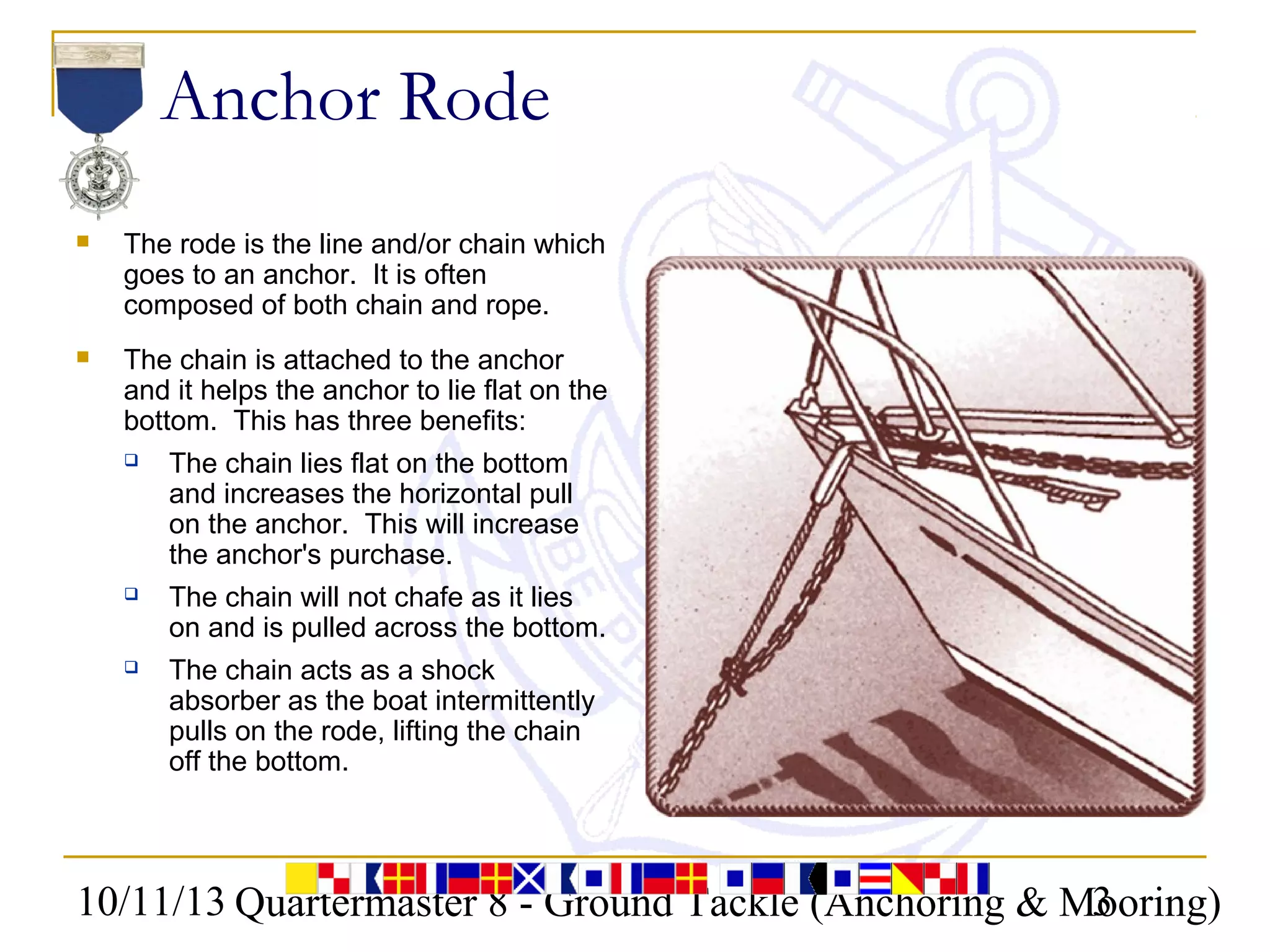
 The rode is the line and/or chain which
goes to an anchor. It is often
composed of both chain and rope.
 The chain is attached to the anchor
and it helps the anchor to lie flat on the
bottom. This has three benefits:
 The chain lies flat on the bottom
and increases the horizontal pull
on the anchor. This will increase
the anchor's purchase.
 The chain will not chafe as it lies
on and is pulled across the bottom.
 The chain acts as a shock
absorber as the boat intermittently
pulls on the rode, lifting the chain
off the bottom.
10/11/13 Quartermaster 8 - Ground Tackle (Anchoring & Mooring)4
Purchase
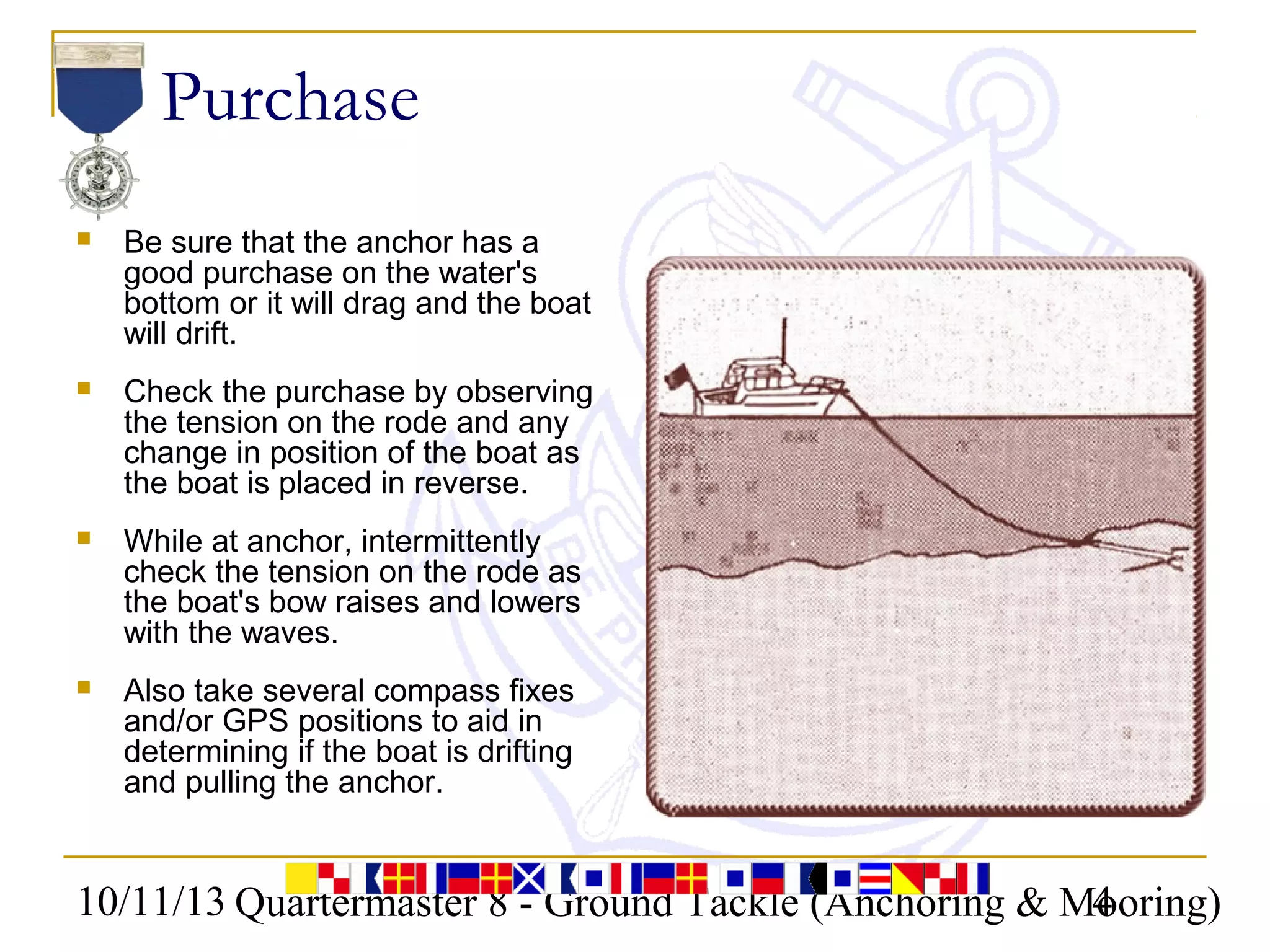
 Be sure that the anchor has a
good purchase on the water's
bottom or it will drag and the boat
will drift.
 Check the purchase by observing
the tension on the rode and any
change in position of the boat as
the boat is placed in reverse.
 While at anchor, intermittently
check the tension on the rode as
the boat's bow raises and lowers
with the waves.
 Also take several compass fixes
and/or GPS positions to aid in
determining if the boat is drifting
and pulling the anchor.
10/11/13 Quartermaster 8 - Ground Tackle (Anchoring & Mooring)5
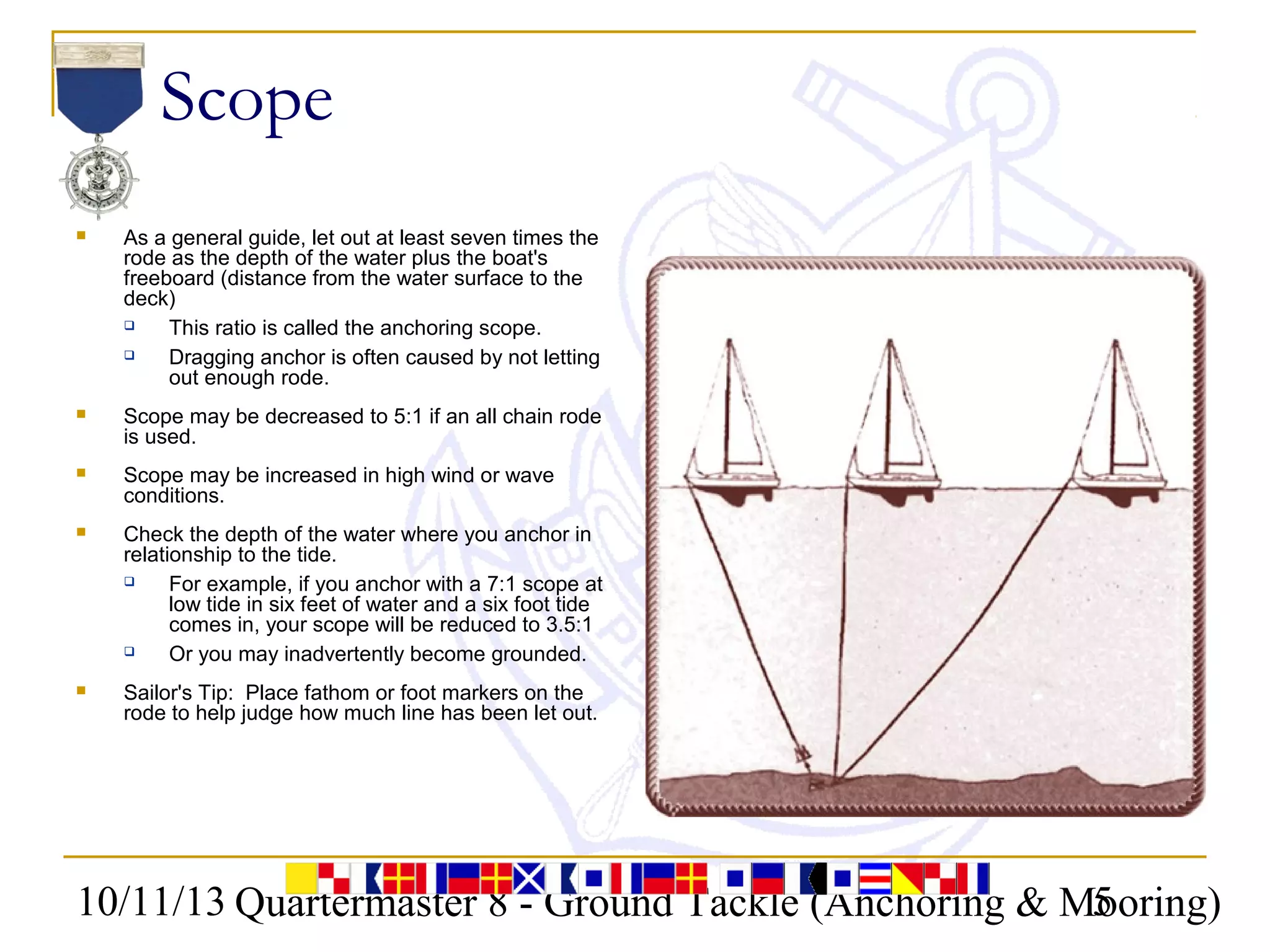
Scope
 As a general guide, let out at least seven times the
rode as the depth of the water plus the boat's
freeboard (distance from the water surface to the
deck)
 This ratio is called the anchoring scope.
 Dragging anchor is often caused by not letting
out enough rode.
 Scope may be decreased to 5:1 if an all chain rode
is used.
 Scope may be increased in high wind or wave
conditions.
 Check the depth of the water where you anchor in
relationship to the tide.
 For example, if you anchor with a 7:1 scope at
low tide in six feet of water and a six foot tide
comes in, your scope will be reduced to 3.5:1
 Or you may inadvertently become grounded.
 Sailor's Tip: Place fathom or foot markers on the
rode to help judge how much line has been let out.
10/11/13 Quartermaster 8 - Ground Tackle (Anchoring & Mooring)6
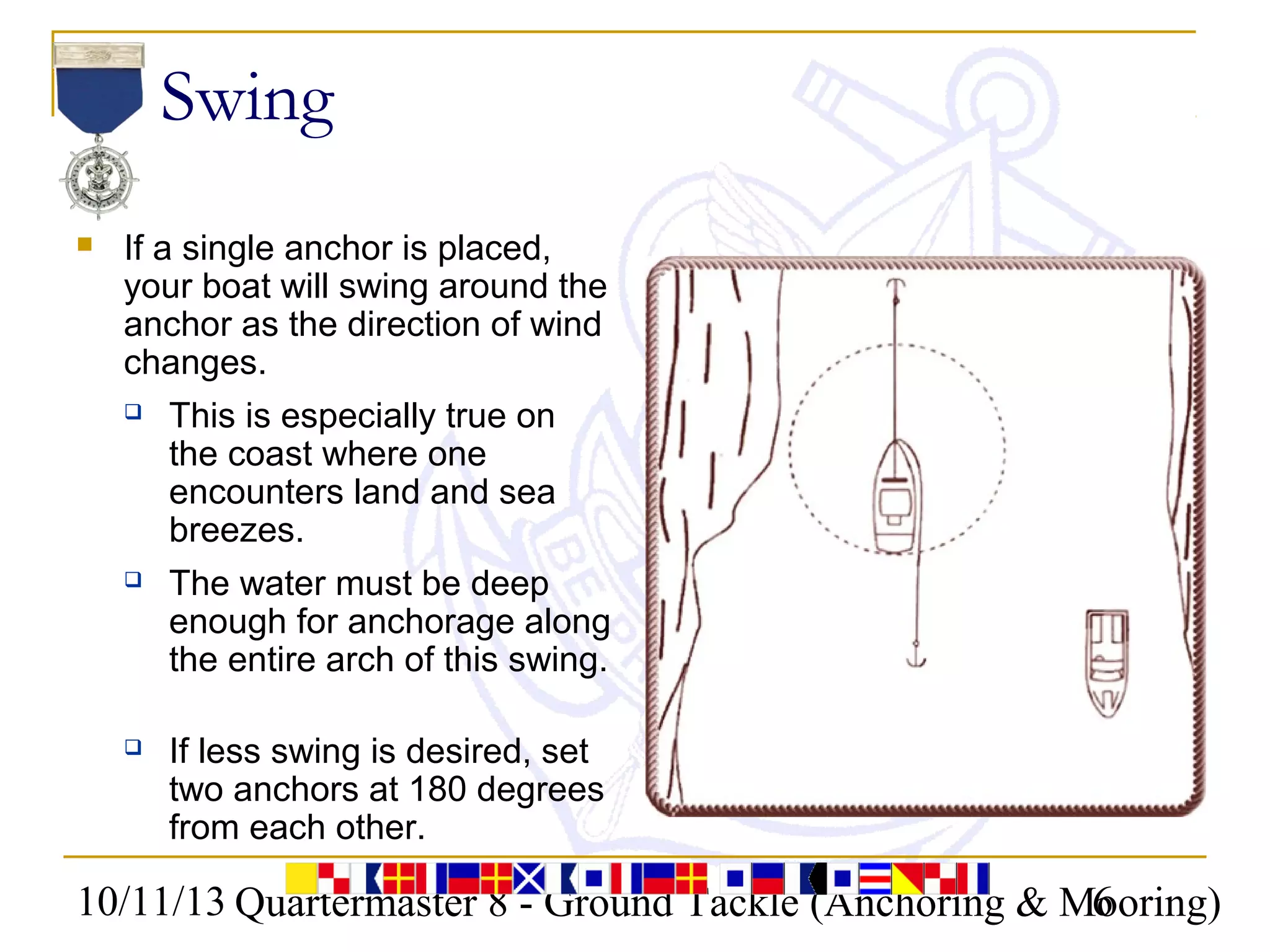
Swing
 If a single anchor is placed,
your boat will swing around the
anchor as the direction of wind
changes.
 This is especially true on
the coast where one
encounters land and sea
breezes.
 The water must be deep
enough for anchorage along
the entire arch of this swing.
 If less swing is desired, set
two anchors at 180 degrees
from each other.
10/11/13 Quartermaster 8 - Ground Tackle (Anchoring & Mooring)7
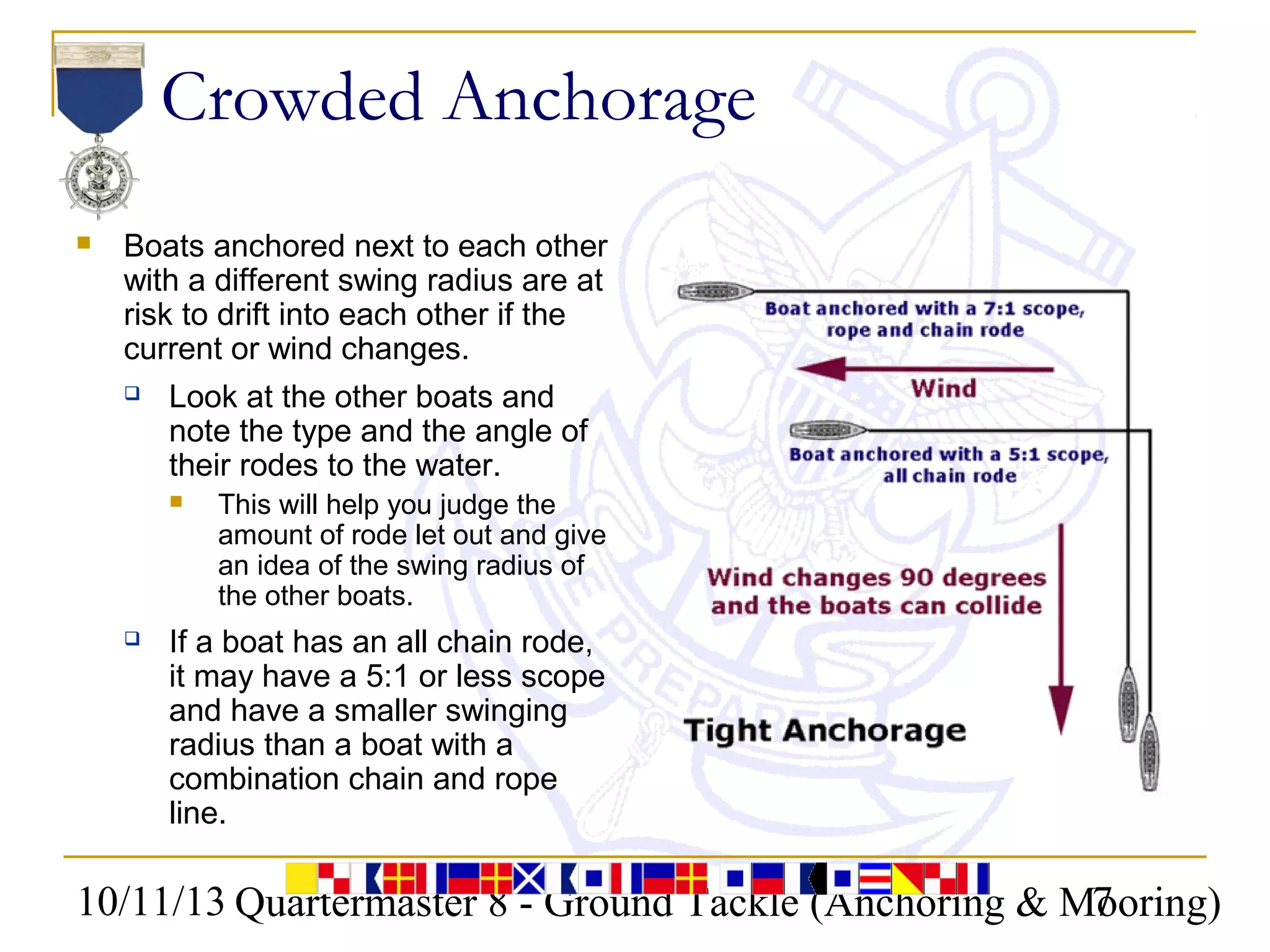
Crowded Anchorage
 Boats anchored next to each other
with a different swing radius are at
risk to drift into each other if the
current or wind changes.
 Look at the other boats and
note the type and the angle of
their rodes to the water.
 This will help you judge the
amount of rode let out and give
an idea of the swing radius of
the other boats.
 If a boat has an all chain rode,
it may have a 5:1 or less scope
and have a smaller swinging
radius than a boat with a
combination chain and rope
line.
10/11/13 Quartermaster 8 - Ground Tackle (Anchoring & Mooring)8
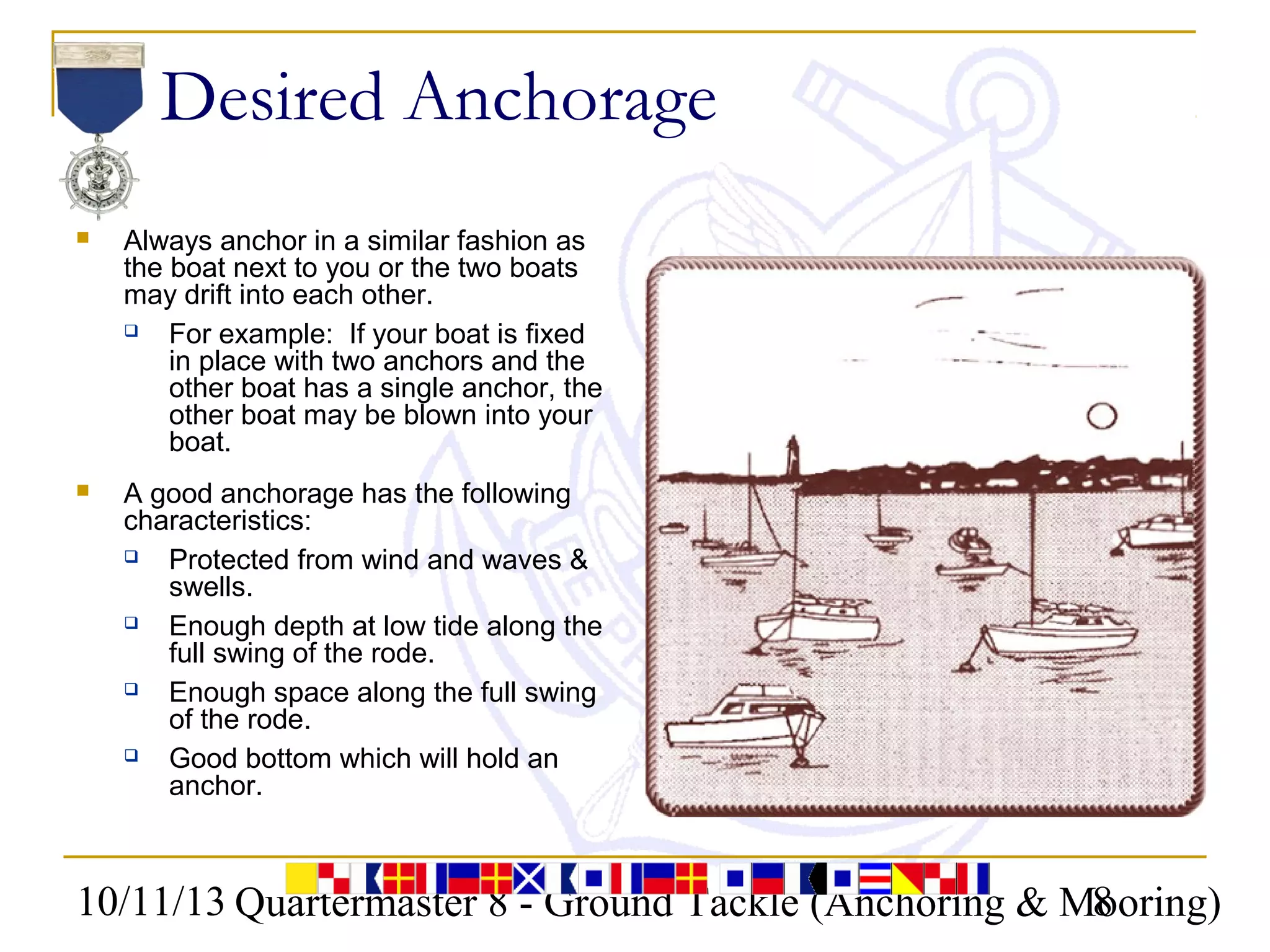
Desired Anchorage
 Always anchor in a similar fashion as
the boat next to you or the two boats
may drift into each other.
 For example: If your boat is fixed
in place with two anchors and the
other boat has a single anchor, the
other boat may be blown into your
boat.
 A good anchorage has the following
characteristics:
 Protected from wind and waves &
swells.
 Enough depth at low tide along the
full swing of the rode.
 Enough space along the full swing
of the rode.
 Good bottom which will hold an
anchor.
10/11/13 Quartermaster 8 - Ground Tackle (Anchoring & Mooring)9
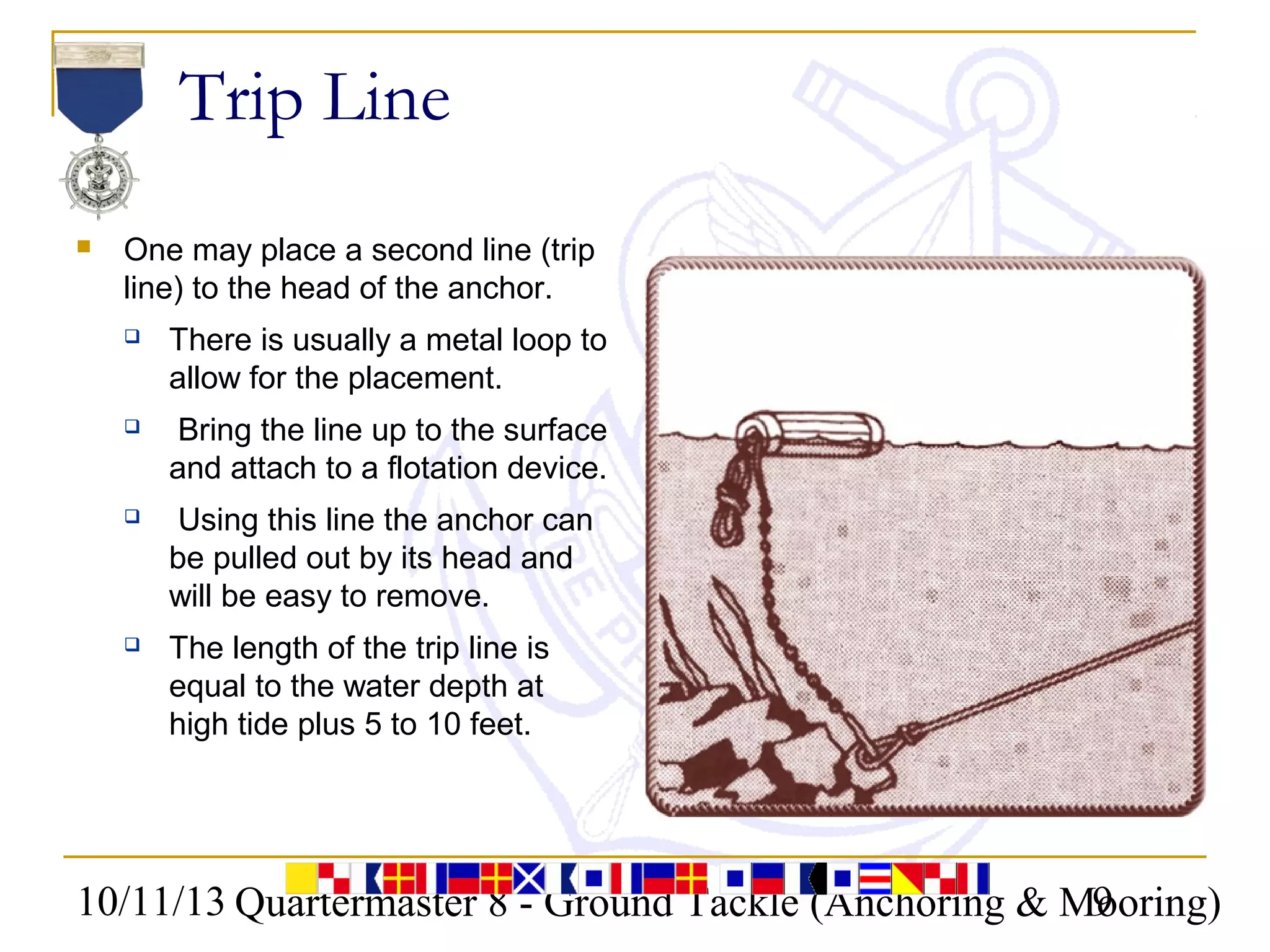
Trip Line
 One may place a second line (trip
line) to the head of the anchor.
 There is usually a metal loop to
allow for the placement.
 Bring the line up to the surface
and attach to a flotation device.
 Using this line the anchor can
be pulled out by its head and
will be easy to remove.
 The length of the trip line is
equal to the water depth at
high tide plus 5 to 10 feet.
10/11/13 Quartermaster 8 - Ground Tackle (Anchoring & Mooring)10
Anchor Commands
 Aweigh Anchor
To raise an anchor off the bottom
 Drop Anchor
To lower an anchor gently to the
bottom
 Take In Slack
The deckhands are to pull in the
slack and snub it around a cleat.
 Take A Strain
The deckhands are to pull on the
line named, snubbing it around the
cleat but allowing a little slippage.
 Ease Off
The line is allowed to slip more
freely.
 Hold
This means to check the line
temporarily.
 Secure Lines
Tie the lines down permanently
 Back Anchor
Carry out a smaller anchor ahead
of the one by which the vessels
rides to take off some of the strain.
10/11/13 Quartermaster 8 - Ground Tackle (Anchoring & Mooring)11
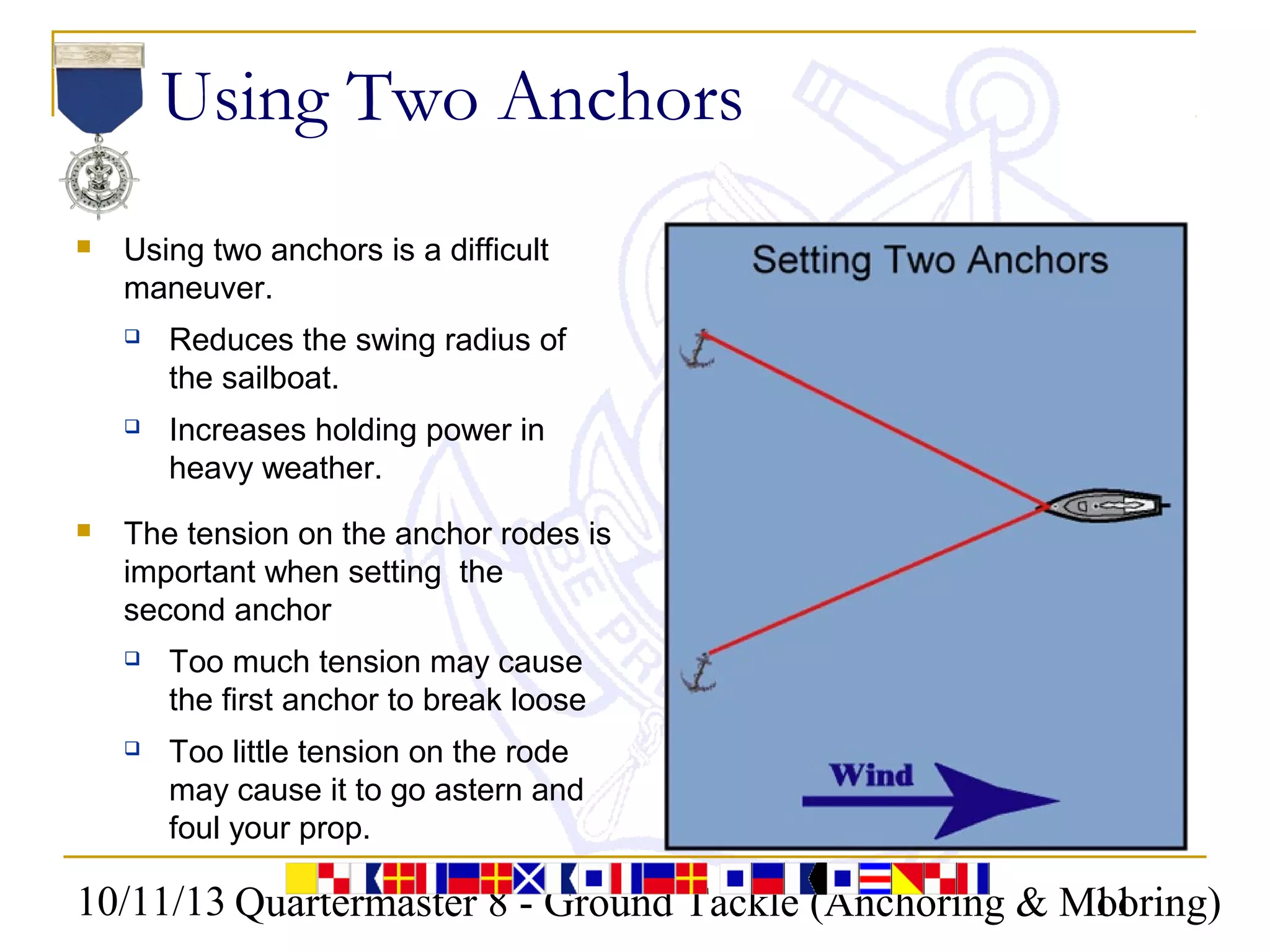
Using Two Anchors
 Using two anchors is a difficult
maneuver.
 Reduces the swing radius of
the sailboat.
 Increases holding power in
heavy weather.
 The tension on the anchor rodes is
important when setting the
second anchor
 Too much tension may cause
the first anchor to break loose
 Too little tension on the rode
may cause it to go astern and
foul your prop.
10/11/13 Quartermaster 8 - Ground Tackle (Anchoring & Mooring)12
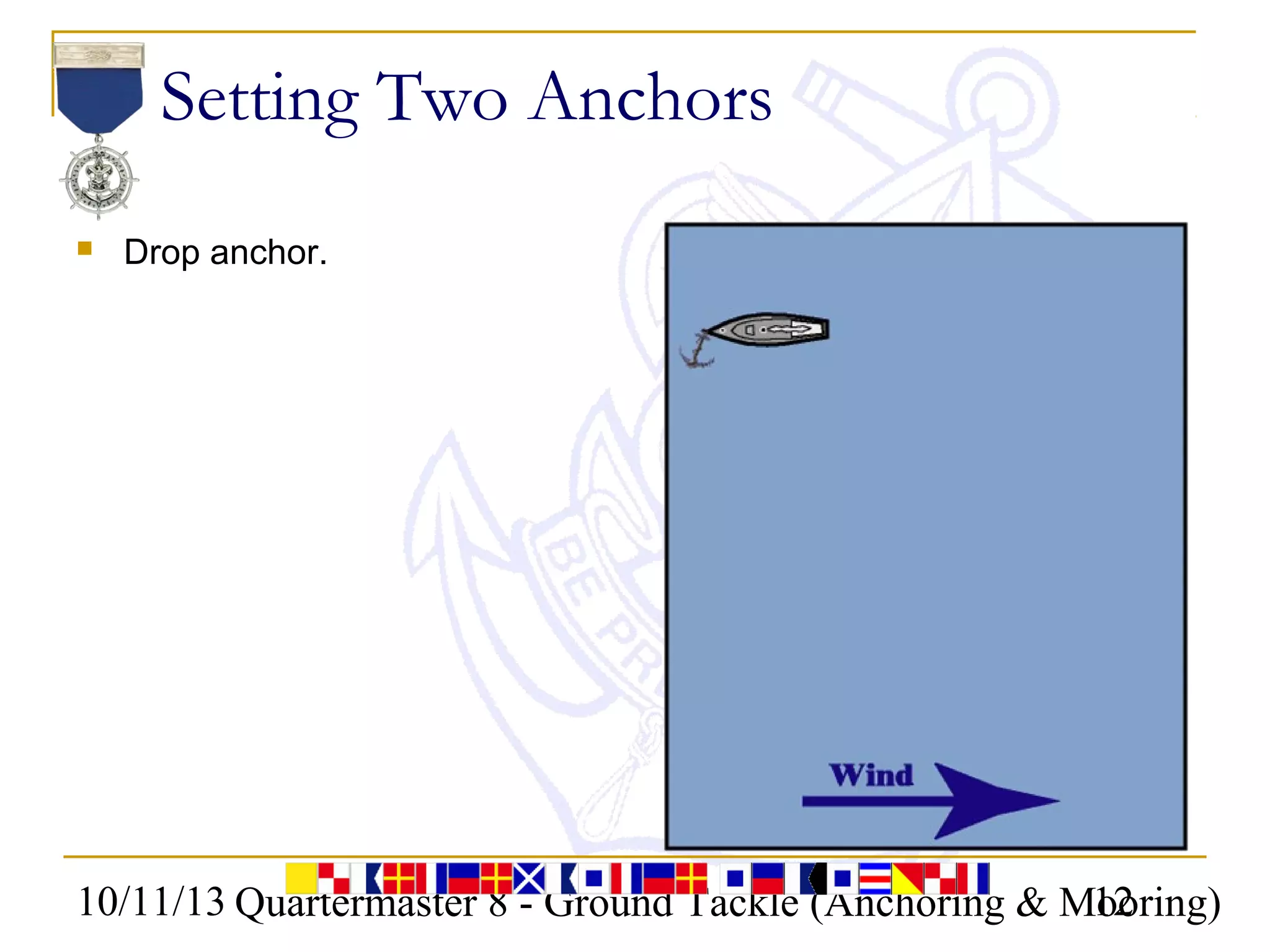
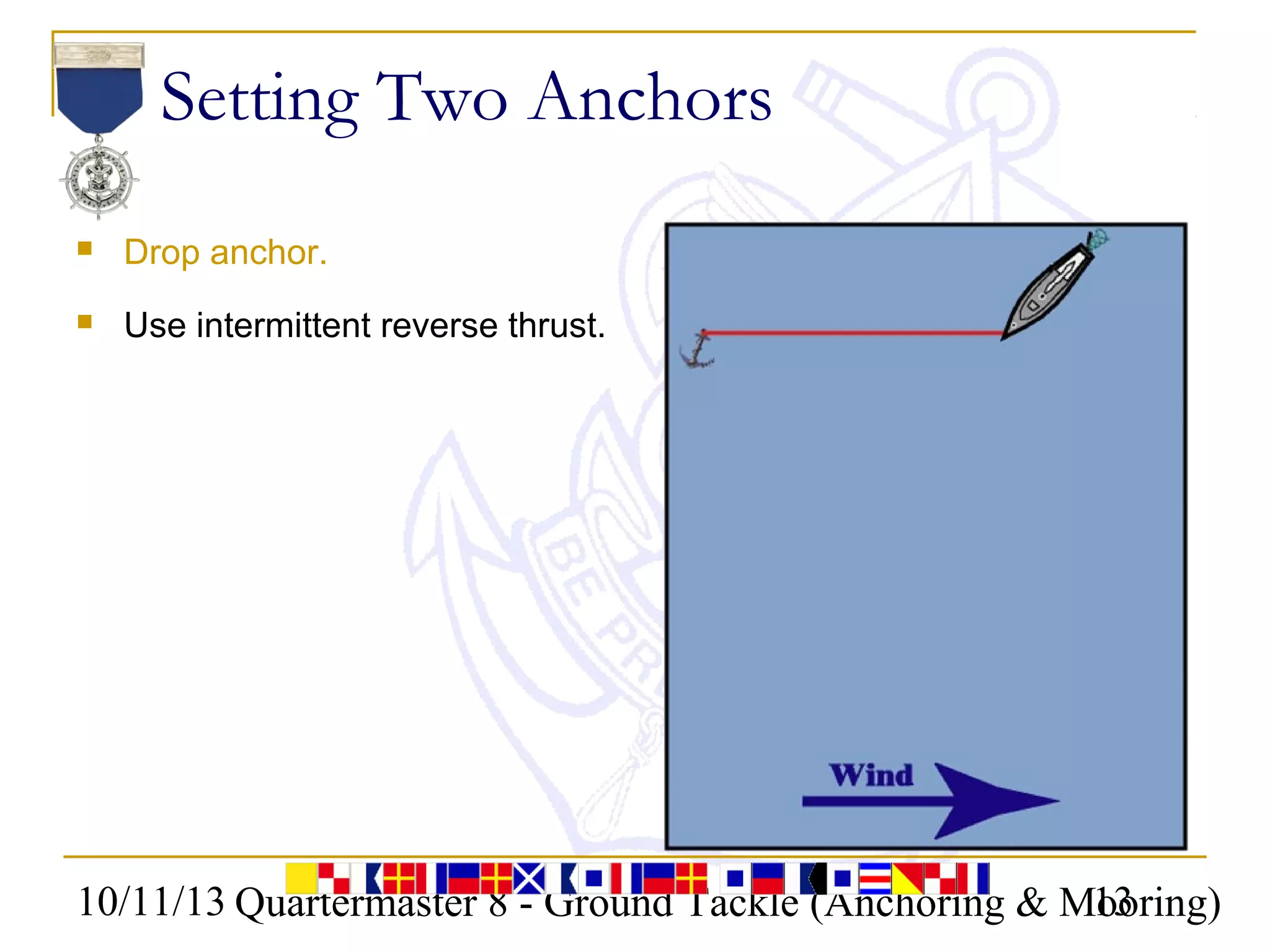
Setting Two Anchors
 Drop anchor.
10/11/13 Quartermaster 8 - Ground Tackle (Anchoring & Mooring)13
Setting Two Anchors
 Drop anchor.
 Use intermittent reverse thrust.
10/11/13 Quartermaster 8 - Ground Tackle (Anchoring & Mooring)14
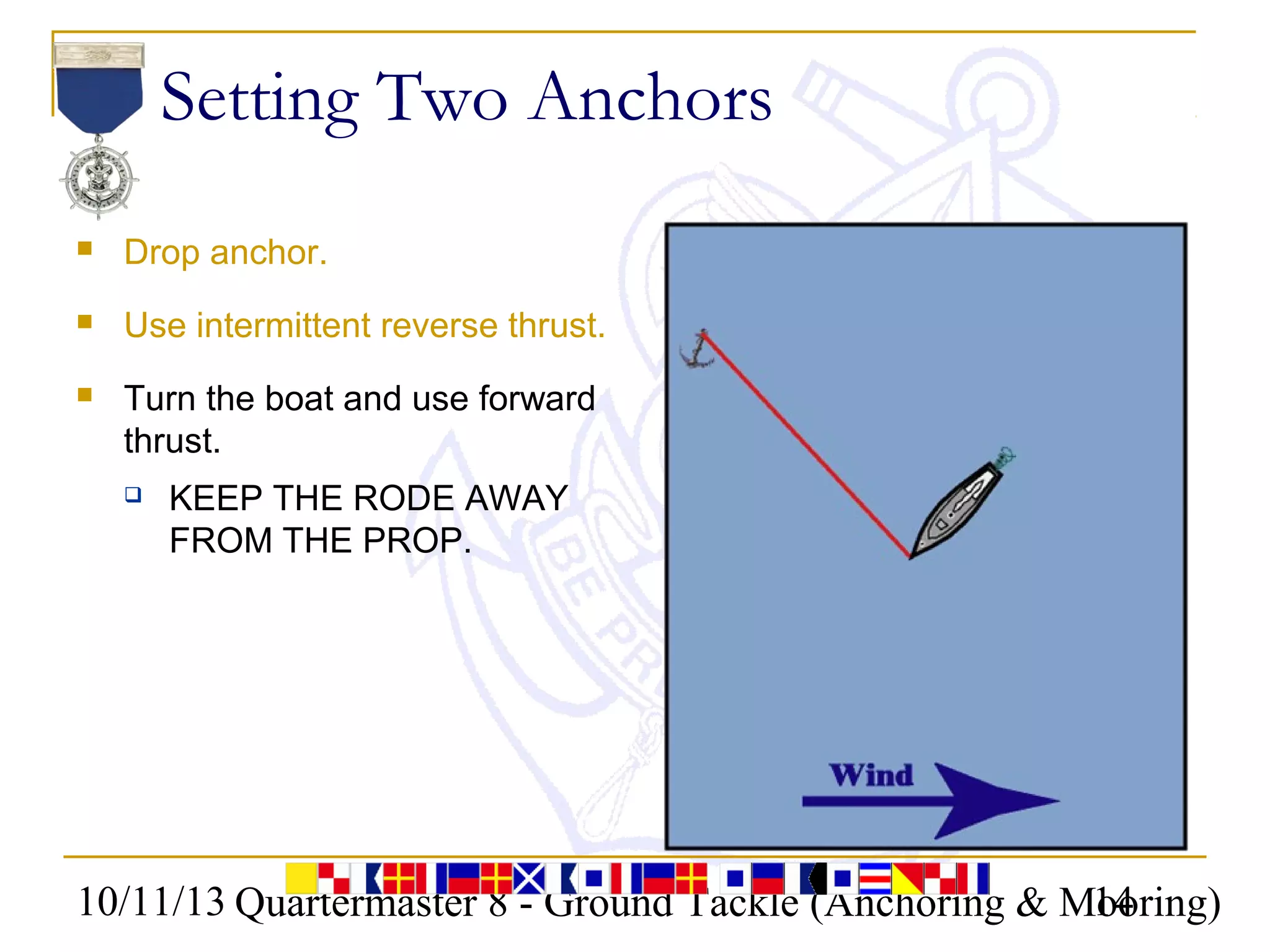
Setting Two Anchors
 Drop anchor.
 Use intermittent reverse thrust.
 Turn the boat and use forward
thrust.
 KEEP THE RODE AWAY
FROM THE PROP.
10/11/13 Quartermaster 8 - Ground Tackle (Anchoring & Mooring)15
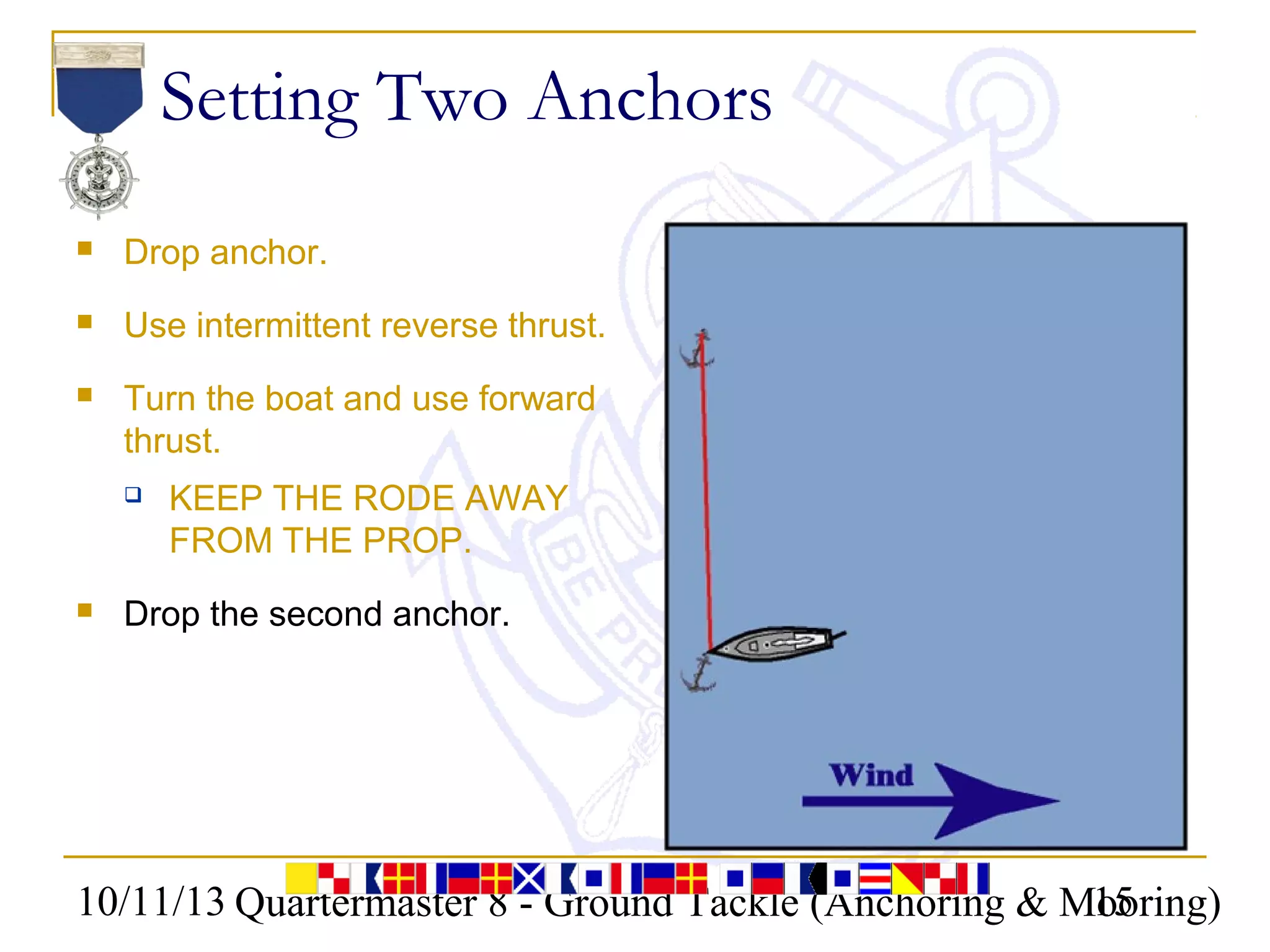
Setting Two Anchors
 Drop anchor.
 Use intermittent reverse thrust.
 Turn the boat and use forward
thrust.
 KEEP THE RODE AWAY
FROM THE PROP.
 Drop the second anchor.
10/11/13 Quartermaster 8 - Ground Tackle (Anchoring & Mooring)16
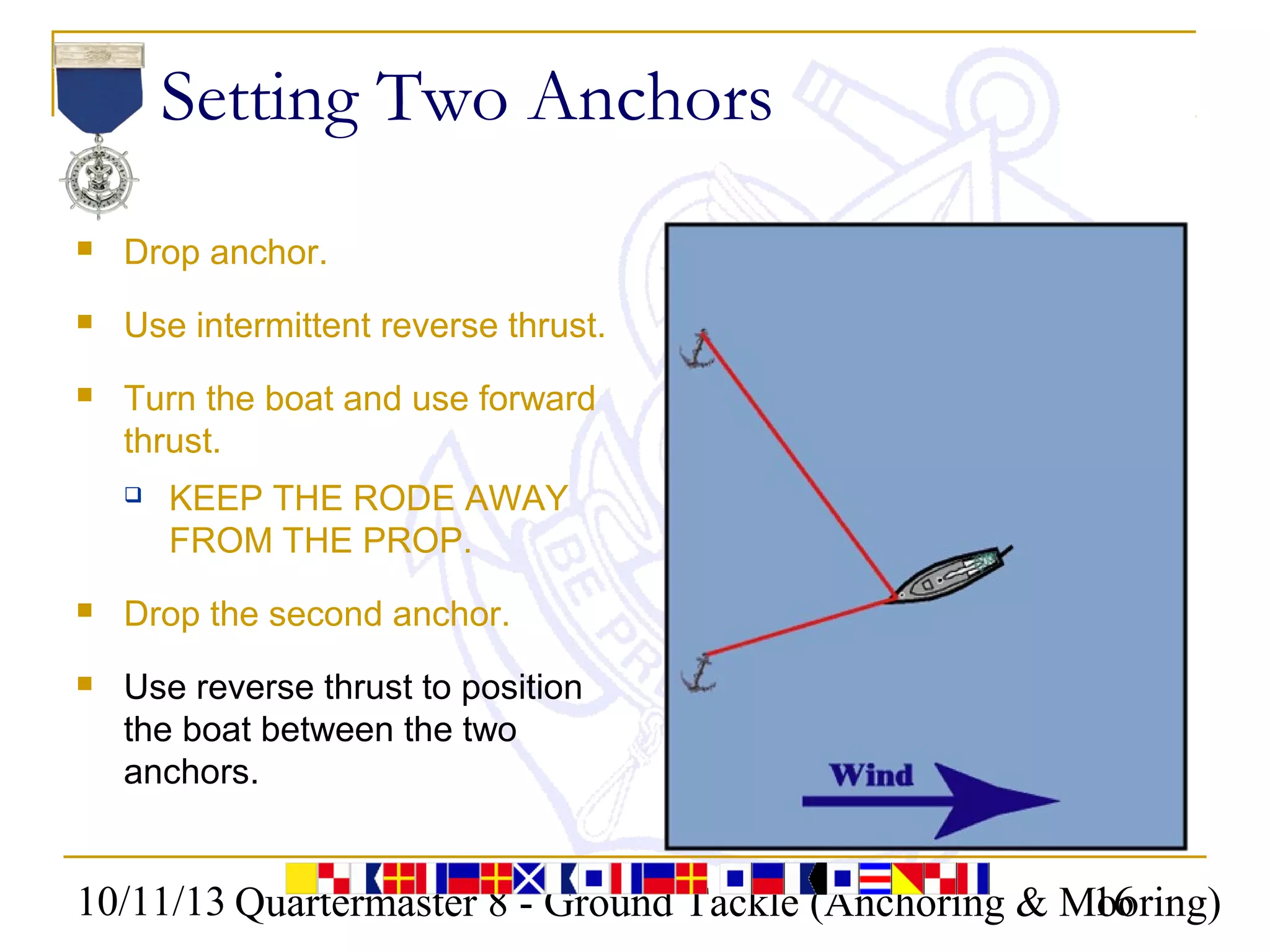
Setting Two Anchors
 Drop anchor.
 Use intermittent reverse thrust.
 Turn the boat and use forward
thrust.
 KEEP THE RODE AWAY
FROM THE PROP.
 Drop the second anchor.
 Use reverse thrust to position
the boat between the two
anchors.
10/11/13 Quartermaster 8 - Ground Tackle (Anchoring & Mooring)17
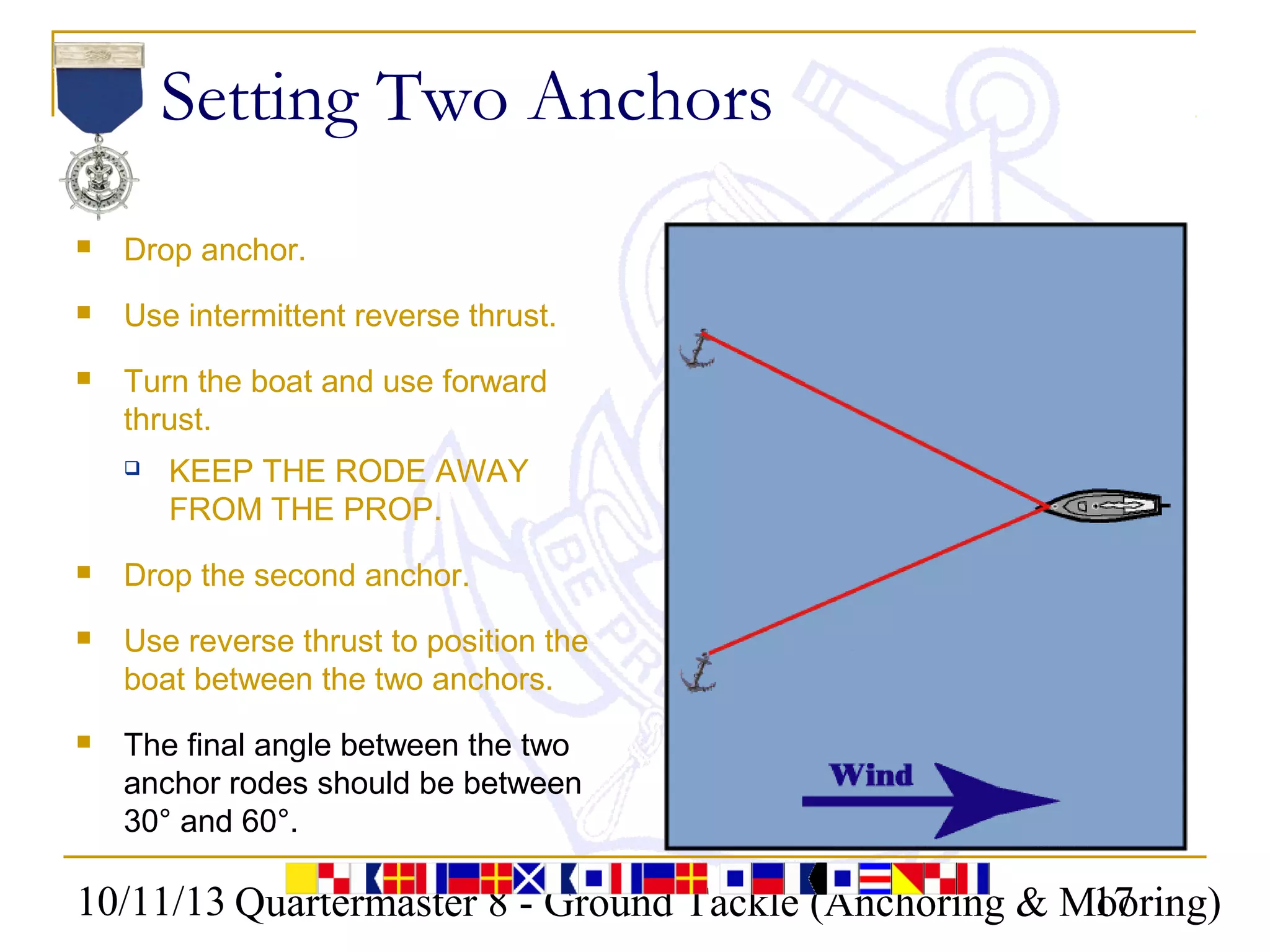
Setting Two Anchors
 Drop anchor.
 Use intermittent reverse thrust.
 Turn the boat and use forward
thrust.
 KEEP THE RODE AWAY
FROM THE PROP.
 Drop the second anchor.
 Use reverse thrust to position the
boat between the two anchors.
 The final angle between the two
anchor rodes should be between
30° and 60°.
10/11/13 Quartermaster 8 - Ground Tackle (Anchoring & Mooring)18
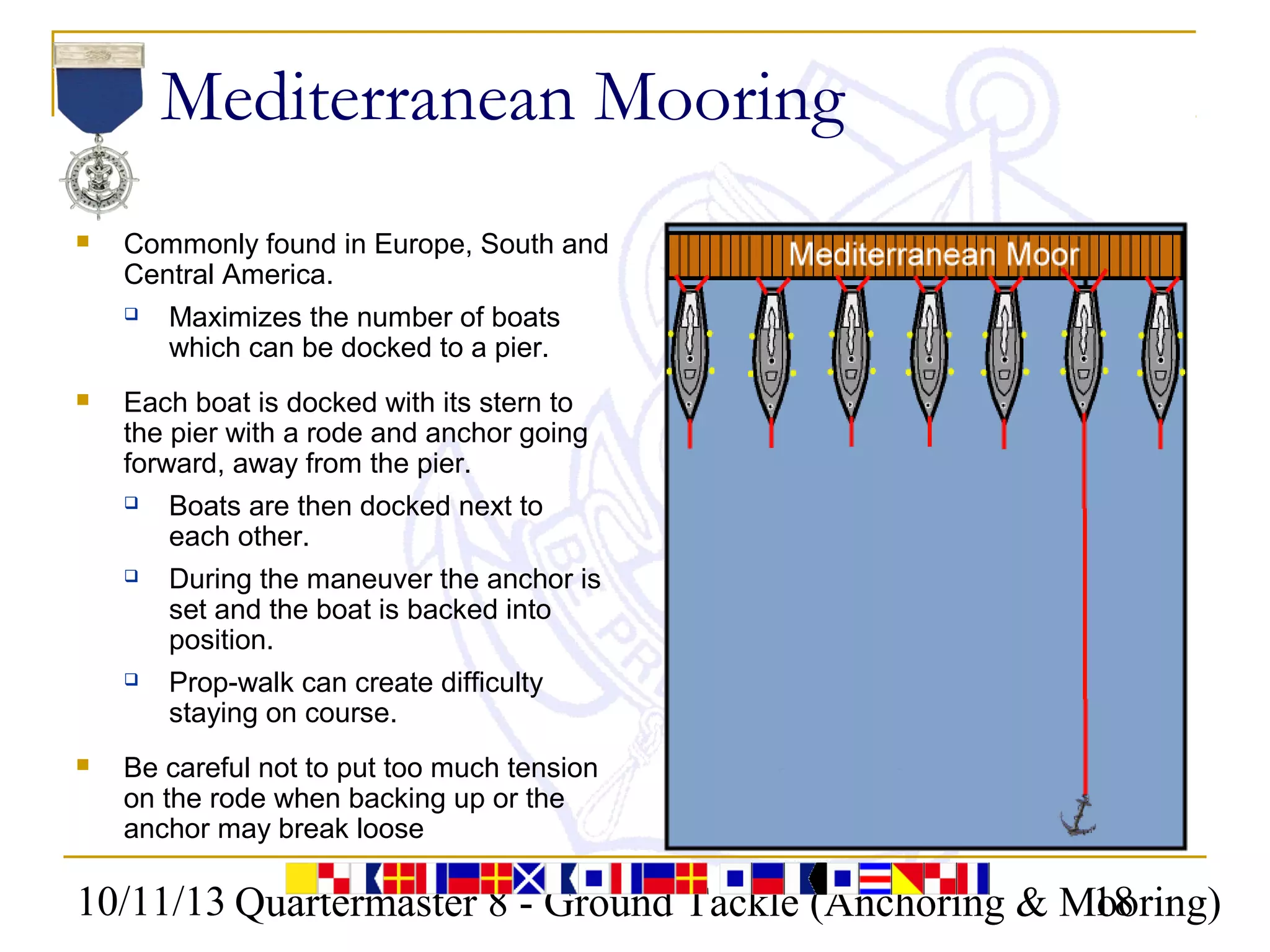
Mediterranean Mooring
 Commonly found in Europe, South and
Central America.
 Maximizes the number of boats
which can be docked to a pier.
 Each boat is docked with its stern to
the pier with a rode and anchor going
forward, away from the pier.
 Boats are then docked next to
each other.
 During the maneuver the anchor is
set and the boat is backed into
position.
 Prop-walk can create difficulty
staying on course.
 Be careful not to put too much tension
on the rode when backing up or the
anchor may break loose
10/11/13 Quartermaster 8 - Ground Tackle (Anchoring & Mooring)19
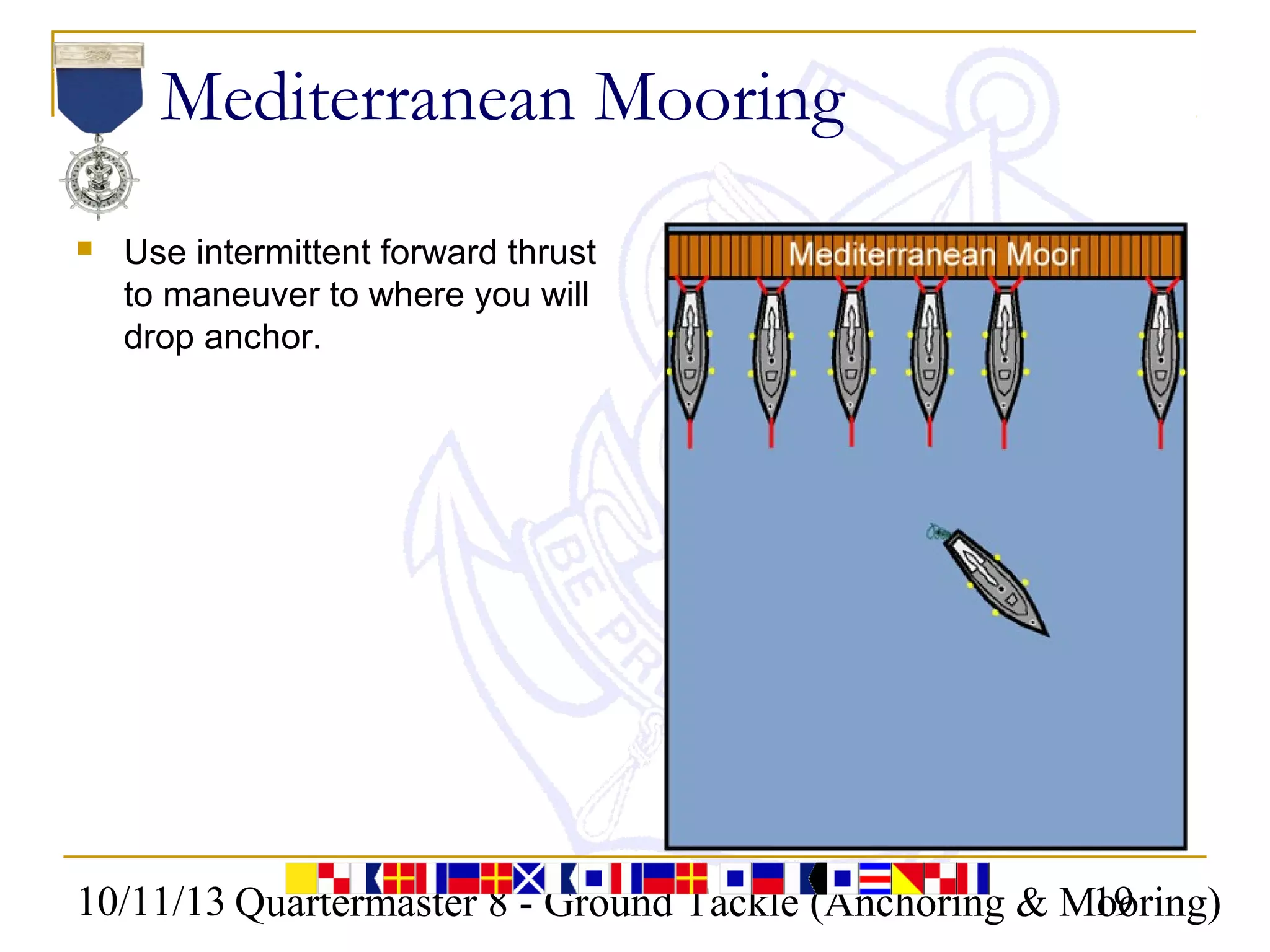
Mediterranean Mooring
 Use intermittent forward thrust
to maneuver to where you will
drop anchor.
10/11/13 Quartermaster 8 - Ground Tackle (Anchoring & Mooring)20
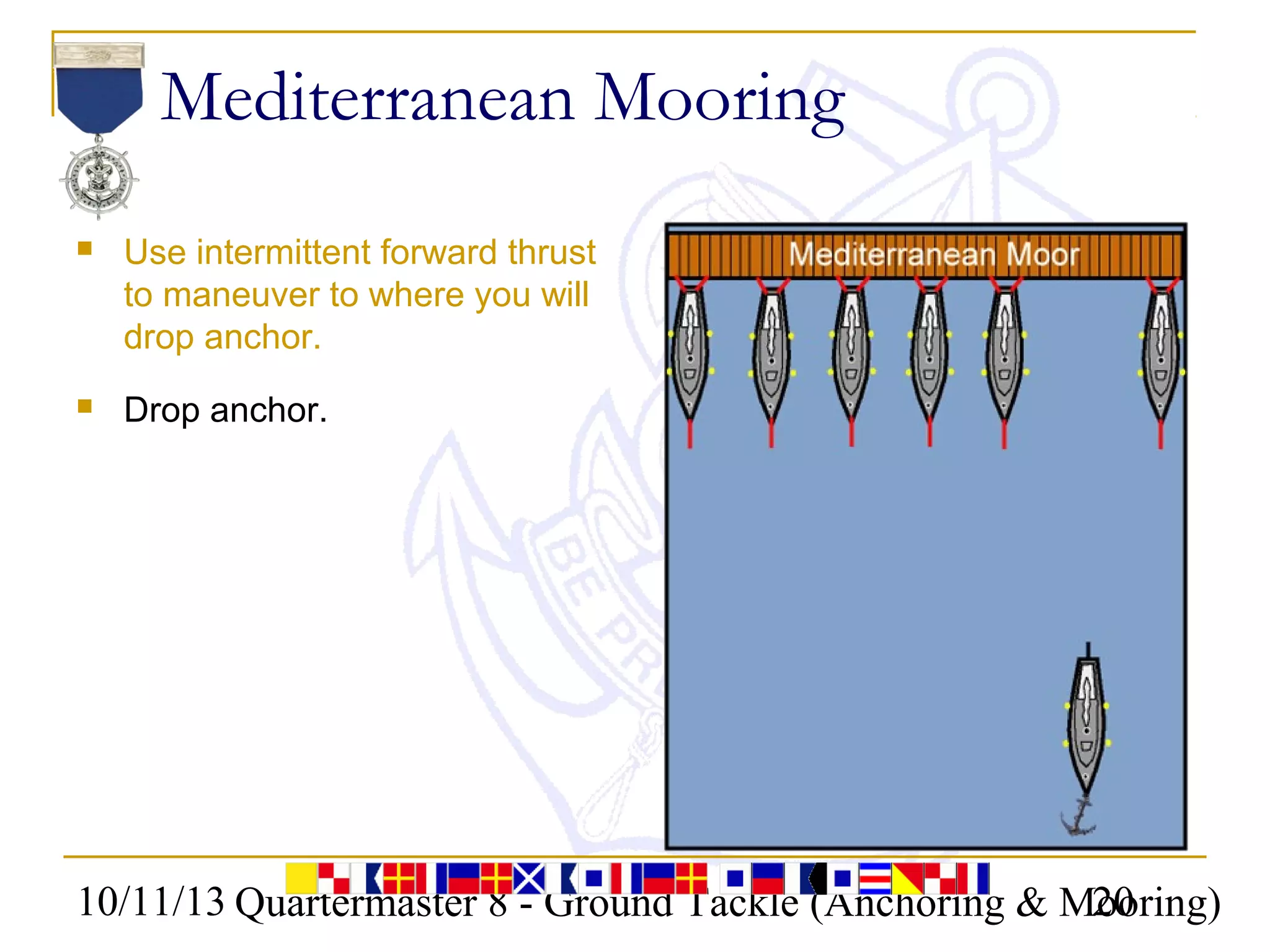
Mediterranean Mooring
 Use intermittent forward thrust
to maneuver to where you will
drop anchor.
 Drop anchor.
10/11/13 Quartermaster 8 - Ground Tackle (Anchoring & Mooring)21
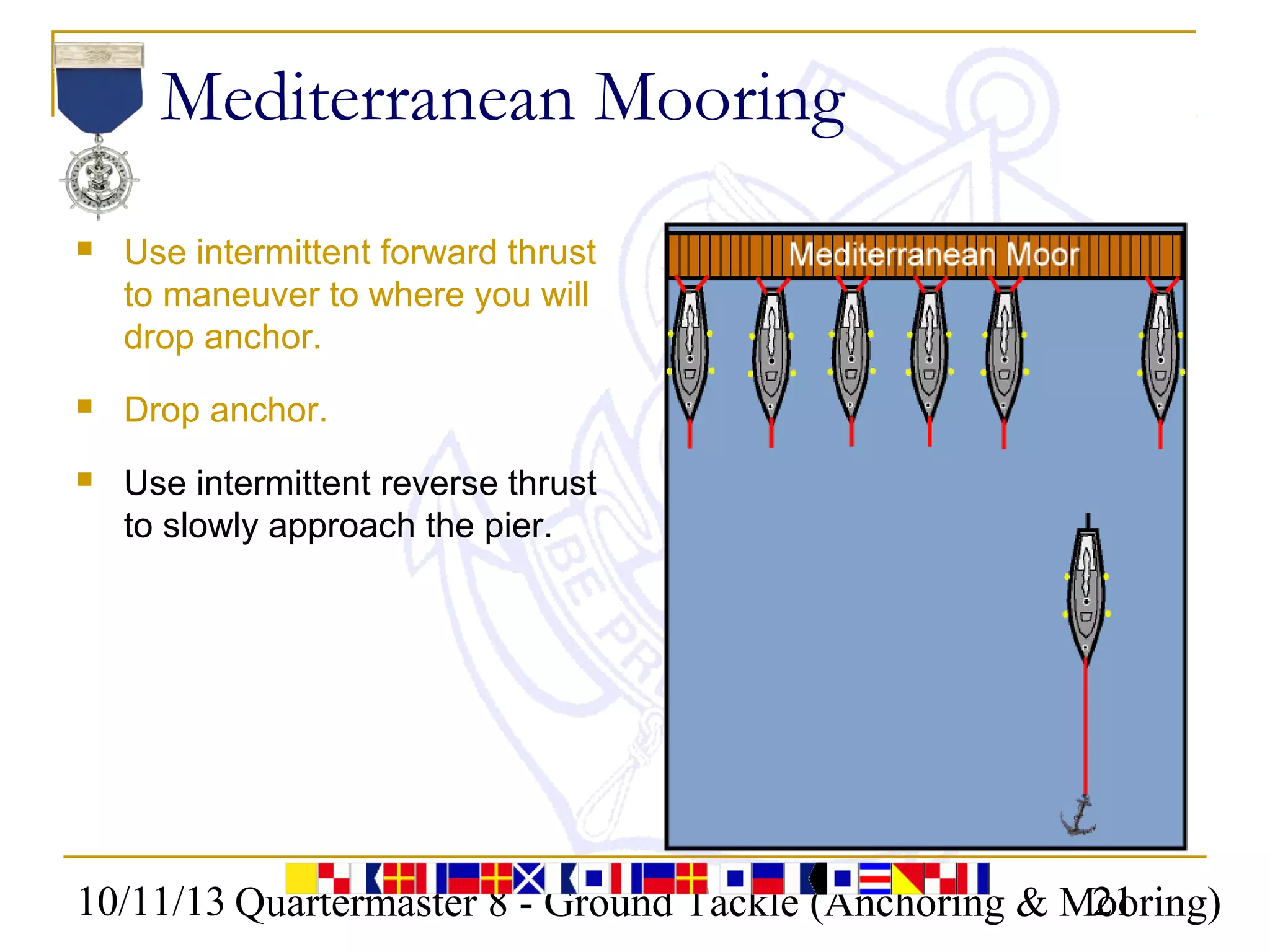
Mediterranean Mooring
 Use intermittent forward thrust
to maneuver to where you will
drop anchor.
 Drop anchor.
 Use intermittent reverse thrust
to slowly approach the pier.
10/11/13 Quartermaster 8 - Ground Tackle (Anchoring & Mooring)22
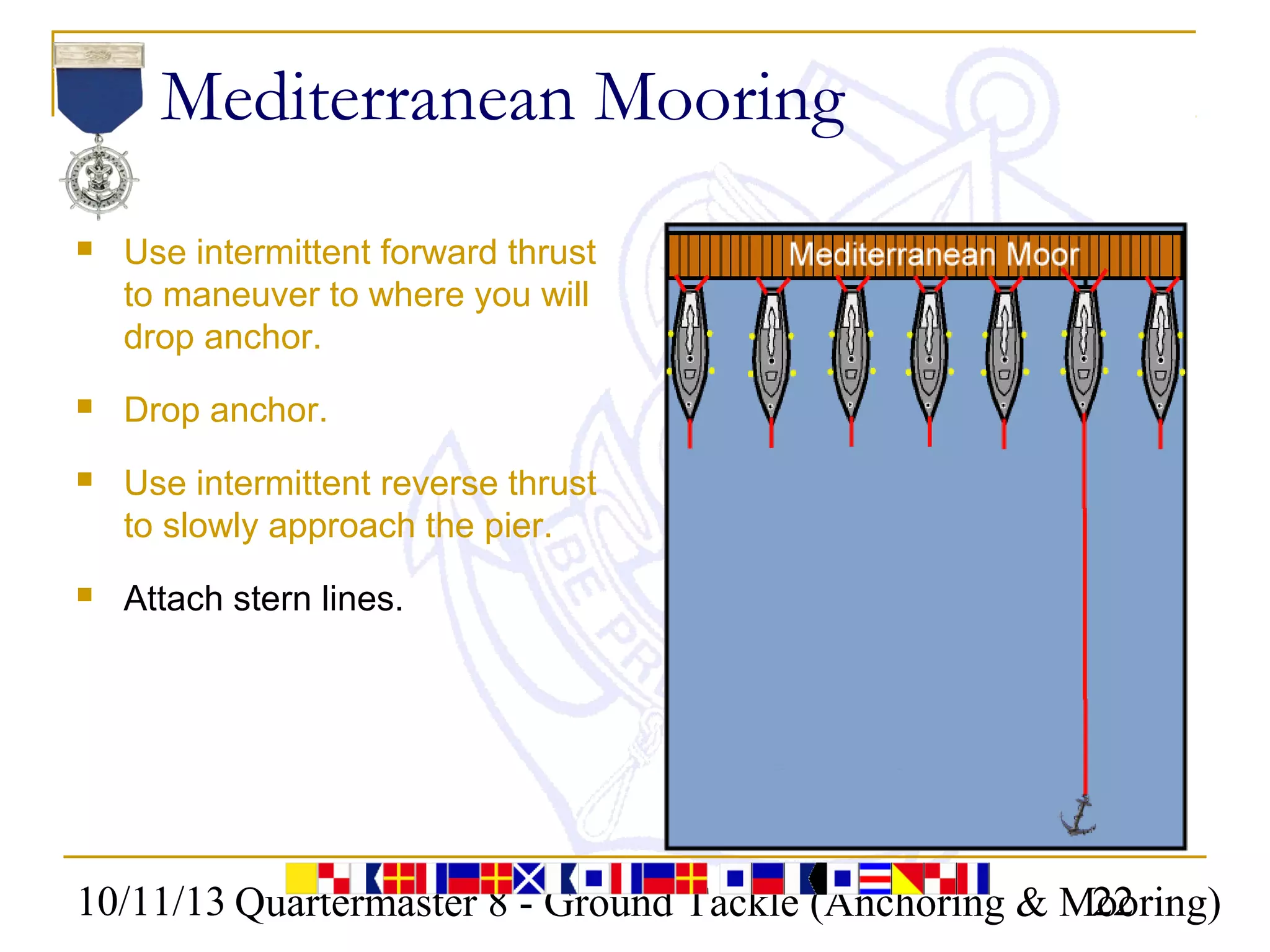
Mediterranean Mooring
 Use intermittent forward thrust
to maneuver to where you will
drop anchor.
 Drop anchor.
 Use intermittent reverse thrust
to slowly approach the pier.
 Attach stern lines.
10/11/13 Quartermaster 8 - Ground Tackle (Anchoring & Mooring)23
Mooring to a Buoy
 Using a permanent mooring is best
when a boat is mostly at its homeport
or when the boat is to be left
unattended for long periods of time.
 A helix anchor or a mushroom
anchor is used for mooring buoys
 Concrete blocks can be used but that
should be many times heavier
(around 2000 pounds) because they
do not dig into the seabed and only
their weight provides holding power.
 Galvanized chain on the mooring
should be about 1.5 times the depth.
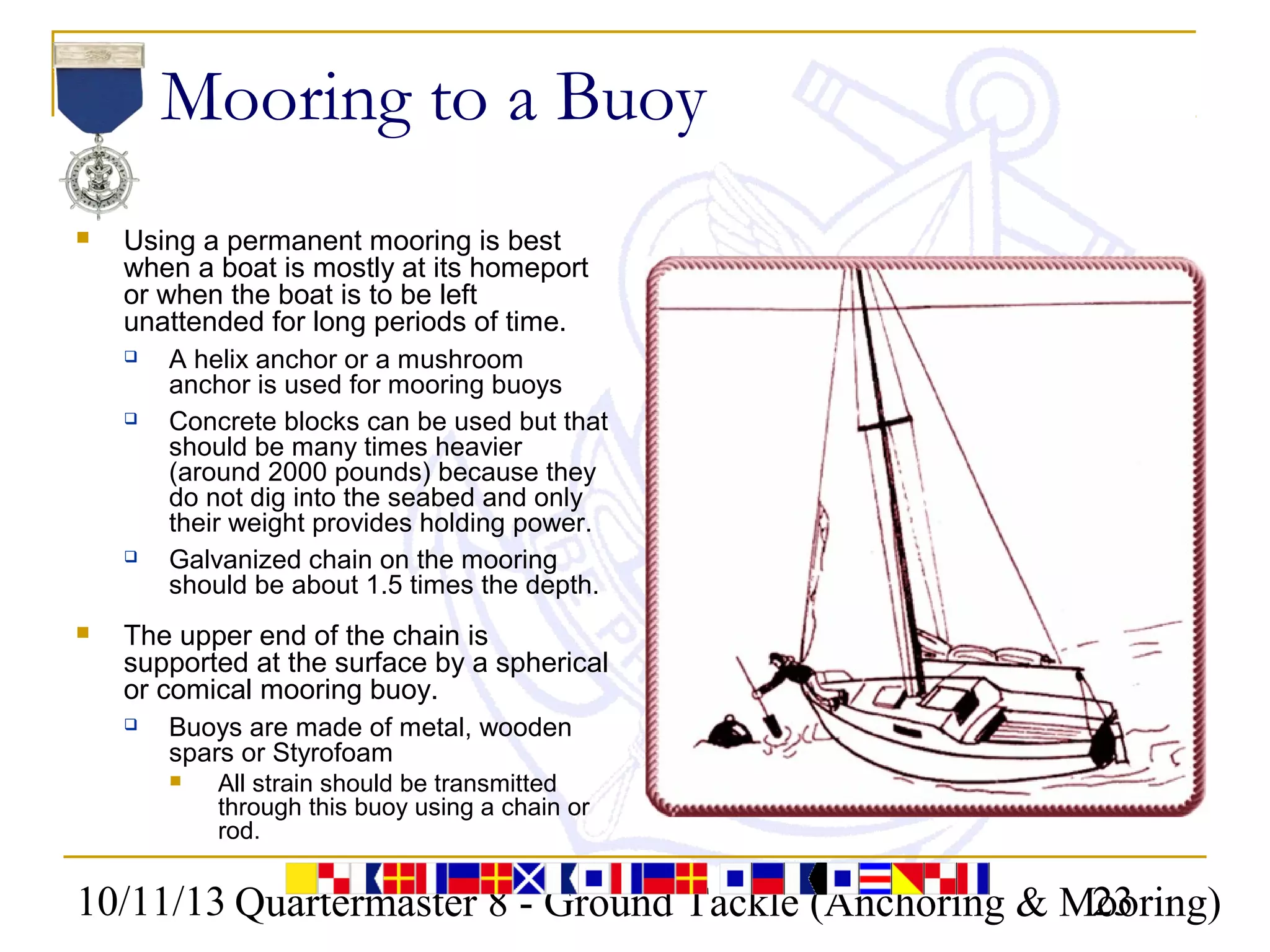
 The upper end of the chain is
supported at the surface by a spherical
or comical mooring buoy.
 Buoys are made of metal, wooden
spars or Styrofoam
 All strain should be transmitted
through this buoy using a chain or
rod.
10/11/13 Quartermaster 8 - Ground Tackle (Anchoring & Mooring)24
Mooring to a Buoy
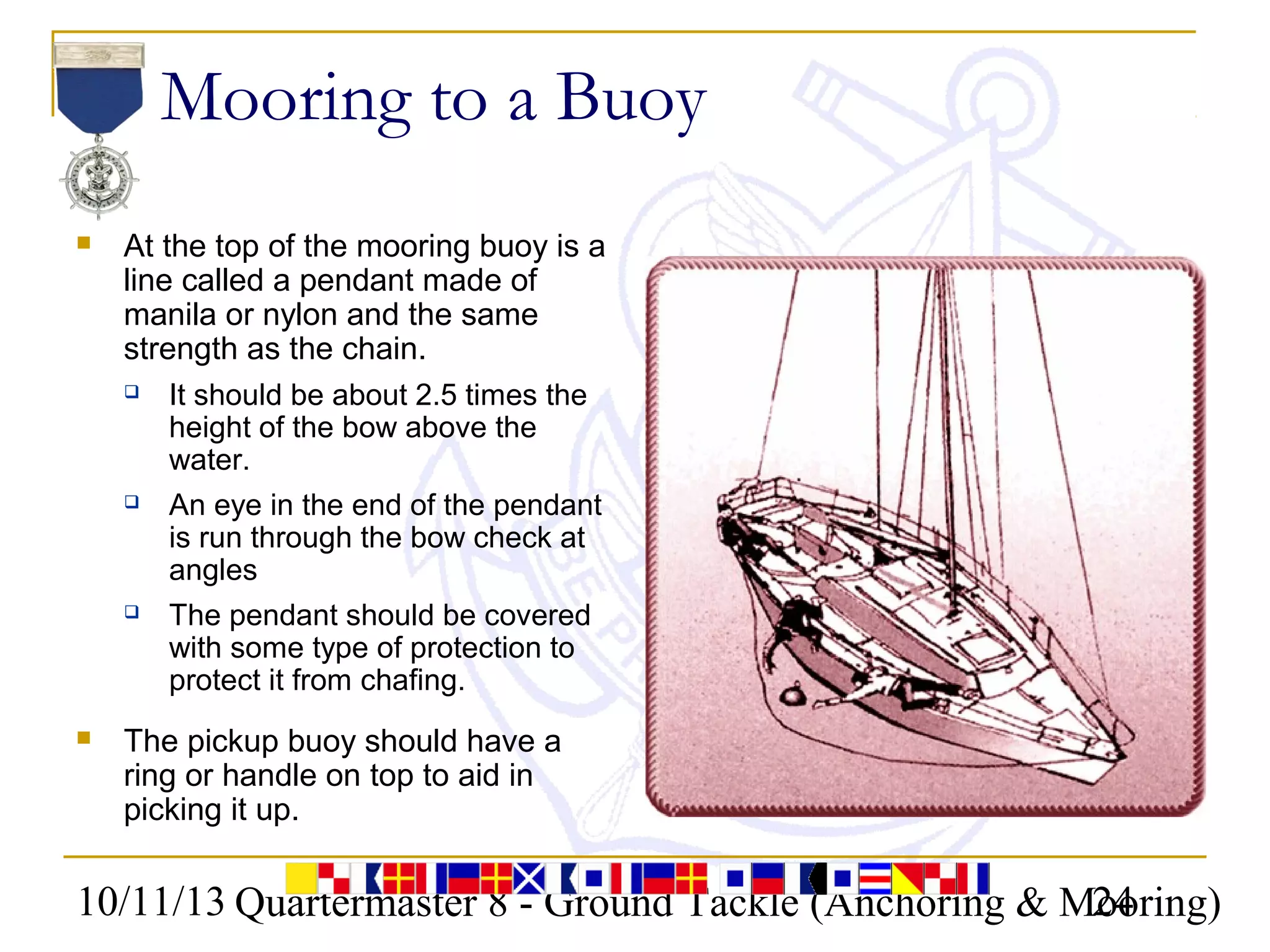
 At the top of the mooring buoy is a
line called a pendant made of
manila or nylon and the same
strength as the chain.
 It should be about 2.5 times the
height of the bow above the
water.
 An eye in the end of the pendant
is run through the bow check at
angles
 The pendant should be covered
with some type of protection to
protect it from chafing.
 The pickup buoy should have a
ring or handle on top to aid in
picking it up.

ground tackle (anchoring and mooring)

  • 1.
    Ground Tackle – Anchoringand Mooring Quartermaster Requirement 8
  • 2.
    10/11/13 Quartermaster 8- Ground Tackle (Anchoring & Mooring)2 Quartermaster Requirement 8  Teach the Ordinary and Able requirements No. 8, Ground Tackle, to a crew.  Know the methods of bringing a boat to anchor or mooring with special emphasis on wind and current with respect to the vessel's course and speed.  Take charge of the craft used by your ship and give all commands to the crew for anchoring and weighing anchor in several different wind and current situations.  Take charge of the craft used by your ship and give all commands to the crew for picking up a mooring buoy and properly mooring the vessel in several wind and current situations.  Note: Depending on the type of craft used by your ship, this requirement may be met either under sail or power.  Reference:  "Ground Tackle" on page 145.
  • 3.
    10/11/13 Quartermaster 8- Ground Tackle (Anchoring & Mooring)3 Anchor Rode  The rode is the line and/or chain which goes to an anchor. It is often composed of both chain and rope.  The chain is attached to the anchor and it helps the anchor to lie flat on the bottom. This has three benefits:  The chain lies flat on the bottom and increases the horizontal pull on the anchor. This will increase the anchor's purchase.  The chain will not chafe as it lies on and is pulled across the bottom.  The chain acts as a shock absorber as the boat intermittently pulls on the rode, lifting the chain off the bottom.
  • 4.
    10/11/13 Quartermaster 8- Ground Tackle (Anchoring & Mooring)4 Purchase  Be sure that the anchor has a good purchase on the water's bottom or it will drag and the boat will drift.  Check the purchase by observing the tension on the rode and any change in position of the boat as the boat is placed in reverse.  While at anchor, intermittently check the tension on the rode as the boat's bow raises and lowers with the waves.  Also take several compass fixes and/or GPS positions to aid in determining if the boat is drifting and pulling the anchor.
  • 5.
    10/11/13 Quartermaster 8- Ground Tackle (Anchoring & Mooring)5 Scope  As a general guide, let out at least seven times the rode as the depth of the water plus the boat's freeboard (distance from the water surface to the deck)  This ratio is called the anchoring scope.  Dragging anchor is often caused by not letting out enough rode.  Scope may be decreased to 5:1 if an all chain rode is used.  Scope may be increased in high wind or wave conditions.  Check the depth of the water where you anchor in relationship to the tide.  For example, if you anchor with a 7:1 scope at low tide in six feet of water and a six foot tide comes in, your scope will be reduced to 3.5:1  Or you may inadvertently become grounded.  Sailor's Tip: Place fathom or foot markers on the rode to help judge how much line has been let out.
  • 6.
    10/11/13 Quartermaster 8- Ground Tackle (Anchoring & Mooring)6 Swing  If a single anchor is placed, your boat will swing around the anchor as the direction of wind changes.  This is especially true on the coast where one encounters land and sea breezes.  The water must be deep enough for anchorage along the entire arch of this swing.  If less swing is desired, set two anchors at 180 degrees from each other.
  • 7.
    10/11/13 Quartermaster 8- Ground Tackle (Anchoring & Mooring)7 Crowded Anchorage  Boats anchored next to each other with a different swing radius are at risk to drift into each other if the current or wind changes.  Look at the other boats and note the type and the angle of their rodes to the water.  This will help you judge the amount of rode let out and give an idea of the swing radius of the other boats.  If a boat has an all chain rode, it may have a 5:1 or less scope and have a smaller swinging radius than a boat with a combination chain and rope line.
  • 8.
    10/11/13 Quartermaster 8- Ground Tackle (Anchoring & Mooring)8 Desired Anchorage  Always anchor in a similar fashion as the boat next to you or the two boats may drift into each other.  For example: If your boat is fixed in place with two anchors and the other boat has a single anchor, the other boat may be blown into your boat.  A good anchorage has the following characteristics:  Protected from wind and waves & swells.  Enough depth at low tide along the full swing of the rode.  Enough space along the full swing of the rode.  Good bottom which will hold an anchor.
  • 9.
    10/11/13 Quartermaster 8- Ground Tackle (Anchoring & Mooring)9 Trip Line  One may place a second line (trip line) to the head of the anchor.  There is usually a metal loop to allow for the placement.  Bring the line up to the surface and attach to a flotation device.  Using this line the anchor can be pulled out by its head and will be easy to remove.  The length of the trip line is equal to the water depth at high tide plus 5 to 10 feet.
  • 10.
    10/11/13 Quartermaster 8- Ground Tackle (Anchoring & Mooring)10 Anchor Commands  Aweigh Anchor To raise an anchor off the bottom  Drop Anchor To lower an anchor gently to the bottom  Take In Slack The deckhands are to pull in the slack and snub it around a cleat.  Take A Strain The deckhands are to pull on the line named, snubbing it around the cleat but allowing a little slippage.  Ease Off The line is allowed to slip more freely.  Hold This means to check the line temporarily.  Secure Lines Tie the lines down permanently  Back Anchor Carry out a smaller anchor ahead of the one by which the vessels rides to take off some of the strain.
  • 11.
    10/11/13 Quartermaster 8- Ground Tackle (Anchoring & Mooring)11 Using Two Anchors  Using two anchors is a difficult maneuver.  Reduces the swing radius of the sailboat.  Increases holding power in heavy weather.  The tension on the anchor rodes is important when setting the second anchor  Too much tension may cause the first anchor to break loose  Too little tension on the rode may cause it to go astern and foul your prop.
  • 12.
    10/11/13 Quartermaster 8- Ground Tackle (Anchoring & Mooring)12 Setting Two Anchors  Drop anchor.
  • 13.
    10/11/13 Quartermaster 8- Ground Tackle (Anchoring & Mooring)13 Setting Two Anchors  Drop anchor.  Use intermittent reverse thrust.
  • 14.
    10/11/13 Quartermaster 8- Ground Tackle (Anchoring & Mooring)14 Setting Two Anchors  Drop anchor.  Use intermittent reverse thrust.  Turn the boat and use forward thrust.  KEEP THE RODE AWAY FROM THE PROP.
  • 15.
    10/11/13 Quartermaster 8- Ground Tackle (Anchoring & Mooring)15 Setting Two Anchors  Drop anchor.  Use intermittent reverse thrust.  Turn the boat and use forward thrust.  KEEP THE RODE AWAY FROM THE PROP.  Drop the second anchor.
  • 16.
    10/11/13 Quartermaster 8- Ground Tackle (Anchoring & Mooring)16 Setting Two Anchors  Drop anchor.  Use intermittent reverse thrust.  Turn the boat and use forward thrust.  KEEP THE RODE AWAY FROM THE PROP.  Drop the second anchor.  Use reverse thrust to position the boat between the two anchors.
  • 17.
    10/11/13 Quartermaster 8- Ground Tackle (Anchoring & Mooring)17 Setting Two Anchors  Drop anchor.  Use intermittent reverse thrust.  Turn the boat and use forward thrust.  KEEP THE RODE AWAY FROM THE PROP.  Drop the second anchor.  Use reverse thrust to position the boat between the two anchors.  The final angle between the two anchor rodes should be between 30° and 60°.
  • 18.
    10/11/13 Quartermaster 8- Ground Tackle (Anchoring & Mooring)18 Mediterranean Mooring  Commonly found in Europe, South and Central America.  Maximizes the number of boats which can be docked to a pier.  Each boat is docked with its stern to the pier with a rode and anchor going forward, away from the pier.  Boats are then docked next to each other.  During the maneuver the anchor is set and the boat is backed into position.  Prop-walk can create difficulty staying on course.  Be careful not to put too much tension on the rode when backing up or the anchor may break loose
  • 19.
    10/11/13 Quartermaster 8- Ground Tackle (Anchoring & Mooring)19 Mediterranean Mooring  Use intermittent forward thrust to maneuver to where you will drop anchor.
  • 20.
    10/11/13 Quartermaster 8- Ground Tackle (Anchoring & Mooring)20 Mediterranean Mooring  Use intermittent forward thrust to maneuver to where you will drop anchor.  Drop anchor.
  • 21.
    10/11/13 Quartermaster 8- Ground Tackle (Anchoring & Mooring)21 Mediterranean Mooring  Use intermittent forward thrust to maneuver to where you will drop anchor.  Drop anchor.  Use intermittent reverse thrust to slowly approach the pier.
  • 22.
    10/11/13 Quartermaster 8- Ground Tackle (Anchoring & Mooring)22 Mediterranean Mooring  Use intermittent forward thrust to maneuver to where you will drop anchor.  Drop anchor.  Use intermittent reverse thrust to slowly approach the pier.  Attach stern lines.
  • 23.
    10/11/13 Quartermaster 8- Ground Tackle (Anchoring & Mooring)23 Mooring to a Buoy  Using a permanent mooring is best when a boat is mostly at its homeport or when the boat is to be left unattended for long periods of time.  A helix anchor or a mushroom anchor is used for mooring buoys  Concrete blocks can be used but that should be many times heavier (around 2000 pounds) because they do not dig into the seabed and only their weight provides holding power.  Galvanized chain on the mooring should be about 1.5 times the depth.  The upper end of the chain is supported at the surface by a spherical or comical mooring buoy.  Buoys are made of metal, wooden spars or Styrofoam  All strain should be transmitted through this buoy using a chain or rod.
  • 24.
    10/11/13 Quartermaster 8- Ground Tackle (Anchoring & Mooring)24 Mooring to a Buoy  At the top of the mooring buoy is a line called a pendant made of manila or nylon and the same strength as the chain.  It should be about 2.5 times the height of the bow above the water.  An eye in the end of the pendant is run through the bow check at angles  The pendant should be covered with some type of protection to protect it from chafing.  The pickup buoy should have a ring or handle on top to aid in picking it up.