MANEUVERING & COLLISION
AVOIDANCE
by Aleksandr D. Pipchenko
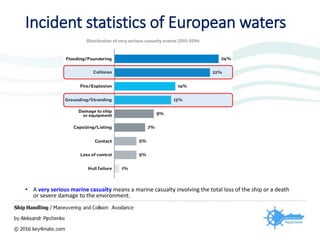
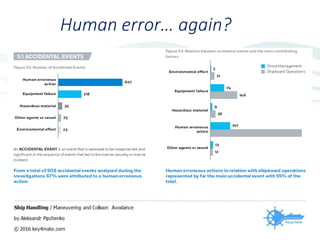
Incident statistics of European waters
• A very serious marine casualty means a marine casualty involving the total loss of the ship or a death
or severe damage to the environment.
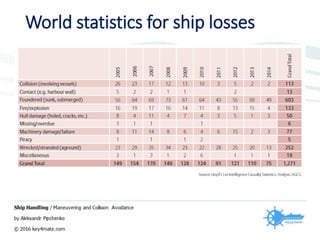
World statistics for ship losses
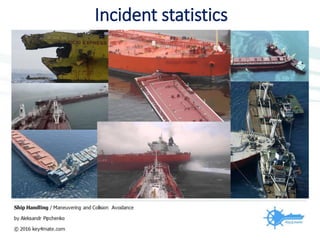
Incident statistics
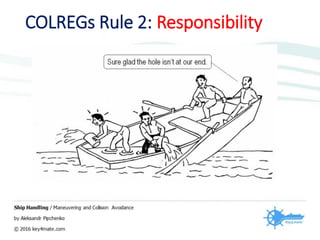
COLREGs Rule 2: Responsibility
Rule 2 (a) requires you to follow both the rules and ‘the ordinary practice of
seamen’. This means that you must always
USE COMMON SENSE
Rule 2 (b) is often misunderstood so read it carefully. It only allows you to
depart from the rules if that is
THE ONLY WAY TO AVOID AN IMMEDIATE DANGER
But, in almost every situation, it is the proper application of the rules that will
keep you out of that danger. Rule 2(b) is never a justification for not following
the rules properly.
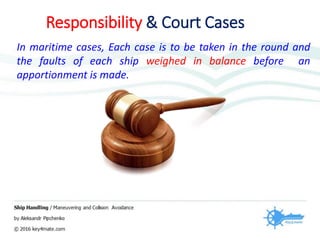
In maritime cases, Each case is to be taken in the round and
the faults of each ship weighed in balance before an
apportionment is made.
Responsibility & Court Cases
Human error… again?
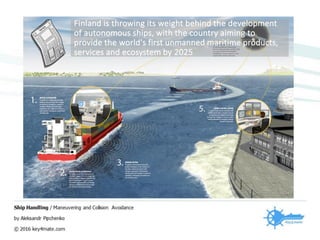
Finland is throwing its weight behind the development
of autonomous ships, with the country aiming to
provide the world's first unmanned maritime products,
services and ecosystem by 2025
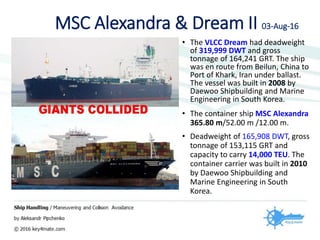
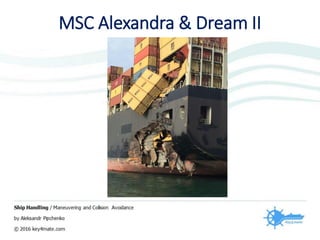
MSC Alexandra & Dream II 03-Aug-16
• The VLCC Dream had deadweight
of 319,999 DWT and gross
tonnage of 164,241 GRT. The ship
was en route from Beilun, China to
Port of Khark, Iran under ballast.
The vessel was built in 2008 by
Daewoo Shipbuilding and Marine
Engineering in South Korea.
• The container ship MSC Alexandra
365.80 m/52.00 m /12.00 m.
• Deadweight of 165,908 DWT, gross
tonnage of 153,115 GRT and
capacity to carry 14,000 TEU. The
container carrier was built in 2010
by Daewoo Shipbuilding and
Marine Engineering in South
Korea.
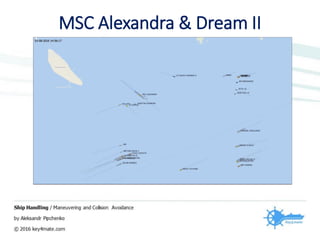
MSC Alexandra & Dream II
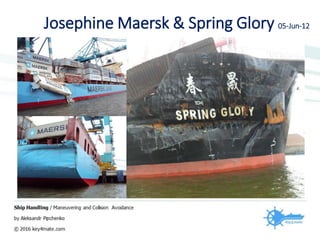
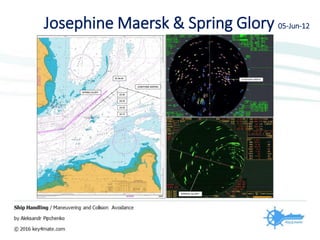
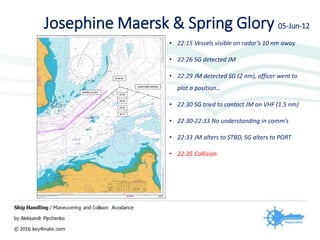
Josephine Maersk & Spring Glory 05-Jun-12
• 22:15 Vessels visible on radar’s 10 nm away
• 22:26 SG detected JM
• 22:29 JM detected SG (2 nm), officer went to
plot a position…
• 22:30 SG tried to contact JM on VHF (1.5 nm)
• 22:30-22:33 No understanding in comm’s
• 22:33 JM alters to STBD, SG alters to PORT
• 22:35 Collision
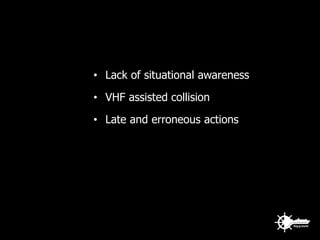
• Lack of situational awareness
• VHF assisted collision
• Late and erroneous actions
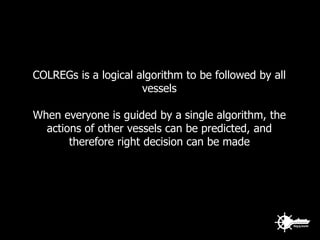
COLREGs is a logical algorithm to be followed by all
vessels
When everyone is guided by a single algorithm, the
actions of other vessels can be predicted, and
therefore right decision can be made
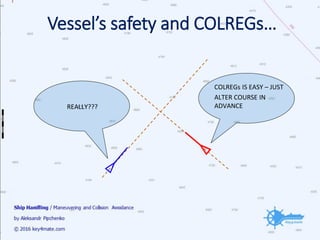
Vessel’s safety and COLREGs…
COLREGs IS EASY – JUST
ALTER COURSE IN
ADVANCEREALLY???
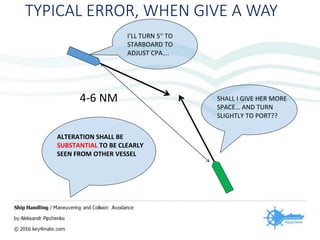
TYPICAL ERROR, WHEN GIVE A WAY
SHALL I GIVE HER MORE
SPACE… AND TURN
SLIGHTLY TO PORT??
4-6 NM
I’LL TURN 5 TO
STARBOARD TO
ADJUST CPA….
ALTERATION SHALL BE
SUBSTANTIAL TO BE CLEARLY
SEEN FROM OTHER VESSEL
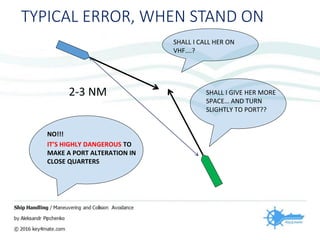
TYPICAL ERROR, WHEN STAND ON
SHALL I GIVE HER MORE
SPACE… AND TURN
SLIGHTLY TO PORT??
2-3 NM
SHALL I CALL HER ON
VHF….?
NO!!!
IT’S HIGHLY DANGEROUS TO
MAKE A PORT ALTERATION IN
CLOSE QUARTERS
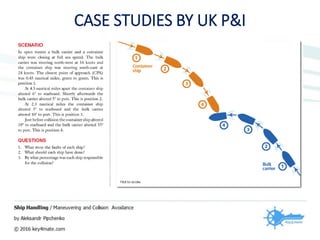
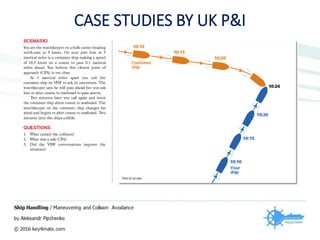
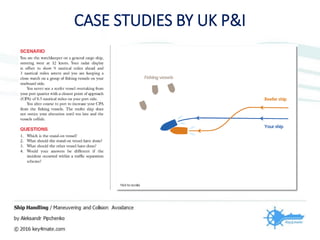
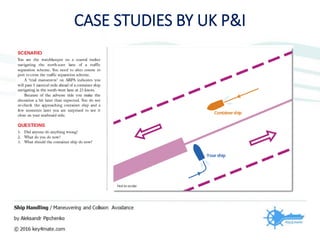
CASE STUDIES BY UK P&I
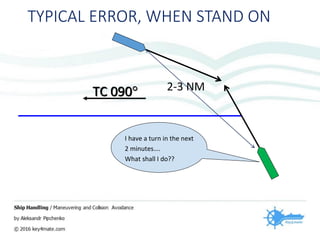
TYPICAL ERROR, WHEN STAND ON
I have a turn in the next
2 minutes….
What shall I do??
2-3 NMTC 090
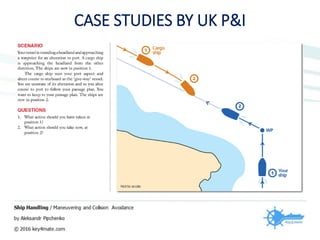
CASE STUDIES BY UK P&I
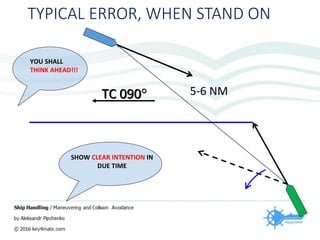
TYPICAL ERROR, WHEN STAND ON
5-6 NMTC 090
YOU SHALL
THINK AHEAD!!!
SHOW CLEAR INTENTION IN
DUE TIME
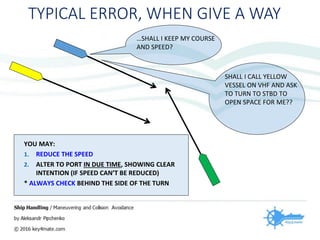
TYPICAL ERROR, WHEN GIVE A WAY
SHALL I CALL YELLOW
VESSEL ON VHF AND ASK
TO TURN TO STBD TO
OPEN SPACE FOR ME??
…SHALL I KEEP MY COURSE
AND SPEED?
YOU MAY:
1. REDUCE THE SPEED
2. ALTER TO PORT IN DUE TIME, SHOWING CLEAR
INTENTION (IF SPEED CAN’T BE REDUCED)
* ALWAYS CHECK BEHIND THE SIDE OF THE TURN
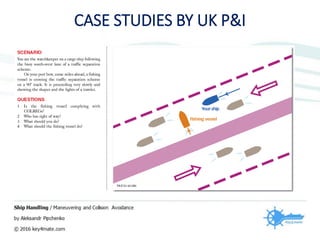
CASE STUDIES BY UK P&I
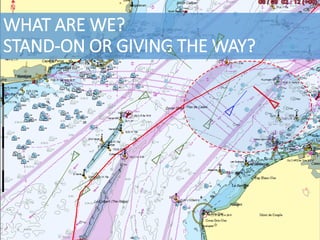
WHAT ARE WE?
STAND-ON OR GIVING THE WAY?
CASE STUDIES BY UK P&I
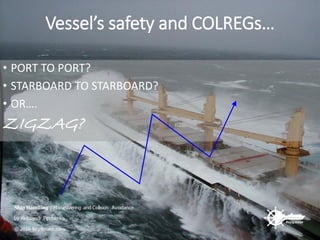
Vessel’s safety and COLREGs…
• PORT TO PORT?
• STARBOARD TO STARBOARD?
• OR….
ZIGZAG?
What is close quarters?
• There’s no common definition for that…
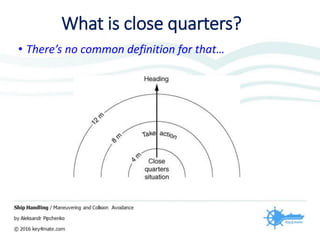
What is close quarters?
• There’s no common definition for that…
When is too late?
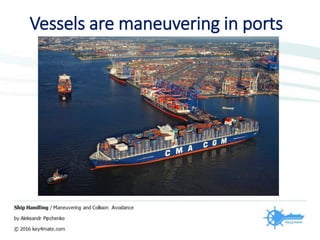
Vessels are maneuvering in ports
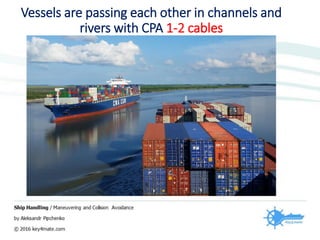
Vessels are passing each other in channels and
rivers with CPA 1-2 cables
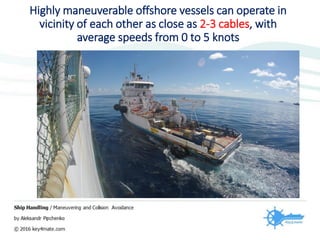
Highly maneuverable offshore vessels can operate in
vicinity of each other as close as 2-3 cables, with
average speeds from 0 to 5 knots
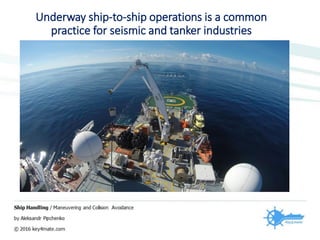
Underway ship-to-ship operations is a common
practice for seismic and tanker industries
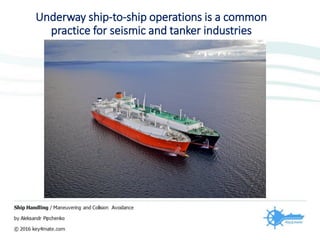
Underway ship-to-ship operations is a common
practice for seismic and tanker industries
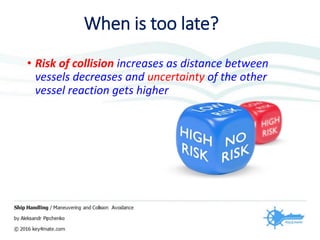
• Risk of collision increases as distance between
vessels decreases and uncertainty of the other
vessel reaction gets higher
When is too late?
• Rule 17: Action by stand-on vessel
• Stand-on vessel may however take action to avoid collision by her
manoeuvre alone, as soon as it becomes apparent to her that the
vessel required to keep out of the way is not taking appropriate
action in compliance with these Rules.
• When, from any cause, the vessel required to keep her course and
speed finds herself so close that collision cannot be avoided by
the action of the give-way vessel alone, she shall take such action
as will best aid to avoid collision.
• A power-driven vessel which takes action in a crossing situation in
accordance with this Rule to avoid collision with another power-
driven vessel shall, if the circumstances of the case admit, not
alter course to port for a vessel on her own port side.
When is too late?
When is too late?
When is too late?
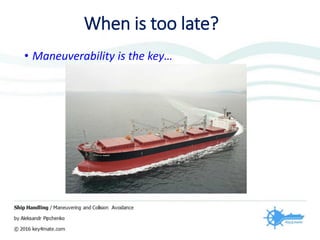
• Maneuverability is the key…
Complacency & the last moment maneuver
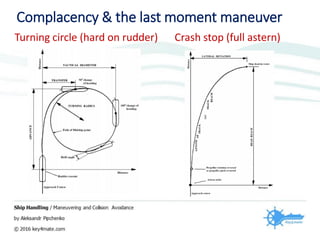
Turning circle (hard on rudder) Crash stop (full astern)
Complacency & the last moment maneuver
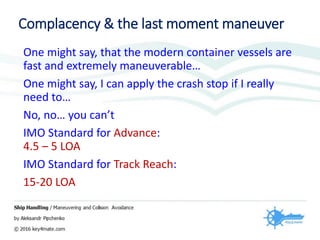
One might say, that the modern container vessels are
fast and extremely maneuverable…
One might say, I can apply the crash stop if I really
need to…
No, no… you can’t
IMO Standard for Advance:
4.5 – 5 LOA
IMO Standard for Track Reach:
15-20 LOA
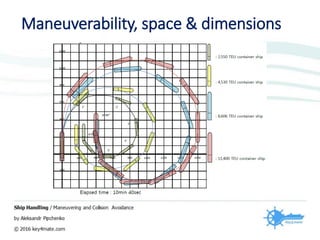
Maneuverability, space & dimensions
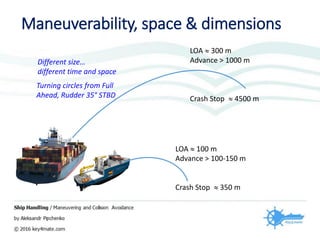
LOA  300 m
Advance > 1000 m
Crash Stop  4500 m
LOA  100 m
Advance > 100-150 m
Crash Stop  350 m
Different size…
different time and space
Turning circles from Full
Ahead, Rudder 35° STBD
Maneuverability, space & dimensions
Complacency & the last moment maneuver
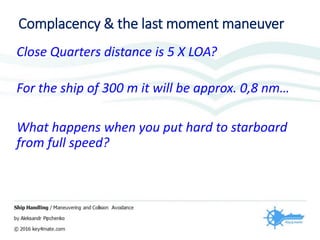
Close Quarters distance is 5 X LOA?
For the ship of 300 m it will be approx. 0,8 nm…
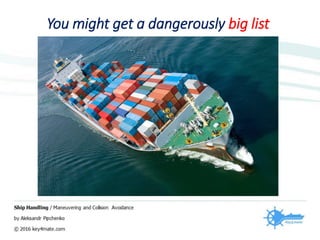
What happens when you put hard to starboard
from full speed?
You might get a dangerously big list
You lose control over the vessel, until you
finish the manoeuvre
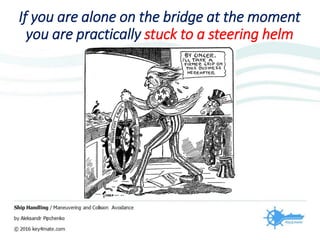
If you are alone on the bridge at the moment
you are practically stuck to a steering helm
What to do, if you see that its critical?
• Reduce your speed, it will give you more time and
lessen the severity
• Do a maneuver earlier. If you turn with 10°
alteration your advance will be 7-10 LOA, list will
not be too bad
For LOA = 300 m, 2100 – 3000 m : 1,13 – 1,62 nm
• Autopilot maneuver takes time, but you have your
hands free
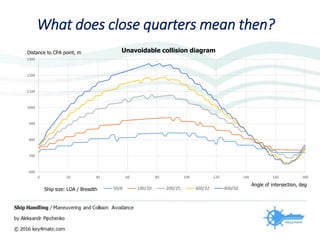
What does close quarters mean then?
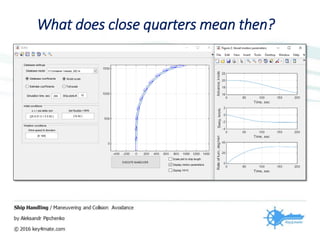
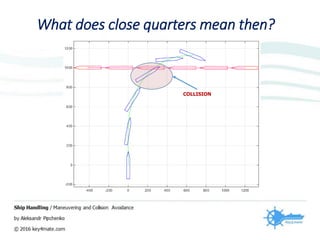
• If you do an alteration with 10° rudder or similar
ROT on Autopilot for 300 LOA you need to be at
least 2 nm away
• So anything less will be the point of no-return or
high risk zone
• 2 nm with 20 knots – TCPA – 6 min
• 2nm with 10 knots – TCPA – 12 min
• Not much time, when you are in anxiety…
What does close quarters mean then?
COLLISION
What does close quarters mean then?
0
0.1
0.2
0.3
0.4
0.5
0.6
0.7
0.8
0.9
1
0 20 40 60 80 100 120 140 160 180
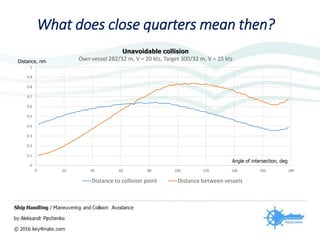
Unavoidable collision
Own vessel 282/32 m, V = 20 kts, Target 300/32 m, V = 15 kts
Distance to collision point Distance between vessels
Distance, nm
What does close quarters mean then?
600
700
800
900
1000
1100
1200
1300
0 20 40 60 80 100 120 140 160 180
Unavoidable collision diagram
50/8 100/20 200/25 300/32 400/50Ship size: LOA / Breadth
Angle of intersection, deg
Distance to CPA point, m
THANK YOU FOR YOUR
ATTENTION!

MANEUVERING & COLLISION AVOIDANCE

  • 1.
  • 2.
    Incident statistics ofEuropean waters • A very serious marine casualty means a marine casualty involving the total loss of the ship or a death or severe damage to the environment.
  • 3.
  • 4.
  • 5.
    COLREGs Rule 2:Responsibility
  • 6.
    Rule 2 (a)requires you to follow both the rules and ‘the ordinary practice of seamen’. This means that you must always USE COMMON SENSE
  • 7.
    Rule 2 (b)is often misunderstood so read it carefully. It only allows you to depart from the rules if that is THE ONLY WAY TO AVOID AN IMMEDIATE DANGER But, in almost every situation, it is the proper application of the rules that will keep you out of that danger. Rule 2(b) is never a justification for not following the rules properly.
  • 8.
    In maritime cases,Each case is to be taken in the round and the faults of each ship weighed in balance before an apportionment is made. Responsibility & Court Cases
  • 9.
  • 10.
    Finland is throwingits weight behind the development of autonomous ships, with the country aiming to provide the world's first unmanned maritime products, services and ecosystem by 2025
  • 11.
    MSC Alexandra &Dream II 03-Aug-16 • The VLCC Dream had deadweight of 319,999 DWT and gross tonnage of 164,241 GRT. The ship was en route from Beilun, China to Port of Khark, Iran under ballast. The vessel was built in 2008 by Daewoo Shipbuilding and Marine Engineering in South Korea. • The container ship MSC Alexandra 365.80 m/52.00 m /12.00 m. • Deadweight of 165,908 DWT, gross tonnage of 153,115 GRT and capacity to carry 14,000 TEU. The container carrier was built in 2010 by Daewoo Shipbuilding and Marine Engineering in South Korea.
  • 12.
  • 13.
  • 14.
    Josephine Maersk &Spring Glory 05-Jun-12
  • 15.
    Josephine Maersk &Spring Glory 05-Jun-12
  • 16.
    Josephine Maersk &Spring Glory 05-Jun-12 • 22:15 Vessels visible on radar’s 10 nm away • 22:26 SG detected JM • 22:29 JM detected SG (2 nm), officer went to plot a position… • 22:30 SG tried to contact JM on VHF (1.5 nm) • 22:30-22:33 No understanding in comm’s • 22:33 JM alters to STBD, SG alters to PORT • 22:35 Collision
  • 17.
    • Lack ofsituational awareness • VHF assisted collision • Late and erroneous actions
  • 18.
    COLREGs is alogical algorithm to be followed by all vessels When everyone is guided by a single algorithm, the actions of other vessels can be predicted, and therefore right decision can be made
  • 19.
    Vessel’s safety andCOLREGs… COLREGs IS EASY – JUST ALTER COURSE IN ADVANCEREALLY???
  • 20.
    TYPICAL ERROR, WHENGIVE A WAY SHALL I GIVE HER MORE SPACE… AND TURN SLIGHTLY TO PORT?? 4-6 NM I’LL TURN 5 TO STARBOARD TO ADJUST CPA…. ALTERATION SHALL BE SUBSTANTIAL TO BE CLEARLY SEEN FROM OTHER VESSEL
  • 21.
    TYPICAL ERROR, WHENSTAND ON SHALL I GIVE HER MORE SPACE… AND TURN SLIGHTLY TO PORT?? 2-3 NM SHALL I CALL HER ON VHF….? NO!!! IT’S HIGHLY DANGEROUS TO MAKE A PORT ALTERATION IN CLOSE QUARTERS
  • 22.
  • 23.
    TYPICAL ERROR, WHENSTAND ON I have a turn in the next 2 minutes…. What shall I do?? 2-3 NMTC 090
  • 24.
  • 25.
    TYPICAL ERROR, WHENSTAND ON 5-6 NMTC 090 YOU SHALL THINK AHEAD!!! SHOW CLEAR INTENTION IN DUE TIME
  • 26.
    TYPICAL ERROR, WHENGIVE A WAY SHALL I CALL YELLOW VESSEL ON VHF AND ASK TO TURN TO STBD TO OPEN SPACE FOR ME?? …SHALL I KEEP MY COURSE AND SPEED? YOU MAY: 1. REDUCE THE SPEED 2. ALTER TO PORT IN DUE TIME, SHOWING CLEAR INTENTION (IF SPEED CAN’T BE REDUCED) * ALWAYS CHECK BEHIND THE SIDE OF THE TURN
  • 27.
  • 28.
  • 29.
    WHAT ARE WE? STAND-ONOR GIVING THE WAY?
  • 31.
  • 32.
  • 34.
    Vessel’s safety andCOLREGs… • PORT TO PORT? • STARBOARD TO STARBOARD? • OR…. ZIGZAG?
  • 35.
    What is closequarters? • There’s no common definition for that…
  • 36.
    What is closequarters? • There’s no common definition for that…
  • 37.
  • 38.
  • 39.
    Vessels are passingeach other in channels and rivers with CPA 1-2 cables
  • 40.
    Highly maneuverable offshorevessels can operate in vicinity of each other as close as 2-3 cables, with average speeds from 0 to 5 knots
  • 41.
    Underway ship-to-ship operationsis a common practice for seismic and tanker industries
  • 42.
    Underway ship-to-ship operationsis a common practice for seismic and tanker industries
  • 43.
    • Risk ofcollision increases as distance between vessels decreases and uncertainty of the other vessel reaction gets higher When is too late?
  • 44.
    • Rule 17:Action by stand-on vessel • Stand-on vessel may however take action to avoid collision by her manoeuvre alone, as soon as it becomes apparent to her that the vessel required to keep out of the way is not taking appropriate action in compliance with these Rules. • When, from any cause, the vessel required to keep her course and speed finds herself so close that collision cannot be avoided by the action of the give-way vessel alone, she shall take such action as will best aid to avoid collision. • A power-driven vessel which takes action in a crossing situation in accordance with this Rule to avoid collision with another power- driven vessel shall, if the circumstances of the case admit, not alter course to port for a vessel on her own port side. When is too late?
  • 45.
  • 46.
    When is toolate? • Maneuverability is the key…
  • 47.
    Complacency & thelast moment maneuver Turning circle (hard on rudder) Crash stop (full astern)
  • 48.
    Complacency & thelast moment maneuver One might say, that the modern container vessels are fast and extremely maneuverable… One might say, I can apply the crash stop if I really need to… No, no… you can’t IMO Standard for Advance: 4.5 – 5 LOA IMO Standard for Track Reach: 15-20 LOA
  • 49.
    Maneuverability, space &dimensions LOA  300 m Advance > 1000 m Crash Stop  4500 m LOA  100 m Advance > 100-150 m Crash Stop  350 m Different size… different time and space Turning circles from Full Ahead, Rudder 35° STBD
  • 50.
  • 51.
    Complacency & thelast moment maneuver Close Quarters distance is 5 X LOA? For the ship of 300 m it will be approx. 0,8 nm… What happens when you put hard to starboard from full speed?
  • 52.
    You might geta dangerously big list
  • 53.
    You lose controlover the vessel, until you finish the manoeuvre
  • 54.
    If you arealone on the bridge at the moment you are practically stuck to a steering helm
  • 55.
    What to do,if you see that its critical? • Reduce your speed, it will give you more time and lessen the severity • Do a maneuver earlier. If you turn with 10° alteration your advance will be 7-10 LOA, list will not be too bad For LOA = 300 m, 2100 – 3000 m : 1,13 – 1,62 nm • Autopilot maneuver takes time, but you have your hands free
  • 56.
    What does closequarters mean then? • If you do an alteration with 10° rudder or similar ROT on Autopilot for 300 LOA you need to be at least 2 nm away • So anything less will be the point of no-return or high risk zone • 2 nm with 20 knots – TCPA – 6 min • 2nm with 10 knots – TCPA – 12 min • Not much time, when you are in anxiety…
  • 57.
    What does closequarters mean then?
  • 58.
    What does closequarters mean then? COLLISION
  • 59.
    What does closequarters mean then? 0 0.1 0.2 0.3 0.4 0.5 0.6 0.7 0.8 0.9 1 0 20 40 60 80 100 120 140 160 180 Unavoidable collision Own vessel 282/32 m, V = 20 kts, Target 300/32 m, V = 15 kts Distance to collision point Distance between vessels Distance, nm
  • 60.
    What does closequarters mean then? 600 700 800 900 1000 1100 1200 1300 0 20 40 60 80 100 120 140 160 180 Unavoidable collision diagram 50/8 100/20 200/25 300/32 400/50Ship size: LOA / Breadth Angle of intersection, deg Distance to CPA point, m
  • 61.
    THANK YOU FORYOUR ATTENTION!