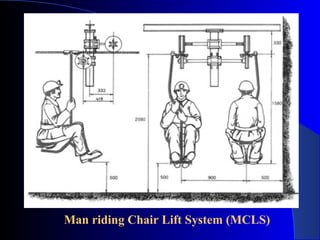
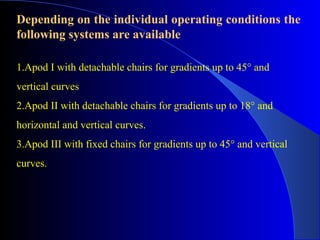
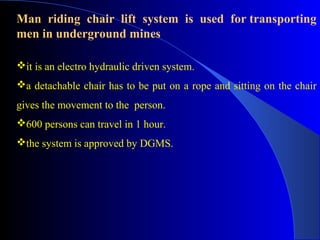
WIRE ROPES

          Presented by
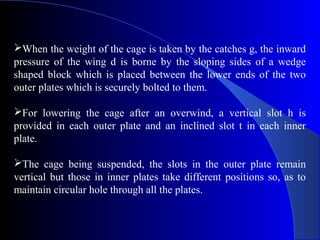
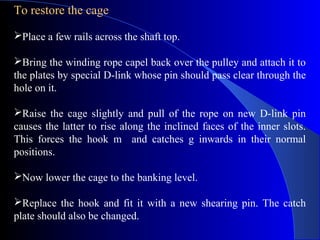
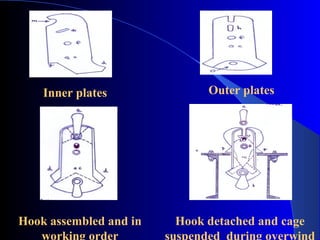
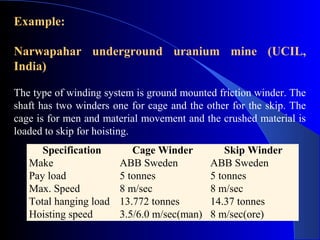
    Prof. Devidas S. Nimaje
      Assistant Professor


Department of Mining Engineering
 National Institute of Technology
    Rourkela-769008, INDIA
Wire ropes are made from steel wires of plain carbon steel having
high tensile strength.

Typical analysis of steel is as follows (by weight percentage):

Carbon – 0.5
Silicon – 0.11
Manganese – 0.48
Sulphur – 0.033
Phosphorous – 0.014 and
Iron – rest

According to I.S. Specification no. 1835 of 1961, neither sulphur
nor phosphorous content in the steel for wire rope should exceed
0.080 %.

Ultimate tensile strength (breaking strength) of the wires used for
haulage/winding ropes is generally between 140 – 170 kgf/mm2
            2              2
Ropes of stainless steel are not used as the material has less tensile
strength.

If the wire rope is to be used in a wet shaft, the wires are
galvanized, i.e. coated with molten zinc.
The wire is subjected to the following tests carried out according
to the standards provided by I.S. specifications:

1.Tensile test

2.Torsion test

3.Bending test

4.Wrapping test

5.Looping test
Types and construction of wire ropes:

On the basis of use, wire ropes are classified as:


Standing Ropes

Required to carry the burden or load but are more or less
stationary. i. e. guide ropes, track ropes etc.

Running Ropes:

Undergo frequent movement, running or coiling often with
varying loads and are flexible e. g. ropes used for winding,
haulage coal cutting machine etc.
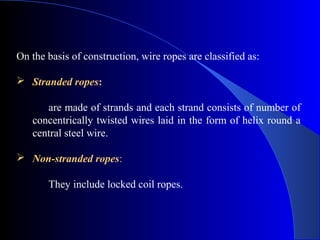
On the basis of construction, wire ropes are classified as:

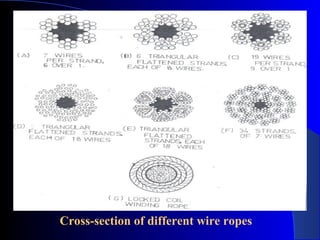
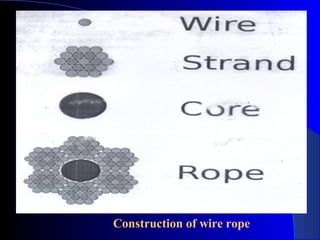
 Stranded ropes:

      are made of strands and each strand consists of number of
   concentrically twisted wires laid in the form of helix round a
   central steel wire.

 Non-stranded ropes:

       They include locked coil ropes.
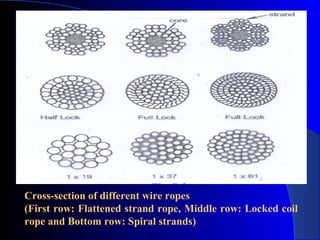
Cross-section of different wire ropes
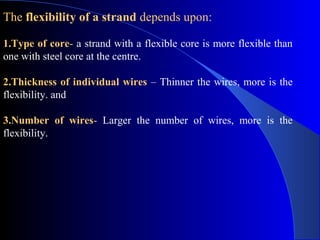
The flexibility of a strand depends upon:

1.Type of core- a strand with a flexible core is more flexible than
one with steel core at the centre.

2.Thickness of individual wires – Thinner the wires, more is the
flexibility. and

3.Number of wires- Larger the number of wires, more is the
flexibility.
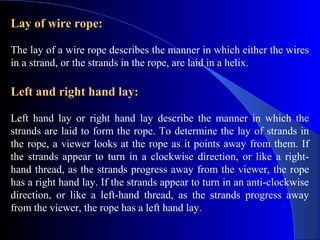
Lay of wire rope:

The lay of a wire rope describes the manner in which either the wires
in a strand, or the strands in the rope, are laid in a helix.

Left and right hand lay:

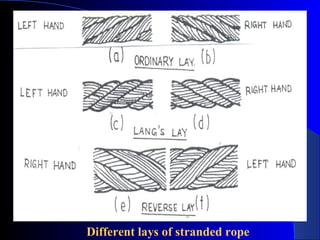
Left hand lay or right hand lay describe the manner in which the
strands are laid to form the rope. To determine the lay of strands in
the rope, a viewer looks at the rope as it points away from them. If
the strands appear to turn in a clockwise direction, or like a right-
hand thread, as the strands progress away from the viewer, the rope
has a right hand lay. If the strands appear to turn in an anti-clockwise
direction, or like a left-hand thread, as the strands progress away
from the viewer, the rope has a left hand lay.
Different lays of stranded rope
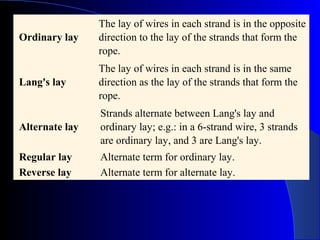
The lay of wires in each strand is in the opposite
Ordinary lay    direction to the lay of the strands that form the
                rope.
                The lay of wires in each strand is in the same
Lang's lay      direction as the lay of the strands that form the
                rope.
                Strands alternate between Lang's lay and
Alternate lay   ordinary lay; e.g.: in a 6-strand wire, 3 strands
                are ordinary lay, and 3 are Lang's lay.
Regular lay     Alternate term for ordinary lay.
Reverse lay     Alternate term for alternate lay.
The specification of a wire rope type – including the number
of wires per strand, the number of strands, and the lay of the rope
– is documented using a commonly accepted coding system,
consisting of a number of abbreviations.

The rope 6x19 FC RH OL FSWR [where 6- Number of strands
that make up the rope, 19 - Number of wires that make up each
strand, FC- Fibre core, RH OL FSWR - Right hand Ordinary lay
Flexible steel wire rope].
Construction of wire rope
Warrington differs from the other types (Filler Wire and Seale
construction) in that the outside layer of wires in each strand of the
wire rope is composed of wires alternately large and small. The
outside wires of both the Filler Wire and Seale construction ropes
are uniform in size.

The fundamental difference between these types is that the layer of
wires underneath the outside layer in the Seale type is made up of
wires all of the same size. The wires under the outside layer of the
Filler Wire rope are made up of a combination of main wires, each
of the same size, and smaller filler wires, each of the same size,
nested between the main wires. The outside layer of wires,
therefore, is supported partly by the main inside wires and partly
by the filler wires.
Some ropes have shaped or formed (triangular) wires to improve
the wear and bearing properties of the outer layers (rather than
circular drawn wire.

By having different lay directions of the strands and wire (left
and right - also known as S and Z); it is possible to balance the
torque value - resulting in a rope that does not tend to untwist
when load is applied. This is called torque balanced or non-
rotating rope.
Flat Rope:

These are used for winding and are made with a flat construction. It
consists of a number of small ropes or strands laid side by side and
laced or stitched together with soft iron wire. The individual wires
are laid up in opposite direction so that those of adjoining ropes test
closely together. For use with the flat rope, a special winder, known
as the reel winder is designed. This is arranged so that the flat rope
winds upon itself in concentric layers which are retained all the
sides by radial arms or by side plates on the reel. By mounting two
reels upon the common shaft, a partly balanced system of winding
could be arranged. The effect is similar to that of a conical drum
with which the cage at greater depth i.e. the greater suspended load
(including rope) is at smaller diameter. The development of circular
stranded ropes, which are cheaper to manufacturer, more reliable in
use and easier to operate cause them to superside the flat rope and
lead to the development of reel winders by drum
Advantages:

1.Compared to the round stranded ropes, they are more flexible.

2.They have been preferred as balancing ropes on the koepe
system of winding.

Disadvantages:

1.Wear in the rope lacing or stitching which holds the individual
rope section together causes difficulty in operating flat ropes
while repairs are slow and expensive.

2.Their life is much shorter compared to the round stranded
ropes.
Round Wire Rope:

The most important attribute for a winding rope is the ability to
withstand, without permanent deformation, repeated bending under
stress such as when the rope is wound over the head sheave or on
the drum.

This requires a construction which is flexible, which the constituent
members are restrained in their respective positions. A construction
using wires laid evenly in a helix about a central core has these
properties and is able to yield under stress, returning to its original
form when the load is removed.
Advantages:

1. Ability to withstand without permanent deformation
   repeated bending under stress.

2. Flexible

3. It returns to its original form when the load is removed.


Disadvantages:

1. Compared to the flat rope they are less flexible.

2. Compared to the flat rope they have less strength.
Locked Coil Rope:

They differ from standard ropes in construction and are made by
spinning concentric layers of single wire around a core and finishing
with one or more surrounding layer of shaped wires which are inter
locked to restrain, the centre layers and to make a smooth cover.

Each layer of wires is spun in a helix about the centre core. Depending
upon the design one or more of the inner layers are made up of
alternate round and shaped or half locked wires

The outer layers of fully inter locked wires is laid on in the opposite
directions to the inner layers with the result that the rope is almost
non-spinning. The cross section of the locked coil rope shows that the
central portion consists of strands of thick round wires only the outer
layer (or two layers) consists of round wires placed between specially
shaped wires of I section, rail section or trapezoidal so that the wires
lock with one another and the rope surfaces is smooth and plain as
Cross-section of different wire ropes
(First row: Flattened strand rope, Middle row: Locked coil
rope and Bottom row: Spiral strands)
Advantages:

1.It has a major advantage in sinking shafts where guide ropes
are not available.
2.For winding and hoisting purposes a locked coil rope is
sometimes preferred.
3.It has capacity factor which permits a high factor of safety.
4.Their smooth exterior causes less abrasion and wear of the
surface in contact. Hence it gives more durability.
5.It has more space factor (75%). Hence greater strength.
6.It has more tendencies to twist or rotate. It reduces wear on the
cage guide.
7.They are greater strength than the round rope because the wires
are more completely arranged.
8.They are greater resistance to crushing.
9.They have fewer tendencies to twist and stretch in working.
Disadvantages:
1.Construction is somewhat difficult.
2.Its interior cannot be lubricated from outside.
3.It is not so flexible.
4.It is somewhat difficult to cap as compared to the standard ropes.
5.They do not stretch as much as the standard ropes and their
smooth exterior cause less abrasion and wear of the surface in
contact.
6.They are not preferred for koepe winders because of smooth
surface and low coefficient of friction.
Precautions:

1.Avoid use of the rope with fiber core, when the rope is subjected to
heat flames and extreme pressure.
2.Buy right construction of rope suitable for the job.
3.Corrosion can be delayed by using galvanized rope.
4.Do not load the rope beyond its safe working load.
5.Ensure that the rope is strongly seized before it is cut.
6.Flexibility of rope should be suitable to the size of the drums and
pulleys and diameter of the rope grooves.
7.Grease the rope and cover properly before storing in a dry
ventilated shed.
8.Handle the rope carefully while transporting and uncoiling to avoid
kinks.
9.Inspect the rope periodically and lubricate with acid free lubricant.
10.Judge the safe life of the rope for the conditions under which it has
to work and replace it in proper time.
Selection of wire ropes:

A wire rope is to be selected on the following considerations:

1.Watery place and corrosive atmosphere - to prevent rusting and
effect of corrosive fumes, a galvanized wire rope should be used in
such places.

2.High temperature – ropes with fibre core should be avoided and
in such places steel core should be used i.e. in foundries, steel
melting shops, etc.

3.Stationary or running /coiling rope – stationary ropes can be of
larger diameter rods or strands e.g. guide ropes in a shaft. Running or
coiling ropes requires flexibility and smaller the drum/ pulley, more
is the flexibility required.
4. Spinning or rotating quality – in a crane rope, one end is free to
   rotate and a non-spinning rope or one with ordinary lay should be
   used. In a sinking shaft, the sinking bucket is not travelling on
   guides and therefore non-spinning rope of locked coil
   construction or a rope with ordinary lay should be used.

5. Shock loads – when the rope has to withstand shock loads, a rope
   with steel core should be used e.g. coal cutting machine rope.

6. Resistance to wear- Ropes for haulages and winders have to be
   flexible and resistance to abrasive wear. Such ropes should be of
   Lang’s lay construction as they offer more wearing surface.

7. Tensile strength and factor of safety – ropes used for winding of
   men should have high tensile strength and high FOS than those
   used for winding of materials only. Ropes of Lang’s lay
   construction stretches under load more than the rope of regular lay
   construction.
8. Bending fatigue- Bending fatigue of a wire rope over sheaves or
   drums causes fatigue failure of the wires. The rope should be
   flexible which is possible in a rope having large number of
   smaller wires.

9. Groove size – the rope should not be loose or too tight in the
   groove of the pulley or drum.

10. Crushing and distortion – a flattened strand rope and locked coil
    rope is better able to withstand crushing than a round strand rope.
    The core should be of steel wire.

Once the construction lay and other characteristics of the rope are
   decided upon, one has to decide its size after calculating the
   stresses that the rope may have to withstand.
Ropes used for different purposes:

1.Winding ropes:
6 x 7 Lang lay FC
6 x 19 Seale regular or Lang lay FC
6 x 21 Filler wire regular or Lang lay FC
6 x 25 Filler wire regular or Lang lay FC
6 x 27 Flattened strand Lang lay FC
6 x 30 Flattened strand Lang lay FC
Locked coil hoist rope

2.Guide ropes:
3.Half locked coil guide rope
3. Winding rope for shaft sinking:
19 x 7 Non-rotating Regular lay or locked coil hoist rope.

4. Haulage ropes:
6 x 7 and 6 x 19 Seale construction in either Regular or Langs lay FC,
    depending upon operating conditions.

5. Coal cutting machine ropes:
6 x 37 Regular lay with IWRC or 6 x 31 Regular lay with IWRC
.
6. Dipper shovel ropes:
• Dipper hoist ropes:
For 32 mm and smaller size, 6 x 25Filler Lang lay with IWRC
For 35 mm to 68 mm size, 6 x 41 Seale Filler Lang lay with IWRC
• Crowd and Retract ropes:
For 58 mm and smaller size, 6 x 41 Seale Filler Lang lay with IWRC
• Boom Hoist ropes:
For 30 mm size, 6 x 25 Filler wire Lang lay with IWRC
7. Dragline Hoist ropes:
For 32 mm to 58 mm size, 6 x 25 Filler wire Lang lay with IWRC or
6 x 41 Seale Filler Lang lay with IWRC

8. Dozers:
6 x 25 Filler wire Regular lay with IWRC (Blade hoist ropes)

9. Guy Ropes (ship masts- stability:
Galvanised strand 1 x 7, 1x 19, 1 x 37 etc or 7 x 7 or 7 x 19

10. Aerial ropeways:
• Bi-cable ropeway:
Track cable: Locked coil (Full or Half lock)
Traction ropes: 22 mm and larger, 6 x 19 seale Lang Lay FC or 6 x
25 Filler wire Lang lay with IWRC
• Monocable ropeway:
6 x7 Lang lay FC
6 x 21 Filler wire Lang lay FC
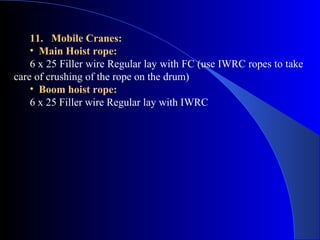
11. Mobile Cranes:
    • Main Hoist rope:
    6 x 25 Filler wire Regular lay with FC (use IWRC ropes to take
care of crushing of the rope on the drum)
    • Boom hoist rope:
    6 x 25 Filler wire Regular lay with IWRC
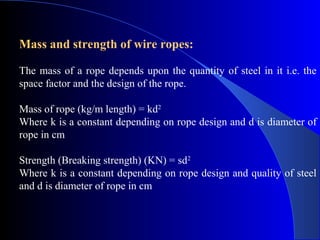
Mass and strength of wire ropes:

The mass of a rope depends upon the quantity of steel in it i.e. the
space factor and the design of the rope.

Mass of rope (kg/m length) = kd2
Where k is a constant depending on rope design and d is diameter of
rope in cm

Strength (Breaking strength) (KN) = sd2
Where k is a constant depending on rope design and quality of steel
and d is diameter of rope in cm
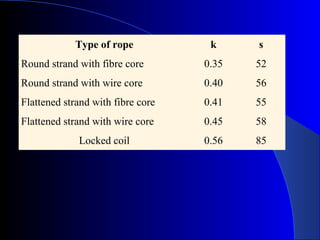
Type of rope            k     s
Round strand with fibre core       0.35   52
Round strand with wire core        0.40   56
Flattened strand with fibre core   0.41   55
Flattened strand with wire core    0.45   58
             Locked coil           0.56   85
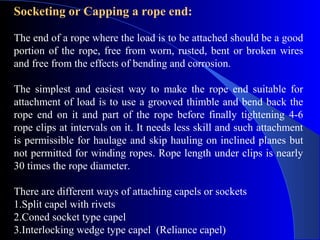
Socketing or Capping a rope end:

The end of a rope where the load is to be attached should be a good
portion of the rope, free from worn, rusted, bent or broken wires
and free from the effects of bending and corrosion.

The simplest and easiest way to make the rope end suitable for
attachment of load is to use a grooved thimble and bend back the
rope end on it and part of the rope before finally tightening 4-6
rope clips at intervals on it. It needs less skill and such attachment
is permissible for haulage and skip hauling on inclined planes but
not permitted for winding ropes. Rope length under clips is nearly
30 times the rope diameter.

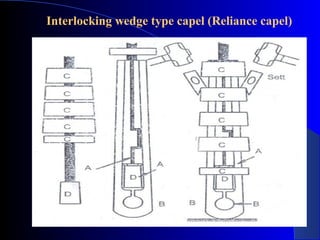
There are different ways of attaching capels or sockets
1.Split capel with rivets
2.Coned socket type capel
3.Interlocking wedge type capel (Reliance capel)
Interlocking wedge type capel (Reliance capel)
TRANSPORT SYSTEM

          Presented by
          Presented by
    Prof. Devidas Nimaje
      Devidas S. S. Nimaje
      Assistant Professor


Department of Mining Engineering
 National Institute of Technology
    Rourkela-769008, INDIA
The main methods of transport are as follows:

A. Rope Haulage
    1. Direct rope haulage
       a. Tail rope haulage
    2. Endless rope haulage
       a. Over-rope
       b. Under-rope
    3. Main and tail rope haulage
    4. Gravity haulage

B. Conveyor system of haulage
    1. Belt conveyor
    2. Cable belt conveyor
3. Chain conveyor
       a. Scraper chain conveyor
       b. Armoured chain conveyor
       c. Gate end loader
       d. Mobile stage loader
       e. Pick-aback conveyor
    4. Plate conveyor
    5. Disc conveyor

C. Locomotive haulage
    a. Diesel locomotive
    b. Electric battery locomotive
    c. Trolley wire locomotive
    d. Cable reel locomotive
    e. Compressed air locomotive
    f. Electro-gyro locomotive

D. Shuttle cars
Underground transport arrangements are divided into two
categories:

1.Main Haulage

2.Gathering haulage

The main haulage arrangement is that which operates between
winding shaft/incline and the main underground loading points. At
the main loading point, the loads are collected from one, two or
more districts.

The gathering haulage arrangement is that which operates between
the working faces and the main loading points.

In a large mine, where the working faces are far from the main
loading point, an intermediate transport arrangement operates and it
is known as secondary haulage.
ROPE HAULAGE

          Presented by
          Presented by
    Prof. Devidas Nimaje
      Devidas S. S. Nimaje
      Assistant Professor


Department of Mining Engineering
 National Institute of Technology
    Rourkela-769008, INDIA
Direct Rope Haulage

 Simplest system employing in the mine.

 consist of one pulling rope and one haulage drum for hauling
  minerals in tubs or mine cars up a gradient which is generally
  steeper than 1 in 10.

 The haulage engine is situated at the top of an inclined roadway.

 The train of tubs is attached to one end of the rope, the other end
  being fixed to the haulage drum.

 The empty tubs attached to the end of the haulage rope travel on
  the down gradient by their own weight and do not require power
  from the haulage engine. The drum shaft is therefore provided
  with a jaw clutch to disengage it from the engine. A slip ring
  motor with drum controller is used.
Advantages:

1.The rope speed is generally 8-12 km/h and the system can operate
between any point of the haulage plane and the haulage engine.

2.It can, therefore, cope with the haulage requirements of an
advancing working face.

3.Only one haulage track is required.

4.The system can also serve branch roads if the gradient is suitable
for down-the-gradient movement of empties by gravity. For this
reason, the branch road deviating at an angle of not more than 40 0
off the main road is convenient.
Disadvantages:

1.High peak power demand as load starts its journey up the
gradient.

2.Severe braking duty on the downward run.

3.High haulage speed demanding high standard of track
maintenance.

4.Not suitable for mild inclination of roads.

5.A derailment is associated with heavy damage because of high
speed.
Direct rope, double drum balanced haulage
 It is the modification of direct rope haulage, two drums are
  provided so that when a train of full tubs is being hauled
  outbye, a set of empty tubs is lowered inbye.

 Both the drums are fitted with clutches and are mounted on
  the same shaft.

 Weights of the rope and the tubs are balanced and only the
  unbalanced load for the engine is mineral.

 This results in a reduced peak power demand and easier
  braking.

 The system gives higher output in each trip of the rope brings
  the loads and there is regular delivery of the loaded tubs.

 The system requires wider roads for the haulage tracks.
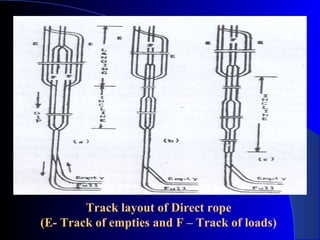
Track layout of Direct rope
(E- Track of empties and F – Track of loads)
Endless rope haulage

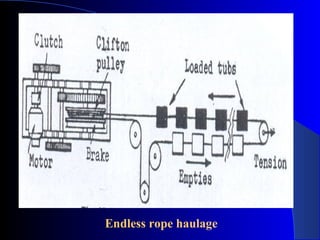
In this system there are two parallel tracks side by side.

One for loaded tubs and another for empty tubs and the endless
rope passing from the driving drum located at out bye end of the
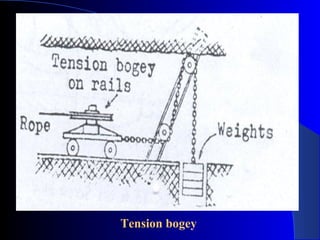
haulage road to the in bye end and back again via a tension bogey.

The tubs loaded as well as empties are attached to the rope with
regular interval with the help of clips so that the entire rope length
has tubs on it at intervals.
Only one end of the tub is attached to the rope at a time. But
where lashing chain is used for attachment the normal practice is
to attach a set of tubs and the attachment or detachment is
performed by stopping the rope if however clips are used for
single tubs they can be attached or detached when the rope is in
motion.

The gradient of haulage road is mild and rarely exceeds 1 in 6.

The rope speed ranges between 3 km/h and 7 km/h and the
haulage is slow moving.

The rope moves in one direction only.
Endless rope haulage
Tension bogey
Types:

There are two types of endless rope haulage.

1.Over Rope type: In over rope type the haulage rope passes
over the tub or set of tubs.

2.Under Rope type: In under rope type it passes beneath the tub
or set of tubs.

Advantages:

1.Because of slow speed, less wear and tear.
2.Accident from derailed tubs does not cause much damage due to
slow speed.
3.Motor of less power required.
4.It does not place heavy demand on the power supply.
Disadvantages:

1.It requires wide roads for two tracks.

2.It is not suitable for sleep gradient.

3.Load on the rope is large and a rope of larger cross-section is
required.

4.Large number of tubs and clips are required as rolling stock.

5.If a breakdown of any tub occurs the whole system comes to a
standstill.

6.It cannot serve a main road and a branch road simultaneously
unless elaborate arrangements are made to course the rope to the
branch line with the help of deflection pulleys. The tubs of main
road rope have to be detached and reattached at the branch line.
Rope clips used in Endless haulage

The tubs, loaded as well as empties, are attached to the rope at
regular intervals with the help of clips, so that the entire rope
length has tubs on it at intervals. When the clips are used for
single tubs they can be attached or detached when the rope is in
motion.

Types of rope clips:

The design of endless haulage rope clips depends on whether the
haulage is of over rope type or of under rope type. Some of the
clips used in the endless haulage are as follows:-

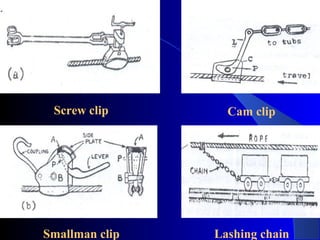
1.Screw Clip
2.Smallman Clip
3.Cam Clip and
4.Lashing Chain
Screw Clip:

This clip is tightened on the rope by a handle and screw and the
   handle is coupled to the draw bar of the tub by a long steel rod
   hinged to the clip.

Smallman Clip:
 consists of a pair of steel cheeks or side plates, loosely held
  together by the adjustable central bolt which has a spring
  surrounding it to keep the plates apart and kept in position by
  pins supporting the lever and the coupling hook.

 The clip can be detached automatically from the rope by fixing
  a bridge-piece or trip bar to a sleeper at such a tight and in
  such a way that the rope passes underneath while the lever of
  the clip strikes against it.
Cam Clip:

This consists of a plate and a cam-shaped lever which is pivoted
and is connected by a small chain to the tub to be hauled. The pull
of the tub turns the lever around the pivot so that the grip of the clip
on the rope is proportional to the load. On undulating roadways, a
clip must be provided at each end of the tub .

Lashing Chain:

The lashing chain is usually 2.5 to 3 m long with a hook at each
end. One hook is attached to the draw bar of the tub and the other
end of the chain is coiled 3 to 4 times around the haulage rope and
is linked to the chain. It slows down the speed of tubs causing less
wear and tear. It helps to prevent accidents by derailing the tubs.
When the lashing chains are used to join tubs, it helps to attach tubs
at different level easily .
Screw clip       Cam clip


Smallman clip   Lashing chain
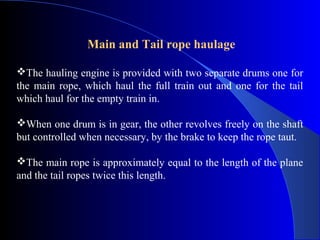
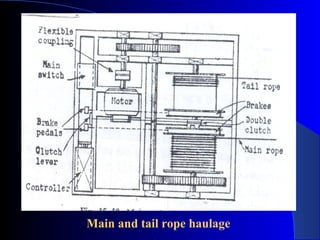
Main and Tail rope haulage

The hauling engine is provided with two separate drums one for
the main rope, which haul the full train out and one for the tail
which haul for the empty train in.

When one drum is in gear, the other revolves freely on the shaft
but controlled when necessary, by the brake to keep the rope taut.

The main rope is approximately equal to the length of the plane
and the tail ropes twice this length.
Only one track is required.

This system of haulage is suitable for undulating roadways
where it is impossible or undesirable to maintain the double track
required for endless rope haulage.

It can readily negotiate curves and it is convenient for working
branches.

It operates at fairly high speeds and with long trains and if a
derailment occurs, the resulting damage and delay likely to be
considerable.
Main and tail rope haulage
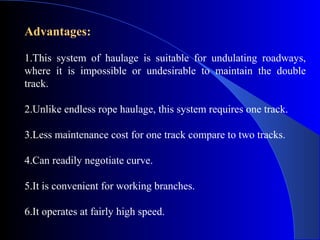
Advantages:

1.This system of haulage is suitable for undulating roadways,
where it is impossible or undesirable to maintain the double
track.

2.Unlike endless rope haulage, this system requires one track.

3.Less maintenance cost for one track compare to two tracks.

4.Can readily negotiate curve.

5.It is convenient for working branches.

6.It operates at fairly high speed.
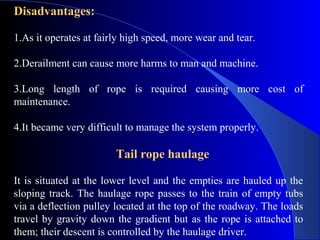
Disadvantages:

1.As it operates at fairly high speed, more wear and tear.

2.Derailment can cause more harms to man and machine.

3.Long length of rope is required causing more cost of
maintenance.

4.It became very difficult to manage the system properly.

                        Tail rope haulage

It is situated at the lower level and the empties are hauled up the
sloping track. The haulage rope passes to the train of empty tubs
via a deflection pulley located at the top of the roadway. The loads
travel by gravity down the gradient but as the rope is attached to
them; their descent is controlled by the haulage driver.
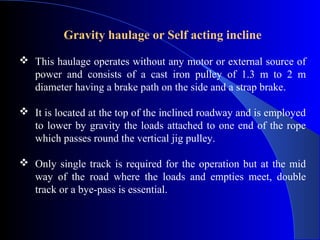
Gravity haulage or Self acting incline
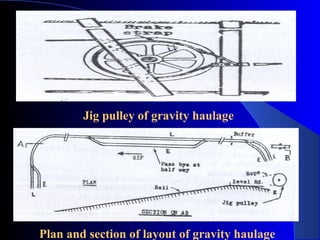
 This haulage operates without any motor or external source of
  power and consists of a cast iron pulley of 1.3 m to 2 m
  diameter having a brake path on the side and a strap brake.

 It is located at the top of the inclined roadway and is employed
  to lower by gravity the loads attached to one end of the rope
  which passes round the vertical jig pulley.

 Only single track is required for the operation but at the mid
  way of the road where the loads and empties meet, double
  track or a bye-pass is essential.
Jig pulley of gravity haulage


Plan and section of layout of gravity haulage
Safety Devices in Haulage

The various safety devices used on haulage roadways are as
follows:

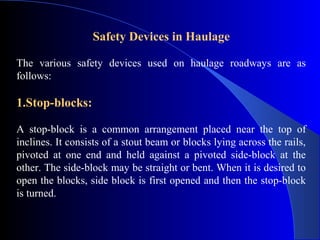
1.Stop-blocks:

A stop-block is a common arrangement placed near the top of
inclines. It consists of a stout beam or blocks lying across the rails,
pivoted at one end and held against a pivoted side-block at the
other. The side-block may be straight or bent. When it is desired to
open the blocks, side block is first opened and then the stop-block
is turned.
2. Buffers:

When any roadways or face is in direct line with a haulage track
and persons may be exposed to danger from runaway tubs, strong
buffer is provided and maintained on haulage road to prevent such
danger; Buffers may be horizontal or vertical.

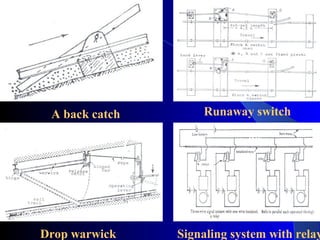
3. Back catches:

It may consist of a pivoted piece of steel rail placed between the
two rails as shown in the figure (monkey catch). Tubs can move
over it only in one direction. In case of backward runway it will
catch the tub axle thus arresting the tubs. A stout wooden block is
pivoted at one end and passed over the rail by a strong spring
allows the tube in one direction only and prevents runway
(backward) in case of spring catch.
4. Pointer plates:

This is fitted on the main haulage track to deflect a backward
runway into the prepared side of the roadway. The derailed tubs
may be automatically re-railed when drawn forward.

5. Drop warwick:

It consists of a girder (heavy type) hinged at one end to a specially
set roof girder and held up at the other by an eye-bolt and pin. The
warwick is released when required in emergency by a haulage
worker pulling the wire to withdraw the pin. It may also be
operated automatically when the uncontrolled movement of tubs
gives long swing to an operating handle.
An obvious disadvantage that excessive impact into the warwick
may displace the roof support, thus causing a roof fall, if the
warwick post (drop girder) is hinged to a roof bar. It is essential
therefore to anchor the warwick to a girder not forming part of the
roof support but firmly set into the side of the roadway. Thought
must also be given to the sitting of the warwick between refuge
holes, avoiding possibility of accidents to persons sheltering
therein. The automatic closing type of warwicks are used which
are balanced by weights. The drop girder is slightly heavier than
the weight rod attachment in this case. The moving tub itself
strikes the weight rod attachment in this case. The moving tub
itself strikes the weight rod to cause dropping of the girder at some
distance.
Such warwicks may be operated by means of:

1.a weight rod suspended from the roof

2.a side warwick in which a side arm is balanced to return to the
closed position either by gravity or by a set of weights after a last
tram has passed, the type has the swinging movement controlled
by balance weights and pulleys.
Where, it is desirable to have the roadway closed that is against
runways when tubs are passing under warwick. It is possible to
connect two warwicks in series so that when one tram opens and
the other is automatically closed. This system can only be installed
where the trams run in one direction.

Warwicks can be arranged to have an automatic tripping device
incorporated whith comes in to operation when the normal speed is
exceeded. This work on the principles that the trams travelling at
normal speed move a pendulum without disconnecting the slip link
which is holding a drop girder by means of a chain and cable. If a
certain speed is exceeded the pendulum is struck a harder blow and
sufficient to release the slip link and thus causing the girder to drop
to the closed position.
6. Agecroft device:

This is designed to arrest forward runways automatically. These
works on the principle that the first axle of the tubs depresses the
higher end of a catch raising the forked end to axle height. If the
tub is passing at normal speed, the forked end drops before the
back axle reaches it. If the tub is moving too fast the back axle is
held by fork and the tub is stopped.

7. Backstays:

Any train of tubs ascending an incline (except endless rope) shall
have a drag or backstay attached to the rear tub so as to prevent
the train from running back. These may be attached to the tub
axle or to the tub drawbar according to their types.
8. Runway switches:

The basic principle of these is that the tubs breaking loose from
a rope are diverted by means of an open track switch.

The runway points are closed by the tub wheels as the train
ascends the incline but they are immediately opened again
automatically by the action of a spring.

Runway tubs are then guided into the side to a place prepared to
receive them.

The points are held in the closed position for tubs descending
the incline, by a light rope attached to a specially designed catch
29-30 m up the incline, which is released by a haulage hand when
the train has gone over the point leaving them in safety position
with the light rope slack.
A form of interconnected stop block and runway switch is used
at the brow of the direct rope haulage plane.

It is so constructed that at one time either the stop block or the
runway switch is effective in the event of a backward runway of a
set of tubs.

It is manually operated by the haulage attendant when the set of
tubs has to pass clear of the stop block.

The distance between the stop block and the safety switch is
sufficient to accommodate the full length of the train.
9. Jazz rails:
The principle of this device is that tubs travelling at normal
speeds pass over a section of the jazz track negotiating the bend
readily.

If the tubs travel at an excessive speed as in the case of runway
they will fail to get round the bend and a derailment occurs.

Rails should be bent to correct radius.
10. Retarders:

Slowing down and stopping tubs are integral parts of haulage
operations.

A hand operated retarder consists of two planks, lined on the top
with belting and mounted on cams. An end cover plank fastened to
the inside faces of planks serves to hold the plank in position.

They are operated by a single lever. When the cams are fully raised
the tub wheels are lifted clear to the rails and a braking action is
provided on the axle. The tub retarders represent waste of energy and
should be avoided in planning. However the speedy movement of
tubs required for quick turnover and higher raising may make its
application essential at pit tops, pit bottoms, haul browheads, etc.
there are many types of elaborate designs and manually controlled.
Smooth braking may be effected by air or hydraulic braking.
 Fully automatic retarders, which are released by pneumatic
  cylinders, are widely used.

 The device consists of two pairs of hinged bars faced with
  renewable skid plates and breaking action effected by
  movements of two opposing pistons in a cylinder containing air.

 The bars are raised above rail level and grip the wheels. When
  no braking is desired, the valve releasing to the atmosphere is
  opened after cutting off compressed air supply. A spring draws
  back the braking bars to normal position.

 Automatic hydraulic tub retarder is suitable for locomotive
  haulage or ordinary rope haulages. The hydraulic pressure is
  supplied from a 1-2 KW electrically driven pump. The
  oncoming tram is retarded by the tread of the leading wheels
  running between fixed skids and an inclined hinged platform
  which acts as wedges.
10. Approach warning device:
It is sometimes necessary to warn men working or travelling in a
haulage roadway.

A simple way of operating a warning device in rope haulage
roads is an arm protruding into the path of oncoming trams which
when deflects closes an electric circuits connected to a signal lamp
or bell.

The device is operated by a lever depressed by tram axle.
A back catch       Runaway switch


Drop warwick    Signaling system with relay
LOCOMOTIVE HAULAGE

           Presented by
           Presented by
     Prof. Devidas Nimaje
       Devidas S. S. Nimaje
       Assistant Professor


 Department of Mining Engineering
  National Institute of Technology
     Rourkela-769008, INDIA
1. Where the gradient of the roadway is mild. Nearly flat gradient
   is preferred. A gradient of 1 in 15 against the loads is considered
   to be limit though locos are generally employed on gradients
   milder than 1 in 25.

2. Where the loco track is in settled ground not subjected to
   movement by mining operations.

3. In the intake airways where the velocity is adequate to keep
   firedamp percentage appreciably low. If diesel locos are used
   the exhaust gases of the locos should be diluted by the air
   current sufficiently well so as to be unharmful to the workers.

4. Where roads are reasonably wide and high.

5. Where transport of mine cars involve long haul distances. Small
   locos for shunting and marshalling at pit bottom are common.
Types:

1.Diesel Locomotive

2.Electric battery locomotive and

3.Overhead wire locomotive (Trolley wire locomotive)
Diesel Locomotive

 It is commonly used. Their weight ranges from 3 to 15 te and
  the power from 15 to 75 KW.

 The power unit is a diesel engine with 2,3 or 4 cylinders of 4
  stroke cycle, compression ignition type. Heavy duty locos are
  of 6 cylinders.

 Locos used in an underground coal mines have the power unit
  in a flameproof enclosure as a safeguard against ignition of
  firedamp.

 The intake air going to the engine passes first through a filter
  and then through a flame trap. Similar flame trap is fitted on
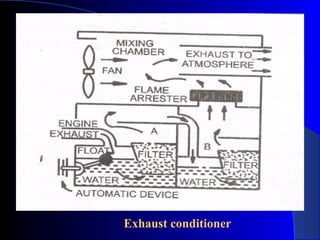
  the exhaust side of the diesel engine [Exhaust conditioner].
The exhaust gases from the engine (very low CO%, O2, N2, CO2
and small quantity of oxides of sulphur and nitrogen mixed with
certain organic compounds like aldehydes which smell
abominably and cause irritation to the nose, throat and eyes)
amounting to all about 0.085 m3/BHP/min are conducted to the
exhaust conditioner, the hot gases are cooled down, filtered ( slag
wool) properly and the flames are trapped inside the exhaust
conditioner ( to remove oxides and aldehydes) and then the gases
are mixed with about 30 - 40 times their volume of fresh air
before being exhausted into the ventilating current.
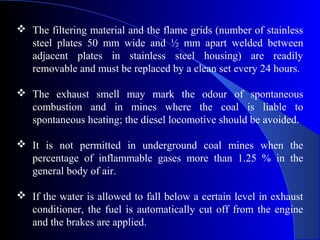
 The filtering material and the flame grids (number of stainless
  steel plates 50 mm wide and ½ mm apart welded between
  adjacent plates in stainless steel housing) are readily
  removable and must be replaced by a clean set every 24 hours.

 The exhaust smell may mark the odour of spontaneous
  combustion and in mines where the coal is liable to
  spontaneous heating; the diesel locomotive should be avoided.

 It is not permitted in underground coal mines when the
  percentage of inflammable gases more than 1.25 % in the
  general body of air.

 If the water is allowed to fall below a certain level in exhaust
  conditioner, the fuel is automatically cut off from the engine
  and the brakes are applied.
Exhaust conditioner
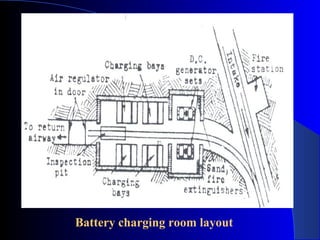
Electric battery locomotive

The power unit is a DC electric motor receiving its current from
a storage battery carried in a casing on the upper part of the chasis.

It is for light and medium duties as they are less powerful,
though battery locos of 13 te weight available in our country.

Range is from 4 – 70 KW continuous rating.

It is quiet in operation and produces no objectionable fumes,
produces less heat, can meet an appreciable overload of short
duration.
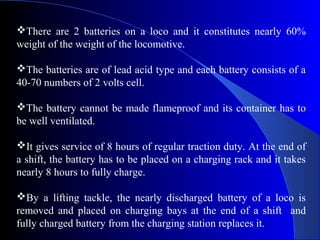
There are 2 batteries on a loco and it constitutes nearly 60%
weight of the weight of the locomotive.

The batteries are of lead acid type and each battery consists of a
40-70 numbers of 2 volts cell.

The battery cannot be made flameproof and its container has to
be well ventilated.

It gives service of 8 hours of regular traction duty. At the end of
a shift, the battery has to be placed on a charging rack and it takes
nearly 8 hours to fully charge.

By a lifting tackle, the nearly discharged battery of a loco is
removed and placed on charging bays at the end of a shift and
fully charged battery from the charging station replaces it.
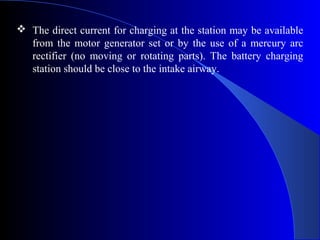
 The direct current for charging at the station may be available
  from the motor generator set or by the use of a mercury arc
  rectifier (no moving or rotating parts). The battery charging
  station should be close to the intake airway.
Battery charging room layout
Overhead wire locomotive (Trolley wire locomotive)
It is equipped with electric motor fed with current from
overhead electric wire through a pantagraph or through a long pole
which is kept pressed against the overhead conductor by spring
tension.

Only direct current is supplied to the overhead wires though in
some foreign countries A.C. is permitted (conversion equipment is
not required but shock hazards are much more serious). The D.C
supply to overhead wires is at 250 volts.

 It is used in a number of coal mines near Kurasia colliery and
few other coal mines of degree-1 gassiness though DGMS office is
generally conservative to granting permission for their
introduction in underground coal mine.

.
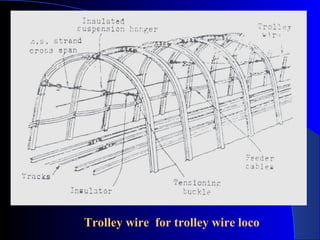
The bare overhead conductors are of hard drawn copper wire
suspended centrally over the track at a height of more than 2 m.
the conductors are suspended through insulators from short cross
wire of mild steel.

An earth leakage wire is connected to cross wire. The rail track
forms the return path for the electric supply circuit and therefore
the former must be suitably bridge at each rail joint by copper
conductors.

Section isolation switches for isolating parts of the roadways
have to be used in easily accessible position to the roadsides.
 The roadways should be sufficiently high and wide to provide
  safe clearance and the ground free from any movement arising
  out of mining operations.

 The roadways have to be equipped with overhead wires and the
  support system.

 Branch roads cannot be negotiated unless they are also so
  equipped.

 Locos are taken to the face by feeding power through a cable
  reel from the terminal of the trolley wire line.

 Mining regulations are stringent in trolley wire locos regarding
  shock to workers and fire damp explosion.

 Such locomotives are used in a wide scale in West Germany in
  deep gassy mines and also American underground coal mines.
Trolley wire for trolley wire loco
Advantages:

1.High Efficiency- of all the other locomotives used in mines,
trolley wire locomotive is more efficient.

2.High Overload capacity- for short periods, especially during
peak loading activity, overloading of the motor do not pose any
problem.

3.Simple maintenance- most of the skilled work is to be done in
the power house.

4.High speed/weight ratio- the motor speed can be easily increased
to give more tractive effort.

5.Reliability- it is robust in construction and not liable to
breakdown.

6.Good control- it gives smooth acceleration and high torque.
AERIAL ROPEWAY

          Presented by
          Presented by
    Prof. Devidas Nimaje
      Devidas S. S. Nimaje
      Assistant Professor


Department of Mining Engineering
 National Institute of Technology
    Rourkela-769008, INDIA
An aerial ropeway is an installation in which transportation of
material or men is effected by moving carriers pulled by ropes
suspended above the ground.

Types:

On the basis of number of ropes and the mode of transportation, the
ropeways are classified as:

1.Mono-cable Ropeway – the ropeway has a single running endless
rope which both support and moves the carriers.

2.Bi-cable Ropeway- the ropeway has two fixed track ropes along
which the carriers are hauled by an endless traction rope.

3.Twin-cable Ropeway- the ropeway has two pairs of track ropes to
support the carriers and one endless traction rope.
Applicability

Aerial ropeway provides the only economic means of long distance
transport over rough country, hilly and difficult terrain, even it can
pass through the congested areas, marshy lands, nallahs, rivers, forests
and important agricultural land.

Aerial ropeways have found wide application in:

1.Transporting and conveying bulk materials between two fixed pts.

2.Aerial dumping of load at any point along the line of route

3.Stocking of materials

4.Dumping of waste materials

5.Transporting of persons in mountainous regions
Advantages:

1.A relatively high transport capacity (upto 500 t/hr)

2.Regularity of service and immunity to all weathers

3.Ability to overcome natural obstructions (rivers, marshy ground etc.)

4.Inherent ability to keep the ground free for other purposes

5.Ability of negotiating steep gradient (70% and over)

6.Possibility of using automation

7.Minimum time lost in transportation

8.Low initial and operating cost and short time for return on capital
Disadvantages:

1.Fixed location of loading station

2.Susceptibility to damage by string winds.

3.The length of the line and transport capacity is limited by
economic and technical consideration.
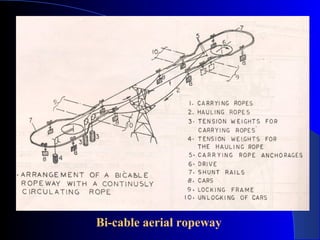
Bi-cable Ropeway

It has following components:

1.Two track ropes or cables stretched at required tension

2.An endless traction rope for handling the loads,

3.Carriers suspended from the track ropes and hauled by the traction
rope and

4.Machinery and other arrangements for loading and unloading
carriers, suspending the track ropes and driving the traction rope.
Bi-cable aerial ropeway
Scope of applicability and Limitations
Bi-cable ropeways are suitable for capacities 100 to 400 t/hr
and

lengths up to 6 km in one section of traction rope.

For capacities less than 100 t/hr and distances less than 300
m, bi-cable ropeway cannot provide the desirable economy.
Different parts
Ropes:

Track ropes:

Track ropes are usually locked coil ropes made of large size wires
in order to have longer life.

 Locked coil ropes provide a smooth surface for the movement of
carrier wheel and the surface wear of it is relatively uniform.

The factor of safety for track rope during installation should be 3
and must be withdrawn from service when it reduces to 2.5.

 Average life of the rope is 5 to 7 years.
Traction rope:
Traction ropes are Six-strand lang’s lay with fibre core.

The rope diameter varies from 12 to 46 mm.

The factor of safety should be 5 during installation and ropes
should be withdrawn when it comes down to 4.
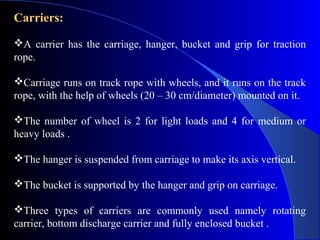
Carriers:

A carrier has the carriage, hanger, bucket and grip for traction
rope.

Carriage runs on track rope with wheels, and it runs on the track
rope, with the help of wheels (20 – 30 cm/diameter) mounted on it.

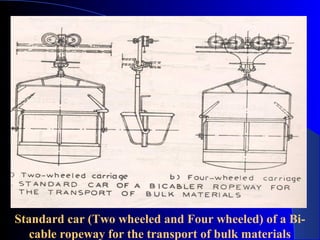
The number of wheel is 2 for light loads and 4 for medium or
heavy loads .

The hanger is suspended from carriage to make its axis vertical.

The bucket is supported by the hanger and grip on carriage.

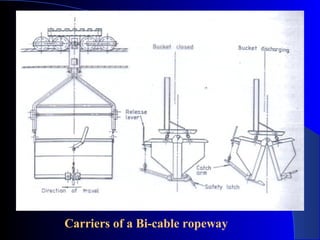
Three types of carriers are commonly used namely rotating
carrier, bottom discharge carrier and fully enclosed bucket .
Carriers of a Bi-cable ropeway
Standard car (Two wheeled and Four wheeled) of a Bi-
   cable ropeway for the transport of bulk materials
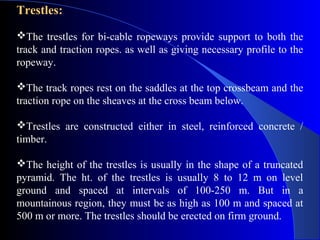
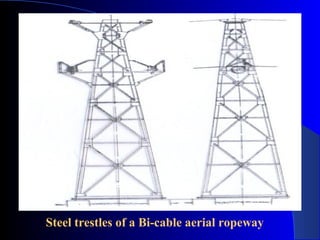
Trestles:
The trestles for bi-cable ropeways provide support to both the
track and traction ropes. as well as giving necessary profile to the
ropeway.

The track ropes rest on the saddles at the top crossbeam and the
traction rope on the sheaves at the cross beam below.

Trestles are constructed either in steel, reinforced concrete /
timber.

The height of the trestles is usually in the shape of a truncated
pyramid. The ht. of the trestles is usually 8 to 12 m on level
ground and spaced at intervals of 100-250 m. But in a
mountainous region, they must be as high as 100 m and spaced at
500 m or more. The trestles should be erected on firm ground.
Steel trestles of a Bi-cable aerial ropeway
Saddles:

These are rolled steel section bent along their longitudinal
central line to allow rope curvature on the support.

The upper part of the saddle is grooved to accommodate and
support the track rope.

For safety against unloading of the rope, the groove dia. should
be 1.5 d and the depth of the groove 0.8d, where d is the diameter
of the rope.
Stations:

Loading station:
Station where carriers are loaded are called loading station and in
bi-cable ropeway it is more complicated than monocable ropeway.

At the loading stations, the track rope tensioning device is
avoided and the end of it is anchored instead. However the
tensioning of the traction rope may be incorporated.
At the entry to station, the carrier leaves the track rope and rides
on the station rail and while leaving it, rides back on the rope. To
facilitate those, rope deflecting saddles are put at the transition
point.

The carriers passes through the arrangement of releasing and
gripping of the traction rope movement of the carrier is controlled
manually or by running chain at automatic station.

Unloading station:

It is the discharged end of the rope way.

The unloading station should be sufficiently high enough above
the ground level to make possible unloading by gravity.
Intermediate station:
When a bi-cable ropeway has more than one section,
intermediate stations are provided where it passes from one
section to another.

Arrangements are there for tensioning.

Angle station:
When it is not possible to take a straight line route, angle
station are provided to change the direction of route.

Here the track ropes of adjacent arms terminate by means of
anchorage or tensioning arrangement.
Examples:

The following are the particulars of the different ropeways
operating in jharia coalfield, India. These are only meant for
transportation of sand in the different collieries:-

Loyabad ropeway- its starting point is river damodar (villages
Jatudih, Ganeshadih, Jarma and Petia, district Dhanbad ). The
length of the ropeway is 21,777 m.

Terminating and serving points are

1.Badroochuck colliery
2.Mudihih colliery
3.Mudihih-Tentulmari colliery
4.Loyabad colliery
 Sijua-Malkera ropeway- its starting point is river
  damodar( village tangabad, district Dhanbad). The length of the
  ropeway is 14,346 metres.

 Terminating and serving points are-

1. Sijua colliery
2. Malera colliery

 Potkee-kankanee ropeway- its starting point is river damodar
  (village Dhawardah, district Dhanbad). The length of the
  ropeway is 22,265 metres.

 Terminating and serving point are-

1. Kankanee colliery
2. Potkee colliery
BELT CONVEYOR

          Presented by
          Presented by
    Prof. Devidas Nimaje
      Devidas S. S. Nimaje
      Assistant Professor


Department of Mining Engineering
 National Institute of Technology
    Rourkela-769008, INDIA
 The belt conveyor is basically an endless belt in a straight line
  stretched between two drums, one driving the system and the
  other acting as a return drum.

 In coal mines and other mines of stratified deposits, where the
  underground mineral if won by longwall method, the transport
  media which often consists of conveyor .
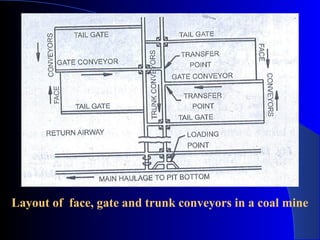
Layout of face, gate and trunk conveyors in a coal mine
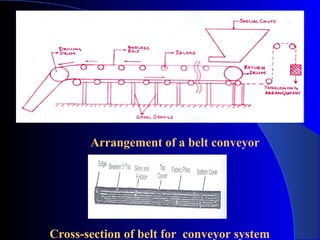
The system of transport by belt conveyor consists of the
following:

1.A flat endless belt which moves continuously and carries at its
top surface the material to be conveyed.

2.The idlers which support the belt.

3.The structure of channel iron on which the idlers are mounted.

4.The tensioning arrangement for keeping the belt in proper
tension.

5.The drums at the discharge and tail end over which the belt
passes.

6.The drive head which comprises the electric motor, coupling,
gearing and snub pulleys
Arrangement of a belt conveyor


Cross-section of belt for conveyor system
Selection of belt conveyor:

1.Amount of material to be conveyed

2.Continuity of operation needed

3.Size of lumps

4.Distance of transportation

5.Environmental allowance

6.Gradient

7.Method of coal winning, i.e. Longwall or Bord and Pillar

•Capital Available
Advantages:

1.A continuous supply of material.

2.Low operating cost than road transportation system.

3.High rate and speed of supply.

4.Bunding can be done to get fair grade.

5.More efficiency and low cost.
Limitations:

Belt conveyor:

1.Cannot be used for long distances

2.Required high one time capital

3.Lumps should not be of big size.

4.Place should be dry enough and air velocity should not be high
.
5.Cannot be worked for high inclinations
Factors for designing of belt conveyor:

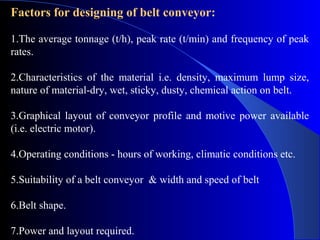
1.The average tonnage (t/h), peak rate (t/min) and frequency of peak
rates.

2.Characteristics of the material i.e. density, maximum lump size,
nature of material-dry, wet, sticky, dusty, chemical action on belt.

3.Graphical layout of conveyor profile and motive power available
(i.e. electric motor).

4.Operating conditions - hours of working, climatic conditions etc.

5.Suitability of a belt conveyor & width and speed of belt

6.Belt shape.

7.Power and layout required.
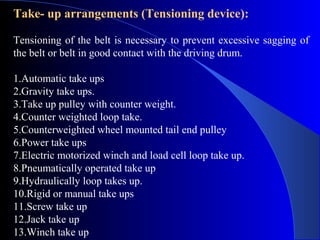
Take- up arrangements (Tensioning device):

Tensioning of the belt is necessary to prevent excessive sagging of
the belt or belt in good contact with the driving drum.

1.Automatic take ups
2.Gravity take ups.
3.Take up pulley with counter weight.
4.Counter weighted loop take.
5.Counterweighted wheel mounted tail end pulley
6.Power take ups
7.Electric motorized winch and load cell loop take up.
8.Pneumatically operated take up
9.Hydraulically loop takes up.
10.Rigid or manual take ups
11.Screw take up
12.Jack take up
13.Winch take up
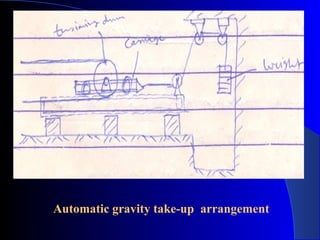
Automatic gravity take-up arrangement
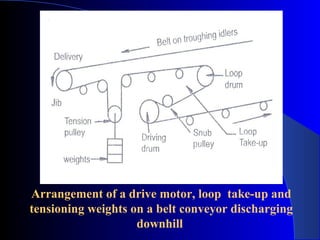
Arrangement of a drive motor, loop take-up and
tensioning weights on a belt conveyor discharging
                    downhill
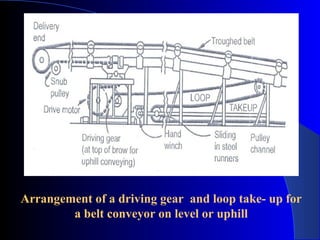
Arrangement of a driving gear and loop take- up for
        a belt conveyor on level or uphill
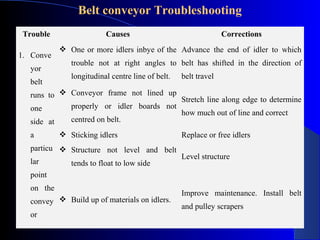
Belt conveyor Troubleshooting
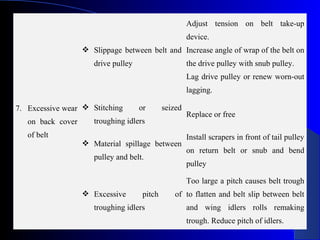
 Trouble                 Causes                                 Corrections
            One or more idlers inbye of the Advance the end of idler to which
1. Conve
              trouble not at right angles to belt has shifted in the direction of
  yor
              longitudinal centre line of belt.   belt travel
  belt
  runs to  Conveyor frame not lined up
                                         Stretch line along edge to determine
  one       properly or idler boards not
                                         how much out of line and correct
  side at   centred on belt.
  a         Sticking idlers                      Replace or free idlers
  particu  Structure not level and belt
                                         Level structure
  lar       tends to float to low side
  point
  on the
                                                  Improve maintenance. Install belt
  convey  Build up of materials on idlers.
                                                  and pulley scrapers
  or
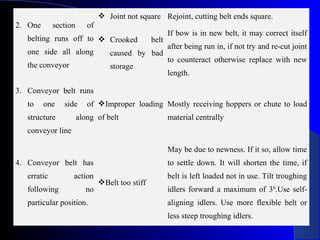
 Joint not square Rejoint, cutting belt ends square.
2. One       section      of
                                                        If bow is in new belt, it may correct itself
   belting runs off to  Crooked                 belt
                                                        after being run in, if not try and re-cut joint
   one side all along             caused by bad
                                                        to counteract otherwise replace with new
   the conveyor                   storage
                                                        length.

3. Conveyor belt runs
   to    one    side      of Improper loading Mostly receiving hoppers or chute to load
   structure           along of belt                    material centrally
   conveyor line

                                                        May be due to newness. If it so, allow time
4. Conveyor belt has                                    to settle down. It will shorten the time, if
   erratic         action                               belt is left loaded not in use. Tilt troughing
                               Belt too stiff
   following             no                             idlers forward a maximum of 30.Use self-
   particular position.                                 aligning idlers. Use more flexible belt or
                                                        less steep troughing idlers.
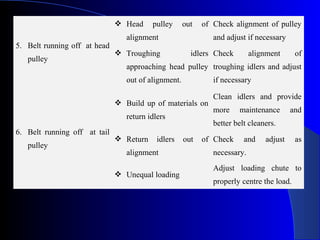
 Head     pulley      out   of Check alignment of pulley
                                 alignment                    and adjust if necessary
5. Belt running off at head
                               Troughing              idlers Check        alignment      of
   pulley
                                 approaching head pulley troughing idlers and adjust
                                 out of alignment.            if necessary

                                                              Clean idlers and provide
                               Build up of materials on
                                                              more    maintenance       and
                                 return idlers
                                                              better belt cleaners.
6. Belt running off at tail
                               Return     idlers    out   of Check     and    adjust     as
   pulley
                                 alignment                    necessary.
                                                              Adjust loading chute to
                               Unequal loading
                                                              properly centre the load.
Adjust tension on belt take-up
                                                       device.
                    Slippage between belt and Increase angle of wrap of the belt on
                      drive pulley                     the drive pulley with snub pulley.
                                                       Lag drive pulley or renew worn-out
                                                       lagging.

7. Excessive wear  Stitching        or       seized
                                                       Replace or free
   on back cover      troughing idlers
   of belt                                             Install scrapers in front of tail pulley
                    Material spillage between
                                                       on return belt or snub and bend
                      pulley and belt.
                                                       pulley

                                                       Too large a pitch causes belt trough
                    Excessive        pitch       of to flatten and belt slip between belt
                      troughing idlers                 and wing idlers rolls remaking
                                                       trough. Reduce pitch of idlers.
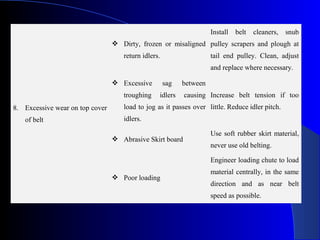
Install   belt   cleaners,   snub
                                  Dirty, frozen or misaligned pulley scrapers and plough at
                                    return idlers.                   tail end pulley. Clean, adjust
                                                                     and replace where necessary.

                                  Excessive         sag   between
                                    troughing    idlers    causing Increase belt tension if too
8. Excessive wear on top cover      load to jog as it passes over little. Reduce idler pitch.
   of belt                          idlers.

                                                                     Use soft rubber skirt material,
                                  Abrasive Skirt board
                                                                     never use old belting.

                                                                     Engineer loading chute to load
                                                                     material centrally, in the same
                                  Poor loading
                                                                     direction and as near belt
                                                                     speed as possible.
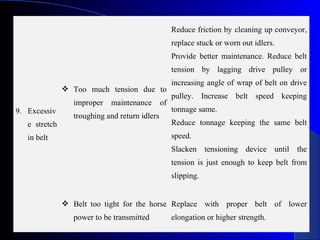
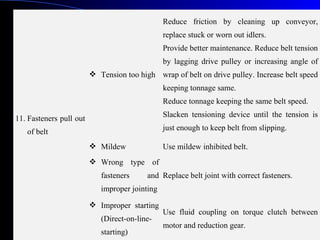
Reduce friction by cleaning up conveyor,
                                                     replace stuck or worn out idlers.
                                                     Provide better maintenance. Reduce belt
                                                     tension by lagging drive pulley or
                                                     increasing angle of wrap of belt on drive
                Too much tension due to
                                                     pulley. Increase belt speed keeping
                  improper   maintenance        of
9. Excessiv                                          tonnage same.
                  troughing and return idlers
   e stretch                                         Reduce tonnage keeping the same belt
   in belt                                           speed.
                                                     Slacken tensioning device until the
                                                     tension is just enough to keep belt from
                                                     slipping.


                Belt too tight for the horse Replace with proper belt of lower
                  power to be transmitted            elongation or higher strength.
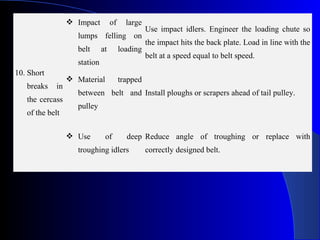
 Impact          of     large
                                                   Use impact idlers. Engineer the loading chute so
                     lumps felling on
                                                   the impact hits the back plate. Load in line with the
                     belt      at        loading
                                                   belt at a speed equal to belt speed.
                     station
10. Short
                   Material             trapped
   breaks    in
                     between belt and Install ploughs or scrapers ahead of tail pulley.
   the cercass
                     pulley
   of the belt

                   Use         of         deep Reduce angle of troughing or replace with
                     troughing idlers              correctly designed belt.
Reduce friction by cleaning up conveyor,
                                                replace stuck or worn out idlers.
                                                Provide better maintenance. Reduce belt tension
                                                by lagging drive pulley or increasing angle of
                          Tension too high wrap of belt on drive pulley. Increase belt speed
                                                keeping tonnage same.
                                                Reduce tonnage keeping the same belt speed.

11. Fasteners pull out                          Slacken tensioning device until the tension is

   of belt                                      just enough to keep belt from slipping.

                          Mildew               Use mildew inhibited belt.
                          Wrong type of
                            fasteners     and Replace belt joint with correct fasteners.
                            improper jointing

                          Improper starting
                                                Use fluid coupling on torque clutch between
                            (Direct-on-line-
                                                motor and reduction gear.
                            starting)
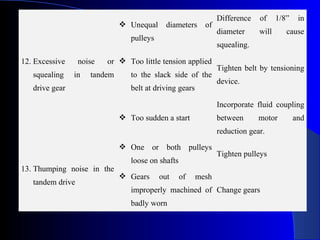
Difference   of     1/8”    in
                               Unequal      diameters     of
                                                                diameter     will      cause
                                 pulleys
                                                                squealing.

12. Excessive     noise   or  Too little tension applied
                                                                Tighten belt by tensioning
   squealing    in   tandem      to the slack side of the
                                                                device.
   drive gear                    belt at driving gears

                                                                Incorporate fluid coupling
                               Too sudden a start              between      motor         and
                                                                reduction gear.
                               One or both pulleys
                                                                Tighten pulleys
                                 loose on shafts
13. Thumping noise in the
                               Gears      out     of    mesh
   tandem drive
                                 improperly machined of Change gears
                                 badly worn
SCRAPER CHAIN CONVEYOR

            Presented by
            Presented by
      Prof. Devidas Nimaje
        Devidas S. S. Nimaje
        Assistant Professor


  Department of Mining Engineering
   National Institute of Technology
      Rourkela-769008, INDIA
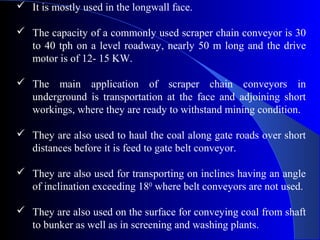
 It is mostly used in the longwall face.

 The capacity of a commonly used scraper chain conveyor is 30
  to 40 tph on a level roadway, nearly 50 m long and the drive
  motor is of 12- 15 KW.

 The main application of scraper chain conveyors in
  underground is transportation at the face and adjoining short
  workings, where they are ready to withstand mining condition.

 They are also used to haul the coal along gate roads over short
  distances before it is feed to gate belt conveyor.

 They are also used for transporting on inclines having an angle
  of inclination exceeding 180 where belt conveyors are not used.

 They are also used on the surface for conveying coal from shaft
  to bunker as well as in screening and washing plants.
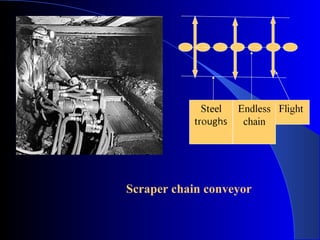
Scraper chain conveyor
Different parts:

1.Trough:

These are stationary things usually 2m long, and consisting of
detachable section bolted together or joined by hooks,

2.Flights:

An endless chain with flights moving in the troughs, which are
nearly 450 mm wide at top and 300 mm at bottom.

3.Chain (endless):

The chain of endless character is installed there. The chain
consists of links and after 3-4 links a flight is provided so, that the
flights are 2-2.5m apart.
4.Tensioning head:

The return or, tail end of the conveyor with its totally enclosed
sprocket drum, is provided with telescopic trough by which the
tension of the chain can be adjusted through Sylvester chain

5.Drive:

For enabling movement a power arrangement with driving
arrangement.

6.Angle iron frame:

to support the troughs.
Types:

On the basis of flexibility—

1.Rigid chain conveyor
2.Flexible / Armoured chain conveyor

On the basis of number of chains used—

1.Single chain conveyor
2.Double centered chain conveyor
3.Double outboard chain conveyor
4.Triple chain conveyor
Rigid chain conveyor:

1.A rigid chain conveyor essentially consists of stationary steel
troughs, each usually 2m long, connected together end to end, and
an endless chain with flights moving in the troughs.

2.Troughs supported on angle iron frame work, slightly dished at
one end. So, that the next one fixed in to form a flush point.

3.Adjacent troughs are secured together and to the frame underway
by both.

4.This gives rigidity to conveyor.

5.The return end is provided with a tensioning arrangement.

6.The capacity is 30- 40 tph on a level roadway, nearly 50m long
and 15KW motor.
Armoured chain conveyor:

1.Used generally on long wall faces, it can be advanced without
dismantling, with hydraulic rams.

2.They can work with lateral or, vertical undulations, and coal
cutting machine and shearers can be mounted on them.

3.Motor power varies between 30 to 185 KW.

4.Pan width at top varies from 750 to 850 mm and pan length from
1.3 to 1.8 m. the vertical flexibility of pans is 3-4 0 and horizontal
flexibility is 2-30.

5. Limiting gradient with flights 1 in 1.5 and without flights 1 in 3.

6. Length may be upto 360 m and capacity is upto 100 tph.
Advantages:

1.Can convey uphill against relatively steep (1 in 3 or more)
gradient as well as of downhill gradient.
2.Much stronger and can be roughly handled.
3.Flexible so, as to dismantle, extended or shortened.

Disadvantages:

1.High initial cost.
2.High power consumption
3.Wear and tear more
4.Highly noisy
5.Producing high percentage of fine dust
SCRAPER HAULAGE

          Presented by
          Presented by
    Prof. Devidas Nimaje
      Devidas S. S. Nimaje
      Assistant Professor


Department of Mining Engineering
 National Institute of Technology
    Rourkela-769008, INDIA
Scraper haulage is the simplest method of transportation of
broken materials where a scraper bucket digs into materials and
transports it by dragging it over natural or specially-prepared
floor.

Types:

Scraper haulage is classified as:


1.Two drum hoist
2.Three drum hoist
a)Without obstacle
b)With obstacle
1. Two drum Scraper hoist:
 There may be different arrangements of scraper haulage
  depending on working conditions and type of scraper hoist
  used.

 The arrangement is generally used where load has to be
  transported along a straight line.

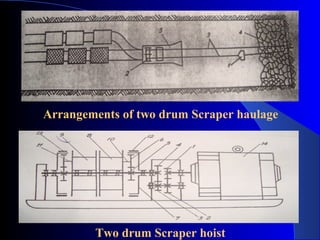
 The main rope is attached to the front end of the scraper
  bucket, while the tail rope passes round a tail block sheave 4
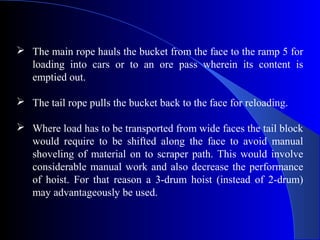
  secured at the face and is fastened to the rear end of the bucket.
 The main rope hauls the bucket from the face to the ramp 5 for
  loading into cars or to an ore pass wherein its content is
  emptied out.

 The tail rope pulls the bucket back to the face for reloading.

 Where load has to be transported from wide faces the tail block
  would require to be shifted along the face to avoid manual
  shoveling of material on to scraper path. This would involve
  considerable manual work and also decrease the performance
  of hoist. For that reason a 3-drum hoist (instead of 2-drum)
  may advantageously be used.
Arrangements of two drum Scraper haulage


        Two drum Scraper hoist
Construction:

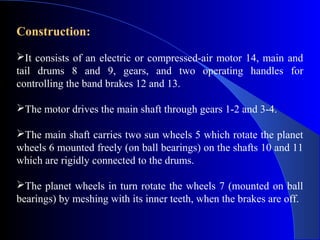
It consists of an electric or compressed-air motor 14, main and
tail drums 8 and 9, gears, and two operating handles for
controlling the band brakes 12 and 13.

The motor drives the main shaft through gears 1-2 and 3-4.

The main shaft carries two sun wheels 5 which rotate the planet
wheels 6 mounted freely (on ball bearings) on the shafts 10 and 11
which are rigidly connected to the drums.

The planet wheels in turn rotate the wheels 7 (mounted on ball
bearings) by meshing with its inner teeth, when the brakes are off.
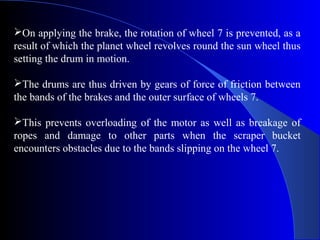
On applying the brake, the rotation of wheel 7 is prevented, as a
result of which the planet wheel revolves round the sun wheel thus
setting the drum in motion.

The drums are thus driven by gears of force of friction between
the bands of the brakes and the outer surface of wheels 7.

This prevents overloading of the motor as well as breakage of
ropes and damage to other parts when the scraper bucket
encounters obstacles due to the bands slipping on the wheel 7.
 Two-drum scraper hoists with sun-and-planet gearing are
  simple and reliable.

 But they have the disadvantage that the tail black has to be
  shifted along face for proper cleaning if the latter is wide
  (otherwise hand-shoveling becomes necessary).

 The more complicated three-drum scraper hoists do not suffer
  from this disadvantage.

 They have similar construction and are fitted with three band
  brakes and consequently three operating handles.
2. Three drum scraper hoist:
In this case three ropes (two tail and one main) are attached to
the bucket and two tail blocks are installed one at each end of the
face so that the scraper bucket may be hauled back to any point
along the face by suitable manipulation of the tail ropes.

The main rope only hails the loaded bucket.

Any modification of this method may be used where the scraper
bucket has to be manipulated around obstacles (for example,
around the pillar).
 In this case, two main and one tail ropes are used.

 One of the main ropes is guided by a guide block while the
  other is guided around the obstacle by a guide roller.

 The loaded bucket is first hauled by the rope passing round
  one guide block sheave to a point clearing one obstacle and
  ones hauled by one, second main rope to one unloading
  point after emptying.

 The bucket is hauled back with the aid of the first main rope
  and the tail rope.

 A similar arrangement may be adopted where the load has
  to be transported along two roadways meeting at an angle.
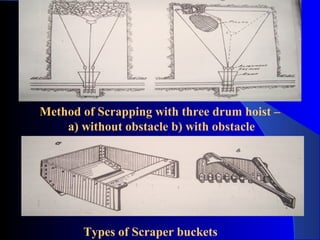
Method of Scrapping with three drum hoist –
    a) without obstacle b) with obstacle


       Types of Scraper buckets
Buckets

Various types of scraper buckets are used in practice, depending
on working conditions and properties of materials to be handled. T

he box-type buckets are suitable for relatively light and well-
fragmented materials. They have a slanting back for easy digging
into the interior and vertical sides for counting the materials during
its transport.

For hard-digging and large-size materials, hoe-type buckets are
used. These dispense with side walls and are often fitted with
detachable manganese-steel digging teeth.
The main factors governing the performance of a scraper bucket
are its weight G and the angle of digging ( the angle between the
slanting back or teeth and the horizontal).

The tare weight of a bucket is usually equal to 0.5 to 0.6 G,
where G is weight of the material in the bucket.

Some types of buckets are provided with arrangements for
increasing their weight by adding two or three cast-iron weights to
improve their digging characteristics.

The angle of digging is chosen as 30 to 35 degree for box-type
buckets and 50 to 60 degree for the hoe-type ones.
Tail Block
 The tail block is anchored to the face by an eye blot wedged in a
  0.5 m deep hole.

 It should be light in weight for easy removal and refixing at face.

 The block sheave is usually 200 to 350 mm in diameter.

                               Ropes
 The ropes for scraper haulage should be flexible and resistant to
  abrasion.

 The parallel-lay rope of Seale-strand construction, in which an
  inner layer of thinner wires is covered with thicker outer wires, is
  most suitable for scraper haulage.
WINDING

          Presented by
          Presented by
    Prof. Devidas Nimaje
      Devidas S. S. Nimaje
      Assistant Professor


Department of Mining Engineering
 National Institute of Technology
    Rourkela-769008, INDIA
Winding system are classified into two groups based on
the device employed to hoist the cage or skip to the
surface:

1.Drum winding

2.Koepe winding (Friction winding)
i.Ground mounted koepe system
ii.Tower mounted koepe system

In the drum winding system, cylindrical drum with tail rope or
bi-cylindro-conical drum are commonly used in most of the mines
because it gives balanced system and reduced the peak power
demand and negative torque.
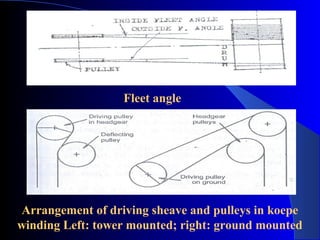
In koepe winding system, the power is transmitted through the
friction between the winding rope and the lining of the sheaves.

In ground mounted koepe system, the winding engine is installed
at the ground level and the headgear sheaves are situated one above
the other or side-by-side on the headgear. The rope operates in the
plane of koepe driving wheel without any angle of fleet.

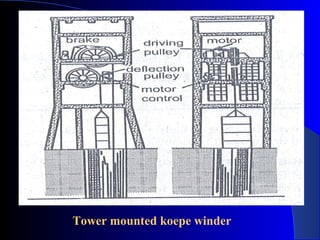
In tower mounted koepe system, the winding engine is installed
on the headgear. It also requires deflecting pulley to deflect the
winding rope.
Tower mounted koepe winder
Selection of Winding system:

It is based on the following factors:

1.Depth: For deeper shaft, koepe winding system is suitable as
compare to drum winding system which is suitable for shallow
shaft.

2.Decking system:For multideck winding system, the drum
winding is suitable.

3.Space: For less space, koepe winding is suitable and for larger
space, drum winding is more suitable.
4.Multilevel: Winding from different levels, drum winding is
suitable while koepe winding is suitable to hoist from one level.

5.Simplicity: Koepe is simple and maintenance is easy.

6.Safety: Drum winding is more safe compare to koepe winding
system.

7.Economic: Koepe is more economic in terms of maintenance,
installation and fitting are easy as compare to drum winding
system
Main Parts of the winding system

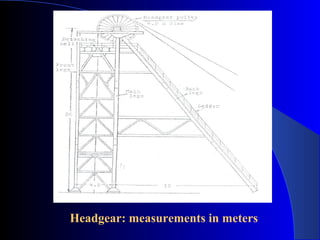
Headgear and Pulley:

The head gear is a steel or concrete framework on the shaft mouth.

Its purpose is:

1.To support the head gear pulleys, the weight of the hoisting rope,
cages and rope guides.

2.To guide the cage to the banking level.

It should withstand dead and live loads and wind pressure.
 The dead loads on the headgear are reasonably constant and
  calculable but the live load due to winding is a variable one
  depending on the length of ropes in the shaft, the contents of
  the cages and the rate of acceleration and deceleration.

 Head gear is used for tower mounted koepe winders are
  designed to carry in addition the load of motors, winding
  pulley and other equipment for winding.

 The head gear consists of nearly vertical columns or girders
  braced with horizontal girders.

    The members narrow at the top and battered at 1 in 8 to 1 in
    10 for a larger width at the foundations.
 Of the four legs the two nearly vertical main legs are connected
  to two inclined back legs (towards the winding engine room).

 The top of the headgear has a steel platform or plate and the
  bush bearings of the winding pulleys rest on the vertical
  members of the headgear frame.

 It is usual to design the upright members of the headgear frame
  to carry the dead weights and the wind pressure, leaving the
  back legs to the take care of the resultant of the live loads due
  to the ropes and cages.
 The height of headgear is decided by considerations of number
  of decks on a cage, banking level or skip discharging point, pit
  top layout and depth of the shaft.

 The headgear pulley should be at such a height above the
  detaching plate that the rope capel is released before it comes in
  contact with head gear pulley. The distance is about 3m.

 The design of the headgear depends upon dead and live loads,
  the depth of the shaft, the quantity of material raised per hour,
  the diameter of the shaft, size of the skip or cage and the
  winding speed of the drum.
Headgear: measurements in meters
 The head gear pulley should have as large a diameter as
  possible to minimize bending stresses in the winding rope.

 Its diameter should be at least 100 times the rope diameter.

 Pulleys of over 2.5 m diameter are generally constructed in two
  halves and bolted together.

 Normally the diameter of the groove of the headgear pulley
  should be 110% of the rope diameter for stranded ropes and
  105% for locked coil ropes.

 This ensures that 1/3rd of the circumference of the rope are in
  contact with the groove.

 A lesser angle of contact causes excessive strain on the rope
  and wear on the pulley.
 The headgear pulley is keyed to a mild steel forged shaft, which
  rests in plain bushed journal bearings.

 The angle of fleet, which is the angle between the vertical plane
  of the pulley and the rope, when the cage is at the pit top or pit
  bottom, should not exceed 1.50. More fleet angle results in wear
  of the rope and wear of the pulley.

 The shafts of the two head gear pulleys which are placed side
  by side are in a horizontal line and their planes of rotation are
  vertical and parallel.

 In the case of koepe winders, ground mounted the planes of
  rotation of the two headgears pulleys are one below another.

 If a drum winder is used for a deep shaft, it may be necessary to
  consider double layer coiling of rope in order to accommodate
  all the rope on the drum and keep the fleet angle limited to 1.50.
Fleet angle


Arrangement of driving sheave and pulleys in koepe
winding Left: tower mounted; right: ground mounted
Cage attachment to Winding Rope

A typical arrangement of attaching cage to winding consists of
four cage chains in the case of a single cage (and 6 chains in the
case of a tandem cage) attach the cage to a triangular distribution
plate which is connected to a safety detaching hook through D-
links. The detaching hook is attached to rope capel.

Under mining regulations all the chains are to be checked in
every 6 months and the detaching hook is made of 1.5%
manganese steel.
Rope attachment to cage
Cages and Skips

The cage is a lift suspended from the winding rope, open at both
ends where gates can be positioned during man riding and it has
rails fitted to the floor for mine cars or tubs.

To prevent the mine cars/ tubs from falling outside the cages,
catches are provided on the floor which act against the axles of the
mine car / tubs; in addition, a long bar, turned at both ends and
hinged at one side of the cage, prevents movement of the tubs
during travel up or down the shaft.

Cages used for man riding have a hand bar near the roof for the
men to hold and at both ends collapsible gates are provided which
can be closed or opened manually or by compressed air.
The roof has a hinged or removable door for accommodating long
timber or rails whenever necessary.

A cage which can accommodate only a single tub is a single cage
and one with two tubs is called tandem cage.

Cages with more decks are used in mechanized mines dealing
with large output.

 The cage travels in the vertical plane.
Advantages of cage:

1.They are made to travel in vertical plane.
2.Winding coal and mineral from different levels is easy.
3.These are best used in shallow mines.
4.A high head gear is not required.
5.Cost is low and efficiency is high.

Disadvantages of cage:

1.The ratio of payload/ gross load is low around 0.35
2.They cannot be fully automatic.
3.There is a problem of accurate landing of cage at decking level.
4.Manpower is required for handling of tubs.
A single deck cage and skip   A skip for automatic
                              tipping in an inclined
                                shaft at Mosabani
 Skip can be filled with minerals through its top opening skips
    traveling in a vertical plane have a discharge opening at the
    bottom for unloading the mineral content but skips traveling a
    rail along an inclined haulage plane are so tilted, during travel,
    near the unloading end that their contents are discharged from
    the top end.

 Skips moving in a vertical plane are sometimes partitioned for
  accommodating men at the upper half and material/ mineral at
  the lower half.

 Skips are provided with cast steel guides shoes having
  malleable cast iron brusher, usually four shoes per cage or skip.

 The skip carries a large payload, usually 8 ton or more,
  compared to the cage and the ratio payload/ gross weight of
  skip (loaded) is high for skip
Advantages of skip:

1.Skip winding is best suitable for deeper shafts where high output is
desirable.
2.The ratio of payload/gross load of loaded skip is high nearly 0.6.
3.Skip lends itself to automatic loading, unloading and decking
operations, and thereby providing quicker cycles.
4.There is less man power requirement for skip installation.
5.Fully automatic installation of skip is possible.
6.Skip can travel on vertical or inclined plane.

Disadvantages of skip:

1.Separate arrangement -made for winding of men and material.
2.It is difficult to import dirt, washery refuse for goaf.
3.It is essential to load skip in upcast shaft.
4.Winding of coal/mineral from different levels is not convenient.
5.A high headgear is required and the shaft sunk deeper.
Keps

Keps are retractable supports for cages that ensure not only
support to the cage but their use results in proper alignment of the
cage floor and decking level so that the stretch of the winding rope
creates no difficulty during decking.

Keps are used at the pit top under our mining regulation.

Their use is not necessary at the pit bottom as the cages rests on
rigid platform at steel girders and wooden planks.

Keps are not required at the mid-set landing and in a shaft served
by koepe winding system.
In the case of koepe winder, the decking difficulties arise and are
overcome by the use of tilted or hinged platforms.

Keps may be operated by hydraulic or pneumatic power. Where
the keps are pneumatically operated they are interlocked with other
decking equipment so that they can be withdrawn or brought into
use at the correct time in the cycle of operations of the associated
equipment at the pit top.

Types:

These are of two types.


1.Rigid keps
2.Davies improved keps gear
Rigid keps:

Rigid keps provide support to cages on hinged platforms.

They are manually operated by the banksman at the pit top.

The ascending cage pushes the keps back and as it is raised
slightly higher than the decking level, the keps fall back in position
by gravity after releasing opening lever.

The cage, after it has come to a halt, is lowered by the winding
engineman to rest on the keps.

When the top cage is to start on its downward journey, the
winding engineman raises the cage only slightly to make it clear of
the keps; the banksman withdraws the latter by manual operation of
a lever which is held by him till the cage is lowered past the keps.
Disadvantages of Rigid keps:

1.Accumulation of slack rope on the pit bottom cage when the top
cage is raises a little for withdrawal of keps. Ascent of the pit
bottom cage is generally associated with shock load on the winding
rope and the stress amounts to 200% of the static load.

2.Loss of time and power in lifting the top cage before its download
travel.
Davies improved keps gear:

The gear consists essentially of the shafts S to which is keyed
the hand lever and a pair of arms A with a steel roller R mounted
on a pin between the arms.

The roller presses against a renewable roller path on a swing
lever L which is pivoted at P and carries a “pallet” mounted on a
steel pin at its other end.

The pallet is free to move upward and around the pin, and
allows upward passage of the cage, but it is prevented from
moving downwards by a projection on the lever L.
The cage is thus securely supported on the upper surface of the
pallet.

The gear may be withdrawn, however without first raising the
cage.

It will be seen that when the hand lever is moved to the left, the
roller R moves upward along the roller path on the lever L, thus
allowing the lever to rotate downwards by gravity around the pin
P until the pallet is clear of the cage.
Rigid keps


Davies improved keps gear
Detaching Hook

Detaching hook which is just placed below the rope capel, is a
safety device which acts when an overwind takes place.

Its purpose is to suspend the cage/ skip in the headgear if an
overwind occurs and at the same time to release the rope to go over
the head gear pulley.

Types of hooks:


1. Ormerod detaching safety hook.
2.King detaching safety hook.
King detaching safety hook:
 It is generally used in most of the winding system.

 It consists of four wrought iron plates i.e., two being moveable
  inner plates and two fixed outer .

 The two inner plates are placed together in opposite ways so that
  the hook of one plate and that of the other jointly form a secure
  hole for the reception of the rope capel bolt.

 A main bolt or centre pin passes through the holes and in all four
  plates and serves

1. To bind the plates together
2. To transmit the tension of the winding rope from the hooks of the
   inner plates to the shackle both of the main D- link and
3. To provide a pivot on which the two inner plates can move.
 The hooks are so curved that pull of the winding rope has no
  tendency to open out the inner plates.

 A copper pin is placed through the holes c in all four plates and
  riveted over to prevent inadvertent movement of the inner plates
  when they are not under tension.

 During an overwind as the ascending cage goes up the hook is
   partially drawn through the circular hole in catch plate, securely
   attached to a horizontal member of the headgear and the lower
   wing d of each plate (inner) is forced inwards.

 The copper pin is thus sheared and hooks in are forcibly separated,
  so releasing the D-link of winding rope capel.

 Simultaneously the catches g on the inner plates are forced
  outwards so that rest on the upper side of the catch plate and the
  cage in thereby safety held.
When the weight of the cage is taken by the catches g, the inward
pressure of the wing d is borne by the sloping sides of a wedge
shaped block which is placed between the lower ends of the two
outer plates which is securely bolted to them.

For lowering the cage after an overwind, a vertical slot h is
provided in each outer plate and an inclined slot t in each inner
plate.

The cage being suspended, the slots in the outer plate remain
vertical but those in inner plates take different positions so, as to
maintain circular hole through all the plates.
To restore the cage
Place a few rails across the shaft top.

Bring the winding rope capel back over the pulley and attach it to
the plates by special D-link whose pin should pass clear through the
hole on it.

Raise the cage slightly and pull of the rope on new D-link pin
causes the latter to rise along the inclined faces of the inner slots.
This forces the hook m and catches g inwards in their normal
positions.

Now lower the cage to the banking level.

Replace the hook and fit it with a new shearing pin. The catch
plate should also be changed.
Inner plates               Outer plates


Hook assembled and in     Hook detached and cage
   working order        suspended during overwind
Example:

Narwapahar underground uranium mine (UCIL,
India)

The type of winding system is ground mounted friction winder. The
shaft has two winders one for cage and the other for the skip. The
cage is for men and material movement and the crushed material is
loaded to skip for hoisting.
      Specification        Cage Winder           Skip Winder
   Make                 ABB Sweden           ABB Sweden
   Pay load             5 tonnes             5 tonnes
   Max. Speed           8 m/sec              8 m/sec
   Total hanging load   13.772 tonnes        14.37 tonnes
   Hoisting speed       3.5/6.0 m/sec(man)   8 m/sec(ore)
Acceleration          0.77 m/s2      0.77 m/s2
Retardation           0.77 m/s2      0.77 m/s2
Hoisting distance     321.5m         324.14 m
Pulley diameter       2.8 m          2.8 m
Pulley speed          54.6 rpm       54.6 rpm
Rope diameter         28 mm          28 mm
Rope length           427.181 m      450 m
Number of ropes       2              2
Counter weight        8.445 tonnes   8.634 tonnes
Tail rope diameter    48 mm          48 mm
Tail rope length      356 m          373 m
Guide rope diameter   32 mm          32 mm
Guide rope length     356.8 m        383 m
Motor                 DMA 315 L      DMA 315 L
Rated output          186 KW         250 KW
Rated voltage         391 V          397 V
Rated current         510 A          683 A
Rated speed           751 rpm        751 rpm
Safety devices

1.Cage block switch (Thyristor controlled):

Cage block switch is used to provide support to the cage during its
downward motion preventing accident. It’s construction is such
that it allows the upward motion but restricts the downward
motion of the cage. It is similar to safety catches.

2.Gate close switch:

Gate close switches are provided which closes the cage from all
sides while transportation of men and material.
3.Over speed MP (Master Piece) :

Over speed switches are provided which cut off the power supply
in case of over speed.

4.Over speed and overwind contrivances (Lilly
Duplex controller):

Position of cage in the shaft:

Two cam dials, one for each direction of motion, are mounted on
hubs, keyed to a common shaft and driven by a spur and worm
gearing on a drive from the rotating winding drum. The gear ratio
is such that a maximum angular movement of the dials of about
300° corresponds to the travel of the cages or skips in the shaft.
Speed of cage in the shaft:

Two centrifugal governors, driven by a shaft from the winding
drum, operate on a floating lever system which is connected to a
pair of floating contacts. An increase in speed causes the governors
to exert more force on the lever system and the floating contacts
come closer together. An increase in speed of about 10% above
normal sounds an alarm and if no action is taken, these contacts
close to operate the safety circuit which cuts off power to the
winding engine and actuates the braking system.

5. Wooden arrester:

It has internal linkage to the cage block controller, in case it fails to
arrest the cage ,wooden arrester will be placed automatically which
blocks the cage.
6. Safety catches:

As a safeguard against the failure of the detaching plate to hold
the cage, safety catches may be fitted in the headgear. These
safety catches consist basically of short levers mounted in the
headgear at intervals that vary from 0.3 to1m.These are located
above the normal running position of the cage. These catches are
free to turn on a pivot. In the event of an over wind the catches
are lifted the cage to pass up into the headgear, they then fall
back to the normal position and so prevent the cage falling back
down the shaft. A mechanical linkage is provided so that all the
catches may be withdrawn simultaneously in order to lower the
cage after an overwind or when the apparatus is to be checked or
to be tested.
7. Slow banking:

When men are being wound, the sensitivity of the system is
increased by applying a spring loaded lever to the fulcrum of the
floating lever system. Auxiliary contacts are fitted and arranged
to close when the controller is thus set for man-riding; and a
circuit is completed to illuminate indicators 'MEN' at the pithead
to show the setting of the controller as required by legislation.
This arrangement is commonly known as the 'slow banker'.
Lilly duplex controller   Whitmore automatic
                              controller
PIT-TOP & PIT-BOTTOM LAYOUTS

               Presented by
               Presented by
         Prof. Devidas Nimaje
           Devidas S. S. Nimaje
           Assistant Professor


     Department of Mining Engineering
      National Institute of Technology
         Rourkela-769008, INDIA
The raising capacity of the mine depends on the shaft capacity which in
turn depends on the manner in which tubs or mine cars are handled at
the pit-top and pit-bottom layout is done with the following
objects in view:

1.Use of the shaft to its full capacity
2.Use of minimum number of tubs in the circuit
3.Use of minimum number of operation
4.Maintaining steady flow of tubs
5.Minimum decking time
6.Lowering of materials
7.Handling of ores or coals of different grades
8.Avoiding large excavations near pit-bottom.

In any pit-top arrangement, the loaded tub or mine car, raised from the
pit, discharges mineral close to the shaft and return to the cage, so as to
require the least number of tubs in circuit. It is also necessary that mine
cars are not allowed to run freely under gravity over long distances.
Run round arrangement at pit-top (cage winding):

1.From the decking level, the loaded tubs are taken to the tippler T via
a weighbridge W and empties travel by gravity to a creeper (which
elevates them to a little above the decking level) and gravitate to the
other side of the cage.

2.A creeper on a load side is not desirable and the usual arrangement
therefore is to have the decking level 4 to 6 m above the ground level
on gantry.

3.A weigh bridge for all the mine cars raised from the pit is a good
practice but is uncommon in our mines.
4.If the quality of the mineral raised from the pit is not the same,
sometimes due to working of two or more seams of coal (or ore from
two different levels) by the same pit, two or more tipplers have to be
provided for the various grades.

5.Two grades coming from the different seams, each raised by a
separate pit, one tippler T1 has been provided for the loaded tubs,
containing shale or stone, which may be disposed by a belt conveyor.
6. Provision may be made for alternative arrangement to unload the
   coal tubs when the usual tippler cannot be used due to breakdown
   stoppage of screening plant. Such arrangement consists in
   providing one or two travelling tipplers, depending upon the
   output, for tipping the coal into the dumping yard.

7. When the decking level is above the ground level, the materials
   are lowered into the mine by loading them into the cage at ground
   level and an opening in the shaft walling, equipped with a gate and
   a track is provided for this purpose, alternatively, a hoist is used
   for taking materials to the decking level.

   Disadvantage

   The large space required and the log circuit which the tubs have to
   pass specially with long wheel base mine cars which requires large
   radius curves.
Pit-top layout with run-round arrangement
Pit-bottom layout to be followed depends upon
The types of transport system used in the vicinity of the pit-
bottom and the method of winding whether skip winding or cage
winding.

The pit-bottom layout lasts the whole life of the pit and has to be
designed to meet the maximum production likely to be handled by
it, as re-arrangement of the pit-bottom is expensive and may involve
costly excavation in stone over a wide area, resulting thereby in
weakening of the shaft pillar.

The re-arrangement takes a long time and hampers normal
production. Though a pit-bottom layout essentially depicts the
transport arrangement near the pit-bottom to deal with a targeted
output, ventilation, drainage and support arrangements have to be
considered in designing it.
Pit-bottom layout(cage winding) ,
      KLMN is shaft pillar
Pit-bottom layout in a thick seam with shaft axis
              along dip and rise.
Lofco system

There are two double tipplers, with one pair of tippler on each side
of the shaft.

Empty car at A is rammed into cage 1, pushing a loaded car from
the cage to tippler C, during the period of subsequent wind, this car is
tipped.

When cage 2 comes up, empty car from D is pushed in the cage 2
and loaded car from cage 2 runs into position B in the tippler and the
cycle is repeated.

The original installation of this type was at Lofco house colliery in
Britain. The mine car never leaves the neighborhood of the shaft.
Efficient dust suppression arrangements have to be adopted as the
dust raised during tipping may be carried down the D.C. shaft.
Lofco arrangement at pit-top
Back shunt circuit

It is adopted in the pit-top layout at Chinakuri and Girmint colleries
using 3.5 te capacity mine cars with a gauge of 1.1 m.

It is cheap, efficient and simple arrangement of reversing cars, but a
spaced feed is necessary to allow sufficient time for each car to clear the
back-shunt before the next one enters.

Clearance can be speeded up :

(i)by making the back-shunt very steep from the position at which the
rear wheels of each car are clear of spring point, or

(ii)by installing a spring buffer in the back-shunt which will arrest the
car as soon as it is clear of the spring point and expel it rapidly.
 The arrangement is good where the long wheel base cars are
  used.

 The width of the circuit is reduced though the lengthy required
  may sometimes cause difficulty if the winding engine room is
  very near the shaft.

 As the tippler is near the shaft, suitable steps have to be taken
  to prevent coal dust from entering it, if down-cast.
 Most of the operation is automatic and only one car is pushed
  into the cage at a time.

 The empty car leaving the back-shunt, enters the cage and the
  points at the crossing are automatically made by the passing of
  the car for the travel of the next car to the other cage.

 The tippler is electrically operated and only 3 men are
  required for the control of the pit-top:

 one banksman,
 one tippler operator and
 one helper to assist the banksman.

 The arrangement (is capable of dealing with an output of
  50000 te/month (coal).
Shunt back layout at pit-bottom
       and pit-top
Turntable circuit
It ensures continuous feed of cars which need not be delivered to
the turn table at regular intervals unlike the back-shunt.

The reversal of car is accomplished within a restricted space.

The turntables for outputs exceeding 500 te/day are usually power
operated.

The length of the pit-top required for turntable circuit is smaller
than that for the back-shunt circuit.
Only 3 men are required at the pit-top.

The track on the empty side is curved because of the short
distance between the shaft and winding engine house.

Turntable circuits with power operated turntables at Kunstoria
colliery provides the most compact arrangements at pit-top with
only 3 men at the pit-top in a shift for dealing with an output of
30000 te/month (coal).
Top: Pit-top layout with turn tables
Bottom: Pit-top layout with traversers
     (TV-traverser, R-ram, T-tippler)
Traverser circuit

It is very compact and shorter than turntable circuit, where cars
have to move from one side of the shaft to another.

A traverser is a platform, running on rails laid at right angles to
the car tracks which are parallel to the length of the cages.

Mine cars emptied at the tippler, to the lengthy of the cages.

Mine cars emptied at the tippler travel to the cage side traverse
which receives them, and the traverse is then pushed and positioned
in front of the cage for ramming the cars into the cage.
The traverse is powered by electricity, compressed air, by
hydraulic means and sometimes by manual labour as in some mines
of Jharia and Raniganj fields.

As traverse saves a considerable space available for car circuits,
they are advantageously used where space is limited, specially on
the engine side.

It is ideally suited for single deck cages.

Tipplers are sometimes incorporated in traversers, making further
saving of space and manpower.

As the traverse has to carry two cars when a tandem cage is used
the track for traverse travel is of wider gauge than the normal car
track.
 It employs only one creeper, with the results that the traverse near
  the cages has to travel less when feeding one cage, but more when
  feeding the other cage.

 This defect can be removed by using two creeper, one on either side
  of the load track, so that each creeper supplies empties to only one
  particular cage.

 Unlike back shunts or turntable circuits, the capacity of the traverse
  circuit cannot be increased once it is installed and the installation
  should cater to the maximum output expected from the mine.
A traverse can deal with 45 to 60 winds per hour and only 3 men
control the pit-top.

The traverse circuit adopted in some mines of Jharia and Raniganj
fields, use traverse only on the engine side employs only one creeper.

In some modernized mines, the cabin of the banksman or the
onsetter, is on the traverse itself, which is electrically operated and
equipped with pusher rams. This enables better control of the traverse
by the operator.
Creeper layout:
Fig shows the layout in a thick seam using creepers for handling
empties and is adopted in some mines of Jharia and Raniganj fields
the length of cages is in dip-rise direction.

Shunt-back layout:
A pit-bottom layout with a traverse arrangement and a belt
conveyor delivering the output of the mine to the pit-bottom .

This type of layout is not used at any of our mines in India.
Layout top semi-permanent loading section
Locomotive Layout:
In a layout with locomotive haulage designed for oneway traffic
loaded cars are pushed into the cage on one side only while empties
are taken out at the other side from where they are sent out to various
districts. Each haulage track serving underground circuit must be
connected with both the full and empty side.

 For locomotive haulage at the shaft bottom, there are two main
  types of layouts which are modified according as the shaft is
  situated in the axis of the main haulage, at right angles or at an
  angle.

1. Loop type

2. Reversing track type
 In the loop type, a loop is provided for bringing the load on
  one side of the shaft and taking the empties to the districts.
  Larger loop will provide more standing space.

 In Reversing track type avoids the loop and brings the empties
  to the full side of the cage with the help of traverse, turntable
  or shunt-back. This eliminates a long run round and reduces
  the idle travel of a locomotive to an absolute minimum,
  however, its capacity to deal with increased output is limited
  and it necessitates greater width at the pit-bottom.
Layout for skip

Pit-bottom arrangement for a skip:

Pit-bottom arrangement for loading the skip usually takes three
forms:


1.Mine cars tipping direct into measuring pockets
2.cars tipping on belt which delivers mineral into pockets
3.Mineral discharge into storage bunker and fed to the measuring
pockets.
The arrangement of tipping direct into pockets is not
considered desirable for the following reasons:

1.As mine cars are to be led to the top of the measuring pockets,
large excavations are necessary near the shaft.

2.If the haulage is to be in the intake, a proper air-lock is to be
maintained across the pocket, which interrupts unloading of cars
when skip is being filled.

3.Loading in the skip is not uniform and important control data are
lost.

4.The pit-bottom becomes very congested.
 In second method, loaded cars pass over a tippler situated 30-50
  m away from the shaft.

 Mineral is discharged into vibratory feeder. It feeds a conveyor
  delivering into the chute which deflects mineral intone of the
  measuring pockets fitted with anti-breakage device.

 When the pocket is filled with skip load weight of mineral, the
  weighing beam operates a valve which turns at the deflecting
  plate of the chute to the other pocket and closes the top of the
  loaded pocket.
The time taken for loading in a pocket synchronizes with the time
required emptying the loaded pocket and winding up of the loaded
skip, when the arriving skip is delayed, conveyor and tippler are
automatically stopped by an interlock system.

This method ensures correct loading of the skip and eliminates
other drawbacks of the earlier arrangement.


In the third method, a trunk conveyor discharges into a concrete
bunker with sides sloped at 450.

A feeder draws the mineral from the bunker and delivers to a
conveyor which conveys it to the pockets.
Pit-top arrangement for a skip:

1.Level in the mineral hopper is known to the banksman and
winding engineman from visual indicators.

2.As the loaded skip comes to bank, the discharge door of the
hopper is closed and receiving door opened; when it is hoisted up in
position, its bottom discharge door is opened automatically and lets
out mineral into the hopper.

3.As the skip is lowered, its discharge door is closed; receiving door
of the hopper is also closed and its discharging door opened
automatically.

4.Suitable system of interlocks ensures performance of all
operations in proper sequence.
General arrangement at the pit-top
  and pit-bottom loading point
MAN-RIDING & MATERIAL
 TRANSPORT SYSTEMS
            Presented by
            Presented by
      Prof. Devidas Nimaje
        Devidas S. S. Nimaje
        Assistant Professor


  Department of Mining Engineering
   National Institute of Technology
      Rourkela-769008, INDIA
 The man riding and material transportation system has received
  wide attention during last 50 years.

 As mine grow in size, the actual productive time at the working
  faces decreases due to longer travelling time required between
  pit bottom and working faces or from the top of the incline to
  the working faces.

 It also leads to less utilization of expensive machinery at the
  face and hence less output and less OMS.

 Also with the increase in demand for raw material involved
  larger quantities of material and machines to be transported to
  the face and installed.
Those factors lead to the concept of quick transport of men and
material mechanically.

Man riding systems are the rapid, safe and comfortable solution
when it comes to transporting persons fast, over long distances,
including horizontal and vertical curves in underground mines.

These systems have become increasingly important in modern
mining where production losses result from ever-longer travel
distances underground.
Ideal requirements for suitable transport system of
transport of men and materials in mines are:

1.To provide continuity of transport from pithead to faces at a
maximum permissible speed with due regards to absolute service
reliability and safety.

2.To be capable of transporting the maximum size and weight of
materials or the maximum number of men involved.

3.To have maximum economy in manshift consumption.
System of transport for men and materials:

1.Rope hauled system
   a) Ground mounted system
        i. Conventional system with vehicles running on
            conventional rail section track.
        ii. Special system with captive vehicles or carriages
            running on special section track e.g. Road railer and
            coolie cars.
   b) Monorail system with trapped load carrying trailors,
        beams, bogies etc around the I section rails suspended
        from the roadway supports or roof bolts.
   2. Locomotives
3.Trackless underground supplies vehicles and tractors
4.Belt conveyors
The man riding system is a long “dual facility” for both men and
material transport which

increase human morale.
has less man hour loss and availability of more man hours.
improves productivity.

Man riding system in underground mines:

Man riding system used in underground mines is classified into two
categories:

1.Man riding Chair Lift System (MCLS)

2.Man riding Car System
Man Riding Chair Lift or Ski Lift System

 Two way men riding simultaneously.
 Curves can be installed in level or inclined roadways.
 The pulley carriages are spaced at 11 m interval in a roadway.
 A distance of 15 m is maintained between two chairs.
 Electric motor upto 70 KW.
 Chair Lift can negotiate horizontal and vertical curves,
 Gradients upto 300 and distances upto 2500 m.
 Min. cross section of roadway - 2m wide and 2 to 10 m high.
 Maximum speed is upto 4 m/s
 Carrying capacity is 720 men/hour at a speed of 3 m/s.
 Endless wire rope by positive friction.
 The system is switched on and off optionally by one or more
   main switches or by a pull-cord in the transport section.
 The chair speed is regulated by means of an adjusting lever
   which permits continuously variable transport speed from 0-
   3.0 m/sec.
The embarking and disembarking stations are made of welded steel
sections with a longitudinal design ensuring reliable chair uncoupling
and pick-up by the wire rope in the transition area from wire rope to
rail
Man riding Chair Lift System (MCLS)
Depending on the individual operating conditions the
following systems are available

1.Apod I with detachable chairs for gradients up to 45° and
vertical curves
2.Apod II with detachable chairs for gradients up to 18° and
horizontal and vertical curves.
3.Apod III with fixed chairs for gradients up to 45° and vertical
curves.
BWF (BHARAT WESTFALIA) in technical partnership with
Machinenfabrik Scharf, GmbH of Germany, today known as SMT
Scharf GmbH ("Schraf"), was the first company to introduce the
MCLS in India, at Chinakuri Colliery, Eastern Coalfields Limited
("ECL"), transporting up to 720 miners per hour at 3.0 m/ sec.
Man riding chair lift system is used for transporting
men in underground mines

it is an electro hydraulic driven system.
a detachable chair has to be put on a rope and sitting on the chair
gives the movement to the person.
600 persons can travel in 1 hour.
the system is approved by DGMS.
Man riding chair lift system in underground mines
Man Riding Car System

 A rope hauled monorail system embodies an overhead I section rail
   suspended from roadway supports or roof bolts carrying a train of
   trolleys, lifting beams or man riding cabins or chairlift man riders
   which run on the bottom flanges with captive rollers engaging the
   web.
 One end of the endless rope is attached to the trolleys etc. whilst the
   other terminates at a rope storage drum attached to and forming part
   of the train of trolleys.
 The monorail is normally operated by an endless haulage winch.
   Monorails (Man riding car system) used for materials transportation
   and man riding.
 It is installed in roadways upto 3 km long and on gradients upto
   450 (1:1).
 A minimum height of the roadway of 1500 mm.
 Materials upto the weight of 3 t/unit load can be transported.
 Pulley frames are fitted to the rails at intervals of 30 m.
 At the end of the monorail, a tensionable return unit is fitted
  which can easily be moved whenever necessary.
 All curves are fitted with brackets where more than one roadway
  has to be served, switch points can be installed which can be
  operated by hand, compressed air or hydraulic power.

 The return pulleys are available in diameter 450 and 630 mm.
  brakes trolleys are designed to halt monorail trains in the event of
  failure of the drawbar.
Man riding car system used in underground mines
Case Studies

Introduction of Man Riding System at SCCL

  27 Man Riding systems were commissioned.
  8 Man Riding systems are under erection.
  3 Man Riding systems are under procurement
Man riding car system specifications used in GDK mines:-


Type of Man riding System       : Chair Car
Cost of the Project             : 211 lakhs.
 Length of the road way        : 1.2 k.m.
Speed of the rope               : 8 kmph
Total cycle time / 1 trip       : 22 min.
Capacity of Man Riding System / Hour : 84 x 3 = 252 persons
Rope anchor car specifications used in GDK mines:-


Rope Anchor car length     -     6130 mm
 Width                     -     1390 mm
Height                     -     1750 mm
Tare weight                -     3500 Kgs
Capacity                    -    24 persons
Specifications of Man Riding car System manufactured by
Andhra Pradesh Heavy Machinery and Engineering
Limited used in SCCL:-

length : 0. 8 km to 1. 56 km
average gradient : 1 in 5. 23 to 1 in 8
no. of persons to be transported max./ shift : 200 – 400.
Chair lift man riding systems used in GDK mines:-

It negotiates a curve of 30 degree gradient
2000 m long.
2m wide roadway
Speed of 2 m/s
Transport 100 men/h
Type of      Year of
Sr.    Name of the
                       MRS         Installati   MRS Supplied by
no.       Mine
                      Working         on

      VK.7 incline,   Chair lift
1                                    1991       Bharat Westfalia
      Kothagudem      system

        5 incline,    Chair lift                   BWF with
2                                   2000
      Kothagudem      system                       SCHARF,

      GDK.8 incline, Man Riding
3                                   2000        Greaves Limited
         RG.II          Car

      GDK.9 incline, Man Riding
4                                   2000           APHMEL
         RG.II          Car
GDK.10 incline, Man Riding
5                                 2001      APHMEL
        RG.II           Car

      GDK.10A        Man Riding
6                                 2000      APHMEL
    incline, RG.II      Car

      GDK.11A        Man Riding
7                                 1992   Greaves Limited
     incline, RG.I      Car

    GDK.1 incline, Man Riding Apr.2002
8                                        APHMEL & Joy
         RG.I           Car

                        Man
9 JK.5, Yellandu                  1992   Greaves Limited
                     Riding Car
Introduction of Man Riding System at WCL:

Rail Car System has been introduced at two mines.
1.Tandsi 1 & 2 mine
2.Maori UG mine

 Man-riding system is under installation & will be
 commissioned shortly :

 1.Saoner No. 1       - Chair Lift system
 2.Shobhapur No. 1           - Rail car system & chair lift system
 3.Tawa mine                 - Chair Lift system
 4.Kumbharkhani mine- Rail car system
Man riding system in 2nd phase in WCL:

1.Ballarpur 3 & 4
2.Chhattarpur
3.Saoner No. 2
4.Saoner No. 3
5.Tandsi 3 & 4 mine
Introduction of Man Riding Chair Lift System at MCL:

In India, Mahanadi coalfields limited introduced man riding chair
lift system at

1.Hirakhand Bundia underground coal mines and achieved
maximum production.

2.Orient–III underground coal mine in 2010.
COAL FACE MACHINERIES

            Presented by
            Presented by
      Prof. Devidas Nimaje
        Devidas S. S. Nimaje
        Assistant Professor


  Department of Mining Engineering
   National Institute of Technology
      Rourkela-769008, INDIA
The following coal face machineries are used in the underground
coal mines for loading, hauling and dumping purposes:


1.Load Haul dumper (LHD)
2.Shuttle car
3.Side Discharge Loader (SDL)
4.Gathering arm loader
1. Load Haul dumper (LHD):

 Also known as a scoop tram
 specialized loading machine manufactured for the underground
    mining industry.
 LHDs are used in >75 % of u/g mines throughout the world and are
    suitable for small and large tunnels, mines, chambers, and stopes.
 It performs loading, hauling and dumping of bulk materials

LHD is categorized into two types:


1. Diesel LHD
2. Electric LHD
Selection:

It depends upon the following factors:


1.Size of operation
2.Length of haul
3.Height of seam
4.Operating condition
5.Local permissibilities
6.Experience
 The main chasis is divided into two halves, front and rear frame.
 Bucket is placed at the front end of front frame and it is raised or
   lowered by two hydraulic cylinders.
 The front and rear frame is joined by articulated joint provide to
   the front and rear frame to swivel through 1000.
 All the control points are in the operators cabin placed at the rear
   frame and also the diesel and hydraulic brakes are placed on the
   rear frame.
 The brake system consists of 4 nos. of disc brakes.
 The braking system has 2 accumulators which maintain the oil
   pressure in the brake system for a short duration, if the oil pump
   stalls due to any reason.
 Accumulators are charged with nitrogen under high pressure.
   Accumulators also provide oil for applying brakes instantaneously in
   case of emergencies.
 Capacity varies from 0.7645 to 6.1 m3,
 gradient 1 in 7,
 maximum speed 8-10 kmph (empty) and loaded speed 3-5 kmph.
 Average output expected from each LHD/day is 200-500 te.
Advantages:

1.Greater flexibility
2.Higher speed of transport
3.Higher productivity
4.Minimum labour requirement
5.Variable gradient
6.Directional change
7.Limited roadway dimensions
8.Continuity of transport ( from surface to underground in case of drift
mine)
9.Interchangeability of equipment- by quick detachment and attachment
techniques, the standard machine can be rapidly converted on site to
perform a variety of tasks.
10.Greater safety
11.Less expensive as a total system.
Disadvantages:

1.Slower for bulk material delivery
2.Less maximum load/trip
3.Difficult in heavy load movement- heavy bulky items are difficult to
handle on tyres.
4.Greater maintenance cost- the roads requires more maintenance than
trucks
5.Larger consumption of engine power in overcoming the rolling
resistance.
Recent development in the design and construction

1.Improved diesel power pack- 4 cylinder model, FLP, control of toxic
fumes, noise, temperature etc. are incorporated.
2.Extension of electric capability- advantage of environmental condition,
cheap, existing power supply can be used, improve performance,
extended tyre life, reduced maintenance, scope of remote control facility
etc favour the wider application of the equipment in the coming future.
3.Improved payload obtained by improving the power, improved
component, mechanical and structural design (20 te capacity) etc.
4.Quick detachable system facilitates to attach or detach any of the items
like bucket, drift material platform, fork body etc.
5.Development of the hauler concept incorporated
6.Man riding is possible
One of its latest model LF2HE tyre mounted load load haul
dumper is a low profile high output machine. Special features of
LF2HE: outstanding power/weight ratio , Low heat generation
,Low center of gravity, Low specific base pressure fall,     safe
parking brake; powerful flood lights, emergency stops, heavy duty
construction, dead man switch ;front and rear end of the machine
linked by an articulated joint.
Specifications:

Standard bucket capacity             1.6 m3
Breakout force at bucket blade       55kN
Lifting time                         7.5 secs
Lowering time                        6.5 secs
Time of roll forward                 5 secs
Electrical components                Flame proof for U/G gassy
                                     mines
Travel speed                         0-8 km/hr (high speed mode);
                                     0-3 km/hr(low speed)
System pressure(max)                 400 bar
Traction motors                      variable axial piston type
Displacement                         107 cc/revolution
Drive power(max)                     45kW
Hydraulic medium                     HFDU 68
Tramming radius                      2300mm
LHD Controller in a fibre enclosure
2. Shuttle car:

1.It is an electrically driven low height transport vehicle running by
rubber tyred wheels powered by a DC( battery type) or A.C. (cable
reel type) driving motors or by diesel engine.
2.It consists of flat open topped and open ended body, on the floor
of which there is a scraper chain conveyor.
3.It has enough mobility, flexibility and rapid advance of face is
possible. It can work nicely upto a gradient of 60 but for a short
haul, it can work upto 100.
4. Floor should not be mucky and height of the roadway should be
   atleast 1.2 m and width 4.2 m to 4.8 m and pillars should be rhombus
   shape of 1200.
5. Loading by scraper chain (for even distribution) and unloading by
   the same scraper chain conveyor is done within 45-60 seconds.
6. On an average 2.5 to 8 te capacity shuttle cars are generally used
   however 14 te capacity shuttle cars are also available.
7. Travelling speed with load 5 to 6 kmph and with no load 7 to 8 kmph
   is possible.
8. Shuttle car can fill 75 % of struck capacity and
9. one shuttle car can transport and unload coal of about 150 te/shift.
Shuttle car
3. Side Discharge Loader (SDL):

1.mounted on a crawler track and is designed for loading the broken
rocks onto a conveyor or into the tub in coal or stone workings.
2.The high travel speed (0.7 m/s) makes it suitable for working with
the discharge point upto 10 m from the working face with no
appreciable reduction in loader output.
3.The loader can be employed on gradients rising or dipping upto 18 0
(1 in 3).
4.It is totally flameproof.
5.The SDL may be adopted for discharge on the left or right side.
Bucket capacity is 2.032 te (maximum).
Optional components:

1.Cable reel
2.0.1m3 coal bucket
3.Head light
4.Dust suppression kit
5.Dump valve with lock and key
 Average output expected from each SDL/day is 200 to 500 te/day.
 At Bankola and Bahula colliery, ECL, India from development panel,
   average production per SDL achieved 125 te with an OMS 1.9
   te/man/shift.
 This equipment is used for applications in underground mining.
 It is indigenously designed and developed by in-house R&D.
 This equipment weighing 9 tonnes, is fitted with 1cu.m. bucket.
 Fitted with powerful 55 KW motor operating at 525V, 50Hz,
 this equipment ensures very high productivity.
 It is ideally suitable for deployment in underground mines where
   intermediate or Semi- mechanization is used.
Side discharge loader (SDL)
Specifications:
  Standard bucket capacity      1.0/1.5m3
  Travelling speed:             2.6 kmph (max.)

  Total weight                   8500/9000 kgs
  Ground pressure                0.9 kg/cm2
  Tractive force                 5200 kgs
  Break out force                3000 kgs
  Electrical components          Flame proof for U/G gassy mines
  Negotiable     gradient    for 1:4, cross gradient 1:6
  driving and loading:
  System pressure (max)         125 bar
  Traction motors:              Radial piston fixed displacement
                                type
  Payload(max):                 2.0 MT

  Drive power (max):            55 kW
4. Gathering arm loader:

Extensively used for loading coal in the narrow workings.

They are basically of two types


1.Caterpillar mounted and
2.Track mounted.
The advantages of track mounted machines are as follows:

1.It is less affected by poor floor conditions.
2.It is possible to do close timbering. the operator is well back from
the loading head and under the protection of bars and girders.
3.Selective mining of dirt bands is possible
4.Flitting speed on rail tracks are generally higher and hence saving in
time.

Disadvantages:

1.Its application is restricted to low low gradients only.
2.The width of the working places which may be cleared is limited by
the reach of the machine.
 It is ruggedly built 1092 mm high crawler mounted loading machine
  with a capacity of 12-25 te/min in coal 1245 mm and higher.

 The gathering arms have a reach of 2350 mm and the central
  conveyor extends 3.35 m beyond the bumper and has a swing of 450 .

 The machine is 8.17 m long x 2359 mm wide x 1092 mm high.

 The machine is powered by five motors- 2 for traction, 2 for head
  and 1 for pump with a total H.P. of 160 hp for A.C. driven machines
  or 118 hp for D.C. driven machines.

 After the coal has been undercut and blasted down or blasted down
  off the solid, the loader advances on the crawler and thrusts its
  gathering head into the heap of coal. While it does so, 2 gathering
  arms acting alternatively sweep and pull the coal on to the chain
  conveyor, which carries the coal onto the end of a flexible jib and
  delivers it into the tubs, shuttle cars or conveyors)
Gathering arm loader
PUMPS

          Presented by
          Presented by
    Prof. Devidas Nimaje
      Devidas S. S. Nimaje
      Assistant Professor


Department of Mining Engineering
 National Institute of Technology
    Rourkela-769008, INDIA
 Hydraulic finds an extensive application in the working of pumps in
  mine Reciprocating pumps are bulky, slow speed, make more noise,
  have more moving parts and demand better standard of maintenance.

 Rotary pumps like the centrifugal and turbine pumps are direct-
  coupled to the electric motor, eliminating use of bulky gearing
  arrangement.

Centrifugal pump:

It consists of:

1. An impeller keyed to a shaft
2. A stationary spiral or volute casing within which the impeller rotates
   rapidly( usually 1450 or 3000 rpm)
3. Suction pipe connecting flange
4. Delivery pipe connecting flange
Top right: Centrifugal Pumps (Monoblock)
        channels in a centrifugal pump.
Left: Fittings in a centrifugal or turbine pump
 The impeller like a wheel formed of two discs between which a
  number of curved blades or vanes are fixed.

 These blades are usually curved backwards compared to the
  direction of rotation.

 There is an opening at the centre, called the eye of the impeller, for
  entry of water sucked into the pump.

 In a single inlet pump, there is only one eye on one side of the
  impeller and

 In the double inlet pump; there are two eyes or entries, one on
  either side of the impeller.

 The diameter of the impeller ranges between 1.5 – 3 times the
  diameter of the eye.
 As the impeller revolves the water is carried round by the blades and
  thrown off from the impeller periphery at an increased radial velocity
  and pressure.

 The water enters the volute casing which is of spiral construction
  with gradually increasing cross-section. In the volute casing, the
  water velocity gradually decreases but the pressure energy of water
  correspondingly increases in accordance with Bernoulli’s theorem
  and the principle of conversion of energy.

 When the water leaves the volute casing it possesses high pressure
  energy but only a little kinetic energy. In practice more than half the
  total pressure is created within the impeller itself and the balance in
  the volute casing.

 Such pump is suitable for heads upto 20 m and large quantities of
  water even upto 40Lacs l/min. in small quarries, in coal washeries
  and for irrigation purposes, a centrifugal pump has proved quite
Turbine pump:

It consists of a number of mounted on one shaft and the water of
each impeller enters stationary diffusing channels of the diffusers
surrounding the impeller.

It will be observed that water enters the impeller nearest to the
suction pipe, is carried by the rotating impeller to the periphery at a
high speed and somewhat increased pressure and then discharge
pressure energy and only a little kinetic energy.

Leaving the diffuser the water enters the next impeller at a high
pressure and low velocity to undergo similar process whereby its
velocity is again increased and pressure further boosted.

The process contributes till water enters the delivery pipe with a
high pressure but only a little velocity.
Turbine pump in section
Pressure build-up in a turbine pump.
 Each impeller with the diffuser surrounding it constitutes one stage
  and the head developed per stage varies from 15 m to 50 km
  depending upon:
1. Diameter and speed of the impeller
2. The curvature of the impeller whether forward or backward
3. The design of the diffuser.

 A turbine pump carries a balancing disc to counteract the axial end
  thrust acts towards the suction end of the pump so that impellers
  revolve truly in their designed positions within each stage which is
  not provided in the centrifugal pump

 The number of impellers on the pump shaft normally does not
  exceed 10 in order to prevent bending and to reduce the length.
  The diffusers, when placed side by side complete the outer casing
  of the pump and the diffusers are hold together by 4 or 5 long bolts
  passing through the flanges of the two end covers which form the
  suction and delivery chambers respectively
Pump fittings:

The valve required with centrifugal or turbine pumps are:

1.A foot valve in the suction pipe to prevent water returning to the sump.
2.A main valve or sluice valve or gate valve in the delivery column.
3.A retaining valve to hold the water in the delivery column if the pump
stops while the main valve is open.
4.Bye-pass valve to enable the pump to be primed with water from the
delivery column before starting up. On small pump, it is generally not
provided.
5.Air cocks (one on each stage to release the air when priming the pump)
6.All these valves are external to the pump and remain steady while the
pump is working. Other fittings include a pressure gauge on the delivery
branch, a vacuum gauge on the suction branch, an optional fitting and a
hydraulic balancing disc.
Arrangement of pipes and valves:

The requirements in the suction pipe of a turbine pump are:

1.The total suction lift, including vertical lift, pipe friction and the
friction of the foot valve and strainer, should not exceed 5 m upto the
centre line of the pump.

2.The suction pipe should be as short as possible, of large diameter
and minimum number of bends or elbows.

3.The pipe line should rise all the way to the pump so as to avoid air
pockets.

4.An efficient strainer should be fitted well below the lowest water
level.
 It should be borne in mind that when the impeller of a centrifugal or
  turbine pump rotates, it causes a suction effect in the pump and water
  enters the suction pipe as the atmospheric pressure forces the water
  in the suction chamber.

 The atmospheric pressure can however hold a water column,
  theoretically, which is 10 m height sea level, if the water is at
  atmospheric temperature.

 The atmospheric pressure has to balance not only the vertical height
  of water column in the suction pipe, but also to overcome the friction
  in the suction pipe, bends and elbows of the suction pipe and further,
  it has to impart the velocity to the water which enters the pipe.

 No matter how efficient the pump is, it can suck water upto a
  maximum of 9 m at sea level, as the atmospheric pressure can push it
  up only upto the vertical height. In practice, however, a vertical lift
  of 4-5 m should be considered to be a convenient maximum height
  for a suction pipe.
Starting a centrifugal or turbine pump:

It must never be started without priming with water as it does not create
a vacuum of more than a few centimeters when working on air.

The procedure to be adopted to start a centrifugal or turbine pump is as
follows:

Before priming keep the air cock of each stage open. When the
particular stage is full of water, the air cock will overflow with water and
close the air cock.

Close the main valve on the delivery column.

Check up for any leakage of air or water on the suction pipe and upto
the air cock.
 Put the motor switch “on”. Let the motor and pump run for ½ to
  1 minute with the valve closed. Open the air cock of one or two
  stages if the water force out with pressure, the pump is working
  satisfactorily. Check this up from the pressure gauge on the
  delivery side of the pump. The gauge should record full
  pressure.
 Now close the air cock and open the main valve on the delivery
  column slowly if the latter is not full with water, but if it is full,
  open the main valve fairly rapidly. If this precaution is not
  observed, the motor may get overloaded. It is a good practice to
  watch the ammeter while the main valve is being opened so that
  the load on the motor can be properly controlled.

 To stop the pump, first close the main valve and then open
   the motor switch.
When starting the pump, if it refuses to deliver the water,
the reasons and remedies are as follows:
See if the direction of rotation is correct. It is always marked on the
casing by an arrow.

See that the strainer and the footvalve are below water level; in the
pump and also check that the footvalve is not kept open by some
obstruction of wooden piece or coal lump. The water in the suction pipe
will flow away, if the footvalve kept open by such obstructions.

Check for air leakage on the suction side. The suction hose may have
small punctured holes due to rough usage. Check at all pipe joints on the
suction side, covering the joints with moist clay, wherever practicable,
helps plug the air leakage.
 Air may leak at the gland of the stuffing box. If possible cover
  the stuffing box with an improvised water seal. Cotton waste,
  fully drenched with water, may be placed at the entry of shaft
  into the gland very often this helps.

 Foreign substance may have obstructed water passage into the
  suction pipe. Tapping the steel suction range with hammer
  may dislodge the obstruction from its position.

 Delivery range might have developed a large leak at a place
  not easily noticeable the motor will be overloaded in such case
  and ammeter will indicate this. .
Laws governing centrifugal or turbine pumps:

1.The quantity of water delivered by a given pump varies directly to the
peripheral speed or r.p.m. of the impeller.

2.The pressure developed by each impeller varies as the square of the
speed.

3.The power required varies as the product of the pressure and quantity
i.e. the cube of the speed.

Thus if the speed of the pump is increased to 1.5 times the original
speed, it will pass a.5 times as much water, it will overcome (1.5) 2 = 2.25
times the head and with this increase it will require (1.5) 3 = 3.375 times
the power. These rules are approximately true.
 A centrifugal or turbine pump only works at its best efficiency when
  dealing with the exact quantity of water and the exact head for which
  it is designed.

    If the head is much reduced the quantity of water will increase
    appreciably and this will overload the motor.

 If a large pump designed for a particular head has to work for a small
  head temporarily, a good arrangement is to take out one or two
  impellers and replace them by dummy impellers.

 A dummy impeller is one which has no vanes (except for joining the
  two discs constituting the impeller) and is therefore does not impart
  any pressure head to the water though the impeller itself rotates along
  with the shaft.
Characteristic curves for turbine pumps:

A characteristic or characteristic curve is a curve which shows how the
magnitude of one quantity varies with the changes in some other related
quantity

In the case of a pump the curves shows the quantity delivered at
various heads and the mechanical efficiency and the power of the pump
when running at a constant speed.

The efficiency curve: the efficiency of any machine is the ratio of
power output to power input and in the case of a direct driven centrifugal
or turbine pumps:

Mechanical efficiency of pump = (H.P in water/ H.P. input to pump
                                 shaft)
                                 = (Water H.P./ Brake H.P. of driver
                                 motor).
Characteristics of a centrifugal pump
 It will be seen from the characteristic curves that the curve rises from
  zero with a closed sluice valve to a maximum at normal duty and
  thereafter falls as the quantity increases.

 A pump should be run for a quantity which gives nearly maximum
  efficiency for small variation in discharge.

 In other words, the operating point of the pump should be on the flat
  portion of the curve depicting efficiency Vs quantity.

 The maximum values of the efficiency varies with the size and make
  of the pump and it may range from 70% for small pumps of 20 l/s to
  nearly 80% or so for large pumps of 80 l/s or more.
The head-volume curve:

It is considered to be the true characteristic of the pump as it depends
only on the impeller design and its speed. The other curves condition
of internal surfaces etc. the points to notice about the head-volume
curve are:

1.The static head is somewhat less than the total head shown in the
graph.

2.The curve is nearly flat for small discharge quantities but falls as the
quantity is increased.

3.The maximum head develops when the sluice valve is closed and
discharge is zero. Some pumps, however have a curve which shows
that the maximum head is nearly 10% above the sluice valve closed.
 At the maximum value of head the pump passes some quantity
  but the head developed falls off gradually as the quantity
  increases. Such curve is said to have a “humped-back” profile.
  The falling head with increased quantity 9is attributed mainly
  to friction and shock losses within the pump.

 The maximum pressure is fixed by the impeller diameter and
  its speed and we cannot obtain a greater pressure head without
  increasing one or the other. It is, therefore, futile to attempt to
  use a turbine pump on a total head greater than that for which
  it is designed.
The brake H.P. curve:

B.H.P. increases more or less stationary with increasing quantities and
it is possible to overload the motor if the head against which the pump is
working is reduced. It can be further noted that the amount of overload is
limited and does not become excessive.

The performance curves of DSM-4M pump, manufactured by
Kirloskar Bros. Ltd.

In a pump using impellers of 348 mm diameter, when the head is 53 m,
the discharge is nearly 47 l/s and the pump consumes 45 KW(pump
alone) at an efficiency of 60%. The same head is developed by a pump
using 330 mm diameter, impellers but the discharge reduces to 43 l/s and
under those conditions the pump alone requires 37 KW at pump
efficiency of nearly 63%. The actual power consumption by motors in
each case will depend upon more efficiency and also on efficiency of
gears screw pump. The Roto pump is an example of the screw pump.
Fig. 7.5. Performance curves of pump


Performance curves of pump
Performance characteristics of DSM type
          Kirloskar pumps
Roto pump:
It differs from the reciprocating and turbine pumps in its
construction and working principle.

It is special type electrically driven valveless, rotative pump
which is inherently self priming with a lift (suction head) of upto
8 m of water.
Principles of Roto pumps
It consists of essentially:

1.A rubber stator which has the form of a double internal helix and is a
push fit in the machined cast iron barrel. The stator may be of synthetic
or natural rubber or of hypalon or viton or other plastic materials.

2.A single helical rotor of special abrasion-resisting or non-corroding
steel (monel metal or stainless steel).

3.Suction and delivery branches, ranging from 19 mm to 75 mm
diameter.

4.Hollow driving shaft, running in ball bearings and transmitting an
eccentric motion to the rotor by a coupling rod of high tensile steel.

The pump requires no foundation and will work on any gradient and
even when placed vertical.
Roto pump in section
Action of the pump:

1.It is an eccentric screw pump.

2.The radial cross section of the rotor is circular and is at all points
eccentric to the axis, the centre of the section lying along a helix whose
axis forms the axis of the rotor.

3.The pitch of the stator is twice that of the rotor and the two engage in
such a fashion that the rotor section travels back and forth across the
stator passage.

4.The rotor maintains a constant seal across the stator. Whilst the rotor
rotates in the stator, cavity formed between the two progresses from
suction to delivery side resulting in uniform metered flow of water.
5.The rotary motion creates an exceptionally high suction which
exhausts all air from intake line resulting in immediate lift of water
without need for priming.

6.Water which enters the suction branch is thus caught up in the space
between the stator and the rotor and is forced through the pump as the
rotor revolves. A positive pressure is developed on the delivery side and
there must be a free passage for the water before the pump is started up.


 The roto pump is normally direct driven by a three phase A.C.
  squirrel cage induction motor running at 580, 720, 960 or 1450 rpm.
  The motor is switched direct on to the line. The pumps are available
  as single stage pumps (0.33 hp of motor) or double stage pumps (10-
  20 hp of motor).
Operating the pump:

1.The pump must never be run in a dry condition or the stator will be
immediately damaged. The pump must first be filled with water for
lubricating purposes before the pipes are connected. Therefore, when
pump is stopped, sufficient liquid is normally trapped in the pump to
provide lubrication on starting again.

2.When the delivery head exceeds about 30 m a hand controlled valve,
with a pipe leading back to the sump, should be provided below the non-
return valve in the delivery pipe in order to relieve the pressure
developed when the pump starts up against a full delivery column.
 The pump is inherently non-clogging and can deal with slurry or
  gritty water.

 It is capable of working on snore i.e. it can handle appreciable
  amount of air along with water. In a pump this feature is of
  particular importance for face dewatering operations where it is
  necessary to pump out water from uneven surfaces and the suction
  pipe is partially uncovered.

 Use of Roto pump avoids construction of deep water collecting
  pits are necessary for centrifugal pumps which require the
  footvalve to be always submerged in water.
 In coal, it is ideal as a face pump and is extensively used at the
  advancing faces where the water contains coal particles of various
  sizes in large quantity.

 It is skid mounted and can be easily shifted and installed as it
  needs no foundation.

 Repairs and replacement are therefore easy with the help of
  semiskilled workers in underground mines and pump need not be
  brought to the surface.

 It has only one gland which can be arranged either at suction side
  or delivery side.

 Leakage of water through gland is minimal.

 The pump is reversible i.e. suction and delivery of the pump can
  be interchanged by merely changing the direction of rotation.
 The maximum head from all causes may be upto 90 m for a suitably
  selected pump. As the pump is inherently non-clogging and self-
  priming, a regular pump attendant is not required. This saves
  manpower.

 The internal velocity of the fluid in Roto pump is negligible as
  compared to that in a centrifugal pump. This feature combined with
  lower pump speeds, minimum wear on housing and rotating parts
  due to erosion considerably resulting in longer service life.

 The high efficiency of Roto pump is maintained over a wide range of
  delivery heads unlike in centrifugal pumps. This aspect makes it
  highly adaptable for face dewatering duties where fluctuations in
  delivery head are encountered.

 Metal sleeve stators are introduced in the market. The metal bonded
  torsion free stator has longer service life and this also results in
  higher efficiency of the pump and higher /stage pressure of 60 m.
Drill operated portable pump:

1.One of the centrifugal pumps which has no motor coupled to it but
it is operated by the electric coal drill in coal mines has proved quite
popular at the advancing coal faces to deal with small accumulation
of water which are normally bailed out by bailing majdoors.

2.The pump, therefore, serves more as a substitute for water bailer
rather than as a face pump.

3.One make available in the market was Rana Drill Pump
manufactured by Rana Sales and Service (Pvt.) Ltd., Chandigarh and
it was on the pattern of Blagdon Durham portable drill pump which
was imported until a few years ago.
4. The centrifugal pump is not coupled to any separate electric motor
   but the drive shaft of the pump has arrangement which engages
   with the drill chuck.

5. The drill has to be held above the water level by hand, otherwise
   water may enter the motor.

6. When power is switched on to the drill, a firm grip of the latter is
   sufficient to overcome the starting torque reaction.

7. The pump can work at a time for about 20 min, the normal rating
   of most of the coal drill. Longer operation makes the drill motor
   hot and cooling takes 30-40 min.
8. It has no suction pipe, no external strainer or footvalve and it is
   self-priming, capable of dealing with gritty water or slurry at the
   face.

9. The delivery pipe is 50 mm bore and the suction is equivalent of
   50 mm bore.

10. It has a capacity of nearly 180 l/min at a total head of 12.2 m
    when operated by a coal drill of about 450 rpm with 1.25 H.P.
    input.

11. The head and capacity increase slightly with higher rpm drills.
Pipes for conveyance of water:

1.It may be made either of mild steel or cast iron.

2.Of these materials, mild steel is generally preferred.

3.MS has a much higher tensile strength than cast iron and can
therefore be much thinner and lighter in weight for a given strength. It
is therefore much more convenient to handle, both in shafts and
underground. It is also a more ductile material and less liable to
fracture from shock loads and it can be bent, when necessary. It can be
threaded and where necessary flanges or small pipe lengths can be
welded on to it.
 Cast iron offers greater resistance to corrosion, both because of its
  nature and greater thickness of the metal as compared with mild steel
  pipes of similar strength. In cases, therefore, where the water
  contains corrosive acids that would rapidly eat through mild steel
  pipes, cast iron is used inspite of greater weight, lower tensile
  strength, brittleness, rigidity and difficulty in welding.

 In recent years, alkathene pipes are being used on an increasing scale
  mainly due to their lightness and low coefficient of friction.

 The diameter of the pipe depends on the volume of water to be
  conveyed (the velocity generally ranging between 1-2.4 m/sec) and
  on the permissible head due to friction.

 The thickness of the pipe depends on the material used, the diameter
  of the pipe and the head of the water to be overcome.
COAL HANDLING PLANT (CHP)

              Presented by
              Presented by
        Prof. Devidas Nimaje
          Devidas S. S. Nimaje
          Assistant Professor


    Department of Mining Engineering
     National Institute of Technology
        Rourkela-769008, INDIA
 It is a plant which handles the coal from its receipt to transporting
   it to Boiler and store in Bunkers.
 It also processes the raw coal to make it suitable for Boiler
   Operation.


Extent of work: -

 Receipt of coal from coal mines, weighing of coal, crushing it to
   required size and transferring the quanta of coal to various coal
   mill bunkers.
 This is the responsibility and duty of the CHP and its staff.
Receipt of Coal:-

Normally Thermal Power Station receives the coal by three modes of
transportation.


1. By Railway (80-90% of the requirement is fulfilled)
2. By Road (if required 5-10% of the requirement is fulfilled)
3. By Aerial ropeways


Aerial ropeway is available only to the power stations which are near
the coal mines ¨ Cost of coal transportation by road is much higher
than that for rail transport hence most of the coal requirement of the
power stations is fulfilled by railway transport.
Demurrage calculations on coal Rakes:-
1.We receive the coal wagons in the form of rakes (55-60 wagons in
each rake).
2.These coal rakes are to be unloaded in given free time normally 12-14
hrs. from the time of receipt of coal rakes.
3.Free time is calculated from the receipt of written intimation of coal
rakes from the railway and written intimation of empty rake formation
from MSEB to railway.
4.Rate of demurrage is Rs.1/- per ton per hour.
5.If coal rake is not unloaded in given free time the demurrage shall be
charged on complete capacity (approx. 3300 metric ton) of coal rake at
the rate of Rs. 1/- per ton per hour.
Major auxiliaries of CHP:-

1. Wagon Tipplers
2. Vibrating Feeders
3. Conveyor Belts
4. Coal Crushers
5. Tippers
6. Electromagnetic Separators.
7. Dust extraction systems
8. Gas Extractor.
1. Wagon Tipplers:-

   These are the giant machines having gear boxes and motor
   assembly and are used to unload the coal wagons into coal
   hoppers in very less time (e.g. 20 wagons/hr. or more).

2. Vibrating Feeders:-

   These are electromagnetic vibrating feeders or sometimes in the
   form of dragging chains which are provided below the coal
   hoppers. This equipment is used for controlled removal of coal
   from coal hoppers.

3. Conveyor Belts:-

   These are the synthetic rubber belts which move on metallic
   rollers called idlers and are used for shifting of coal from one
   place to other places.
4. Coal Crushers:-

   We receive the coal in the form of odd shaped lumps. These
   lumps are to be crushed to required size. These lumps are crushed
   by coal crushers.

5. Tippers:-

These are the motorized or manually operated machines and are used
for feeding the coal to different coal bunkers as per their
requirement.

6. Electromagnetic Separators:-

Electromagnets are used for removing of Iron and magnetic
impurities from the coal.
7. Dust Extraction System:-

This system is provided in CHP for suppression of coal dust in coal
handling plant.

8. Gas Extractors:-

Gas extractors are provided at the bunker level to remove all types of
poisonous and non poisonous gases from the working area.
Operational Cycles:-

1. Normal Bunkering Cycle:-

Shifting of coal received from coal wagons directly to coal bunkers is
normal bunkering cycle.

2. Stacking Cycle:-

When there is no coal requirement at coal bunkers even then CHP has
to unload the received coal which is stacked at open ground called
yard. This is stacking cycle.

3. Reclaiming Cycle:-

As and when coal wagons are not available the requirement of coal
bunkers is fulfilled from the stacked coal this is reclaiming cycle.
Weighing of Coal:-

Weighing of coal is carried out at wagon tippler. Weight of loaded
wagon is taken; after unloading the coal, weight of empty wagon is taken
the difference of the two will give the weight of the coal (normally 55-60
metric ton of coal come in each wagon).

Payment of Coal:-

Payment of coal is made to the coalmines as per the weighing of coal
carried out at their premises. However, if any dispute arises regarding
weighing of coal same is to be settled by the committee of both the
parties.
Stone shells:-

Sometimes stone shells are received along with coal same has to be
removed from the coal before bunkering and is done sometimes
manually or by different type of machines. If quantum of stone shells
is beyond minimum limit the cost of the coal is recovered from the
coal mines against the quantity of stone shells received from them.


Chemical Analysis of Coal:-

Sample of coal is randomly collected from each rake by concerned
MSEB staff and detailed chemical analysis, calculation of calorific value
is carried out and is confirmed whether it is as per agreement with the
coal mines or not.
Year of
             Project & features              Capacity Complet
                                                        ion
1. Coal Handling Plant at Parichha Thermal
   Power Station (UPSEB), UPSEB
   Turnkey: Design to commissioning
                                             675 TPH   1984
   Wagon Tippler, Ring Granulator, Plough
   Feeder, Conveyor (1.6 Km)
   Civil, Structure, Electrics
2. Jayant CHP, Northern Coal Fields Ltd.
   Turnkey: Design to commissioning
                                              1200
   Gyratory Crusher, Apron Feeder, EOT                 1987
                                              TPH
   Crane, Conveyor (1 Km)
   Civil, Structure, Electrics
                                .
3. Coal Preparation Plant, Kedla, CCL
   Consultancy services for project & detailed
                                                   650
   engineering, construction, erection &               2001
                                                   TPH
   commissioning of washery including CHP
   Conveyors (4 Km)

4. Coal Handling Plant (Ph-II), Nigahi, NCL
   Planning, Design, Engineering, Construction,
   Fabrication, Supply, Erection, Trial run and
   Commissioning on Turnkey basis.
                                                   1600
   Major Items: Gyratory Crusher, Apron Feeder,         2009
                                                   TPH
   EOT Crane, complete utilities etc.
   Conveyor system of length approx. 4.0 km
   3000T Silo with rapid wagon loading system of
   5500 TPH.
Coal Handling Plant (Ph-II), Nigahi,
 Northern Coal Fields Ltd., India
REFERENCES
Acharya, D. And Roy, P., High Production Technologies for
Underground Mines, The mining, geological & metallurgical
institute of India, Pp: 231-250

Das Samir Kumar (1992), Modern coal mining technology,
Lovely Prakashan, Dhanbad.

Deshmukh D. J. (2010), Elements of Mining Technology, Vol-
III, Denett and Company, Nagpur, Seventh edition.

Ghatak, S. (1995), Mine pumps haulage and winding, Coalfield
publication, Asansol.

http://en.wikipedia.org/wiki/Wire_rope

http://westerncoal.nic.in/wcl_tech.
http://www.bwf.co.in/products-mining.asp?links=pr1

http://www.indiamart.com/aphmel/tunneling-mining-machinery.html

http://www.ucil.gov.in/web/jaduguda_mine.html

http://www.indiastudychannel.com/resources/84033-INFORMATION

Karlein N.T., (1967), Mine Transport, Orient Longman
Publication, First Edition, Pp. 61-65.
Mathur S.P.(1999), Coal mining in India, M.S. Enterprises,
Bilaspur.

Mukherjee, N.(1979-80), Special issue on Materials handling in
mines, The Mining Engineer, Vol. XI, The Journal of The Tech.
Mining Engineering Society, Dept. of Mining Engg., IIT,
Kharagpur.

Ramlu M.A.(1996), Mine hoisting, Oxford and IBH, New Delhi.
Mining machinary nit rourkela

Mining machinary nit rourkela

  • 1.
    WIRE ROPES Presented by Prof. Devidas S. Nimaje Assistant Professor Department of Mining Engineering National Institute of Technology Rourkela-769008, INDIA
  • 2.
    Wire ropes aremade from steel wires of plain carbon steel having high tensile strength. Typical analysis of steel is as follows (by weight percentage): Carbon – 0.5 Silicon – 0.11 Manganese – 0.48 Sulphur – 0.033 Phosphorous – 0.014 and Iron – rest According to I.S. Specification no. 1835 of 1961, neither sulphur nor phosphorous content in the steel for wire rope should exceed 0.080 %. Ultimate tensile strength (breaking strength) of the wires used for haulage/winding ropes is generally between 140 – 170 kgf/mm2 2 2
  • 3.
    Ropes of stainlesssteel are not used as the material has less tensile strength. If the wire rope is to be used in a wet shaft, the wires are galvanized, i.e. coated with molten zinc. The wire is subjected to the following tests carried out according to the standards provided by I.S. specifications: 1.Tensile test 2.Torsion test 3.Bending test 4.Wrapping test 5.Looping test
  • 4.
    Types and constructionof wire ropes: On the basis of use, wire ropes are classified as: Standing Ropes Required to carry the burden or load but are more or less stationary. i. e. guide ropes, track ropes etc. Running Ropes: Undergo frequent movement, running or coiling often with varying loads and are flexible e. g. ropes used for winding, haulage coal cutting machine etc.
  • 5.
    On the basisof construction, wire ropes are classified as:  Stranded ropes: are made of strands and each strand consists of number of concentrically twisted wires laid in the form of helix round a central steel wire.  Non-stranded ropes: They include locked coil ropes.
  • 6.
  • 7.
    The flexibility ofa strand depends upon: 1.Type of core- a strand with a flexible core is more flexible than one with steel core at the centre. 2.Thickness of individual wires – Thinner the wires, more is the flexibility. and 3.Number of wires- Larger the number of wires, more is the flexibility.
  • 8.
    Lay of wirerope: The lay of a wire rope describes the manner in which either the wires in a strand, or the strands in the rope, are laid in a helix. Left and right hand lay: Left hand lay or right hand lay describe the manner in which the strands are laid to form the rope. To determine the lay of strands in the rope, a viewer looks at the rope as it points away from them. If the strands appear to turn in a clockwise direction, or like a right- hand thread, as the strands progress away from the viewer, the rope has a right hand lay. If the strands appear to turn in an anti-clockwise direction, or like a left-hand thread, as the strands progress away from the viewer, the rope has a left hand lay.
  • 9.
    Different lays ofstranded rope
  • 10.
    The lay ofwires in each strand is in the opposite Ordinary lay direction to the lay of the strands that form the rope. The lay of wires in each strand is in the same Lang's lay direction as the lay of the strands that form the rope. Strands alternate between Lang's lay and Alternate lay ordinary lay; e.g.: in a 6-strand wire, 3 strands are ordinary lay, and 3 are Lang's lay. Regular lay Alternate term for ordinary lay. Reverse lay Alternate term for alternate lay.
  • 11.
    The specification ofa wire rope type – including the number of wires per strand, the number of strands, and the lay of the rope – is documented using a commonly accepted coding system, consisting of a number of abbreviations. The rope 6x19 FC RH OL FSWR [where 6- Number of strands that make up the rope, 19 - Number of wires that make up each strand, FC- Fibre core, RH OL FSWR - Right hand Ordinary lay Flexible steel wire rope].
  • 12.
  • 13.
    Warrington differs fromthe other types (Filler Wire and Seale construction) in that the outside layer of wires in each strand of the wire rope is composed of wires alternately large and small. The outside wires of both the Filler Wire and Seale construction ropes are uniform in size. The fundamental difference between these types is that the layer of wires underneath the outside layer in the Seale type is made up of wires all of the same size. The wires under the outside layer of the Filler Wire rope are made up of a combination of main wires, each of the same size, and smaller filler wires, each of the same size, nested between the main wires. The outside layer of wires, therefore, is supported partly by the main inside wires and partly by the filler wires.
  • 14.
    Some ropes haveshaped or formed (triangular) wires to improve the wear and bearing properties of the outer layers (rather than circular drawn wire. By having different lay directions of the strands and wire (left and right - also known as S and Z); it is possible to balance the torque value - resulting in a rope that does not tend to untwist when load is applied. This is called torque balanced or non- rotating rope.
  • 15.
    Flat Rope: These areused for winding and are made with a flat construction. It consists of a number of small ropes or strands laid side by side and laced or stitched together with soft iron wire. The individual wires are laid up in opposite direction so that those of adjoining ropes test closely together. For use with the flat rope, a special winder, known as the reel winder is designed. This is arranged so that the flat rope winds upon itself in concentric layers which are retained all the sides by radial arms or by side plates on the reel. By mounting two reels upon the common shaft, a partly balanced system of winding could be arranged. The effect is similar to that of a conical drum with which the cage at greater depth i.e. the greater suspended load (including rope) is at smaller diameter. The development of circular stranded ropes, which are cheaper to manufacturer, more reliable in use and easier to operate cause them to superside the flat rope and lead to the development of reel winders by drum
  • 16.
    Advantages: 1.Compared to theround stranded ropes, they are more flexible. 2.They have been preferred as balancing ropes on the koepe system of winding. Disadvantages: 1.Wear in the rope lacing or stitching which holds the individual rope section together causes difficulty in operating flat ropes while repairs are slow and expensive. 2.Their life is much shorter compared to the round stranded ropes.
  • 17.
    Round Wire Rope: Themost important attribute for a winding rope is the ability to withstand, without permanent deformation, repeated bending under stress such as when the rope is wound over the head sheave or on the drum. This requires a construction which is flexible, which the constituent members are restrained in their respective positions. A construction using wires laid evenly in a helix about a central core has these properties and is able to yield under stress, returning to its original form when the load is removed.
  • 18.
    Advantages: 1. Ability towithstand without permanent deformation repeated bending under stress. 2. Flexible 3. It returns to its original form when the load is removed. Disadvantages: 1. Compared to the flat rope they are less flexible. 2. Compared to the flat rope they have less strength.
  • 19.
    Locked Coil Rope: Theydiffer from standard ropes in construction and are made by spinning concentric layers of single wire around a core and finishing with one or more surrounding layer of shaped wires which are inter locked to restrain, the centre layers and to make a smooth cover. Each layer of wires is spun in a helix about the centre core. Depending upon the design one or more of the inner layers are made up of alternate round and shaped or half locked wires The outer layers of fully inter locked wires is laid on in the opposite directions to the inner layers with the result that the rope is almost non-spinning. The cross section of the locked coil rope shows that the central portion consists of strands of thick round wires only the outer layer (or two layers) consists of round wires placed between specially shaped wires of I section, rail section or trapezoidal so that the wires lock with one another and the rope surfaces is smooth and plain as
  • 20.
    Cross-section of differentwire ropes (First row: Flattened strand rope, Middle row: Locked coil rope and Bottom row: Spiral strands)
  • 21.
    Advantages: 1.It has amajor advantage in sinking shafts where guide ropes are not available. 2.For winding and hoisting purposes a locked coil rope is sometimes preferred. 3.It has capacity factor which permits a high factor of safety. 4.Their smooth exterior causes less abrasion and wear of the surface in contact. Hence it gives more durability. 5.It has more space factor (75%). Hence greater strength. 6.It has more tendencies to twist or rotate. It reduces wear on the cage guide. 7.They are greater strength than the round rope because the wires are more completely arranged. 8.They are greater resistance to crushing. 9.They have fewer tendencies to twist and stretch in working.
  • 22.
    Disadvantages: 1.Construction is somewhatdifficult. 2.Its interior cannot be lubricated from outside. 3.It is not so flexible. 4.It is somewhat difficult to cap as compared to the standard ropes. 5.They do not stretch as much as the standard ropes and their smooth exterior cause less abrasion and wear of the surface in contact. 6.They are not preferred for koepe winders because of smooth surface and low coefficient of friction.
  • 23.
    Precautions: 1.Avoid use ofthe rope with fiber core, when the rope is subjected to heat flames and extreme pressure. 2.Buy right construction of rope suitable for the job. 3.Corrosion can be delayed by using galvanized rope. 4.Do not load the rope beyond its safe working load. 5.Ensure that the rope is strongly seized before it is cut. 6.Flexibility of rope should be suitable to the size of the drums and pulleys and diameter of the rope grooves. 7.Grease the rope and cover properly before storing in a dry ventilated shed. 8.Handle the rope carefully while transporting and uncoiling to avoid kinks. 9.Inspect the rope periodically and lubricate with acid free lubricant. 10.Judge the safe life of the rope for the conditions under which it has to work and replace it in proper time.
  • 24.
    Selection of wireropes: A wire rope is to be selected on the following considerations: 1.Watery place and corrosive atmosphere - to prevent rusting and effect of corrosive fumes, a galvanized wire rope should be used in such places. 2.High temperature – ropes with fibre core should be avoided and in such places steel core should be used i.e. in foundries, steel melting shops, etc. 3.Stationary or running /coiling rope – stationary ropes can be of larger diameter rods or strands e.g. guide ropes in a shaft. Running or coiling ropes requires flexibility and smaller the drum/ pulley, more is the flexibility required.
  • 25.
    4. Spinning orrotating quality – in a crane rope, one end is free to rotate and a non-spinning rope or one with ordinary lay should be used. In a sinking shaft, the sinking bucket is not travelling on guides and therefore non-spinning rope of locked coil construction or a rope with ordinary lay should be used. 5. Shock loads – when the rope has to withstand shock loads, a rope with steel core should be used e.g. coal cutting machine rope. 6. Resistance to wear- Ropes for haulages and winders have to be flexible and resistance to abrasive wear. Such ropes should be of Lang’s lay construction as they offer more wearing surface. 7. Tensile strength and factor of safety – ropes used for winding of men should have high tensile strength and high FOS than those used for winding of materials only. Ropes of Lang’s lay construction stretches under load more than the rope of regular lay construction.
  • 26.
    8. Bending fatigue-Bending fatigue of a wire rope over sheaves or drums causes fatigue failure of the wires. The rope should be flexible which is possible in a rope having large number of smaller wires. 9. Groove size – the rope should not be loose or too tight in the groove of the pulley or drum. 10. Crushing and distortion – a flattened strand rope and locked coil rope is better able to withstand crushing than a round strand rope. The core should be of steel wire. Once the construction lay and other characteristics of the rope are decided upon, one has to decide its size after calculating the stresses that the rope may have to withstand.
  • 27.
    Ropes used fordifferent purposes: 1.Winding ropes: 6 x 7 Lang lay FC 6 x 19 Seale regular or Lang lay FC 6 x 21 Filler wire regular or Lang lay FC 6 x 25 Filler wire regular or Lang lay FC 6 x 27 Flattened strand Lang lay FC 6 x 30 Flattened strand Lang lay FC Locked coil hoist rope 2.Guide ropes: 3.Half locked coil guide rope
  • 28.
    3. Winding ropefor shaft sinking: 19 x 7 Non-rotating Regular lay or locked coil hoist rope. 4. Haulage ropes: 6 x 7 and 6 x 19 Seale construction in either Regular or Langs lay FC, depending upon operating conditions. 5. Coal cutting machine ropes: 6 x 37 Regular lay with IWRC or 6 x 31 Regular lay with IWRC . 6. Dipper shovel ropes: • Dipper hoist ropes: For 32 mm and smaller size, 6 x 25Filler Lang lay with IWRC For 35 mm to 68 mm size, 6 x 41 Seale Filler Lang lay with IWRC • Crowd and Retract ropes: For 58 mm and smaller size, 6 x 41 Seale Filler Lang lay with IWRC • Boom Hoist ropes: For 30 mm size, 6 x 25 Filler wire Lang lay with IWRC
  • 29.
    7. Dragline Hoistropes: For 32 mm to 58 mm size, 6 x 25 Filler wire Lang lay with IWRC or 6 x 41 Seale Filler Lang lay with IWRC 8. Dozers: 6 x 25 Filler wire Regular lay with IWRC (Blade hoist ropes) 9. Guy Ropes (ship masts- stability: Galvanised strand 1 x 7, 1x 19, 1 x 37 etc or 7 x 7 or 7 x 19 10. Aerial ropeways: • Bi-cable ropeway: Track cable: Locked coil (Full or Half lock) Traction ropes: 22 mm and larger, 6 x 19 seale Lang Lay FC or 6 x 25 Filler wire Lang lay with IWRC • Monocable ropeway: 6 x7 Lang lay FC 6 x 21 Filler wire Lang lay FC
  • 30.
    11. Mobile Cranes: • Main Hoist rope: 6 x 25 Filler wire Regular lay with FC (use IWRC ropes to take care of crushing of the rope on the drum) • Boom hoist rope: 6 x 25 Filler wire Regular lay with IWRC
  • 31.
    Mass and strengthof wire ropes: The mass of a rope depends upon the quantity of steel in it i.e. the space factor and the design of the rope. Mass of rope (kg/m length) = kd2 Where k is a constant depending on rope design and d is diameter of rope in cm Strength (Breaking strength) (KN) = sd2 Where k is a constant depending on rope design and quality of steel and d is diameter of rope in cm
  • 32.
    Type of rope k s Round strand with fibre core 0.35 52 Round strand with wire core 0.40 56 Flattened strand with fibre core 0.41 55 Flattened strand with wire core 0.45 58 Locked coil 0.56 85
  • 33.
    Socketing or Cappinga rope end: The end of a rope where the load is to be attached should be a good portion of the rope, free from worn, rusted, bent or broken wires and free from the effects of bending and corrosion. The simplest and easiest way to make the rope end suitable for attachment of load is to use a grooved thimble and bend back the rope end on it and part of the rope before finally tightening 4-6 rope clips at intervals on it. It needs less skill and such attachment is permissible for haulage and skip hauling on inclined planes but not permitted for winding ropes. Rope length under clips is nearly 30 times the rope diameter. There are different ways of attaching capels or sockets 1.Split capel with rivets 2.Coned socket type capel 3.Interlocking wedge type capel (Reliance capel)
  • 34.
    Interlocking wedge typecapel (Reliance capel)
  • 35.
    TRANSPORT SYSTEM Presented by Presented by Prof. Devidas Nimaje Devidas S. S. Nimaje Assistant Professor Department of Mining Engineering National Institute of Technology Rourkela-769008, INDIA
  • 36.
    The main methodsof transport are as follows: A. Rope Haulage 1. Direct rope haulage a. Tail rope haulage 2. Endless rope haulage a. Over-rope b. Under-rope 3. Main and tail rope haulage 4. Gravity haulage B. Conveyor system of haulage 1. Belt conveyor 2. Cable belt conveyor
  • 37.
    3. Chain conveyor a. Scraper chain conveyor b. Armoured chain conveyor c. Gate end loader d. Mobile stage loader e. Pick-aback conveyor 4. Plate conveyor 5. Disc conveyor C. Locomotive haulage a. Diesel locomotive b. Electric battery locomotive c. Trolley wire locomotive d. Cable reel locomotive e. Compressed air locomotive f. Electro-gyro locomotive D. Shuttle cars
  • 38.
    Underground transport arrangementsare divided into two categories: 1.Main Haulage 2.Gathering haulage The main haulage arrangement is that which operates between winding shaft/incline and the main underground loading points. At the main loading point, the loads are collected from one, two or more districts. The gathering haulage arrangement is that which operates between the working faces and the main loading points. In a large mine, where the working faces are far from the main loading point, an intermediate transport arrangement operates and it is known as secondary haulage.
  • 39.
    ROPE HAULAGE Presented by Presented by Prof. Devidas Nimaje Devidas S. S. Nimaje Assistant Professor Department of Mining Engineering National Institute of Technology Rourkela-769008, INDIA
  • 40.
    Direct Rope Haulage Simplest system employing in the mine.  consist of one pulling rope and one haulage drum for hauling minerals in tubs or mine cars up a gradient which is generally steeper than 1 in 10.  The haulage engine is situated at the top of an inclined roadway.  The train of tubs is attached to one end of the rope, the other end being fixed to the haulage drum.  The empty tubs attached to the end of the haulage rope travel on the down gradient by their own weight and do not require power from the haulage engine. The drum shaft is therefore provided with a jaw clutch to disengage it from the engine. A slip ring motor with drum controller is used.
  • 41.
    Advantages: 1.The rope speedis generally 8-12 km/h and the system can operate between any point of the haulage plane and the haulage engine. 2.It can, therefore, cope with the haulage requirements of an advancing working face. 3.Only one haulage track is required. 4.The system can also serve branch roads if the gradient is suitable for down-the-gradient movement of empties by gravity. For this reason, the branch road deviating at an angle of not more than 40 0 off the main road is convenient.
  • 42.
    Disadvantages: 1.High peak powerdemand as load starts its journey up the gradient. 2.Severe braking duty on the downward run. 3.High haulage speed demanding high standard of track maintenance. 4.Not suitable for mild inclination of roads. 5.A derailment is associated with heavy damage because of high speed.
  • 43.
    Direct rope, doubledrum balanced haulage  It is the modification of direct rope haulage, two drums are provided so that when a train of full tubs is being hauled outbye, a set of empty tubs is lowered inbye.  Both the drums are fitted with clutches and are mounted on the same shaft.  Weights of the rope and the tubs are balanced and only the unbalanced load for the engine is mineral.  This results in a reduced peak power demand and easier braking.  The system gives higher output in each trip of the rope brings the loads and there is regular delivery of the loaded tubs.  The system requires wider roads for the haulage tracks.
  • 44.
    Track layout ofDirect rope (E- Track of empties and F – Track of loads)
  • 45.
    Endless rope haulage Inthis system there are two parallel tracks side by side. One for loaded tubs and another for empty tubs and the endless rope passing from the driving drum located at out bye end of the haulage road to the in bye end and back again via a tension bogey. The tubs loaded as well as empties are attached to the rope with regular interval with the help of clips so that the entire rope length has tubs on it at intervals.
  • 46.
    Only one endof the tub is attached to the rope at a time. But where lashing chain is used for attachment the normal practice is to attach a set of tubs and the attachment or detachment is performed by stopping the rope if however clips are used for single tubs they can be attached or detached when the rope is in motion. The gradient of haulage road is mild and rarely exceeds 1 in 6. The rope speed ranges between 3 km/h and 7 km/h and the haulage is slow moving. The rope moves in one direction only.
  • 47.
  • 48.
  • 49.
    Types: There are twotypes of endless rope haulage. 1.Over Rope type: In over rope type the haulage rope passes over the tub or set of tubs. 2.Under Rope type: In under rope type it passes beneath the tub or set of tubs. Advantages: 1.Because of slow speed, less wear and tear. 2.Accident from derailed tubs does not cause much damage due to slow speed. 3.Motor of less power required. 4.It does not place heavy demand on the power supply.
  • 50.
    Disadvantages: 1.It requires wideroads for two tracks. 2.It is not suitable for sleep gradient. 3.Load on the rope is large and a rope of larger cross-section is required. 4.Large number of tubs and clips are required as rolling stock. 5.If a breakdown of any tub occurs the whole system comes to a standstill. 6.It cannot serve a main road and a branch road simultaneously unless elaborate arrangements are made to course the rope to the branch line with the help of deflection pulleys. The tubs of main road rope have to be detached and reattached at the branch line.
  • 51.
    Rope clips usedin Endless haulage The tubs, loaded as well as empties, are attached to the rope at regular intervals with the help of clips, so that the entire rope length has tubs on it at intervals. When the clips are used for single tubs they can be attached or detached when the rope is in motion. Types of rope clips: The design of endless haulage rope clips depends on whether the haulage is of over rope type or of under rope type. Some of the clips used in the endless haulage are as follows:- 1.Screw Clip 2.Smallman Clip 3.Cam Clip and 4.Lashing Chain
  • 52.
    Screw Clip: This clipis tightened on the rope by a handle and screw and the handle is coupled to the draw bar of the tub by a long steel rod hinged to the clip. Smallman Clip:  consists of a pair of steel cheeks or side plates, loosely held together by the adjustable central bolt which has a spring surrounding it to keep the plates apart and kept in position by pins supporting the lever and the coupling hook.  The clip can be detached automatically from the rope by fixing a bridge-piece or trip bar to a sleeper at such a tight and in such a way that the rope passes underneath while the lever of the clip strikes against it.
  • 53.
    Cam Clip: This consistsof a plate and a cam-shaped lever which is pivoted and is connected by a small chain to the tub to be hauled. The pull of the tub turns the lever around the pivot so that the grip of the clip on the rope is proportional to the load. On undulating roadways, a clip must be provided at each end of the tub . Lashing Chain: The lashing chain is usually 2.5 to 3 m long with a hook at each end. One hook is attached to the draw bar of the tub and the other end of the chain is coiled 3 to 4 times around the haulage rope and is linked to the chain. It slows down the speed of tubs causing less wear and tear. It helps to prevent accidents by derailing the tubs. When the lashing chains are used to join tubs, it helps to attach tubs at different level easily .
  • 54.
    Screw clip Cam clip Smallman clip Lashing chain
  • 55.
    Main and Tailrope haulage The hauling engine is provided with two separate drums one for the main rope, which haul the full train out and one for the tail which haul for the empty train in. When one drum is in gear, the other revolves freely on the shaft but controlled when necessary, by the brake to keep the rope taut. The main rope is approximately equal to the length of the plane and the tail ropes twice this length.
  • 56.
    Only one trackis required. This system of haulage is suitable for undulating roadways where it is impossible or undesirable to maintain the double track required for endless rope haulage. It can readily negotiate curves and it is convenient for working branches. It operates at fairly high speeds and with long trains and if a derailment occurs, the resulting damage and delay likely to be considerable.
  • 57.
    Main and tailrope haulage
  • 58.
    Advantages: 1.This system ofhaulage is suitable for undulating roadways, where it is impossible or undesirable to maintain the double track. 2.Unlike endless rope haulage, this system requires one track. 3.Less maintenance cost for one track compare to two tracks. 4.Can readily negotiate curve. 5.It is convenient for working branches. 6.It operates at fairly high speed.
  • 59.
    Disadvantages: 1.As it operatesat fairly high speed, more wear and tear. 2.Derailment can cause more harms to man and machine. 3.Long length of rope is required causing more cost of maintenance. 4.It became very difficult to manage the system properly. Tail rope haulage It is situated at the lower level and the empties are hauled up the sloping track. The haulage rope passes to the train of empty tubs via a deflection pulley located at the top of the roadway. The loads travel by gravity down the gradient but as the rope is attached to them; their descent is controlled by the haulage driver.
  • 60.
    Gravity haulage orSelf acting incline  This haulage operates without any motor or external source of power and consists of a cast iron pulley of 1.3 m to 2 m diameter having a brake path on the side and a strap brake.  It is located at the top of the inclined roadway and is employed to lower by gravity the loads attached to one end of the rope which passes round the vertical jig pulley.  Only single track is required for the operation but at the mid way of the road where the loads and empties meet, double track or a bye-pass is essential.
  • 61.
    Jig pulley ofgravity haulage Plan and section of layout of gravity haulage
  • 62.
    Safety Devices inHaulage The various safety devices used on haulage roadways are as follows: 1.Stop-blocks: A stop-block is a common arrangement placed near the top of inclines. It consists of a stout beam or blocks lying across the rails, pivoted at one end and held against a pivoted side-block at the other. The side-block may be straight or bent. When it is desired to open the blocks, side block is first opened and then the stop-block is turned.
  • 63.
    2. Buffers: When anyroadways or face is in direct line with a haulage track and persons may be exposed to danger from runaway tubs, strong buffer is provided and maintained on haulage road to prevent such danger; Buffers may be horizontal or vertical. 3. Back catches: It may consist of a pivoted piece of steel rail placed between the two rails as shown in the figure (monkey catch). Tubs can move over it only in one direction. In case of backward runway it will catch the tub axle thus arresting the tubs. A stout wooden block is pivoted at one end and passed over the rail by a strong spring allows the tube in one direction only and prevents runway (backward) in case of spring catch.
  • 64.
    4. Pointer plates: Thisis fitted on the main haulage track to deflect a backward runway into the prepared side of the roadway. The derailed tubs may be automatically re-railed when drawn forward. 5. Drop warwick: It consists of a girder (heavy type) hinged at one end to a specially set roof girder and held up at the other by an eye-bolt and pin. The warwick is released when required in emergency by a haulage worker pulling the wire to withdraw the pin. It may also be operated automatically when the uncontrolled movement of tubs gives long swing to an operating handle.
  • 65.
    An obvious disadvantagethat excessive impact into the warwick may displace the roof support, thus causing a roof fall, if the warwick post (drop girder) is hinged to a roof bar. It is essential therefore to anchor the warwick to a girder not forming part of the roof support but firmly set into the side of the roadway. Thought must also be given to the sitting of the warwick between refuge holes, avoiding possibility of accidents to persons sheltering therein. The automatic closing type of warwicks are used which are balanced by weights. The drop girder is slightly heavier than the weight rod attachment in this case. The moving tub itself strikes the weight rod attachment in this case. The moving tub itself strikes the weight rod to cause dropping of the girder at some distance.
  • 66.
    Such warwicks maybe operated by means of: 1.a weight rod suspended from the roof 2.a side warwick in which a side arm is balanced to return to the closed position either by gravity or by a set of weights after a last tram has passed, the type has the swinging movement controlled by balance weights and pulleys.
  • 67.
    Where, it isdesirable to have the roadway closed that is against runways when tubs are passing under warwick. It is possible to connect two warwicks in series so that when one tram opens and the other is automatically closed. This system can only be installed where the trams run in one direction. Warwicks can be arranged to have an automatic tripping device incorporated whith comes in to operation when the normal speed is exceeded. This work on the principles that the trams travelling at normal speed move a pendulum without disconnecting the slip link which is holding a drop girder by means of a chain and cable. If a certain speed is exceeded the pendulum is struck a harder blow and sufficient to release the slip link and thus causing the girder to drop to the closed position.
  • 68.
    6. Agecroft device: Thisis designed to arrest forward runways automatically. These works on the principle that the first axle of the tubs depresses the higher end of a catch raising the forked end to axle height. If the tub is passing at normal speed, the forked end drops before the back axle reaches it. If the tub is moving too fast the back axle is held by fork and the tub is stopped. 7. Backstays: Any train of tubs ascending an incline (except endless rope) shall have a drag or backstay attached to the rear tub so as to prevent the train from running back. These may be attached to the tub axle or to the tub drawbar according to their types.
  • 69.
    8. Runway switches: Thebasic principle of these is that the tubs breaking loose from a rope are diverted by means of an open track switch. The runway points are closed by the tub wheels as the train ascends the incline but they are immediately opened again automatically by the action of a spring. Runway tubs are then guided into the side to a place prepared to receive them. The points are held in the closed position for tubs descending the incline, by a light rope attached to a specially designed catch 29-30 m up the incline, which is released by a haulage hand when the train has gone over the point leaving them in safety position with the light rope slack.
  • 70.
    A form ofinterconnected stop block and runway switch is used at the brow of the direct rope haulage plane. It is so constructed that at one time either the stop block or the runway switch is effective in the event of a backward runway of a set of tubs. It is manually operated by the haulage attendant when the set of tubs has to pass clear of the stop block. The distance between the stop block and the safety switch is sufficient to accommodate the full length of the train.
  • 71.
    9. Jazz rails: Theprinciple of this device is that tubs travelling at normal speeds pass over a section of the jazz track negotiating the bend readily. If the tubs travel at an excessive speed as in the case of runway they will fail to get round the bend and a derailment occurs. Rails should be bent to correct radius.
  • 72.
    10. Retarders: Slowing downand stopping tubs are integral parts of haulage operations. A hand operated retarder consists of two planks, lined on the top with belting and mounted on cams. An end cover plank fastened to the inside faces of planks serves to hold the plank in position. They are operated by a single lever. When the cams are fully raised the tub wheels are lifted clear to the rails and a braking action is provided on the axle. The tub retarders represent waste of energy and should be avoided in planning. However the speedy movement of tubs required for quick turnover and higher raising may make its application essential at pit tops, pit bottoms, haul browheads, etc. there are many types of elaborate designs and manually controlled. Smooth braking may be effected by air or hydraulic braking.
  • 73.
     Fully automaticretarders, which are released by pneumatic cylinders, are widely used.  The device consists of two pairs of hinged bars faced with renewable skid plates and breaking action effected by movements of two opposing pistons in a cylinder containing air.  The bars are raised above rail level and grip the wheels. When no braking is desired, the valve releasing to the atmosphere is opened after cutting off compressed air supply. A spring draws back the braking bars to normal position.  Automatic hydraulic tub retarder is suitable for locomotive haulage or ordinary rope haulages. The hydraulic pressure is supplied from a 1-2 KW electrically driven pump. The oncoming tram is retarded by the tread of the leading wheels running between fixed skids and an inclined hinged platform which acts as wedges.
  • 74.
    10. Approach warningdevice: It is sometimes necessary to warn men working or travelling in a haulage roadway. A simple way of operating a warning device in rope haulage roads is an arm protruding into the path of oncoming trams which when deflects closes an electric circuits connected to a signal lamp or bell. The device is operated by a lever depressed by tram axle.
  • 75.
    A back catch Runaway switch Drop warwick Signaling system with relay
  • 76.
    LOCOMOTIVE HAULAGE Presented by Presented by Prof. Devidas Nimaje Devidas S. S. Nimaje Assistant Professor Department of Mining Engineering National Institute of Technology Rourkela-769008, INDIA
  • 77.
    1. Where thegradient of the roadway is mild. Nearly flat gradient is preferred. A gradient of 1 in 15 against the loads is considered to be limit though locos are generally employed on gradients milder than 1 in 25. 2. Where the loco track is in settled ground not subjected to movement by mining operations. 3. In the intake airways where the velocity is adequate to keep firedamp percentage appreciably low. If diesel locos are used the exhaust gases of the locos should be diluted by the air current sufficiently well so as to be unharmful to the workers. 4. Where roads are reasonably wide and high. 5. Where transport of mine cars involve long haul distances. Small locos for shunting and marshalling at pit bottom are common.
  • 78.
    Types: 1.Diesel Locomotive 2.Electric batterylocomotive and 3.Overhead wire locomotive (Trolley wire locomotive)
  • 79.
    Diesel Locomotive  Itis commonly used. Their weight ranges from 3 to 15 te and the power from 15 to 75 KW.  The power unit is a diesel engine with 2,3 or 4 cylinders of 4 stroke cycle, compression ignition type. Heavy duty locos are of 6 cylinders.  Locos used in an underground coal mines have the power unit in a flameproof enclosure as a safeguard against ignition of firedamp.  The intake air going to the engine passes first through a filter and then through a flame trap. Similar flame trap is fitted on the exhaust side of the diesel engine [Exhaust conditioner].
  • 80.
    The exhaust gasesfrom the engine (very low CO%, O2, N2, CO2 and small quantity of oxides of sulphur and nitrogen mixed with certain organic compounds like aldehydes which smell abominably and cause irritation to the nose, throat and eyes) amounting to all about 0.085 m3/BHP/min are conducted to the exhaust conditioner, the hot gases are cooled down, filtered ( slag wool) properly and the flames are trapped inside the exhaust conditioner ( to remove oxides and aldehydes) and then the gases are mixed with about 30 - 40 times their volume of fresh air before being exhausted into the ventilating current.
  • 81.
     The filteringmaterial and the flame grids (number of stainless steel plates 50 mm wide and ½ mm apart welded between adjacent plates in stainless steel housing) are readily removable and must be replaced by a clean set every 24 hours.  The exhaust smell may mark the odour of spontaneous combustion and in mines where the coal is liable to spontaneous heating; the diesel locomotive should be avoided.  It is not permitted in underground coal mines when the percentage of inflammable gases more than 1.25 % in the general body of air.  If the water is allowed to fall below a certain level in exhaust conditioner, the fuel is automatically cut off from the engine and the brakes are applied.
  • 82.
  • 83.
    Electric battery locomotive Thepower unit is a DC electric motor receiving its current from a storage battery carried in a casing on the upper part of the chasis. It is for light and medium duties as they are less powerful, though battery locos of 13 te weight available in our country. Range is from 4 – 70 KW continuous rating. It is quiet in operation and produces no objectionable fumes, produces less heat, can meet an appreciable overload of short duration.
  • 84.
    There are 2batteries on a loco and it constitutes nearly 60% weight of the weight of the locomotive. The batteries are of lead acid type and each battery consists of a 40-70 numbers of 2 volts cell. The battery cannot be made flameproof and its container has to be well ventilated. It gives service of 8 hours of regular traction duty. At the end of a shift, the battery has to be placed on a charging rack and it takes nearly 8 hours to fully charge. By a lifting tackle, the nearly discharged battery of a loco is removed and placed on charging bays at the end of a shift and fully charged battery from the charging station replaces it.
  • 85.
     The directcurrent for charging at the station may be available from the motor generator set or by the use of a mercury arc rectifier (no moving or rotating parts). The battery charging station should be close to the intake airway.
  • 86.
  • 87.
    Overhead wire locomotive(Trolley wire locomotive) It is equipped with electric motor fed with current from overhead electric wire through a pantagraph or through a long pole which is kept pressed against the overhead conductor by spring tension. Only direct current is supplied to the overhead wires though in some foreign countries A.C. is permitted (conversion equipment is not required but shock hazards are much more serious). The D.C supply to overhead wires is at 250 volts.  It is used in a number of coal mines near Kurasia colliery and few other coal mines of degree-1 gassiness though DGMS office is generally conservative to granting permission for their introduction in underground coal mine. .
  • 88.
    The bare overheadconductors are of hard drawn copper wire suspended centrally over the track at a height of more than 2 m. the conductors are suspended through insulators from short cross wire of mild steel. An earth leakage wire is connected to cross wire. The rail track forms the return path for the electric supply circuit and therefore the former must be suitably bridge at each rail joint by copper conductors. Section isolation switches for isolating parts of the roadways have to be used in easily accessible position to the roadsides.
  • 89.
     The roadwaysshould be sufficiently high and wide to provide safe clearance and the ground free from any movement arising out of mining operations.  The roadways have to be equipped with overhead wires and the support system.  Branch roads cannot be negotiated unless they are also so equipped.  Locos are taken to the face by feeding power through a cable reel from the terminal of the trolley wire line.  Mining regulations are stringent in trolley wire locos regarding shock to workers and fire damp explosion.  Such locomotives are used in a wide scale in West Germany in deep gassy mines and also American underground coal mines.
  • 90.
    Trolley wire fortrolley wire loco
  • 91.
    Advantages: 1.High Efficiency- ofall the other locomotives used in mines, trolley wire locomotive is more efficient. 2.High Overload capacity- for short periods, especially during peak loading activity, overloading of the motor do not pose any problem. 3.Simple maintenance- most of the skilled work is to be done in the power house. 4.High speed/weight ratio- the motor speed can be easily increased to give more tractive effort. 5.Reliability- it is robust in construction and not liable to breakdown. 6.Good control- it gives smooth acceleration and high torque.
  • 92.
    AERIAL ROPEWAY Presented by Presented by Prof. Devidas Nimaje Devidas S. S. Nimaje Assistant Professor Department of Mining Engineering National Institute of Technology Rourkela-769008, INDIA
  • 93.
    An aerial ropewayis an installation in which transportation of material or men is effected by moving carriers pulled by ropes suspended above the ground. Types: On the basis of number of ropes and the mode of transportation, the ropeways are classified as: 1.Mono-cable Ropeway – the ropeway has a single running endless rope which both support and moves the carriers. 2.Bi-cable Ropeway- the ropeway has two fixed track ropes along which the carriers are hauled by an endless traction rope. 3.Twin-cable Ropeway- the ropeway has two pairs of track ropes to support the carriers and one endless traction rope.
  • 94.
    Applicability Aerial ropeway providesthe only economic means of long distance transport over rough country, hilly and difficult terrain, even it can pass through the congested areas, marshy lands, nallahs, rivers, forests and important agricultural land. Aerial ropeways have found wide application in: 1.Transporting and conveying bulk materials between two fixed pts. 2.Aerial dumping of load at any point along the line of route 3.Stocking of materials 4.Dumping of waste materials 5.Transporting of persons in mountainous regions
  • 95.
    Advantages: 1.A relatively hightransport capacity (upto 500 t/hr) 2.Regularity of service and immunity to all weathers 3.Ability to overcome natural obstructions (rivers, marshy ground etc.) 4.Inherent ability to keep the ground free for other purposes 5.Ability of negotiating steep gradient (70% and over) 6.Possibility of using automation 7.Minimum time lost in transportation 8.Low initial and operating cost and short time for return on capital
  • 96.
    Disadvantages: 1.Fixed location ofloading station 2.Susceptibility to damage by string winds. 3.The length of the line and transport capacity is limited by economic and technical consideration.
  • 97.
    Bi-cable Ropeway It hasfollowing components: 1.Two track ropes or cables stretched at required tension 2.An endless traction rope for handling the loads, 3.Carriers suspended from the track ropes and hauled by the traction rope and 4.Machinery and other arrangements for loading and unloading carriers, suspending the track ropes and driving the traction rope.
  • 98.
  • 99.
    Scope of applicabilityand Limitations Bi-cable ropeways are suitable for capacities 100 to 400 t/hr and lengths up to 6 km in one section of traction rope. For capacities less than 100 t/hr and distances less than 300 m, bi-cable ropeway cannot provide the desirable economy.
  • 100.
    Different parts Ropes: Track ropes: Trackropes are usually locked coil ropes made of large size wires in order to have longer life.  Locked coil ropes provide a smooth surface for the movement of carrier wheel and the surface wear of it is relatively uniform. The factor of safety for track rope during installation should be 3 and must be withdrawn from service when it reduces to 2.5.  Average life of the rope is 5 to 7 years.
  • 101.
    Traction rope: Traction ropesare Six-strand lang’s lay with fibre core. The rope diameter varies from 12 to 46 mm. The factor of safety should be 5 during installation and ropes should be withdrawn when it comes down to 4.
  • 102.
    Carriers: A carrier hasthe carriage, hanger, bucket and grip for traction rope. Carriage runs on track rope with wheels, and it runs on the track rope, with the help of wheels (20 – 30 cm/diameter) mounted on it. The number of wheel is 2 for light loads and 4 for medium or heavy loads . The hanger is suspended from carriage to make its axis vertical. The bucket is supported by the hanger and grip on carriage. Three types of carriers are commonly used namely rotating carrier, bottom discharge carrier and fully enclosed bucket .
  • 103.
    Carriers of aBi-cable ropeway
  • 104.
    Standard car (Twowheeled and Four wheeled) of a Bi- cable ropeway for the transport of bulk materials
  • 105.
    Trestles: The trestles forbi-cable ropeways provide support to both the track and traction ropes. as well as giving necessary profile to the ropeway. The track ropes rest on the saddles at the top crossbeam and the traction rope on the sheaves at the cross beam below. Trestles are constructed either in steel, reinforced concrete / timber. The height of the trestles is usually in the shape of a truncated pyramid. The ht. of the trestles is usually 8 to 12 m on level ground and spaced at intervals of 100-250 m. But in a mountainous region, they must be as high as 100 m and spaced at 500 m or more. The trestles should be erected on firm ground.
  • 106.
    Steel trestles ofa Bi-cable aerial ropeway
  • 107.
    Saddles: These are rolledsteel section bent along their longitudinal central line to allow rope curvature on the support. The upper part of the saddle is grooved to accommodate and support the track rope. For safety against unloading of the rope, the groove dia. should be 1.5 d and the depth of the groove 0.8d, where d is the diameter of the rope.
  • 108.
    Stations: Loading station: Station wherecarriers are loaded are called loading station and in bi-cable ropeway it is more complicated than monocable ropeway. At the loading stations, the track rope tensioning device is avoided and the end of it is anchored instead. However the tensioning of the traction rope may be incorporated.
  • 109.
    At the entryto station, the carrier leaves the track rope and rides on the station rail and while leaving it, rides back on the rope. To facilitate those, rope deflecting saddles are put at the transition point. The carriers passes through the arrangement of releasing and gripping of the traction rope movement of the carrier is controlled manually or by running chain at automatic station. Unloading station: It is the discharged end of the rope way. The unloading station should be sufficiently high enough above the ground level to make possible unloading by gravity.
  • 110.
    Intermediate station: When abi-cable ropeway has more than one section, intermediate stations are provided where it passes from one section to another. Arrangements are there for tensioning. Angle station: When it is not possible to take a straight line route, angle station are provided to change the direction of route. Here the track ropes of adjacent arms terminate by means of anchorage or tensioning arrangement.
  • 111.
    Examples: The following arethe particulars of the different ropeways operating in jharia coalfield, India. These are only meant for transportation of sand in the different collieries:- Loyabad ropeway- its starting point is river damodar (villages Jatudih, Ganeshadih, Jarma and Petia, district Dhanbad ). The length of the ropeway is 21,777 m. Terminating and serving points are 1.Badroochuck colliery 2.Mudihih colliery 3.Mudihih-Tentulmari colliery 4.Loyabad colliery
  • 112.
     Sijua-Malkera ropeway-its starting point is river damodar( village tangabad, district Dhanbad). The length of the ropeway is 14,346 metres.  Terminating and serving points are- 1. Sijua colliery 2. Malera colliery  Potkee-kankanee ropeway- its starting point is river damodar (village Dhawardah, district Dhanbad). The length of the ropeway is 22,265 metres.  Terminating and serving point are- 1. Kankanee colliery 2. Potkee colliery
  • 113.
    BELT CONVEYOR Presented by Presented by Prof. Devidas Nimaje Devidas S. S. Nimaje Assistant Professor Department of Mining Engineering National Institute of Technology Rourkela-769008, INDIA
  • 114.
     The beltconveyor is basically an endless belt in a straight line stretched between two drums, one driving the system and the other acting as a return drum.  In coal mines and other mines of stratified deposits, where the underground mineral if won by longwall method, the transport media which often consists of conveyor .
  • 115.
    Layout of face,gate and trunk conveyors in a coal mine
  • 116.
    The system oftransport by belt conveyor consists of the following: 1.A flat endless belt which moves continuously and carries at its top surface the material to be conveyed. 2.The idlers which support the belt. 3.The structure of channel iron on which the idlers are mounted. 4.The tensioning arrangement for keeping the belt in proper tension. 5.The drums at the discharge and tail end over which the belt passes. 6.The drive head which comprises the electric motor, coupling, gearing and snub pulleys
  • 117.
    Arrangement of abelt conveyor Cross-section of belt for conveyor system
  • 118.
    Selection of beltconveyor: 1.Amount of material to be conveyed 2.Continuity of operation needed 3.Size of lumps 4.Distance of transportation 5.Environmental allowance 6.Gradient 7.Method of coal winning, i.e. Longwall or Bord and Pillar •Capital Available
  • 119.
    Advantages: 1.A continuous supplyof material. 2.Low operating cost than road transportation system. 3.High rate and speed of supply. 4.Bunding can be done to get fair grade. 5.More efficiency and low cost.
  • 120.
    Limitations: Belt conveyor: 1.Cannot beused for long distances 2.Required high one time capital 3.Lumps should not be of big size. 4.Place should be dry enough and air velocity should not be high . 5.Cannot be worked for high inclinations
  • 121.
    Factors for designingof belt conveyor: 1.The average tonnage (t/h), peak rate (t/min) and frequency of peak rates. 2.Characteristics of the material i.e. density, maximum lump size, nature of material-dry, wet, sticky, dusty, chemical action on belt. 3.Graphical layout of conveyor profile and motive power available (i.e. electric motor). 4.Operating conditions - hours of working, climatic conditions etc. 5.Suitability of a belt conveyor & width and speed of belt 6.Belt shape. 7.Power and layout required.
  • 122.
    Take- up arrangements(Tensioning device): Tensioning of the belt is necessary to prevent excessive sagging of the belt or belt in good contact with the driving drum. 1.Automatic take ups 2.Gravity take ups. 3.Take up pulley with counter weight. 4.Counter weighted loop take. 5.Counterweighted wheel mounted tail end pulley 6.Power take ups 7.Electric motorized winch and load cell loop take up. 8.Pneumatically operated take up 9.Hydraulically loop takes up. 10.Rigid or manual take ups 11.Screw take up 12.Jack take up 13.Winch take up
  • 123.
  • 124.
    Arrangement of adrive motor, loop take-up and tensioning weights on a belt conveyor discharging downhill
  • 125.
    Arrangement of adriving gear and loop take- up for a belt conveyor on level or uphill
  • 126.
    Belt conveyor Troubleshooting Trouble Causes Corrections  One or more idlers inbye of the Advance the end of idler to which 1. Conve trouble not at right angles to belt has shifted in the direction of yor longitudinal centre line of belt. belt travel belt runs to  Conveyor frame not lined up Stretch line along edge to determine one properly or idler boards not how much out of line and correct side at centred on belt. a  Sticking idlers Replace or free idlers particu  Structure not level and belt Level structure lar tends to float to low side point on the Improve maintenance. Install belt convey  Build up of materials on idlers. and pulley scrapers or
  • 127.
     Joint notsquare Rejoint, cutting belt ends square. 2. One section of If bow is in new belt, it may correct itself belting runs off to  Crooked belt after being run in, if not try and re-cut joint one side all along caused by bad to counteract otherwise replace with new the conveyor storage length. 3. Conveyor belt runs to one side of Improper loading Mostly receiving hoppers or chute to load structure along of belt material centrally conveyor line May be due to newness. If it so, allow time 4. Conveyor belt has to settle down. It will shorten the time, if erratic action belt is left loaded not in use. Tilt troughing Belt too stiff following no idlers forward a maximum of 30.Use self- particular position. aligning idlers. Use more flexible belt or less steep troughing idlers.
  • 128.
     Head pulley out of Check alignment of pulley alignment and adjust if necessary 5. Belt running off at head  Troughing idlers Check alignment of pulley approaching head pulley troughing idlers and adjust out of alignment. if necessary Clean idlers and provide  Build up of materials on more maintenance and return idlers better belt cleaners. 6. Belt running off at tail  Return idlers out of Check and adjust as pulley alignment necessary. Adjust loading chute to  Unequal loading properly centre the load.
  • 129.
    Adjust tension onbelt take-up device.  Slippage between belt and Increase angle of wrap of the belt on drive pulley the drive pulley with snub pulley. Lag drive pulley or renew worn-out lagging. 7. Excessive wear  Stitching or seized Replace or free on back cover troughing idlers of belt Install scrapers in front of tail pulley  Material spillage between on return belt or snub and bend pulley and belt. pulley Too large a pitch causes belt trough  Excessive pitch of to flatten and belt slip between belt troughing idlers and wing idlers rolls remaking trough. Reduce pitch of idlers.
  • 130.
    Install belt cleaners, snub  Dirty, frozen or misaligned pulley scrapers and plough at return idlers. tail end pulley. Clean, adjust and replace where necessary.  Excessive sag between troughing idlers causing Increase belt tension if too 8. Excessive wear on top cover load to jog as it passes over little. Reduce idler pitch. of belt idlers. Use soft rubber skirt material,  Abrasive Skirt board never use old belting. Engineer loading chute to load material centrally, in the same  Poor loading direction and as near belt speed as possible.
  • 131.
    Reduce friction bycleaning up conveyor, replace stuck or worn out idlers. Provide better maintenance. Reduce belt tension by lagging drive pulley or increasing angle of wrap of belt on drive  Too much tension due to pulley. Increase belt speed keeping improper maintenance of 9. Excessiv tonnage same. troughing and return idlers e stretch Reduce tonnage keeping the same belt in belt speed. Slacken tensioning device until the tension is just enough to keep belt from slipping.  Belt too tight for the horse Replace with proper belt of lower power to be transmitted elongation or higher strength.
  • 132.
     Impact of large Use impact idlers. Engineer the loading chute so lumps felling on the impact hits the back plate. Load in line with the belt at loading belt at a speed equal to belt speed. station 10. Short  Material trapped breaks in between belt and Install ploughs or scrapers ahead of tail pulley. the cercass pulley of the belt  Use of deep Reduce angle of troughing or replace with troughing idlers correctly designed belt.
  • 133.
    Reduce friction bycleaning up conveyor, replace stuck or worn out idlers. Provide better maintenance. Reduce belt tension by lagging drive pulley or increasing angle of  Tension too high wrap of belt on drive pulley. Increase belt speed keeping tonnage same. Reduce tonnage keeping the same belt speed. 11. Fasteners pull out Slacken tensioning device until the tension is of belt just enough to keep belt from slipping.  Mildew Use mildew inhibited belt.  Wrong type of fasteners and Replace belt joint with correct fasteners. improper jointing  Improper starting Use fluid coupling on torque clutch between (Direct-on-line- motor and reduction gear. starting)
  • 134.
    Difference of 1/8” in  Unequal diameters of diameter will cause pulleys squealing. 12. Excessive noise or  Too little tension applied Tighten belt by tensioning squealing in tandem to the slack side of the device. drive gear belt at driving gears Incorporate fluid coupling  Too sudden a start between motor and reduction gear.  One or both pulleys Tighten pulleys loose on shafts 13. Thumping noise in the  Gears out of mesh tandem drive improperly machined of Change gears badly worn
  • 135.
    SCRAPER CHAIN CONVEYOR Presented by Presented by Prof. Devidas Nimaje Devidas S. S. Nimaje Assistant Professor Department of Mining Engineering National Institute of Technology Rourkela-769008, INDIA
  • 136.
     It ismostly used in the longwall face.  The capacity of a commonly used scraper chain conveyor is 30 to 40 tph on a level roadway, nearly 50 m long and the drive motor is of 12- 15 KW.  The main application of scraper chain conveyors in underground is transportation at the face and adjoining short workings, where they are ready to withstand mining condition.  They are also used to haul the coal along gate roads over short distances before it is feed to gate belt conveyor.  They are also used for transporting on inclines having an angle of inclination exceeding 180 where belt conveyors are not used.  They are also used on the surface for conveying coal from shaft to bunker as well as in screening and washing plants.
  • 137.
  • 138.
    Different parts: 1.Trough: These arestationary things usually 2m long, and consisting of detachable section bolted together or joined by hooks, 2.Flights: An endless chain with flights moving in the troughs, which are nearly 450 mm wide at top and 300 mm at bottom. 3.Chain (endless): The chain of endless character is installed there. The chain consists of links and after 3-4 links a flight is provided so, that the flights are 2-2.5m apart.
  • 139.
    4.Tensioning head: The returnor, tail end of the conveyor with its totally enclosed sprocket drum, is provided with telescopic trough by which the tension of the chain can be adjusted through Sylvester chain 5.Drive: For enabling movement a power arrangement with driving arrangement. 6.Angle iron frame: to support the troughs.
  • 140.
    Types: On the basisof flexibility— 1.Rigid chain conveyor 2.Flexible / Armoured chain conveyor On the basis of number of chains used— 1.Single chain conveyor 2.Double centered chain conveyor 3.Double outboard chain conveyor 4.Triple chain conveyor
  • 141.
    Rigid chain conveyor: 1.Arigid chain conveyor essentially consists of stationary steel troughs, each usually 2m long, connected together end to end, and an endless chain with flights moving in the troughs. 2.Troughs supported on angle iron frame work, slightly dished at one end. So, that the next one fixed in to form a flush point. 3.Adjacent troughs are secured together and to the frame underway by both. 4.This gives rigidity to conveyor. 5.The return end is provided with a tensioning arrangement. 6.The capacity is 30- 40 tph on a level roadway, nearly 50m long and 15KW motor.
  • 142.
    Armoured chain conveyor: 1.Usedgenerally on long wall faces, it can be advanced without dismantling, with hydraulic rams. 2.They can work with lateral or, vertical undulations, and coal cutting machine and shearers can be mounted on them. 3.Motor power varies between 30 to 185 KW. 4.Pan width at top varies from 750 to 850 mm and pan length from 1.3 to 1.8 m. the vertical flexibility of pans is 3-4 0 and horizontal flexibility is 2-30. 5. Limiting gradient with flights 1 in 1.5 and without flights 1 in 3. 6. Length may be upto 360 m and capacity is upto 100 tph.
  • 143.
    Advantages: 1.Can convey uphillagainst relatively steep (1 in 3 or more) gradient as well as of downhill gradient. 2.Much stronger and can be roughly handled. 3.Flexible so, as to dismantle, extended or shortened. Disadvantages: 1.High initial cost. 2.High power consumption 3.Wear and tear more 4.Highly noisy 5.Producing high percentage of fine dust
  • 144.
    SCRAPER HAULAGE Presented by Presented by Prof. Devidas Nimaje Devidas S. S. Nimaje Assistant Professor Department of Mining Engineering National Institute of Technology Rourkela-769008, INDIA
  • 145.
    Scraper haulage isthe simplest method of transportation of broken materials where a scraper bucket digs into materials and transports it by dragging it over natural or specially-prepared floor. Types: Scraper haulage is classified as: 1.Two drum hoist 2.Three drum hoist a)Without obstacle b)With obstacle
  • 146.
    1. Two drumScraper hoist:  There may be different arrangements of scraper haulage depending on working conditions and type of scraper hoist used.  The arrangement is generally used where load has to be transported along a straight line.  The main rope is attached to the front end of the scraper bucket, while the tail rope passes round a tail block sheave 4 secured at the face and is fastened to the rear end of the bucket.
  • 147.
     The mainrope hauls the bucket from the face to the ramp 5 for loading into cars or to an ore pass wherein its content is emptied out.  The tail rope pulls the bucket back to the face for reloading.  Where load has to be transported from wide faces the tail block would require to be shifted along the face to avoid manual shoveling of material on to scraper path. This would involve considerable manual work and also decrease the performance of hoist. For that reason a 3-drum hoist (instead of 2-drum) may advantageously be used.
  • 148.
    Arrangements of twodrum Scraper haulage Two drum Scraper hoist
  • 149.
    Construction: It consists ofan electric or compressed-air motor 14, main and tail drums 8 and 9, gears, and two operating handles for controlling the band brakes 12 and 13. The motor drives the main shaft through gears 1-2 and 3-4. The main shaft carries two sun wheels 5 which rotate the planet wheels 6 mounted freely (on ball bearings) on the shafts 10 and 11 which are rigidly connected to the drums. The planet wheels in turn rotate the wheels 7 (mounted on ball bearings) by meshing with its inner teeth, when the brakes are off.
  • 150.
    On applying thebrake, the rotation of wheel 7 is prevented, as a result of which the planet wheel revolves round the sun wheel thus setting the drum in motion. The drums are thus driven by gears of force of friction between the bands of the brakes and the outer surface of wheels 7. This prevents overloading of the motor as well as breakage of ropes and damage to other parts when the scraper bucket encounters obstacles due to the bands slipping on the wheel 7.
  • 151.
     Two-drum scraperhoists with sun-and-planet gearing are simple and reliable.  But they have the disadvantage that the tail black has to be shifted along face for proper cleaning if the latter is wide (otherwise hand-shoveling becomes necessary).  The more complicated three-drum scraper hoists do not suffer from this disadvantage.  They have similar construction and are fitted with three band brakes and consequently three operating handles.
  • 152.
    2. Three drumscraper hoist: In this case three ropes (two tail and one main) are attached to the bucket and two tail blocks are installed one at each end of the face so that the scraper bucket may be hauled back to any point along the face by suitable manipulation of the tail ropes. The main rope only hails the loaded bucket. Any modification of this method may be used where the scraper bucket has to be manipulated around obstacles (for example, around the pillar).
  • 153.
     In thiscase, two main and one tail ropes are used.  One of the main ropes is guided by a guide block while the other is guided around the obstacle by a guide roller.  The loaded bucket is first hauled by the rope passing round one guide block sheave to a point clearing one obstacle and ones hauled by one, second main rope to one unloading point after emptying.  The bucket is hauled back with the aid of the first main rope and the tail rope.  A similar arrangement may be adopted where the load has to be transported along two roadways meeting at an angle.
  • 154.
    Method of Scrappingwith three drum hoist – a) without obstacle b) with obstacle Types of Scraper buckets
  • 155.
    Buckets Various types ofscraper buckets are used in practice, depending on working conditions and properties of materials to be handled. T he box-type buckets are suitable for relatively light and well- fragmented materials. They have a slanting back for easy digging into the interior and vertical sides for counting the materials during its transport. For hard-digging and large-size materials, hoe-type buckets are used. These dispense with side walls and are often fitted with detachable manganese-steel digging teeth.
  • 156.
    The main factorsgoverning the performance of a scraper bucket are its weight G and the angle of digging ( the angle between the slanting back or teeth and the horizontal). The tare weight of a bucket is usually equal to 0.5 to 0.6 G, where G is weight of the material in the bucket. Some types of buckets are provided with arrangements for increasing their weight by adding two or three cast-iron weights to improve their digging characteristics. The angle of digging is chosen as 30 to 35 degree for box-type buckets and 50 to 60 degree for the hoe-type ones.
  • 157.
    Tail Block  Thetail block is anchored to the face by an eye blot wedged in a 0.5 m deep hole.  It should be light in weight for easy removal and refixing at face.  The block sheave is usually 200 to 350 mm in diameter. Ropes  The ropes for scraper haulage should be flexible and resistant to abrasion.  The parallel-lay rope of Seale-strand construction, in which an inner layer of thinner wires is covered with thicker outer wires, is most suitable for scraper haulage.
  • 158.
    WINDING Presented by Presented by Prof. Devidas Nimaje Devidas S. S. Nimaje Assistant Professor Department of Mining Engineering National Institute of Technology Rourkela-769008, INDIA
  • 159.
    Winding system areclassified into two groups based on the device employed to hoist the cage or skip to the surface: 1.Drum winding 2.Koepe winding (Friction winding) i.Ground mounted koepe system ii.Tower mounted koepe system In the drum winding system, cylindrical drum with tail rope or bi-cylindro-conical drum are commonly used in most of the mines because it gives balanced system and reduced the peak power demand and negative torque.
  • 160.
    In koepe windingsystem, the power is transmitted through the friction between the winding rope and the lining of the sheaves. In ground mounted koepe system, the winding engine is installed at the ground level and the headgear sheaves are situated one above the other or side-by-side on the headgear. The rope operates in the plane of koepe driving wheel without any angle of fleet. In tower mounted koepe system, the winding engine is installed on the headgear. It also requires deflecting pulley to deflect the winding rope.
  • 161.
  • 162.
    Selection of Windingsystem: It is based on the following factors: 1.Depth: For deeper shaft, koepe winding system is suitable as compare to drum winding system which is suitable for shallow shaft. 2.Decking system:For multideck winding system, the drum winding is suitable. 3.Space: For less space, koepe winding is suitable and for larger space, drum winding is more suitable.
  • 163.
    4.Multilevel: Winding fromdifferent levels, drum winding is suitable while koepe winding is suitable to hoist from one level. 5.Simplicity: Koepe is simple and maintenance is easy. 6.Safety: Drum winding is more safe compare to koepe winding system. 7.Economic: Koepe is more economic in terms of maintenance, installation and fitting are easy as compare to drum winding system
  • 164.
    Main Parts ofthe winding system Headgear and Pulley: The head gear is a steel or concrete framework on the shaft mouth. Its purpose is: 1.To support the head gear pulleys, the weight of the hoisting rope, cages and rope guides. 2.To guide the cage to the banking level. It should withstand dead and live loads and wind pressure.
  • 165.
     The deadloads on the headgear are reasonably constant and calculable but the live load due to winding is a variable one depending on the length of ropes in the shaft, the contents of the cages and the rate of acceleration and deceleration.  Head gear is used for tower mounted koepe winders are designed to carry in addition the load of motors, winding pulley and other equipment for winding.  The head gear consists of nearly vertical columns or girders braced with horizontal girders.  The members narrow at the top and battered at 1 in 8 to 1 in 10 for a larger width at the foundations.
  • 166.
     Of thefour legs the two nearly vertical main legs are connected to two inclined back legs (towards the winding engine room).  The top of the headgear has a steel platform or plate and the bush bearings of the winding pulleys rest on the vertical members of the headgear frame.  It is usual to design the upright members of the headgear frame to carry the dead weights and the wind pressure, leaving the back legs to the take care of the resultant of the live loads due to the ropes and cages.
  • 167.
     The heightof headgear is decided by considerations of number of decks on a cage, banking level or skip discharging point, pit top layout and depth of the shaft.  The headgear pulley should be at such a height above the detaching plate that the rope capel is released before it comes in contact with head gear pulley. The distance is about 3m.  The design of the headgear depends upon dead and live loads, the depth of the shaft, the quantity of material raised per hour, the diameter of the shaft, size of the skip or cage and the winding speed of the drum.
  • 168.
  • 169.
     The headgear pulley should have as large a diameter as possible to minimize bending stresses in the winding rope.  Its diameter should be at least 100 times the rope diameter.  Pulleys of over 2.5 m diameter are generally constructed in two halves and bolted together.  Normally the diameter of the groove of the headgear pulley should be 110% of the rope diameter for stranded ropes and 105% for locked coil ropes.  This ensures that 1/3rd of the circumference of the rope are in contact with the groove.  A lesser angle of contact causes excessive strain on the rope and wear on the pulley.
  • 170.
     The headgearpulley is keyed to a mild steel forged shaft, which rests in plain bushed journal bearings.  The angle of fleet, which is the angle between the vertical plane of the pulley and the rope, when the cage is at the pit top or pit bottom, should not exceed 1.50. More fleet angle results in wear of the rope and wear of the pulley.  The shafts of the two head gear pulleys which are placed side by side are in a horizontal line and their planes of rotation are vertical and parallel.  In the case of koepe winders, ground mounted the planes of rotation of the two headgears pulleys are one below another.  If a drum winder is used for a deep shaft, it may be necessary to consider double layer coiling of rope in order to accommodate all the rope on the drum and keep the fleet angle limited to 1.50.
  • 171.
    Fleet angle Arrangement ofdriving sheave and pulleys in koepe winding Left: tower mounted; right: ground mounted
  • 172.
    Cage attachment toWinding Rope A typical arrangement of attaching cage to winding consists of four cage chains in the case of a single cage (and 6 chains in the case of a tandem cage) attach the cage to a triangular distribution plate which is connected to a safety detaching hook through D- links. The detaching hook is attached to rope capel. Under mining regulations all the chains are to be checked in every 6 months and the detaching hook is made of 1.5% manganese steel.
  • 173.
  • 174.
    Cages and Skips Thecage is a lift suspended from the winding rope, open at both ends where gates can be positioned during man riding and it has rails fitted to the floor for mine cars or tubs. To prevent the mine cars/ tubs from falling outside the cages, catches are provided on the floor which act against the axles of the mine car / tubs; in addition, a long bar, turned at both ends and hinged at one side of the cage, prevents movement of the tubs during travel up or down the shaft. Cages used for man riding have a hand bar near the roof for the men to hold and at both ends collapsible gates are provided which can be closed or opened manually or by compressed air.
  • 175.
    The roof hasa hinged or removable door for accommodating long timber or rails whenever necessary. A cage which can accommodate only a single tub is a single cage and one with two tubs is called tandem cage. Cages with more decks are used in mechanized mines dealing with large output.  The cage travels in the vertical plane.
  • 176.
    Advantages of cage: 1.Theyare made to travel in vertical plane. 2.Winding coal and mineral from different levels is easy. 3.These are best used in shallow mines. 4.A high head gear is not required. 5.Cost is low and efficiency is high. Disadvantages of cage: 1.The ratio of payload/ gross load is low around 0.35 2.They cannot be fully automatic. 3.There is a problem of accurate landing of cage at decking level. 4.Manpower is required for handling of tubs.
  • 177.
    A single deckcage and skip A skip for automatic tipping in an inclined shaft at Mosabani
  • 178.
     Skip canbe filled with minerals through its top opening skips traveling in a vertical plane have a discharge opening at the bottom for unloading the mineral content but skips traveling a rail along an inclined haulage plane are so tilted, during travel, near the unloading end that their contents are discharged from the top end.  Skips moving in a vertical plane are sometimes partitioned for accommodating men at the upper half and material/ mineral at the lower half.  Skips are provided with cast steel guides shoes having malleable cast iron brusher, usually four shoes per cage or skip.  The skip carries a large payload, usually 8 ton or more, compared to the cage and the ratio payload/ gross weight of skip (loaded) is high for skip
  • 179.
    Advantages of skip: 1.Skipwinding is best suitable for deeper shafts where high output is desirable. 2.The ratio of payload/gross load of loaded skip is high nearly 0.6. 3.Skip lends itself to automatic loading, unloading and decking operations, and thereby providing quicker cycles. 4.There is less man power requirement for skip installation. 5.Fully automatic installation of skip is possible. 6.Skip can travel on vertical or inclined plane. Disadvantages of skip: 1.Separate arrangement -made for winding of men and material. 2.It is difficult to import dirt, washery refuse for goaf. 3.It is essential to load skip in upcast shaft. 4.Winding of coal/mineral from different levels is not convenient. 5.A high headgear is required and the shaft sunk deeper.
  • 180.
    Keps Keps are retractablesupports for cages that ensure not only support to the cage but their use results in proper alignment of the cage floor and decking level so that the stretch of the winding rope creates no difficulty during decking. Keps are used at the pit top under our mining regulation. Their use is not necessary at the pit bottom as the cages rests on rigid platform at steel girders and wooden planks. Keps are not required at the mid-set landing and in a shaft served by koepe winding system.
  • 181.
    In the caseof koepe winder, the decking difficulties arise and are overcome by the use of tilted or hinged platforms. Keps may be operated by hydraulic or pneumatic power. Where the keps are pneumatically operated they are interlocked with other decking equipment so that they can be withdrawn or brought into use at the correct time in the cycle of operations of the associated equipment at the pit top. Types: These are of two types. 1.Rigid keps 2.Davies improved keps gear
  • 182.
    Rigid keps: Rigid kepsprovide support to cages on hinged platforms. They are manually operated by the banksman at the pit top. The ascending cage pushes the keps back and as it is raised slightly higher than the decking level, the keps fall back in position by gravity after releasing opening lever. The cage, after it has come to a halt, is lowered by the winding engineman to rest on the keps. When the top cage is to start on its downward journey, the winding engineman raises the cage only slightly to make it clear of the keps; the banksman withdraws the latter by manual operation of a lever which is held by him till the cage is lowered past the keps.
  • 183.
    Disadvantages of Rigidkeps: 1.Accumulation of slack rope on the pit bottom cage when the top cage is raises a little for withdrawal of keps. Ascent of the pit bottom cage is generally associated with shock load on the winding rope and the stress amounts to 200% of the static load. 2.Loss of time and power in lifting the top cage before its download travel.
  • 184.
    Davies improved kepsgear: The gear consists essentially of the shafts S to which is keyed the hand lever and a pair of arms A with a steel roller R mounted on a pin between the arms. The roller presses against a renewable roller path on a swing lever L which is pivoted at P and carries a “pallet” mounted on a steel pin at its other end. The pallet is free to move upward and around the pin, and allows upward passage of the cage, but it is prevented from moving downwards by a projection on the lever L.
  • 185.
    The cage isthus securely supported on the upper surface of the pallet. The gear may be withdrawn, however without first raising the cage. It will be seen that when the hand lever is moved to the left, the roller R moves upward along the roller path on the lever L, thus allowing the lever to rotate downwards by gravity around the pin P until the pallet is clear of the cage.
  • 186.
  • 187.
    Detaching Hook Detaching hookwhich is just placed below the rope capel, is a safety device which acts when an overwind takes place. Its purpose is to suspend the cage/ skip in the headgear if an overwind occurs and at the same time to release the rope to go over the head gear pulley. Types of hooks: 1. Ormerod detaching safety hook. 2.King detaching safety hook.
  • 188.
    King detaching safetyhook:  It is generally used in most of the winding system.  It consists of four wrought iron plates i.e., two being moveable inner plates and two fixed outer .  The two inner plates are placed together in opposite ways so that the hook of one plate and that of the other jointly form a secure hole for the reception of the rope capel bolt.  A main bolt or centre pin passes through the holes and in all four plates and serves 1. To bind the plates together 2. To transmit the tension of the winding rope from the hooks of the inner plates to the shackle both of the main D- link and 3. To provide a pivot on which the two inner plates can move.
  • 189.
     The hooksare so curved that pull of the winding rope has no tendency to open out the inner plates.  A copper pin is placed through the holes c in all four plates and riveted over to prevent inadvertent movement of the inner plates when they are not under tension.  During an overwind as the ascending cage goes up the hook is partially drawn through the circular hole in catch plate, securely attached to a horizontal member of the headgear and the lower wing d of each plate (inner) is forced inwards.  The copper pin is thus sheared and hooks in are forcibly separated, so releasing the D-link of winding rope capel.  Simultaneously the catches g on the inner plates are forced outwards so that rest on the upper side of the catch plate and the cage in thereby safety held.
  • 190.
    When the weightof the cage is taken by the catches g, the inward pressure of the wing d is borne by the sloping sides of a wedge shaped block which is placed between the lower ends of the two outer plates which is securely bolted to them. For lowering the cage after an overwind, a vertical slot h is provided in each outer plate and an inclined slot t in each inner plate. The cage being suspended, the slots in the outer plate remain vertical but those in inner plates take different positions so, as to maintain circular hole through all the plates.
  • 191.
    To restore thecage Place a few rails across the shaft top. Bring the winding rope capel back over the pulley and attach it to the plates by special D-link whose pin should pass clear through the hole on it. Raise the cage slightly and pull of the rope on new D-link pin causes the latter to rise along the inclined faces of the inner slots. This forces the hook m and catches g inwards in their normal positions. Now lower the cage to the banking level. Replace the hook and fit it with a new shearing pin. The catch plate should also be changed.
  • 192.
    Inner plates Outer plates Hook assembled and in Hook detached and cage working order suspended during overwind
  • 193.
    Example: Narwapahar underground uraniummine (UCIL, India) The type of winding system is ground mounted friction winder. The shaft has two winders one for cage and the other for the skip. The cage is for men and material movement and the crushed material is loaded to skip for hoisting. Specification Cage Winder Skip Winder Make ABB Sweden ABB Sweden Pay load 5 tonnes 5 tonnes Max. Speed 8 m/sec 8 m/sec Total hanging load 13.772 tonnes 14.37 tonnes Hoisting speed 3.5/6.0 m/sec(man) 8 m/sec(ore)
  • 194.
    Acceleration 0.77 m/s2 0.77 m/s2 Retardation 0.77 m/s2 0.77 m/s2 Hoisting distance 321.5m 324.14 m Pulley diameter 2.8 m 2.8 m Pulley speed 54.6 rpm 54.6 rpm Rope diameter 28 mm 28 mm Rope length 427.181 m 450 m Number of ropes 2 2 Counter weight 8.445 tonnes 8.634 tonnes Tail rope diameter 48 mm 48 mm Tail rope length 356 m 373 m Guide rope diameter 32 mm 32 mm Guide rope length 356.8 m 383 m Motor DMA 315 L DMA 315 L Rated output 186 KW 250 KW Rated voltage 391 V 397 V Rated current 510 A 683 A Rated speed 751 rpm 751 rpm
  • 195.
    Safety devices 1.Cage blockswitch (Thyristor controlled): Cage block switch is used to provide support to the cage during its downward motion preventing accident. It’s construction is such that it allows the upward motion but restricts the downward motion of the cage. It is similar to safety catches. 2.Gate close switch: Gate close switches are provided which closes the cage from all sides while transportation of men and material.
  • 196.
    3.Over speed MP(Master Piece) : Over speed switches are provided which cut off the power supply in case of over speed. 4.Over speed and overwind contrivances (Lilly Duplex controller): Position of cage in the shaft: Two cam dials, one for each direction of motion, are mounted on hubs, keyed to a common shaft and driven by a spur and worm gearing on a drive from the rotating winding drum. The gear ratio is such that a maximum angular movement of the dials of about 300° corresponds to the travel of the cages or skips in the shaft.
  • 197.
    Speed of cagein the shaft: Two centrifugal governors, driven by a shaft from the winding drum, operate on a floating lever system which is connected to a pair of floating contacts. An increase in speed causes the governors to exert more force on the lever system and the floating contacts come closer together. An increase in speed of about 10% above normal sounds an alarm and if no action is taken, these contacts close to operate the safety circuit which cuts off power to the winding engine and actuates the braking system. 5. Wooden arrester: It has internal linkage to the cage block controller, in case it fails to arrest the cage ,wooden arrester will be placed automatically which blocks the cage.
  • 198.
    6. Safety catches: Asa safeguard against the failure of the detaching plate to hold the cage, safety catches may be fitted in the headgear. These safety catches consist basically of short levers mounted in the headgear at intervals that vary from 0.3 to1m.These are located above the normal running position of the cage. These catches are free to turn on a pivot. In the event of an over wind the catches are lifted the cage to pass up into the headgear, they then fall back to the normal position and so prevent the cage falling back down the shaft. A mechanical linkage is provided so that all the catches may be withdrawn simultaneously in order to lower the cage after an overwind or when the apparatus is to be checked or to be tested.
  • 199.
    7. Slow banking: Whenmen are being wound, the sensitivity of the system is increased by applying a spring loaded lever to the fulcrum of the floating lever system. Auxiliary contacts are fitted and arranged to close when the controller is thus set for man-riding; and a circuit is completed to illuminate indicators 'MEN' at the pithead to show the setting of the controller as required by legislation. This arrangement is commonly known as the 'slow banker'.
  • 200.
    Lilly duplex controller Whitmore automatic controller
  • 201.
    PIT-TOP & PIT-BOTTOMLAYOUTS Presented by Presented by Prof. Devidas Nimaje Devidas S. S. Nimaje Assistant Professor Department of Mining Engineering National Institute of Technology Rourkela-769008, INDIA
  • 202.
    The raising capacityof the mine depends on the shaft capacity which in turn depends on the manner in which tubs or mine cars are handled at the pit-top and pit-bottom layout is done with the following objects in view: 1.Use of the shaft to its full capacity 2.Use of minimum number of tubs in the circuit 3.Use of minimum number of operation 4.Maintaining steady flow of tubs 5.Minimum decking time 6.Lowering of materials 7.Handling of ores or coals of different grades 8.Avoiding large excavations near pit-bottom. In any pit-top arrangement, the loaded tub or mine car, raised from the pit, discharges mineral close to the shaft and return to the cage, so as to require the least number of tubs in circuit. It is also necessary that mine cars are not allowed to run freely under gravity over long distances.
  • 203.
    Run round arrangementat pit-top (cage winding): 1.From the decking level, the loaded tubs are taken to the tippler T via a weighbridge W and empties travel by gravity to a creeper (which elevates them to a little above the decking level) and gravitate to the other side of the cage. 2.A creeper on a load side is not desirable and the usual arrangement therefore is to have the decking level 4 to 6 m above the ground level on gantry. 3.A weigh bridge for all the mine cars raised from the pit is a good practice but is uncommon in our mines.
  • 204.
    4.If the qualityof the mineral raised from the pit is not the same, sometimes due to working of two or more seams of coal (or ore from two different levels) by the same pit, two or more tipplers have to be provided for the various grades. 5.Two grades coming from the different seams, each raised by a separate pit, one tippler T1 has been provided for the loaded tubs, containing shale or stone, which may be disposed by a belt conveyor.
  • 205.
    6. Provision maybe made for alternative arrangement to unload the coal tubs when the usual tippler cannot be used due to breakdown stoppage of screening plant. Such arrangement consists in providing one or two travelling tipplers, depending upon the output, for tipping the coal into the dumping yard. 7. When the decking level is above the ground level, the materials are lowered into the mine by loading them into the cage at ground level and an opening in the shaft walling, equipped with a gate and a track is provided for this purpose, alternatively, a hoist is used for taking materials to the decking level. Disadvantage The large space required and the log circuit which the tubs have to pass specially with long wheel base mine cars which requires large radius curves.
  • 206.
    Pit-top layout withrun-round arrangement
  • 207.
    Pit-bottom layout tobe followed depends upon The types of transport system used in the vicinity of the pit- bottom and the method of winding whether skip winding or cage winding. The pit-bottom layout lasts the whole life of the pit and has to be designed to meet the maximum production likely to be handled by it, as re-arrangement of the pit-bottom is expensive and may involve costly excavation in stone over a wide area, resulting thereby in weakening of the shaft pillar. The re-arrangement takes a long time and hampers normal production. Though a pit-bottom layout essentially depicts the transport arrangement near the pit-bottom to deal with a targeted output, ventilation, drainage and support arrangements have to be considered in designing it.
  • 208.
    Pit-bottom layout(cage winding), KLMN is shaft pillar
  • 209.
    Pit-bottom layout ina thick seam with shaft axis along dip and rise.
  • 210.
    Lofco system There aretwo double tipplers, with one pair of tippler on each side of the shaft. Empty car at A is rammed into cage 1, pushing a loaded car from the cage to tippler C, during the period of subsequent wind, this car is tipped. When cage 2 comes up, empty car from D is pushed in the cage 2 and loaded car from cage 2 runs into position B in the tippler and the cycle is repeated. The original installation of this type was at Lofco house colliery in Britain. The mine car never leaves the neighborhood of the shaft. Efficient dust suppression arrangements have to be adopted as the dust raised during tipping may be carried down the D.C. shaft.
  • 211.
  • 212.
    Back shunt circuit Itis adopted in the pit-top layout at Chinakuri and Girmint colleries using 3.5 te capacity mine cars with a gauge of 1.1 m. It is cheap, efficient and simple arrangement of reversing cars, but a spaced feed is necessary to allow sufficient time for each car to clear the back-shunt before the next one enters. Clearance can be speeded up : (i)by making the back-shunt very steep from the position at which the rear wheels of each car are clear of spring point, or (ii)by installing a spring buffer in the back-shunt which will arrest the car as soon as it is clear of the spring point and expel it rapidly.
  • 213.
     The arrangementis good where the long wheel base cars are used.  The width of the circuit is reduced though the lengthy required may sometimes cause difficulty if the winding engine room is very near the shaft.  As the tippler is near the shaft, suitable steps have to be taken to prevent coal dust from entering it, if down-cast.
  • 214.
     Most ofthe operation is automatic and only one car is pushed into the cage at a time.  The empty car leaving the back-shunt, enters the cage and the points at the crossing are automatically made by the passing of the car for the travel of the next car to the other cage.  The tippler is electrically operated and only 3 men are required for the control of the pit-top:  one banksman,  one tippler operator and  one helper to assist the banksman.  The arrangement (is capable of dealing with an output of 50000 te/month (coal).
  • 215.
    Shunt back layoutat pit-bottom and pit-top
  • 216.
    Turntable circuit It ensurescontinuous feed of cars which need not be delivered to the turn table at regular intervals unlike the back-shunt. The reversal of car is accomplished within a restricted space. The turntables for outputs exceeding 500 te/day are usually power operated. The length of the pit-top required for turntable circuit is smaller than that for the back-shunt circuit.
  • 217.
    Only 3 menare required at the pit-top. The track on the empty side is curved because of the short distance between the shaft and winding engine house. Turntable circuits with power operated turntables at Kunstoria colliery provides the most compact arrangements at pit-top with only 3 men at the pit-top in a shift for dealing with an output of 30000 te/month (coal).
  • 218.
    Top: Pit-top layoutwith turn tables Bottom: Pit-top layout with traversers (TV-traverser, R-ram, T-tippler)
  • 219.
    Traverser circuit It isvery compact and shorter than turntable circuit, where cars have to move from one side of the shaft to another. A traverser is a platform, running on rails laid at right angles to the car tracks which are parallel to the length of the cages. Mine cars emptied at the tippler, to the lengthy of the cages. Mine cars emptied at the tippler travel to the cage side traverse which receives them, and the traverse is then pushed and positioned in front of the cage for ramming the cars into the cage.
  • 220.
    The traverse ispowered by electricity, compressed air, by hydraulic means and sometimes by manual labour as in some mines of Jharia and Raniganj fields. As traverse saves a considerable space available for car circuits, they are advantageously used where space is limited, specially on the engine side. It is ideally suited for single deck cages. Tipplers are sometimes incorporated in traversers, making further saving of space and manpower. As the traverse has to carry two cars when a tandem cage is used the track for traverse travel is of wider gauge than the normal car track.
  • 221.
     It employsonly one creeper, with the results that the traverse near the cages has to travel less when feeding one cage, but more when feeding the other cage.  This defect can be removed by using two creeper, one on either side of the load track, so that each creeper supplies empties to only one particular cage.  Unlike back shunts or turntable circuits, the capacity of the traverse circuit cannot be increased once it is installed and the installation should cater to the maximum output expected from the mine.
  • 222.
    A traverse candeal with 45 to 60 winds per hour and only 3 men control the pit-top. The traverse circuit adopted in some mines of Jharia and Raniganj fields, use traverse only on the engine side employs only one creeper. In some modernized mines, the cabin of the banksman or the onsetter, is on the traverse itself, which is electrically operated and equipped with pusher rams. This enables better control of the traverse by the operator.
  • 223.
    Creeper layout: Fig showsthe layout in a thick seam using creepers for handling empties and is adopted in some mines of Jharia and Raniganj fields the length of cages is in dip-rise direction. Shunt-back layout: A pit-bottom layout with a traverse arrangement and a belt conveyor delivering the output of the mine to the pit-bottom . This type of layout is not used at any of our mines in India.
  • 224.
  • 225.
    Locomotive Layout: In alayout with locomotive haulage designed for oneway traffic loaded cars are pushed into the cage on one side only while empties are taken out at the other side from where they are sent out to various districts. Each haulage track serving underground circuit must be connected with both the full and empty side.  For locomotive haulage at the shaft bottom, there are two main types of layouts which are modified according as the shaft is situated in the axis of the main haulage, at right angles or at an angle. 1. Loop type 2. Reversing track type
  • 226.
     In theloop type, a loop is provided for bringing the load on one side of the shaft and taking the empties to the districts. Larger loop will provide more standing space.  In Reversing track type avoids the loop and brings the empties to the full side of the cage with the help of traverse, turntable or shunt-back. This eliminates a long run round and reduces the idle travel of a locomotive to an absolute minimum, however, its capacity to deal with increased output is limited and it necessitates greater width at the pit-bottom.
  • 227.
    Layout for skip Pit-bottomarrangement for a skip: Pit-bottom arrangement for loading the skip usually takes three forms: 1.Mine cars tipping direct into measuring pockets 2.cars tipping on belt which delivers mineral into pockets 3.Mineral discharge into storage bunker and fed to the measuring pockets.
  • 228.
    The arrangement oftipping direct into pockets is not considered desirable for the following reasons: 1.As mine cars are to be led to the top of the measuring pockets, large excavations are necessary near the shaft. 2.If the haulage is to be in the intake, a proper air-lock is to be maintained across the pocket, which interrupts unloading of cars when skip is being filled. 3.Loading in the skip is not uniform and important control data are lost. 4.The pit-bottom becomes very congested.
  • 229.
     In secondmethod, loaded cars pass over a tippler situated 30-50 m away from the shaft.  Mineral is discharged into vibratory feeder. It feeds a conveyor delivering into the chute which deflects mineral intone of the measuring pockets fitted with anti-breakage device.  When the pocket is filled with skip load weight of mineral, the weighing beam operates a valve which turns at the deflecting plate of the chute to the other pocket and closes the top of the loaded pocket.
  • 230.
    The time takenfor loading in a pocket synchronizes with the time required emptying the loaded pocket and winding up of the loaded skip, when the arriving skip is delayed, conveyor and tippler are automatically stopped by an interlock system. This method ensures correct loading of the skip and eliminates other drawbacks of the earlier arrangement. In the third method, a trunk conveyor discharges into a concrete bunker with sides sloped at 450. A feeder draws the mineral from the bunker and delivers to a conveyor which conveys it to the pockets.
  • 231.
    Pit-top arrangement fora skip: 1.Level in the mineral hopper is known to the banksman and winding engineman from visual indicators. 2.As the loaded skip comes to bank, the discharge door of the hopper is closed and receiving door opened; when it is hoisted up in position, its bottom discharge door is opened automatically and lets out mineral into the hopper. 3.As the skip is lowered, its discharge door is closed; receiving door of the hopper is also closed and its discharging door opened automatically. 4.Suitable system of interlocks ensures performance of all operations in proper sequence.
  • 232.
    General arrangement atthe pit-top and pit-bottom loading point
  • 233.
    MAN-RIDING & MATERIAL TRANSPORT SYSTEMS Presented by Presented by Prof. Devidas Nimaje Devidas S. S. Nimaje Assistant Professor Department of Mining Engineering National Institute of Technology Rourkela-769008, INDIA
  • 234.
     The manriding and material transportation system has received wide attention during last 50 years.  As mine grow in size, the actual productive time at the working faces decreases due to longer travelling time required between pit bottom and working faces or from the top of the incline to the working faces.  It also leads to less utilization of expensive machinery at the face and hence less output and less OMS.  Also with the increase in demand for raw material involved larger quantities of material and machines to be transported to the face and installed.
  • 235.
    Those factors leadto the concept of quick transport of men and material mechanically. Man riding systems are the rapid, safe and comfortable solution when it comes to transporting persons fast, over long distances, including horizontal and vertical curves in underground mines. These systems have become increasingly important in modern mining where production losses result from ever-longer travel distances underground.
  • 236.
    Ideal requirements forsuitable transport system of transport of men and materials in mines are: 1.To provide continuity of transport from pithead to faces at a maximum permissible speed with due regards to absolute service reliability and safety. 2.To be capable of transporting the maximum size and weight of materials or the maximum number of men involved. 3.To have maximum economy in manshift consumption.
  • 237.
    System of transportfor men and materials: 1.Rope hauled system a) Ground mounted system i. Conventional system with vehicles running on conventional rail section track. ii. Special system with captive vehicles or carriages running on special section track e.g. Road railer and coolie cars. b) Monorail system with trapped load carrying trailors, beams, bogies etc around the I section rails suspended from the roadway supports or roof bolts. 2. Locomotives 3.Trackless underground supplies vehicles and tractors 4.Belt conveyors
  • 238.
    The man ridingsystem is a long “dual facility” for both men and material transport which increase human morale. has less man hour loss and availability of more man hours. improves productivity. Man riding system in underground mines: Man riding system used in underground mines is classified into two categories: 1.Man riding Chair Lift System (MCLS) 2.Man riding Car System
  • 239.
    Man Riding ChairLift or Ski Lift System  Two way men riding simultaneously.  Curves can be installed in level or inclined roadways.  The pulley carriages are spaced at 11 m interval in a roadway.  A distance of 15 m is maintained between two chairs.  Electric motor upto 70 KW.  Chair Lift can negotiate horizontal and vertical curves,  Gradients upto 300 and distances upto 2500 m.  Min. cross section of roadway - 2m wide and 2 to 10 m high.
  • 240.
     Maximum speedis upto 4 m/s  Carrying capacity is 720 men/hour at a speed of 3 m/s.  Endless wire rope by positive friction.  The system is switched on and off optionally by one or more main switches or by a pull-cord in the transport section.  The chair speed is regulated by means of an adjusting lever which permits continuously variable transport speed from 0- 3.0 m/sec.
  • 241.
    The embarking anddisembarking stations are made of welded steel sections with a longitudinal design ensuring reliable chair uncoupling and pick-up by the wire rope in the transition area from wire rope to rail
  • 242.
    Man riding ChairLift System (MCLS)
  • 243.
    Depending on theindividual operating conditions the following systems are available 1.Apod I with detachable chairs for gradients up to 45° and vertical curves 2.Apod II with detachable chairs for gradients up to 18° and horizontal and vertical curves. 3.Apod III with fixed chairs for gradients up to 45° and vertical curves.
  • 244.
    BWF (BHARAT WESTFALIA)in technical partnership with Machinenfabrik Scharf, GmbH of Germany, today known as SMT Scharf GmbH ("Schraf"), was the first company to introduce the MCLS in India, at Chinakuri Colliery, Eastern Coalfields Limited ("ECL"), transporting up to 720 miners per hour at 3.0 m/ sec.
  • 245.
    Man riding chairlift system is used for transporting men in underground mines it is an electro hydraulic driven system. a detachable chair has to be put on a rope and sitting on the chair gives the movement to the person. 600 persons can travel in 1 hour. the system is approved by DGMS.
  • 246.
    Man riding chairlift system in underground mines
  • 247.
    Man Riding CarSystem  A rope hauled monorail system embodies an overhead I section rail suspended from roadway supports or roof bolts carrying a train of trolleys, lifting beams or man riding cabins or chairlift man riders which run on the bottom flanges with captive rollers engaging the web.  One end of the endless rope is attached to the trolleys etc. whilst the other terminates at a rope storage drum attached to and forming part of the train of trolleys.  The monorail is normally operated by an endless haulage winch. Monorails (Man riding car system) used for materials transportation and man riding.
  • 248.
     It isinstalled in roadways upto 3 km long and on gradients upto 450 (1:1).  A minimum height of the roadway of 1500 mm.  Materials upto the weight of 3 t/unit load can be transported.  Pulley frames are fitted to the rails at intervals of 30 m.  At the end of the monorail, a tensionable return unit is fitted which can easily be moved whenever necessary.  All curves are fitted with brackets where more than one roadway has to be served, switch points can be installed which can be operated by hand, compressed air or hydraulic power.  The return pulleys are available in diameter 450 and 630 mm. brakes trolleys are designed to halt monorail trains in the event of failure of the drawbar.
  • 249.
    Man riding carsystem used in underground mines
  • 250.
    Case Studies Introduction ofMan Riding System at SCCL  27 Man Riding systems were commissioned.  8 Man Riding systems are under erection.  3 Man Riding systems are under procurement
  • 251.
    Man riding carsystem specifications used in GDK mines:- Type of Man riding System : Chair Car Cost of the Project : 211 lakhs.  Length of the road way : 1.2 k.m. Speed of the rope : 8 kmph Total cycle time / 1 trip : 22 min. Capacity of Man Riding System / Hour : 84 x 3 = 252 persons
  • 252.
    Rope anchor carspecifications used in GDK mines:- Rope Anchor car length - 6130 mm  Width - 1390 mm Height - 1750 mm Tare weight - 3500 Kgs Capacity - 24 persons
  • 253.
    Specifications of ManRiding car System manufactured by Andhra Pradesh Heavy Machinery and Engineering Limited used in SCCL:- length : 0. 8 km to 1. 56 km average gradient : 1 in 5. 23 to 1 in 8 no. of persons to be transported max./ shift : 200 – 400.
  • 254.
    Chair lift manriding systems used in GDK mines:- It negotiates a curve of 30 degree gradient 2000 m long. 2m wide roadway Speed of 2 m/s Transport 100 men/h
  • 255.
    Type of Year of Sr. Name of the MRS Installati MRS Supplied by no. Mine Working on VK.7 incline, Chair lift 1 1991 Bharat Westfalia Kothagudem system 5 incline, Chair lift BWF with 2 2000 Kothagudem system SCHARF, GDK.8 incline, Man Riding 3 2000 Greaves Limited RG.II Car GDK.9 incline, Man Riding 4 2000 APHMEL RG.II Car
  • 256.
    GDK.10 incline, ManRiding 5 2001 APHMEL RG.II Car GDK.10A Man Riding 6 2000 APHMEL incline, RG.II Car GDK.11A Man Riding 7 1992 Greaves Limited incline, RG.I Car GDK.1 incline, Man Riding Apr.2002 8 APHMEL & Joy RG.I Car Man 9 JK.5, Yellandu 1992 Greaves Limited Riding Car
  • 257.
    Introduction of ManRiding System at WCL: Rail Car System has been introduced at two mines. 1.Tandsi 1 & 2 mine 2.Maori UG mine Man-riding system is under installation & will be commissioned shortly : 1.Saoner No. 1 - Chair Lift system 2.Shobhapur No. 1 - Rail car system & chair lift system 3.Tawa mine - Chair Lift system 4.Kumbharkhani mine- Rail car system
  • 258.
    Man riding systemin 2nd phase in WCL: 1.Ballarpur 3 & 4 2.Chhattarpur 3.Saoner No. 2 4.Saoner No. 3 5.Tandsi 3 & 4 mine
  • 259.
    Introduction of ManRiding Chair Lift System at MCL: In India, Mahanadi coalfields limited introduced man riding chair lift system at 1.Hirakhand Bundia underground coal mines and achieved maximum production. 2.Orient–III underground coal mine in 2010.
  • 260.
    COAL FACE MACHINERIES Presented by Presented by Prof. Devidas Nimaje Devidas S. S. Nimaje Assistant Professor Department of Mining Engineering National Institute of Technology Rourkela-769008, INDIA
  • 261.
    The following coalface machineries are used in the underground coal mines for loading, hauling and dumping purposes: 1.Load Haul dumper (LHD) 2.Shuttle car 3.Side Discharge Loader (SDL) 4.Gathering arm loader
  • 262.
    1. Load Hauldumper (LHD):  Also known as a scoop tram  specialized loading machine manufactured for the underground mining industry.  LHDs are used in >75 % of u/g mines throughout the world and are suitable for small and large tunnels, mines, chambers, and stopes.  It performs loading, hauling and dumping of bulk materials LHD is categorized into two types: 1. Diesel LHD 2. Electric LHD
  • 263.
    Selection: It depends uponthe following factors: 1.Size of operation 2.Length of haul 3.Height of seam 4.Operating condition 5.Local permissibilities 6.Experience
  • 264.
     The mainchasis is divided into two halves, front and rear frame.  Bucket is placed at the front end of front frame and it is raised or lowered by two hydraulic cylinders.  The front and rear frame is joined by articulated joint provide to the front and rear frame to swivel through 1000.  All the control points are in the operators cabin placed at the rear frame and also the diesel and hydraulic brakes are placed on the rear frame.  The brake system consists of 4 nos. of disc brakes.
  • 265.
     The brakingsystem has 2 accumulators which maintain the oil pressure in the brake system for a short duration, if the oil pump stalls due to any reason.  Accumulators are charged with nitrogen under high pressure. Accumulators also provide oil for applying brakes instantaneously in case of emergencies.  Capacity varies from 0.7645 to 6.1 m3,  gradient 1 in 7,  maximum speed 8-10 kmph (empty) and loaded speed 3-5 kmph.  Average output expected from each LHD/day is 200-500 te.
  • 266.
    Advantages: 1.Greater flexibility 2.Higher speedof transport 3.Higher productivity 4.Minimum labour requirement 5.Variable gradient 6.Directional change 7.Limited roadway dimensions 8.Continuity of transport ( from surface to underground in case of drift mine) 9.Interchangeability of equipment- by quick detachment and attachment techniques, the standard machine can be rapidly converted on site to perform a variety of tasks. 10.Greater safety 11.Less expensive as a total system.
  • 267.
    Disadvantages: 1.Slower for bulkmaterial delivery 2.Less maximum load/trip 3.Difficult in heavy load movement- heavy bulky items are difficult to handle on tyres. 4.Greater maintenance cost- the roads requires more maintenance than trucks 5.Larger consumption of engine power in overcoming the rolling resistance.
  • 268.
    Recent development inthe design and construction 1.Improved diesel power pack- 4 cylinder model, FLP, control of toxic fumes, noise, temperature etc. are incorporated. 2.Extension of electric capability- advantage of environmental condition, cheap, existing power supply can be used, improve performance, extended tyre life, reduced maintenance, scope of remote control facility etc favour the wider application of the equipment in the coming future. 3.Improved payload obtained by improving the power, improved component, mechanical and structural design (20 te capacity) etc. 4.Quick detachable system facilitates to attach or detach any of the items like bucket, drift material platform, fork body etc. 5.Development of the hauler concept incorporated 6.Man riding is possible
  • 269.
    One of itslatest model LF2HE tyre mounted load load haul dumper is a low profile high output machine. Special features of LF2HE: outstanding power/weight ratio , Low heat generation ,Low center of gravity, Low specific base pressure fall, safe parking brake; powerful flood lights, emergency stops, heavy duty construction, dead man switch ;front and rear end of the machine linked by an articulated joint.
  • 270.
    Specifications: Standard bucket capacity 1.6 m3 Breakout force at bucket blade 55kN Lifting time 7.5 secs Lowering time 6.5 secs Time of roll forward 5 secs Electrical components Flame proof for U/G gassy mines Travel speed 0-8 km/hr (high speed mode); 0-3 km/hr(low speed) System pressure(max) 400 bar Traction motors variable axial piston type Displacement 107 cc/revolution Drive power(max) 45kW Hydraulic medium HFDU 68 Tramming radius 2300mm
  • 271.
    LHD Controller ina fibre enclosure
  • 272.
    2. Shuttle car: 1.Itis an electrically driven low height transport vehicle running by rubber tyred wheels powered by a DC( battery type) or A.C. (cable reel type) driving motors or by diesel engine. 2.It consists of flat open topped and open ended body, on the floor of which there is a scraper chain conveyor. 3.It has enough mobility, flexibility and rapid advance of face is possible. It can work nicely upto a gradient of 60 but for a short haul, it can work upto 100.
  • 273.
    4. Floor shouldnot be mucky and height of the roadway should be atleast 1.2 m and width 4.2 m to 4.8 m and pillars should be rhombus shape of 1200. 5. Loading by scraper chain (for even distribution) and unloading by the same scraper chain conveyor is done within 45-60 seconds. 6. On an average 2.5 to 8 te capacity shuttle cars are generally used however 14 te capacity shuttle cars are also available. 7. Travelling speed with load 5 to 6 kmph and with no load 7 to 8 kmph is possible. 8. Shuttle car can fill 75 % of struck capacity and 9. one shuttle car can transport and unload coal of about 150 te/shift.
  • 274.
  • 275.
    3. Side DischargeLoader (SDL): 1.mounted on a crawler track and is designed for loading the broken rocks onto a conveyor or into the tub in coal or stone workings. 2.The high travel speed (0.7 m/s) makes it suitable for working with the discharge point upto 10 m from the working face with no appreciable reduction in loader output. 3.The loader can be employed on gradients rising or dipping upto 18 0 (1 in 3). 4.It is totally flameproof. 5.The SDL may be adopted for discharge on the left or right side. Bucket capacity is 2.032 te (maximum).
  • 276.
    Optional components: 1.Cable reel 2.0.1m3coal bucket 3.Head light 4.Dust suppression kit 5.Dump valve with lock and key
  • 277.
     Average outputexpected from each SDL/day is 200 to 500 te/day.  At Bankola and Bahula colliery, ECL, India from development panel, average production per SDL achieved 125 te with an OMS 1.9 te/man/shift.  This equipment is used for applications in underground mining.  It is indigenously designed and developed by in-house R&D.  This equipment weighing 9 tonnes, is fitted with 1cu.m. bucket.  Fitted with powerful 55 KW motor operating at 525V, 50Hz,  this equipment ensures very high productivity.  It is ideally suitable for deployment in underground mines where intermediate or Semi- mechanization is used.
  • 278.
  • 279.
    Specifications: Standardbucket capacity 1.0/1.5m3 Travelling speed: 2.6 kmph (max.) Total weight 8500/9000 kgs Ground pressure 0.9 kg/cm2 Tractive force 5200 kgs Break out force 3000 kgs Electrical components Flame proof for U/G gassy mines Negotiable gradient for 1:4, cross gradient 1:6 driving and loading: System pressure (max) 125 bar Traction motors: Radial piston fixed displacement type Payload(max): 2.0 MT Drive power (max): 55 kW
  • 280.
    4. Gathering armloader: Extensively used for loading coal in the narrow workings. They are basically of two types 1.Caterpillar mounted and 2.Track mounted.
  • 281.
    The advantages oftrack mounted machines are as follows: 1.It is less affected by poor floor conditions. 2.It is possible to do close timbering. the operator is well back from the loading head and under the protection of bars and girders. 3.Selective mining of dirt bands is possible 4.Flitting speed on rail tracks are generally higher and hence saving in time. Disadvantages: 1.Its application is restricted to low low gradients only. 2.The width of the working places which may be cleared is limited by the reach of the machine.
  • 282.
     It isruggedly built 1092 mm high crawler mounted loading machine with a capacity of 12-25 te/min in coal 1245 mm and higher.  The gathering arms have a reach of 2350 mm and the central conveyor extends 3.35 m beyond the bumper and has a swing of 450 .  The machine is 8.17 m long x 2359 mm wide x 1092 mm high.  The machine is powered by five motors- 2 for traction, 2 for head and 1 for pump with a total H.P. of 160 hp for A.C. driven machines or 118 hp for D.C. driven machines.  After the coal has been undercut and blasted down or blasted down off the solid, the loader advances on the crawler and thrusts its gathering head into the heap of coal. While it does so, 2 gathering arms acting alternatively sweep and pull the coal on to the chain conveyor, which carries the coal onto the end of a flexible jib and delivers it into the tubs, shuttle cars or conveyors)
  • 283.
  • 284.
    PUMPS Presented by Presented by Prof. Devidas Nimaje Devidas S. S. Nimaje Assistant Professor Department of Mining Engineering National Institute of Technology Rourkela-769008, INDIA
  • 285.
     Hydraulic findsan extensive application in the working of pumps in mine Reciprocating pumps are bulky, slow speed, make more noise, have more moving parts and demand better standard of maintenance.  Rotary pumps like the centrifugal and turbine pumps are direct- coupled to the electric motor, eliminating use of bulky gearing arrangement. Centrifugal pump: It consists of: 1. An impeller keyed to a shaft 2. A stationary spiral or volute casing within which the impeller rotates rapidly( usually 1450 or 3000 rpm) 3. Suction pipe connecting flange 4. Delivery pipe connecting flange
  • 286.
    Top right: CentrifugalPumps (Monoblock) channels in a centrifugal pump. Left: Fittings in a centrifugal or turbine pump
  • 287.
     The impellerlike a wheel formed of two discs between which a number of curved blades or vanes are fixed.  These blades are usually curved backwards compared to the direction of rotation.  There is an opening at the centre, called the eye of the impeller, for entry of water sucked into the pump.  In a single inlet pump, there is only one eye on one side of the impeller and  In the double inlet pump; there are two eyes or entries, one on either side of the impeller.  The diameter of the impeller ranges between 1.5 – 3 times the diameter of the eye.
  • 288.
     As theimpeller revolves the water is carried round by the blades and thrown off from the impeller periphery at an increased radial velocity and pressure.  The water enters the volute casing which is of spiral construction with gradually increasing cross-section. In the volute casing, the water velocity gradually decreases but the pressure energy of water correspondingly increases in accordance with Bernoulli’s theorem and the principle of conversion of energy.  When the water leaves the volute casing it possesses high pressure energy but only a little kinetic energy. In practice more than half the total pressure is created within the impeller itself and the balance in the volute casing.  Such pump is suitable for heads upto 20 m and large quantities of water even upto 40Lacs l/min. in small quarries, in coal washeries and for irrigation purposes, a centrifugal pump has proved quite
  • 289.
    Turbine pump: It consistsof a number of mounted on one shaft and the water of each impeller enters stationary diffusing channels of the diffusers surrounding the impeller. It will be observed that water enters the impeller nearest to the suction pipe, is carried by the rotating impeller to the periphery at a high speed and somewhat increased pressure and then discharge pressure energy and only a little kinetic energy. Leaving the diffuser the water enters the next impeller at a high pressure and low velocity to undergo similar process whereby its velocity is again increased and pressure further boosted. The process contributes till water enters the delivery pipe with a high pressure but only a little velocity.
  • 290.
  • 291.
    Pressure build-up ina turbine pump.
  • 292.
     Each impellerwith the diffuser surrounding it constitutes one stage and the head developed per stage varies from 15 m to 50 km depending upon: 1. Diameter and speed of the impeller 2. The curvature of the impeller whether forward or backward 3. The design of the diffuser.  A turbine pump carries a balancing disc to counteract the axial end thrust acts towards the suction end of the pump so that impellers revolve truly in their designed positions within each stage which is not provided in the centrifugal pump  The number of impellers on the pump shaft normally does not exceed 10 in order to prevent bending and to reduce the length. The diffusers, when placed side by side complete the outer casing of the pump and the diffusers are hold together by 4 or 5 long bolts passing through the flanges of the two end covers which form the suction and delivery chambers respectively
  • 293.
    Pump fittings: The valverequired with centrifugal or turbine pumps are: 1.A foot valve in the suction pipe to prevent water returning to the sump. 2.A main valve or sluice valve or gate valve in the delivery column. 3.A retaining valve to hold the water in the delivery column if the pump stops while the main valve is open. 4.Bye-pass valve to enable the pump to be primed with water from the delivery column before starting up. On small pump, it is generally not provided. 5.Air cocks (one on each stage to release the air when priming the pump) 6.All these valves are external to the pump and remain steady while the pump is working. Other fittings include a pressure gauge on the delivery branch, a vacuum gauge on the suction branch, an optional fitting and a hydraulic balancing disc.
  • 294.
    Arrangement of pipesand valves: The requirements in the suction pipe of a turbine pump are: 1.The total suction lift, including vertical lift, pipe friction and the friction of the foot valve and strainer, should not exceed 5 m upto the centre line of the pump. 2.The suction pipe should be as short as possible, of large diameter and minimum number of bends or elbows. 3.The pipe line should rise all the way to the pump so as to avoid air pockets. 4.An efficient strainer should be fitted well below the lowest water level.
  • 295.
     It shouldbe borne in mind that when the impeller of a centrifugal or turbine pump rotates, it causes a suction effect in the pump and water enters the suction pipe as the atmospheric pressure forces the water in the suction chamber.  The atmospheric pressure can however hold a water column, theoretically, which is 10 m height sea level, if the water is at atmospheric temperature.  The atmospheric pressure has to balance not only the vertical height of water column in the suction pipe, but also to overcome the friction in the suction pipe, bends and elbows of the suction pipe and further, it has to impart the velocity to the water which enters the pipe.  No matter how efficient the pump is, it can suck water upto a maximum of 9 m at sea level, as the atmospheric pressure can push it up only upto the vertical height. In practice, however, a vertical lift of 4-5 m should be considered to be a convenient maximum height for a suction pipe.
  • 296.
    Starting a centrifugalor turbine pump: It must never be started without priming with water as it does not create a vacuum of more than a few centimeters when working on air. The procedure to be adopted to start a centrifugal or turbine pump is as follows: Before priming keep the air cock of each stage open. When the particular stage is full of water, the air cock will overflow with water and close the air cock. Close the main valve on the delivery column. Check up for any leakage of air or water on the suction pipe and upto the air cock.
  • 297.
     Put themotor switch “on”. Let the motor and pump run for ½ to 1 minute with the valve closed. Open the air cock of one or two stages if the water force out with pressure, the pump is working satisfactorily. Check this up from the pressure gauge on the delivery side of the pump. The gauge should record full pressure.  Now close the air cock and open the main valve on the delivery column slowly if the latter is not full with water, but if it is full, open the main valve fairly rapidly. If this precaution is not observed, the motor may get overloaded. It is a good practice to watch the ammeter while the main valve is being opened so that the load on the motor can be properly controlled.  To stop the pump, first close the main valve and then open the motor switch.
  • 298.
    When starting thepump, if it refuses to deliver the water, the reasons and remedies are as follows: See if the direction of rotation is correct. It is always marked on the casing by an arrow. See that the strainer and the footvalve are below water level; in the pump and also check that the footvalve is not kept open by some obstruction of wooden piece or coal lump. The water in the suction pipe will flow away, if the footvalve kept open by such obstructions. Check for air leakage on the suction side. The suction hose may have small punctured holes due to rough usage. Check at all pipe joints on the suction side, covering the joints with moist clay, wherever practicable, helps plug the air leakage.
  • 299.
     Air mayleak at the gland of the stuffing box. If possible cover the stuffing box with an improvised water seal. Cotton waste, fully drenched with water, may be placed at the entry of shaft into the gland very often this helps.  Foreign substance may have obstructed water passage into the suction pipe. Tapping the steel suction range with hammer may dislodge the obstruction from its position.  Delivery range might have developed a large leak at a place not easily noticeable the motor will be overloaded in such case and ammeter will indicate this. .
  • 300.
    Laws governing centrifugalor turbine pumps: 1.The quantity of water delivered by a given pump varies directly to the peripheral speed or r.p.m. of the impeller. 2.The pressure developed by each impeller varies as the square of the speed. 3.The power required varies as the product of the pressure and quantity i.e. the cube of the speed. Thus if the speed of the pump is increased to 1.5 times the original speed, it will pass a.5 times as much water, it will overcome (1.5) 2 = 2.25 times the head and with this increase it will require (1.5) 3 = 3.375 times the power. These rules are approximately true.
  • 301.
     A centrifugalor turbine pump only works at its best efficiency when dealing with the exact quantity of water and the exact head for which it is designed.  If the head is much reduced the quantity of water will increase appreciably and this will overload the motor.  If a large pump designed for a particular head has to work for a small head temporarily, a good arrangement is to take out one or two impellers and replace them by dummy impellers.  A dummy impeller is one which has no vanes (except for joining the two discs constituting the impeller) and is therefore does not impart any pressure head to the water though the impeller itself rotates along with the shaft.
  • 302.
    Characteristic curves forturbine pumps: A characteristic or characteristic curve is a curve which shows how the magnitude of one quantity varies with the changes in some other related quantity In the case of a pump the curves shows the quantity delivered at various heads and the mechanical efficiency and the power of the pump when running at a constant speed. The efficiency curve: the efficiency of any machine is the ratio of power output to power input and in the case of a direct driven centrifugal or turbine pumps: Mechanical efficiency of pump = (H.P in water/ H.P. input to pump shaft) = (Water H.P./ Brake H.P. of driver motor).
  • 303.
    Characteristics of acentrifugal pump
  • 304.
     It willbe seen from the characteristic curves that the curve rises from zero with a closed sluice valve to a maximum at normal duty and thereafter falls as the quantity increases.  A pump should be run for a quantity which gives nearly maximum efficiency for small variation in discharge.  In other words, the operating point of the pump should be on the flat portion of the curve depicting efficiency Vs quantity.  The maximum values of the efficiency varies with the size and make of the pump and it may range from 70% for small pumps of 20 l/s to nearly 80% or so for large pumps of 80 l/s or more.
  • 305.
    The head-volume curve: Itis considered to be the true characteristic of the pump as it depends only on the impeller design and its speed. The other curves condition of internal surfaces etc. the points to notice about the head-volume curve are: 1.The static head is somewhat less than the total head shown in the graph. 2.The curve is nearly flat for small discharge quantities but falls as the quantity is increased. 3.The maximum head develops when the sluice valve is closed and discharge is zero. Some pumps, however have a curve which shows that the maximum head is nearly 10% above the sluice valve closed.
  • 306.
     At themaximum value of head the pump passes some quantity but the head developed falls off gradually as the quantity increases. Such curve is said to have a “humped-back” profile. The falling head with increased quantity 9is attributed mainly to friction and shock losses within the pump.  The maximum pressure is fixed by the impeller diameter and its speed and we cannot obtain a greater pressure head without increasing one or the other. It is, therefore, futile to attempt to use a turbine pump on a total head greater than that for which it is designed.
  • 307.
    The brake H.P.curve: B.H.P. increases more or less stationary with increasing quantities and it is possible to overload the motor if the head against which the pump is working is reduced. It can be further noted that the amount of overload is limited and does not become excessive. The performance curves of DSM-4M pump, manufactured by Kirloskar Bros. Ltd. In a pump using impellers of 348 mm diameter, when the head is 53 m, the discharge is nearly 47 l/s and the pump consumes 45 KW(pump alone) at an efficiency of 60%. The same head is developed by a pump using 330 mm diameter, impellers but the discharge reduces to 43 l/s and under those conditions the pump alone requires 37 KW at pump efficiency of nearly 63%. The actual power consumption by motors in each case will depend upon more efficiency and also on efficiency of gears screw pump. The Roto pump is an example of the screw pump.
  • 308.
    Fig. 7.5. Performancecurves of pump Performance curves of pump
  • 309.
    Performance characteristics ofDSM type Kirloskar pumps
  • 310.
    Roto pump: It differsfrom the reciprocating and turbine pumps in its construction and working principle. It is special type electrically driven valveless, rotative pump which is inherently self priming with a lift (suction head) of upto 8 m of water.
  • 311.
  • 312.
    It consists ofessentially: 1.A rubber stator which has the form of a double internal helix and is a push fit in the machined cast iron barrel. The stator may be of synthetic or natural rubber or of hypalon or viton or other plastic materials. 2.A single helical rotor of special abrasion-resisting or non-corroding steel (monel metal or stainless steel). 3.Suction and delivery branches, ranging from 19 mm to 75 mm diameter. 4.Hollow driving shaft, running in ball bearings and transmitting an eccentric motion to the rotor by a coupling rod of high tensile steel. The pump requires no foundation and will work on any gradient and even when placed vertical.
  • 313.
    Roto pump insection
  • 314.
    Action of thepump: 1.It is an eccentric screw pump. 2.The radial cross section of the rotor is circular and is at all points eccentric to the axis, the centre of the section lying along a helix whose axis forms the axis of the rotor. 3.The pitch of the stator is twice that of the rotor and the two engage in such a fashion that the rotor section travels back and forth across the stator passage. 4.The rotor maintains a constant seal across the stator. Whilst the rotor rotates in the stator, cavity formed between the two progresses from suction to delivery side resulting in uniform metered flow of water.
  • 315.
    5.The rotary motioncreates an exceptionally high suction which exhausts all air from intake line resulting in immediate lift of water without need for priming. 6.Water which enters the suction branch is thus caught up in the space between the stator and the rotor and is forced through the pump as the rotor revolves. A positive pressure is developed on the delivery side and there must be a free passage for the water before the pump is started up.  The roto pump is normally direct driven by a three phase A.C. squirrel cage induction motor running at 580, 720, 960 or 1450 rpm. The motor is switched direct on to the line. The pumps are available as single stage pumps (0.33 hp of motor) or double stage pumps (10- 20 hp of motor).
  • 316.
    Operating the pump: 1.Thepump must never be run in a dry condition or the stator will be immediately damaged. The pump must first be filled with water for lubricating purposes before the pipes are connected. Therefore, when pump is stopped, sufficient liquid is normally trapped in the pump to provide lubrication on starting again. 2.When the delivery head exceeds about 30 m a hand controlled valve, with a pipe leading back to the sump, should be provided below the non- return valve in the delivery pipe in order to relieve the pressure developed when the pump starts up against a full delivery column.
  • 317.
     The pumpis inherently non-clogging and can deal with slurry or gritty water.  It is capable of working on snore i.e. it can handle appreciable amount of air along with water. In a pump this feature is of particular importance for face dewatering operations where it is necessary to pump out water from uneven surfaces and the suction pipe is partially uncovered.  Use of Roto pump avoids construction of deep water collecting pits are necessary for centrifugal pumps which require the footvalve to be always submerged in water.
  • 318.
     In coal,it is ideal as a face pump and is extensively used at the advancing faces where the water contains coal particles of various sizes in large quantity.  It is skid mounted and can be easily shifted and installed as it needs no foundation.  Repairs and replacement are therefore easy with the help of semiskilled workers in underground mines and pump need not be brought to the surface.  It has only one gland which can be arranged either at suction side or delivery side.  Leakage of water through gland is minimal.  The pump is reversible i.e. suction and delivery of the pump can be interchanged by merely changing the direction of rotation.
  • 319.
     The maximumhead from all causes may be upto 90 m for a suitably selected pump. As the pump is inherently non-clogging and self- priming, a regular pump attendant is not required. This saves manpower.  The internal velocity of the fluid in Roto pump is negligible as compared to that in a centrifugal pump. This feature combined with lower pump speeds, minimum wear on housing and rotating parts due to erosion considerably resulting in longer service life.  The high efficiency of Roto pump is maintained over a wide range of delivery heads unlike in centrifugal pumps. This aspect makes it highly adaptable for face dewatering duties where fluctuations in delivery head are encountered.  Metal sleeve stators are introduced in the market. The metal bonded torsion free stator has longer service life and this also results in higher efficiency of the pump and higher /stage pressure of 60 m.
  • 320.
    Drill operated portablepump: 1.One of the centrifugal pumps which has no motor coupled to it but it is operated by the electric coal drill in coal mines has proved quite popular at the advancing coal faces to deal with small accumulation of water which are normally bailed out by bailing majdoors. 2.The pump, therefore, serves more as a substitute for water bailer rather than as a face pump. 3.One make available in the market was Rana Drill Pump manufactured by Rana Sales and Service (Pvt.) Ltd., Chandigarh and it was on the pattern of Blagdon Durham portable drill pump which was imported until a few years ago.
  • 321.
    4. The centrifugalpump is not coupled to any separate electric motor but the drive shaft of the pump has arrangement which engages with the drill chuck. 5. The drill has to be held above the water level by hand, otherwise water may enter the motor. 6. When power is switched on to the drill, a firm grip of the latter is sufficient to overcome the starting torque reaction. 7. The pump can work at a time for about 20 min, the normal rating of most of the coal drill. Longer operation makes the drill motor hot and cooling takes 30-40 min.
  • 322.
    8. It hasno suction pipe, no external strainer or footvalve and it is self-priming, capable of dealing with gritty water or slurry at the face. 9. The delivery pipe is 50 mm bore and the suction is equivalent of 50 mm bore. 10. It has a capacity of nearly 180 l/min at a total head of 12.2 m when operated by a coal drill of about 450 rpm with 1.25 H.P. input. 11. The head and capacity increase slightly with higher rpm drills.
  • 323.
    Pipes for conveyanceof water: 1.It may be made either of mild steel or cast iron. 2.Of these materials, mild steel is generally preferred. 3.MS has a much higher tensile strength than cast iron and can therefore be much thinner and lighter in weight for a given strength. It is therefore much more convenient to handle, both in shafts and underground. It is also a more ductile material and less liable to fracture from shock loads and it can be bent, when necessary. It can be threaded and where necessary flanges or small pipe lengths can be welded on to it.
  • 324.
     Cast ironoffers greater resistance to corrosion, both because of its nature and greater thickness of the metal as compared with mild steel pipes of similar strength. In cases, therefore, where the water contains corrosive acids that would rapidly eat through mild steel pipes, cast iron is used inspite of greater weight, lower tensile strength, brittleness, rigidity and difficulty in welding.  In recent years, alkathene pipes are being used on an increasing scale mainly due to their lightness and low coefficient of friction.  The diameter of the pipe depends on the volume of water to be conveyed (the velocity generally ranging between 1-2.4 m/sec) and on the permissible head due to friction.  The thickness of the pipe depends on the material used, the diameter of the pipe and the head of the water to be overcome.
  • 325.
    COAL HANDLING PLANT(CHP) Presented by Presented by Prof. Devidas Nimaje Devidas S. S. Nimaje Assistant Professor Department of Mining Engineering National Institute of Technology Rourkela-769008, INDIA
  • 326.
     It isa plant which handles the coal from its receipt to transporting it to Boiler and store in Bunkers.  It also processes the raw coal to make it suitable for Boiler Operation. Extent of work: -  Receipt of coal from coal mines, weighing of coal, crushing it to required size and transferring the quanta of coal to various coal mill bunkers.  This is the responsibility and duty of the CHP and its staff.
  • 327.
    Receipt of Coal:- NormallyThermal Power Station receives the coal by three modes of transportation. 1. By Railway (80-90% of the requirement is fulfilled) 2. By Road (if required 5-10% of the requirement is fulfilled) 3. By Aerial ropeways Aerial ropeway is available only to the power stations which are near the coal mines ¨ Cost of coal transportation by road is much higher than that for rail transport hence most of the coal requirement of the power stations is fulfilled by railway transport.
  • 328.
    Demurrage calculations oncoal Rakes:- 1.We receive the coal wagons in the form of rakes (55-60 wagons in each rake). 2.These coal rakes are to be unloaded in given free time normally 12-14 hrs. from the time of receipt of coal rakes. 3.Free time is calculated from the receipt of written intimation of coal rakes from the railway and written intimation of empty rake formation from MSEB to railway. 4.Rate of demurrage is Rs.1/- per ton per hour. 5.If coal rake is not unloaded in given free time the demurrage shall be charged on complete capacity (approx. 3300 metric ton) of coal rake at the rate of Rs. 1/- per ton per hour.
  • 329.
    Major auxiliaries ofCHP:- 1. Wagon Tipplers 2. Vibrating Feeders 3. Conveyor Belts 4. Coal Crushers 5. Tippers 6. Electromagnetic Separators. 7. Dust extraction systems 8. Gas Extractor.
  • 330.
    1. Wagon Tipplers:- These are the giant machines having gear boxes and motor assembly and are used to unload the coal wagons into coal hoppers in very less time (e.g. 20 wagons/hr. or more). 2. Vibrating Feeders:- These are electromagnetic vibrating feeders or sometimes in the form of dragging chains which are provided below the coal hoppers. This equipment is used for controlled removal of coal from coal hoppers. 3. Conveyor Belts:- These are the synthetic rubber belts which move on metallic rollers called idlers and are used for shifting of coal from one place to other places.
  • 331.
    4. Coal Crushers:- We receive the coal in the form of odd shaped lumps. These lumps are to be crushed to required size. These lumps are crushed by coal crushers. 5. Tippers:- These are the motorized or manually operated machines and are used for feeding the coal to different coal bunkers as per their requirement. 6. Electromagnetic Separators:- Electromagnets are used for removing of Iron and magnetic impurities from the coal.
  • 332.
    7. Dust ExtractionSystem:- This system is provided in CHP for suppression of coal dust in coal handling plant. 8. Gas Extractors:- Gas extractors are provided at the bunker level to remove all types of poisonous and non poisonous gases from the working area.
  • 333.
    Operational Cycles:- 1. NormalBunkering Cycle:- Shifting of coal received from coal wagons directly to coal bunkers is normal bunkering cycle. 2. Stacking Cycle:- When there is no coal requirement at coal bunkers even then CHP has to unload the received coal which is stacked at open ground called yard. This is stacking cycle. 3. Reclaiming Cycle:- As and when coal wagons are not available the requirement of coal bunkers is fulfilled from the stacked coal this is reclaiming cycle.
  • 334.
    Weighing of Coal:- Weighingof coal is carried out at wagon tippler. Weight of loaded wagon is taken; after unloading the coal, weight of empty wagon is taken the difference of the two will give the weight of the coal (normally 55-60 metric ton of coal come in each wagon). Payment of Coal:- Payment of coal is made to the coalmines as per the weighing of coal carried out at their premises. However, if any dispute arises regarding weighing of coal same is to be settled by the committee of both the parties.
  • 335.
    Stone shells:- Sometimes stoneshells are received along with coal same has to be removed from the coal before bunkering and is done sometimes manually or by different type of machines. If quantum of stone shells is beyond minimum limit the cost of the coal is recovered from the coal mines against the quantity of stone shells received from them. Chemical Analysis of Coal:- Sample of coal is randomly collected from each rake by concerned MSEB staff and detailed chemical analysis, calculation of calorific value is carried out and is confirmed whether it is as per agreement with the coal mines or not.
  • 336.
    Year of Project & features Capacity Complet ion 1. Coal Handling Plant at Parichha Thermal Power Station (UPSEB), UPSEB Turnkey: Design to commissioning 675 TPH 1984 Wagon Tippler, Ring Granulator, Plough Feeder, Conveyor (1.6 Km) Civil, Structure, Electrics 2. Jayant CHP, Northern Coal Fields Ltd. Turnkey: Design to commissioning 1200 Gyratory Crusher, Apron Feeder, EOT 1987 TPH Crane, Conveyor (1 Km) Civil, Structure, Electrics .
  • 337.
    3. Coal PreparationPlant, Kedla, CCL Consultancy services for project & detailed 650 engineering, construction, erection & 2001 TPH commissioning of washery including CHP Conveyors (4 Km) 4. Coal Handling Plant (Ph-II), Nigahi, NCL Planning, Design, Engineering, Construction, Fabrication, Supply, Erection, Trial run and Commissioning on Turnkey basis. 1600 Major Items: Gyratory Crusher, Apron Feeder, 2009 TPH EOT Crane, complete utilities etc. Conveyor system of length approx. 4.0 km 3000T Silo with rapid wagon loading system of 5500 TPH.
  • 339.
    Coal Handling Plant(Ph-II), Nigahi, Northern Coal Fields Ltd., India
  • 340.
    REFERENCES Acharya, D. AndRoy, P., High Production Technologies for Underground Mines, The mining, geological & metallurgical institute of India, Pp: 231-250 Das Samir Kumar (1992), Modern coal mining technology, Lovely Prakashan, Dhanbad. Deshmukh D. J. (2010), Elements of Mining Technology, Vol- III, Denett and Company, Nagpur, Seventh edition. Ghatak, S. (1995), Mine pumps haulage and winding, Coalfield publication, Asansol. http://en.wikipedia.org/wiki/Wire_rope http://westerncoal.nic.in/wcl_tech.
  • 341.
  • 342.
    Mathur S.P.(1999), Coalmining in India, M.S. Enterprises, Bilaspur. Mukherjee, N.(1979-80), Special issue on Materials handling in mines, The Mining Engineer, Vol. XI, The Journal of The Tech. Mining Engineering Society, Dept. of Mining Engg., IIT, Kharagpur. Ramlu M.A.(1996), Mine hoisting, Oxford and IBH, New Delhi.