⚡
SHIP HULL AND STRUCTURAL TERMS
BY:
VIPIN DEVARAJ
DEPT OF SHIP TECHNOLOGY,
TRAINEE,INTERNATIONAL SHIPPING
BUREAU, KAKKANAD ,KOCHI
© VIPIN DEVARAJ, DEPARTMENT OF SHIP TECHNOLOGY,CUSAT
⚡ SHIPS STRUCTURAL COMPONENTS
© VIPIN DEVARAJ, DEPARTMENT OF SHIP TECHNOLOGY,CUSAT
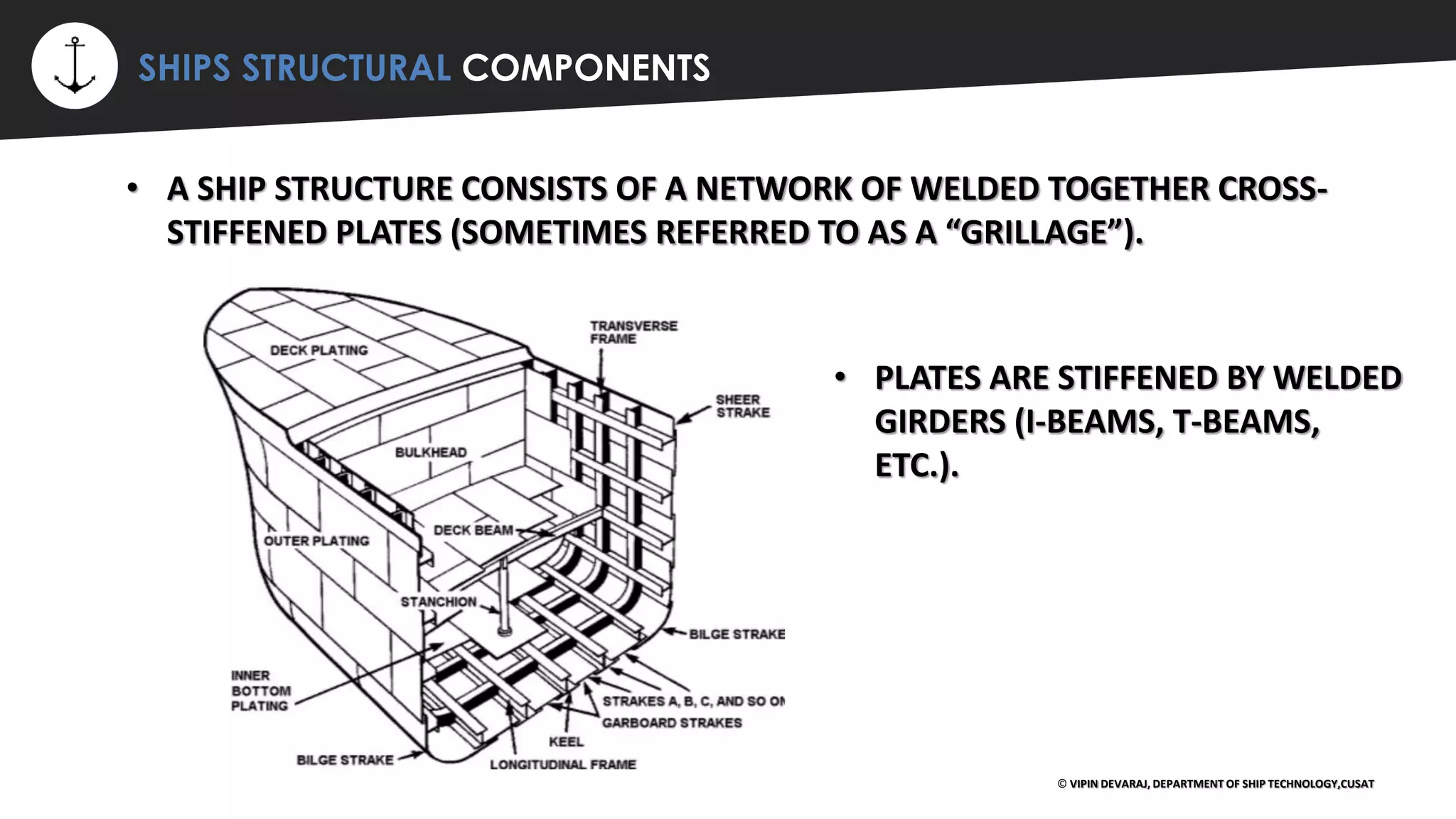
• A SHIP STRUCTURE CONSISTS OF A NETWORK OF WELDED TOGETHER CROSS-
STIFFENED PLATES (SOMETIMES REFERRED TO AS A “GRILLAGE”).
• PLATES ARE STIFFENED BY WELDED
GIRDERS (I-BEAMS, T-BEAMS,
ETC.).
⚡ SHIPS STRUCTURAL COMPONENTS
© VIPIN DEVARAJ, DEPARTMENT OF SHIP TECHNOLOGY,CUSAT
STRUCTURAL MEMBERS TO BE DISCUSSED ARE AS FOLLOWS:
• KEEL
• PLATING
• FRAMES
• FLOORS
• DECK BEAMS
• LONGITUDNALS
• DECK GIRDERS
⚡ KEEL
© VIPIN DEVARAJ, DEPARTMENT OF SHIP TECHNOLOGY,CUSAT
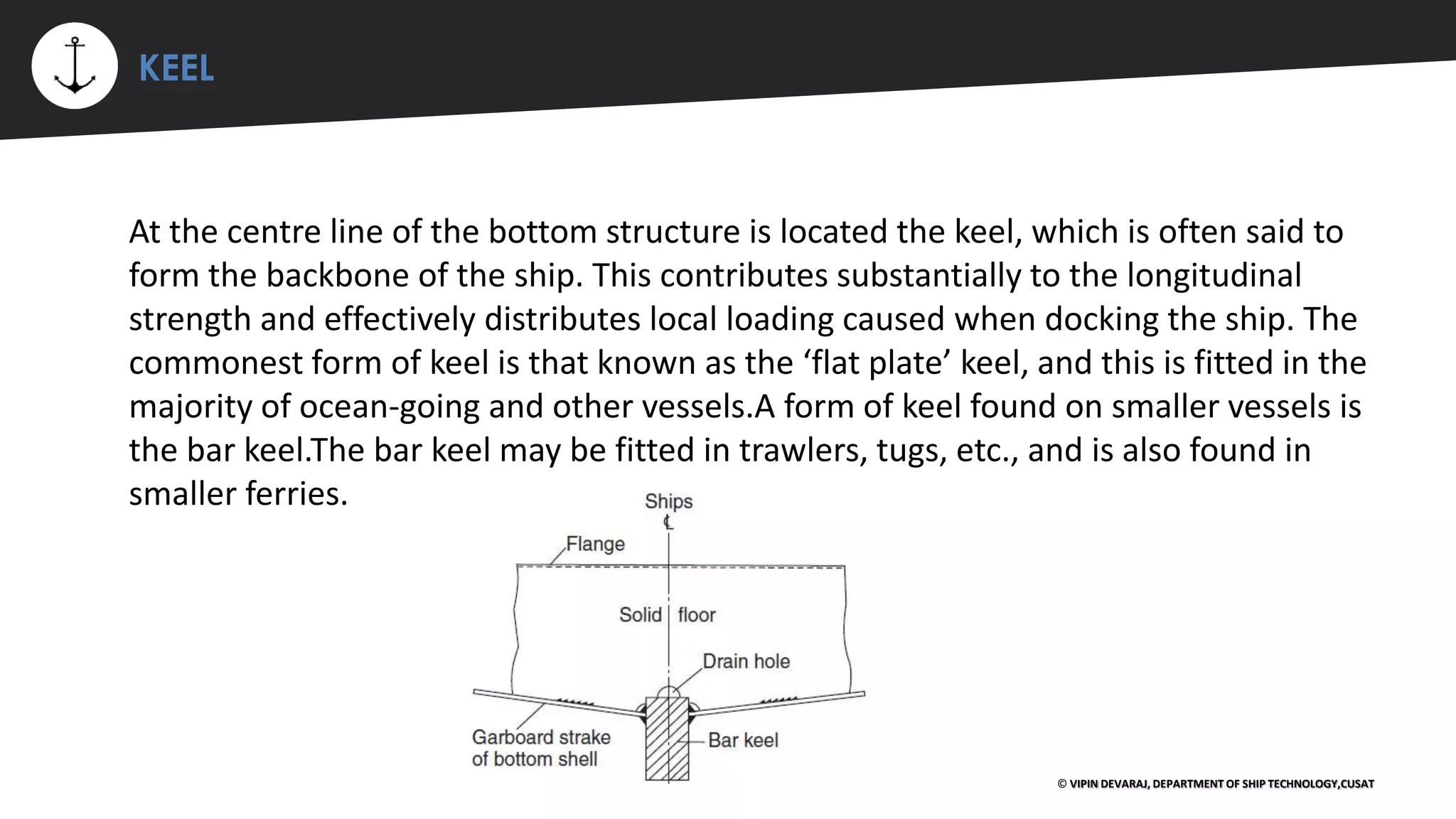
At the centre line of the bottom structure is located the keel, which is often said to
form the backbone of the ship. This contributes substantially to the longitudinal
strength and effectively distributes local loading caused when docking the ship. The
commonest form of keel is that known as the ‘flat plate’ keel, and this is fitted in the
majority of ocean-going and other vessels.A form of keel found on smaller vessels is
the bar keel.The bar keel may be fitted in trawlers, tugs, etc., and is also found in
smaller ferries.
⚡ PLATING
© VIPIN DEVARAJ, DEPARTMENT OF SHIP TECHNOLOGY,CUSAT
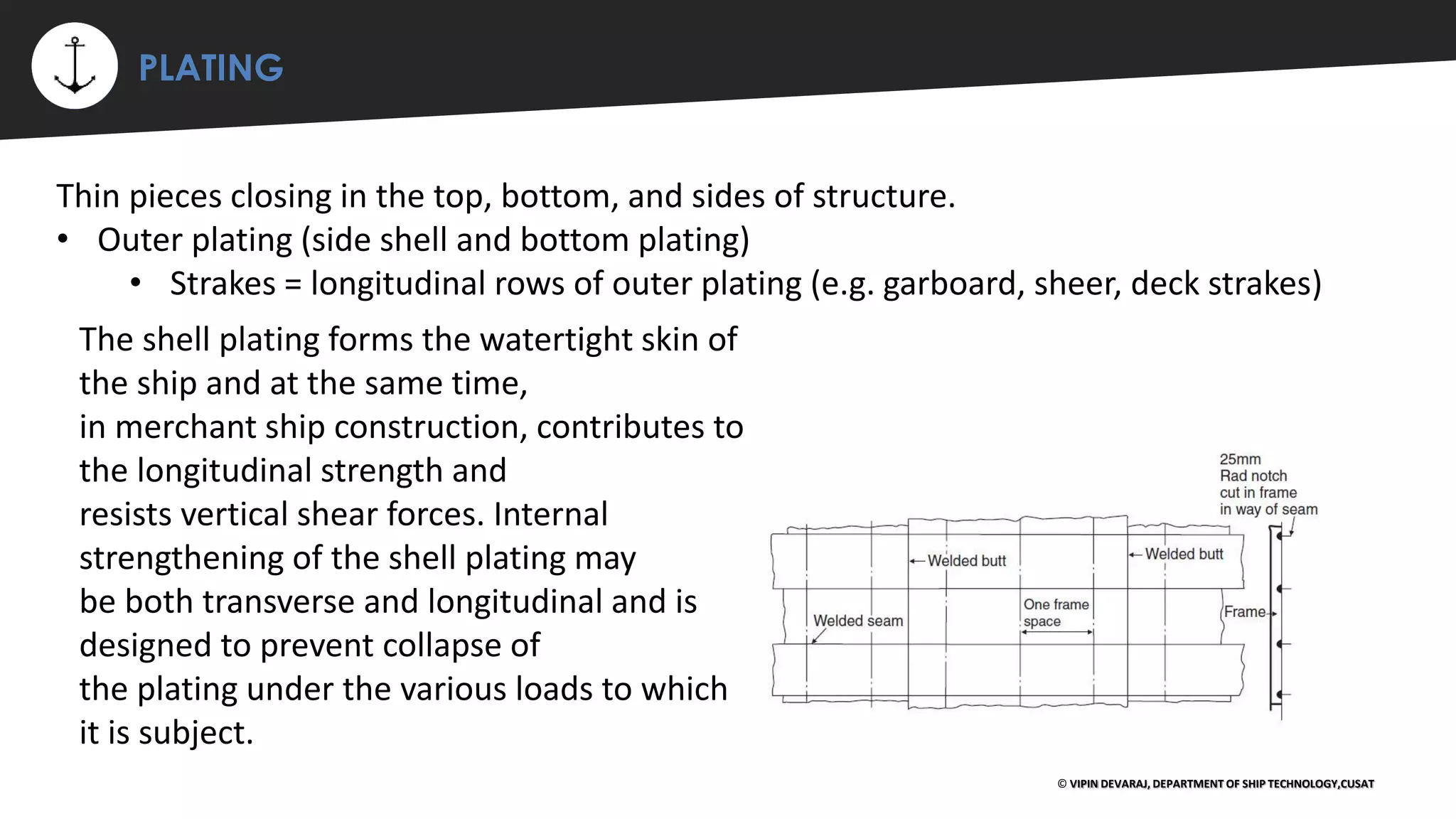
Thin pieces closing in the top, bottom, and sides of structure.
• Outer plating (side shell and bottom plating)
• Strakes = longitudinal rows of outer plating (e.g. garboard, sheer, deck strakes)
The shell plating forms the watertight skin of
the ship and at the same time,
in merchant ship construction, contributes to
the longitudinal strength and
resists vertical shear forces. Internal
strengthening of the shell plating may
be both transverse and longitudinal and is
designed to prevent collapse of
the plating under the various loads to which
it is subject.
⚡ FLOORS
© VIPIN DEVARAJ, DEPARTMENT OF SHIP TECHNOLOGY,CUSAT
The transverse vertical plates dividing these tanks into sections are called
floors. Vertical transverse plate floors are provided both where the bottom is
transversely and longitudinally framed. At the ends of bottom tank spaces and
under the main bulkheads, watertight or oil tight plate floors are provided.
‘solid plate floors’ are fitted to strengthen the bottom transversely and
support the inner bottom. These run transversely from the continuous center
girder to the bilge, and manholes provided for access through the tanks and
lightening holes are cut in each solid plate floor. The spacing of the solid plate
floors varies according to the loads supported and local stresses experienced.
At intermediate frame spaces between the solid plate floors, 'bracket floors’
are fitted. The bracket floor consists simply of short transverse plate brackets
fitted in way of the centre girder and tank sides
⚡ OTHER STRUCTURAL MEMBERS
© VIPIN DEVARAJ, DEPARTMENT OF SHIP TECHNOLOGY,CUSAT
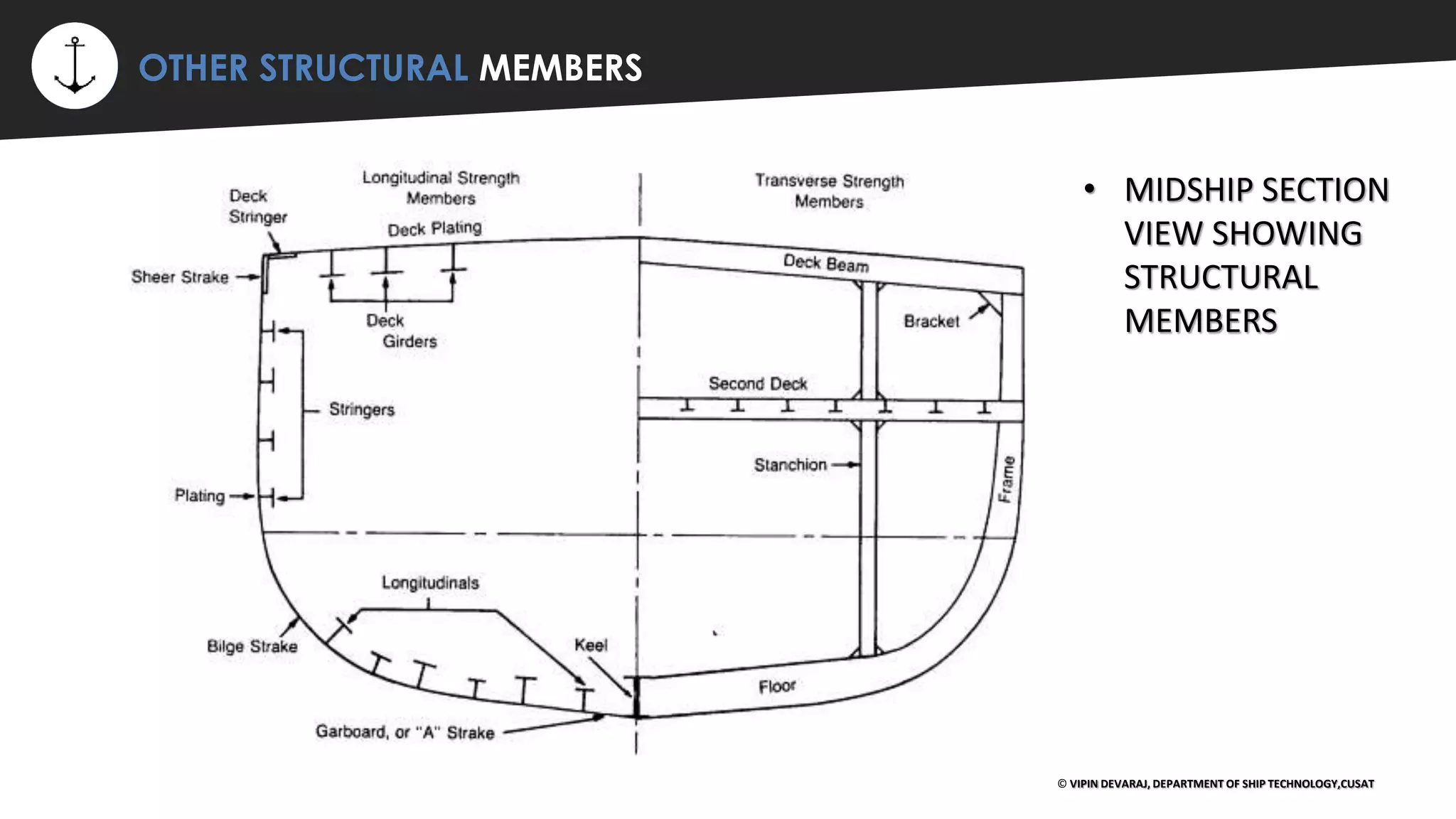
Stringers are large beams or angles fitted in various parts of the vessel to give
added strength. Depending upon their locations, stringers are known as bilge
stringers, side stringers, hold stringers, etc
Bulkheads (longitudinal & transverse) :-Bulkheads are large partitions made of
plates riveted or welded together and stiffened with angle bars, tee bars, etc.
Depending on the type of ship there are transverse, longitudinal and side
bulkheads. They divide the ship into compartments fore-and-aft, or from port to
starboard, and they may run between two or more decks
Frames – Girders which run transversely from keel to main deck. Used to
transversely stiffen the outer plating.
⚡ OTHER STRUCTURAL MEMBERS
© VIPIN DEVARAJ, DEPARTMENT OF SHIP TECHNOLOGY,CUSAT
• MIDSHIP SECTION
VIEW SHOWING
STRUCTURAL
MEMBERS
⚡ FRAMING
© VIPIN DEVARAJ, DEPARTMENT OF SHIP TECHNOLOGY,CUSAT
• TYPES OF FRAMING SYSTEMS
•For combating primarily hydrostatic and side impact loads
•Closely spaced continuous frames with widely spaced longitudinals
•Used primarily for
• Short ships (lengths less than typical ocean waves: ~ 300ft)
• Submarines
•Thick side plating is required
•Longitudinal strength is relatively low.
1. Transverse Framing
Primary role of transverse members is to resist the hydrostatic loads.Usually used
in ship with length less than 100m
⚡ FRAMING
© VIPIN DEVARAJ, DEPARTMENT OF SHIP TECHNOLOGY,CUSAT
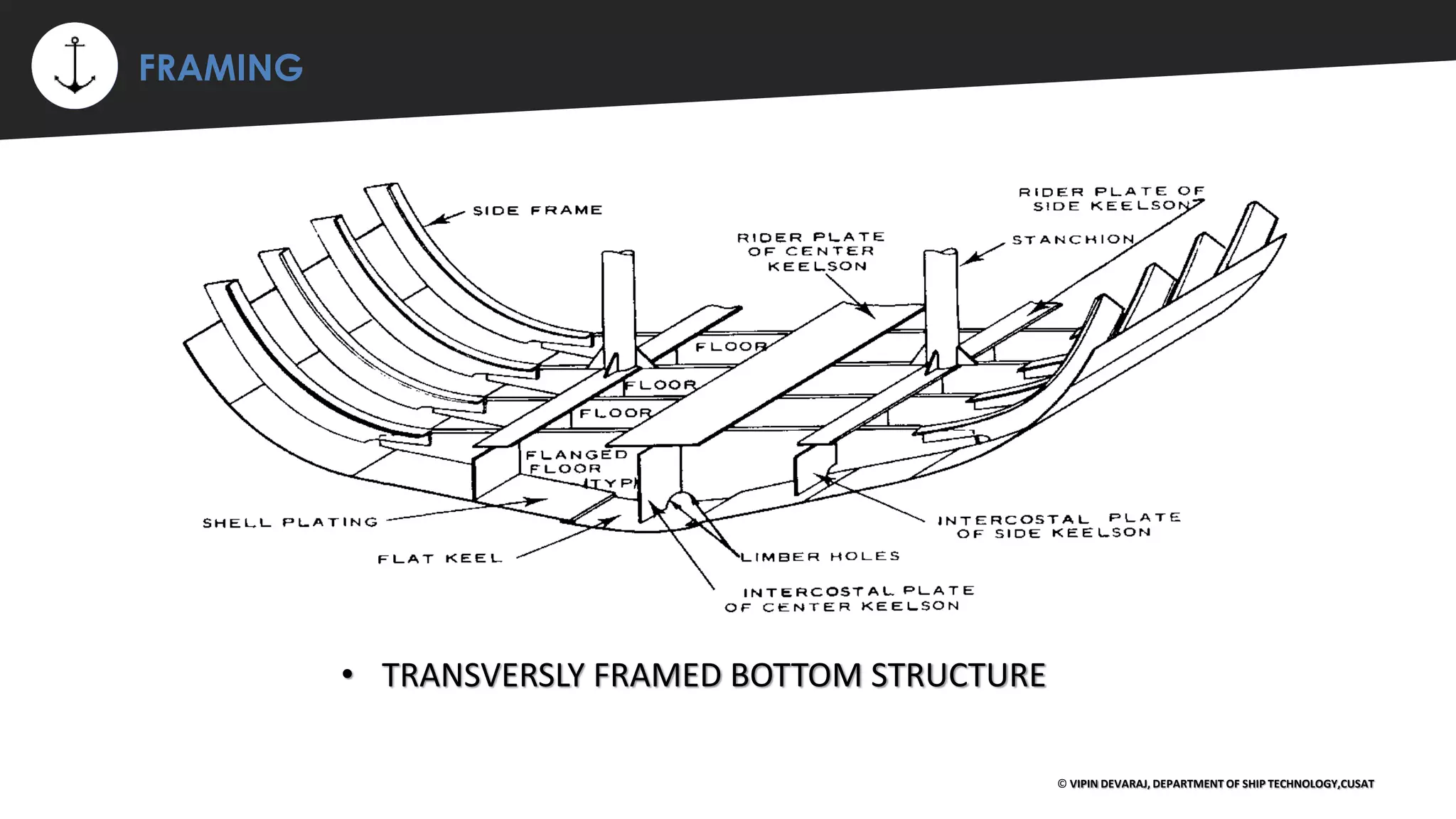
• TRANSVERSLY FRAMED BOTTOM STRUCTURE
⚡ FRAMING
© VIPIN DEVARAJ, DEPARTMENT OF SHIP TECHNOLOGY,CUSAT
2.Longitudinal Framing
•For combating primarily longitudinal bending (flexure) loads
•Closely spaced longitudinals and more widely spaced (deep web) frames
•Side plating is comparably thin …primarily designed to keep the water out
Primary role of longitudinal members is to resist the longitudinal bending
stress due to sagging and hogging
⚡ FRAMING
© VIPIN DEVARAJ, DEPARTMENT OF SHIP TECHNOLOGY,CUSAT
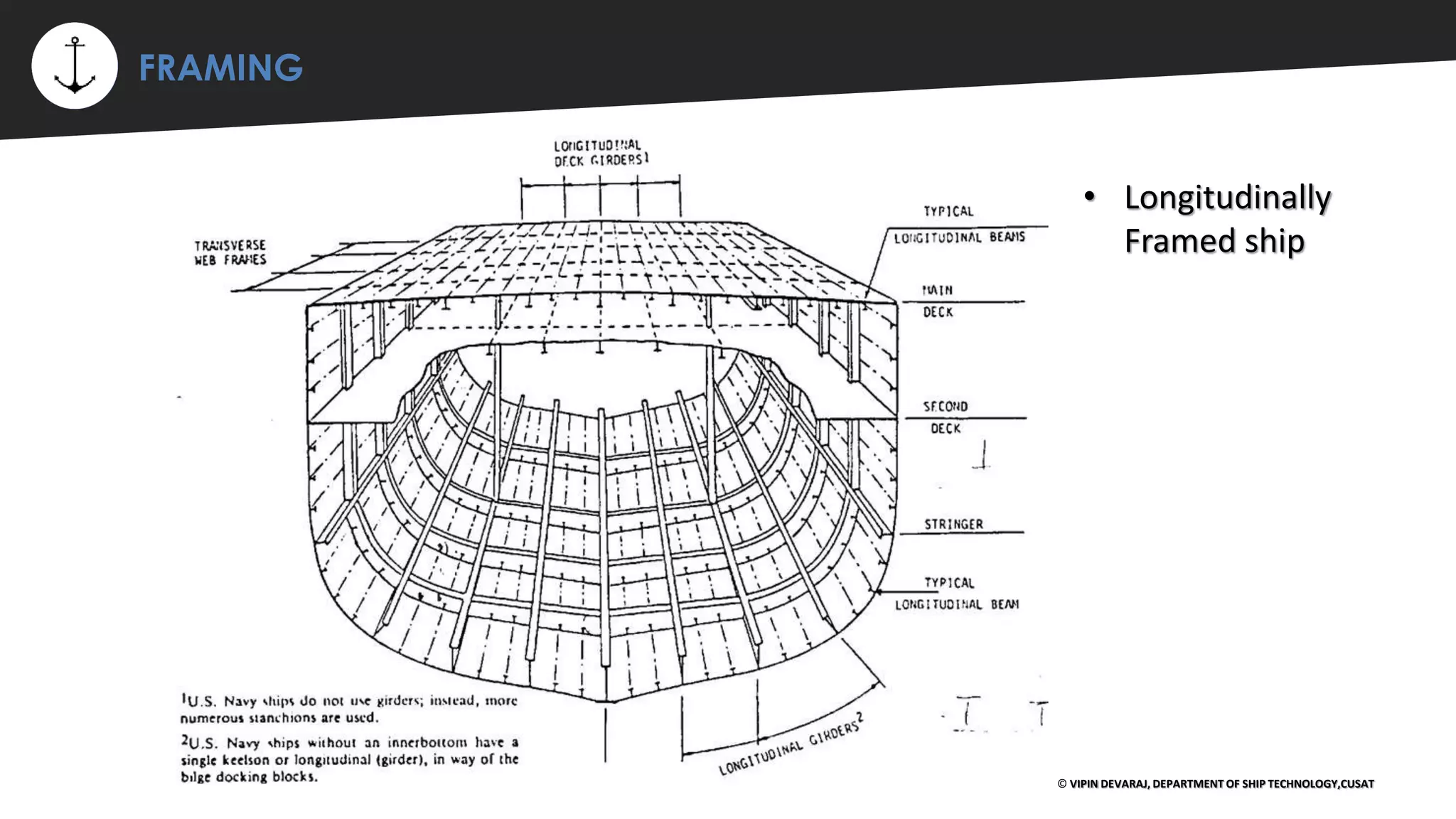
• Longitudinally
Framed ship
⚡ FRAMING
© VIPIN DEVARAJ, DEPARTMENT OF SHIP TECHNOLOGY,CUSAT
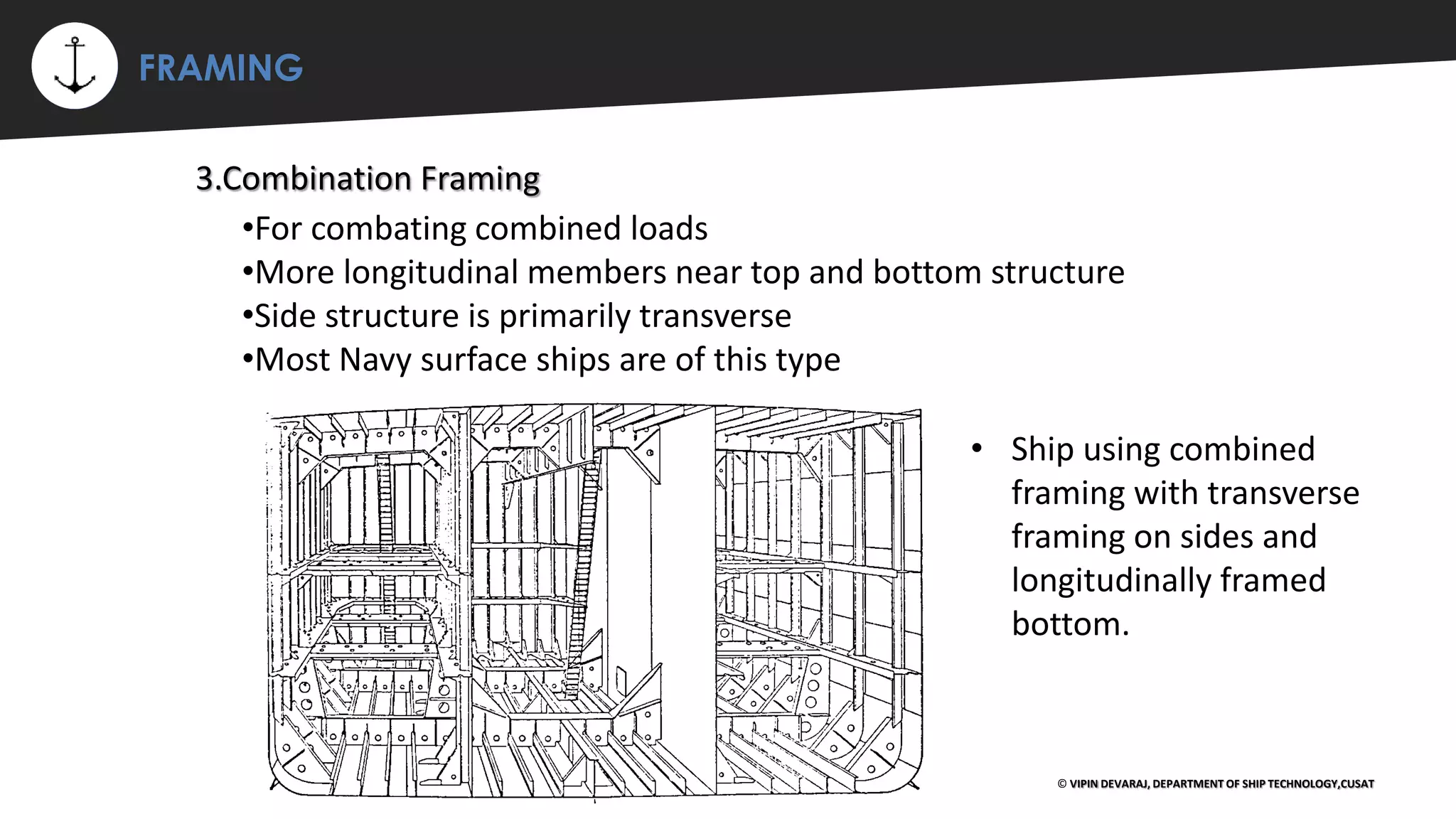
3.Combination Framing
•For combating combined loads
•More longitudinal members near top and bottom structure
•Side structure is primarily transverse
•Most Navy surface ships are of this type
• Ship using combined
framing with transverse
framing on sides and
longitudinally framed
bottom.
⚡ TYPES OF BOTTOM CONSTRUCTIONS
© VIPIN DEVARAJ, DEPARTMENT OF SHIP TECHNOLOGY,CUSAT
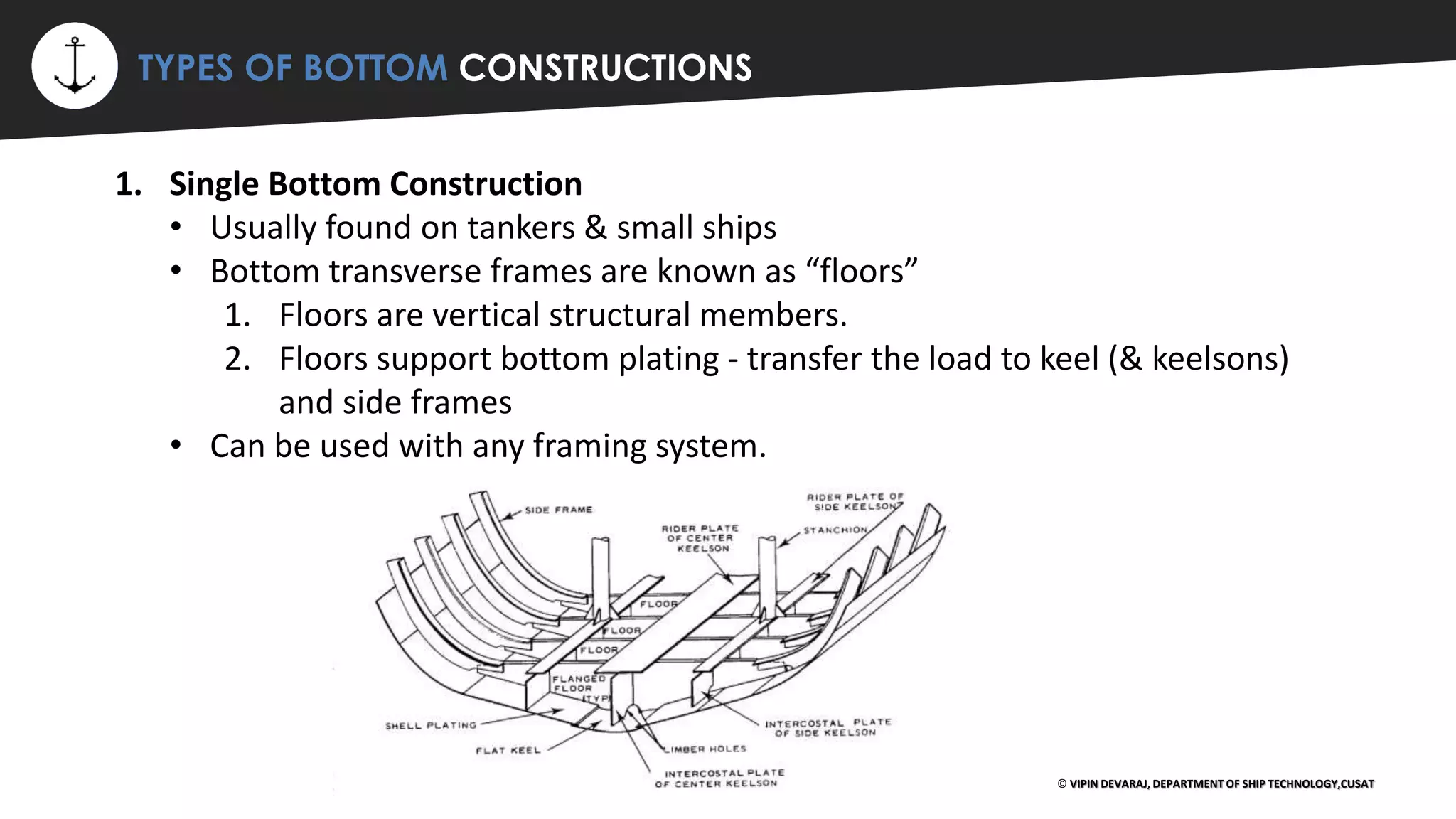
1. Single Bottom Construction
• Usually found on tankers & small ships
• Bottom transverse frames are known as “floors”
1. Floors are vertical structural members.
2. Floors support bottom plating - transfer the load to keel (& keelsons)
and side frames
• Can be used with any framing system.
⚡ TYPES OF BOTTOM CONSTRUCTIONS
© VIPIN DEVARAJ, DEPARTMENT OF SHIP TECHNOLOGY,CUSAT
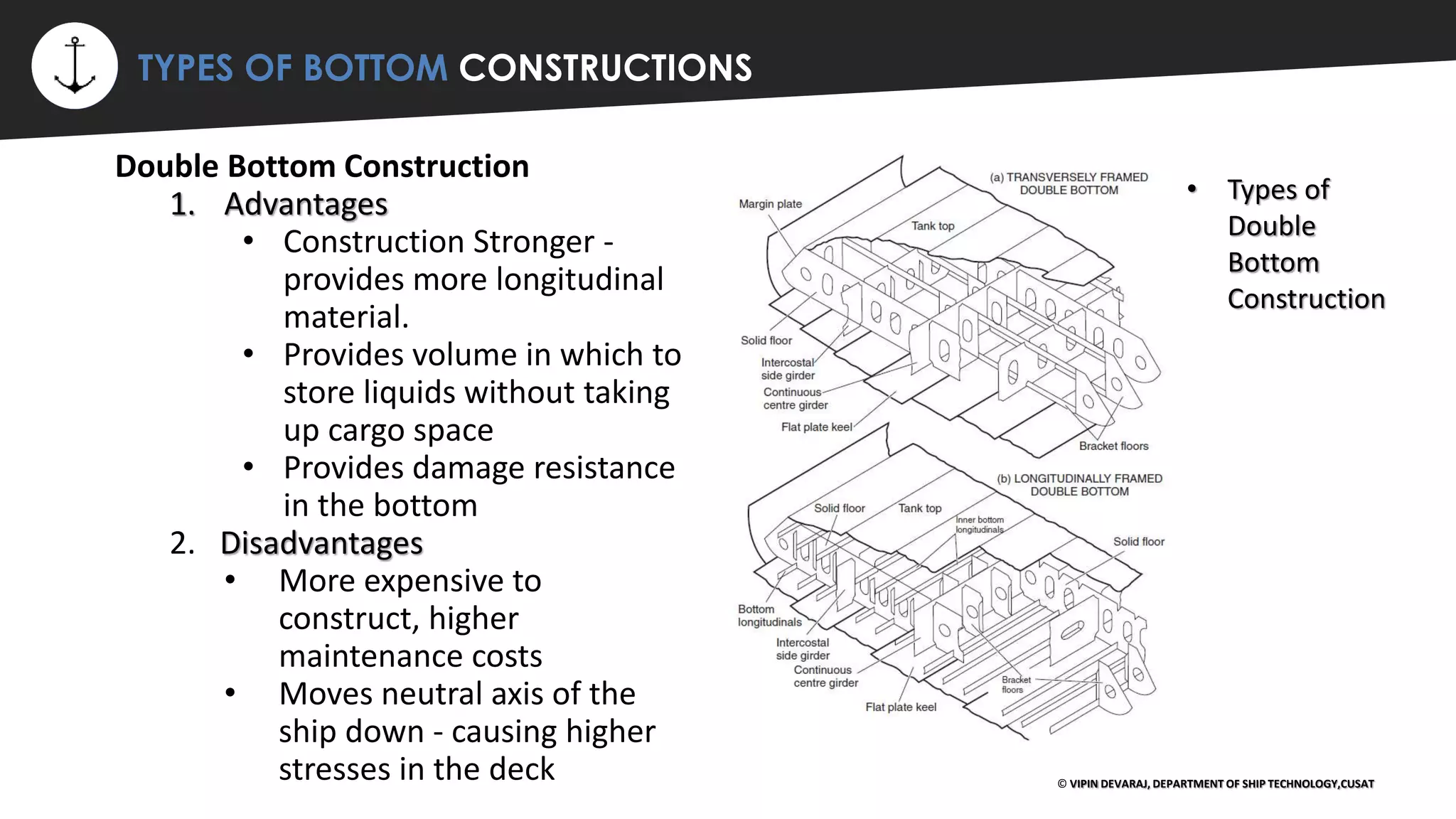
Double Bottom Construction
1. Advantages
• Construction Stronger -
provides more longitudinal
material.
• Provides volume in which to
store liquids without taking
up cargo space
• Provides damage resistance
in the bottom
2. Disadvantages
• More expensive to
construct, higher
maintenance costs
• Moves neutral axis of the
ship down - causing higher
stresses in the deck
• Types of
Double
Bottom
Construction
⚡ TYPES OF BOTTOM CONSTRUCTIONS
© VIPIN DEVARAJ, DEPARTMENT OF SHIP TECHNOLOGY,CUSAT
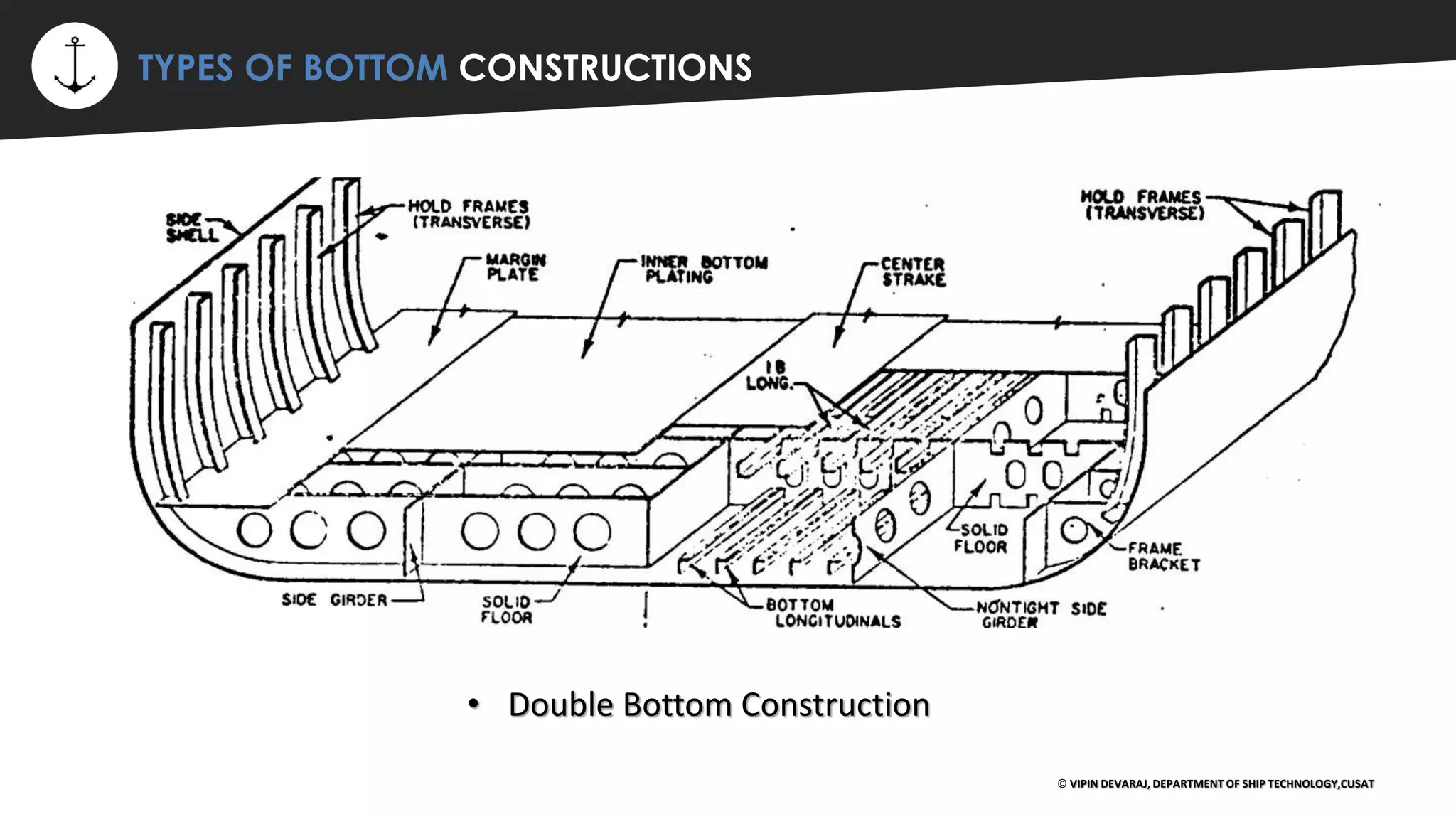
• Double Bottom Construction
⚡
THANK YOU
© VIPIN DEVARAJ, DEPARTMENT OF SHIP TECHNOLOGY,CUSAT

Structural members of ship

  • 1.
    ⚡ SHIP HULL ANDSTRUCTURAL TERMS BY: VIPIN DEVARAJ DEPT OF SHIP TECHNOLOGY, TRAINEE,INTERNATIONAL SHIPPING BUREAU, KAKKANAD ,KOCHI © VIPIN DEVARAJ, DEPARTMENT OF SHIP TECHNOLOGY,CUSAT
  • 2.
    ⚡ SHIPS STRUCTURALCOMPONENTS © VIPIN DEVARAJ, DEPARTMENT OF SHIP TECHNOLOGY,CUSAT • A SHIP STRUCTURE CONSISTS OF A NETWORK OF WELDED TOGETHER CROSS- STIFFENED PLATES (SOMETIMES REFERRED TO AS A “GRILLAGE”). • PLATES ARE STIFFENED BY WELDED GIRDERS (I-BEAMS, T-BEAMS, ETC.).
  • 3.
    ⚡ SHIPS STRUCTURALCOMPONENTS © VIPIN DEVARAJ, DEPARTMENT OF SHIP TECHNOLOGY,CUSAT STRUCTURAL MEMBERS TO BE DISCUSSED ARE AS FOLLOWS: • KEEL • PLATING • FRAMES • FLOORS • DECK BEAMS • LONGITUDNALS • DECK GIRDERS
  • 4.
    ⚡ KEEL © VIPINDEVARAJ, DEPARTMENT OF SHIP TECHNOLOGY,CUSAT At the centre line of the bottom structure is located the keel, which is often said to form the backbone of the ship. This contributes substantially to the longitudinal strength and effectively distributes local loading caused when docking the ship. The commonest form of keel is that known as the ‘flat plate’ keel, and this is fitted in the majority of ocean-going and other vessels.A form of keel found on smaller vessels is the bar keel.The bar keel may be fitted in trawlers, tugs, etc., and is also found in smaller ferries.
  • 5.
    ⚡ PLATING © VIPINDEVARAJ, DEPARTMENT OF SHIP TECHNOLOGY,CUSAT Thin pieces closing in the top, bottom, and sides of structure. • Outer plating (side shell and bottom plating) • Strakes = longitudinal rows of outer plating (e.g. garboard, sheer, deck strakes) The shell plating forms the watertight skin of the ship and at the same time, in merchant ship construction, contributes to the longitudinal strength and resists vertical shear forces. Internal strengthening of the shell plating may be both transverse and longitudinal and is designed to prevent collapse of the plating under the various loads to which it is subject.
  • 6.
    ⚡ FLOORS © VIPINDEVARAJ, DEPARTMENT OF SHIP TECHNOLOGY,CUSAT The transverse vertical plates dividing these tanks into sections are called floors. Vertical transverse plate floors are provided both where the bottom is transversely and longitudinally framed. At the ends of bottom tank spaces and under the main bulkheads, watertight or oil tight plate floors are provided. ‘solid plate floors’ are fitted to strengthen the bottom transversely and support the inner bottom. These run transversely from the continuous center girder to the bilge, and manholes provided for access through the tanks and lightening holes are cut in each solid plate floor. The spacing of the solid plate floors varies according to the loads supported and local stresses experienced. At intermediate frame spaces between the solid plate floors, 'bracket floors’ are fitted. The bracket floor consists simply of short transverse plate brackets fitted in way of the centre girder and tank sides
  • 7.
    ⚡ OTHER STRUCTURALMEMBERS © VIPIN DEVARAJ, DEPARTMENT OF SHIP TECHNOLOGY,CUSAT Stringers are large beams or angles fitted in various parts of the vessel to give added strength. Depending upon their locations, stringers are known as bilge stringers, side stringers, hold stringers, etc Bulkheads (longitudinal & transverse) :-Bulkheads are large partitions made of plates riveted or welded together and stiffened with angle bars, tee bars, etc. Depending on the type of ship there are transverse, longitudinal and side bulkheads. They divide the ship into compartments fore-and-aft, or from port to starboard, and they may run between two or more decks Frames – Girders which run transversely from keel to main deck. Used to transversely stiffen the outer plating.
  • 8.
    ⚡ OTHER STRUCTURALMEMBERS © VIPIN DEVARAJ, DEPARTMENT OF SHIP TECHNOLOGY,CUSAT • MIDSHIP SECTION VIEW SHOWING STRUCTURAL MEMBERS
  • 9.
    ⚡ FRAMING © VIPINDEVARAJ, DEPARTMENT OF SHIP TECHNOLOGY,CUSAT • TYPES OF FRAMING SYSTEMS •For combating primarily hydrostatic and side impact loads •Closely spaced continuous frames with widely spaced longitudinals •Used primarily for • Short ships (lengths less than typical ocean waves: ~ 300ft) • Submarines •Thick side plating is required •Longitudinal strength is relatively low. 1. Transverse Framing Primary role of transverse members is to resist the hydrostatic loads.Usually used in ship with length less than 100m
  • 10.
    ⚡ FRAMING © VIPINDEVARAJ, DEPARTMENT OF SHIP TECHNOLOGY,CUSAT • TRANSVERSLY FRAMED BOTTOM STRUCTURE
  • 11.
    ⚡ FRAMING © VIPINDEVARAJ, DEPARTMENT OF SHIP TECHNOLOGY,CUSAT 2.Longitudinal Framing •For combating primarily longitudinal bending (flexure) loads •Closely spaced longitudinals and more widely spaced (deep web) frames •Side plating is comparably thin …primarily designed to keep the water out Primary role of longitudinal members is to resist the longitudinal bending stress due to sagging and hogging
  • 12.
    ⚡ FRAMING © VIPINDEVARAJ, DEPARTMENT OF SHIP TECHNOLOGY,CUSAT • Longitudinally Framed ship
  • 13.
    ⚡ FRAMING © VIPINDEVARAJ, DEPARTMENT OF SHIP TECHNOLOGY,CUSAT 3.Combination Framing •For combating combined loads •More longitudinal members near top and bottom structure •Side structure is primarily transverse •Most Navy surface ships are of this type • Ship using combined framing with transverse framing on sides and longitudinally framed bottom.
  • 14.
    ⚡ TYPES OFBOTTOM CONSTRUCTIONS © VIPIN DEVARAJ, DEPARTMENT OF SHIP TECHNOLOGY,CUSAT 1. Single Bottom Construction • Usually found on tankers & small ships • Bottom transverse frames are known as “floors” 1. Floors are vertical structural members. 2. Floors support bottom plating - transfer the load to keel (& keelsons) and side frames • Can be used with any framing system.
  • 15.
    ⚡ TYPES OFBOTTOM CONSTRUCTIONS © VIPIN DEVARAJ, DEPARTMENT OF SHIP TECHNOLOGY,CUSAT Double Bottom Construction 1. Advantages • Construction Stronger - provides more longitudinal material. • Provides volume in which to store liquids without taking up cargo space • Provides damage resistance in the bottom 2. Disadvantages • More expensive to construct, higher maintenance costs • Moves neutral axis of the ship down - causing higher stresses in the deck • Types of Double Bottom Construction
  • 16.
    ⚡ TYPES OFBOTTOM CONSTRUCTIONS © VIPIN DEVARAJ, DEPARTMENT OF SHIP TECHNOLOGY,CUSAT • Double Bottom Construction
  • 17.
    ⚡ THANK YOU © VIPINDEVARAJ, DEPARTMENT OF SHIP TECHNOLOGY,CUSAT