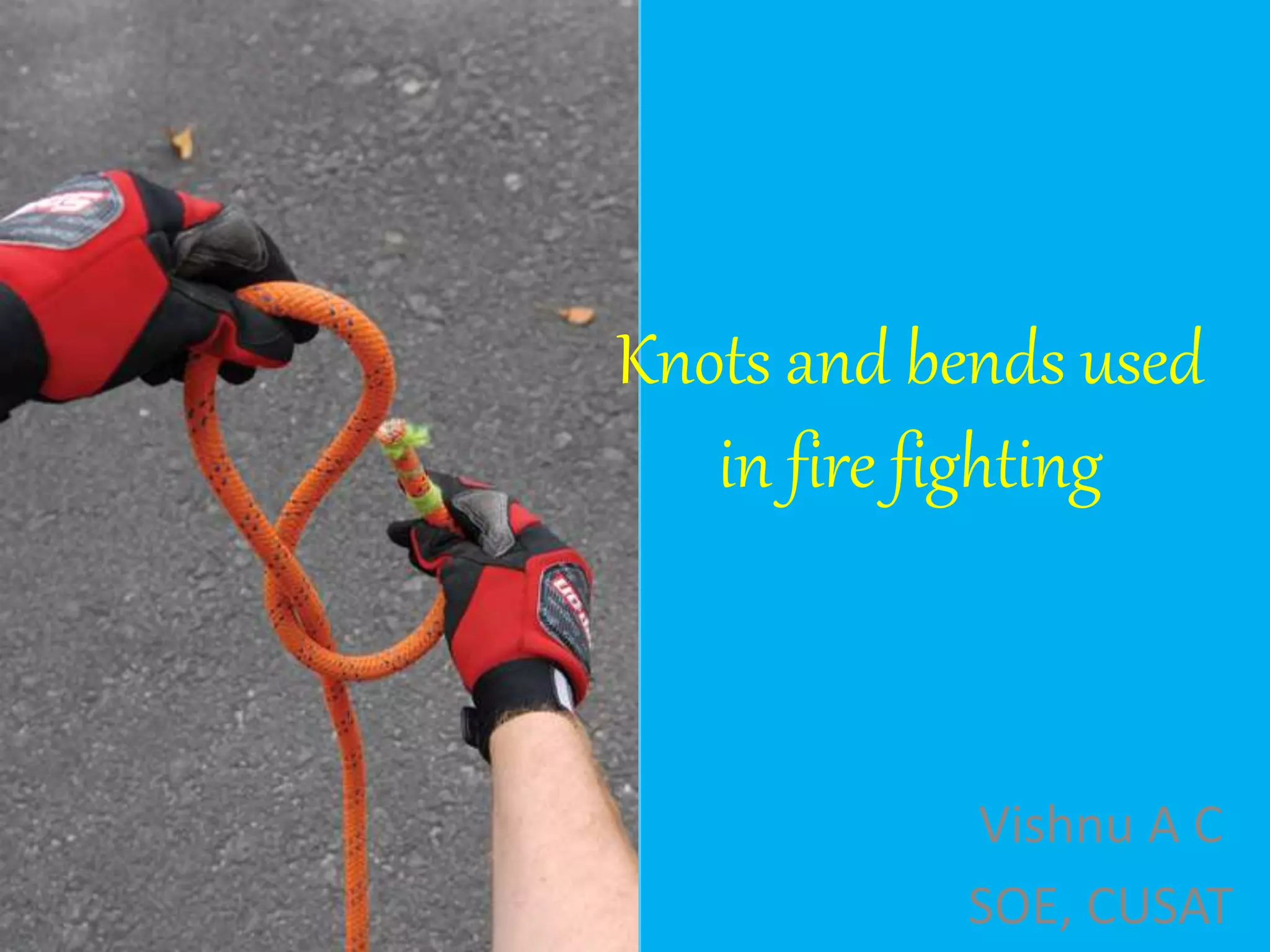



Knots and bends used
in fire fighting
Vishnu A C
SOE, CUSAT
• Ropes are widely used in the fire service.
• May be your only means for rescue
• A fire fighter must be able to tie simple knots
accurately and without hesitation.
Introduction
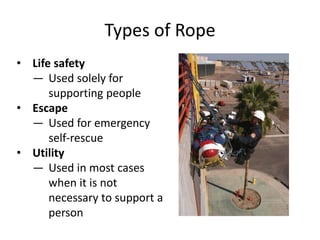
• Life safety
— Used solely for
supporting people
• Escape
— Used for emergency
self-rescue
• Utility
— Used in most cases
when it is not
necessary to support a
person
Types of Rope
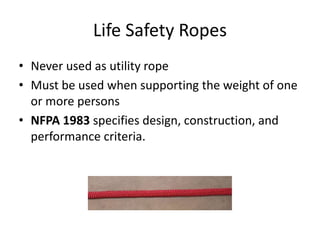
• Never used as utility rope
• Must be used when supporting the weight of one
or more persons
• NFPA 1983 specifies design, construction, and
performance criteria.
Life Safety Ropes
• Technical use life safety rope
– 3/8” (9.5 mm) or greater, but is less than 1/2”
(12.5mm) in diameter
• General use life safety rope
– is no larger than 5/8” (16 mm) and no smaller
than 7/16” (11 mm) in diameter
Types of Life Safety Rope
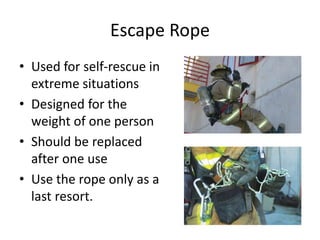
• Used for self-rescue in
extreme situations
• Designed for the
weight of one person
• Should be replaced
after one use
• Use the rope only as a
last resort.
Escape Rope
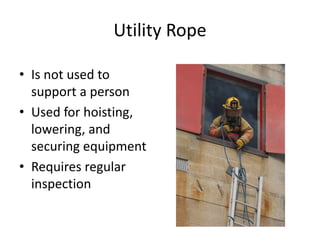
• Is not used to
support a person
• Used for hoisting,
lowering, and
securing equipment
• Requires regular
inspection
Utility Rope
• Ropes can be made of many types of
materials.
• Earliest ropes were made from natural vines
woven together.
• Now ropes are made of synthetic material and
Wire ropes.
Rope materials
• Wire rope is a combination of steel wires
arranged around a central fiber core
• The breaking load of wire is considerably
greater than that of fiber rope of equivalent
size
• it is far less flexible
• limited to equipment usage like winch,
ladders, etc.
Wire Ropes
• Natural fiber ropes were often made of manila.
• Currently used for utility, not life safety, tasks
Drawbacks to Using Natural Fiber ropes
• Lose their load- carrying ability over time
• Subject to mildew
• Absorb 50 percent of their weight in water
• Degrade quickly
• Difficult to meet block creel construction
requirement with natural fibers
Natural Fibers
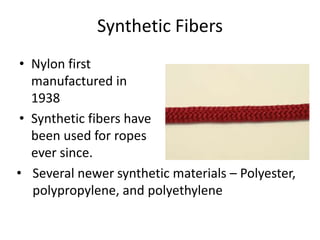
• Nylon first
manufactured in
1938
• Synthetic fibers have
been used for ropes
ever since.
Synthetic Fibers
• Several newer synthetic materials – Polyester,
polypropylene, and polyethylene
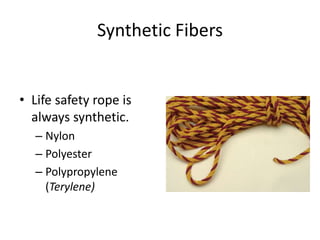
• Life safety rope is
always synthetic.
– Nylon
– Polyester
– Polypropylene
(Terylene)
Synthetic Fibers
Advantages to using Synthetic
Fiber Ropes
• Strength to Diameter ratio
• Longevity over natural fibers
• Thinner without sacrificing strength
• Less absorbent than natural fiber ropes
• Greater strength and added safety
• More fire-retardant than natural fiber ropes
Drawbacks to using Synthetic fiber
ropes
• Can be damaged by prolonged exposure to
ultraviolet light
• Can be damaged by exposure to strong acids
or alkalis
• Susceptible to abrasion
Rope Construction
• There are several types of rope
construction.
• The best choice depends on the specific
application.
– Twisted Rope Construction
– Braided Rope Construction
– Kernmantle Rope Construction
– Dynamic and Static Rope Construction
– Dynamic and Static Kernmantle Rope
Construction
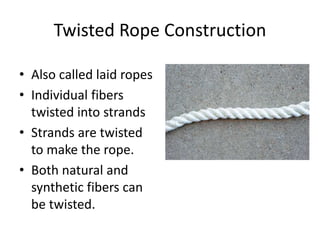
Twisted Rope Construction
• Also called laid ropes
• Individual fibers
twisted into strands
• Strands are twisted
to make the rope.
• Both natural and
synthetic fibers can
be twisted.
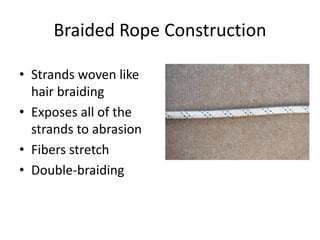
Braided Rope Construction
• Strands woven like
hair braiding
• Exposes all of the
strands to abrasion
• Fibers stretch
• Double-braiding
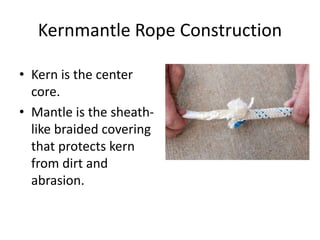
Kernmantle Rope Construction
• Kern is the center
core.
• Mantle is the sheath-
like braided covering
that protects kern
from dirt and
abrasion.
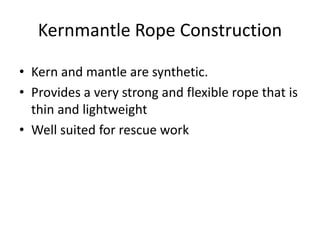
Kernmantle Rope Construction
• Kern and mantle are synthetic.
• Provides a very strong and flexible rope that is
thin and lightweight
• Well suited for rescue work
Dynamic and Static
Rope Construction
• Dynamic
– Designed to be elastic
– Usually used by mountain climbers
• Static
– Has a limited range of elasticity
– More suitable for rescue situations
Dynamic and Static
Kernmantle Rope Construction
• Dynamic
– Constructed with overlapping or woven fibers
– When loaded, the fibers pull tighter.
• Static
– Constructed with fibers parallel to each other
– Little elasticity and limited elongation
Causes of Deteriorations of Ropes
• Abrasion and Chaffing
• Breaking of internal fibers
• Kinking or Sharp bends
• Dragging on ground
• Overloading
• Entry of grits into the fibers
• Chemical attack
Rope Maintenance
• All ropes require proper care.
• Four parts to maintenance:
– Care
– Clean
– Inspect
– Store
Care of the Rope
• Protect the rope from sharp and abrasive surface.
• Protect the rope from rubbing against another
rope or a webbing.
• Protect the rope from heat, chemical and flames.
• Protect the rope from prolonged exposure to
sunlight.
• Follow the manufacture’s recommendations for
rope care.
• Never step on rope.
Clean the Rope
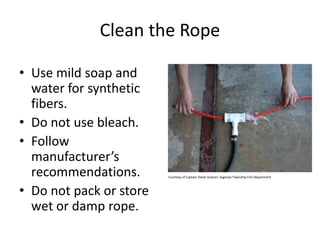
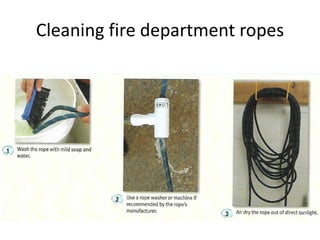
• Use mild soap and
water for synthetic
fibers.
• Do not use bleach.
• Follow
manufacturer’s
recommendations.
• Do not pack or store
wet or damp rope.
Courtesy of Captain David Jackson, Saginaw Township Fire Department
Cleaning fire department ropes
Questions to consider when
Inspecting Life Safety Ropes
• Has the rope been exposed to heat or flame?
• Has the rope been exposed to abrasion?
• Has the rope been exposed to chemicals?
• Has the rope been exposed to shock loads?
• Are there any depressions, discoloration, or
lumps in the rope?
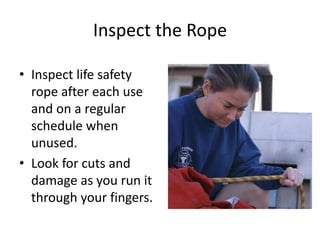
Inspect the Rope
• Inspect life safety
rope after each use
and on a regular
schedule when
unused.
• Look for cuts and
damage as you run it
through your fingers.
Inspect the Rope
• A life safety rope that is no longer usable must
be pulled from service and either destroyed or
marked as a utility rope.
Signs of Possible Rope Deterioration
• Discoloration
• Shiny marking from heat or friction.
• Damaged sheath
• Core fibers poking through the sheath
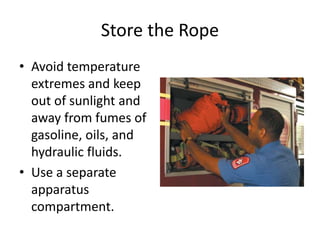
Store the Rope
• Avoid temperature
extremes and keep
out of sunlight and
away from fumes of
gasoline, oils, and
hydraulic fluids.
• Use a separate
apparatus
compartment.
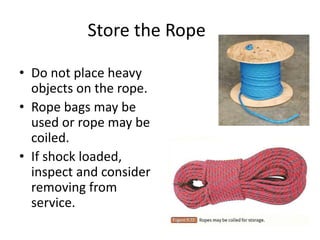
Store the Rope
• Do not place heavy
objects on the rope.
• Rope bags may be
used or rope may be
coiled.
• If shock loaded,
inspect and consider
removing from
service.
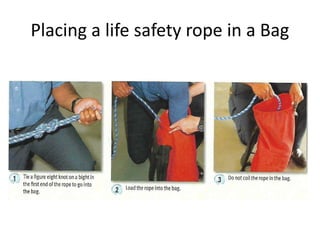
Placing a life safety rope in a Bag
Knots
• Ways of fastening ropes and webbing to
objects or each other.
• Fire fighters must know how and when to use
knots.
– Knots are used for multiple purposes.
– Knots reduce rope load-carrying capability.
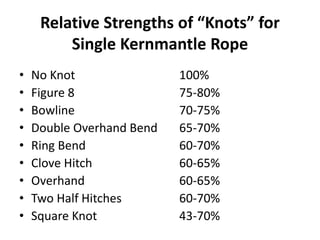
Relative Strengths of “Knots” for
Single Kernmantle Rope
• No Knot 100%
• Figure 8 75-80%
• Bowline 70-75%
• Double Overhand Bend 65-70%
• Ring Bend 60-70%
• Clove Hitch 60-65%
• Overhand 60-65%
• Two Half Hitches 60-70%
• Square Knot 43-70%
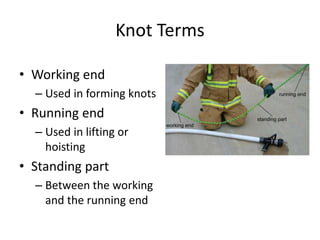
Knot Terms
• Working end
– Used in forming knots
• Running end
– Used in lifting or
hoisting
• Standing part
– Between the working
and the running end
Knot Terms
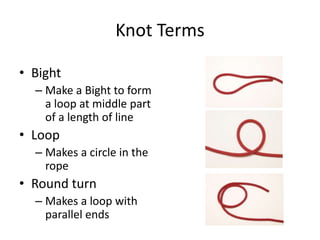
• Bight
– Make a Bight to form
a loop at middle part
of a length of line
• Loop
– Makes a circle in the
rope
• Round turn
– Makes a loop with
parallel ends
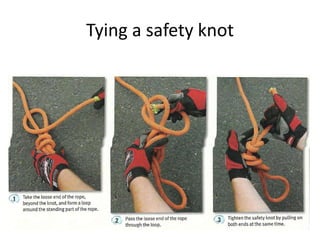
Safety Knot
• Secures the leftover working end of the rope
to the standing part of the rope.
• Ensures primary knot will not become undone
• To test, try sliding it on the standing part of
the rope.
– A knot that is tied correctly will slide.
Tying a safety knot
Loop Knots
• Used to form a loop in the end of a rope
• May be used for hoisting tools, securing a
person, or identifying the end of a stored
rope.
• Will not slip easily but are easy to untie
Loop Knots
• Figure eight knot
– Used to produce a family of other knots
– Seldom used alone
• Figure eight on a bight
– Secures loop at the working end
– Can be used to attach rope to fixed object or a
piece of equipment
Loop Knots
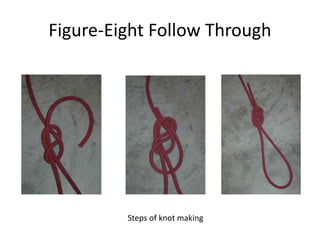
• Figure eight follow-through
– Useful for attaching a rope to a fixed ring or a solid
object with an “eye”
• Figure eight bend
– Used to join two ropes together
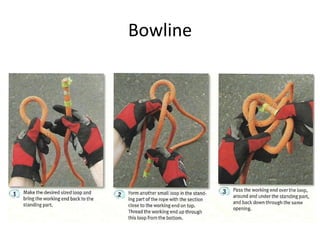
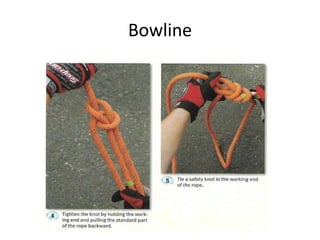
• Bowline
– Used to secure a rope to an object or anchor point
Loop Knots
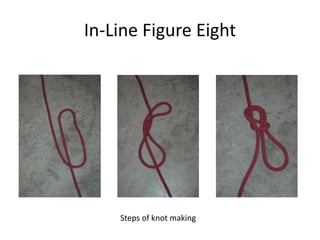
• In- Line Figure eight
• Figure eight follow-through
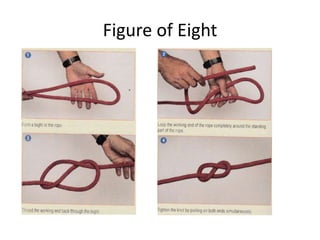
Figure of Eight
In-Line Figure Eight
Steps of knot making
Figure-Eight Follow Through
Steps of knot making
Bowline
Bowline
Hitches
• Wrap around an object
• Used to secure working end to a solid object
or to tie a rope to an object before hoisting it
Hitches
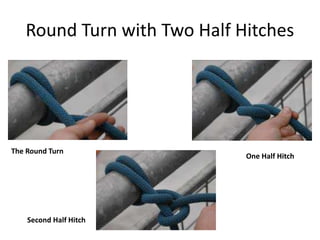
• Half hitch
– Not secure by itself
– Used only in conjunction with other knots.
– Long objects may need several half hitches.
Round Turn with Two Half Hitches
The Round Turn
One Half Hitch
Second Half Hitch
Hitches
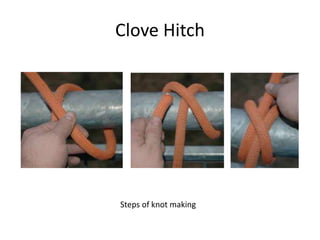
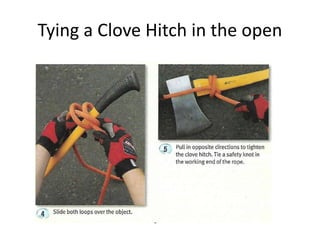
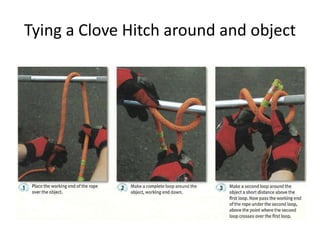
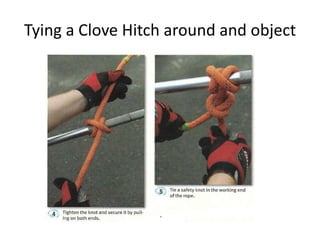
• Clove hitch
– Used to attach rope to a round object
– Will hold if tension is applied
Clove Hitch
Steps of knot making
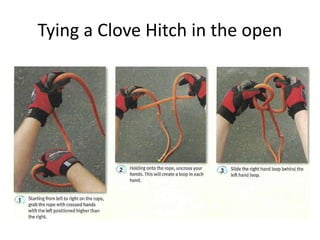
Tying a Clove Hitch in the open
Tying a Clove Hitch around and object
Hitches
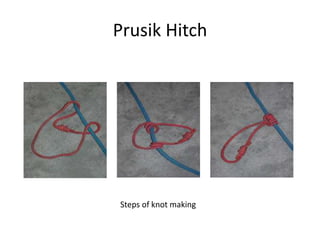
• Prussik Hitch
– The prussik hitch or “prussik” is formed from pre-
tied 8mm accessory cord.
– Operations company members should only use
the three-wrap prussik.
– The three wrap Prusik Hitch is for rescue loads up
to 600 lbs.
Prusik Hitch
Steps of knot making
Bends
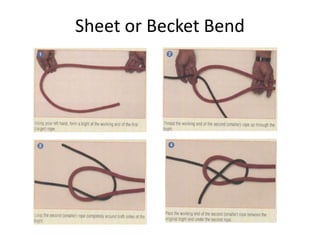
• Used to join two ropes together
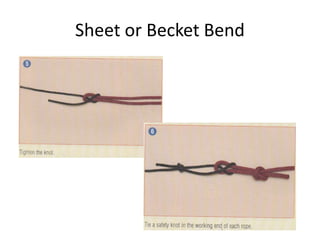
– The sheet bend or Becket bend can be used to join
two ropes of unequal size.
– The water knot or ring bend is used to join
webbing of the same or different sizes together.
Bends
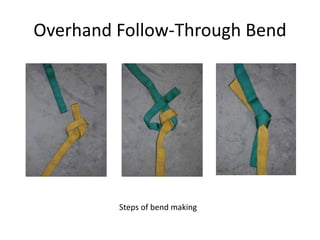
• Overhand follow-through Bend
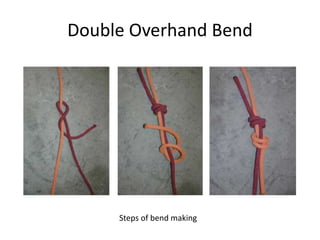
• Double overhand bend
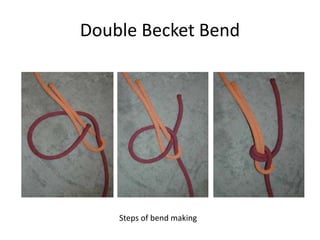
• Double Becket Bend
• Square bend
Sheet or Becket Bend
Double Becket Bend
Steps of bend making
Overhand Follow-Through Bend
Steps of bend making
Double Overhand Bend
Steps of bend making
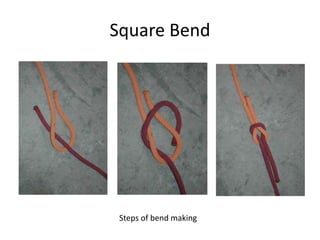
Square Bend
Steps of bend making
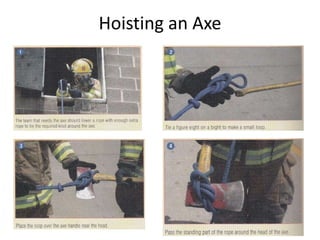
Hoisting an Axe
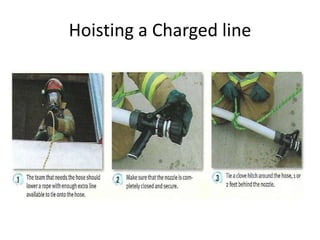
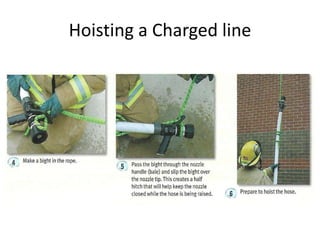
Hoisting a Charged line
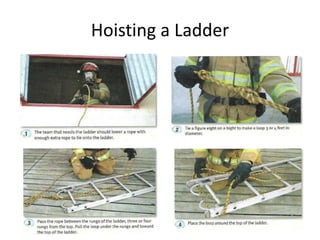
Hoisting a Ladder
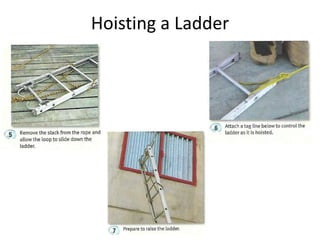
Hoisting a Ladder
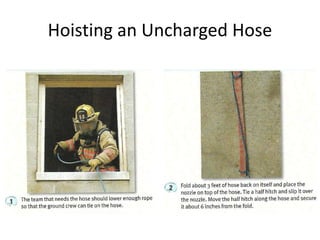
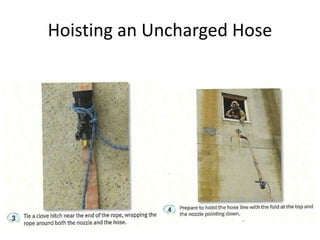
Hoisting an Uncharged Hose
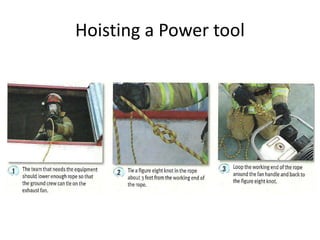
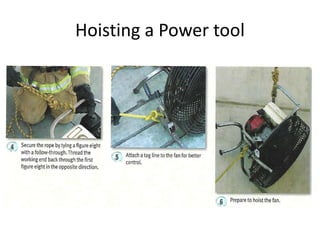
Hoisting a Power tool
THANK YOU

Rope and Knots

  • 1.
    Knots and bendsused in fire fighting Vishnu A C SOE, CUSAT
  • 2.
    • Ropes arewidely used in the fire service. • May be your only means for rescue • A fire fighter must be able to tie simple knots accurately and without hesitation. Introduction
  • 3.
    • Life safety —Used solely for supporting people • Escape — Used for emergency self-rescue • Utility — Used in most cases when it is not necessary to support a person Types of Rope
  • 4.
    • Never usedas utility rope • Must be used when supporting the weight of one or more persons • NFPA 1983 specifies design, construction, and performance criteria. Life Safety Ropes
  • 5.
    • Technical uselife safety rope – 3/8” (9.5 mm) or greater, but is less than 1/2” (12.5mm) in diameter • General use life safety rope – is no larger than 5/8” (16 mm) and no smaller than 7/16” (11 mm) in diameter Types of Life Safety Rope
  • 6.
    • Used forself-rescue in extreme situations • Designed for the weight of one person • Should be replaced after one use • Use the rope only as a last resort. Escape Rope
  • 7.
    • Is notused to support a person • Used for hoisting, lowering, and securing equipment • Requires regular inspection Utility Rope
  • 8.
    • Ropes canbe made of many types of materials. • Earliest ropes were made from natural vines woven together. • Now ropes are made of synthetic material and Wire ropes. Rope materials
  • 9.
    • Wire ropeis a combination of steel wires arranged around a central fiber core • The breaking load of wire is considerably greater than that of fiber rope of equivalent size • it is far less flexible • limited to equipment usage like winch, ladders, etc. Wire Ropes
  • 10.
    • Natural fiberropes were often made of manila. • Currently used for utility, not life safety, tasks Drawbacks to Using Natural Fiber ropes • Lose their load- carrying ability over time • Subject to mildew • Absorb 50 percent of their weight in water • Degrade quickly • Difficult to meet block creel construction requirement with natural fibers Natural Fibers
  • 11.
    • Nylon first manufacturedin 1938 • Synthetic fibers have been used for ropes ever since. Synthetic Fibers • Several newer synthetic materials – Polyester, polypropylene, and polyethylene
  • 12.
    • Life safetyrope is always synthetic. – Nylon – Polyester – Polypropylene (Terylene) Synthetic Fibers
  • 13.
    Advantages to usingSynthetic Fiber Ropes • Strength to Diameter ratio • Longevity over natural fibers • Thinner without sacrificing strength • Less absorbent than natural fiber ropes • Greater strength and added safety • More fire-retardant than natural fiber ropes
  • 14.
    Drawbacks to usingSynthetic fiber ropes • Can be damaged by prolonged exposure to ultraviolet light • Can be damaged by exposure to strong acids or alkalis • Susceptible to abrasion
  • 15.
    Rope Construction • Thereare several types of rope construction. • The best choice depends on the specific application. – Twisted Rope Construction – Braided Rope Construction – Kernmantle Rope Construction – Dynamic and Static Rope Construction – Dynamic and Static Kernmantle Rope Construction
  • 16.
    Twisted Rope Construction •Also called laid ropes • Individual fibers twisted into strands • Strands are twisted to make the rope. • Both natural and synthetic fibers can be twisted.
  • 17.
    Braided Rope Construction •Strands woven like hair braiding • Exposes all of the strands to abrasion • Fibers stretch • Double-braiding
  • 18.
    Kernmantle Rope Construction •Kern is the center core. • Mantle is the sheath- like braided covering that protects kern from dirt and abrasion.
  • 19.
    Kernmantle Rope Construction •Kern and mantle are synthetic. • Provides a very strong and flexible rope that is thin and lightweight • Well suited for rescue work
  • 20.
    Dynamic and Static RopeConstruction • Dynamic – Designed to be elastic – Usually used by mountain climbers • Static – Has a limited range of elasticity – More suitable for rescue situations
  • 21.
    Dynamic and Static KernmantleRope Construction • Dynamic – Constructed with overlapping or woven fibers – When loaded, the fibers pull tighter. • Static – Constructed with fibers parallel to each other – Little elasticity and limited elongation
  • 22.
    Causes of Deteriorationsof Ropes • Abrasion and Chaffing • Breaking of internal fibers • Kinking or Sharp bends • Dragging on ground • Overloading • Entry of grits into the fibers • Chemical attack
  • 23.
    Rope Maintenance • Allropes require proper care. • Four parts to maintenance: – Care – Clean – Inspect – Store
  • 24.
    Care of theRope • Protect the rope from sharp and abrasive surface. • Protect the rope from rubbing against another rope or a webbing. • Protect the rope from heat, chemical and flames. • Protect the rope from prolonged exposure to sunlight. • Follow the manufacture’s recommendations for rope care. • Never step on rope.
  • 25.
    Clean the Rope •Use mild soap and water for synthetic fibers. • Do not use bleach. • Follow manufacturer’s recommendations. • Do not pack or store wet or damp rope. Courtesy of Captain David Jackson, Saginaw Township Fire Department
  • 26.
  • 27.
    Questions to considerwhen Inspecting Life Safety Ropes • Has the rope been exposed to heat or flame? • Has the rope been exposed to abrasion? • Has the rope been exposed to chemicals? • Has the rope been exposed to shock loads? • Are there any depressions, discoloration, or lumps in the rope?
  • 28.
    Inspect the Rope •Inspect life safety rope after each use and on a regular schedule when unused. • Look for cuts and damage as you run it through your fingers.
  • 29.
    Inspect the Rope •A life safety rope that is no longer usable must be pulled from service and either destroyed or marked as a utility rope. Signs of Possible Rope Deterioration • Discoloration • Shiny marking from heat or friction. • Damaged sheath • Core fibers poking through the sheath
  • 30.
    Store the Rope •Avoid temperature extremes and keep out of sunlight and away from fumes of gasoline, oils, and hydraulic fluids. • Use a separate apparatus compartment.
  • 31.
    Store the Rope •Do not place heavy objects on the rope. • Rope bags may be used or rope may be coiled. • If shock loaded, inspect and consider removing from service.
  • 32.
    Placing a lifesafety rope in a Bag
  • 33.
    Knots • Ways offastening ropes and webbing to objects or each other. • Fire fighters must know how and when to use knots. – Knots are used for multiple purposes. – Knots reduce rope load-carrying capability.
  • 34.
    Relative Strengths of“Knots” for Single Kernmantle Rope • No Knot 100% • Figure 8 75-80% • Bowline 70-75% • Double Overhand Bend 65-70% • Ring Bend 60-70% • Clove Hitch 60-65% • Overhand 60-65% • Two Half Hitches 60-70% • Square Knot 43-70%
  • 35.
    Knot Terms • Workingend – Used in forming knots • Running end – Used in lifting or hoisting • Standing part – Between the working and the running end
  • 36.
    Knot Terms • Bight –Make a Bight to form a loop at middle part of a length of line • Loop – Makes a circle in the rope • Round turn – Makes a loop with parallel ends
  • 37.
    Safety Knot • Securesthe leftover working end of the rope to the standing part of the rope. • Ensures primary knot will not become undone • To test, try sliding it on the standing part of the rope. – A knot that is tied correctly will slide.
  • 38.
  • 39.
    Loop Knots • Usedto form a loop in the end of a rope • May be used for hoisting tools, securing a person, or identifying the end of a stored rope. • Will not slip easily but are easy to untie
  • 40.
    Loop Knots • Figureeight knot – Used to produce a family of other knots – Seldom used alone • Figure eight on a bight – Secures loop at the working end – Can be used to attach rope to fixed object or a piece of equipment
  • 41.
    Loop Knots • Figureeight follow-through – Useful for attaching a rope to a fixed ring or a solid object with an “eye” • Figure eight bend – Used to join two ropes together • Bowline – Used to secure a rope to an object or anchor point
  • 42.
    Loop Knots • In-Line Figure eight • Figure eight follow-through
  • 43.
  • 44.
  • 45.
  • 46.
  • 47.
  • 48.
    Hitches • Wrap aroundan object • Used to secure working end to a solid object or to tie a rope to an object before hoisting it
  • 49.
    Hitches • Half hitch –Not secure by itself – Used only in conjunction with other knots. – Long objects may need several half hitches.
  • 50.
    Round Turn withTwo Half Hitches The Round Turn One Half Hitch Second Half Hitch
  • 51.
    Hitches • Clove hitch –Used to attach rope to a round object – Will hold if tension is applied
  • 52.
  • 53.
    Tying a CloveHitch in the open
  • 54.
    Tying a CloveHitch in the open
  • 55.
    Tying a CloveHitch around and object
  • 56.
    Tying a CloveHitch around and object
  • 57.
    Hitches • Prussik Hitch –The prussik hitch or “prussik” is formed from pre- tied 8mm accessory cord. – Operations company members should only use the three-wrap prussik. – The three wrap Prusik Hitch is for rescue loads up to 600 lbs.
  • 58.
  • 59.
    Bends • Used tojoin two ropes together – The sheet bend or Becket bend can be used to join two ropes of unequal size. – The water knot or ring bend is used to join webbing of the same or different sizes together.
  • 60.
    Bends • Overhand follow-throughBend • Double overhand bend • Double Becket Bend • Square bend
  • 61.
  • 62.
  • 63.
  • 64.
  • 65.
  • 66.
  • 67.
  • 68.
  • 69.
  • 70.
  • 71.
  • 72.
  • 73.
  • 74.
  • 75.
  • 76.