MINE MACHINERY
WIRE ROPES
By
Mr. Ajeet Mehra
Assistant Professor
Department of Mining Engineering
What is wire rope?
Wire Rope is an important engineering material which is being used in
Mining & other engineering industries. It is used for holding, lifting,
moving and pulling various things.
Wire ropes are made from steel wires of plain carbon steel having high
tensile strength.
Composition of wire rope:
Carbon – 0.5
Silicon – 0.11
Manganese – 0.48
Sulphur – 0.033
Phosphorous – 0.014 and
Iron – rest
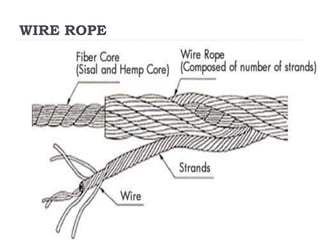
WIRE ROPE
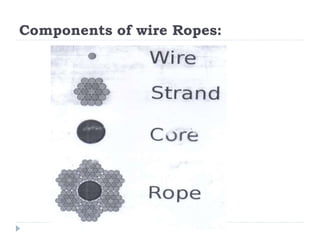
Components of wire Ropes:
Wire: It is a metal drawn out into the form of a thin flexible
thread or rod made of ductile metal. It is used to make a
strand in a rope.
Strand: A strand is formed by laying up one or more layers
of wires around a strand core. A strand core is either a
single wire or made up of a number of wires.
Core: It is the centre of the wire rope around which the
strand of wire is laid or coiled.
Components of wire Ropes:
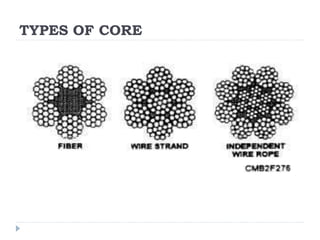
TYPES OF CORE
1) Fiber Core: It is made of fibers & generally used as a main core in
stranded ropes. It provides more flexibility to the rope. It also serves as a
cushion to reduce the effects of sudden strain and acts as an oil reservoir
to lubricate the wire and strands (to reduce friction). Wire rope with a
fiber core is used when flexibility of the rope is important.
2) Steel Wire Core: It is a steel wire, which is used as a core. Generally it
is used in strands & locked coil ropes. A wire strand core resists more
heat than a fiber core and also adds about 15 percent to the strength of
the rope; however, the wire strand core make the wire less flexible than
a fiber core.
3) Independent Wire Rope Core (IWRC): If a rope itself is used as a
core, it is known as independent wire rope core. It is used when rope is
subjected to kinetic shocks. This core strengthens the rope, provides
support against crushing, and supplies maximum resistance to heat.
TYPES OF CORE
ROPE USED FOR DIFFERENT PURPOSE
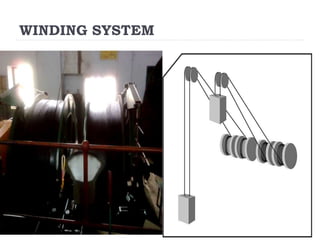
1.Winding ropes
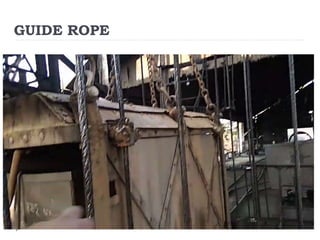
2.Guide ropes
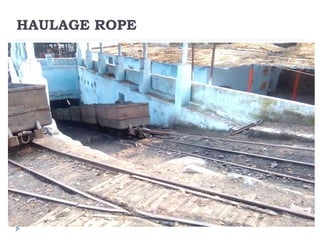
3.Haulage ropes
4.Coal cutting machines
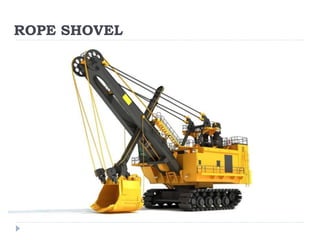
5.Dipper shovel ropes
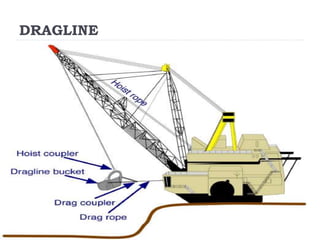
6.Dragline hoist rope
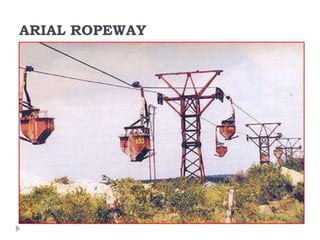
7.Aerial rope way
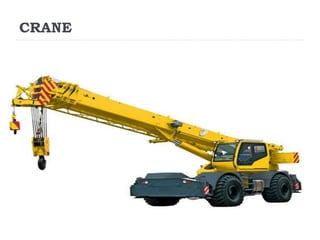
8.Mobile cranes
9.Bridges
WINDING SYSTEM
GUIDE ROPE
HAULAGE ROPE
ROPE SHOVEL
DRAGLINE
CRANE
ARIAL ROPEWAY
INFIELD TEST FOR WIRE ROPE
The wire is subjected to the following tests carried out according to
the standards provided by I.S. specifications:
1. Tensile Test-The specified length of wire is subjected to a
stretching force in a testing machine until the rope may
break.
2. Torsion Test- A specified length of wire rope is stretched
and its both ends are gripped into vice. One of each is
twisted until it is break.
3. Bending Test- One of the wire is fixed in vice with specially
rounded laws and the wire bend towards and backward
through 180° over the jaws until break.
INFIELD TEST FOR WIRE ROPE
4. Wrapping Test- In this test the wire is bent & one end of wire is
wrapped tightly around the other, usually for 8 turns. It is then
unwrapped & if there is no sign of cracking, it means that the
rope is still suitable for the job.
5. Looping Test- The end of short piece are taken one on each
hand & stress generate on the rope by rounding in forward
& backward direction. Repeat this process until the wire
break.
TYPES OF WIRE ROPE
On the basis of use, wire ropes are classified as:
1. Standing Ropes: Required to carry the burden or
load but are more or less stationary. i. e. guide ropes,
track ropes etc.
2. Running Ropes: Undergo frequent movement,
running or coiling often with varying loads and are
flexible e. g. ropes used for winding, haulage coal
cutting machine etc.
TYPES OF WIRE ROPE
On the basis of construction, wire ropes are classified as:
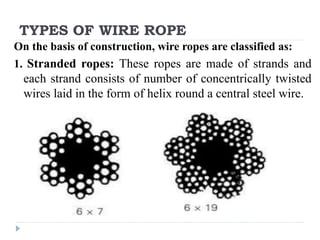
1. Stranded ropes: These ropes are made of strands and
each strand consists of number of concentrically twisted
wires laid in the form of helix round a central steel wire.
STRANDED ROPE
Advantages of Stranded Rope
1) Simple in construction.
2) Cheap.
3) Easy to examine visually.
4) Flexibility is more.
Disadvantages of Stranded Rope
1) Turning tendency (rotating tendency as the load
change).
2) More external wears.
TYPES OF WIRE ROPE
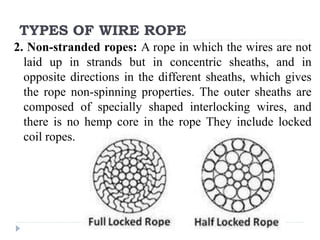
2. Non-stranded ropes: A rope in which the wires are not
laid up in strands but in concentric sheaths, and in
opposite directions in the different sheaths, which gives
the rope non-spinning properties. The outer sheaths are
composed of specially shaped interlocking wires, and
there is no hemp core in the rope They include locked
coil ropes.
ADVANTAGES OF LOCKED COIL ROPE
1) Greater strength.
2) Smooth external surface hence can be used as
guide rope.
3) Non-rotating.
4) Permanent stretch is less.
5) External wear is less.
6) Crushing strength is more.
DISADVANTAGES OF LOCKED COIL ROPE
1) Inner wire cannot be examined.
2) Less flexibility.
3) External portion of the rope cannot be
lubricated.
4) These ropes cannot be splices.
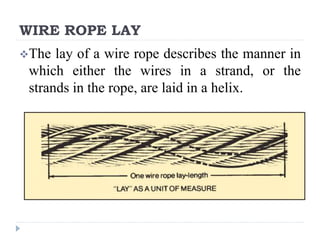
WIRE ROPE LAY
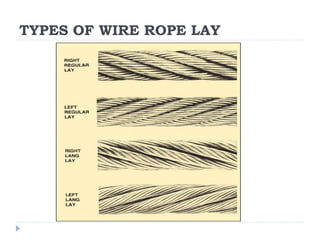
The lay of a wire rope describes the manner in
which either the wires in a strand, or the
strands in the rope, are laid in a helix.
TYPES OF WIRE ROPE LAY
Right hand Lay: wires spiral round the core in
the same direction as the threads of a right hand
screw.
Left hand Lay: wires spiral round the core in
the opposite direction as the threads of a right
hand screw.
TYPES OF WIRE ROPE LAY
Regular Lay or Ordinary Lay: In this type of
rope, individual wire in the strand and strand
itself laid in opposite direction. Because of this
opposite constructional characteristics, the
rope does not spin. This type of rope is used in
shaft sinking operations.
TYPES OF WIRE ROPE LAY
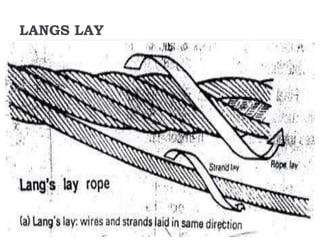
Langs Lay: In this type of rope, individual
wire in the strand and strand itself laid in same
direction. Because of this same constructional
characteristics, the rope is more compact This
rope can be used in rope haulages. The wear
due to friction is even and therefore the rope is
durable. This rope has a spinning tendency so
it is not used in shaft sinking, hoist drums.
LANGS LAY
TYPES OF WIRE ROPE LAY
FLEXIBILITY OF WIRE ROPE
Flexibility of wire rope depends on the following
factors.
Types of core:- a strand with a flexible core is more
flexible than one with steel core at the centre.
Thickness of individual wire:- Thinner the wires,
more is the flexibility. And
No. of wire:- Larger the number of wires, more is the
flexibility.
ROPE USED FOR DIFFERENT PURPOSE
Machine/Place Rope Used
1. Winding A rope of suitable size, round strand fiber core,
Lang’s lay construction
2. Haulage rope A suitable size, round strand fiber core, Lang’s lay
construction
3. Guide rope Suitable size, guide size, full/half locked coil.
4. Shaft sinking Suitable size, round strand, ordinary lay, steel core
or locked coil rope.
5. Cranes Suitable size, regular lay or ordinary lay with steel
core.
6. Drag line Suitable size, Lang’s lay with IWRC (steel core).
7. Shovel Suitable size, Lang’s lay with IWRC (steel core).
SELECTION OF WIRE ROPE
The following factors should be consider during
selection of wire rope.
1) Watery Places or Corrosive Atmosphere: Under
such conditions a galvanized rope should be used
to prevent rusting & effect of corrosive water.
2) Stationary or Running Coiling Rope: If a rope
is used as a working rope etc. it is known as
running coiling rope. These types of rope should
have more flexibility than it is required for a
stationary rope i.e. guide rope.
SELECTION OF WIRE ROPE
3) Rotating Quality: In a crane one end of the rope
is free to rotate hence a rope which is having a
non-rotating property should be used. In case of
haulages rotating property of the rope is not a
problem.
4) Shock Loads: If a rope is subjected to frequent
shock loads, in that case a rope with steel core
should be used.
SELECTION OF WIRE ROPE
5) Resistance to Wears: Ropes used for haulage &
winding should have high resistance to wear, in
other words such ropes should have a smooth
external surface, under such conditions it is
preferred to use a Lang’s lay construction.
6) Factor of Safety (Men/Material Transport): If a
rope is used for men winding it should have higher
factor of safety than it is required for material
transport.
SELECTION OF WIRE ROPE
7) Crushing Strength: If a rope is subjected to
crushing load, it should have high crushing
strength. Under such conditions if flatten strand
rope, steel core rope or locked coil rope can be
used.
8) Bending of the Rope: If a rope is subjected to
frequent bending, then a rope used should have
more flexibility.
SELECTION OF WIRE ROPE
9) Groove Size: The rope should not be loose or too
tight in the groove of the pulley or drum.
10) Crushing and Distortion: a flattened strand
rope and locked coil rope is better able to
withstand crushing than a round strand rope. The
core should be of steel wire.
SPACE FACTOR OF WIRE ROPE
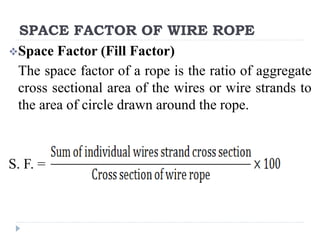
Space Factor (Fill Factor)
The space factor of a rope is the ratio of aggregate
cross sectional area of the wires or wire strands to
the area of circle drawn around the rope.
S. F. =
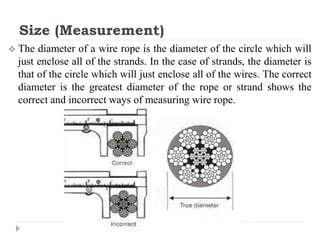
Size (Measurement)
 The diameter of a wire rope is the diameter of the circle which will
just enclose all of the strands. In the case of strands, the diameter is
that of the circle which will just enclose all of the wires. The correct
diameter is the greatest diameter of the rope or strand shows the
correct and incorrect ways of measuring wire rope.
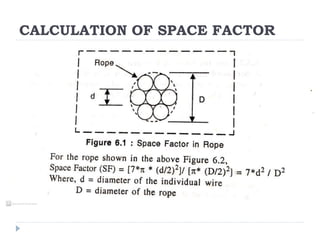
CALCULATION OF SPACE FACTOR
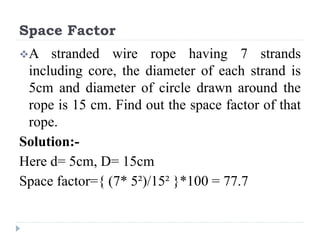
Space Factor
A stranded wire rope having 7 strands
including core, the diameter of each strand is
5cm and diameter of circle drawn around the
rope is 15 cm. Find out the space factor of that
rope.
Solution:-
Here d= 5cm, D= 15cm
Space factor={ (7* 5²)/15² }*100 = 77.7
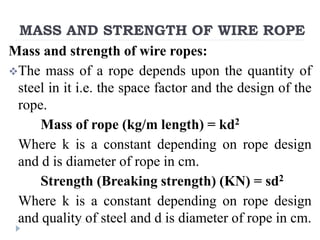
MASS AND STRENGTH OF WIRE ROPE
Mass and strength of wire ropes:
The mass of a rope depends upon the quantity of
steel in it i.e. the space factor and the design of the
rope.
Mass of rope (kg/m length) = kd2
Where k is a constant depending on rope design
and d is diameter of rope in cm.
Strength (Breaking strength) (KN) = sd2
Where k is a constant depending on rope design
and quality of steel and d is diameter of rope in cm.
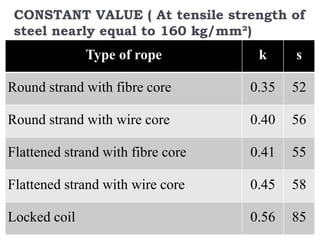
CONSTANT VALUE ( At tensile strength of
steel nearly equal to 160 kg/mm²)
Type of rope k s
Round strand with fibre core 0.35 52
Round strand with wire core 0.40 56
Flattened strand with fibre core 0.41 55
Flattened strand with wire core 0.45 58
Locked coil 0.56 85
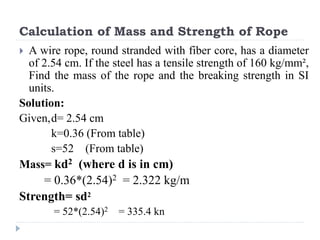
Calculation of Mass and Strength of Rope
 A wire rope, round stranded with fiber core, has a diameter
of 2.54 cm. If the steel has a tensile strength of 160 kg/mm²,
Find the mass of the rope and the breaking strength in SI
units.
Solution:
Given,d= 2.54 cm
k=0.36 (From table)
s=52 (From table)
Mass= kd2 (where d is in cm)
= 0.36*(2.54)2 = 2.322 kg/m
Strength= sd2
= 52*(2.54)2 = 335.4 kn
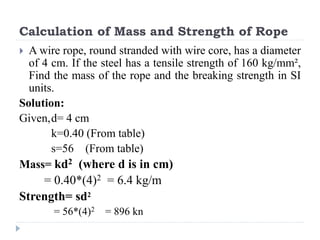
Calculation of Mass and Strength of Rope
 A wire rope, round stranded with wire core, has a diameter
of 4 cm. If the steel has a tensile strength of 160 kg/mm²,
Find the mass of the rope and the breaking strength in SI
units.
Solution:
Given,d= 4 cm
k=0.40 (From table)
s=56 (From table)
Mass= kd2 (where d is in cm)
= 0.40*(4)2 = 6.4 kg/m
Strength= sd2
= 56*(4)2 = 896 kn
WIRE ROPE CAPPING
The process of making wire rope end suitable for
attachment of load is known as wire rope capping.
The end of a rope where the load is to be attached
should be a good portion of the rope, free from
worn, rusted, bent or broken wires and free from
the effects of bending and corrosion.
TYPES OF ROPE CAPEL
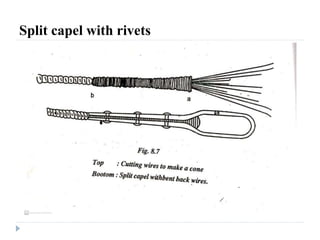
1. Split capel with rivets
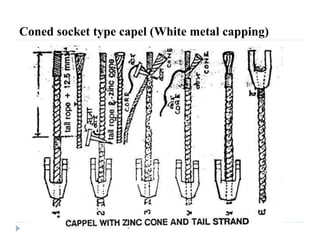
2. Coned socket type capel (White metal capping)
3. Interlocking wedge type capel (Reliance capel)
Split capel with rivets
 This is normally used on haulage ropes in mines but
not permitted on winding ropes.
 Conical portion of capel fits the rope. Near the end of
the rope mark two points, one point one cone length
away and another point, two cone lengths away from
the end.
 On the rope between points, wrap a number of turns
of binding wire tightly to form a layer. Near give
several wrappings of the wire to make it thick and
slightly conical.
Split capel with rivets
 Open out wires between rope end and point and clean them
with petrol, kerosene oil or diesel oil to remove grease, oil or
rust. After fanning out the wires cut 1/3rd of them to 1/3rd
length and another 1/3rd to 2/3rd length. Turn back all the wires
on the rope portion to give a cone and tie them on that rope
portion with binding wire.
 Cut the exposed fiber core. Hammer a thin wooden wedge into
the cone at the end. Push a split capel with its mouth slightly
widened on to the cone and hammer the widened arms in
position to grip the coned portion of the rope. Rivets are then
hammered into the capel and through the rope at 3-4 points
nearly 200mm apart.
Split capel with rivets
Coned socket type capel (White metal capping)
 The coned socket type capel is probably the most
compact type of rope capping. This can be fitted on
the rope used for practically every purpose, including
winding.
 A place is marked on the rope.
 The rope is seized at a length of twice diameter of the
rope at this determined place.
 The socket is now pushed over the rope and the rope
beyond the seizing is opened.
 The central hemp rope is cut. The wires are opened
individually and made to form a brush shape.
Coned socket type capel (White metal capping)
 These wires are cleaned with the help of kerosene or
diesel oil or petrel. (Water soluble degreasing fluid or non
inflammable organic solvent is preferred. Paraffin in not
recommended).
 The wires are now cleaned with dry cotton.
 Pull the brush through the capel such that the brush
remains Inside its conical portion.
 Clamp the cappel complete with the rope in place such
that the rope is vertical for a length of at least 24 times of
its diameter.
 Seal the junction of the rope and cappel with asbestos
yarn or moist clay to prevent escape of molten metal.
Coned socket type capel (White metal capping)
 Heat the socket evenly up to 100 degree centigrade
with the help of blow lamp (not permitted in
underground coal mines). When the socket is hot,
powdered resin is sprinkled over the rope brush in
the capel.
 White metal is heated up to 365°C and is poured in
the molten form in the conical hole of the capel.
 The metal is allowed to cool gradually till the capel
cools down to the atmospheric temperature.
Coned socket type capel (White metal capping)
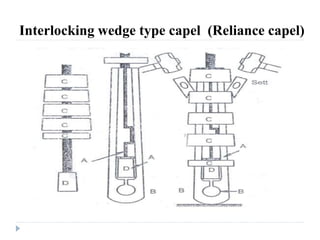
Interlocking wedge type capel (Reliance capel)
 In this capel there are two iron wedges which grip
the rope near the required end where a white metal
block is prepared. There is U-shaped steel strapped
which is placed over the two wedges & on which 4
- 5 iron clamps are fitted by hammering.
1) Prepare a white metal block at the required end of
the rope.
2) Insert the iron clamps on to the rope in order of
numbers (largest number first). The jaws of capel
are about 24 times more diameters.
Interlocking wedge type capel (Reliance capel)
3) Properly clean any grease or lubricant from that
portion of the rope, which will be griped by the
wedges.
4) Place the two wedges around the rope approximately
in the position they will occupy when in capel.
5) Fit the U-shaped strip over the wedges such that the
U-shaped strip & wedge top are in one line. Draw the
iron clamps over the U-shaped strip.
6) Hammer the iron clamps for proper grip. The ring
number one should not be hammered because it is
only for the safety of the white metal block. With this
capping operation is over.
Interlocking wedge type capel (Reliance capel)
ROPE SPLICING
Splicing is a method of joining two wire ropes
permanently without using special fittings or
attachment.
Splicing of winding drum rope is not permitted by
DGMS after splicing the diameter of rope should
not increase & also the joint should have almost
original strength of the rope.
Splicing length depends on the diameter of the
rope.
METHOD OF SPLICING
1. Decide the length for splicing of Rope.
2. After deciding the length of the splice, the ends of
the rope are brought nearer and overlapped for the
length of the splice.
3. Beyond the overlapping length, the thin binding
wire is lightly coiled and the rope is seized.
METHOD OF SPLICING
4. The strands are now opened out up to the
place of binding and the core of rope is cut.
5. The alternate strands near the binding are cut
such that 0.3m length are cut out, from the
binding.
6. The places of both binding of ropes are
brought face to face and the strands are
arranged in such that the long strand of one
rope are opposite the short/cut strand of the
other rope.
METHOD OF SPLICING
7. The opened out strands of left hand rope are
tied temporarily to the strand of the right hand
rope.
8. Strand of one rope is run over the place
vacated by the out-coming strand of the other
rope. The strands are laid in correct bed till all
except 0.3 m of the strand is remaining.
9. Cut off the extra strand (came out) to keep an
equal length & tie the strands temporarily in
its place.
METHOD OF SPLICING
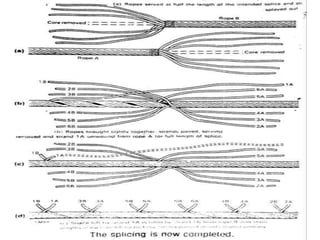
10. This process is repeated for the balance 2 pair
of strands but stopping the pair at
predetermined equidistance places.
11. Repeat the process for the other rope strands
till the spliced length, gives an appearance of
6 pairs of tails coming out at crossing.
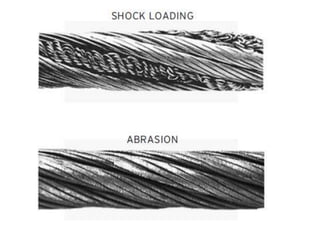
Type of Deterioration in the Ropes
1) Wear: Wear in the rope can be classified as
external wear & internal wear. Internal wear is due
to the movement of the wires which cannot be
controlled, but if the external wears become
excessive in nature, the cause should be found & it
should be corrected.
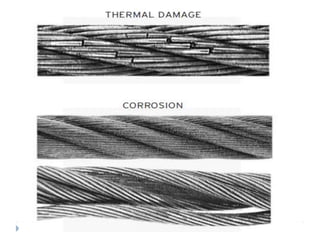
2) Corrosion: The water spray, unsuitable
lubricants, acids, salts etc cause it. Any water will
cause corrosion if it gets in contact with the steel
surfaces. Corrosion can be denied by using proper
lubrication & galvanized ropes.
Type of Deterioration in the Ropes
3) Water-Corrosion: Corrosion produces a weak
layer of oxides & this layer of oxides is removed
very fast by the wearing action & again a fresh
steel surface is present for further corrosion.
Hence the joint effect of wears & corrosion is
much higher than their individual effect.
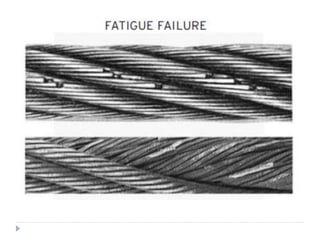
4) Fatigue: If a rope is subjected to rapid reversal of
stresses i.e. loading & unloading of the rope,
bending of the rope etc. the rope fails as much
lower stress level. This is due the fatigue.
CARE & MAINTENANCE OF WIRE ROPE
1) Buy right construction of rope suitable for the
job.
2) Under corrosive atmosphere use the
galvanized rope.
3) Do not load the rope beyond its safe working
load.
4) Ensure that the rope is strongly sized before it
is cut.
CARE & MAINTENANCE OF WIRE ROPE
5) Fiber core should not be used if the rope is
subjected external pressure (crushing load).
6) Flexibility of rope should be suitable to the
size of drums & pulleys.
7) Grease the rope & cover properly before
storing in a dry ventilated shade.
8) Handle the rope carefully while transporting
& uncoiling to avoid kinks.
CARE & MAINTENANCE OF WIRE ROPE
9) Inspect the rope frequently & lubricate with
acid free lubricant.
10) Judge the safe life of the rope for the
conditions under which it is used & replace it
in proper time.

Mine machinery - Wire ropes

  • 1.
    MINE MACHINERY WIRE ROPES By Mr.Ajeet Mehra Assistant Professor Department of Mining Engineering
  • 2.
    What is wirerope? Wire Rope is an important engineering material which is being used in Mining & other engineering industries. It is used for holding, lifting, moving and pulling various things. Wire ropes are made from steel wires of plain carbon steel having high tensile strength. Composition of wire rope: Carbon – 0.5 Silicon – 0.11 Manganese – 0.48 Sulphur – 0.033 Phosphorous – 0.014 and Iron – rest
  • 3.
  • 4.
    Components of wireRopes: Wire: It is a metal drawn out into the form of a thin flexible thread or rod made of ductile metal. It is used to make a strand in a rope. Strand: A strand is formed by laying up one or more layers of wires around a strand core. A strand core is either a single wire or made up of a number of wires. Core: It is the centre of the wire rope around which the strand of wire is laid or coiled.
  • 5.
  • 6.
    TYPES OF CORE 1)Fiber Core: It is made of fibers & generally used as a main core in stranded ropes. It provides more flexibility to the rope. It also serves as a cushion to reduce the effects of sudden strain and acts as an oil reservoir to lubricate the wire and strands (to reduce friction). Wire rope with a fiber core is used when flexibility of the rope is important. 2) Steel Wire Core: It is a steel wire, which is used as a core. Generally it is used in strands & locked coil ropes. A wire strand core resists more heat than a fiber core and also adds about 15 percent to the strength of the rope; however, the wire strand core make the wire less flexible than a fiber core. 3) Independent Wire Rope Core (IWRC): If a rope itself is used as a core, it is known as independent wire rope core. It is used when rope is subjected to kinetic shocks. This core strengthens the rope, provides support against crushing, and supplies maximum resistance to heat.
  • 7.
  • 8.
    ROPE USED FORDIFFERENT PURPOSE 1.Winding ropes 2.Guide ropes 3.Haulage ropes 4.Coal cutting machines 5.Dipper shovel ropes 6.Dragline hoist rope 7.Aerial rope way 8.Mobile cranes 9.Bridges
  • 9.
  • 10.
  • 11.
  • 12.
  • 13.
  • 14.
  • 15.
  • 16.
    INFIELD TEST FORWIRE ROPE The wire is subjected to the following tests carried out according to the standards provided by I.S. specifications: 1. Tensile Test-The specified length of wire is subjected to a stretching force in a testing machine until the rope may break. 2. Torsion Test- A specified length of wire rope is stretched and its both ends are gripped into vice. One of each is twisted until it is break. 3. Bending Test- One of the wire is fixed in vice with specially rounded laws and the wire bend towards and backward through 180° over the jaws until break.
  • 17.
    INFIELD TEST FORWIRE ROPE 4. Wrapping Test- In this test the wire is bent & one end of wire is wrapped tightly around the other, usually for 8 turns. It is then unwrapped & if there is no sign of cracking, it means that the rope is still suitable for the job. 5. Looping Test- The end of short piece are taken one on each hand & stress generate on the rope by rounding in forward & backward direction. Repeat this process until the wire break.
  • 18.
    TYPES OF WIREROPE On the basis of use, wire ropes are classified as: 1. Standing Ropes: Required to carry the burden or load but are more or less stationary. i. e. guide ropes, track ropes etc. 2. Running Ropes: Undergo frequent movement, running or coiling often with varying loads and are flexible e. g. ropes used for winding, haulage coal cutting machine etc.
  • 19.
    TYPES OF WIREROPE On the basis of construction, wire ropes are classified as: 1. Stranded ropes: These ropes are made of strands and each strand consists of number of concentrically twisted wires laid in the form of helix round a central steel wire.
  • 20.
    STRANDED ROPE Advantages ofStranded Rope 1) Simple in construction. 2) Cheap. 3) Easy to examine visually. 4) Flexibility is more. Disadvantages of Stranded Rope 1) Turning tendency (rotating tendency as the load change). 2) More external wears.
  • 21.
    TYPES OF WIREROPE 2. Non-stranded ropes: A rope in which the wires are not laid up in strands but in concentric sheaths, and in opposite directions in the different sheaths, which gives the rope non-spinning properties. The outer sheaths are composed of specially shaped interlocking wires, and there is no hemp core in the rope They include locked coil ropes.
  • 22.
    ADVANTAGES OF LOCKEDCOIL ROPE 1) Greater strength. 2) Smooth external surface hence can be used as guide rope. 3) Non-rotating. 4) Permanent stretch is less. 5) External wear is less. 6) Crushing strength is more.
  • 23.
    DISADVANTAGES OF LOCKEDCOIL ROPE 1) Inner wire cannot be examined. 2) Less flexibility. 3) External portion of the rope cannot be lubricated. 4) These ropes cannot be splices.
  • 24.
    WIRE ROPE LAY Thelay of a wire rope describes the manner in which either the wires in a strand, or the strands in the rope, are laid in a helix.
  • 25.
    TYPES OF WIREROPE LAY Right hand Lay: wires spiral round the core in the same direction as the threads of a right hand screw. Left hand Lay: wires spiral round the core in the opposite direction as the threads of a right hand screw.
  • 26.
    TYPES OF WIREROPE LAY Regular Lay or Ordinary Lay: In this type of rope, individual wire in the strand and strand itself laid in opposite direction. Because of this opposite constructional characteristics, the rope does not spin. This type of rope is used in shaft sinking operations.
  • 27.
    TYPES OF WIREROPE LAY Langs Lay: In this type of rope, individual wire in the strand and strand itself laid in same direction. Because of this same constructional characteristics, the rope is more compact This rope can be used in rope haulages. The wear due to friction is even and therefore the rope is durable. This rope has a spinning tendency so it is not used in shaft sinking, hoist drums.
  • 28.
  • 29.
    TYPES OF WIREROPE LAY
  • 30.
    FLEXIBILITY OF WIREROPE Flexibility of wire rope depends on the following factors. Types of core:- a strand with a flexible core is more flexible than one with steel core at the centre. Thickness of individual wire:- Thinner the wires, more is the flexibility. And No. of wire:- Larger the number of wires, more is the flexibility.
  • 31.
    ROPE USED FORDIFFERENT PURPOSE Machine/Place Rope Used 1. Winding A rope of suitable size, round strand fiber core, Lang’s lay construction 2. Haulage rope A suitable size, round strand fiber core, Lang’s lay construction 3. Guide rope Suitable size, guide size, full/half locked coil. 4. Shaft sinking Suitable size, round strand, ordinary lay, steel core or locked coil rope. 5. Cranes Suitable size, regular lay or ordinary lay with steel core. 6. Drag line Suitable size, Lang’s lay with IWRC (steel core). 7. Shovel Suitable size, Lang’s lay with IWRC (steel core).
  • 32.
    SELECTION OF WIREROPE The following factors should be consider during selection of wire rope. 1) Watery Places or Corrosive Atmosphere: Under such conditions a galvanized rope should be used to prevent rusting & effect of corrosive water. 2) Stationary or Running Coiling Rope: If a rope is used as a working rope etc. it is known as running coiling rope. These types of rope should have more flexibility than it is required for a stationary rope i.e. guide rope.
  • 33.
    SELECTION OF WIREROPE 3) Rotating Quality: In a crane one end of the rope is free to rotate hence a rope which is having a non-rotating property should be used. In case of haulages rotating property of the rope is not a problem. 4) Shock Loads: If a rope is subjected to frequent shock loads, in that case a rope with steel core should be used.
  • 34.
    SELECTION OF WIREROPE 5) Resistance to Wears: Ropes used for haulage & winding should have high resistance to wear, in other words such ropes should have a smooth external surface, under such conditions it is preferred to use a Lang’s lay construction. 6) Factor of Safety (Men/Material Transport): If a rope is used for men winding it should have higher factor of safety than it is required for material transport.
  • 35.
    SELECTION OF WIREROPE 7) Crushing Strength: If a rope is subjected to crushing load, it should have high crushing strength. Under such conditions if flatten strand rope, steel core rope or locked coil rope can be used. 8) Bending of the Rope: If a rope is subjected to frequent bending, then a rope used should have more flexibility.
  • 36.
    SELECTION OF WIREROPE 9) Groove Size: The rope should not be loose or too tight in the groove of the pulley or drum. 10) Crushing and Distortion: a flattened strand rope and locked coil rope is better able to withstand crushing than a round strand rope. The core should be of steel wire.
  • 37.
    SPACE FACTOR OFWIRE ROPE Space Factor (Fill Factor) The space factor of a rope is the ratio of aggregate cross sectional area of the wires or wire strands to the area of circle drawn around the rope. S. F. =
  • 38.
    Size (Measurement)  Thediameter of a wire rope is the diameter of the circle which will just enclose all of the strands. In the case of strands, the diameter is that of the circle which will just enclose all of the wires. The correct diameter is the greatest diameter of the rope or strand shows the correct and incorrect ways of measuring wire rope.
  • 39.
  • 40.
    Space Factor A strandedwire rope having 7 strands including core, the diameter of each strand is 5cm and diameter of circle drawn around the rope is 15 cm. Find out the space factor of that rope. Solution:- Here d= 5cm, D= 15cm Space factor={ (7* 5²)/15² }*100 = 77.7
  • 41.
    MASS AND STRENGTHOF WIRE ROPE Mass and strength of wire ropes: The mass of a rope depends upon the quantity of steel in it i.e. the space factor and the design of the rope. Mass of rope (kg/m length) = kd2 Where k is a constant depending on rope design and d is diameter of rope in cm. Strength (Breaking strength) (KN) = sd2 Where k is a constant depending on rope design and quality of steel and d is diameter of rope in cm.
  • 42.
    CONSTANT VALUE (At tensile strength of steel nearly equal to 160 kg/mm²) Type of rope k s Round strand with fibre core 0.35 52 Round strand with wire core 0.40 56 Flattened strand with fibre core 0.41 55 Flattened strand with wire core 0.45 58 Locked coil 0.56 85
  • 43.
    Calculation of Massand Strength of Rope  A wire rope, round stranded with fiber core, has a diameter of 2.54 cm. If the steel has a tensile strength of 160 kg/mm², Find the mass of the rope and the breaking strength in SI units. Solution: Given,d= 2.54 cm k=0.36 (From table) s=52 (From table) Mass= kd2 (where d is in cm) = 0.36*(2.54)2 = 2.322 kg/m Strength= sd2 = 52*(2.54)2 = 335.4 kn
  • 44.
    Calculation of Massand Strength of Rope  A wire rope, round stranded with wire core, has a diameter of 4 cm. If the steel has a tensile strength of 160 kg/mm², Find the mass of the rope and the breaking strength in SI units. Solution: Given,d= 4 cm k=0.40 (From table) s=56 (From table) Mass= kd2 (where d is in cm) = 0.40*(4)2 = 6.4 kg/m Strength= sd2 = 56*(4)2 = 896 kn
  • 45.
    WIRE ROPE CAPPING Theprocess of making wire rope end suitable for attachment of load is known as wire rope capping. The end of a rope where the load is to be attached should be a good portion of the rope, free from worn, rusted, bent or broken wires and free from the effects of bending and corrosion.
  • 46.
    TYPES OF ROPECAPEL 1. Split capel with rivets 2. Coned socket type capel (White metal capping) 3. Interlocking wedge type capel (Reliance capel)
  • 47.
    Split capel withrivets  This is normally used on haulage ropes in mines but not permitted on winding ropes.  Conical portion of capel fits the rope. Near the end of the rope mark two points, one point one cone length away and another point, two cone lengths away from the end.  On the rope between points, wrap a number of turns of binding wire tightly to form a layer. Near give several wrappings of the wire to make it thick and slightly conical.
  • 48.
    Split capel withrivets  Open out wires between rope end and point and clean them with petrol, kerosene oil or diesel oil to remove grease, oil or rust. After fanning out the wires cut 1/3rd of them to 1/3rd length and another 1/3rd to 2/3rd length. Turn back all the wires on the rope portion to give a cone and tie them on that rope portion with binding wire.  Cut the exposed fiber core. Hammer a thin wooden wedge into the cone at the end. Push a split capel with its mouth slightly widened on to the cone and hammer the widened arms in position to grip the coned portion of the rope. Rivets are then hammered into the capel and through the rope at 3-4 points nearly 200mm apart.
  • 49.
  • 50.
    Coned socket typecapel (White metal capping)  The coned socket type capel is probably the most compact type of rope capping. This can be fitted on the rope used for practically every purpose, including winding.  A place is marked on the rope.  The rope is seized at a length of twice diameter of the rope at this determined place.  The socket is now pushed over the rope and the rope beyond the seizing is opened.  The central hemp rope is cut. The wires are opened individually and made to form a brush shape.
  • 51.
    Coned socket typecapel (White metal capping)  These wires are cleaned with the help of kerosene or diesel oil or petrel. (Water soluble degreasing fluid or non inflammable organic solvent is preferred. Paraffin in not recommended).  The wires are now cleaned with dry cotton.  Pull the brush through the capel such that the brush remains Inside its conical portion.  Clamp the cappel complete with the rope in place such that the rope is vertical for a length of at least 24 times of its diameter.  Seal the junction of the rope and cappel with asbestos yarn or moist clay to prevent escape of molten metal.
  • 52.
    Coned socket typecapel (White metal capping)  Heat the socket evenly up to 100 degree centigrade with the help of blow lamp (not permitted in underground coal mines). When the socket is hot, powdered resin is sprinkled over the rope brush in the capel.  White metal is heated up to 365°C and is poured in the molten form in the conical hole of the capel.  The metal is allowed to cool gradually till the capel cools down to the atmospheric temperature.
  • 53.
    Coned socket typecapel (White metal capping)
  • 54.
    Interlocking wedge typecapel (Reliance capel)  In this capel there are two iron wedges which grip the rope near the required end where a white metal block is prepared. There is U-shaped steel strapped which is placed over the two wedges & on which 4 - 5 iron clamps are fitted by hammering. 1) Prepare a white metal block at the required end of the rope. 2) Insert the iron clamps on to the rope in order of numbers (largest number first). The jaws of capel are about 24 times more diameters.
  • 55.
    Interlocking wedge typecapel (Reliance capel) 3) Properly clean any grease or lubricant from that portion of the rope, which will be griped by the wedges. 4) Place the two wedges around the rope approximately in the position they will occupy when in capel. 5) Fit the U-shaped strip over the wedges such that the U-shaped strip & wedge top are in one line. Draw the iron clamps over the U-shaped strip. 6) Hammer the iron clamps for proper grip. The ring number one should not be hammered because it is only for the safety of the white metal block. With this capping operation is over.
  • 56.
    Interlocking wedge typecapel (Reliance capel)
  • 57.
    ROPE SPLICING Splicing isa method of joining two wire ropes permanently without using special fittings or attachment. Splicing of winding drum rope is not permitted by DGMS after splicing the diameter of rope should not increase & also the joint should have almost original strength of the rope. Splicing length depends on the diameter of the rope.
  • 58.
    METHOD OF SPLICING 1.Decide the length for splicing of Rope. 2. After deciding the length of the splice, the ends of the rope are brought nearer and overlapped for the length of the splice. 3. Beyond the overlapping length, the thin binding wire is lightly coiled and the rope is seized.
  • 59.
    METHOD OF SPLICING 4.The strands are now opened out up to the place of binding and the core of rope is cut. 5. The alternate strands near the binding are cut such that 0.3m length are cut out, from the binding. 6. The places of both binding of ropes are brought face to face and the strands are arranged in such that the long strand of one rope are opposite the short/cut strand of the other rope.
  • 60.
    METHOD OF SPLICING 7.The opened out strands of left hand rope are tied temporarily to the strand of the right hand rope. 8. Strand of one rope is run over the place vacated by the out-coming strand of the other rope. The strands are laid in correct bed till all except 0.3 m of the strand is remaining. 9. Cut off the extra strand (came out) to keep an equal length & tie the strands temporarily in its place.
  • 61.
    METHOD OF SPLICING 10.This process is repeated for the balance 2 pair of strands but stopping the pair at predetermined equidistance places. 11. Repeat the process for the other rope strands till the spliced length, gives an appearance of 6 pairs of tails coming out at crossing.
  • 63.
    Type of Deteriorationin the Ropes 1) Wear: Wear in the rope can be classified as external wear & internal wear. Internal wear is due to the movement of the wires which cannot be controlled, but if the external wears become excessive in nature, the cause should be found & it should be corrected. 2) Corrosion: The water spray, unsuitable lubricants, acids, salts etc cause it. Any water will cause corrosion if it gets in contact with the steel surfaces. Corrosion can be denied by using proper lubrication & galvanized ropes.
  • 64.
    Type of Deteriorationin the Ropes 3) Water-Corrosion: Corrosion produces a weak layer of oxides & this layer of oxides is removed very fast by the wearing action & again a fresh steel surface is present for further corrosion. Hence the joint effect of wears & corrosion is much higher than their individual effect. 4) Fatigue: If a rope is subjected to rapid reversal of stresses i.e. loading & unloading of the rope, bending of the rope etc. the rope fails as much lower stress level. This is due the fatigue.
  • 68.
    CARE & MAINTENANCEOF WIRE ROPE 1) Buy right construction of rope suitable for the job. 2) Under corrosive atmosphere use the galvanized rope. 3) Do not load the rope beyond its safe working load. 4) Ensure that the rope is strongly sized before it is cut.
  • 69.
    CARE & MAINTENANCEOF WIRE ROPE 5) Fiber core should not be used if the rope is subjected external pressure (crushing load). 6) Flexibility of rope should be suitable to the size of drums & pulleys. 7) Grease the rope & cover properly before storing in a dry ventilated shade. 8) Handle the rope carefully while transporting & uncoiling to avoid kinks.
  • 70.
    CARE & MAINTENANCEOF WIRE ROPE 9) Inspect the rope frequently & lubricate with acid free lubricant. 10) Judge the safe life of the rope for the conditions under which it is used & replace it in proper time.