2 January 2021 M a r i n e E n g i n e e r i n g K n o w l e d g e U E 2 3 1 | Y A S S E R B . A . F A R A G
DECK machinery and cargo system
 Deck machinery is also called ship deck
machinery.
 it is a kind of mechanical machinery installed
on the ship’s deck.
 Deck machinery is also a necessary mechanical
equipment or device for ship docking, loading
and unloading cargo, passengers’ getting on
and off.
 Ship deck machinery mainly includes anchor
windlass, winch, fair-lead, mooring bollard, lift
boat davit, deck fittings, etc.
DECK MACHINERIES FOR CARGO SHIPS
• THE VARIOUS ITEMS OF MACHINERY AND EQUIPMENT FOUND OUTSIDE OF THE
MACHINERY SPACE OF MODERN CARGO SHIP. THESE INCLUDE DECK MACHINERY
SUCH AS MOORING EQUIPMENT, ANCHOR HANDLING EQUIPMENT, CARGO
HANDLING EQUIPMENT AND HATCH COVERS. OTHER ITEMS INCLUDE LIFEBOATS
AND LIFE RAFTS, EMERGENCY EQUIPMENT, WATERTIGHT DOORS, STABILIZERS
AND BOW THRUSTERS. THE OPERATIONS OF MOORING, CARGO HANDLING AND
ANCHOR HANDLING ALL INVOLVE CONTROLLED PULLS OR LIFTS USING CHAIN
CABLES, WIRE OR HEMP ROPES. THE DRIVE FORCE AND CONTROL
ARRANGEMENTS ADOPTED WILL INFLUENCE THE OPERATIONS. SEVERAL
METHODS ARE CURRENTLY IN USE, AND THESE WILL BE EXAMINED BEFORE
CONSIDERING THE ASSOCIATED EQUIPMENT. THREE FORMS OF POWER ARE
CURRENTLY IN USE: STEAM, HYDRAULIC AND ELECTRIC, EACH GOT ITS
ADVANTAGES AND DISADVANTAGES FOR PARTICULAR DUTIES OR LOCATIONS.
The other auxiliary machineries includes
Deck gears, Small deck machinery,
Winches and hatch covers.
Cargo pumping and ballast system
on tankers
Mast and Derricks
 Mast is a vertical spar primarily meant to carry sails but
it is also used to carry radar, satellite aerials, and
navigational lights.
 These are made either of wood or steel.
 Derrick is a large spar fixed to mast by goose neck and
it is used like a crane for hoisting heavy weights.
Block, Pulleys and Fish pump
 These are common in all types of fishing vessel and are
used for a variety of purposes like leading the ropes to
convenient positions for handling the net.
 A block is a wooden or metal case in which one or more
sheaves are fitted.
 Fish pumps are mainly used on purse seiners to transfer
the catch from net to the deck.
Rollers and Gantries
 Powered stern rollers are used in gill netters to haul the
gill nets by net reels.
 In Danish seiners, towing rollers are used to haul the
rope.
 Gantry is a four-in-one contrivance used in trawlers
which replaces gallows, mast, derrick and stays.
 It assists in positioning of warp leads, hitching of otter
boards and lifting heavy catches etc.
1. Mooring windlass. Normally either an electric or Hydraulic motor drives 2 cable lifter and 2
warp ends. There are many designs but due to slow speed of cable lifter(3-5rpm) a slow
speed worm gear and a single step spur gear between cable lifter and warp end is used
2. Anchor Capstans. Vertical capstans use a vertical shaft, with the motor and gearbox situated
below the winch unit (usually below decks. With larger cables the capstan barrels is mounted
separately on another shaft
3. Winch windlasses. This arrangement uses a mooring winch to drive the windlass. Both port
and starboard units are interconnected to facilitate standby and additional power should
the situation arise
Conventional equipment
866
M a r i n e E n g i n e e r i n g K n o w l e d g e U E 2 3 1 | Y A S S E R B . A . F A R A G
2 January 2021
1. Storage part of the mooring drum
2. Pulling section of the drum (working part)
3. Brake band
4. Gear box
5. Electro-hydraulic motor
6. Warping head
7. Chain in the gypsy wheel
8. Dog clutch
9. Anchor
10. Hawse pipe
11. Spurling pipe
12. Chain locker
13. Chain stopper with security device
14. Guide roller
15. Bollard
16. Guide roller
17. Deck
18. Hatch to chain locker
Mooring equipment
867
M a r i n e E n g i n e e r i n g K n o w l e d g e U E 2 3 1 | Y A S S E R B . A . F A R A G
2 January 2021
Winches
 Winches are used commonly in trawlers, purse seiners and Danish seiners to haul the net and the catch on
to the board.
 Winches are used for different fishing methods like single drum(split type), two-drum on one shaft or more
drums on parallel shafts (double rigging and purse seining).
There are different kinds of winches. They are distinct from each other depending on their use. There are 7 types
of winches currently available there. For example –
• Lever winch
• Snubbing Winch
• Wakeskate winch
• Glider Winch
• Air Winch
• Capstan winch
• Mooring winch
 They are placed in the fore and aft direction depending on the requirement.
 Winches can be driven either mechanically from the main engine or electrically or hydraulically or direct
drive by separate engine.
1. Lever Winch:
Lever winches are particular kinds of winches that do not use spools. Instead of a spool, they have Self-gripping jaws. Therefore, they use Self-gripping jaws
for moving cable or rope through the winch. One can move several tons of weight only by moving a handle back and forth by using a lever winch.
2. Snubbing Winch:
Snubbing winch is a winch of a vertical spool. It has ratchet mechanism like a conventional winch. But it has no crank handle or another type of drive like a
standard winch.The line can be reeled and tightened by pulling tail line. Snubbing Winch also allows a controlled release of pressure.To control stress, it uses
an operator around the ratcheted spool. Also, it controls pressure using the friction of the line.
3. Wake-skate Winch:
Wakeskate winch using is growing widely among the watersports enthusiasts. It is a favorite pastime for them. It forms of a spool, engine, frame, handles,
rope and other types of simple transmissions.
4. Glider Winch:
For launching a glider or plane, we use a particular type of winch. It is the glider winch. Usually, we fit them to a heavy vehicle or a trailer
. This method is a
cheaper alternative to aerotowing.European gliding clubs widely use this method. In a glider winch, the engine is usually of petrol, diesel or LPG. You will
also find winches having electric or hydraulic engines.This winch can pull in a 1000 to 1600-meter cable attached to the glider
. After a steep and short climb,
you can release the cable at the height of 400 to 700 meters.
5. Air Winch:
Air winch is also known as air tugger or air hoist. This winch is the air- powered version of a winch. It can lift the materials. You can also utilize them for the
suspension of materials.They are more durable, versatile and safer than hydraulic, diesel and electric winches. That's why various companies often prefer to
use air winches.
6. Capstan Winch:
Capstan winch is a vertical-axle winch. It is a rotating device made for using on sailing ships. Sailors use this winch in sailing ships to apply force to the
cables and ropes. The principal of the capstan winch is similar to the windlass.
7. Mooring Winch:
Mooring winch is a mechanical device. It is used to secure a ship to the berth. It is a device with some barrels that pulls the cables or wires. To berth, the
ship ashore mooring winch plays a significant role.
Windlass
 Windlass is special type of winch used for handling anchor chain.
 This is also be driven with electric or hydraulic.
Net Haulers and Net Drums
 Net haulers are designed to suit the fishing method and popular mostly on
trawlers, gill netters and purse seiners.
 They may be fitted on the rails on deck or hung from a boom.
 Net haulers can be driven mechanically, electrically or hydraulically.
 Net Drums are used in gill netting, trawling and seining.
 They differ from net haulers in that the entire net is wound on the
drum.
 Most net drums are fitted at the stern.
 These also prevent the fouling of the gear during the operation.
Line Haulers
 Line haulers are used in
heaving the lines.
 Line haulers are used in
hauling the trolling lines,
handlines and jigging lines.
 Other machineries like water
separators, coiler, brailer,
power blocks, triplex, jigging
machines etc.
 a piece of marine device to hold a boat in place.
 The winch contains a drum divided into working part and storage part.
 This mooring winch has functions such as shifting, holding and
positioning for loading and unloading. They can operate in various ways
and are fixed in place on the deck of a ship in key positions.
 Sailors should carefully position and secure the ship when it comes into
port.
 Some mooring winches are electric ,hydraulic or controlled with gas
generators.
 The lines can be quite dangerous for unwary sailors and passengers, who
may not be aware of the risk if the mooring winch equipment is being
operated remotely.
 Windlass is a machine used on ships, which can heave up
equipment such as a ship's anchor or a fishing trawl.
 It is designed not only to meet class requirements but also
operational needs, which are often seen in off-shore tugs and
vessels.
 The windlass duty ratings are greatly increased to match
greater anchoring depths. Windlass controls at remote
wheelhouse for out-of-sight operation is optional.
 An anchor windlass is a machine that restrains and manipulates the
anchor chain or rope on a boat, allowing the anchor to be raised and
lowered.
 A brake is provided for control and a windlass is usually powered by an
electric or hydraulic motor. This windlass is suitable for anchor chain
diameters ranging from 19 mm to 120 mm.
 Winches can be hydraulic, electric or diesel driven and are available in
vertical and horizontal positions.
 used to haul up the anchor , to kedge off, deploy a second anchor, raise a
sail, serve as an emergency tow point, or provide assistance in high wind
and current berthing situations. The anchor raising system carries heavy
loads and can be dangerous. The operator should simply push the button
or crank the handle to deploy or raise the ground tackle.
• LOCATED SEPARATELY BUT CLOSE TO THE MOORING WINCHES OR AS AN INTEGRAL PART
OF THEM, THE WINDLASS IS THE DEVICE USED FOR LOWERING AND RAISING THE
ANCHOR IT DOES THIS IN TANDEM WITH THE BOW OR CHAIN STOPPER WHICH
PREVENTS CHAIN SLIPPAGE WHEN ANCHORED AND WHEN RAISING THE ANCHOR.
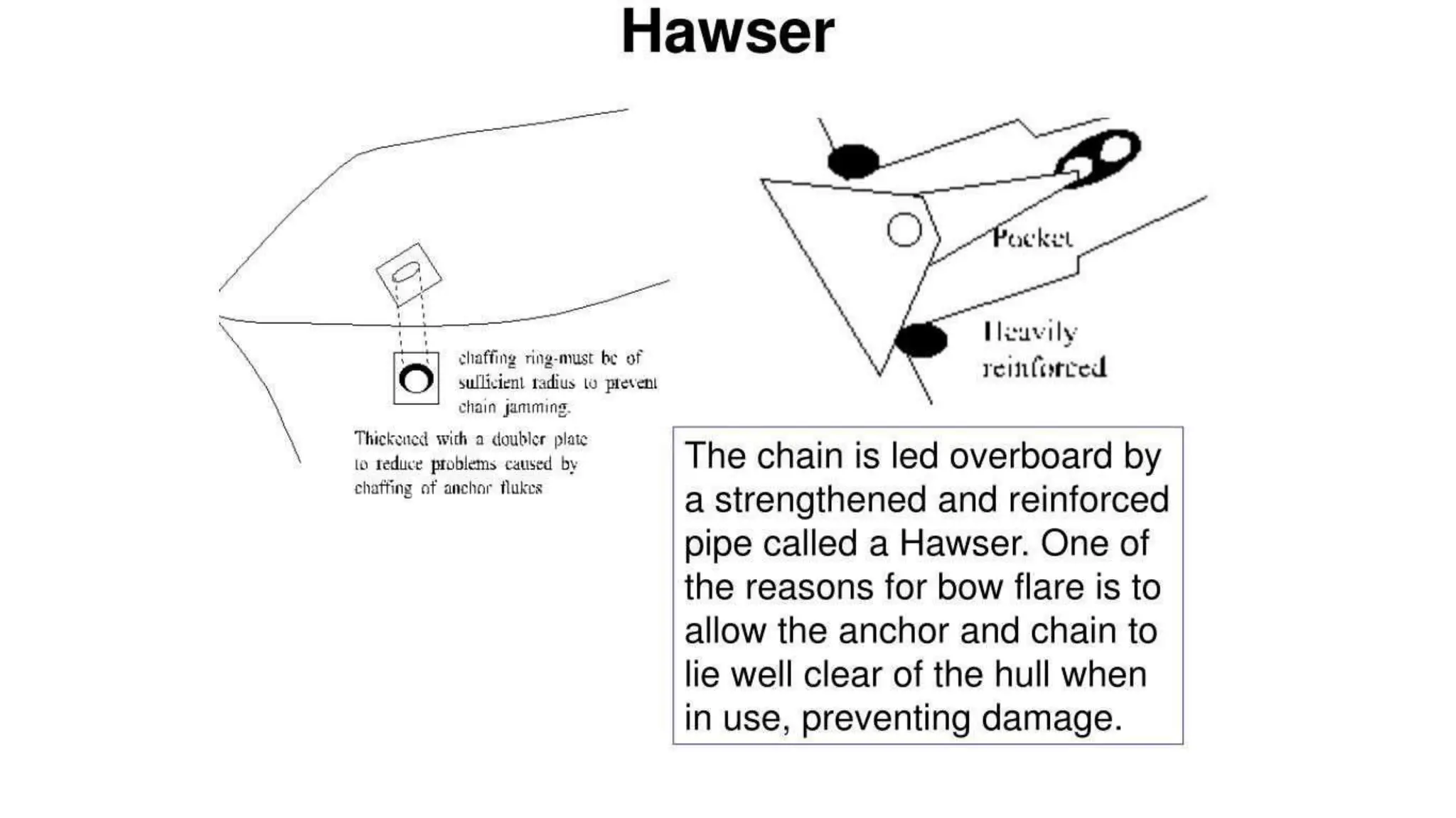
• THE ANCHOR CHAIN PASSES FROM THE ANCHOR AND THROUGH THE HAWSE PIPE, OVER
THE WINDLASS AND DOWN INTO THE CHAIN LOCKER WHERE THE END IS SECURED. THE
WINDLASS IS DRIVEN BY A MOTOR, EITHER ELECTRIC OR HYDRAULIC, AND FEATURES A
BRAKE AND CLUTCH FOR USE IN DIFFERENT OPERATIONS. ANCHORING IS USUALLY DONE
IN ONE OF TWO WAYS; LETTING GO OR WALKING BACK. BEFORE ANCHORING THE
ANCHOR CHAIN MUST BE RELEASED FROM ITS LASHINGS ON THE BOW STOPPER.
 For harbor tugs and escort duty tugs, we design a small
diameter windlass to adapt to a high power winch drum.
 To meet operational requirements, with built-in automatic
rope render-recovery feature, the winch drum is fitted with
rope tension and length readout.
 We recommend to our customers that all towing escort winch
should be equipped with an emergency release system.
 As an option for simple mooring applications, clients can
choose remote wheelhouse for out-of-sight operation with
length readout and winch controls.
 Tension control system can also be built into the system,
allowing the moored vessel to compensate for draft changes
during loading or unloading operations or tidal changes.
MOORING WINCH
• A WINCH IS A MARINE DECK EQUIPMENT DEVICE FOR HANDLING WIRES OR ROPES AND
WORKS BY SPOOLING THE WIRE OR ROPE ON A DRUM WITH A HORIZONTAL AXIS. THE
WINCH CAN BE POWERED BY ELECTRIC OR HYDRAULIC MOTORS; STEAM WINCHES
WERE ONCE COMMON BUT ARE NOW OBSOLETE.
• WINCHES ON SHIPS ARE FIXED AND USED FOR SPECIFIC PURPOSES. AS PREVIOUSLY
MENTIONED CARGO DERRICKS ARE NOW MUCH LESS COMMON AND SO THE WINCHES
NEEDED TO PROVIDE POWER FOR THESE HAVE ALSO BEEN MORE OR LESS
ABANDONED.
• THE MOST COMMON USE OF A WINCH IS FOR MOORING MEANING THE WINCHES ARE
MOSTLY LOCATED ON THE FORE AND AFTER DECKS AT BOTH SIDES OF THE SHIP. TUGS
AND OFFSHORE VESSELS SUCH AS AHTS, SEISMIC SURVEY AND OSVS WILL ALSO BE
EQUIPPED WITH WORK WINCHES DESIGNED FOR THE VERY HEAVY DUTY WORK THESE
SHIPS ARE USED FOR.
Anchor Drop !
868
M a r i n e E n g i n e e r i n g K n o w l e d g e U E 2 3 1 | Y A S S E R B . A . F A R A G
2 January 2021
Efficient working of the anchor windlass is essential to the safety of the ship. It’s design and
performance is subjected to strict classification society rules.
Basically they require that
 Cable lifter brake shall be capable of controlling
the cable and anchor when disconnected from the
gearing at letting go. The Av
. Speed of cable shall be
5-7 m/s.
 The heaving capacity shall be 4-6 times the weight
of one anchor at speeds between 9 and 15
m/minute. The lifting wt shall be between 20-70
tonnes.
 The braking effort obtained at the lifter shall at
least 40% of the breaking strength of the cable.
Anchor Handling
869
M a r i n e E n g i n e e r i n g K n o w l e d g e U E 2 3 1 | Y A S S E R B . A . F A R A G
2 January 2021
 The windlass must be capable of
pulling the anchor from a depth of
25% of the total cable carried, i.e.
50% of the length of chain on one
side.
 It should be capable of lifting the
anchor from 82.5m to 27.5m at
9m/min.
 Normal anchor handling equipment
incorporates warp ends for mooring
purposes with light line speed of up
to 1m/sec.
Anchor Handling
870
M a r i n e E n g i n e e r i n g K n o w l e d g e U E 2 3 1 | Y A S S E R B . A . F A R A G
2 January 2021
• The anchoring equipment fitted to the
majority of vessels consists of two matched
units, offering a degree of redundancy
.
• These units consists of an anchor
, chain (or
for smaller vessels wire), a gypsum or chain
lifter wheel, brake, lift motor and various
chain stopper arrangements.
• When not in he use the chain is stowed in a
chain locker
.
• Systems fitted with wire are stowed on a
drum in the same way as winches.
1. The windlass must be capable of pulling the anchor
from a depth of 25% of the total cable carried, i.e.
50% of the length of chain on one side
2. It should be capable of lifting the anchor from 82.5m
to 27.5m at 9m/min.
Anchoring equipment
871
M a r i n e E n g i n e e r i n g K n o w l e d g e U E 2 3 1 | Y A S S E R B . A . F A R A G
2 January 2021
CHAIN STOPPER
• CHAIN STOPPER, CABLE STOPPER. A FITTING USED TO SECURE THE
ANCHOR CHAIN WHEN RIDING AT ANCHOR, THEREBY RELIEVING
THE STRAIN ON THE WINDLASS, AND ALSO FOR SECURING THE
ANCHOR IN THE HOUSED POSITION IN THEHAWSEPIPE.
• THE ANCHOR CHAIN STOPPER IS A DEVICE FOR HOLDING THE
ANCHOR CHAIN TO THE WINDLASS AND THE HAWSE HOLE. THE
ANCHOR CHAIN STOPPER IS USED FOR SETTING THE ANCHOR AND
DISCHARGE TO THE WINDLASS.
TUGGER WINCH
• ELECTRIC TUGGER WINCHES ARE DRIVEN BY A SINGLE- OR TWO-
SPEED EFFICIENT ELECTRIC MOTOR OR A STATE-OF-THE-ART
VARIABLE FREQUENCY DRIVE. LINE PULLS RANGE FROM FIVE TO 30
TONNES. A LOCAL CONTROL PANEL IS SITUATED ADJACENT TO
THE WINCH. A WIRED-CONTROLLER OR REMOTE-CONTROL FROM
THE WHEELHOUSE ARE ALSO AVAILABLE AS OPTIONS.
• ALL WINCHES ARE ALSO AVAILABLE WITH LOW-PRESSURE AND
HIGH-PRESSURE HYDRAULIC DRIVES.
ANCHOR FAIRLEAD
• A FAIRLEAD IS A DEVICE TO GUIDE A LINE, ROPE OR CABLE AROUND AN OBJECT,
OUT OF THE WAY OR TO STOP IT FROM MOVING LATERALLY. TYPICALLY A
FAIRLEAD WILL BE A RING OR HOOK.
• THE FAIRLEAD MAY BE A SEPARATE PIECE OF HARDWARE, OR IT COULD BE A
HOLE IN THE STRUCTURE.
• A FAIRLEAD CAN ALSO BE USED TO STOP A STRAIGHT RUN OF LINE FROM
VIBRATING OR RUBBING ON ANOTHER SURFACE. AN ADDITIONAL USE
ON BOATS IS TO KEEP A LOOSE END OF LINE FROM SLIDING AROUND THE DECK.
• IF THE LINE IS MEANT TO BE MOVED WHILE IN THE FAIRLEAD, THE ANGLE IN THE
LINE CREATED BY THE FAIRLEAD MUST BE SHALLOW TO MINIMIZE FRICTION. FOR
LARGER ANGLES A BLOCK OR PULLEY IS USED AS A FAIRLEAD TO REDUCE
FRICTION. WHERE THE LINE IS REMOVED FROM A HOOK FAIRLEAD BEFORE
USING, THE ANGLE IS NOT AN ISSUE.
M a r i n e E n g i n e e r i n g K n o w l e d g e U E 2 3 1 | Y A S S E R B . A . F A R A G
2
SJ
a
atn
u
u
r
a
d
ra
yy
2,0J2
a
1
nuary 2, 2021
Electric drives
 Should be totally enclosed
 DC drives are still used because they got good
torque range over the full speed though they
need regular attention.
 Control of contactor operated armature
resistance is fully replaced with Ward Leonard
system for good regulation ; especially at
lowering loads ( The present day Ward Leonard
generator is driven by an AC motor)
 DC motors may also be controlled by
thyristors which converts AC to variable DC
voltage.
 AC Induction motors can be wound rotor or
cage type. Speed control being pole changing
or rotor resistance change type. Another form
of AC motor control being VFD drives which
controls the applied frequency and voltage.
872
Drives
Drives
Hydraulic Systems
 provide a good means of distribution of
power obtained from pump driven by a
constant direction/speed AC motor
. This
oil can be made to drive thro’ hydraulic
motors to power the actuating devices.
Both constant delivery and variable
delivery type pumps and motors are
commonly use
 The fixed output pumps can be of the
Woodward hydraulic engine governor type
which maintain reserve oil at pressure to
cater to demand
873
M a r i n e E n g i n e e r i n g K n o w l e d g e U E 2 3 1 | Y A S S E R B . A . F A R A G
2 January 2021
Drives
Hydraulic Systems
 Variable displacement pumps can be of
axial or radial piston types where
operational valves can be avoided.
 It is very essential for all hydraulic systems
be provided with interlocking arrangements
for pump and motors so that control levers
remain automatically in neutral to avoid
inadvertent start ups.
874
M a r i n e E n g i n e e r i n g K n o w l e d g e U E 2 3 1 | Y A S S E R B . A . F A R A G
2 January 2021
Drives
Hydraulic Systems
 Overload protection thro’ relief valves to
safeguard system at 30-40% over pressure
Atmospheric contamination isolation, oil
compatibility
, system cleanliness, regular
routine maintenance etc. can see thro’ long
periods of trouble free operation
875
M a r i n e E n g i n e e r i n g K n o w l e d g e U E 2 3 1 | Y A S S E R B . A . F A R A G
2 January 2021
• Cargo winch numbers and capacity are decided in
advance keeping in mind the no of hatches and the
size to work.
• The speed varies from 0.45 m/s at full load to
1.75m/s at light load with 40 kw at full load of 7 T
and 20 kw for 3 T
• Advantage of the derrick system is that only 2
winches are reqd. and has a faster cycle time. But
safe working load is less and takes quite some time to
rig up the system prior to cargo work.
• Slewing derrick system was an exception to the above
and which could be rigged up and change in set up
was faster
.
Deck Cranes
876
M a r i n e E n g i n e e r i n g K n o w l e d g e U E 2 3 1 | Y A S S E R B . A . F A R A G
2 January 2021
Marine hydraulic crane
1. A marine hydraulic crane is a type of crane that is specifically designed to be used in marine
environments, such as on ships, offshore platforms, and docks. It is typically powered by hydraulic
systems that use pressurized fluids to generate mechanical force. The main advantage of hydraulic
cranes is that they are able to lift heavy loads with ease and precision. They are also able to operate in
harsh marine environments, including in high winds and rough seas, due to their sturdy construction
and design.
2. Marine hydraulic cranes come in a variety of sizes and types, with lifting capacities ranging from a few
hundred kilograms to several tonnes. They are commonly used for a range of tasks on board ships and
offshore platforms, including cargo handling, lifting and lowering equipment, and launching and
retrieving boats and other vessels.
3. In addition to their lifting capabilities, hydraulic cranes can also be equipped with various attachments
and tools, such as hooks, grabs, and buckets, which can be used for specific tasks. Overall, marine
hydraulic cranes are an essential tool for many marine operations and are designed to withstand the
rigors of the sea while providing reliable and efficient performance.
 A deck crane is a kind of machine, usually equipped with a
hoist, wire ropes (chains) and sheaves.
 It can be used to lift and lower materials and also to move
them horizontally. This ship crane is mainly used for lifting
heavy things and transporting them to other places.
 The ship crane is widely applied in transport industry to load
and unload freight, in construction industry to move materials
and in manufacturing industry to assemble heavy equipment.
 Deck cranes cover the range of wire luffing cranes, cylinder
luffing cranes, grab cranes, gantries and heavy lift cranes.
1. lifting capacity.
2. easy and convenient to operate.
3. impact resistance and good braking performance.
4. safe and reliable. It should own high loading and unloading
efficiency of cargoes.
5. A good adaptability to cargoes.
 The structure of telescopic boom crane is
compact, which makes it adaptable for many
mobile applications.
 When it is not used, we can set the suspension
arm to the minimum physical dimension.
 These telescopic boom cranes are usually used
for short-term construction projects, rescue
jobs, lifting boats in and out of the water, etc.
 These boom cranes can be hydraulically
extended and retracted without a knuckle
function. These cranes are always used with a
hoisting winch installation.
 type of full rotational marine crane.
 Good performance, simple operation, reliable rotation,
and flexible compact structure make it own high
operation efficiency.
 This design offers a compact size for storage and
control. Their arms are much lighter than boom truck
cranes, and they are designed to allow for more
payloads.
 This deck crane comes with different types of control
systems, such as stand up, control from the ground,
seat control and radio remote control.
 This deck crane may swing through an arc to give
additional lateral movement.
 Straight boom crane is designed for loading and
unloading ship-borne containers at a port. It is
capable of lifting and loading dangerous cargoes. It
can be used as hose crane when working on oil
products in chemical docks and also be used as
hydraulic straight boom marine crane when
installed on ships. Straight boom crane is often
applied to where there are no many loading and
unloading operations. This crane owns a hoist fixed
on a trolley that runs horizontally along tracks and
usually fitted on a single beam or two beams. The
crane frame is supported by a gantry system with
equalized beams and wheels. The hydraulic straight
boom marine crane come in various sizes and some
can move very heavy loads used in shipyards or
industrial installations.
 1. The straight boom crane can run smoothly.
2. Rates of speed can be changed with 360°rotation.
3. Both electro hydraulic and manual control are provided.
4. This crane is of high safety and reliability.
5. Hydraulic straight boom marine crane can be operated
conveniently.
Hydraulic circuit
No. Name
1 Oil motor for hoisting
winch
2 Oil motor for luffing
winch
3 Oil motor for slewing
device
4 Counter balance valve
5 Control valve
6 Electric motor
7 Oil pump
8 Relief valve
9 Oil cooler
10 Thermo switch
11 Filter
12 Oil tank
13 Unloading valve
Single-opening & Multi-opening. Can be operated by
the ship’s crane or external help. Sealing between
hatch covers and coaming is generally achieved by
sliding rubber packing
Lift-away hatch covers
877
M a r i n e E n g i n e e r i n g K n o w l e d g e U E 2 3 1 | Y A S S E R B . A . F A R A G
2 January 2021
The folding pair is operated by hydraulic cylinders acting directly on the end hinge arms which are connected at
stools on the deck. When the cylinders push the end panel up from the closed position, the cover is folded and
the second panel, fitted with wheels, rolls on the rails to the stowage position
Hydraulic Folding Types
878
M a r i n e E n g i n e e r i n g K n o w l e d g e U E 2 3 1 | Y A S S E R B . A . F A R A G
2 January 2021
• Side-rolling hatch covers stow in a transverse
direction while end-rolling types stow
longitudinally. The traditional side-rolling cover
consists of two panels per hatch, each panel
rolling sideways on a pair of transverse ramps,
thus presenting a minimum obstacle when
loading. In some cases both panels can be stowed
together on one side to further enhance access
when loading and unloading. This alternative
reduces daylight opening by approximately 50%.
Rolling types for combination/dry bulk carriers
879
M a r i n e E n g i n e e r i n g K n o w l e d g e U E 2 3 1 | Y A S S E R B . A . F A R A G
2 January 2021
18 September 2020 M a r i n e E n g i n e e r i n g K n o w l e d g e U E 2 3 1 | Y A S S E R B . A . F A R A G
Cargo Systems
kenRT/May-2002/ver 1.0 Competence 1 - Control fire-fighting operations on ships 102
IGS System with Zones
Return
kenRT/May-2002/ver 1.0 Competence 1 - Control fire-fighting operations on ships 103
 a division into gas-dangerous
and gas-free spaces
 strict segregation between
cargo spaces and systems and
machinery accommodation
spaces and systems
Tactics
 Requirements on Tankers (cont’d)…
INERT GAS SYSTEMS (IGS)
Introduction
• In the late sixties and up till today the shipping world has been
shocked by several severe tanker explosions. In most cases it is
believed that a proper use of inert gas in the tanks might have
saved the ships and many lives.
• Consequently, IMO established rules, specifications for the
design, construction and use of inert gas systems.
(SOLAS Ch.II-2 and Guidelines on Inert Gas Systems).
• During operation, oil will nearly always have hydrocarbon gases
in some or all of the cargo tanks. In certain periods, especially
1
during cargo handling and tank washing, the hydrocarbon gases may
be mixed with air to explosive concentrations unless preventive
measures are taken.
• Hydrocarbon gas normally encountered in oil tankers cannot burn in
an atmosphere containing less than 11% oxygen by volume.
Accordingly, one way to provide protection against fire or explosion
in the vapour space of cargo tanks is to keep the oxygen level below
11% by volume. This is usually achieved by using a fixed piping
arrangement to blow inert gas into each cargo tank in order to
reduce the air content, and hence the oxygen content, and render the
tank non-flammable.
2
Application (Ref. SOLAS Ch.II-2)
• For oil tankers of 20,000 tonnes DWT and upwards, fire
protection of cargo tanks shall be achieved by a fixed inert gas system in
accordance with the requirements of the Fire Safety Systems Code.
• Oil tankers operating with a cargo tank cleaning procedure using
crude oil washing shall be fitted with an inert gas system complying with
the Fire Safety Systems Code and with fixed tank washing machines.
• Double hull spaces shall be fitted with suitable connections for
the supply of inert gas.
• Tankers fitted with a fixed inert gas system shall be provided wih
a closed ullaging system.
3
Inert gas systems
• Inert gas is an essential requirement for chemical
tankers, being used to maintain the quality of some
cargoes, reducing cargo or oxidation or the formation
of moisture, preventing dangerous chemical reactions,
safety blanketing low flash cargoes, blowing and
clearing ships' cargo lines and for ensuring the safety
during washing processes of non-gas-free tanks.
• Most vessels are equipped with a system of nitrogen
storage tanks or bottles that are replenished when
empty.
• This method is preferred because it uses pure nitrogen
and so is acceptable for all the above duties. Cargo
planners must ensure that topping up facilities are
available at sufficient port of call on long voyages
overseas
• Some chemical tankers are fitted with inert gas generators (flue
gases are not used because of the variation of impurities) which
burn liquid fuel and air in such a manner that as much oxygen as
possible is burned.
• After combustion the gas consists mainly of nitrogen, carbon
dioxide and water vapour. When cooled some of the vapour
condenses and this liquid is separated off.
• The remaining gas is fed into a further cooler where the
temperature is lowered to about +3oC.
• The gas is then dried by passing it through silica gel which dries it to
a dewpoint of -18oC
Inert gas systems
Inert gas system
A typical specification for an inert gas is
given below:
• Nitrogen, N2 84 %
• Carbon dioxide, CO2 15 %
• Oxygen, O2 0.5 % max.
• Carbon monoxide, CO 30 ppm
max.
• Hydrogen 100 ppm
max.
• Sulphur dioxide 50 ppm max.
• Dewpoint -18oC
INERT GAS SYSTEM
Why use inert gas systems?
A fire needs heat, fuel and oxygen to develop. Taking away
one of these elements in the fire triangle will stop or prevent a
fire. Thus, an oxygen content in a tank below 8% achieved by
addition of inert gas is one of the options for preventing the
fire. As a measure to achieve tanker safety, the 1978 Protocol
to the International Convention for the Safety of Life at Sea
(SOLAS) include the requirement for Inert Gas Systems on all
new tankers over 20,000 dwt.
REQUIREMENTS OF INERT GAS SYSTEM
ALARMS
• High Oxygen content in Inert
Gas main line.
• Low Gas pressure in Inert
Gas Main.
• Low Pressure in water supply
to the deck water seal.
• High Temerature of Gas in
Inert Gas Main
• Low Water Pressure to the
scrubber.
• High gas Pressure in Inert
Gas Main.
SHUT DOWNS
• High Temerature of Gas in
Inert Gas Main
• Low Water Pressure to the
scrubber.
• High gas Pressure in Inert Gas
Main.
• Cargo Pump shut down due to
• Casing high temperature
• Bearing High Temperature
• Motor overload
• Emergency Shut down
• High revolution of pumps
(high speed trip)
EQUIPMENT
• INERT GAS GENERATORS
• NITROGEN GENERATORS
• NITROGEN CYLINDERS
• FGS (NOT USED GENERALLY ON CHEMICAL TANKERS)
INERT GAS SYSTEMS (IGS)
Introduction
• In the late sixties and up till today the shipping world has been
shocked by several severe tanker explosions. In most cases it is
believed that a proper use of inert gas in the tanks might have
saved the ships and many lives.
• Consequently, IMO established rules, specifications for the
design, construction and use of inert gas systems.
(SOLAS Ch.II-2 and Guidelines on Inert Gas Systems).
• During operation, oil will nearly always have hydrocarbon gases
in some or all of the cargo tanks. In certain periods, especially
1
during cargo handling and tank washing, the hydrocarbon gases may
be mixed with air to explosive concentrations unless preventive
measures are taken.
• Hydrocarbon gas normally encountered in oil tankers cannot burn in
an atmosphere containing less than 11% oxygen by volume.
Accordingly, one way to provide protection against fire or explosion
in the vapour space of cargo tanks is to keep the oxygen level below
11% by volume. This is usually achieved by using a fixed piping
arrangement to blow inert gas into each cargo tank in order to
reduce the air content, and hence the oxygen content, and render the
tank non-flammable.
2
Application (Ref. SOLAS Ch.II-2)
• For oil tankers of 20,000 tonnes DWT and upwards, fire
protection of cargo tanks shall be achieved by a fixed inert gas system in
accordance with the requirements of the Fire Safety Systems Code.
• Oil tankers operating with a cargo tank cleaning procedure using
crude oil washing shall be fitted with an inert gas system complying with
the Fire Safety Systems Code and with fixed tank washing machines.
• Double hull spaces shall be fitted with suitable connections for
the supply of inert gas.
• Tankers fitted with a fixed inert gas system shall be provided wih
a closed ullaging system.
3
Definitions:
• Inert Gas means a gas or a mixture of gases, such as flue gas,
containing insufficient oxygen to support the combustion of hydrocarbons.
• Inert Condition means a condition in which the oxygen content
throughout the atmosphere of a tank has been reduced to 8 per cent or less by
volume by addition of inert gas.
• Inert Gas Plant means all equipment specially fitted to supply, cool,
clean, pressurize, monitor and control delivery of inert gas to cargo tank
systems.
• Inert Gas Distribution System means all piping, valves, and associated
fittings to distribute inert gas from the inert gas plant to cargo tanks, to vent
gases to atmosphere and to protect tanks against excessive pressure or vacuum.
4
• Inert Gas System means an inert gas plant and inert gas distribution
system together with means for preventing backflow of cargo gases to the
machinery spaces, fixed and portable measuring instruments and control devices.
• Inerting means the introduction of inert gas into a tank with the object of
attaining an inert condition as defined above.
• Topping-up means the introduction of inert gas into a tank which is already
in an inert condition with the object of raising the tank pressure to prevent any
ingress of air.
• Purging means the introduction of inert gas into a tank already in an inert
condition with the object of :
- further reducing the oxygen content; and/or
- reducing the existing hydrocarbon gas content to a level below which
combustion cannot be supported if air is subsequently introduced into the
tank. 5
Effect of Inert Gas on Flammability
• A Flammability Composition Diagram is given in figure 1. The
effect of inert gas on flammability has already been explained earlier.
(Ref. Flammability and Explosiveness given in, Hazards associated with
the handling and carriage of petroluem, slides 32 to 37).
6
7
8
Sources of Inert Gas
• The possible sources of inert gas on oil tankers are:
- the uptake from the ship’s main or auxiliary boilers (boiler flue
gas); or
- an independent inert gas generator; or
- a gas turbine plant when equipped with an after burner.
Quality of Inert Gas
• Good combustion control in ship’s boilers is necessary to
achieve an oxygen content of 5 per cent by volume. In order to
obtain this quality, it may be necessary to use automatic
combustion control.
9
Methods of Gas Replacement
• There are three operations which involve replacement of gas in
cargo tanks, namely;
- Inerting;
- purging;
- gas-freeing.
• In each of these replacement operations, one of two processes can
predominate:
- dilution, which is a mixing process;
- displacement, which is a layering process.
INERTING
• PURGING OF HYDROCARBON CONTENT PRIOR TO AERATING
• INERT GAS INTRODUCED INTO CARGO TANK THROUGH LIQUID
LINES
• DISPLACEMENT METHOD USED
• HYDROCARBON/INERT GAS MIXTURE VENTED THOUGH
VAPOUR LINE TO TERMINAL FLARE OR VENTED THROUGH
MAST RISER
10
• Dilution Method
The dilution theory assumes that the incoming gas mixes with the
original gases to form a homogeneous mixture throughout the tank. The
result is that the concentration of the original gas decreases exponentially.
In practice the actual rate of gas replacement depends upon the volume
flow of the incoming gas, its entry velocity, and the dimensions of the
tank.
For complete gas replacement it is important that the entry
velocity of the incoming gas is high enough for the jet to reach the
bottom of the tank. It is therefore important to confirm the ability of every
installation using this principle to achieve the required degree of gas
replacement.
See figures 2 and 3.
Changing Atmospheres - Dilution
Mix of gases vented
Fig.2 shows an inlet and outlet configuration for the dilution process and illustrates the
turbulent nature of the gas flow within the tank.
Fig.3 shows typical curves of gas concentration against time for three different
sampling positions. 11
Changing Atmospheres - Displacement
Lighter
Heavier
N
A
I
H
itrogen
ir
nert Gas
eavy cargo
vapour
Light cargo
vapour
12
• Displacement Method
Ideal replacement requires a stable horizontal interface
between the lighter gas entering at the top of the tank and the
heavier gas being displaced from the bottom of the tank through
some suitable piping arrangement (e.g. Purge pipe).
This method requires a relatively low entry velocity of gas
and in practice more than one volume change is necessary. It is
therefore important to confirm the ability of every installation
using this principle to achieve the required degree of gas
replacement throughout the tank.
See figures 4 and 5.
13
Displacement Method/Principle
14
Figure 4 shows an inlet and outlet configuration for the displacement
process, and indicates the interface between the incoming and outgoing
gases.
Figure 5 shows typical curves of gas concentration against time for
three different sampling levels.
General Policy of Cargo Tank Atmosphere Control
• Oil tankers fitted with an inert gas system should have their cargo
tanks kept in a nonflammable condition at all times (see figure 1).
It follows that:
- tanks should be kept in an inert condition whenever they
contain cargo residues or ballast. The oxygen content should be
kept at 8% or less by volume with a positive gas pressure
in all the cargo tanks;
15
- the atmosphere within the tank should make the transition from
an inert condition to a gas-free condition without passing through the
flammable condition. In practice this means that before any tank is gas-
freed, it would be purged with inert gas until the hydrocarbon content of
the tank atmosphere is below the critical dilution line (see figure 1);
- when an oil tanker is in a gas-free condition before arrival at a
loading port, tanks should be inerted prior to loading.
• In order to maintain cargo tanks in a non-flammable condition,
the system is required to:
16
- inert empty cargo tanks;
- be operated during cargo and ballast handling;
- purge tanks prior to gas-freeing;
- top up pressure in cargo tanks when necessary.
The Inert Gas System
• The Inert Gas System consists of three distinct parts, which:
- produce the inert gas;
- cool and clean the gas;
- distribute the gas.
• Good quality inert gas from the generating plant, contains:
- Nitrogen … approx. 80% by volume;
- Carbon Dioxide.. approx. 14% by volume;
- Oxygen … approx. 4% by volume;
- Water vapour … approx. 2% by volume;
and small quantities of undesirable by-products such as nitrous
oxides, sulphur dioxide, carbon monoxide and soot particles.
The composition of inert gas is given in figure 6.
17
Figure 6 : Composition of Inert Gas
18
• Inert Flue Gas System
A typical arrangement for an inert flue gas system is shown in
figure 7.
It consists of flue gas isolating valves located at the boiler
uptake points through which pass hot, dirty gases to the scrubber and
demister. Here the gas is cooled and cleaned before being piped to
blowers which deliver the gas through the deck water seal, the non-
return valve, and the deck isolating valve to the cargo tanks.
A gas pressure regulating valve is fitted downstream of the
blowers to regulate the flow of gases to the cargo tank.
A liquid-filled pressure vacuum breaker is fitted to prevent
19
20
Fig. 7 : Inert Flue Gas System
excessive pressure or vacuum from causing structural damage to cargo
tanks.
A vent is fitted between the deck isolating/non-return valve and
the gas pressure regulating valve to vent any leakage when the plant is
shut down.
For delivering inert gas to the cargo tanks during cargo discharge,
deballasting, tank cleaning and for topping up the pressure of gas in the
tank during other phases of the voyage, an inert gas deck main runs
forward from the deck isolating valve for the length of the cargo deck.
From this inert gas main, inert gas branch lines lead to the top of each
cargo tank.
21
• Inert Gas Scrubber
The purpose of the scrubber is to cool the flue gas and remove
most of the sulphur dioxide and particulate soot. All three actions
are achieved by direct contact between the flue gas and large
quantities of sea water.
A diagram of a Scrubber is given in figure 8
Before entering the bottom of the scrubbing tower, the gas is
cooled by being passed either through a water spray, or bubbled
through a water seal.
In the scrubbing tower itself the gas moves upwards through
downward flowing water. For maximum contact between gas and
22
Figure 8: Scrubber
23
Start S.W. Pump
Demister
Baffle Plates
Flow Meter
S.W. Pump Running
Demister
Water Spray
Baffle Plates
Precooling Spray
Water Seal
Overflow Drain
Start I.G.
Flow Meter
Demister
Water Spray
Baffle Plates
S.W. Pump Running
Precooling Spray
Water Seal
Overflow Drain
I.G. Blower started
I.G. Outlet To
Blower
I.G. Inlet
From Boiler
Flow Meter
water, several layers made up of one or more of the following
arrangements are fitted:
- spray nozzles;
- trays of ‘packed’ stones or plastic chippings;
- perforated impingement plates; etc.
At the top of or downstream of the scrubbing tower, water
droplets are removed by one or more demisters which may be
polypropylene mattresses or cyclone dryers.
The scrubber should be capable of dealing with the quantity of
inert gas required, and its construction should allow for hot corrosive
gases.
24
The performance of the scrubber at full gas flow should be such as to
remove at least 90 per cent of sulphur dioxide and to remove solids
effectively. Drainage of the effluent should not be impaired when the
ship is fully loaded. In product carriers more stringent requirements
may be needed for product quality.
• Inert Gas Blowers
Blowers are used to deliver the scrubbed flue gas to the cargo
tanks (See figure 7). SOLAS requires that at least two blowers shall
be provided which together shall be capable of delivering inert gas to
the cargo tanks at a rate of at least 125 per cent of the maximum rate
of discharge capacity of the ship expressed as a volume.
25
Each blower has an inlet valve and a discharge valve. Blowers may
also have an air inlet and may therefore also be used to gas-free cargo
tanks (See figure 7).
Corrosion-resistant materials or coatings must be used in the
construction of blowers and casings to protect them from the
corrosive effect of the gas.
Fan casings should be fitted with drains to prevent damage by an
accumulation of water. Means should be provided such as fresh
water washing to remove the build-up of deposits which could cause
vibration during blower operation. Sufficient openings should be
provided to permit inspection.
26
Failure of the blowers should be indicated by an alarm (SOLAS
Ch.II-2). Means should be fitted for continuously indicating the
temperature and pressure of the inert gas at the discharge side of the
blowers (SOLAS Ch.II-2).
Inert Gas Blowers should shut down automatically in the event
of:
- Low water pressure or low flow rate in the scrubber;
- High water level in the scrubber;
- High gas temperature. (SOLAS Ch.II-2)
27
The Blower pressure/volume characteristics should be matched
to the maximum system requirements. The characteristics should be
such that in the event of the discharge of any combination of cargo
tanks at maximum discharge rate, a minimum pressure of 200 mm
water gauge is maintained in any cargo tank after allowing for pressure
losses due to:
- The scrubber tower and demister;
- The piping conveying the hot gas to the scrubbing tower;
- The distribution piping downstream of the scrubber;
- The deck water seal;
- The length and diameter of the inert gas distribution system.
28
• Inert Gas Pressure Regulating Valve
The Inert Gas Pressure Regulating Valve (pressure control
arrangements) should be fitted to fulfil two functions:
- To prevent automatically any backflow of gas in the event of
either a failure of the inert gas blower, scrubber pump etc., or when the
inert gas plant is operating correctly but the deck water seal and
mechanical non-return valve have failed and the pressure of gas in the
tank exceeds the blower discharge pressure, e.g. during simultaneous
stripping and ballasting operations;
- To regulate the flow of inert gas to the inert gas deck main.
A typical arrangement is given in figure 9.
29
Figure 9 : Inert Gas Pressure Regulating Valve 30
The Inert Gas Pressure Regulating Valve is automatically controlled by
means of a pressure transmitter and pressure controller.
There are different arrangements for controlling the inert gas pressure
in the inert gas main, i.e. :
- Throttling the regulating valve;
- Recirculating the inert gas to the scrubber;
- Venting inert gas into the atmosphere.
31
The pressure of the inert gas in the inert gas main must be monitored.
An alarm should be given when the pressure exceeds the set limit
(SOLAS Ch.II-2).
When the pressure in the inert gas main forward of the non-return
devices falls below 50mm water gauge, an audible alarm should be given,
or alternatively, the main cargo pumps should shut down automatically
(SOLAS Ch.II-2).
• Non-return Devices (SOLAS Ch.II-2).
The Deck Water Seal and mechanical non-return valve together form
the means of automatically preventing the backflow of cargo gases from the
cargo tanks to the machinery space or other safe area in which the inert gas
plant is located. 32
• Deck Water Seal (SOLAS Ch.II-2).
This is the principal barrier. A water seal is fitted which
permits inert gas to be delivered to the deck main but prevents
any backflow of cargo gas even when the inert gas plant is shut
down. It is vital that a supply of water is maintained to the seal at
all times, particularly when the inert gas plant is shut down. In
addition, drains should be led directly overboard and should not
pass through the machinery spaces.
There are three different types of Deck Water Seals, namely:
33
.1 A Wet type seal;
.2 A Semi-Dry type seal;
.3 A Dry Type seal.
Wet type seal
This is the simplest type of deck water seal. When the inert gas
plant is operating, the gas bubbles through the water from the
submerged inert gas inlet pipe, but if the tank pressure exceeds the
pressure in the inert gas inlet line the water is pressed up into this inlet
pipe and thus prevents backflow. The drawback of this type of water
seal is that water droplets may be carried over with the inert gas which,
34
although it does not impair the quality of the inert gas, could increase
corrosion. A demister should, therefore, be fitted in the gas outlet from
the water seal to reduce any carry-over.
Figure 10 shows an example of a wet type seal.
35
Figure 10: Deck water seal – Wet type.
36
GAS INLET GAS OUTLET
LOW LEVEL ALARM
WATER INLET
WATER OVERBOARD
GAS OUTLET
WATER OVERBOARD
WET SEAL (GAS ALWAYS PASS THROUGH WATER)
WATER INLET
INERT GAS INLET
GAS PASS THR. DEMISTER
INERT GAS BUBBLED
THROUGH THE WATER
WATER INLET
WATER OVERBOARD
WET SEAL (GAS ALWAYS PASS THROUGH WATER)
BACK FLOW OF GAS
DUE TO LEAK IN
ISOLATING VALVE
EXCESS PRESS. OF GAS IN
OUTLETPIPEWILL CAUSE A
COLUMN OF WATER TO
RISE IN INLET PIPE
LOW LEVEL ALARM
Semi-dry type seal
In this type of seal, instead of bubbling through the water trap the
inert gas flow draws the sealing water into a separate holding chamber
by venturi action thus avoiding or at least reducing the amount of water
droplets being carried over. Otherwise it is functionally the same as wet
type.
Figure 11 shows an example of a semi-dry type seal.
37
Figure 11: Deck water seal – Semi-dry type
38
WATER DISPLACED BY
GAS PRESSURE
Hydrocarbon/inert gas leak
past the non-return valves
due to high gas pressure in
the deck main line.
Gas pressure acting on the
surface of water in the outlet
pipe would cause a column
of water to rise in inlet arm.
Dry type seal
In this type of seal, the water is drained when the inert gas plant
is in operation (gas flowing to the tanks) and filled with water when the
inert gas plant is either shut down or the tank pressure exceeds the inert
gas blower discharge pressure. Filling and draining are performed by
automatically operated valves controlled by the levels in the water seal
and drop tanks and by the operating state of the hlowers. The advantage
of this type is that water carry-over is prevented. The drawback could be
the risk of failure of the automatically controlled valves which may
render the water seal ineffective.
Figure 12 shows an example of a dry type seal.
39
Figure 12 : Deck water seal – Dry type 40
OPEN
SHUT
As inert gas is supplied ,The
drain valve opens automatically
Drain valve shuts automatically
when the tank is dry
Inert gas passes the seal
without touching water
Water drain out
SHUT
OPEN
As inert gas plant is stopped,
dump valve opens automatically
Water drain from Drop Tank to
Seal Tank
Hydrocarbon/inert gas leak past
the isolating valves due to high
gas pressure in the deck main line.
High gas pressure of back flow causes
a column of water to rise in the inlet
And form a water seal
OPEN
41
Deck Water Seal Alarm
For the Deck Water Seal, an alarm must be activated when
the water level falls by a pre-determined amount, but before the seal
is rendered ineffective.
Heating arrangements should be provided to prevent
freezing of the seal.
Sight glasses and inspection openings should be provided on
the deck seal to permit satisfactory observation of the water level
during its operation and to facilitate a thorough survey. The sight
glasses should be reinforced to withstand impact.
Deck Mechanical Non-Return Valve and Deck Isolating Valve
As a further precaution to avoid any backflow of gas from the
cargo tanks, and to prevent any backflow of liquid which may enter the
inert gas main if the cargo tanks are overfilled, SOLAS Ch.II-2
requires a mechanical non-return valve or equivalent, which should be
fitted forward of the deck water seal and should operate automatically
at all times.
This valve should be provided with a positive means of closure
or, alternatively, a separate deck isolating valve fitted forward of the
non-return valve, so that the inert gas deck main may be isolated from
the non-return devices. The separate isolating valve has the advantage
42
of enabling maintenance work to be carried out on the non-return
valve.
Liquid-filled P/V Breaker
One or more liquid-filled pressure/vacuum valves should be fitted
(SOLAS Ch.II-2).
These devices require little maintenance, but will only operate at
the required pressure if they are filled to the correct level with liquid of
the correct density. Either a suitable oil or a freshwater/glycol mixture
should be used to prevent freezing in cold weather. Evaporation, ingress
of seawater, condensation and corrosion should be taken into
consideration and adequately compensated for. 43
The designer should ensure that the characteristics of the deck
water seal, pressure/vacuum breakers and pressure/vacuum valves and
the pressure settings of the high and low inert gas deck pressure alarms
are compatible. It is also desirable to check that all pressure/vacuum
devices are operating at their designed pressure settings.
The operating principle of a liquid-filled pressure/vacuum
breaker is shown in figure 13.
44
45
Figure 13: Operating Principle of Liquid-filled Pressure
/ Vacuum Breakers
Inert Gas Operations
On board oil tankers required to be fitted with an inert gas
system, the system should be used during the full cycle of tanker
operations. The cargo tanks should preferably at all times be inerted
and have a tank atmosphere with an oxygen content not exceeding 8%
by volume except when the tanks need to be gas-free.
During normal operation of oil tankers, the following inert gas
operations take place:
- Inerting of empty gas-free tanks;
- Inerting during loading and simultaneous discharge of
ballast from cargo tanks;
- ‘Topping-up’ during loaded and ballast sea voyages;
46
- Inerting during discharging and ballasting;
- Inerting during tank cleaning;
- Purging prior to gas-freeing;
- Use of the IGS for gas-freeing.
• Inerting of empty gas-free tanks
Inerting of empty gas-free tanks is shown in figure 14.
Inerting of empty gas-free tanks should be continued till the
oxygen content is reduced to below 8% by volume. Purge pipes/vents
should be closed and the tanks pressurized with inert gas.
When all tanks have been inerted, they should be kept common
with the inert gas main and maintained at a positive pressure in excess
of 100 mmWG during the rest of the cycle of tanker operation.
47
Figure 14: Condition: Inerting of tanks filled with air. 48
• Inerting during loading and simultaneous discharge of
ballast from cargo tanks
See figure 15.
During loading without deballasting, it is normally not
necessary to operate the inert gas system. Figure 16 indicates this
operation with stopped inert gas system.
On completion of loading and prior commencement of
loaded voyage, the IGS may have to be started and tanks pressurized
to 300-600 mmWG.
49
Figure 15: Condition : Simultaneous loading and deballasting
of cargo tanks with IGS in use 50
Figure 16: Condition : Loading or Ballasting with IGS stopped. 51
• ‘Topping-up’ during loaded and ballast sea voyages
During the loaded and ballast sea voyages, the cargo tanks should
be kept inerted with a positive pressure (above 100mmWG).
The positive pressure may, however, be disturbed by several
factors. The most common are:
- leakages in valves and hatch covers;
- change of pressure in the tanks due to temperature variations (i.e.
day and night and sea/air temperature changes);
- rolling, pitching and heaving in rough sea.
52
‘Topping-up’ of the tank inert gas pressure may be done by starting up
the inert gas system or by using a special ‘topping-up’ generator, if
fitted.
The volume of inert gas needed for this ‘topping-up’ operation
is normally small in loaded condition.
Figure 17 illustrates ‘topping-up’ of tanks.
53
Figure 17: Condition: ‘topping-up’ of tanks. 54
• Inerting during Discharging and Ballasting
Figure 18 shows the IGS in operation during cargo discharge.
Figure 19 shows the IGS in operation during simultaneous
discharge and ballasting.
On completion of cargo discharge and stripping, and prior
commencement of ballast voyage, the tanks should be pressurized
to 300-600 mmWG inert gas pressure.
55
56
Figure 18: Condition : IGS in operation during cargo discharge
Figure 19: Condition : IGS in operation during simultaneous
discharge and ballasting 57
• Inerting during Tank-cleaning
The oxygen content in the tank atmosphere should always be
checked before any tank cleaning is started. No tank cleaning, either
with the cargo oil – Crude Oil Washing (COW) – or with water, should
be started unless the oxygen content measured in the tanks is 8% by
volume or less and inert gas pressure is possitive (above 100 mmWG).
The conditions during tank cleaning with water are shown in
figure 20.
58
59
Figure 20: Tank Cleaning with water
• Purging prior to gas-freeing
When it is desired to gas-free a tank after washing, the
concentration of hydrocarbon vapour should be reduced by purging
the inerted cargo tank with inert gas. Purge pipes/vents should be
opened to atmosphere and inert gas introduced into the tank until the
hydrocarbon vapour concentration measured in the efflux gas has been
reduced to 2% by volume (below the critical line of dilution with air)
and until such time, as determined by previous tests on cargo tanks, has
elapsed to ensure that readings have stabilized and the efflux is
representative of the atmosphere within the tank.
60
• Gas-freeing
Gas-freeing of cargo tanks should only be carried out when tank
entry is necessary (e.g. for essential inspection, maintenance and repairs).
It should not be started until it is established that a flammable
atmosphere in the tank will not be created as a result (purged with inert
gas to below critical line of dilution with air).
Gas freeing may be effected by pneumatically, hydraulically or
steam-driven portable blowers, or by fixed equipment. In either case it is
necessary to isolate the appropriate tanks to avoid contamination from the
inert gas main.
61
When a large number of cargo tanks are required to be gas-freed (e.g.
dry-docking etc.), the inert gas fans may be used as gas-freeing fans.
IGS is generally fitted with a fresh air suction duct on the suction side of
the fans (see 4a in figure 21). Gas-freeing can then be carried out by;
shutting the boiler uptake valves (2), isolating scrubber (3), shutting the
inert gas fans’ suction valves(4) and taking direct suction from
atmosphere (4a). Fresh air will then flow into the inert gas main on
deck.
See figure 21: Condition: Gas-freeing with inert gas fans.
Gas-freeing should continue until; the entire tank has an oxygen content
of 21% by volume, a reading of less than 1% of LFL is obtained on a
combustible gas indicator, and toxic gas, if any, is below its TLV. 62
Figure 21: Condition: Gas-freeing with inert gas fans.
63
Emergency Procedures
In the event of total failure of the inert gas system to deliver the
required quality and quantity of inert gas and maintain a positive
pressure in the cargo tanks and slop tanks, action must be taken
immediately to prevent any air being drawn into the tank. All
cargo tank operations should be stopped, the deck isolating valve
should be closed and immediate action should be taken to repair
the inert gas system.
In the case of tankers engaged in the carriage of crude oil it is
essential that the cargo tanks be maintained in the inerted
64
condition to avoid the hazard of pyrophoric iron sulphide ignition. If it is
assessed that the tanks cannot be maintained in an inerted condition before
the inert gas system can be repaired, an external supply of inert gas should
be connected to the system through the arrangements required by SOLAS
as soon as practicable, to avoid air being drawn into the cargo tanks.
In the case of product carriers, if it is considered to be totally
impracticable to effect a repair to enable the inert gas system to deliver the
required quality and quantity of gas and maintain a positive pressure in the
cargo tanks, cargo discharge and deballasting may only be resumed
provided that either an external supply of inert gas is connected to the
system through the arrangements required by SOLAS, or the following
precautions are taken: 65
- The venting system is checked to ensure that approved devices
to prevent the passage of flame into cargo tanks are fitted and that
these devices are in a satisfactory condition.
- The valves on the vent mast risers are opened.
- No free fall of water or slops is permitted.
- No dipping, ullaging, sampling or other equipment should be
introduced into the tank. If it is necessary for such equipment to be
introduced into the tank, this should be done only after at least 30
minutes have elapsed since the injection of inert gas ceased.
All metal components of equipment to be introduced into the tank
should be securely earthed. This restriction should be applied until
a period of five hours has elapsed since injection of inert gas has
ceased. 66
Inert Gas Generator schematic
IGG combustion system
The inert gas produced is
perfectly acceptable for use
during tank cleaning and line
blowing, and when the ship is
in the products trade, but it is
not suitable for blanketing or
padding the majority of
chemicals. Such inert gas
could contaminate the
vapour space above the cargo
or leave carbon deposits or
acidic formations detrimental
to the coating on tank walls.
Schematic process diagram with Inert Gas Generator,
Refrigeration cooler and dryer.
Inert Gas Generator during final assembly.
R22 Compressor
FW
Condenser
Inert Gas Generation
R22 Compressor
FW
Condenser
Inert Gas Generation
Water Content at Dew point Temp
IG Control system
INERT GAS UNIT
N2 RM
IG plant and controls
2.3.Inert gas Generators
• For gas- and chemical transportation the Inert Gas needs to be of high
purity. For many applications oxygen levels of 0,5% or even 0,1% are
required, in combination with a water dew-point of about -45°C and
sometimes lower (-65°C). Also here, the burner is the heart of the
system as the Inert Gas needs to be absolutely soot free in the first
place. This is achieved with the Combustion system. When the gas
leaves the generator, it has the right composition, but it is saturated
with 100% water and has to be dried.
2.3.Inert gas Generators
• The drying process takes place in two steps. In the first step of the
refrigerant cooler, the gas temperature is lowered to 5°C which results in
condensation of a great quantity of water. In the second stage the inert
gas is dehumidified further in a double vessel type drying-unit using
activated alumina or absorbent. The whole process operates under a
pressure of about 0,3 bar(g).
Low pressure, low dew-point Inert gas Generators are typically used on
CHEMICAL CARRIERS with refrigerated cargoes carriers. Enraf Smit Gas
Systems is one such supplier in this segment.
2.3.Inert Gas system
Vessel is provided with one Inert gas generator. The unit burns low sulfur
diesel oil to produce 5600 SCFM of IG.
Inert gas system is used for inerting cargo tanks & pipelines for Gas
freeing operation and for inerting Hold spaces.
Gas Volume
Discharge pressure
Dew point
O2 content
CO
H2
SO2 + NO2
NO + NO2
CO2
N2
Soot
5 PSIG
-45 deg C
1 % Max
0.5 % Max (100 ppm)
500 PPM Max
50 PPM Max
300 PPM max
15 % Approx
Balance (80 to 85 %)
0
Refrigerant type inert gas cooler.
IG Plant
IG Plant
IG Plant O2 analyzer
IG DRYER
IG NRV & CONN TO CARGO
IG drier & NRV connection to cargo
Dehumidifier
Desiccant type dryer of 15000 Nm3/h at a dew-point of -65C.
IG plant/Dry air unit
• The dew point of dry air produced by the unit shall
equal that specified for inert gas.
• The combustion chamber of the inert gas generator
shall be horizontal or near horizontal, so as to avoid
potential pollution during start up and in the event
of flame failure. No refractory linings shall be
employed.
• The plant shall be arranged for fully automatic
operation. Starting shall be performed under local
control and equipment shall be provided to allow
remote control and monitoring from the cargo
control room.
IG plant/Dry air unit
• Where regenerative dryers are installed, facilities shall be
provided to allow regeneration in the absence of a supply of
steam in order to allow the unit to produce dry air in the event
of the vessel being laid up. Where refrigerated dryers are
installed, Refrigerant 410A or other non-ozone depleting
refrigerant shall be used.
DRY AIR SYSTEM
1. To Prevent icing and maintain a non corrosive
atmosphere inside the tank
2. To aerate the tanks with dry air.
3. The air supplied is dried in 2 stages
4. Drying is done at 5 deg. C. by condensing the
atmosphere and draining to the bottom of the heat
exchanger.
5. Activated Alumina removes most of the moisture
giving a dew point of -25deg. C.
6. Use of blowers further reduce the dew point to -
40deg.C
Air drying system
• Old silica/Alumina become powder and cause dust
problems to cooling systems.
• Timing of purge sequences Symptoms of problems
N2 System
• An arrangement by which the requirement for an inert gas
generator is deleted and replaced by larger capacity nitrogen
Generator may be considered as an option.
• The inert gas plant with associated scrubber, cooling system,
fuel system, fire protection etc., replaced by a simple air
dryer unit with blowers providing dry air at Dew Point 45°C at
atmospheric pressure.
• A recent development for producing nitrogen for inerting on
gas ships is the pressure swing adsorption method which
uses compressed air and a molecular sieve adsorbent.
• This method produces nitrogen of at least 97% purity with
just traces of moisture and carbon dioxide and so could well
be an alternative method of inert gas generation on chemical
tankers of the future
N2 System
The total capacity of the nitrogen generators
increased so as to provide sufficient nitrogen flow at
95% purity for cargo tank inerting operations.
The large capacity nitrogen plant will allow nitrogen
to replace instrument air throughout the vessel,
reducing duplicated pipe work and eliminating the
need for separate instrument air receivers,
instrument air dryers etc.
N2 System
Nitrogen IGG systems
produce nitrogen gas from
air by means of membrane
separators.
• Each separator consists of
a bundle of hollow fibers
in a cylindrical shell.
• As compressed air is fed
into the separator
OXYGEN, CARBON dioxide
and water vapor permeate
through the walls of the
fibers faster than the
nitrogen, leaving behind a
product stream of super-
dry nitrogen.
N2 System
• The nitrogen leaves the separator at essentially the same
pressure as the incoming feed air. The secondary oxygen rich
stream is by-passed to atmosphere at nearly atmospheric
pressure.
• A standard skid mounted system consists of a number of
separators, feed air filters, feed air heater, piping,
instrumentation and controls for automatic unattended
operation
N2 GENERATORS USE ON BOARD
– FOR MAINTAINING POSITIVE PRESSURES IN
• INTER BARRIER SPACES
• INSULATION SPACES
• SUPPLYING NITROGEN TO ANNULAR SPACES ON MOSS SHIPS
– PURGING EQUIPMENT AND PIPELINES
– SEAL GAS FOR EQUIPMENT – HD AND LDs
– NITROGEN VENT MAST FLAME SNUFFING
• OPERATING PRINCIPLE
– MEMBRANE USED TO SEPARATE AIR INTO NITROGEN AND
OXYGEN
– DUE TO VARYING PERMEATION RATES THE GASES SEPARATE
– COMPRESSED AIR IS FED INTO A BUNDLE OF MEMBRANES AND
OXYGEN AND OTHER GASES ARE VENTED
– BUFFER TANKS PROVIDED FOR STORAGE
N2 Pressurization and purge
N2 system is used for the following purposes:
• Purging the cargo tank hold insulation space and maintain clear of vapor
• Maintain the cargo compressors, heaters, pumps etc at dehydrated condition
• by purging with N2
• Purging cargo piping
• Purging gas piping (GNG) to ship’s boilers
• To supply gaseous nitrogen sealing gas for high & low duty vapor compressor seals.
• Vent riser fire extinguishing
There are two liquid nitrogen storage tanks (In certain case only one tank but
total capacity as mentioned)(6545 US Gallons at -320 F) which are filled by liquid
N2 from shore connections or used as a storage for GN2 generated in GN2
generator in engine room.
N2 to cofferdams and empty ballast
tanks
• The Insulation Spaces are to be pressurized with
Inert gas.
• Use vacuum pumps to remove air and moisture,
evacuate to about 200mb
• Pressure in tank should always be higher than
secondary barrier space pressure
• Pressure in Secondary barrier space should be
slightly higher than primary barrier space
• Monitor regularly the pressure pre-set Levels for
loaded and ballast conditions.
IBS Pressure Control
IS Pressure Control
Nitrogen Supply to IBS and IS Spaces
Nitrogen Supply to IS
Detail of Nitrogen Supply to IS
Interbarrier Space Inerting - NO96
Nitrogen Supply to IS – NO96
Nitrogen System
Liquid N2 is vaporized and warmed to ambient
temperature
Nitrogen header supplies GN2 by 1 inch line to void
space N2 makeup supply header (three valves
located outside each cargo tank cover at main deck
level) which supplies low pressure N2 to annular
insulation spaces around each of cargo tank through
low pressure regulator valve.
Nitrogen System
The regulator valve maintains space press I inch of
water above cargo tank hold (Moss type)
N2 flows through an orifice (0.11 inch dial) plate
from low pressure regulator to lower & upper
annular spaces. The orifice plate protects the
annular insulation space from over pressurization.
Gas may be sampled with in the upper & lower
hemisphere of insulation system by two valves
located at main deck level outside tank covers.
N2 line & barrier space relief valves
• GENERAL:
As per the IBC Code, all cargo tanks should be provided
with a pressure relief system appropriate to the design
of the cargo containment system and the cargo being
carried.
• Hold spaces, interbarrier spaces and cargo piping which
may be subject to pressures beyond their design
capabilities should also be provided with a suitable
safety relief system.
N2 line & barrier space relief valves
• The pressure safety relief system should be connected to a
vent piping system designed so as to minimize the possibility
of cargo vapor accumulating about the decks, or entering
accommodation service and control station spaces, and
machinery spaces, or other spaces where it may create a
dangerous condition.
N2 generator
• Nitrogen produced by the unit shall meet the specification of the containment
system designer
• but, in any case, shall be dust and oil free and shall meet the following minimum
quality
• requirements:
• O2 . 3% volume
• Dew Point .65°C at atmospheric pressure
• The plant shall operate fully automatically and shall be arranged for remote control
and monitoring from the cargo control room. Discharge flow shall be diverted if the
oxygen
content exceeds 3% by volume.
N2 generator
• Two equally sized nitrogen generator plants of the
membrane permeation type are usually installed within
the machinery casing with direct access to the machinery
space and to the deck.
• The capacity shall be such that one unit shall satisfy all
normal service requirements, including normal loading,
with a 50% margin.
• Periods of exceptionally high demand, such as the initial
cool down of the cargo system from ambient conditions
may be satisfied by two units operating in parallel. The
plant should be provided with a buffer tank of sufficient
capacity to ensure that the plant shall not start more
than once per two hour period in normal operation at
sea.
• Feed air may be supplied to the nitrogen generator from
the engine room compressed air system.
N2 RM2
N2 TANK
N2 Control & tank
Membrane Separators
Nitrogen Separators
INERTING LINE DIAGRAM
INERTING
• OPERATION IS COMPLETE WHEN HC CONTENT LESS THAN 0.5 % BY VOL
• ALL PUMP COLOUMNS AND PIPELINES ALSO TO BE INERTED
• ENSURE PROCESS HAS MINUMUM TURBULENCE
• MONITOR TANK PRESSURES, DO NOT ALLOW THEM TO FALL BELOW THE
PRESSURE DIFFRENTIAL REQUIEMENT WITH THE BARIER SPACE
AERATION
• DRY AIR INTRODUCED INTO TANKS VAPOUR HEADER
• INERT GAS REMOVED FROM THE TANK VIA THE LIQUID LINES
• OPERATION COMPLETE
– WHEN 21% OXYGEN IN TANKS
– Carbon Monoxide CO 50 PPM (max)
– Carbon Dioxide CO2 5000 PPM (max)
Aerating points of operation
• For aerating, gas replacement Is carried out by the diffusion method because the
difference between the specific gravities of air and IG is small.
• In parallel with aerating, the gas in the hold spaces is also vented into the air,
lowering the pressure in the hold space to about atmospheric pressure. Attention
should be given to the difference between the pressures of tanks and hold spaces.
• While aerating a tank, gas freeing is carried out for the pipelines leading into the
tank, with the valves near the dome and the safety hand valves opened.
• For cargo gears in which inert gas may be remaining, the gas freeing operation
should be carried out by feeding air, in parallel with aerating operation.
• During the aerating operation, the O2 concentration should be
measured periodically.
• Gas freeing a tank progresses relatively quickly until the O2
concentration reaches about 18%, but gas freeing tends to be
slow when O2 concentration exceeds 18%.
• Each concentration of O2, combustible gas, CO2 and CO is
measured to adjust it finally to the docking standard.
Aerating
Target figure for aerating
• O2 concentration: 20 volume % or
more
• Combustible gas concentration : Less than 0.095
volume %
• CO2 concentration: Less than 0.5
volume %
• CO concentration: 50 ppm or less
• The standards for docking chemical ships safely is
specified by the Japan Shipbuilding Industries
Association
245
Combustion
air fan IG Genera-tor
Pressure/Vacuum
Breaker
Oil Fuel
Pump Deck water seal
INERT
GAS
SYSTEM
(Source:
SMIT
OVENS)
246
N2 MEMBRANE
GENERATOR
(Source:DOW)
Fire prevention and fire fighting
• If fire is still not coming under control then there
is a danger of flash over and roll over.
• Assess the situation review the fire risk
assessment and if necessary call back the attack
and take head count and check for casualty.
• If there had been casualty before take precaution
before mount rescue mission without unduly
risking the life of the fire fighters.
• Prepare to deploy full flooding fixed fire
installation what ever is installed on ships.
Tanker Pipeline Systems
Direct Line
Ring Main
Free Flow
Cruciform
Direct Line system
 It consists of lines running
longitudinally in the centre tanks
and branching out to bell mouths
in the centre and wing tanks.
 The system is uncomplicated and
found on some crude carriers
DIRECT LINE
Advantage:
• Quick loading & discharging.
• Short pipe line.
• Less bend.
• Less loss of pressure due to pipe line friction.
• Direct line to provide better suction.
• Time of washing the line is short.
• System is cheaper than the other system.
• Leak is minimized.
• Easy to operate so less training is required.
• It is easy to separate each cargo.
Direct Line
 Advantages:-
 Relatively Fast
 Cheaper
 Good Segregation
 Line Wash fast
 Less Maintenance
•DISADVANTAGES:-
•NOT SO VERSATILE
•LINE WASHING INTO
DESIGNATED TANKS
DIRECT LINE
Direct Line (Loading)
Open Cargo
Tank Valves
Open
Crossover
Valves
Open Drop
Valves
Open Bulkhead Masters
Open Manifold
Valves
•When all valves confirmed open
•Ship and shore checks complete
•Request commence slow loading
Disadvantage:
•In case of leaking the control of
leakage is difficult.
•This system is very inflexible.
Direct Line (Discharge)
•When all valves confirmed open
•Ship and shore checks complete
•Request commence de-bottom
Open
Risers
Open Pump
Suction
valves
Open
Bulkhead
Masters
Crack Open
Pump
discharge
valves
Open Manifld
Valves
Start 1st Pump at
slow speed
•When Deck, Pumproom and
overside checks completed
•& Shore receiving
Start 2nd Pump at
slow speed
Open Crossover
Valves
Open Cargo
Tank Valves
DIRECT LINE
Direct Line (Loading)
RING MAIN SYSTEM
Ring-main systems
 It is also called the circular system. This type of piping
system provides for the handling of several different
types of oil.
 A particular tank can be pumped out either by a direct
suction line or through another line by use of a cross-
over. The system is very versatile.
Ring-main systems
 The pipeline system illustrated above in Diagram 1 is
better suited to the centre line bulkhead type of ship.
Each tank or oil compartment has two suctions — one
Direct suction and one Indirect suction.
 The direct suctions for the port tanks are all on the
port cargo line, and feed the port cargo pump. The
indirect suctions for the port cargo tanks feed the
starboard cargo line and the starboard cargo pump.
Ring-main systems
 Master valves are provided on each line between the tanks, so as to
isolate each tank from the other when necessary. This particular
vessel is not fitted with a stripping line and pump.
 This type of pumping system providing for the handling of several
different types of oil was a natural development from the earlier
types which were only suitable for one grade of oil.
 To drain the oil from the main tanks it was necessary to list first one
way, and then the other, so as to keep the strum covered and to
help the flow of oil towards the suction.
RING MAIN
 Advantages
 Versatile
 Disadvantages:
 Erosion @ bends
 Expensive
 High maintenance
 Line washing difficult
 Relatively slow load/discharge
RING MAIN
 Diagram 2 shows a vessel fitted with a Circular Line or
Ring Main but adjusted for the twin bulkhead type of
vessel. This ship is also fitted with a stripping system.
 Inspection of the pipeline system shows that the
pipeline travels around the ship in the wing tanks,
crossing over from one side to the other.
RING MAIN
 Each wing tank has a suction on the line which passes through
it. The centre tanks have two suctions, one on either side
leading to the port and starboard lines respectively.
 It will be noted that the master valves provide separation
between the tanks as in the earlier system. When the level of
the oil in any particular tank has fallen to a foot or less, the
main pumps are switched to another full tank, and the
stripping pump is brought into operation.
Ring main system - Advantage:
 In this system
any tank can be
discharged by
any pump. Thus
different grade
of the cargo can
be loaded.
RING MAIN
RING MAIN
RING MAIN
Disadvantage:
• Is not flexible.
• One grade is dischargeable if more risk of
contamination exists.
• Risk of overflow exists if level of all tank doses
not carefully monitoring.
Free-flow system
 In this system, the oil flows freely into the aft most tanks when the
interconnecting gate valves are opened.
 Main suction bell-mouths in a full free flow tanker will only be provided in the
aft tanks. However, each tank is generally provided with a small stripping line.
 This system has the distinct advantage of having lesser and less complicated
piping system in the tanks and is suitable for large tankers which usually do
not carry many grades of oil.
 Obviously, the flexibility of operations is comparatively less as compared to
other piping systems. Some ships are also designed as part free flow i.e. free
flow system only between certain tanks, which is a hybrid or cross between a
full free flow system and a ring main system.
Free Flow
 Advantages
 Fast load/discharge
 Simple
 Disadvantages:
 Poor segregation
 Vessel usually requires a pipeline system as well
Free flow system - Advantage:
• Main pipe line is not used for discharge.
• Less pipe line.
• Less bend.
• Less friction & more pressure cause very high
discharge.
FREE FLOW SYSTEM
Open Centre Cargo
Tank Valves
Open wing tank
cargo valves
Open Main Tank
Suction Valves
Open Cargo Pump
Suction Valves
Open Manifold
Valves
Crack Open No.1
Pump Discharge
Valve
X When Ship shore checks
completed
Start No.1 Cargo Pump at slow
RPM and De-bottom
•When deck and overside checks
completed
•Ship/Shore ready continue running up
pumps
X
X
Crack Open
Discharge valves
& Start remaining
pumps
FREE FLOW SYSTEM
Disadvantage:
• Is not flexible.
• One grade is
dischargeable if more
risk of contamination
exists.
• Risk of overflow exists
if level of all tank
doses not carefully
monitoring.
Points to Pounder for all types of Pipe
lines
THE FREE FLOW SYSTEM THE DIRECT LINE SYSTEM THE RING MAIN SYSTEM
Used on large crude Carriers Used on VLCC Used on Product Carriers
Carry only one garde Of cargo Carry two or three grade Of cargo Carry several Different products
Large gate valve built in The
bulkhead Simple lines leading in the Tanks
Stern trim cause the oil To flow
to the Aftermost tank
Due to straight length of Pipeline, there is
better Suction & less loss of Pressure
Due to the number of Bends, joints and
valve It take longer time
Suction main cargo pump
Situated in aft
Fewer valve & bends Means less erosion &
leak Less maintenance Required.
Due to the number of Bends, joints and
valve Means more erosion & Leaks More
maintenance Required
Thorough washing of line is Not possible
unless the Washing are flushed into The
tank & discharged From there
Thorough washing of Line is possible
without Flushing into the tank
Due to fewer valves leaks Are difficult to
control Valve segregation not Provided
Required two valve Segregation
Between products
The initial cost of fitting Is less than ring
main System The initial cost of Fitting is higher
Valves:
 The valves used in tankers for cargo can be either
butterfly valves, gate valves or sometimes rarely even
globe valves.
 At pump discharges, a non-return flap valve is usually
fitted. A detailed description of the merits and
demerits of each type of valve will be outside the
scope of this course.
 The valves may be hydraulically, pneumatically or
manually operated. Manual valves can have an
extended spindle to enable operation of a tank valve
from the deck.
 It is important to note that the valve closure period is
deliberately slow to avoid surge pressures. In the
hydraulic and pneumatic system, the timing is
normally pre-set to a safe limit and rarely requires to
be adjusted.
Valves:
 However, in manually operated valves the closing time is
regulated by the operator. Dangerous surge pressure can build
up which can rupture a pipeline or a part of it even in a remote
location. The higher the fluid pressure in the pipeline, the
greater will be the risk of rupture and pollution.
 The most critical period is the last 25% when closing the valve
or the first 25% when opening it. One can actually hear the
liquid squeezing through the valve. The rate of closure during
this period should be especially slow and controlled.
Valves:
Load and Discharge
# No3
Diesel Jet Fuel
Petrol
# No2
# No1
38
6. Cargo Systems
Centrifugal cargo pumps with a double entry impeller have
largely replaced reciprocating pumps in oil tankers . These
pumps are cheaper, have no suction or delivery valves,
pistons, rings, etc and therefore require less maintenance .
The compact centrifugal pump can be mounted horizontally or
vertically in the pump room with a turbine, or in some ships
electric motor, drive from the engine room.
The drive shaft passes through the engine room bulkhead via
a gas-tight seal . Rate of pumping is high (2600 m3 /hr) until a
low level is reached, when loss of head and impeded flow
through frames and limber holes makes slowdown in the rate
of pumping necessary if use of a small stripping pump is to be
avoided.
Systems such as the Worthington- Simpson 'Vac-Strip' enable
a faster general rate of discharge to be maintained while
reducing the rate of discharge at lower tank levels to allow for
draining .
Tuesday,
o
39
Vac-Strip System
Suction from the cargo tank is taken through a separator tank to the
pump inlet and discharge from the pump is through a butterfly valve t
the deck main .When cargo tank level drops and flow is less than the
rate of pumping, liquid level in the separator tank will also reduce and
this will be registered by the level monitoring device . The latter will
automatically start the vacuum pump and cause the opening of a
diaphragm valve to allow passage of vapour to the vacuum pump from
the separator tank. General accumulation of vapour in the suction tank
will cause the same result . The vacuum pump will prime the system by
removing air or vapour . Rise of liquid in the separator tank will cause
the vacuum pump and vapour valve to be closed down . Continuing
drop in liquid level due to slow draining necessitates a slowdown in the
pumping rate and this is achieved by throttling of the main pump
butterfly discharge valve . Valve closure is controlled by the level
monitoring device. The butterfly valve can also be hand operated .
Throttling is not harmful to the centrifugal pump in the short term. The
primer/vacuum pump driven by an electric motor in the engine room is
of the water ring type
6. Cargo Systems
Vac-Strip System
The separator tank works like a reservoir feeding
the pump with liquid. The liquid level inside the
separator tank will fall when the level in the cargo
tank is getting lower than the height of the
separator tank. The void space above the liquid
inside the separator tank will increase. In this
stage, falling pump pressure should be observed
before the vacuum system is activated. At a fixed
limit on the separator tank, the vacuum pump will
start creating a vacuum in the void space above
the liquid. The valve between the separator tank
and the vacuum tank will open and the liquid will
be sucked into the separator tank because of the
vacuum. At the same time, the delivery valve is
automatically (or manually) throttled. This is done
to give time for the separator tank to refill itself.
Tuesday, 285
6. Cargo Systems
Conventional Oil Tanker
342
M a r i n e E n g i n e e r i n g K n o w l e d g e U E 2 3 1 | Y A S S E R B . A . F A R A G
18 September
Parallel operation of centrifugal pumps
When equal pumps are run in parallel, the
delivery head for the system will be equal to
the delivery head for one pump. The capacity,
however, will increase in proportion to the
number of pumps. If, for instance one pump
has a capacity of 1,330 m3/hr. at a delivery
head of 88 meters, two pumps in parallel will
deliver 2,660 m3/hr. and three pumps 3,990
m3/hr. at the same head.
Tuesday, 287
Parallel operation of centrifugal pumps
To plot in pump curve “B” add the delivery amount of the
two pumps at the different delivery heads. As shown in
curve “A” the delivery at 20mlc. is 1,770 m3/hour, point 1.
Plot a new point at 20mlc. (1,770 + 1,770) = 3540
m3/hour, point 11. In the same way, we are plotting the
values according to the table above. When all the values
are plotted, a new curve
is drawn through the plotted points, curve “B”. Where the
new curve is crossing the system curve, the delivery
amount and delivery head for two pumps in parallel
operation will be read. The same procedure stands for 3 or
4 pumps in parallel operation.
Starting pump number 2 will not double the capacity
because a higher volume of flow creates higher dynamic
resistance. The increase in capacity will then be relatively
less for each pump added.
Tuesday, 288
Pump Calculations  Case Study
• On the example curve in this chapter, a curve is
drawn for one pump which runs with a fixed
revolution.
• the curve for the pipe, which consists of static and
dynamic backpressure. The static backpressure is
caused by the difference between the shore tank’s
liquid level and the vessel’s cargo tank’s liquid level.
• Friction resistance in valves, bends, pipes, etc causes
the dynamic backpressure
• in point “A” (point of intersection), the pump delivers
1,560m3/hour at a delivery head of 58 mlc. The oil’s
density in the example is 820kg/m3. Out of this
information, it is possible to find out what 58mlc.
corresponds to in pumping pressure (manometer
pressure) by use of the following formula:
Tuesday, 289
Pump Calculations  Case Study
p = ρ x g x h
p = pump pressure
ρ = the liquid’s density - 820kg/ m3
g = the earth’s gravity acceleration - 9,81m/s2 h
= delivery head - 58mlc.
The values used are just for this example. The
denomination, which appears, is called Pascal (Pa).
100,000 Pa is equal to 1bar.
Calculate the manometer pressure:
p = ρ x g x h
p = 820kg/ m3 x 9,81m/s2 x 58mlc.
p = 466,563 Pa.
p = 4,7 bar. (4,66563).
Tuesday, 290
Pump Calculations  Case Study
The dynamic backpressure may change, i.e. when
throttling on the pump’s delivery valve. In this example,
the discharge rate will be reduced to 1000m3/h.
Choose to do so by throttling the pump’s delivery valve,
and when doing so, calculate the manometer pressure.
First, draw a new curve (see the dotted curve) which
crosses the pump curve at a delivery rate of 1000m3/h,
which creates the new intersection point “B”.
From the point of intersection “B”, a horizontal line is
drawn on the left side of the curve. The new delivery
head is 98 metres. With the same formula as before the
manometer pressure is calculated:
p = ρ x g x h
p = ρ x g x h
p = 820kg/ m3 x 9,81m/s2 x 98
p = 788,331 Pa
P = 7,9bar (7,88331bar)
Tuesday,
50
Pump Calculations  Case Study
Out of the
Tuesday, 292
same formula,
i
t
is also possible to
the
calculate the delivery head by reading
manometer pressure. An example using the same
curve diagram, the manometer pressure is 6,3bar
which compares to (6,3 x 100,000) = 630,000 Pa.
Calculate the delivery head by turning the formula
p= x g x h, to:
h = p : (ρx g)
This will give following delivery head:
h = p : (ρ x g)
h = 630,000 Pa : (820kg/ m3 x 9,81m/s2)
h = 78,3 mlc.
Barrel-type cargo pump
• The pump with double eye inlet.
• The pipe connections in bottom half of casing has two
external bearings above the impeller
, the upper one takes all
the hydraulic thrust and the lower act as a radial load
bearing.
• This pump has some advantages over its counterparts:
1. Impeller can be sited lower in the pump room thus
improving suction conditions and reducing stripping
time,
2. Removal of impeller without disturbing pipe joints.
3. Easier access to beatings and shaft seal without
removal of rotating elements.
343
M a r i n e E n g i n e e r i n g K n o w l e d g e U E 2 3 1 | Y A S S E R B . A . F A R A G
18 September
Inducer
• Inducers are sometimes fitted to centrifugal pump impeller
shafts at suction.
• Their purpose is to ensure the supply of fluid to the impeller
is at sufficient pressure to avoid cavitation at impeller
suction (less NPSHreq), i.e. it enables the pump to operate
with a lower net positive supply head (NPSHav).
344
M a r i n e E n g i n e e r i n g K n o w l e d g e U E 2 3 1 | Y A S S E R B . A . F A R A G
18 September
Submerged pump
The Submerged electric motor driven pump rests on a
spring cartridge which closes when the pump is raised and
seals off the tank from the column
• Chemical, LPG, or multi-product tanker: a separate pump
is sited in each tank.
• Pumps driven through line shafting coupled to hydraulic
motor on deck (deep well, single or multistage or
submerged pumps electrically or hydraulically driven)
• The Submersible pumps eliminate line shaft bearings, and
gland problems but expensive problems could occur due
to hydraulic fluid leakage into the cargo and vice-versa.
345
M a r i n e E n g i n e e r i n g K n o w l e d g e U E 2 3 1 | Y A S S E R B . A . F A R A G
18 September
LPG
 Petroleum hydrocarbon products such as Propane and Butane, and mixtures of both have been
categorised by the oil industry as LPG.
 The most important property of LPG is that it is suitable for being pressurised into liquid form and
transported..
 At least one of the following conditions need to be complied with, for transportation of LPG:
• The gas should be pressurised at ambient temperature.
• The gas should be fully refrigerated at its boiling point. Boiling point of LPG rangers from -30
degree Celsius to -48 degree Celsius. This condition is called fully-refrigerated condition.
• The gas must be semi-refrigerated to a reduced temperature and pressurised
 Other gases such as ammonia, ethylene and propylene are also transported in liquefied form in LPG
carriers. Ethylene, however
, has a lower boiling point (-140 degree Celsius) than other LPGs. Hence it
must be carried in semi-refrigerated or fully-refrigerated conditions.
346
M a r i n e E n g i n e e r i n g K n o w l e d g e U E 2 3 1 | Y A S S E R B . A . F A R A G
18 September
LNG
 Natural gas from which impurities like sulphur and carbon-dioxide have been removed, is called Liquefied Natural
Gas.
 After removal of impurities, it is cooled to its boiling point (-162 degree Celsius), at or almost at atmospheric pressure.
 Note here, that unlike LPG, LNG is cooled to low temperatures but not pressurised much above atmospheric
pressure. This is what makes the design of LNG carriers slightly different from LPG carriers.
 LNG, at this condition is transported as liquid methane.
347
M a r i n e E n g i n e e r i n g K n o w l e d g e U E 2 3 1 | Y A S S E R B . A . F A R A G
18 September
NG transport
LNG consists mainly of methane (CH4), with minor amounts of other
hydrocarbons (ethane, propane, butane and pentane). By liquefying the
methane gas, LNG takes up only 1/600th of the volume of natural gas in its
gaseous state, which means the gas can be distributed around the world
more efficiently
. By comparison, compressed natural gas (CNG) takes up
around 1/100th of the volume of natural gas in its gaseous state, depending
on the actual pressure.
348
M a r i n e E n g i n e e r i n g K n o w l e d g e U E 2 3 1 | Y A S S E R B . A . F A R A G
18 September
Tanks types
1. Integral T
anks
• These are the tanks that form a primary structural part of the ship and are influenced by the loads
coming onto the hull structure.
• They are mainly used for cases when LPG is to be carried at conditions close to atmospheric condition,
for example – Butane. That is because, in this case, there are no requirements for expansion or
contraction of the tank structure.
2. Independent tanks
 These tanks are self-supporting in nature, and they do not form an integral part of the hull structure.
Hence, they do not contribute to the overall strength of the hull girder
.
 According to IGC Code, Chapter 4, independent tanks are categorised into three types:
1. T
ype ‘A’ tanks
2. T
ype ‘B’ tanks
3. T
ype ‘C’ tanks
349
M a r i n e E n g i n e e r i n g K n o w l e d g e U E 2 3 1 | Y A S S E R B . A . F A R A G
18 September
Tank types
1. T
ype ‘A’ tanks
• These tanks are designed using the traditional method
of ship structural design.
• LPG at near-atmospheric conditions or LNG can be
carried in these tanks.
• The design pressure of T
ype A tanks is less than 700
mbar.
• The IGC Code specifies that Type ‘A
’ tanks must have a
secondary barrier to contain any leakage for at least
15 days.
• The secondary barrier must be a complete barrier of
such capacity that it is sufficient to contain the entire
tank volume at any heel angle.
350
M a r i n e E n g i n e e r i n g K n o w l e d g e U E 2 3 1 | Y A S S E R B . A . F A R A G
18 September
Type ‘A’ tanks
• The above figure shows how the aluminium tank structure is not integrated
to the inner hull of the methane carrier by means of any metal contact.
• The inner hull plating and aluminium tank plating are separated by layers
consisting of timber
, glass fibre, and balsa panels for insulation from
external temperatures.
• The balsa panels are held together by plywood on both faces which are
sealed using PVC foam seals. An inert space of 2 or 3 mm separates the
inner glass fibre layer from the aluminium tank plate. This space is provided
for insulation and also allows expansion and contraction of the tank
structure. This type of non-welded integration makes this tank structurally
independent in nature.
351
M a r i n e E n g i n e e r i n g K n o w l e d g e U E 2 3 1 | Y A S S E R B . A . F A R A G
18 September
Type ‘B’ tanks
• The most common arrangement of Type ‘B’ tank is Kvaerner-Moss
Spherical T
ank.
• The tank structure is spherical in shape, and it is so positioned in the ship’s
hull that only half or a greater portion of the sphere is under the main deck
level. The outer surface of the tank plating is provided with external
insulation, and the portion of the tank above the main deck level is
protected by a weather protective layer
. A vertical tubular support is led
from the top of the tank to the bottom, which houses the piping and the
access rungs.
• As evident from the layout, any leakage in the tank would cause the spill to
accumulate on the drip tray below the tank. The drip pan and the
equatorial region of the tank are equipped with temperature sensors to
detect the presence of LNG. This acts as a partial secondary barrier for the
tank.
• LNG is usually carried in this type of tanks. A flexible foundation allows
free expansion and contraction according to thermal conditions, and such
dimensional changes do not interact with the primary hull structure.
352
M a r i n e E n g i n e e r i n g K n o w l e d g e U E 2 3 1 | Y A S S E R B . A . F A R A G
18 September
Type ‘B’ tanks
The following are the advantages of Kvaerner-Moss
Spherical tanks:
 It enables space between the inner and outer hull
which can be used for ballast and provided
protection to cargo in case of side-ward collision
damages.
 The spherical shape allows even distribution of
stress, therefore reducing the risk of fracture or
failure.
 Since ‘Leak before Failure’ concept is used in the
design, it presumes and ensures that the primary
barrier (tank shell) will fail progressively and not
catastrophically
. This allows crack generation to
occur before it propagates and causes ultimate
failure
353
M a r i n e E n g i n e e r i n g K n o w l e d g e U E 2 3 1 | Y A S S E R B . A . F A R A G
18 September
Type ‘C’ tanks
• These tanks are designed as cryogenic pressure vessels, using conventional
pressure vessel codes, and the dominant design criteria is the vapour pressure.
The design pressure for these tanks is in ranges above 2000 mbar.
• The most common shapes for these tanks are cylindrical and bi-lobe. Though
Type ‘C’ tanks are used in both, LPG and LNG carriers, it is the dominant design in
LNG carriers.
• Note, in Figure, that the space between the two cylinders is rendered useless. Due
to this, the use of cylindrical tanks is a poor use of the hull volume. In order to
circumvent this, the pressure vessels are made to intersect, or bilobe tanks are
used.
• The hold space is filled with inert gas or dry air. Sensors placed in the hold space
can detect the change in composition of the inert gas or dry air due to fuel vapour,
and leakages can hence be detected and prevented. Bilobe tanks at the forward
end of the ship are tapered at the end.
354
M a r i n e E n g i n e e r i n g K n o w l e d g e U E 2 3 1 | Y A S S E R B . A . F A R A G
18 September
Membrane Tanks
• Unlike independent tanks, membrane tanks are non-
self-supporting structures.
• Their primary barrier consists of a thin layer of
membrane (0.7 to 1.5 mm thick).
• The membrane is supported to the inner hull structure
through an insulation that can range up to 10 mm
thickness as per IMO IGC Code.
• Due to their non-self-supporting nature, the inner hull
bears the loads imparted onto the tank. This way
, the
expansions and contractions due to thermal fluctuations
are compensated by not allowing the stress to be taken
up by the membrane itself.
• Membrane tanks are primarily used for LNG cargo.
355
M a r i n e E n g i n e e r i n g K n o w l e d g e U E 2 3 1 | Y A S S E R B . A . F A R A G
18 September
Membrane Tanks
The advantages of membrane tanks are as follows:
• They are generally of smaller gross tonnage, that is
the space occupied within the hull is lower for a given
cargo volume.
• Due to the above reason, maximum space in the hold
can be used for cargo containment.
• Since the height of tanks above the main deck is
significantly lesser compared to the cases of Moss
tanks, membrane tanks provide allow visibility from
the navigational bridge. This also allows a lower
wheelhouse.
356
M a r i n e E n g i n e e r i n g K n o w l e d g e U E 2 3 1 | Y A S S E R B . A . F A R A G
18 September
• A typical LNG carrier has four to six tanks located
along the center-line of the vessel.
• Inside each tank there are typically three
submerged pumps.
• There are two main cargo pumps which are used
in cargo discharge operations and a much smaller
pump which is referred to as the spray pump.
• The spray pump is used for either pumping out
liquid LNG to be used as fuel (via a vaporizer), or
for cooling down cargo tanks. It can also be used for
"stripping" out the last of the cargo in discharge
operations.
• All of these pumps are contained within what is
known as the pump tower which hangs from the
top of the tank and runs the entire depth of the
tank. The pump tower also contains the tank
gauging system and the tank filling line, all of
which are located near the bottom of the tank.
Cargo Systems
M a r i n e E n g i n e e r i n g K n o w l e d g e U E 2 3 1 | Y A S S E R B . A . F A R A G
18 September
Deepwell pump
• For liquified gas cargo system, deepwell pumps are or submerged
electrically because of the cargo low temperature.
• The long shaft of the deepwell pump runs in Carbon bearings, the shaft
being protected in way of the bearings by stainless steel sleeves.
• The pump shaft is positioned within the discharge pipe to allow the liquid
cargo to lubricate and cool the bearings.
• The risk of overheated bearings if the pump run dry is reduced by a
pressure cut-out or thermal switch.
• The liquified gas is carried at its boiling temperature to ensure that the
ullage space above the liquid is filled with cargo vapour and air is
excluded.
358
M a r i n e E n g i n e e r i n g K n o w l e d g e U E 2 3 1 | Y A S S E R B . A . F A R A G
18 September
Deepwell pump
• The residue cargo to maintain the tank air free and allows the tank
temperature to be kept at the carrying level and avoid tank structure
from being expanded and contracted.
• The weight of the pump shaft and impeller are opposed by one or more
carrier bearings.
• Lift force of the shaft also requires a downward-acting thrust bearing.
• The number of pump stages is dictated by the discharge head
required.
• The inducer frequently fitted to centrifugal liquified gas pumps at the
pump suction.
• Deepwell pumps in general are driven by hydraulic motors or by a
flameproof electric motors situated at deck level.
• Duplication of pumps in tanks is the safeguard against breakdown of
deepwell pumps in liquid gas carriers.
359
M a r i n e E n g i n e e r i n g K n o w l e d g e U E 2 3 1 | Y A S S E R B . A . F A R A G
18 September
VAC-Strip System
360
M a r i n e E n g i n e e r i n g K n o w l e d g e U E 2 3 1 | Y A S S E R B . A . F A R A G
18 September
Chemical Tanker Cargo System
• The practice of positioning submersible or deepwell pumps
within cargo tanks eliminates pump room dangers.
• The expense of extra suction pipework and the risk of mixing
cargoes with resulting contamination
Three concentric tubes make up:
• the high pressure oil supply pipe to the hydraulic motor
, the
return pipe (1,2), and a protective outer cofferdam (3) .
• Working pressure for the hydraulic circuit is up to about 170
bar and return pressure about 3 bar .
• The impeller suction is positioned close to the bottom of the
suction well for good tank drainage but when pumping is
completed the vertical discharge pipe will be left full of
liquid.
• Stopping the pump would allow the liquid to fall back into
the tank and clearing of the tank of cargo or of water used
in tank cleaning would be a constant problem.
361
M a r i n e E n g i n e e r i n g K n o w l e d g e U E 2 3 1 | Y A S S E R B . A . F A R A G
18 September
FRAMO System
362
M a r i n e E n g i n e e r i n g K n o w l e d g e U E 2 3 1 | Y A S S E R B . A . F A R A G
18 September
FRAMO - CARGO PUMPING SYSTEM
1. Framo hydraulically driven submerged cargo pumps provide safe, efficient and flexible cargo
handling of any type of liquid cargo. Improved cargo handling performance gives quicker turnaround
time, more ton-miles and fewer voyages in ballast.
2. The Framo cargo pump is of a robust construction made to efficiently empty any cargo tank
containing the most heavy, viscous or aggressive cargoes.
3. The hydraulic driveline is designed for a safe and reliable pumping and final stripping of the most
volatile or dangerous cargoes carried in bulk.
4. No risks of any build up of heat due to a fail-safe design where the pump motor and bearings are
constantly lubricated and cooled by the hydraulic oil driving medium.
5. The Framo cargo pump can handle any type of cargo. One voyage it may be a petroleum product,
next voyage an acid or something heated/cooled/volatile or viscous.
6. A cargo pumping system must be able to discharge, drain and clean the cargo tanks in an efficient
manner to make the vessel ready to receive a new cargo.
7. The Framo cargo pump is a vertical single stage centrifugal pump powered by a hydraulic motor for
safe and efficient operation.
8. All our cargo pumps are made in stainless steel material and designed with a smooth and easy-to-
clean surface with a limited number of flanges which gives a superior ability to pump any liquid.
9. Vertical single stage, single suction impeller, axially balanced
10. Robust hydraulic drive with short and stiff drive shaft.
11. Cofferdam, ventilated to atmosphere, protecting the entire pump.
12. Anti-rotation brake; loading through pump
 The pump’s cofferdam is purged before and after discharge operation. Any leakage
across the cargo seals or hydraulic oil seals collected in the cofferdam, will be forced
to the exhaust trap on deck where it can be measured.
 This is a simple and reliable seal condition monitoring system. No need for any
electric sensors nor any automatic control system.
 When the cargo tank is empty, the speed of the cargo pump is reduced to
perform the final stripping of tank:
 • Close the cargo valve
 • Open the small ball valve on the stripping line
 • Pressurize the pipe stack by connecting the purging hose with compressed air or
nitrogen press cargo out through the stripping line and into the cargo line
 The pump impeller rotates and acts as a non-return valve to prevent cargo
from returning back to tank.
 the Framo cargo pump can be equipped with a vacuum drain line that will
empty suction well completely and allow for a dry tank top and quick re-
loading of cargo.
Stripping
FRAMO – DESIGN FEATURES
1. Concentric hydraulic pipes for maximum safety.
2. Mechanical seal against hydraulic oiL
3. Double lip seal against cargo, only exposed to static pressure.
4. Smooth pump exterior; self draining and easy to clean.
5. The Framo cargo pump is easy to operate. The hydraulic drive provides for a remote and local
stepless capacity control through the Speed Torque Control (STC) valve on the pump’s top plate.
6. The cargo pump can pump anything liquid, regardless of specific weight or viscosity.
7. It is impossible to overload or to overspeed the pump. The STC valve automatically regulates
hydraulic oil pressure and flow to the hydraulic motor according to the given discharge
situation.
8. The pump design allows operation with a minimum of liquid in the tank which saves time spent
for drainage and tank cleaning.
9. The Framo cargo pump has a built-in efficient stripping system.
10. Seal monitoring is performed from the cargo pump top plate by purging the cofferdam.
11. Replacement of wear and tear parts is easily done from inside of the tank without interfering
with the hydraulic section.
12. Dangerous chemicals, acids, oils or edibles must be handled in a safe way for people and
environment.
13. The tanker must be equipped with cargo pumps that can efficiently empty cargo tanks and
associated cargo piping to meet the most stringent requirements, and withstand the tough
impact during hours of tank cleaning afterwards.
14. Switch between cargoes without cargo contamination. Carry anything from acids to drinking
water.
FRAMO System
• purging connections are fitted to clear the discharge pipe (and the cofferdam if
there is leakage) .
• Discharge pipe purging is effected by closing the deck discharge valve as the
tank clears of liquid, then with the pump left running to prevent cargo fallback
opening the purge connection shown. The compressed air or inert gas at 7 bar
will clear the vertical discharge pipe by pressurising it from the top and forcing
liquid cargo up through the small riser to the deck main.
• The cofferdam is also pressurised before the pump is stopped, to check for
leakage . This safety cofferdam around the hydraulic pipes is connected to the
drainage chamber at the bottom of the pump. Seals above and below the
chamber exclude ingress of low pressure hydraulic oil and liquid cargo from the
tank, respectively . The bottom seal is subject only to pressure from the head
of cargo in the tank, not to pump pressure .
363
M a r i n e E n g i n e e r i n g K n o w l e d g e U E 2 3 1 | Y A S S E R B . A . F A R A G
18 September
FRAMO System
DESIGN PRESSURE:
CARGO 25 BAR
HIGH PRESSURE, HYDRAULIC: 320 BAR
RETURN PRESSURE, HYDRAULIC: 16 BAR
COFFERDAM: 10 BAR
Submerged
Ballast
Water
Pump
364
M a r i n e E n g i n e e r i n g K n o w l e d g e U E 2 3 1 | Y A S S E R B . A . F A R A G
18 September
6. Cargo Systems
Submerged Cargo Pump System (Frank Mohn)
 The practice of positioning submersible or deepwell pumps within
cargo tanks eliminates pump room dangers.
 The expense of extra suction pipework and the risk of mixing cargoes
with resulting contamination
 Three concentric tubes make up:
the high pressure oil supply pipe (1) to the hydraulic motor, the return
pipe (2), and a protective outer cofferdam (3) .
 Working pressure for the hydraulic circuit is up to about 170 bar and
return pressure about 3 bar .
 The impeller suction is positioned close to the bottom of the suction
well for good tank drainage but when pumping is completed the
vertical discharge pipe will be left full of liquid.
 Stopping the pump would allow the liquid to fall back into the tank
and clearing of the tank of cargo or of water used in tank cleaning
would be a constant problem.
Tuesday, 325
Submerged Cargo Pump System (Frank Mohn)
 purging connections are fitted to clear the discharge pipe (and the
cofferdam if there is leakage) .
 Discharge pipe purging is effected by closing the deck discharge
valve as the tank clears of liquid, then with the pump left running to
prevent cargo fallback opening the purge connection shown. The
compressed air or inert gas at 7 bar will clear the vertical discharge
pipe by pressurising it from the top and forcing liquid cargo up
through the small riser to the deck main.
 The cofferdam is also pressurised before the pump is stopped, to
check for leakage . This safety cofferdam around the hydraulic pipes
is connected to the drainage chamber at the bottom of the pump.
Seals above and below the chamber exclude ingress of low pressure
hydraulic oil and liquid cargo from the tank, respectively . The bottom
seal is subject only to pressure from the head of cargo in the tank, not
to pump pressure .
6. Cargo Systems
Tuesday, 326
Submerged Cargo Pump System (Frank Mohn)
Tuesday, 327
DESIGN PRESSURE:
CARGO 25 BAR
HIGH PRESSURE, HYDRAULIC: 320
BAR RETURN PRESSURE,
HYDRAULIC: 16 BAR COFFERDAM: 10
BAR
Submerged Ballast Water Pump
Tuesday, 328
SUBMERGED BALLAST PUMPS
1. Installation of ballast pumps inside the double side ballast tanks in
combination with a submerged cargo pump in each cargo tank make the
pump room superfluous. This arrangement provides a safer ship design and
make more space available for carrying cargo.
2. The Framo submerged ballast pump is a centrifugal pump, designed for
installation inside the ballast tanks.
3. The pump unit is mounted inside the air separator and protected by a
cofferdam.
4. A fail-safe design ensures that impeller will always be immersed in water.
5. This is a compact design which saves space and makes the installation easy.
6. An air ejector is connected to the pumps suction side. Automatic start and
stop of the air ejector makes the pump self priming.
7. The pump is manufactured from stainless steel with seawater resistant bronze
impeller.
8. Individual capacities of up to 3.000 m3/h.
9. Stepless capacity control
10. Robust design with a short and rigid drive shaft
11. Lubrication and cooling of motor and bearings by the hydraulic drive oil
12. Cofferdam between ballast water and hydraulic section
13. Concentric hydraulic pipes for maximum safety
14. Easy to install, operate and maintain
15. Can be connected to any ballast water treatment system.
2015
Complete System
Tuesday, February 10,
330
HYDRAULIC DRIVE
HYDRAULIC DRIVE
1. A complete system designed and assembly manufactured by Framo. Hydraulic drive provides the most flexible and safe
power transmission for a cargo pumping system on tankers.
2. The hydraulic power pack prime movers can be electric motors or diesel engines.
3. A combination of electric motor and diesel engine prime movers allows the ship’s generators to be designed for the
relatively low power requirement in sea-going mode rather than the considerably higher requirement during cargo
unloading.
4. The ship’s auxiliary engines can therefore operate with an economic load while at sea where the majority of running hours
will be. The diesel hydraulic power packs will provide any additional power needed for a high capacity/high head cargo
discharge.
5. All power packs, stainless steel system tank, oil cooler, and full flow filter are mounted, piped and wired on a module for
resilient installation onboard.
6. This Hydraulic power unit is full scale tested together with the control system module before shipment.
7. The hydraulic pumps are of the variable displacement type and fitted with a pulsation damper for maximum reductions in
pulses and noise.
8. A power saving device incorporated into the Framo control system automatically regulate and share the load between each
power pack in operation.
9. The hydraulic power unit and all cargo pumps and other consumers are operated and monitored from the Framo control
panel.
10.The control system can be interfaced with ships Integrated Control System.
FRAMO PIPING
FRAMO PIPING
1. The need for quality hydraulic installation onboard vessels operating in severe marine environment has led to the development and
manufacturing of Framo hydraulic piping systems.
2. The hydraulic piping system is based on high quality components and piping materials.
3. Duplex stainless steel on all high pressure branch pipes and pilot pipes on deck.
4. Stainless steel AISI 316L on all low pressure hydraulic pipes on deck.
5. The hydraulic pipes are of high standard with smooth internal surface intended for hydraulic oil with high cleanliness. All service valves
are made from stainless steel.
6. The Framo hydraulic piping system is designed with extensive use of cold bending in order to limit the number of flanged connections.
7. Framo supply specially designed flanges for all pressure ratings, flexible bulkhead penetrations, resilient pipe clamps, anchor supports,
and other accessories for the hydraulic piping system.
8. Prefabrication of the piping system to any level of complexity from a single spool piece to a full system is available.
9. In all areas of design special attention is given to reduce vibration and noise from components and pumps.
10. The cargo pumps, hydraulic power units and hydraulic piping are all resilient installed.
11. The cargo piping arrangement depends on the type of vessel, the cargoes carried and the number of segregations required.
12. In close cooperation with shipowner and yard Framo can assist in designing an optimal cargo piping layout.
13. A functional system should not only be designed with the purpose of a quick loading and discharge operation, but also provide for
efficient draining and cleaning.
14. To prevent sediments settling on the tank-top during transport and to maintain the liquid quality, a Framo diffusor can be installed on
the outlet of the dropline. During voyage cargo is circulated through the diffusor by running the cargo pump at intervals.
15. The diffusors are specially designed for individual cargo tanks, and each diffusor contains several nozzles, whose number and dimensions
are determined on the basis of the dimensions and shape of the tank-top.
16. Diffusors are normally produced in high-molybdenum stainless steel for exposure to Phosphoric Acid, but are also available in AlSl 316L
for other cargoes. Forced cargo circulation should be repeated at regular intervals throughout the voyage
CARGO HEATING
1. Framo deck mounted cargo heaters eliminate the need for in-tank heating coils. The cargo tank interior can be made with flush tank top
free from coils, brackets and clamps.
2. A flush tank top facilitates quicker stripping with less cargo remaining in the tank. The cargo tank washing can be performed quicker, with
less consumption of washing water and less slop handling.
3. High flexibility to heat all traded cargoes, such as heavy fuel oils, oil products, palm oils and other chemicals that may be temperature
sensitive and requires a gentle heating procedure.
4. The specially shaped heating elements secure easy cargo circulation and have a low surface temperature against cargo.
5. The high capacity and low pressure drop through the cargo heater gives a low power consumption during circulation and secure
6. a good mixing and heat distribution inside the cargo tank.
7. The heating medium can be saturated steam, hot water or thermal oil.
8. Framo deck mounted cargo heating system is supplied as an integral part of the cargo pumping system for all sizes of oil tankers,
chemical tankers.
9. Circulate the cargo through the deck mounted cargo heater
10. Adjust heating capacity to meet cargo requirements
11. Heat gently with careful temperature increase across the heater
12. High circulated cargo flow gives a good heat distribution inside the cargo tank.
13. The cargo heater is made for a tough marine environment Stainless steel
14. Compact welded plate type design
1. • Large heating surface
2. • Low pressure drop
3. • Vertical self draining
4. • Easy to clean
5. • Easy to inspect
6. • Cargo heater is only exposed to cargo when in use
PRESSURE SURGE AND LIQUID PRESSURE
Tuesday, 339
When a valve on a liquid line is closed too quickly, the pressure inside the line increases
to a hazardous high level very quickly.
Quick changes to the liquid flow in a pipeline may lead to a pressure surge resulting in a
rupture in the pipeline system. This surge pressure can be recognised by a “knock” in the
pipeline. This type of pressure peak is generated very quickly in the pipeline, faster than a
common safety valve is capable to relieve.
The consequence may be the breakdown of the pipeline system and thereby high risk of
pollution, fire and personal injury.
Pressure surge may appear if:
• The emergency shutdown valves are activated and closed too quickly. ESD/Emergency Shut Down)
• Fast closing/opening of manual or remote operated valves.
• Fast variation of the volume flow resulting that a non-return valve starts hammering.
• When a pump is started and stopped.
PRESSURE SURGE AND LIQUID PRESSURE
Tuesday, 340
A pipeline of 250 meters and 150 mm in diameter is used for water transfer at a capacity of 400
m3/hrs. The total mass of the moving liquid inside the pipe is 4400 kg and moves with a velocity of
6,3 meters/second. If a valve is closed immediately, the kinetic energy will convert almost
immediately to potential energy. The pressure surge may reach approximately 40 bars within 0,3
seconds.
If the liquid is a condensed gas or crude oil, vapour may be present. These vapour bubbles will
collapse when the pressure increases. The collapsed bubbles will generate pressure waves that
will also be transmitted through the pipeline system. In an opposite case where the pressure is
decreasing rapidly, a volatile liquid will start boiling. The above mentioned cases illustrate why it
is especially important that the valves and pumps are cautiously operated so neither dangerous
pressure peaks nor pressure drops are generated.
PRESSURE SURGE AND LIQUID PRESSURE
Tuesday, 341
PRESSURE SURGE AND LIQUID PRESSURE
A pressure peak is generated and will be transmitted at the speed of sound (the only way possible)
back towards the pump. When the wave of pressure reaches the pump, some of the pressure will
unload through the pump, but the resistance here will also operate as a “wall”. The pressure is rebuilt
and reflected back towards the ESD valve again.
Tuesday, 342
PRESSURE SURGE AND LIQUID PRESSURE
Tuesday, 343
PRESSURE SURGE AND LIQUID PRESSURE
Tuesday, 344
 Maintenance and testing of the ESD-valves’ closing time is the most important of the above mentioned causes.
Closing time of the ESD-valves, which is too short, may lead to generation of a dangerous pressure surge. Always
consult the terminal representatives about the required pipe line period.
 Necessary time for a safe closure of valves can be calculated based on the expected maximum pressure surge
when the pressure wave has passed forward and backward through the pipeline. The speed of the sound is set to
1,320 m/s. If the pipeline is 2 km, the calculated time for maximum pressure surge at closure of the ESD valve is:
T = (2 x L) / Speed of sound = (2 x 2,000 m) / 1320 m/s = 3 s
The maximum pressure surge will occur 3 seconds from closure of the ESD valve. This time is called a “pipeline
period”. It is assumed that the safe closing time is five times a pipeline period, so the closing time should at
minimum be:
5 x 3s = 15 seconds
LIFE BOATS
• A LIFEBOAT OR LIFE RAFT IS A SMALL, RIGID OR INFLATABLE BOAT CARRIED FOR
EMERGENCY EVACUATION IN THE EVENT OF A DISASTER ABOARD A
SHIP. LIFEBOAT DRILLS ARE REQUIRED BY LAW ON LARGER COMMERCIAL SHIPS.
RAFTS (LIFE RAFTS) ARE ALSO USED. IN THE MILITARY, A LIFEBOAT MAY DOUBLE
AS A WHALEBOAT, DINGHY, OR GIG. THE SHIP'S TENDERS OF CRUISE
SHIPS OFTEN DOUBLE AS LIFEBOATS. RECREATIONAL SAILORS USUALLY CARRY
INFLATABLE LIFE RAFTS, THOUGH A FEW PREFER SMALL PROACTIVE LIFEBOATS
THAT ARE HARDER TO SINK AND CAN BE SAILED TO SAFETY.
• INFLATABLE LIFEBOATS MAY BE EQUIPPED WITH AUTO-INFLATION (CARBON
DIOXIDE OR NITROGEN) CANISTERS OR MECHANICAL PUMPS. A QUICK RELEASE
AND PRESSURE RELEASE MECHANISM IS FITTED ON SHIPS SO THAT THE
CANISTER OR PUMP AUTOMATICALLY INFLATES THE LIFEBOAT, AND THE
LIFEBOAT BREAKS FREE OF THE SINKING VESSEL. COMMERCIAL AIRCRAFT ARE
ALSO REQUIRED TO CARRY AUTO-INFLATING LIFE RAFTS IN CASE OF AN
EMERGENCY WATER LANDING; OFFSHORE OIL PLATFORMS ALSO HAVE LIFE
RAFTS.
 Lift boat davit is usually referred to "davit". It is designed for
unlading lifeboat or work boat of special equipment. According to
the launching modes of operation, it can be divided into roll out
type, wave inverse and gravity type. With the requirements of
SOLAS (Convention on the Safety of Life at Sea) norms, now lift
boat davit is divided into drop type, gravity fall arm type, four
connecting rod type, platform, single arm cranes, etc. This davit is
used to store, land and recycle lifeboat special combination
frame. Located on both sides of the ship deck, lift boat davit is
usually inside the ship's rail. When it is used, the davit extends
out, lifts the boat and puts it down. The design of the lift boat
davit is in accordance with the latest requirements of the standard
1974 SOLAS and international LSA Code (MSC 48(66))
 Deck fitting is a type of ventilated attachment that must be
screwed tightly to the deck of the vessel for sturdy transport.
For boaters, deck fitting is referred to pieces of hardware.
These metal pieces are used to secure various items to the
deck, including fishing rods, ropes and rigging, tarps and
sails, railings, life preservers and steering wheels. These
deck fittings come in many shapes and sizes.
 Eg:custom-made roller chocks, roller fairleads, towing pads,
chain stoppers, etc.
 A fairlead is a device to guide a line, rope or cable around an
object, out of the way or to stop it from moving laterally.
Typically a fairlead will be a ring or hook. The fairlead may be
a separate piece of hardware, or it could be a hole in the
structure.
 A fairlead can also be used to stop a straight run of line from
vibrating or rubbing on another surface. An additional use on
boats is to keep a loose end of line from sliding around the
deck
 A capstan is a vertical- axled rotating machine developed for
use on sailing ships to apply force to ropes, cables, and
hawsers. The principle is similar to that of the windlass, which
has a horizontal axle.
CAPSTAN
• SHIP CAPSTAN IS THE DEVICE INSTALLED AND USED ON SHIPS TO WIND ROPE,
CABLE OR CHAIN DURING ANCHORING, MOORING, PULLING, LOADING,
UNLOADING OPERATIONS AND SO ON. FROM THE SHIP CAPSTAN DEFINITION
WE CAN KNOW THAT THE CAPSTAN HAS WIDE APPLICATION, WHICH MAKES
IT IMPORTANT EQUIPMENT ON SHIP. THE CAPSTAN IS A DRUM SHAPED
MACHINE AND IT INCLUDES HORIZONTAL CAPSTAN AND VERTICAL CAPSTAN,
ONE ADVANTAGE OF USING CAPSTAN ON SHIP IS THAT IT CAN SAVE SOME
WEIGHT AND SPACE ON DECK ESPECIALLY AS VERTICAL CAPSTAN BECAUSE
ITS MOTOR AND SOME OTHER PARTS ARE MOUNTED BELOW DECK.
• THE CAPSTAN IS THE SIMPLE BUT IMPORTANT DEVICE ON SHIP NO MATTER
WHAT DRIVE TYPE AND WHAT INSTALLATION WAY IT ADOPTS, AND IT MAKES
SHIP ANCHORING AND MOORING EASIER BECAUSE IT HAS EASY OPERATION
AND CAN WORK EFFICIENTLY LIKE MARINE WINCHES FOR BOATS. IF YOU
HAVE ANY QUESTION ABOUT SHIP CAPSTAN FOR SALE, JUST TELL US AND WE
WILL PROVIDE SOLUTIONS FOR YOU VERY SOON. CHOOSE THE CAPSTAN FOR
 . Before Operation
1) Take down the canvas cover on the deck machinery, then check
whether there are some obstacles around and the control crank is in
neutral position or not. This can prevent oil motor from suddenly moving
when hydraulic pump is started.
2) Check and confirm that the hydraulic tank’s oil level is normal.
3) Forbid the use of shore power control hydraulic ship deck machinery.
4) After the first start or maintenance, we should check whether the
steering pump is consistent with the arrow direction on the pump case.
Don’t keep the hydraulic pump reversal to avoid damaging the hydraulic
pump. Check whether pipeline has leakage and there is abnormal sound
and vibration or not during pump’ running.
5) Confirm all the above normal, and then release the dog driver from the
reversing handle of deck machinery.
 During Operation
1) When operating in the navigation bridge (if already long-
time no use), spin the bypass valve on the remote console to
the bottom towards the operation direction, and then
connect the reversing valve rod of the ship deck machinery
with the actuating mechanism of remote control oil cylinder.
2) When operating the warping winch, push the control
handle to the warping position. While heaving up the anchor,
loosen the chain cable stopper and hand brake band, and
then push the clutch handle to the heave away anchor
position.
3) Pay attention to the pressure gauge of the remote control
box during running. If the pressure exceeds the rated
pressure, we must stop operation.
4) When the remote control handle is in the neutral position,
cable crane hydraulic brake cylinder should be in brake
position. If the red light of the remote control station is on, it
means that the brake system works well.
 . After Operation
1) Brake the anchor machine brake tightly, close
the chain stopper, open the clutch, put the control
handle in neutral position, release the actuating
mechanism of remote control oil cylinder, and then
use the dog driver to lock the handle.
2) Put the remote control handle of the navigation
bridge in the neutral position, spin the bypass
valve to the bottom towards the BYPASS direction,
and then close the pump power.
3) Use canvas cover to cover the deck machinery.
deck machinery and cargo operations .pptx

deck machinery and cargo operations .pptx

  • 1.
    2 January 2021M a r i n e E n g i n e e r i n g K n o w l e d g e U E 2 3 1 | Y A S S E R B . A . F A R A G DECK machinery and cargo system
  • 2.
     Deck machineryis also called ship deck machinery.  it is a kind of mechanical machinery installed on the ship’s deck.  Deck machinery is also a necessary mechanical equipment or device for ship docking, loading and unloading cargo, passengers’ getting on and off.  Ship deck machinery mainly includes anchor windlass, winch, fair-lead, mooring bollard, lift boat davit, deck fittings, etc.
  • 3.
    DECK MACHINERIES FORCARGO SHIPS • THE VARIOUS ITEMS OF MACHINERY AND EQUIPMENT FOUND OUTSIDE OF THE MACHINERY SPACE OF MODERN CARGO SHIP. THESE INCLUDE DECK MACHINERY SUCH AS MOORING EQUIPMENT, ANCHOR HANDLING EQUIPMENT, CARGO HANDLING EQUIPMENT AND HATCH COVERS. OTHER ITEMS INCLUDE LIFEBOATS AND LIFE RAFTS, EMERGENCY EQUIPMENT, WATERTIGHT DOORS, STABILIZERS AND BOW THRUSTERS. THE OPERATIONS OF MOORING, CARGO HANDLING AND ANCHOR HANDLING ALL INVOLVE CONTROLLED PULLS OR LIFTS USING CHAIN CABLES, WIRE OR HEMP ROPES. THE DRIVE FORCE AND CONTROL ARRANGEMENTS ADOPTED WILL INFLUENCE THE OPERATIONS. SEVERAL METHODS ARE CURRENTLY IN USE, AND THESE WILL BE EXAMINED BEFORE CONSIDERING THE ASSOCIATED EQUIPMENT. THREE FORMS OF POWER ARE CURRENTLY IN USE: STEAM, HYDRAULIC AND ELECTRIC, EACH GOT ITS ADVANTAGES AND DISADVANTAGES FOR PARTICULAR DUTIES OR LOCATIONS.
  • 4.
    The other auxiliarymachineries includes Deck gears, Small deck machinery, Winches and hatch covers. Cargo pumping and ballast system on tankers
  • 5.
    Mast and Derricks Mast is a vertical spar primarily meant to carry sails but it is also used to carry radar, satellite aerials, and navigational lights.  These are made either of wood or steel.  Derrick is a large spar fixed to mast by goose neck and it is used like a crane for hoisting heavy weights.
  • 7.
    Block, Pulleys andFish pump  These are common in all types of fishing vessel and are used for a variety of purposes like leading the ropes to convenient positions for handling the net.  A block is a wooden or metal case in which one or more sheaves are fitted.  Fish pumps are mainly used on purse seiners to transfer the catch from net to the deck.
  • 8.
    Rollers and Gantries Powered stern rollers are used in gill netters to haul the gill nets by net reels.  In Danish seiners, towing rollers are used to haul the rope.  Gantry is a four-in-one contrivance used in trawlers which replaces gallows, mast, derrick and stays.  It assists in positioning of warp leads, hitching of otter boards and lifting heavy catches etc.
  • 11.
    1. Mooring windlass.Normally either an electric or Hydraulic motor drives 2 cable lifter and 2 warp ends. There are many designs but due to slow speed of cable lifter(3-5rpm) a slow speed worm gear and a single step spur gear between cable lifter and warp end is used 2. Anchor Capstans. Vertical capstans use a vertical shaft, with the motor and gearbox situated below the winch unit (usually below decks. With larger cables the capstan barrels is mounted separately on another shaft 3. Winch windlasses. This arrangement uses a mooring winch to drive the windlass. Both port and starboard units are interconnected to facilitate standby and additional power should the situation arise Conventional equipment 866 M a r i n e E n g i n e e r i n g K n o w l e d g e U E 2 3 1 | Y A S S E R B . A . F A R A G 2 January 2021
  • 12.
    1. Storage partof the mooring drum 2. Pulling section of the drum (working part) 3. Brake band 4. Gear box 5. Electro-hydraulic motor 6. Warping head 7. Chain in the gypsy wheel 8. Dog clutch 9. Anchor 10. Hawse pipe 11. Spurling pipe 12. Chain locker 13. Chain stopper with security device 14. Guide roller 15. Bollard 16. Guide roller 17. Deck 18. Hatch to chain locker Mooring equipment 867 M a r i n e E n g i n e e r i n g K n o w l e d g e U E 2 3 1 | Y A S S E R B . A . F A R A G 2 January 2021
  • 13.
    Winches  Winches areused commonly in trawlers, purse seiners and Danish seiners to haul the net and the catch on to the board.  Winches are used for different fishing methods like single drum(split type), two-drum on one shaft or more drums on parallel shafts (double rigging and purse seining). There are different kinds of winches. They are distinct from each other depending on their use. There are 7 types of winches currently available there. For example – • Lever winch • Snubbing Winch • Wakeskate winch • Glider Winch • Air Winch • Capstan winch • Mooring winch  They are placed in the fore and aft direction depending on the requirement.  Winches can be driven either mechanically from the main engine or electrically or hydraulically or direct drive by separate engine.
  • 14.
    1. Lever Winch: Leverwinches are particular kinds of winches that do not use spools. Instead of a spool, they have Self-gripping jaws. Therefore, they use Self-gripping jaws for moving cable or rope through the winch. One can move several tons of weight only by moving a handle back and forth by using a lever winch. 2. Snubbing Winch: Snubbing winch is a winch of a vertical spool. It has ratchet mechanism like a conventional winch. But it has no crank handle or another type of drive like a standard winch.The line can be reeled and tightened by pulling tail line. Snubbing Winch also allows a controlled release of pressure.To control stress, it uses an operator around the ratcheted spool. Also, it controls pressure using the friction of the line. 3. Wake-skate Winch: Wakeskate winch using is growing widely among the watersports enthusiasts. It is a favorite pastime for them. It forms of a spool, engine, frame, handles, rope and other types of simple transmissions. 4. Glider Winch: For launching a glider or plane, we use a particular type of winch. It is the glider winch. Usually, we fit them to a heavy vehicle or a trailer . This method is a cheaper alternative to aerotowing.European gliding clubs widely use this method. In a glider winch, the engine is usually of petrol, diesel or LPG. You will also find winches having electric or hydraulic engines.This winch can pull in a 1000 to 1600-meter cable attached to the glider . After a steep and short climb, you can release the cable at the height of 400 to 700 meters. 5. Air Winch: Air winch is also known as air tugger or air hoist. This winch is the air- powered version of a winch. It can lift the materials. You can also utilize them for the suspension of materials.They are more durable, versatile and safer than hydraulic, diesel and electric winches. That's why various companies often prefer to use air winches. 6. Capstan Winch: Capstan winch is a vertical-axle winch. It is a rotating device made for using on sailing ships. Sailors use this winch in sailing ships to apply force to the cables and ropes. The principal of the capstan winch is similar to the windlass. 7. Mooring Winch: Mooring winch is a mechanical device. It is used to secure a ship to the berth. It is a device with some barrels that pulls the cables or wires. To berth, the ship ashore mooring winch plays a significant role.
  • 15.
    Windlass  Windlass isspecial type of winch used for handling anchor chain.  This is also be driven with electric or hydraulic.
  • 22.
    Net Haulers andNet Drums  Net haulers are designed to suit the fishing method and popular mostly on trawlers, gill netters and purse seiners.  They may be fitted on the rails on deck or hung from a boom.  Net haulers can be driven mechanically, electrically or hydraulically.  Net Drums are used in gill netting, trawling and seining.  They differ from net haulers in that the entire net is wound on the drum.  Most net drums are fitted at the stern.  These also prevent the fouling of the gear during the operation.
  • 24.
    Line Haulers  Linehaulers are used in heaving the lines.  Line haulers are used in hauling the trolling lines, handlines and jigging lines.  Other machineries like water separators, coiler, brailer, power blocks, triplex, jigging machines etc.
  • 25.
     a pieceof marine device to hold a boat in place.  The winch contains a drum divided into working part and storage part.  This mooring winch has functions such as shifting, holding and positioning for loading and unloading. They can operate in various ways and are fixed in place on the deck of a ship in key positions.  Sailors should carefully position and secure the ship when it comes into port.  Some mooring winches are electric ,hydraulic or controlled with gas generators.  The lines can be quite dangerous for unwary sailors and passengers, who may not be aware of the risk if the mooring winch equipment is being operated remotely.
  • 27.
     Windlass isa machine used on ships, which can heave up equipment such as a ship's anchor or a fishing trawl.  It is designed not only to meet class requirements but also operational needs, which are often seen in off-shore tugs and vessels.  The windlass duty ratings are greatly increased to match greater anchoring depths. Windlass controls at remote wheelhouse for out-of-sight operation is optional.
  • 28.
     An anchorwindlass is a machine that restrains and manipulates the anchor chain or rope on a boat, allowing the anchor to be raised and lowered.  A brake is provided for control and a windlass is usually powered by an electric or hydraulic motor. This windlass is suitable for anchor chain diameters ranging from 19 mm to 120 mm.  Winches can be hydraulic, electric or diesel driven and are available in vertical and horizontal positions.  used to haul up the anchor , to kedge off, deploy a second anchor, raise a sail, serve as an emergency tow point, or provide assistance in high wind and current berthing situations. The anchor raising system carries heavy loads and can be dangerous. The operator should simply push the button or crank the handle to deploy or raise the ground tackle.
  • 30.
    • LOCATED SEPARATELYBUT CLOSE TO THE MOORING WINCHES OR AS AN INTEGRAL PART OF THEM, THE WINDLASS IS THE DEVICE USED FOR LOWERING AND RAISING THE ANCHOR IT DOES THIS IN TANDEM WITH THE BOW OR CHAIN STOPPER WHICH PREVENTS CHAIN SLIPPAGE WHEN ANCHORED AND WHEN RAISING THE ANCHOR. • THE ANCHOR CHAIN PASSES FROM THE ANCHOR AND THROUGH THE HAWSE PIPE, OVER THE WINDLASS AND DOWN INTO THE CHAIN LOCKER WHERE THE END IS SECURED. THE WINDLASS IS DRIVEN BY A MOTOR, EITHER ELECTRIC OR HYDRAULIC, AND FEATURES A BRAKE AND CLUTCH FOR USE IN DIFFERENT OPERATIONS. ANCHORING IS USUALLY DONE IN ONE OF TWO WAYS; LETTING GO OR WALKING BACK. BEFORE ANCHORING THE ANCHOR CHAIN MUST BE RELEASED FROM ITS LASHINGS ON THE BOW STOPPER.
  • 31.
     For harbortugs and escort duty tugs, we design a small diameter windlass to adapt to a high power winch drum.  To meet operational requirements, with built-in automatic rope render-recovery feature, the winch drum is fitted with rope tension and length readout.  We recommend to our customers that all towing escort winch should be equipped with an emergency release system.
  • 33.
     As anoption for simple mooring applications, clients can choose remote wheelhouse for out-of-sight operation with length readout and winch controls.  Tension control system can also be built into the system, allowing the moored vessel to compensate for draft changes during loading or unloading operations or tidal changes.
  • 35.
  • 36.
    • A WINCHIS A MARINE DECK EQUIPMENT DEVICE FOR HANDLING WIRES OR ROPES AND WORKS BY SPOOLING THE WIRE OR ROPE ON A DRUM WITH A HORIZONTAL AXIS. THE WINCH CAN BE POWERED BY ELECTRIC OR HYDRAULIC MOTORS; STEAM WINCHES WERE ONCE COMMON BUT ARE NOW OBSOLETE. • WINCHES ON SHIPS ARE FIXED AND USED FOR SPECIFIC PURPOSES. AS PREVIOUSLY MENTIONED CARGO DERRICKS ARE NOW MUCH LESS COMMON AND SO THE WINCHES NEEDED TO PROVIDE POWER FOR THESE HAVE ALSO BEEN MORE OR LESS ABANDONED. • THE MOST COMMON USE OF A WINCH IS FOR MOORING MEANING THE WINCHES ARE MOSTLY LOCATED ON THE FORE AND AFTER DECKS AT BOTH SIDES OF THE SHIP. TUGS AND OFFSHORE VESSELS SUCH AS AHTS, SEISMIC SURVEY AND OSVS WILL ALSO BE EQUIPPED WITH WORK WINCHES DESIGNED FOR THE VERY HEAVY DUTY WORK THESE SHIPS ARE USED FOR.
  • 37.
    Anchor Drop ! 868 Ma r i n e E n g i n e e r i n g K n o w l e d g e U E 2 3 1 | Y A S S E R B . A . F A R A G 2 January 2021
  • 38.
    Efficient working ofthe anchor windlass is essential to the safety of the ship. It’s design and performance is subjected to strict classification society rules. Basically they require that  Cable lifter brake shall be capable of controlling the cable and anchor when disconnected from the gearing at letting go. The Av . Speed of cable shall be 5-7 m/s.  The heaving capacity shall be 4-6 times the weight of one anchor at speeds between 9 and 15 m/minute. The lifting wt shall be between 20-70 tonnes.  The braking effort obtained at the lifter shall at least 40% of the breaking strength of the cable. Anchor Handling 869 M a r i n e E n g i n e e r i n g K n o w l e d g e U E 2 3 1 | Y A S S E R B . A . F A R A G 2 January 2021
  • 39.
     The windlassmust be capable of pulling the anchor from a depth of 25% of the total cable carried, i.e. 50% of the length of chain on one side.  It should be capable of lifting the anchor from 82.5m to 27.5m at 9m/min.  Normal anchor handling equipment incorporates warp ends for mooring purposes with light line speed of up to 1m/sec. Anchor Handling 870 M a r i n e E n g i n e e r i n g K n o w l e d g e U E 2 3 1 | Y A S S E R B . A . F A R A G 2 January 2021
  • 40.
    • The anchoringequipment fitted to the majority of vessels consists of two matched units, offering a degree of redundancy . • These units consists of an anchor , chain (or for smaller vessels wire), a gypsum or chain lifter wheel, brake, lift motor and various chain stopper arrangements. • When not in he use the chain is stowed in a chain locker . • Systems fitted with wire are stowed on a drum in the same way as winches. 1. The windlass must be capable of pulling the anchor from a depth of 25% of the total cable carried, i.e. 50% of the length of chain on one side 2. It should be capable of lifting the anchor from 82.5m to 27.5m at 9m/min. Anchoring equipment 871 M a r i n e E n g i n e e r i n g K n o w l e d g e U E 2 3 1 | Y A S S E R B . A . F A R A G 2 January 2021
  • 44.
  • 45.
    • CHAIN STOPPER,CABLE STOPPER. A FITTING USED TO SECURE THE ANCHOR CHAIN WHEN RIDING AT ANCHOR, THEREBY RELIEVING THE STRAIN ON THE WINDLASS, AND ALSO FOR SECURING THE ANCHOR IN THE HOUSED POSITION IN THEHAWSEPIPE. • THE ANCHOR CHAIN STOPPER IS A DEVICE FOR HOLDING THE ANCHOR CHAIN TO THE WINDLASS AND THE HAWSE HOLE. THE ANCHOR CHAIN STOPPER IS USED FOR SETTING THE ANCHOR AND DISCHARGE TO THE WINDLASS.
  • 52.
  • 53.
    • ELECTRIC TUGGERWINCHES ARE DRIVEN BY A SINGLE- OR TWO- SPEED EFFICIENT ELECTRIC MOTOR OR A STATE-OF-THE-ART VARIABLE FREQUENCY DRIVE. LINE PULLS RANGE FROM FIVE TO 30 TONNES. A LOCAL CONTROL PANEL IS SITUATED ADJACENT TO THE WINCH. A WIRED-CONTROLLER OR REMOTE-CONTROL FROM THE WHEELHOUSE ARE ALSO AVAILABLE AS OPTIONS. • ALL WINCHES ARE ALSO AVAILABLE WITH LOW-PRESSURE AND HIGH-PRESSURE HYDRAULIC DRIVES.
  • 54.
  • 55.
    • A FAIRLEADIS A DEVICE TO GUIDE A LINE, ROPE OR CABLE AROUND AN OBJECT, OUT OF THE WAY OR TO STOP IT FROM MOVING LATERALLY. TYPICALLY A FAIRLEAD WILL BE A RING OR HOOK. • THE FAIRLEAD MAY BE A SEPARATE PIECE OF HARDWARE, OR IT COULD BE A HOLE IN THE STRUCTURE. • A FAIRLEAD CAN ALSO BE USED TO STOP A STRAIGHT RUN OF LINE FROM VIBRATING OR RUBBING ON ANOTHER SURFACE. AN ADDITIONAL USE ON BOATS IS TO KEEP A LOOSE END OF LINE FROM SLIDING AROUND THE DECK. • IF THE LINE IS MEANT TO BE MOVED WHILE IN THE FAIRLEAD, THE ANGLE IN THE LINE CREATED BY THE FAIRLEAD MUST BE SHALLOW TO MINIMIZE FRICTION. FOR LARGER ANGLES A BLOCK OR PULLEY IS USED AS A FAIRLEAD TO REDUCE FRICTION. WHERE THE LINE IS REMOVED FROM A HOOK FAIRLEAD BEFORE USING, THE ANGLE IS NOT AN ISSUE.
  • 56.
    M a ri n e E n g i n e e r i n g K n o w l e d g e U E 2 3 1 | Y A S S E R B . A . F A R A G 2 SJ a atn u u r a d ra yy 2,0J2 a 1 nuary 2, 2021 Electric drives  Should be totally enclosed  DC drives are still used because they got good torque range over the full speed though they need regular attention.  Control of contactor operated armature resistance is fully replaced with Ward Leonard system for good regulation ; especially at lowering loads ( The present day Ward Leonard generator is driven by an AC motor)  DC motors may also be controlled by thyristors which converts AC to variable DC voltage.  AC Induction motors can be wound rotor or cage type. Speed control being pole changing or rotor resistance change type. Another form of AC motor control being VFD drives which controls the applied frequency and voltage. 872 Drives
  • 57.
    Drives Hydraulic Systems  providea good means of distribution of power obtained from pump driven by a constant direction/speed AC motor . This oil can be made to drive thro’ hydraulic motors to power the actuating devices. Both constant delivery and variable delivery type pumps and motors are commonly use  The fixed output pumps can be of the Woodward hydraulic engine governor type which maintain reserve oil at pressure to cater to demand 873 M a r i n e E n g i n e e r i n g K n o w l e d g e U E 2 3 1 | Y A S S E R B . A . F A R A G 2 January 2021
  • 58.
    Drives Hydraulic Systems  Variabledisplacement pumps can be of axial or radial piston types where operational valves can be avoided.  It is very essential for all hydraulic systems be provided with interlocking arrangements for pump and motors so that control levers remain automatically in neutral to avoid inadvertent start ups. 874 M a r i n e E n g i n e e r i n g K n o w l e d g e U E 2 3 1 | Y A S S E R B . A . F A R A G 2 January 2021
  • 59.
    Drives Hydraulic Systems  Overloadprotection thro’ relief valves to safeguard system at 30-40% over pressure Atmospheric contamination isolation, oil compatibility , system cleanliness, regular routine maintenance etc. can see thro’ long periods of trouble free operation 875 M a r i n e E n g i n e e r i n g K n o w l e d g e U E 2 3 1 | Y A S S E R B . A . F A R A G 2 January 2021
  • 63.
    • Cargo winchnumbers and capacity are decided in advance keeping in mind the no of hatches and the size to work. • The speed varies from 0.45 m/s at full load to 1.75m/s at light load with 40 kw at full load of 7 T and 20 kw for 3 T • Advantage of the derrick system is that only 2 winches are reqd. and has a faster cycle time. But safe working load is less and takes quite some time to rig up the system prior to cargo work. • Slewing derrick system was an exception to the above and which could be rigged up and change in set up was faster . Deck Cranes 876 M a r i n e E n g i n e e r i n g K n o w l e d g e U E 2 3 1 | Y A S S E R B . A . F A R A G 2 January 2021
  • 64.
    Marine hydraulic crane 1.A marine hydraulic crane is a type of crane that is specifically designed to be used in marine environments, such as on ships, offshore platforms, and docks. It is typically powered by hydraulic systems that use pressurized fluids to generate mechanical force. The main advantage of hydraulic cranes is that they are able to lift heavy loads with ease and precision. They are also able to operate in harsh marine environments, including in high winds and rough seas, due to their sturdy construction and design. 2. Marine hydraulic cranes come in a variety of sizes and types, with lifting capacities ranging from a few hundred kilograms to several tonnes. They are commonly used for a range of tasks on board ships and offshore platforms, including cargo handling, lifting and lowering equipment, and launching and retrieving boats and other vessels. 3. In addition to their lifting capabilities, hydraulic cranes can also be equipped with various attachments and tools, such as hooks, grabs, and buckets, which can be used for specific tasks. Overall, marine hydraulic cranes are an essential tool for many marine operations and are designed to withstand the rigors of the sea while providing reliable and efficient performance.
  • 66.
     A deckcrane is a kind of machine, usually equipped with a hoist, wire ropes (chains) and sheaves.  It can be used to lift and lower materials and also to move them horizontally. This ship crane is mainly used for lifting heavy things and transporting them to other places.  The ship crane is widely applied in transport industry to load and unload freight, in construction industry to move materials and in manufacturing industry to assemble heavy equipment.  Deck cranes cover the range of wire luffing cranes, cylinder luffing cranes, grab cranes, gantries and heavy lift cranes.
  • 67.
    1. lifting capacity. 2.easy and convenient to operate. 3. impact resistance and good braking performance. 4. safe and reliable. It should own high loading and unloading efficiency of cargoes. 5. A good adaptability to cargoes.
  • 68.
     The structureof telescopic boom crane is compact, which makes it adaptable for many mobile applications.  When it is not used, we can set the suspension arm to the minimum physical dimension.  These telescopic boom cranes are usually used for short-term construction projects, rescue jobs, lifting boats in and out of the water, etc.  These boom cranes can be hydraulically extended and retracted without a knuckle function. These cranes are always used with a hoisting winch installation.
  • 70.
     type offull rotational marine crane.  Good performance, simple operation, reliable rotation, and flexible compact structure make it own high operation efficiency.  This design offers a compact size for storage and control. Their arms are much lighter than boom truck cranes, and they are designed to allow for more payloads.  This deck crane comes with different types of control systems, such as stand up, control from the ground, seat control and radio remote control.  This deck crane may swing through an arc to give additional lateral movement.
  • 72.
     Straight boomcrane is designed for loading and unloading ship-borne containers at a port. It is capable of lifting and loading dangerous cargoes. It can be used as hose crane when working on oil products in chemical docks and also be used as hydraulic straight boom marine crane when installed on ships. Straight boom crane is often applied to where there are no many loading and unloading operations. This crane owns a hoist fixed on a trolley that runs horizontally along tracks and usually fitted on a single beam or two beams. The crane frame is supported by a gantry system with equalized beams and wheels. The hydraulic straight boom marine crane come in various sizes and some can move very heavy loads used in shipyards or industrial installations.
  • 73.
     1. Thestraight boom crane can run smoothly. 2. Rates of speed can be changed with 360°rotation. 3. Both electro hydraulic and manual control are provided. 4. This crane is of high safety and reliability. 5. Hydraulic straight boom marine crane can be operated conveniently.
  • 82.
    Hydraulic circuit No. Name 1Oil motor for hoisting winch 2 Oil motor for luffing winch 3 Oil motor for slewing device 4 Counter balance valve 5 Control valve 6 Electric motor 7 Oil pump 8 Relief valve 9 Oil cooler 10 Thermo switch 11 Filter 12 Oil tank 13 Unloading valve
  • 98.
    Single-opening & Multi-opening.Can be operated by the ship’s crane or external help. Sealing between hatch covers and coaming is generally achieved by sliding rubber packing Lift-away hatch covers 877 M a r i n e E n g i n e e r i n g K n o w l e d g e U E 2 3 1 | Y A S S E R B . A . F A R A G 2 January 2021
  • 99.
    The folding pairis operated by hydraulic cylinders acting directly on the end hinge arms which are connected at stools on the deck. When the cylinders push the end panel up from the closed position, the cover is folded and the second panel, fitted with wheels, rolls on the rails to the stowage position Hydraulic Folding Types 878 M a r i n e E n g i n e e r i n g K n o w l e d g e U E 2 3 1 | Y A S S E R B . A . F A R A G 2 January 2021
  • 100.
    • Side-rolling hatchcovers stow in a transverse direction while end-rolling types stow longitudinally. The traditional side-rolling cover consists of two panels per hatch, each panel rolling sideways on a pair of transverse ramps, thus presenting a minimum obstacle when loading. In some cases both panels can be stowed together on one side to further enhance access when loading and unloading. This alternative reduces daylight opening by approximately 50%. Rolling types for combination/dry bulk carriers 879 M a r i n e E n g i n e e r i n g K n o w l e d g e U E 2 3 1 | Y A S S E R B . A . F A R A G 2 January 2021
  • 101.
    18 September 2020M a r i n e E n g i n e e r i n g K n o w l e d g e U E 2 3 1 | Y A S S E R B . A . F A R A G Cargo Systems
  • 102.
    kenRT/May-2002/ver 1.0 Competence1 - Control fire-fighting operations on ships 102 IGS System with Zones Return
  • 103.
    kenRT/May-2002/ver 1.0 Competence1 - Control fire-fighting operations on ships 103  a division into gas-dangerous and gas-free spaces  strict segregation between cargo spaces and systems and machinery accommodation spaces and systems Tactics  Requirements on Tankers (cont’d)…
  • 104.
    INERT GAS SYSTEMS(IGS) Introduction • In the late sixties and up till today the shipping world has been shocked by several severe tanker explosions. In most cases it is believed that a proper use of inert gas in the tanks might have saved the ships and many lives. • Consequently, IMO established rules, specifications for the design, construction and use of inert gas systems. (SOLAS Ch.II-2 and Guidelines on Inert Gas Systems). • During operation, oil will nearly always have hydrocarbon gases in some or all of the cargo tanks. In certain periods, especially 1
  • 105.
    during cargo handlingand tank washing, the hydrocarbon gases may be mixed with air to explosive concentrations unless preventive measures are taken. • Hydrocarbon gas normally encountered in oil tankers cannot burn in an atmosphere containing less than 11% oxygen by volume. Accordingly, one way to provide protection against fire or explosion in the vapour space of cargo tanks is to keep the oxygen level below 11% by volume. This is usually achieved by using a fixed piping arrangement to blow inert gas into each cargo tank in order to reduce the air content, and hence the oxygen content, and render the tank non-flammable. 2
  • 106.
    Application (Ref. SOLASCh.II-2) • For oil tankers of 20,000 tonnes DWT and upwards, fire protection of cargo tanks shall be achieved by a fixed inert gas system in accordance with the requirements of the Fire Safety Systems Code. • Oil tankers operating with a cargo tank cleaning procedure using crude oil washing shall be fitted with an inert gas system complying with the Fire Safety Systems Code and with fixed tank washing machines. • Double hull spaces shall be fitted with suitable connections for the supply of inert gas. • Tankers fitted with a fixed inert gas system shall be provided wih a closed ullaging system. 3
  • 107.
    Inert gas systems •Inert gas is an essential requirement for chemical tankers, being used to maintain the quality of some cargoes, reducing cargo or oxidation or the formation of moisture, preventing dangerous chemical reactions, safety blanketing low flash cargoes, blowing and clearing ships' cargo lines and for ensuring the safety during washing processes of non-gas-free tanks. • Most vessels are equipped with a system of nitrogen storage tanks or bottles that are replenished when empty. • This method is preferred because it uses pure nitrogen and so is acceptable for all the above duties. Cargo planners must ensure that topping up facilities are available at sufficient port of call on long voyages overseas
  • 108.
    • Some chemicaltankers are fitted with inert gas generators (flue gases are not used because of the variation of impurities) which burn liquid fuel and air in such a manner that as much oxygen as possible is burned. • After combustion the gas consists mainly of nitrogen, carbon dioxide and water vapour. When cooled some of the vapour condenses and this liquid is separated off. • The remaining gas is fed into a further cooler where the temperature is lowered to about +3oC. • The gas is then dried by passing it through silica gel which dries it to a dewpoint of -18oC Inert gas systems
  • 109.
    Inert gas system Atypical specification for an inert gas is given below: • Nitrogen, N2 84 % • Carbon dioxide, CO2 15 % • Oxygen, O2 0.5 % max. • Carbon monoxide, CO 30 ppm max. • Hydrogen 100 ppm max. • Sulphur dioxide 50 ppm max. • Dewpoint -18oC
  • 110.
    INERT GAS SYSTEM Whyuse inert gas systems? A fire needs heat, fuel and oxygen to develop. Taking away one of these elements in the fire triangle will stop or prevent a fire. Thus, an oxygen content in a tank below 8% achieved by addition of inert gas is one of the options for preventing the fire. As a measure to achieve tanker safety, the 1978 Protocol to the International Convention for the Safety of Life at Sea (SOLAS) include the requirement for Inert Gas Systems on all new tankers over 20,000 dwt.
  • 111.
    REQUIREMENTS OF INERTGAS SYSTEM ALARMS • High Oxygen content in Inert Gas main line. • Low Gas pressure in Inert Gas Main. • Low Pressure in water supply to the deck water seal. • High Temerature of Gas in Inert Gas Main • Low Water Pressure to the scrubber. • High gas Pressure in Inert Gas Main. SHUT DOWNS • High Temerature of Gas in Inert Gas Main • Low Water Pressure to the scrubber. • High gas Pressure in Inert Gas Main. • Cargo Pump shut down due to • Casing high temperature • Bearing High Temperature • Motor overload • Emergency Shut down • High revolution of pumps (high speed trip)
  • 112.
    EQUIPMENT • INERT GASGENERATORS • NITROGEN GENERATORS • NITROGEN CYLINDERS • FGS (NOT USED GENERALLY ON CHEMICAL TANKERS)
  • 113.
    INERT GAS SYSTEMS(IGS) Introduction • In the late sixties and up till today the shipping world has been shocked by several severe tanker explosions. In most cases it is believed that a proper use of inert gas in the tanks might have saved the ships and many lives. • Consequently, IMO established rules, specifications for the design, construction and use of inert gas systems. (SOLAS Ch.II-2 and Guidelines on Inert Gas Systems). • During operation, oil will nearly always have hydrocarbon gases in some or all of the cargo tanks. In certain periods, especially 1
  • 114.
    during cargo handlingand tank washing, the hydrocarbon gases may be mixed with air to explosive concentrations unless preventive measures are taken. • Hydrocarbon gas normally encountered in oil tankers cannot burn in an atmosphere containing less than 11% oxygen by volume. Accordingly, one way to provide protection against fire or explosion in the vapour space of cargo tanks is to keep the oxygen level below 11% by volume. This is usually achieved by using a fixed piping arrangement to blow inert gas into each cargo tank in order to reduce the air content, and hence the oxygen content, and render the tank non-flammable. 2
  • 115.
    Application (Ref. SOLASCh.II-2) • For oil tankers of 20,000 tonnes DWT and upwards, fire protection of cargo tanks shall be achieved by a fixed inert gas system in accordance with the requirements of the Fire Safety Systems Code. • Oil tankers operating with a cargo tank cleaning procedure using crude oil washing shall be fitted with an inert gas system complying with the Fire Safety Systems Code and with fixed tank washing machines. • Double hull spaces shall be fitted with suitable connections for the supply of inert gas. • Tankers fitted with a fixed inert gas system shall be provided wih a closed ullaging system. 3
  • 116.
    Definitions: • Inert Gasmeans a gas or a mixture of gases, such as flue gas, containing insufficient oxygen to support the combustion of hydrocarbons. • Inert Condition means a condition in which the oxygen content throughout the atmosphere of a tank has been reduced to 8 per cent or less by volume by addition of inert gas. • Inert Gas Plant means all equipment specially fitted to supply, cool, clean, pressurize, monitor and control delivery of inert gas to cargo tank systems. • Inert Gas Distribution System means all piping, valves, and associated fittings to distribute inert gas from the inert gas plant to cargo tanks, to vent gases to atmosphere and to protect tanks against excessive pressure or vacuum. 4
  • 117.
    • Inert GasSystem means an inert gas plant and inert gas distribution system together with means for preventing backflow of cargo gases to the machinery spaces, fixed and portable measuring instruments and control devices. • Inerting means the introduction of inert gas into a tank with the object of attaining an inert condition as defined above. • Topping-up means the introduction of inert gas into a tank which is already in an inert condition with the object of raising the tank pressure to prevent any ingress of air. • Purging means the introduction of inert gas into a tank already in an inert condition with the object of : - further reducing the oxygen content; and/or - reducing the existing hydrocarbon gas content to a level below which combustion cannot be supported if air is subsequently introduced into the tank. 5
  • 118.
    Effect of InertGas on Flammability • A Flammability Composition Diagram is given in figure 1. The effect of inert gas on flammability has already been explained earlier. (Ref. Flammability and Explosiveness given in, Hazards associated with the handling and carriage of petroluem, slides 32 to 37). 6
  • 119.
  • 120.
    8 Sources of InertGas • The possible sources of inert gas on oil tankers are: - the uptake from the ship’s main or auxiliary boilers (boiler flue gas); or - an independent inert gas generator; or - a gas turbine plant when equipped with an after burner. Quality of Inert Gas • Good combustion control in ship’s boilers is necessary to achieve an oxygen content of 5 per cent by volume. In order to obtain this quality, it may be necessary to use automatic combustion control.
  • 121.
    9 Methods of GasReplacement • There are three operations which involve replacement of gas in cargo tanks, namely; - Inerting; - purging; - gas-freeing. • In each of these replacement operations, one of two processes can predominate: - dilution, which is a mixing process; - displacement, which is a layering process.
  • 122.
    INERTING • PURGING OFHYDROCARBON CONTENT PRIOR TO AERATING • INERT GAS INTRODUCED INTO CARGO TANK THROUGH LIQUID LINES • DISPLACEMENT METHOD USED • HYDROCARBON/INERT GAS MIXTURE VENTED THOUGH VAPOUR LINE TO TERMINAL FLARE OR VENTED THROUGH MAST RISER
  • 123.
    10 • Dilution Method Thedilution theory assumes that the incoming gas mixes with the original gases to form a homogeneous mixture throughout the tank. The result is that the concentration of the original gas decreases exponentially. In practice the actual rate of gas replacement depends upon the volume flow of the incoming gas, its entry velocity, and the dimensions of the tank. For complete gas replacement it is important that the entry velocity of the incoming gas is high enough for the jet to reach the bottom of the tank. It is therefore important to confirm the ability of every installation using this principle to achieve the required degree of gas replacement. See figures 2 and 3.
  • 124.
    Changing Atmospheres -Dilution Mix of gases vented
  • 125.
    Fig.2 shows aninlet and outlet configuration for the dilution process and illustrates the turbulent nature of the gas flow within the tank. Fig.3 shows typical curves of gas concentration against time for three different sampling positions. 11
  • 126.
    Changing Atmospheres -Displacement Lighter Heavier N A I H itrogen ir nert Gas eavy cargo vapour Light cargo vapour
  • 127.
    12 • Displacement Method Idealreplacement requires a stable horizontal interface between the lighter gas entering at the top of the tank and the heavier gas being displaced from the bottom of the tank through some suitable piping arrangement (e.g. Purge pipe). This method requires a relatively low entry velocity of gas and in practice more than one volume change is necessary. It is therefore important to confirm the ability of every installation using this principle to achieve the required degree of gas replacement throughout the tank. See figures 4 and 5.
  • 128.
  • 129.
    14 Figure 4 showsan inlet and outlet configuration for the displacement process, and indicates the interface between the incoming and outgoing gases. Figure 5 shows typical curves of gas concentration against time for three different sampling levels. General Policy of Cargo Tank Atmosphere Control • Oil tankers fitted with an inert gas system should have their cargo tanks kept in a nonflammable condition at all times (see figure 1). It follows that: - tanks should be kept in an inert condition whenever they contain cargo residues or ballast. The oxygen content should be kept at 8% or less by volume with a positive gas pressure in all the cargo tanks;
  • 130.
    15 - the atmospherewithin the tank should make the transition from an inert condition to a gas-free condition without passing through the flammable condition. In practice this means that before any tank is gas- freed, it would be purged with inert gas until the hydrocarbon content of the tank atmosphere is below the critical dilution line (see figure 1); - when an oil tanker is in a gas-free condition before arrival at a loading port, tanks should be inerted prior to loading. • In order to maintain cargo tanks in a non-flammable condition, the system is required to:
  • 131.
    16 - inert emptycargo tanks; - be operated during cargo and ballast handling; - purge tanks prior to gas-freeing; - top up pressure in cargo tanks when necessary. The Inert Gas System • The Inert Gas System consists of three distinct parts, which: - produce the inert gas; - cool and clean the gas; - distribute the gas. • Good quality inert gas from the generating plant, contains:
  • 132.
    - Nitrogen …approx. 80% by volume; - Carbon Dioxide.. approx. 14% by volume; - Oxygen … approx. 4% by volume; - Water vapour … approx. 2% by volume; and small quantities of undesirable by-products such as nitrous oxides, sulphur dioxide, carbon monoxide and soot particles. The composition of inert gas is given in figure 6. 17
  • 133.
    Figure 6 :Composition of Inert Gas 18
  • 134.
    • Inert FlueGas System A typical arrangement for an inert flue gas system is shown in figure 7. It consists of flue gas isolating valves located at the boiler uptake points through which pass hot, dirty gases to the scrubber and demister. Here the gas is cooled and cleaned before being piped to blowers which deliver the gas through the deck water seal, the non- return valve, and the deck isolating valve to the cargo tanks. A gas pressure regulating valve is fitted downstream of the blowers to regulate the flow of gases to the cargo tank. A liquid-filled pressure vacuum breaker is fitted to prevent 19
  • 135.
    20 Fig. 7 :Inert Flue Gas System
  • 136.
    excessive pressure orvacuum from causing structural damage to cargo tanks. A vent is fitted between the deck isolating/non-return valve and the gas pressure regulating valve to vent any leakage when the plant is shut down. For delivering inert gas to the cargo tanks during cargo discharge, deballasting, tank cleaning and for topping up the pressure of gas in the tank during other phases of the voyage, an inert gas deck main runs forward from the deck isolating valve for the length of the cargo deck. From this inert gas main, inert gas branch lines lead to the top of each cargo tank. 21
  • 137.
    • Inert GasScrubber The purpose of the scrubber is to cool the flue gas and remove most of the sulphur dioxide and particulate soot. All three actions are achieved by direct contact between the flue gas and large quantities of sea water. A diagram of a Scrubber is given in figure 8 Before entering the bottom of the scrubbing tower, the gas is cooled by being passed either through a water spray, or bubbled through a water seal. In the scrubbing tower itself the gas moves upwards through downward flowing water. For maximum contact between gas and 22
  • 138.
  • 139.
  • 140.
    S.W. Pump Running Demister WaterSpray Baffle Plates Precooling Spray Water Seal Overflow Drain Start I.G. Flow Meter
  • 141.
    Demister Water Spray Baffle Plates S.W.Pump Running Precooling Spray Water Seal Overflow Drain I.G. Blower started I.G. Outlet To Blower I.G. Inlet From Boiler Flow Meter
  • 142.
    water, several layersmade up of one or more of the following arrangements are fitted: - spray nozzles; - trays of ‘packed’ stones or plastic chippings; - perforated impingement plates; etc. At the top of or downstream of the scrubbing tower, water droplets are removed by one or more demisters which may be polypropylene mattresses or cyclone dryers. The scrubber should be capable of dealing with the quantity of inert gas required, and its construction should allow for hot corrosive gases. 24
  • 143.
    The performance ofthe scrubber at full gas flow should be such as to remove at least 90 per cent of sulphur dioxide and to remove solids effectively. Drainage of the effluent should not be impaired when the ship is fully loaded. In product carriers more stringent requirements may be needed for product quality. • Inert Gas Blowers Blowers are used to deliver the scrubbed flue gas to the cargo tanks (See figure 7). SOLAS requires that at least two blowers shall be provided which together shall be capable of delivering inert gas to the cargo tanks at a rate of at least 125 per cent of the maximum rate of discharge capacity of the ship expressed as a volume. 25
  • 144.
    Each blower hasan inlet valve and a discharge valve. Blowers may also have an air inlet and may therefore also be used to gas-free cargo tanks (See figure 7). Corrosion-resistant materials or coatings must be used in the construction of blowers and casings to protect them from the corrosive effect of the gas. Fan casings should be fitted with drains to prevent damage by an accumulation of water. Means should be provided such as fresh water washing to remove the build-up of deposits which could cause vibration during blower operation. Sufficient openings should be provided to permit inspection. 26
  • 145.
    Failure of theblowers should be indicated by an alarm (SOLAS Ch.II-2). Means should be fitted for continuously indicating the temperature and pressure of the inert gas at the discharge side of the blowers (SOLAS Ch.II-2). Inert Gas Blowers should shut down automatically in the event of: - Low water pressure or low flow rate in the scrubber; - High water level in the scrubber; - High gas temperature. (SOLAS Ch.II-2) 27
  • 146.
    The Blower pressure/volumecharacteristics should be matched to the maximum system requirements. The characteristics should be such that in the event of the discharge of any combination of cargo tanks at maximum discharge rate, a minimum pressure of 200 mm water gauge is maintained in any cargo tank after allowing for pressure losses due to: - The scrubber tower and demister; - The piping conveying the hot gas to the scrubbing tower; - The distribution piping downstream of the scrubber; - The deck water seal; - The length and diameter of the inert gas distribution system. 28
  • 147.
    • Inert GasPressure Regulating Valve The Inert Gas Pressure Regulating Valve (pressure control arrangements) should be fitted to fulfil two functions: - To prevent automatically any backflow of gas in the event of either a failure of the inert gas blower, scrubber pump etc., or when the inert gas plant is operating correctly but the deck water seal and mechanical non-return valve have failed and the pressure of gas in the tank exceeds the blower discharge pressure, e.g. during simultaneous stripping and ballasting operations; - To regulate the flow of inert gas to the inert gas deck main. A typical arrangement is given in figure 9. 29
  • 148.
    Figure 9 :Inert Gas Pressure Regulating Valve 30
  • 149.
    The Inert GasPressure Regulating Valve is automatically controlled by means of a pressure transmitter and pressure controller. There are different arrangements for controlling the inert gas pressure in the inert gas main, i.e. : - Throttling the regulating valve; - Recirculating the inert gas to the scrubber; - Venting inert gas into the atmosphere. 31
  • 150.
    The pressure ofthe inert gas in the inert gas main must be monitored. An alarm should be given when the pressure exceeds the set limit (SOLAS Ch.II-2). When the pressure in the inert gas main forward of the non-return devices falls below 50mm water gauge, an audible alarm should be given, or alternatively, the main cargo pumps should shut down automatically (SOLAS Ch.II-2). • Non-return Devices (SOLAS Ch.II-2). The Deck Water Seal and mechanical non-return valve together form the means of automatically preventing the backflow of cargo gases from the cargo tanks to the machinery space or other safe area in which the inert gas plant is located. 32
  • 151.
    • Deck WaterSeal (SOLAS Ch.II-2). This is the principal barrier. A water seal is fitted which permits inert gas to be delivered to the deck main but prevents any backflow of cargo gas even when the inert gas plant is shut down. It is vital that a supply of water is maintained to the seal at all times, particularly when the inert gas plant is shut down. In addition, drains should be led directly overboard and should not pass through the machinery spaces. There are three different types of Deck Water Seals, namely: 33
  • 152.
    .1 A Wettype seal; .2 A Semi-Dry type seal; .3 A Dry Type seal. Wet type seal This is the simplest type of deck water seal. When the inert gas plant is operating, the gas bubbles through the water from the submerged inert gas inlet pipe, but if the tank pressure exceeds the pressure in the inert gas inlet line the water is pressed up into this inlet pipe and thus prevents backflow. The drawback of this type of water seal is that water droplets may be carried over with the inert gas which, 34
  • 153.
    although it doesnot impair the quality of the inert gas, could increase corrosion. A demister should, therefore, be fitted in the gas outlet from the water seal to reduce any carry-over. Figure 10 shows an example of a wet type seal. 35
  • 154.
    Figure 10: Deckwater seal – Wet type. 36
  • 155.
    GAS INLET GASOUTLET LOW LEVEL ALARM WATER INLET WATER OVERBOARD GAS OUTLET WATER OVERBOARD WET SEAL (GAS ALWAYS PASS THROUGH WATER) WATER INLET INERT GAS INLET GAS PASS THR. DEMISTER INERT GAS BUBBLED THROUGH THE WATER
  • 156.
    WATER INLET WATER OVERBOARD WETSEAL (GAS ALWAYS PASS THROUGH WATER) BACK FLOW OF GAS DUE TO LEAK IN ISOLATING VALVE EXCESS PRESS. OF GAS IN OUTLETPIPEWILL CAUSE A COLUMN OF WATER TO RISE IN INLET PIPE LOW LEVEL ALARM
  • 157.
    Semi-dry type seal Inthis type of seal, instead of bubbling through the water trap the inert gas flow draws the sealing water into a separate holding chamber by venturi action thus avoiding or at least reducing the amount of water droplets being carried over. Otherwise it is functionally the same as wet type. Figure 11 shows an example of a semi-dry type seal. 37
  • 158.
    Figure 11: Deckwater seal – Semi-dry type 38
  • 159.
  • 160.
    Hydrocarbon/inert gas leak pastthe non-return valves due to high gas pressure in the deck main line. Gas pressure acting on the surface of water in the outlet pipe would cause a column of water to rise in inlet arm.
  • 161.
    Dry type seal Inthis type of seal, the water is drained when the inert gas plant is in operation (gas flowing to the tanks) and filled with water when the inert gas plant is either shut down or the tank pressure exceeds the inert gas blower discharge pressure. Filling and draining are performed by automatically operated valves controlled by the levels in the water seal and drop tanks and by the operating state of the hlowers. The advantage of this type is that water carry-over is prevented. The drawback could be the risk of failure of the automatically controlled valves which may render the water seal ineffective. Figure 12 shows an example of a dry type seal. 39
  • 162.
    Figure 12 :Deck water seal – Dry type 40
  • 163.
    OPEN SHUT As inert gasis supplied ,The drain valve opens automatically Drain valve shuts automatically when the tank is dry Inert gas passes the seal without touching water Water drain out
  • 164.
    SHUT OPEN As inert gasplant is stopped, dump valve opens automatically Water drain from Drop Tank to Seal Tank Hydrocarbon/inert gas leak past the isolating valves due to high gas pressure in the deck main line. High gas pressure of back flow causes a column of water to rise in the inlet And form a water seal OPEN
  • 165.
    41 Deck Water SealAlarm For the Deck Water Seal, an alarm must be activated when the water level falls by a pre-determined amount, but before the seal is rendered ineffective. Heating arrangements should be provided to prevent freezing of the seal. Sight glasses and inspection openings should be provided on the deck seal to permit satisfactory observation of the water level during its operation and to facilitate a thorough survey. The sight glasses should be reinforced to withstand impact.
  • 166.
    Deck Mechanical Non-ReturnValve and Deck Isolating Valve As a further precaution to avoid any backflow of gas from the cargo tanks, and to prevent any backflow of liquid which may enter the inert gas main if the cargo tanks are overfilled, SOLAS Ch.II-2 requires a mechanical non-return valve or equivalent, which should be fitted forward of the deck water seal and should operate automatically at all times. This valve should be provided with a positive means of closure or, alternatively, a separate deck isolating valve fitted forward of the non-return valve, so that the inert gas deck main may be isolated from the non-return devices. The separate isolating valve has the advantage 42
  • 167.
    of enabling maintenancework to be carried out on the non-return valve. Liquid-filled P/V Breaker One or more liquid-filled pressure/vacuum valves should be fitted (SOLAS Ch.II-2). These devices require little maintenance, but will only operate at the required pressure if they are filled to the correct level with liquid of the correct density. Either a suitable oil or a freshwater/glycol mixture should be used to prevent freezing in cold weather. Evaporation, ingress of seawater, condensation and corrosion should be taken into consideration and adequately compensated for. 43
  • 168.
    The designer shouldensure that the characteristics of the deck water seal, pressure/vacuum breakers and pressure/vacuum valves and the pressure settings of the high and low inert gas deck pressure alarms are compatible. It is also desirable to check that all pressure/vacuum devices are operating at their designed pressure settings. The operating principle of a liquid-filled pressure/vacuum breaker is shown in figure 13. 44
  • 169.
    45 Figure 13: OperatingPrinciple of Liquid-filled Pressure / Vacuum Breakers
  • 172.
    Inert Gas Operations Onboard oil tankers required to be fitted with an inert gas system, the system should be used during the full cycle of tanker operations. The cargo tanks should preferably at all times be inerted and have a tank atmosphere with an oxygen content not exceeding 8% by volume except when the tanks need to be gas-free. During normal operation of oil tankers, the following inert gas operations take place: - Inerting of empty gas-free tanks; - Inerting during loading and simultaneous discharge of ballast from cargo tanks; - ‘Topping-up’ during loaded and ballast sea voyages; 46
  • 173.
    - Inerting duringdischarging and ballasting; - Inerting during tank cleaning; - Purging prior to gas-freeing; - Use of the IGS for gas-freeing. • Inerting of empty gas-free tanks Inerting of empty gas-free tanks is shown in figure 14. Inerting of empty gas-free tanks should be continued till the oxygen content is reduced to below 8% by volume. Purge pipes/vents should be closed and the tanks pressurized with inert gas. When all tanks have been inerted, they should be kept common with the inert gas main and maintained at a positive pressure in excess of 100 mmWG during the rest of the cycle of tanker operation. 47
  • 174.
    Figure 14: Condition:Inerting of tanks filled with air. 48
  • 175.
    • Inerting duringloading and simultaneous discharge of ballast from cargo tanks See figure 15. During loading without deballasting, it is normally not necessary to operate the inert gas system. Figure 16 indicates this operation with stopped inert gas system. On completion of loading and prior commencement of loaded voyage, the IGS may have to be started and tanks pressurized to 300-600 mmWG. 49
  • 176.
    Figure 15: Condition: Simultaneous loading and deballasting of cargo tanks with IGS in use 50
  • 177.
    Figure 16: Condition: Loading or Ballasting with IGS stopped. 51
  • 178.
    • ‘Topping-up’ duringloaded and ballast sea voyages During the loaded and ballast sea voyages, the cargo tanks should be kept inerted with a positive pressure (above 100mmWG). The positive pressure may, however, be disturbed by several factors. The most common are: - leakages in valves and hatch covers; - change of pressure in the tanks due to temperature variations (i.e. day and night and sea/air temperature changes); - rolling, pitching and heaving in rough sea. 52
  • 179.
    ‘Topping-up’ of thetank inert gas pressure may be done by starting up the inert gas system or by using a special ‘topping-up’ generator, if fitted. The volume of inert gas needed for this ‘topping-up’ operation is normally small in loaded condition. Figure 17 illustrates ‘topping-up’ of tanks. 53
  • 180.
    Figure 17: Condition:‘topping-up’ of tanks. 54
  • 181.
    • Inerting duringDischarging and Ballasting Figure 18 shows the IGS in operation during cargo discharge. Figure 19 shows the IGS in operation during simultaneous discharge and ballasting. On completion of cargo discharge and stripping, and prior commencement of ballast voyage, the tanks should be pressurized to 300-600 mmWG inert gas pressure. 55
  • 182.
    56 Figure 18: Condition: IGS in operation during cargo discharge
  • 183.
    Figure 19: Condition: IGS in operation during simultaneous discharge and ballasting 57
  • 184.
    • Inerting duringTank-cleaning The oxygen content in the tank atmosphere should always be checked before any tank cleaning is started. No tank cleaning, either with the cargo oil – Crude Oil Washing (COW) – or with water, should be started unless the oxygen content measured in the tanks is 8% by volume or less and inert gas pressure is possitive (above 100 mmWG). The conditions during tank cleaning with water are shown in figure 20. 58
  • 185.
    59 Figure 20: TankCleaning with water
  • 186.
    • Purging priorto gas-freeing When it is desired to gas-free a tank after washing, the concentration of hydrocarbon vapour should be reduced by purging the inerted cargo tank with inert gas. Purge pipes/vents should be opened to atmosphere and inert gas introduced into the tank until the hydrocarbon vapour concentration measured in the efflux gas has been reduced to 2% by volume (below the critical line of dilution with air) and until such time, as determined by previous tests on cargo tanks, has elapsed to ensure that readings have stabilized and the efflux is representative of the atmosphere within the tank. 60
  • 187.
    • Gas-freeing Gas-freeing ofcargo tanks should only be carried out when tank entry is necessary (e.g. for essential inspection, maintenance and repairs). It should not be started until it is established that a flammable atmosphere in the tank will not be created as a result (purged with inert gas to below critical line of dilution with air). Gas freeing may be effected by pneumatically, hydraulically or steam-driven portable blowers, or by fixed equipment. In either case it is necessary to isolate the appropriate tanks to avoid contamination from the inert gas main. 61
  • 188.
    When a largenumber of cargo tanks are required to be gas-freed (e.g. dry-docking etc.), the inert gas fans may be used as gas-freeing fans. IGS is generally fitted with a fresh air suction duct on the suction side of the fans (see 4a in figure 21). Gas-freeing can then be carried out by; shutting the boiler uptake valves (2), isolating scrubber (3), shutting the inert gas fans’ suction valves(4) and taking direct suction from atmosphere (4a). Fresh air will then flow into the inert gas main on deck. See figure 21: Condition: Gas-freeing with inert gas fans. Gas-freeing should continue until; the entire tank has an oxygen content of 21% by volume, a reading of less than 1% of LFL is obtained on a combustible gas indicator, and toxic gas, if any, is below its TLV. 62
  • 189.
    Figure 21: Condition:Gas-freeing with inert gas fans. 63
  • 190.
    Emergency Procedures In theevent of total failure of the inert gas system to deliver the required quality and quantity of inert gas and maintain a positive pressure in the cargo tanks and slop tanks, action must be taken immediately to prevent any air being drawn into the tank. All cargo tank operations should be stopped, the deck isolating valve should be closed and immediate action should be taken to repair the inert gas system. In the case of tankers engaged in the carriage of crude oil it is essential that the cargo tanks be maintained in the inerted 64
  • 191.
    condition to avoidthe hazard of pyrophoric iron sulphide ignition. If it is assessed that the tanks cannot be maintained in an inerted condition before the inert gas system can be repaired, an external supply of inert gas should be connected to the system through the arrangements required by SOLAS as soon as practicable, to avoid air being drawn into the cargo tanks. In the case of product carriers, if it is considered to be totally impracticable to effect a repair to enable the inert gas system to deliver the required quality and quantity of gas and maintain a positive pressure in the cargo tanks, cargo discharge and deballasting may only be resumed provided that either an external supply of inert gas is connected to the system through the arrangements required by SOLAS, or the following precautions are taken: 65
  • 192.
    - The ventingsystem is checked to ensure that approved devices to prevent the passage of flame into cargo tanks are fitted and that these devices are in a satisfactory condition. - The valves on the vent mast risers are opened. - No free fall of water or slops is permitted. - No dipping, ullaging, sampling or other equipment should be introduced into the tank. If it is necessary for such equipment to be introduced into the tank, this should be done only after at least 30 minutes have elapsed since the injection of inert gas ceased. All metal components of equipment to be introduced into the tank should be securely earthed. This restriction should be applied until a period of five hours has elapsed since injection of inert gas has ceased. 66
  • 193.
  • 194.
    IGG combustion system Theinert gas produced is perfectly acceptable for use during tank cleaning and line blowing, and when the ship is in the products trade, but it is not suitable for blanketing or padding the majority of chemicals. Such inert gas could contaminate the vapour space above the cargo or leave carbon deposits or acidic formations detrimental to the coating on tank walls.
  • 195.
    Schematic process diagramwith Inert Gas Generator, Refrigeration cooler and dryer.
  • 196.
    Inert Gas Generatorduring final assembly.
  • 197.
  • 198.
  • 199.
    Water Content atDew point Temp
  • 200.
  • 201.
    INERT GAS UNIT N2RM IG plant and controls
  • 202.
    2.3.Inert gas Generators •For gas- and chemical transportation the Inert Gas needs to be of high purity. For many applications oxygen levels of 0,5% or even 0,1% are required, in combination with a water dew-point of about -45°C and sometimes lower (-65°C). Also here, the burner is the heart of the system as the Inert Gas needs to be absolutely soot free in the first place. This is achieved with the Combustion system. When the gas leaves the generator, it has the right composition, but it is saturated with 100% water and has to be dried.
  • 203.
    2.3.Inert gas Generators •The drying process takes place in two steps. In the first step of the refrigerant cooler, the gas temperature is lowered to 5°C which results in condensation of a great quantity of water. In the second stage the inert gas is dehumidified further in a double vessel type drying-unit using activated alumina or absorbent. The whole process operates under a pressure of about 0,3 bar(g). Low pressure, low dew-point Inert gas Generators are typically used on CHEMICAL CARRIERS with refrigerated cargoes carriers. Enraf Smit Gas Systems is one such supplier in this segment.
  • 204.
    2.3.Inert Gas system Vesselis provided with one Inert gas generator. The unit burns low sulfur diesel oil to produce 5600 SCFM of IG. Inert gas system is used for inerting cargo tanks & pipelines for Gas freeing operation and for inerting Hold spaces. Gas Volume Discharge pressure Dew point O2 content CO H2 SO2 + NO2 NO + NO2 CO2 N2 Soot 5 PSIG -45 deg C 1 % Max 0.5 % Max (100 ppm) 500 PPM Max 50 PPM Max 300 PPM max 15 % Approx Balance (80 to 85 %) 0
  • 205.
  • 206.
  • 207.
  • 208.
    IG Plant O2analyzer
  • 209.
    IG DRYER IG NRV& CONN TO CARGO IG drier & NRV connection to cargo
  • 210.
  • 211.
    Desiccant type dryerof 15000 Nm3/h at a dew-point of -65C.
  • 212.
    IG plant/Dry airunit • The dew point of dry air produced by the unit shall equal that specified for inert gas. • The combustion chamber of the inert gas generator shall be horizontal or near horizontal, so as to avoid potential pollution during start up and in the event of flame failure. No refractory linings shall be employed. • The plant shall be arranged for fully automatic operation. Starting shall be performed under local control and equipment shall be provided to allow remote control and monitoring from the cargo control room.
  • 213.
    IG plant/Dry airunit • Where regenerative dryers are installed, facilities shall be provided to allow regeneration in the absence of a supply of steam in order to allow the unit to produce dry air in the event of the vessel being laid up. Where refrigerated dryers are installed, Refrigerant 410A or other non-ozone depleting refrigerant shall be used.
  • 214.
    DRY AIR SYSTEM 1.To Prevent icing and maintain a non corrosive atmosphere inside the tank 2. To aerate the tanks with dry air. 3. The air supplied is dried in 2 stages 4. Drying is done at 5 deg. C. by condensing the atmosphere and draining to the bottom of the heat exchanger. 5. Activated Alumina removes most of the moisture giving a dew point of -25deg. C. 6. Use of blowers further reduce the dew point to - 40deg.C
  • 215.
    Air drying system •Old silica/Alumina become powder and cause dust problems to cooling systems. • Timing of purge sequences Symptoms of problems
  • 216.
    N2 System • Anarrangement by which the requirement for an inert gas generator is deleted and replaced by larger capacity nitrogen Generator may be considered as an option. • The inert gas plant with associated scrubber, cooling system, fuel system, fire protection etc., replaced by a simple air dryer unit with blowers providing dry air at Dew Point 45°C at atmospheric pressure. • A recent development for producing nitrogen for inerting on gas ships is the pressure swing adsorption method which uses compressed air and a molecular sieve adsorbent. • This method produces nitrogen of at least 97% purity with just traces of moisture and carbon dioxide and so could well be an alternative method of inert gas generation on chemical tankers of the future
  • 217.
    N2 System The totalcapacity of the nitrogen generators increased so as to provide sufficient nitrogen flow at 95% purity for cargo tank inerting operations. The large capacity nitrogen plant will allow nitrogen to replace instrument air throughout the vessel, reducing duplicated pipe work and eliminating the need for separate instrument air receivers, instrument air dryers etc.
  • 218.
    N2 System Nitrogen IGGsystems produce nitrogen gas from air by means of membrane separators. • Each separator consists of a bundle of hollow fibers in a cylindrical shell. • As compressed air is fed into the separator OXYGEN, CARBON dioxide and water vapor permeate through the walls of the fibers faster than the nitrogen, leaving behind a product stream of super- dry nitrogen.
  • 219.
    N2 System • Thenitrogen leaves the separator at essentially the same pressure as the incoming feed air. The secondary oxygen rich stream is by-passed to atmosphere at nearly atmospheric pressure. • A standard skid mounted system consists of a number of separators, feed air filters, feed air heater, piping, instrumentation and controls for automatic unattended operation
  • 220.
    N2 GENERATORS USEON BOARD – FOR MAINTAINING POSITIVE PRESSURES IN • INTER BARRIER SPACES • INSULATION SPACES • SUPPLYING NITROGEN TO ANNULAR SPACES ON MOSS SHIPS – PURGING EQUIPMENT AND PIPELINES – SEAL GAS FOR EQUIPMENT – HD AND LDs – NITROGEN VENT MAST FLAME SNUFFING • OPERATING PRINCIPLE – MEMBRANE USED TO SEPARATE AIR INTO NITROGEN AND OXYGEN – DUE TO VARYING PERMEATION RATES THE GASES SEPARATE – COMPRESSED AIR IS FED INTO A BUNDLE OF MEMBRANES AND OXYGEN AND OTHER GASES ARE VENTED – BUFFER TANKS PROVIDED FOR STORAGE
  • 221.
    N2 Pressurization andpurge N2 system is used for the following purposes: • Purging the cargo tank hold insulation space and maintain clear of vapor • Maintain the cargo compressors, heaters, pumps etc at dehydrated condition • by purging with N2 • Purging cargo piping • Purging gas piping (GNG) to ship’s boilers • To supply gaseous nitrogen sealing gas for high & low duty vapor compressor seals. • Vent riser fire extinguishing There are two liquid nitrogen storage tanks (In certain case only one tank but total capacity as mentioned)(6545 US Gallons at -320 F) which are filled by liquid N2 from shore connections or used as a storage for GN2 generated in GN2 generator in engine room.
  • 222.
    N2 to cofferdamsand empty ballast tanks • The Insulation Spaces are to be pressurized with Inert gas. • Use vacuum pumps to remove air and moisture, evacuate to about 200mb • Pressure in tank should always be higher than secondary barrier space pressure • Pressure in Secondary barrier space should be slightly higher than primary barrier space • Monitor regularly the pressure pre-set Levels for loaded and ballast conditions.
  • 223.
  • 224.
  • 225.
    Nitrogen Supply toIBS and IS Spaces
  • 226.
  • 227.
    Detail of NitrogenSupply to IS
  • 228.
  • 229.
    Nitrogen Supply toIS – NO96
  • 230.
    Nitrogen System Liquid N2is vaporized and warmed to ambient temperature Nitrogen header supplies GN2 by 1 inch line to void space N2 makeup supply header (three valves located outside each cargo tank cover at main deck level) which supplies low pressure N2 to annular insulation spaces around each of cargo tank through low pressure regulator valve.
  • 231.
    Nitrogen System The regulatorvalve maintains space press I inch of water above cargo tank hold (Moss type) N2 flows through an orifice (0.11 inch dial) plate from low pressure regulator to lower & upper annular spaces. The orifice plate protects the annular insulation space from over pressurization. Gas may be sampled with in the upper & lower hemisphere of insulation system by two valves located at main deck level outside tank covers.
  • 232.
    N2 line &barrier space relief valves • GENERAL: As per the IBC Code, all cargo tanks should be provided with a pressure relief system appropriate to the design of the cargo containment system and the cargo being carried. • Hold spaces, interbarrier spaces and cargo piping which may be subject to pressures beyond their design capabilities should also be provided with a suitable safety relief system.
  • 233.
    N2 line &barrier space relief valves • The pressure safety relief system should be connected to a vent piping system designed so as to minimize the possibility of cargo vapor accumulating about the decks, or entering accommodation service and control station spaces, and machinery spaces, or other spaces where it may create a dangerous condition.
  • 234.
    N2 generator • Nitrogenproduced by the unit shall meet the specification of the containment system designer • but, in any case, shall be dust and oil free and shall meet the following minimum quality • requirements: • O2 . 3% volume • Dew Point .65°C at atmospheric pressure • The plant shall operate fully automatically and shall be arranged for remote control and monitoring from the cargo control room. Discharge flow shall be diverted if the oxygen content exceeds 3% by volume.
  • 235.
    N2 generator • Twoequally sized nitrogen generator plants of the membrane permeation type are usually installed within the machinery casing with direct access to the machinery space and to the deck. • The capacity shall be such that one unit shall satisfy all normal service requirements, including normal loading, with a 50% margin. • Periods of exceptionally high demand, such as the initial cool down of the cargo system from ambient conditions may be satisfied by two units operating in parallel. The plant should be provided with a buffer tank of sufficient capacity to ensure that the plant shall not start more than once per two hour period in normal operation at sea. • Feed air may be supplied to the nitrogen generator from the engine room compressed air system.
  • 236.
    N2 RM2 N2 TANK N2Control & tank
  • 237.
  • 238.
  • 239.
  • 240.
    INERTING • OPERATION ISCOMPLETE WHEN HC CONTENT LESS THAN 0.5 % BY VOL • ALL PUMP COLOUMNS AND PIPELINES ALSO TO BE INERTED • ENSURE PROCESS HAS MINUMUM TURBULENCE • MONITOR TANK PRESSURES, DO NOT ALLOW THEM TO FALL BELOW THE PRESSURE DIFFRENTIAL REQUIEMENT WITH THE BARIER SPACE
  • 241.
    AERATION • DRY AIRINTRODUCED INTO TANKS VAPOUR HEADER • INERT GAS REMOVED FROM THE TANK VIA THE LIQUID LINES • OPERATION COMPLETE – WHEN 21% OXYGEN IN TANKS – Carbon Monoxide CO 50 PPM (max) – Carbon Dioxide CO2 5000 PPM (max)
  • 242.
    Aerating points ofoperation • For aerating, gas replacement Is carried out by the diffusion method because the difference between the specific gravities of air and IG is small. • In parallel with aerating, the gas in the hold spaces is also vented into the air, lowering the pressure in the hold space to about atmospheric pressure. Attention should be given to the difference between the pressures of tanks and hold spaces. • While aerating a tank, gas freeing is carried out for the pipelines leading into the tank, with the valves near the dome and the safety hand valves opened. • For cargo gears in which inert gas may be remaining, the gas freeing operation should be carried out by feeding air, in parallel with aerating operation.
  • 243.
    • During theaerating operation, the O2 concentration should be measured periodically. • Gas freeing a tank progresses relatively quickly until the O2 concentration reaches about 18%, but gas freeing tends to be slow when O2 concentration exceeds 18%. • Each concentration of O2, combustible gas, CO2 and CO is measured to adjust it finally to the docking standard. Aerating
  • 244.
    Target figure foraerating • O2 concentration: 20 volume % or more • Combustible gas concentration : Less than 0.095 volume % • CO2 concentration: Less than 0.5 volume % • CO concentration: 50 ppm or less • The standards for docking chemical ships safely is specified by the Japan Shipbuilding Industries Association
  • 245.
    245 Combustion air fan IGGenera-tor Pressure/Vacuum Breaker Oil Fuel Pump Deck water seal INERT GAS SYSTEM (Source: SMIT OVENS)
  • 246.
  • 247.
    Fire prevention andfire fighting • If fire is still not coming under control then there is a danger of flash over and roll over. • Assess the situation review the fire risk assessment and if necessary call back the attack and take head count and check for casualty. • If there had been casualty before take precaution before mount rescue mission without unduly risking the life of the fire fighters. • Prepare to deploy full flooding fixed fire installation what ever is installed on ships.
  • 248.
    Tanker Pipeline Systems DirectLine Ring Main Free Flow Cruciform
  • 249.
    Direct Line system It consists of lines running longitudinally in the centre tanks and branching out to bell mouths in the centre and wing tanks.  The system is uncomplicated and found on some crude carriers
  • 250.
  • 251.
    Advantage: • Quick loading& discharging. • Short pipe line. • Less bend. • Less loss of pressure due to pipe line friction. • Direct line to provide better suction. • Time of washing the line is short. • System is cheaper than the other system. • Leak is minimized. • Easy to operate so less training is required. • It is easy to separate each cargo.
  • 252.
    Direct Line  Advantages:- Relatively Fast  Cheaper  Good Segregation  Line Wash fast  Less Maintenance •DISADVANTAGES:- •NOT SO VERSATILE •LINE WASHING INTO DESIGNATED TANKS
  • 253.
  • 254.
    Direct Line (Loading) OpenCargo Tank Valves Open Crossover Valves Open Drop Valves Open Bulkhead Masters Open Manifold Valves •When all valves confirmed open •Ship and shore checks complete •Request commence slow loading
  • 255.
    Disadvantage: •In case ofleaking the control of leakage is difficult. •This system is very inflexible.
  • 256.
    Direct Line (Discharge) •Whenall valves confirmed open •Ship and shore checks complete •Request commence de-bottom Open Risers Open Pump Suction valves Open Bulkhead Masters Crack Open Pump discharge valves Open Manifld Valves Start 1st Pump at slow speed •When Deck, Pumproom and overside checks completed •& Shore receiving Start 2nd Pump at slow speed Open Crossover Valves Open Cargo Tank Valves
  • 257.
  • 258.
  • 259.
  • 260.
    Ring-main systems  Itis also called the circular system. This type of piping system provides for the handling of several different types of oil.  A particular tank can be pumped out either by a direct suction line or through another line by use of a cross- over. The system is very versatile.
  • 262.
    Ring-main systems  Thepipeline system illustrated above in Diagram 1 is better suited to the centre line bulkhead type of ship. Each tank or oil compartment has two suctions — one Direct suction and one Indirect suction.  The direct suctions for the port tanks are all on the port cargo line, and feed the port cargo pump. The indirect suctions for the port cargo tanks feed the starboard cargo line and the starboard cargo pump.
  • 263.
    Ring-main systems  Mastervalves are provided on each line between the tanks, so as to isolate each tank from the other when necessary. This particular vessel is not fitted with a stripping line and pump.  This type of pumping system providing for the handling of several different types of oil was a natural development from the earlier types which were only suitable for one grade of oil.  To drain the oil from the main tanks it was necessary to list first one way, and then the other, so as to keep the strum covered and to help the flow of oil towards the suction.
  • 264.
    RING MAIN  Advantages Versatile  Disadvantages:  Erosion @ bends  Expensive  High maintenance  Line washing difficult  Relatively slow load/discharge
  • 265.
    RING MAIN  Diagram2 shows a vessel fitted with a Circular Line or Ring Main but adjusted for the twin bulkhead type of vessel. This ship is also fitted with a stripping system.  Inspection of the pipeline system shows that the pipeline travels around the ship in the wing tanks, crossing over from one side to the other.
  • 266.
    RING MAIN  Eachwing tank has a suction on the line which passes through it. The centre tanks have two suctions, one on either side leading to the port and starboard lines respectively.  It will be noted that the master valves provide separation between the tanks as in the earlier system. When the level of the oil in any particular tank has fallen to a foot or less, the main pumps are switched to another full tank, and the stripping pump is brought into operation.
  • 267.
    Ring main system- Advantage:  In this system any tank can be discharged by any pump. Thus different grade of the cargo can be loaded.
  • 268.
  • 269.
  • 270.
  • 271.
    Disadvantage: • Is notflexible. • One grade is dischargeable if more risk of contamination exists. • Risk of overflow exists if level of all tank doses not carefully monitoring.
  • 272.
    Free-flow system  Inthis system, the oil flows freely into the aft most tanks when the interconnecting gate valves are opened.  Main suction bell-mouths in a full free flow tanker will only be provided in the aft tanks. However, each tank is generally provided with a small stripping line.  This system has the distinct advantage of having lesser and less complicated piping system in the tanks and is suitable for large tankers which usually do not carry many grades of oil.  Obviously, the flexibility of operations is comparatively less as compared to other piping systems. Some ships are also designed as part free flow i.e. free flow system only between certain tanks, which is a hybrid or cross between a full free flow system and a ring main system.
  • 273.
    Free Flow  Advantages Fast load/discharge  Simple  Disadvantages:  Poor segregation  Vessel usually requires a pipeline system as well
  • 274.
    Free flow system- Advantage: • Main pipe line is not used for discharge. • Less pipe line. • Less bend. • Less friction & more pressure cause very high discharge.
  • 275.
    FREE FLOW SYSTEM OpenCentre Cargo Tank Valves Open wing tank cargo valves Open Main Tank Suction Valves Open Cargo Pump Suction Valves Open Manifold Valves Crack Open No.1 Pump Discharge Valve X When Ship shore checks completed Start No.1 Cargo Pump at slow RPM and De-bottom •When deck and overside checks completed •Ship/Shore ready continue running up pumps X X Crack Open Discharge valves & Start remaining pumps
  • 276.
  • 277.
    Disadvantage: • Is notflexible. • One grade is dischargeable if more risk of contamination exists. • Risk of overflow exists if level of all tank doses not carefully monitoring.
  • 278.
    Points to Pounderfor all types of Pipe lines THE FREE FLOW SYSTEM THE DIRECT LINE SYSTEM THE RING MAIN SYSTEM Used on large crude Carriers Used on VLCC Used on Product Carriers Carry only one garde Of cargo Carry two or three grade Of cargo Carry several Different products Large gate valve built in The bulkhead Simple lines leading in the Tanks Stern trim cause the oil To flow to the Aftermost tank Due to straight length of Pipeline, there is better Suction & less loss of Pressure Due to the number of Bends, joints and valve It take longer time Suction main cargo pump Situated in aft Fewer valve & bends Means less erosion & leak Less maintenance Required. Due to the number of Bends, joints and valve Means more erosion & Leaks More maintenance Required Thorough washing of line is Not possible unless the Washing are flushed into The tank & discharged From there Thorough washing of Line is possible without Flushing into the tank Due to fewer valves leaks Are difficult to control Valve segregation not Provided Required two valve Segregation Between products The initial cost of fitting Is less than ring main System The initial cost of Fitting is higher
  • 279.
    Valves:  The valvesused in tankers for cargo can be either butterfly valves, gate valves or sometimes rarely even globe valves.  At pump discharges, a non-return flap valve is usually fitted. A detailed description of the merits and demerits of each type of valve will be outside the scope of this course.
  • 280.
     The valvesmay be hydraulically, pneumatically or manually operated. Manual valves can have an extended spindle to enable operation of a tank valve from the deck.  It is important to note that the valve closure period is deliberately slow to avoid surge pressures. In the hydraulic and pneumatic system, the timing is normally pre-set to a safe limit and rarely requires to be adjusted. Valves:
  • 281.
     However, inmanually operated valves the closing time is regulated by the operator. Dangerous surge pressure can build up which can rupture a pipeline or a part of it even in a remote location. The higher the fluid pressure in the pipeline, the greater will be the risk of rupture and pollution.  The most critical period is the last 25% when closing the valve or the first 25% when opening it. One can actually hear the liquid squeezing through the valve. The rate of closure during this period should be especially slow and controlled. Valves:
  • 282.
    Load and Discharge #No3 Diesel Jet Fuel Petrol # No2 # No1
  • 283.
    38 6. Cargo Systems Centrifugalcargo pumps with a double entry impeller have largely replaced reciprocating pumps in oil tankers . These pumps are cheaper, have no suction or delivery valves, pistons, rings, etc and therefore require less maintenance . The compact centrifugal pump can be mounted horizontally or vertically in the pump room with a turbine, or in some ships electric motor, drive from the engine room. The drive shaft passes through the engine room bulkhead via a gas-tight seal . Rate of pumping is high (2600 m3 /hr) until a low level is reached, when loss of head and impeded flow through frames and limber holes makes slowdown in the rate of pumping necessary if use of a small stripping pump is to be avoided. Systems such as the Worthington- Simpson 'Vac-Strip' enable a faster general rate of discharge to be maintained while reducing the rate of discharge at lower tank levels to allow for draining . Tuesday,
  • 284.
    o 39 Vac-Strip System Suction fromthe cargo tank is taken through a separator tank to the pump inlet and discharge from the pump is through a butterfly valve t the deck main .When cargo tank level drops and flow is less than the rate of pumping, liquid level in the separator tank will also reduce and this will be registered by the level monitoring device . The latter will automatically start the vacuum pump and cause the opening of a diaphragm valve to allow passage of vapour to the vacuum pump from the separator tank. General accumulation of vapour in the suction tank will cause the same result . The vacuum pump will prime the system by removing air or vapour . Rise of liquid in the separator tank will cause the vacuum pump and vapour valve to be closed down . Continuing drop in liquid level due to slow draining necessitates a slowdown in the pumping rate and this is achieved by throttling of the main pump butterfly discharge valve . Valve closure is controlled by the level monitoring device. The butterfly valve can also be hand operated . Throttling is not harmful to the centrifugal pump in the short term. The primer/vacuum pump driven by an electric motor in the engine room is of the water ring type 6. Cargo Systems
  • 285.
    Vac-Strip System The separatortank works like a reservoir feeding the pump with liquid. The liquid level inside the separator tank will fall when the level in the cargo tank is getting lower than the height of the separator tank. The void space above the liquid inside the separator tank will increase. In this stage, falling pump pressure should be observed before the vacuum system is activated. At a fixed limit on the separator tank, the vacuum pump will start creating a vacuum in the void space above the liquid. The valve between the separator tank and the vacuum tank will open and the liquid will be sucked into the separator tank because of the vacuum. At the same time, the delivery valve is automatically (or manually) throttled. This is done to give time for the separator tank to refill itself. Tuesday, 285 6. Cargo Systems
  • 286.
    Conventional Oil Tanker 342 Ma r i n e E n g i n e e r i n g K n o w l e d g e U E 2 3 1 | Y A S S E R B . A . F A R A G 18 September
  • 287.
    Parallel operation ofcentrifugal pumps When equal pumps are run in parallel, the delivery head for the system will be equal to the delivery head for one pump. The capacity, however, will increase in proportion to the number of pumps. If, for instance one pump has a capacity of 1,330 m3/hr. at a delivery head of 88 meters, two pumps in parallel will deliver 2,660 m3/hr. and three pumps 3,990 m3/hr. at the same head. Tuesday, 287
  • 288.
    Parallel operation ofcentrifugal pumps To plot in pump curve “B” add the delivery amount of the two pumps at the different delivery heads. As shown in curve “A” the delivery at 20mlc. is 1,770 m3/hour, point 1. Plot a new point at 20mlc. (1,770 + 1,770) = 3540 m3/hour, point 11. In the same way, we are plotting the values according to the table above. When all the values are plotted, a new curve is drawn through the plotted points, curve “B”. Where the new curve is crossing the system curve, the delivery amount and delivery head for two pumps in parallel operation will be read. The same procedure stands for 3 or 4 pumps in parallel operation. Starting pump number 2 will not double the capacity because a higher volume of flow creates higher dynamic resistance. The increase in capacity will then be relatively less for each pump added. Tuesday, 288
  • 289.
    Pump Calculations Case Study • On the example curve in this chapter, a curve is drawn for one pump which runs with a fixed revolution. • the curve for the pipe, which consists of static and dynamic backpressure. The static backpressure is caused by the difference between the shore tank’s liquid level and the vessel’s cargo tank’s liquid level. • Friction resistance in valves, bends, pipes, etc causes the dynamic backpressure • in point “A” (point of intersection), the pump delivers 1,560m3/hour at a delivery head of 58 mlc. The oil’s density in the example is 820kg/m3. Out of this information, it is possible to find out what 58mlc. corresponds to in pumping pressure (manometer pressure) by use of the following formula: Tuesday, 289
  • 290.
    Pump Calculations Case Study p = ρ x g x h p = pump pressure ρ = the liquid’s density - 820kg/ m3 g = the earth’s gravity acceleration - 9,81m/s2 h = delivery head - 58mlc. The values used are just for this example. The denomination, which appears, is called Pascal (Pa). 100,000 Pa is equal to 1bar. Calculate the manometer pressure: p = ρ x g x h p = 820kg/ m3 x 9,81m/s2 x 58mlc. p = 466,563 Pa. p = 4,7 bar. (4,66563). Tuesday, 290
  • 291.
    Pump Calculations Case Study The dynamic backpressure may change, i.e. when throttling on the pump’s delivery valve. In this example, the discharge rate will be reduced to 1000m3/h. Choose to do so by throttling the pump’s delivery valve, and when doing so, calculate the manometer pressure. First, draw a new curve (see the dotted curve) which crosses the pump curve at a delivery rate of 1000m3/h, which creates the new intersection point “B”. From the point of intersection “B”, a horizontal line is drawn on the left side of the curve. The new delivery head is 98 metres. With the same formula as before the manometer pressure is calculated: p = ρ x g x h p = ρ x g x h p = 820kg/ m3 x 9,81m/s2 x 98 p = 788,331 Pa P = 7,9bar (7,88331bar) Tuesday, 50
  • 292.
    Pump Calculations Case Study Out of the Tuesday, 292 same formula, i t is also possible to the calculate the delivery head by reading manometer pressure. An example using the same curve diagram, the manometer pressure is 6,3bar which compares to (6,3 x 100,000) = 630,000 Pa. Calculate the delivery head by turning the formula p= x g x h, to: h = p : (ρx g) This will give following delivery head: h = p : (ρ x g) h = 630,000 Pa : (820kg/ m3 x 9,81m/s2) h = 78,3 mlc.
  • 293.
    Barrel-type cargo pump •The pump with double eye inlet. • The pipe connections in bottom half of casing has two external bearings above the impeller , the upper one takes all the hydraulic thrust and the lower act as a radial load bearing. • This pump has some advantages over its counterparts: 1. Impeller can be sited lower in the pump room thus improving suction conditions and reducing stripping time, 2. Removal of impeller without disturbing pipe joints. 3. Easier access to beatings and shaft seal without removal of rotating elements. 343 M a r i n e E n g i n e e r i n g K n o w l e d g e U E 2 3 1 | Y A S S E R B . A . F A R A G 18 September
  • 294.
    Inducer • Inducers aresometimes fitted to centrifugal pump impeller shafts at suction. • Their purpose is to ensure the supply of fluid to the impeller is at sufficient pressure to avoid cavitation at impeller suction (less NPSHreq), i.e. it enables the pump to operate with a lower net positive supply head (NPSHav). 344 M a r i n e E n g i n e e r i n g K n o w l e d g e U E 2 3 1 | Y A S S E R B . A . F A R A G 18 September
  • 295.
    Submerged pump The Submergedelectric motor driven pump rests on a spring cartridge which closes when the pump is raised and seals off the tank from the column • Chemical, LPG, or multi-product tanker: a separate pump is sited in each tank. • Pumps driven through line shafting coupled to hydraulic motor on deck (deep well, single or multistage or submerged pumps electrically or hydraulically driven) • The Submersible pumps eliminate line shaft bearings, and gland problems but expensive problems could occur due to hydraulic fluid leakage into the cargo and vice-versa. 345 M a r i n e E n g i n e e r i n g K n o w l e d g e U E 2 3 1 | Y A S S E R B . A . F A R A G 18 September
  • 296.
    LPG  Petroleum hydrocarbonproducts such as Propane and Butane, and mixtures of both have been categorised by the oil industry as LPG.  The most important property of LPG is that it is suitable for being pressurised into liquid form and transported..  At least one of the following conditions need to be complied with, for transportation of LPG: • The gas should be pressurised at ambient temperature. • The gas should be fully refrigerated at its boiling point. Boiling point of LPG rangers from -30 degree Celsius to -48 degree Celsius. This condition is called fully-refrigerated condition. • The gas must be semi-refrigerated to a reduced temperature and pressurised  Other gases such as ammonia, ethylene and propylene are also transported in liquefied form in LPG carriers. Ethylene, however , has a lower boiling point (-140 degree Celsius) than other LPGs. Hence it must be carried in semi-refrigerated or fully-refrigerated conditions. 346 M a r i n e E n g i n e e r i n g K n o w l e d g e U E 2 3 1 | Y A S S E R B . A . F A R A G 18 September
  • 297.
    LNG  Natural gasfrom which impurities like sulphur and carbon-dioxide have been removed, is called Liquefied Natural Gas.  After removal of impurities, it is cooled to its boiling point (-162 degree Celsius), at or almost at atmospheric pressure.  Note here, that unlike LPG, LNG is cooled to low temperatures but not pressurised much above atmospheric pressure. This is what makes the design of LNG carriers slightly different from LPG carriers.  LNG, at this condition is transported as liquid methane. 347 M a r i n e E n g i n e e r i n g K n o w l e d g e U E 2 3 1 | Y A S S E R B . A . F A R A G 18 September
  • 298.
    NG transport LNG consistsmainly of methane (CH4), with minor amounts of other hydrocarbons (ethane, propane, butane and pentane). By liquefying the methane gas, LNG takes up only 1/600th of the volume of natural gas in its gaseous state, which means the gas can be distributed around the world more efficiently . By comparison, compressed natural gas (CNG) takes up around 1/100th of the volume of natural gas in its gaseous state, depending on the actual pressure. 348 M a r i n e E n g i n e e r i n g K n o w l e d g e U E 2 3 1 | Y A S S E R B . A . F A R A G 18 September
  • 304.
    Tanks types 1. IntegralT anks • These are the tanks that form a primary structural part of the ship and are influenced by the loads coming onto the hull structure. • They are mainly used for cases when LPG is to be carried at conditions close to atmospheric condition, for example – Butane. That is because, in this case, there are no requirements for expansion or contraction of the tank structure. 2. Independent tanks  These tanks are self-supporting in nature, and they do not form an integral part of the hull structure. Hence, they do not contribute to the overall strength of the hull girder .  According to IGC Code, Chapter 4, independent tanks are categorised into three types: 1. T ype ‘A’ tanks 2. T ype ‘B’ tanks 3. T ype ‘C’ tanks 349 M a r i n e E n g i n e e r i n g K n o w l e d g e U E 2 3 1 | Y A S S E R B . A . F A R A G 18 September
  • 305.
    Tank types 1. T ype‘A’ tanks • These tanks are designed using the traditional method of ship structural design. • LPG at near-atmospheric conditions or LNG can be carried in these tanks. • The design pressure of T ype A tanks is less than 700 mbar. • The IGC Code specifies that Type ‘A ’ tanks must have a secondary barrier to contain any leakage for at least 15 days. • The secondary barrier must be a complete barrier of such capacity that it is sufficient to contain the entire tank volume at any heel angle. 350 M a r i n e E n g i n e e r i n g K n o w l e d g e U E 2 3 1 | Y A S S E R B . A . F A R A G 18 September
  • 306.
    Type ‘A’ tanks •The above figure shows how the aluminium tank structure is not integrated to the inner hull of the methane carrier by means of any metal contact. • The inner hull plating and aluminium tank plating are separated by layers consisting of timber , glass fibre, and balsa panels for insulation from external temperatures. • The balsa panels are held together by plywood on both faces which are sealed using PVC foam seals. An inert space of 2 or 3 mm separates the inner glass fibre layer from the aluminium tank plate. This space is provided for insulation and also allows expansion and contraction of the tank structure. This type of non-welded integration makes this tank structurally independent in nature. 351 M a r i n e E n g i n e e r i n g K n o w l e d g e U E 2 3 1 | Y A S S E R B . A . F A R A G 18 September
  • 307.
    Type ‘B’ tanks •The most common arrangement of Type ‘B’ tank is Kvaerner-Moss Spherical T ank. • The tank structure is spherical in shape, and it is so positioned in the ship’s hull that only half or a greater portion of the sphere is under the main deck level. The outer surface of the tank plating is provided with external insulation, and the portion of the tank above the main deck level is protected by a weather protective layer . A vertical tubular support is led from the top of the tank to the bottom, which houses the piping and the access rungs. • As evident from the layout, any leakage in the tank would cause the spill to accumulate on the drip tray below the tank. The drip pan and the equatorial region of the tank are equipped with temperature sensors to detect the presence of LNG. This acts as a partial secondary barrier for the tank. • LNG is usually carried in this type of tanks. A flexible foundation allows free expansion and contraction according to thermal conditions, and such dimensional changes do not interact with the primary hull structure. 352 M a r i n e E n g i n e e r i n g K n o w l e d g e U E 2 3 1 | Y A S S E R B . A . F A R A G 18 September
  • 308.
    Type ‘B’ tanks Thefollowing are the advantages of Kvaerner-Moss Spherical tanks:  It enables space between the inner and outer hull which can be used for ballast and provided protection to cargo in case of side-ward collision damages.  The spherical shape allows even distribution of stress, therefore reducing the risk of fracture or failure.  Since ‘Leak before Failure’ concept is used in the design, it presumes and ensures that the primary barrier (tank shell) will fail progressively and not catastrophically . This allows crack generation to occur before it propagates and causes ultimate failure 353 M a r i n e E n g i n e e r i n g K n o w l e d g e U E 2 3 1 | Y A S S E R B . A . F A R A G 18 September
  • 309.
    Type ‘C’ tanks •These tanks are designed as cryogenic pressure vessels, using conventional pressure vessel codes, and the dominant design criteria is the vapour pressure. The design pressure for these tanks is in ranges above 2000 mbar. • The most common shapes for these tanks are cylindrical and bi-lobe. Though Type ‘C’ tanks are used in both, LPG and LNG carriers, it is the dominant design in LNG carriers. • Note, in Figure, that the space between the two cylinders is rendered useless. Due to this, the use of cylindrical tanks is a poor use of the hull volume. In order to circumvent this, the pressure vessels are made to intersect, or bilobe tanks are used. • The hold space is filled with inert gas or dry air. Sensors placed in the hold space can detect the change in composition of the inert gas or dry air due to fuel vapour, and leakages can hence be detected and prevented. Bilobe tanks at the forward end of the ship are tapered at the end. 354 M a r i n e E n g i n e e r i n g K n o w l e d g e U E 2 3 1 | Y A S S E R B . A . F A R A G 18 September
  • 310.
    Membrane Tanks • Unlikeindependent tanks, membrane tanks are non- self-supporting structures. • Their primary barrier consists of a thin layer of membrane (0.7 to 1.5 mm thick). • The membrane is supported to the inner hull structure through an insulation that can range up to 10 mm thickness as per IMO IGC Code. • Due to their non-self-supporting nature, the inner hull bears the loads imparted onto the tank. This way , the expansions and contractions due to thermal fluctuations are compensated by not allowing the stress to be taken up by the membrane itself. • Membrane tanks are primarily used for LNG cargo. 355 M a r i n e E n g i n e e r i n g K n o w l e d g e U E 2 3 1 | Y A S S E R B . A . F A R A G 18 September
  • 311.
    Membrane Tanks The advantagesof membrane tanks are as follows: • They are generally of smaller gross tonnage, that is the space occupied within the hull is lower for a given cargo volume. • Due to the above reason, maximum space in the hold can be used for cargo containment. • Since the height of tanks above the main deck is significantly lesser compared to the cases of Moss tanks, membrane tanks provide allow visibility from the navigational bridge. This also allows a lower wheelhouse. 356 M a r i n e E n g i n e e r i n g K n o w l e d g e U E 2 3 1 | Y A S S E R B . A . F A R A G 18 September
  • 312.
    • A typicalLNG carrier has four to six tanks located along the center-line of the vessel. • Inside each tank there are typically three submerged pumps. • There are two main cargo pumps which are used in cargo discharge operations and a much smaller pump which is referred to as the spray pump. • The spray pump is used for either pumping out liquid LNG to be used as fuel (via a vaporizer), or for cooling down cargo tanks. It can also be used for "stripping" out the last of the cargo in discharge operations. • All of these pumps are contained within what is known as the pump tower which hangs from the top of the tank and runs the entire depth of the tank. The pump tower also contains the tank gauging system and the tank filling line, all of which are located near the bottom of the tank. Cargo Systems M a r i n e E n g i n e e r i n g K n o w l e d g e U E 2 3 1 | Y A S S E R B . A . F A R A G 18 September
  • 313.
    Deepwell pump • Forliquified gas cargo system, deepwell pumps are or submerged electrically because of the cargo low temperature. • The long shaft of the deepwell pump runs in Carbon bearings, the shaft being protected in way of the bearings by stainless steel sleeves. • The pump shaft is positioned within the discharge pipe to allow the liquid cargo to lubricate and cool the bearings. • The risk of overheated bearings if the pump run dry is reduced by a pressure cut-out or thermal switch. • The liquified gas is carried at its boiling temperature to ensure that the ullage space above the liquid is filled with cargo vapour and air is excluded. 358 M a r i n e E n g i n e e r i n g K n o w l e d g e U E 2 3 1 | Y A S S E R B . A . F A R A G 18 September
  • 314.
    Deepwell pump • Theresidue cargo to maintain the tank air free and allows the tank temperature to be kept at the carrying level and avoid tank structure from being expanded and contracted. • The weight of the pump shaft and impeller are opposed by one or more carrier bearings. • Lift force of the shaft also requires a downward-acting thrust bearing. • The number of pump stages is dictated by the discharge head required. • The inducer frequently fitted to centrifugal liquified gas pumps at the pump suction. • Deepwell pumps in general are driven by hydraulic motors or by a flameproof electric motors situated at deck level. • Duplication of pumps in tanks is the safeguard against breakdown of deepwell pumps in liquid gas carriers. 359 M a r i n e E n g i n e e r i n g K n o w l e d g e U E 2 3 1 | Y A S S E R B . A . F A R A G 18 September
  • 315.
    VAC-Strip System 360 M ar i n e E n g i n e e r i n g K n o w l e d g e U E 2 3 1 | Y A S S E R B . A . F A R A G 18 September
  • 316.
    Chemical Tanker CargoSystem • The practice of positioning submersible or deepwell pumps within cargo tanks eliminates pump room dangers. • The expense of extra suction pipework and the risk of mixing cargoes with resulting contamination Three concentric tubes make up: • the high pressure oil supply pipe to the hydraulic motor , the return pipe (1,2), and a protective outer cofferdam (3) . • Working pressure for the hydraulic circuit is up to about 170 bar and return pressure about 3 bar . • The impeller suction is positioned close to the bottom of the suction well for good tank drainage but when pumping is completed the vertical discharge pipe will be left full of liquid. • Stopping the pump would allow the liquid to fall back into the tank and clearing of the tank of cargo or of water used in tank cleaning would be a constant problem. 361 M a r i n e E n g i n e e r i n g K n o w l e d g e U E 2 3 1 | Y A S S E R B . A . F A R A G 18 September
  • 317.
    FRAMO System 362 M ar i n e E n g i n e e r i n g K n o w l e d g e U E 2 3 1 | Y A S S E R B . A . F A R A G 18 September
  • 318.
    FRAMO - CARGOPUMPING SYSTEM 1. Framo hydraulically driven submerged cargo pumps provide safe, efficient and flexible cargo handling of any type of liquid cargo. Improved cargo handling performance gives quicker turnaround time, more ton-miles and fewer voyages in ballast. 2. The Framo cargo pump is of a robust construction made to efficiently empty any cargo tank containing the most heavy, viscous or aggressive cargoes. 3. The hydraulic driveline is designed for a safe and reliable pumping and final stripping of the most volatile or dangerous cargoes carried in bulk. 4. No risks of any build up of heat due to a fail-safe design where the pump motor and bearings are constantly lubricated and cooled by the hydraulic oil driving medium. 5. The Framo cargo pump can handle any type of cargo. One voyage it may be a petroleum product, next voyage an acid or something heated/cooled/volatile or viscous. 6. A cargo pumping system must be able to discharge, drain and clean the cargo tanks in an efficient manner to make the vessel ready to receive a new cargo. 7. The Framo cargo pump is a vertical single stage centrifugal pump powered by a hydraulic motor for safe and efficient operation. 8. All our cargo pumps are made in stainless steel material and designed with a smooth and easy-to- clean surface with a limited number of flanges which gives a superior ability to pump any liquid. 9. Vertical single stage, single suction impeller, axially balanced 10. Robust hydraulic drive with short and stiff drive shaft. 11. Cofferdam, ventilated to atmosphere, protecting the entire pump. 12. Anti-rotation brake; loading through pump
  • 319.
     The pump’scofferdam is purged before and after discharge operation. Any leakage across the cargo seals or hydraulic oil seals collected in the cofferdam, will be forced to the exhaust trap on deck where it can be measured.  This is a simple and reliable seal condition monitoring system. No need for any electric sensors nor any automatic control system.
  • 321.
     When thecargo tank is empty, the speed of the cargo pump is reduced to perform the final stripping of tank:  • Close the cargo valve  • Open the small ball valve on the stripping line  • Pressurize the pipe stack by connecting the purging hose with compressed air or nitrogen press cargo out through the stripping line and into the cargo line  The pump impeller rotates and acts as a non-return valve to prevent cargo from returning back to tank.  the Framo cargo pump can be equipped with a vacuum drain line that will empty suction well completely and allow for a dry tank top and quick re- loading of cargo. Stripping
  • 322.
    FRAMO – DESIGNFEATURES 1. Concentric hydraulic pipes for maximum safety. 2. Mechanical seal against hydraulic oiL 3. Double lip seal against cargo, only exposed to static pressure. 4. Smooth pump exterior; self draining and easy to clean. 5. The Framo cargo pump is easy to operate. The hydraulic drive provides for a remote and local stepless capacity control through the Speed Torque Control (STC) valve on the pump’s top plate. 6. The cargo pump can pump anything liquid, regardless of specific weight or viscosity. 7. It is impossible to overload or to overspeed the pump. The STC valve automatically regulates hydraulic oil pressure and flow to the hydraulic motor according to the given discharge situation. 8. The pump design allows operation with a minimum of liquid in the tank which saves time spent for drainage and tank cleaning. 9. The Framo cargo pump has a built-in efficient stripping system. 10. Seal monitoring is performed from the cargo pump top plate by purging the cofferdam. 11. Replacement of wear and tear parts is easily done from inside of the tank without interfering with the hydraulic section. 12. Dangerous chemicals, acids, oils or edibles must be handled in a safe way for people and environment. 13. The tanker must be equipped with cargo pumps that can efficiently empty cargo tanks and associated cargo piping to meet the most stringent requirements, and withstand the tough impact during hours of tank cleaning afterwards. 14. Switch between cargoes without cargo contamination. Carry anything from acids to drinking water.
  • 323.
    FRAMO System • purgingconnections are fitted to clear the discharge pipe (and the cofferdam if there is leakage) . • Discharge pipe purging is effected by closing the deck discharge valve as the tank clears of liquid, then with the pump left running to prevent cargo fallback opening the purge connection shown. The compressed air or inert gas at 7 bar will clear the vertical discharge pipe by pressurising it from the top and forcing liquid cargo up through the small riser to the deck main. • The cofferdam is also pressurised before the pump is stopped, to check for leakage . This safety cofferdam around the hydraulic pipes is connected to the drainage chamber at the bottom of the pump. Seals above and below the chamber exclude ingress of low pressure hydraulic oil and liquid cargo from the tank, respectively . The bottom seal is subject only to pressure from the head of cargo in the tank, not to pump pressure . 363 M a r i n e E n g i n e e r i n g K n o w l e d g e U E 2 3 1 | Y A S S E R B . A . F A R A G 18 September
  • 324.
    FRAMO System DESIGN PRESSURE: CARGO25 BAR HIGH PRESSURE, HYDRAULIC: 320 BAR RETURN PRESSURE, HYDRAULIC: 16 BAR COFFERDAM: 10 BAR Submerged Ballast Water Pump 364 M a r i n e E n g i n e e r i n g K n o w l e d g e U E 2 3 1 | Y A S S E R B . A . F A R A G 18 September
  • 325.
    6. Cargo Systems SubmergedCargo Pump System (Frank Mohn)  The practice of positioning submersible or deepwell pumps within cargo tanks eliminates pump room dangers.  The expense of extra suction pipework and the risk of mixing cargoes with resulting contamination  Three concentric tubes make up: the high pressure oil supply pipe (1) to the hydraulic motor, the return pipe (2), and a protective outer cofferdam (3) .  Working pressure for the hydraulic circuit is up to about 170 bar and return pressure about 3 bar .  The impeller suction is positioned close to the bottom of the suction well for good tank drainage but when pumping is completed the vertical discharge pipe will be left full of liquid.  Stopping the pump would allow the liquid to fall back into the tank and clearing of the tank of cargo or of water used in tank cleaning would be a constant problem. Tuesday, 325
  • 326.
    Submerged Cargo PumpSystem (Frank Mohn)  purging connections are fitted to clear the discharge pipe (and the cofferdam if there is leakage) .  Discharge pipe purging is effected by closing the deck discharge valve as the tank clears of liquid, then with the pump left running to prevent cargo fallback opening the purge connection shown. The compressed air or inert gas at 7 bar will clear the vertical discharge pipe by pressurising it from the top and forcing liquid cargo up through the small riser to the deck main.  The cofferdam is also pressurised before the pump is stopped, to check for leakage . This safety cofferdam around the hydraulic pipes is connected to the drainage chamber at the bottom of the pump. Seals above and below the chamber exclude ingress of low pressure hydraulic oil and liquid cargo from the tank, respectively . The bottom seal is subject only to pressure from the head of cargo in the tank, not to pump pressure . 6. Cargo Systems Tuesday, 326
  • 327.
    Submerged Cargo PumpSystem (Frank Mohn) Tuesday, 327 DESIGN PRESSURE: CARGO 25 BAR HIGH PRESSURE, HYDRAULIC: 320 BAR RETURN PRESSURE, HYDRAULIC: 16 BAR COFFERDAM: 10 BAR
  • 328.
    Submerged Ballast WaterPump Tuesday, 328
  • 329.
    SUBMERGED BALLAST PUMPS 1.Installation of ballast pumps inside the double side ballast tanks in combination with a submerged cargo pump in each cargo tank make the pump room superfluous. This arrangement provides a safer ship design and make more space available for carrying cargo. 2. The Framo submerged ballast pump is a centrifugal pump, designed for installation inside the ballast tanks. 3. The pump unit is mounted inside the air separator and protected by a cofferdam. 4. A fail-safe design ensures that impeller will always be immersed in water. 5. This is a compact design which saves space and makes the installation easy. 6. An air ejector is connected to the pumps suction side. Automatic start and stop of the air ejector makes the pump self priming. 7. The pump is manufactured from stainless steel with seawater resistant bronze impeller. 8. Individual capacities of up to 3.000 m3/h. 9. Stepless capacity control 10. Robust design with a short and rigid drive shaft 11. Lubrication and cooling of motor and bearings by the hydraulic drive oil 12. Cofferdam between ballast water and hydraulic section 13. Concentric hydraulic pipes for maximum safety 14. Easy to install, operate and maintain 15. Can be connected to any ballast water treatment system.
  • 330.
  • 331.
  • 332.
    HYDRAULIC DRIVE 1. Acomplete system designed and assembly manufactured by Framo. Hydraulic drive provides the most flexible and safe power transmission for a cargo pumping system on tankers. 2. The hydraulic power pack prime movers can be electric motors or diesel engines. 3. A combination of electric motor and diesel engine prime movers allows the ship’s generators to be designed for the relatively low power requirement in sea-going mode rather than the considerably higher requirement during cargo unloading. 4. The ship’s auxiliary engines can therefore operate with an economic load while at sea where the majority of running hours will be. The diesel hydraulic power packs will provide any additional power needed for a high capacity/high head cargo discharge. 5. All power packs, stainless steel system tank, oil cooler, and full flow filter are mounted, piped and wired on a module for resilient installation onboard. 6. This Hydraulic power unit is full scale tested together with the control system module before shipment. 7. The hydraulic pumps are of the variable displacement type and fitted with a pulsation damper for maximum reductions in pulses and noise. 8. A power saving device incorporated into the Framo control system automatically regulate and share the load between each power pack in operation. 9. The hydraulic power unit and all cargo pumps and other consumers are operated and monitored from the Framo control panel. 10.The control system can be interfaced with ships Integrated Control System.
  • 333.
  • 334.
    FRAMO PIPING 1. Theneed for quality hydraulic installation onboard vessels operating in severe marine environment has led to the development and manufacturing of Framo hydraulic piping systems. 2. The hydraulic piping system is based on high quality components and piping materials. 3. Duplex stainless steel on all high pressure branch pipes and pilot pipes on deck. 4. Stainless steel AISI 316L on all low pressure hydraulic pipes on deck. 5. The hydraulic pipes are of high standard with smooth internal surface intended for hydraulic oil with high cleanliness. All service valves are made from stainless steel. 6. The Framo hydraulic piping system is designed with extensive use of cold bending in order to limit the number of flanged connections. 7. Framo supply specially designed flanges for all pressure ratings, flexible bulkhead penetrations, resilient pipe clamps, anchor supports, and other accessories for the hydraulic piping system. 8. Prefabrication of the piping system to any level of complexity from a single spool piece to a full system is available. 9. In all areas of design special attention is given to reduce vibration and noise from components and pumps. 10. The cargo pumps, hydraulic power units and hydraulic piping are all resilient installed. 11. The cargo piping arrangement depends on the type of vessel, the cargoes carried and the number of segregations required. 12. In close cooperation with shipowner and yard Framo can assist in designing an optimal cargo piping layout. 13. A functional system should not only be designed with the purpose of a quick loading and discharge operation, but also provide for efficient draining and cleaning. 14. To prevent sediments settling on the tank-top during transport and to maintain the liquid quality, a Framo diffusor can be installed on the outlet of the dropline. During voyage cargo is circulated through the diffusor by running the cargo pump at intervals. 15. The diffusors are specially designed for individual cargo tanks, and each diffusor contains several nozzles, whose number and dimensions are determined on the basis of the dimensions and shape of the tank-top. 16. Diffusors are normally produced in high-molybdenum stainless steel for exposure to Phosphoric Acid, but are also available in AlSl 316L for other cargoes. Forced cargo circulation should be repeated at regular intervals throughout the voyage
  • 337.
    CARGO HEATING 1. Framodeck mounted cargo heaters eliminate the need for in-tank heating coils. The cargo tank interior can be made with flush tank top free from coils, brackets and clamps. 2. A flush tank top facilitates quicker stripping with less cargo remaining in the tank. The cargo tank washing can be performed quicker, with less consumption of washing water and less slop handling. 3. High flexibility to heat all traded cargoes, such as heavy fuel oils, oil products, palm oils and other chemicals that may be temperature sensitive and requires a gentle heating procedure. 4. The specially shaped heating elements secure easy cargo circulation and have a low surface temperature against cargo. 5. The high capacity and low pressure drop through the cargo heater gives a low power consumption during circulation and secure 6. a good mixing and heat distribution inside the cargo tank. 7. The heating medium can be saturated steam, hot water or thermal oil. 8. Framo deck mounted cargo heating system is supplied as an integral part of the cargo pumping system for all sizes of oil tankers, chemical tankers. 9. Circulate the cargo through the deck mounted cargo heater 10. Adjust heating capacity to meet cargo requirements 11. Heat gently with careful temperature increase across the heater 12. High circulated cargo flow gives a good heat distribution inside the cargo tank. 13. The cargo heater is made for a tough marine environment Stainless steel 14. Compact welded plate type design 1. • Large heating surface 2. • Low pressure drop 3. • Vertical self draining 4. • Easy to clean 5. • Easy to inspect 6. • Cargo heater is only exposed to cargo when in use
  • 339.
    PRESSURE SURGE ANDLIQUID PRESSURE Tuesday, 339 When a valve on a liquid line is closed too quickly, the pressure inside the line increases to a hazardous high level very quickly. Quick changes to the liquid flow in a pipeline may lead to a pressure surge resulting in a rupture in the pipeline system. This surge pressure can be recognised by a “knock” in the pipeline. This type of pressure peak is generated very quickly in the pipeline, faster than a common safety valve is capable to relieve. The consequence may be the breakdown of the pipeline system and thereby high risk of pollution, fire and personal injury. Pressure surge may appear if: • The emergency shutdown valves are activated and closed too quickly. ESD/Emergency Shut Down) • Fast closing/opening of manual or remote operated valves. • Fast variation of the volume flow resulting that a non-return valve starts hammering. • When a pump is started and stopped.
  • 340.
    PRESSURE SURGE ANDLIQUID PRESSURE Tuesday, 340 A pipeline of 250 meters and 150 mm in diameter is used for water transfer at a capacity of 400 m3/hrs. The total mass of the moving liquid inside the pipe is 4400 kg and moves with a velocity of 6,3 meters/second. If a valve is closed immediately, the kinetic energy will convert almost immediately to potential energy. The pressure surge may reach approximately 40 bars within 0,3 seconds. If the liquid is a condensed gas or crude oil, vapour may be present. These vapour bubbles will collapse when the pressure increases. The collapsed bubbles will generate pressure waves that will also be transmitted through the pipeline system. In an opposite case where the pressure is decreasing rapidly, a volatile liquid will start boiling. The above mentioned cases illustrate why it is especially important that the valves and pumps are cautiously operated so neither dangerous pressure peaks nor pressure drops are generated.
  • 341.
    PRESSURE SURGE ANDLIQUID PRESSURE Tuesday, 341
  • 342.
    PRESSURE SURGE ANDLIQUID PRESSURE A pressure peak is generated and will be transmitted at the speed of sound (the only way possible) back towards the pump. When the wave of pressure reaches the pump, some of the pressure will unload through the pump, but the resistance here will also operate as a “wall”. The pressure is rebuilt and reflected back towards the ESD valve again. Tuesday, 342
  • 343.
    PRESSURE SURGE ANDLIQUID PRESSURE Tuesday, 343
  • 344.
    PRESSURE SURGE ANDLIQUID PRESSURE Tuesday, 344  Maintenance and testing of the ESD-valves’ closing time is the most important of the above mentioned causes. Closing time of the ESD-valves, which is too short, may lead to generation of a dangerous pressure surge. Always consult the terminal representatives about the required pipe line period.  Necessary time for a safe closure of valves can be calculated based on the expected maximum pressure surge when the pressure wave has passed forward and backward through the pipeline. The speed of the sound is set to 1,320 m/s. If the pipeline is 2 km, the calculated time for maximum pressure surge at closure of the ESD valve is: T = (2 x L) / Speed of sound = (2 x 2,000 m) / 1320 m/s = 3 s The maximum pressure surge will occur 3 seconds from closure of the ESD valve. This time is called a “pipeline period”. It is assumed that the safe closing time is five times a pipeline period, so the closing time should at minimum be: 5 x 3s = 15 seconds
  • 345.
  • 346.
    • A LIFEBOATOR LIFE RAFT IS A SMALL, RIGID OR INFLATABLE BOAT CARRIED FOR EMERGENCY EVACUATION IN THE EVENT OF A DISASTER ABOARD A SHIP. LIFEBOAT DRILLS ARE REQUIRED BY LAW ON LARGER COMMERCIAL SHIPS. RAFTS (LIFE RAFTS) ARE ALSO USED. IN THE MILITARY, A LIFEBOAT MAY DOUBLE AS A WHALEBOAT, DINGHY, OR GIG. THE SHIP'S TENDERS OF CRUISE SHIPS OFTEN DOUBLE AS LIFEBOATS. RECREATIONAL SAILORS USUALLY CARRY INFLATABLE LIFE RAFTS, THOUGH A FEW PREFER SMALL PROACTIVE LIFEBOATS THAT ARE HARDER TO SINK AND CAN BE SAILED TO SAFETY. • INFLATABLE LIFEBOATS MAY BE EQUIPPED WITH AUTO-INFLATION (CARBON DIOXIDE OR NITROGEN) CANISTERS OR MECHANICAL PUMPS. A QUICK RELEASE AND PRESSURE RELEASE MECHANISM IS FITTED ON SHIPS SO THAT THE CANISTER OR PUMP AUTOMATICALLY INFLATES THE LIFEBOAT, AND THE LIFEBOAT BREAKS FREE OF THE SINKING VESSEL. COMMERCIAL AIRCRAFT ARE ALSO REQUIRED TO CARRY AUTO-INFLATING LIFE RAFTS IN CASE OF AN EMERGENCY WATER LANDING; OFFSHORE OIL PLATFORMS ALSO HAVE LIFE RAFTS.
  • 347.
     Lift boatdavit is usually referred to "davit". It is designed for unlading lifeboat or work boat of special equipment. According to the launching modes of operation, it can be divided into roll out type, wave inverse and gravity type. With the requirements of SOLAS (Convention on the Safety of Life at Sea) norms, now lift boat davit is divided into drop type, gravity fall arm type, four connecting rod type, platform, single arm cranes, etc. This davit is used to store, land and recycle lifeboat special combination frame. Located on both sides of the ship deck, lift boat davit is usually inside the ship's rail. When it is used, the davit extends out, lifts the boat and puts it down. The design of the lift boat davit is in accordance with the latest requirements of the standard 1974 SOLAS and international LSA Code (MSC 48(66))
  • 357.
     Deck fittingis a type of ventilated attachment that must be screwed tightly to the deck of the vessel for sturdy transport. For boaters, deck fitting is referred to pieces of hardware. These metal pieces are used to secure various items to the deck, including fishing rods, ropes and rigging, tarps and sails, railings, life preservers and steering wheels. These deck fittings come in many shapes and sizes.  Eg:custom-made roller chocks, roller fairleads, towing pads, chain stoppers, etc.
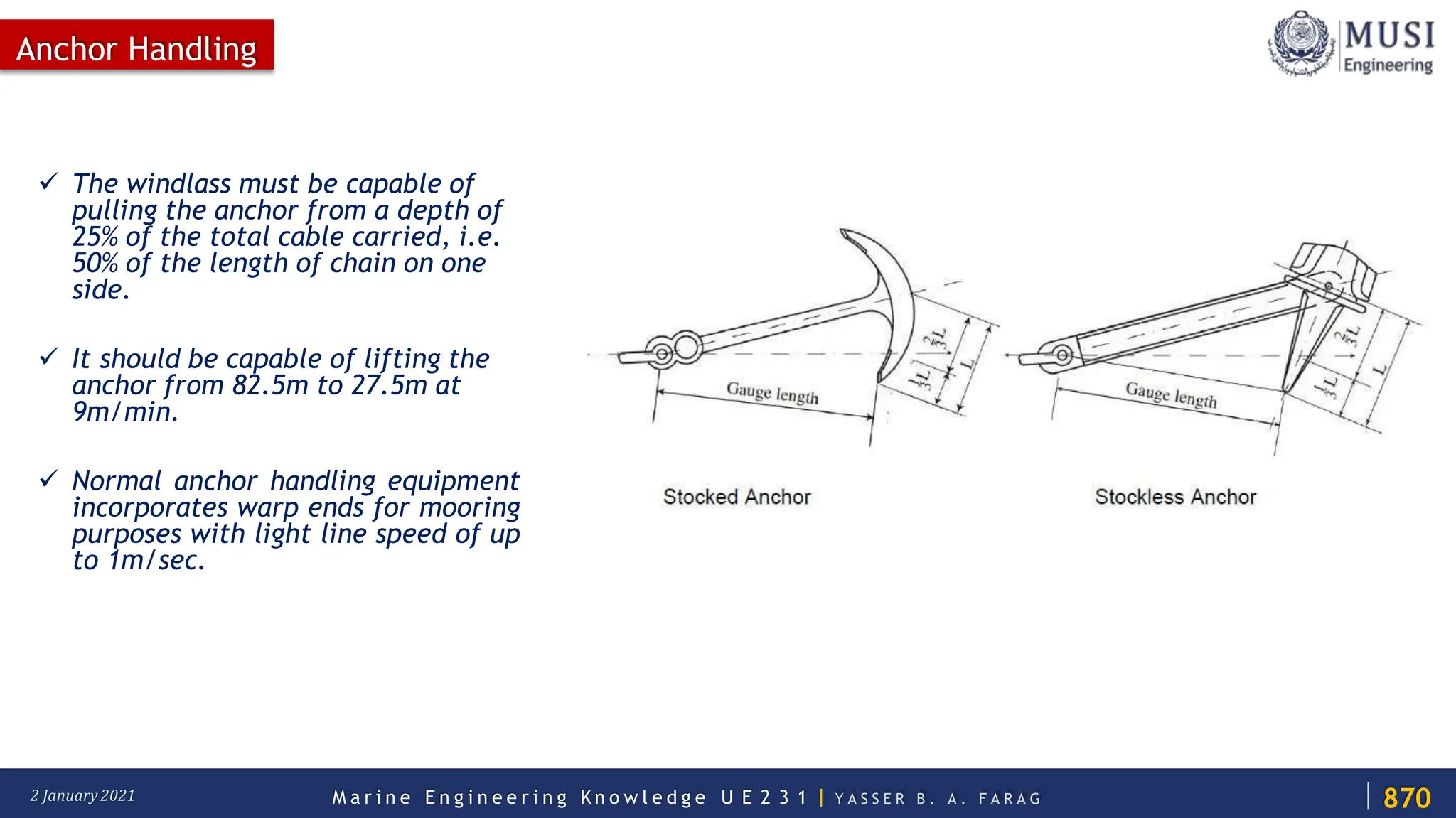
  • 360.
     A fairleadis a device to guide a line, rope or cable around an object, out of the way or to stop it from moving laterally. Typically a fairlead will be a ring or hook. The fairlead may be a separate piece of hardware, or it could be a hole in the structure.  A fairlead can also be used to stop a straight run of line from vibrating or rubbing on another surface. An additional use on boats is to keep a loose end of line from sliding around the deck
  • 362.
     A capstanis a vertical- axled rotating machine developed for use on sailing ships to apply force to ropes, cables, and hawsers. The principle is similar to that of the windlass, which has a horizontal axle.
  • 363.
  • 364.
    • SHIP CAPSTANIS THE DEVICE INSTALLED AND USED ON SHIPS TO WIND ROPE, CABLE OR CHAIN DURING ANCHORING, MOORING, PULLING, LOADING, UNLOADING OPERATIONS AND SO ON. FROM THE SHIP CAPSTAN DEFINITION WE CAN KNOW THAT THE CAPSTAN HAS WIDE APPLICATION, WHICH MAKES IT IMPORTANT EQUIPMENT ON SHIP. THE CAPSTAN IS A DRUM SHAPED MACHINE AND IT INCLUDES HORIZONTAL CAPSTAN AND VERTICAL CAPSTAN, ONE ADVANTAGE OF USING CAPSTAN ON SHIP IS THAT IT CAN SAVE SOME WEIGHT AND SPACE ON DECK ESPECIALLY AS VERTICAL CAPSTAN BECAUSE ITS MOTOR AND SOME OTHER PARTS ARE MOUNTED BELOW DECK. • THE CAPSTAN IS THE SIMPLE BUT IMPORTANT DEVICE ON SHIP NO MATTER WHAT DRIVE TYPE AND WHAT INSTALLATION WAY IT ADOPTS, AND IT MAKES SHIP ANCHORING AND MOORING EASIER BECAUSE IT HAS EASY OPERATION AND CAN WORK EFFICIENTLY LIKE MARINE WINCHES FOR BOATS. IF YOU HAVE ANY QUESTION ABOUT SHIP CAPSTAN FOR SALE, JUST TELL US AND WE WILL PROVIDE SOLUTIONS FOR YOU VERY SOON. CHOOSE THE CAPSTAN FOR
  • 365.
     . BeforeOperation 1) Take down the canvas cover on the deck machinery, then check whether there are some obstacles around and the control crank is in neutral position or not. This can prevent oil motor from suddenly moving when hydraulic pump is started. 2) Check and confirm that the hydraulic tank’s oil level is normal. 3) Forbid the use of shore power control hydraulic ship deck machinery. 4) After the first start or maintenance, we should check whether the steering pump is consistent with the arrow direction on the pump case. Don’t keep the hydraulic pump reversal to avoid damaging the hydraulic pump. Check whether pipeline has leakage and there is abnormal sound and vibration or not during pump’ running. 5) Confirm all the above normal, and then release the dog driver from the reversing handle of deck machinery.
  • 366.
     During Operation 1)When operating in the navigation bridge (if already long- time no use), spin the bypass valve on the remote console to the bottom towards the operation direction, and then connect the reversing valve rod of the ship deck machinery with the actuating mechanism of remote control oil cylinder. 2) When operating the warping winch, push the control handle to the warping position. While heaving up the anchor, loosen the chain cable stopper and hand brake band, and then push the clutch handle to the heave away anchor position. 3) Pay attention to the pressure gauge of the remote control box during running. If the pressure exceeds the rated pressure, we must stop operation. 4) When the remote control handle is in the neutral position, cable crane hydraulic brake cylinder should be in brake position. If the red light of the remote control station is on, it means that the brake system works well.
  • 367.
     . AfterOperation 1) Brake the anchor machine brake tightly, close the chain stopper, open the clutch, put the control handle in neutral position, release the actuating mechanism of remote control oil cylinder, and then use the dog driver to lock the handle. 2) Put the remote control handle of the navigation bridge in the neutral position, spin the bypass valve to the bottom towards the BYPASS direction, and then close the pump power. 3) Use canvas cover to cover the deck machinery.