DECISION MAKING
PROCESS
DECISION MAKING
DECISION MAKING IS NOT EASY
•IT Must be done amid
•Ever-changing factors
•Unclear information
•Conflicting points of view
DECISION AND
DECISION MAKING
DECISION = Choice made from
available alternatives.
DECISION MAKING = Process of
identifying problems and
opportunities and resolving them.
THE SIGNIFICANCE OF DECISION
MAKING
Better Utilisation Of Resources
Facing Problems And Challenges
Business Growth
Achieving Objectives
Increases Efficiency
Facilitates Innovation
Motivate Employees
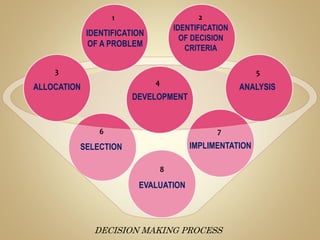
DECISION MAKING PROCESS
IDENTIFICATION
OF A PROBLEM
IDENTIFICATION
OF DECISION
CRITERIA
ALLOCATION
DEVELOPMENT
ANALYSIS
EVALUATION
IMPLIMENTATIONSELECTION
1 2
3
4
5
6 7
8
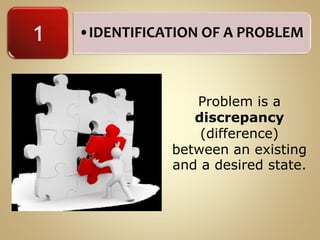
•IDENTIFICATION OF A PROBLEM1
Problem is a
discrepancy
(difference)
between an existing
and a desired state.
The word criteria, is
defined as “a
standard by which
something can be
judged”.
•IDENTIFICATION OF DECISION
CRITERIA2
•ALLOCATION OF WEIGHTS TO
CRITERIA3
 The next step in the decision making process
is prioritization.
 Prioritization is achieved by assigning
quantitative weights to each criteria
element.
 The weightage defines the relative
significance of each element.
•DEVELOPMENT OF
ALTERNATIVES4
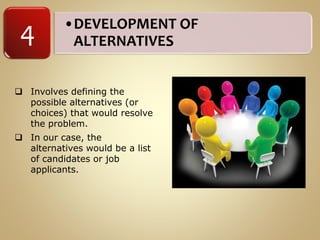
 Involves defining the
possible alternatives (or
choices) that would resolve
the problem.
 In our case, the
alternatives would be a list
of candidates or job
applicants.
•ANALYSIS OF ALTERNATIVES5
 Alternatives are
rated and analyzed
on the basis of the
criteria
 The rating can be
based on a specified
scale, say 1 – 5 etc.
•SELECTION OF AN ALTERNATIVE6
 Involves choosing the
best alternative, based
on the above rating and
analysis
 Generally implies
selecting the alternative
with the highest score.
•IMPLIMENTATION OF AN
ALTERNATIVE
7
 Putting the decision
into action.
 Involves clear
communication of the
decision to all
concerned and
obtaining their
commitment.
•EVALUATION8
 Evaluation forms an integral
part of any process.
 Involves evaluation of the
outcome based on the desired
goal and criteria.
 Involves assessing the
effectiveness and efficiency of
the outcome (or the entire
process).
 In case of any undesired
results, each step of the
process is carefully reviewed to
trace the root causes.
“A DECISION IS A JUDGMENT. IT IS A CHOICE
BETWEEN ALTERNATIVES. IT IS RARELY A
CHOICE BETWEEN RIGHT AND WRONG. IT IS
AT BEST A CHOICE BETWEEN “ALMOST RIGHT”
AND “PROBABLY WRONG”. -DRUCKER
“A manager by profession is a decision maker;
Uncertainty is his opponent, overcoming it is
his mission.”
One more thing…..

Decision making process

  • 1.
  • 2.
    DECISION MAKING DECISION MAKINGIS NOT EASY •IT Must be done amid •Ever-changing factors •Unclear information •Conflicting points of view
  • 3.
    DECISION AND DECISION MAKING DECISION= Choice made from available alternatives. DECISION MAKING = Process of identifying problems and opportunities and resolving them.
  • 4.
    THE SIGNIFICANCE OFDECISION MAKING Better Utilisation Of Resources Facing Problems And Challenges Business Growth Achieving Objectives Increases Efficiency Facilitates Innovation Motivate Employees
  • 5.
    DECISION MAKING PROCESS IDENTIFICATION OFA PROBLEM IDENTIFICATION OF DECISION CRITERIA ALLOCATION DEVELOPMENT ANALYSIS EVALUATION IMPLIMENTATIONSELECTION 1 2 3 4 5 6 7 8
  • 6.
    •IDENTIFICATION OF APROBLEM1 Problem is a discrepancy (difference) between an existing and a desired state.
  • 7.
    The word criteria,is defined as “a standard by which something can be judged”. •IDENTIFICATION OF DECISION CRITERIA2
  • 8.
    •ALLOCATION OF WEIGHTSTO CRITERIA3  The next step in the decision making process is prioritization.  Prioritization is achieved by assigning quantitative weights to each criteria element.  The weightage defines the relative significance of each element.
  • 9.
    •DEVELOPMENT OF ALTERNATIVES4  Involvesdefining the possible alternatives (or choices) that would resolve the problem.  In our case, the alternatives would be a list of candidates or job applicants.
  • 10.
    •ANALYSIS OF ALTERNATIVES5 Alternatives are rated and analyzed on the basis of the criteria  The rating can be based on a specified scale, say 1 – 5 etc.
  • 11.
    •SELECTION OF ANALTERNATIVE6  Involves choosing the best alternative, based on the above rating and analysis  Generally implies selecting the alternative with the highest score.
  • 12.
    •IMPLIMENTATION OF AN ALTERNATIVE 7 Putting the decision into action.  Involves clear communication of the decision to all concerned and obtaining their commitment.
  • 13.
    •EVALUATION8  Evaluation formsan integral part of any process.  Involves evaluation of the outcome based on the desired goal and criteria.  Involves assessing the effectiveness and efficiency of the outcome (or the entire process).  In case of any undesired results, each step of the process is carefully reviewed to trace the root causes.
  • 14.
    “A DECISION ISA JUDGMENT. IT IS A CHOICE BETWEEN ALTERNATIVES. IT IS RARELY A CHOICE BETWEEN RIGHT AND WRONG. IT IS AT BEST A CHOICE BETWEEN “ALMOST RIGHT” AND “PROBABLY WRONG”. -DRUCKER “A manager by profession is a decision maker; Uncertainty is his opponent, overcoming it is his mission.”
  • 15.