Business Decision
     Making


       Free Powerpoint Templates
                                   Page 1
A Core Function
  Managers are responsible for effective and efficient
   execution of these organizational functions.

  A typical manager performs a number of functions
   that are categorized as:
    Interpersonal
    Informational
     Decisional
  One of the key traits that distinguish managers from
   operatives is the ability to make Independent
   Decisions.


                    Free Powerpoint Templates
                                                      Page 2
What is Decision-Making?

The word decision is defined as:
“A choice between two or more alternatives”.
Thus decision-making can be defined as:
“the selection of a course of action from among
alternatives ”.


 The process of choosing the most appropriate
  alternative from a given set of alternatives.


                   Free Powerpoint Templates
                                                  Page 3
Types of problems decision makers face

Managerial decision making typically centers on three
types of problems:
    Crisis
        A crisis problem is a serious difficulty requiring immediate action.
    Non-Crisis
         A non-crisis problem is an issue that requires resolution but does not
  simultaneously have the importance and immediacy characteristics of a
  crisis.
    Opportunity Problems
         An opportunity problem is a situation that offers strong potential for
  significant organizational gain if appropriate actions are taken.


                            Free Powerpoint Templates
                                                                               Page 4
Differences in decision making situations

• There are two situation
   Programmed Decision Making
       Programmed Decisions are those made in routine, repetitive, well-
 structured situations through the use of predetermined decision rules.


   Non-Programmed Decision Making
        Non-programmed Decisions are those for which predetermined
 decision rules are impractical because the situations are novel and/or
 relatively ill structured.


                          Free Powerpoint Templates
                                                                          Page 5
Strategic Decisions

  • Administrative decisions
  • Routine or Operating decisions


Individual and Group decisions


                Free Powerpoint Templates
                                            Page 6
Decision-Making Process
1) Identifying a problem
2) Identifying decision criteria
3) Allocating weights to criteria
4) Developing alternatives
5) Analyzing alternatives
6) Selecting an alternative
7) Implementing the alternative
8) Evaluation (of decision effectiveness)


                    Free Powerpoint Templates
                                                Page 7
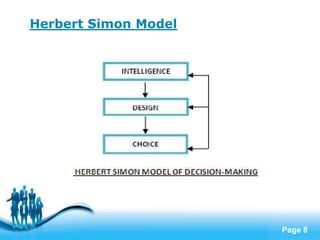
Herbert Simon Model


           Free Powerpoint Templates
                                       Page 8
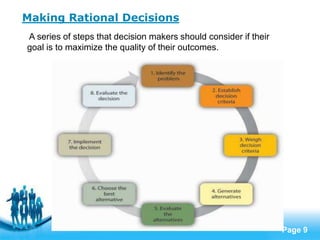
Making Rational Decisions
A series of steps that decision makers should consider if their
goal is to maximize the quality of their outcomes.


                        Free Powerpoint Templates
                                                                  Page 9
Rational Economic Man Model
• By Adam Smith, it states that managers are always rational
and choose the alternative which provides maximum gain.
• A rational decision maker has a clear idea of the problem to
be solved and he is fully objective and logical in approach.
Assumptions
1.   Decision maker has a clear and well defined goal
2.   Is rational and uninfluenced by emotions
3.   Can identify the problem clearly and precisely
4.   He knows all the alternatives available, with consequences
5.   Can rank all consequences according to preferences
6.   Has full freedom to choose the best alternative.

                       Free Powerpoint Templates
                                                           Page 10
Bounded Rationality
   A critique of the rational man model. Administrative man he
   says is the way decisions are actually made.

   He says there are limits on decision making:
   1. Bounded rationality: imperfect information about goals
   and courses of action and relation of means to ends. Only
   perceive a few of the possible decisions, courses of action,
   dimly perceive means end relation.
   2. Bounded discretion: constraints on optimizing, prior
   commitments, moral and ethical standards, laws, and
   social standards.
   Forced to make decisions that are just good enough.
   Called Satisficing. Search for a needle in the haystack.
   Optimize is to look for the sharpest. Satisfied is to search
   until you find the needle that is just sharp enough to do the
   job.
                    Free Powerpoint Templates
                                                           Page 11
Bounded Rational: Causes

  1. Inadequate goal formulation
  2. Vaguely defined problems
  3. Imperfect knowledge
  4. Limited time and resources
  5. Human Limitations
  6. Power Politics
  7. Environmental Dynamics


                      Free Powerpoint Templates
                                                  Page 12
Group Decision-making

The group members interact with each other, discuss
the problem and make a collective decision.
The factors requiring group decisions include:
1.   Involving sensitive issues
2.   High cost alternatives
3.   Involving very high risk factor
4.   Strategic impact


                     Free Powerpoint Templates
                                                      Page 13
Group Decisions: Advantages

1. Acceptance of group members
2. Coordination is easier
3. Communication is easier
4. Existence of large alternatives
5. More information can be processed
6. Diversity of experience and perspectives


                   Free Powerpoint Templates
                                               Page 14
Group Decisions: Disadvantages

 1. Take longer time
 2. Group can be indecisive
 3. Groups can compromise
 4. Groups can be dominated
 5. Groups can “play games”
 6. Victim to Groupthink - group members over look
    other available alternatives for the sake of complete
    consensus


                    Free Powerpoint Templates
                                                       Page 15
Decision Making with Quantitative Tools

1. Marginal Analysis – Comparison of additional revenues from additional
   costs to point where the cost resulting MC=MR

2. Cost Effectiveness Analysis – Cost Benefit Analysis

3. Risk Analysis – Determination of the nature and size of risk involved

4. Linear Programming – Technique for determination of optimum
   combination of limited resources to minimize cost or to maximise profits.

5. Operations Research- Scientific analysis of decision problems

6. Decision Tree- Graphic method used for identifying the available
   alternatives and the risk and outcome associated with each alternative.

7. Network Analysis- Analysis of a project into small interconnected in a
   logical order. CPM and PERT


                            Free Powerpoint Templates
                                                                            Page 16
Decision Making with Qualitative Tools


1. Brainstorming - A group creativity technique by which a group tries to
   find a solution for a specific problem by gathering a list of ideas
   spontaneously contributed by its members.

2. Delphi Technique - A structured communication technique, originally
   developed as a systematic, interactive forecasting method which relies
   on a panel of experts. the experts answer questionnaires in two or
   more rounds. After each round, a facilitator provides an anonymous
   summary of the experts’ forecasts from the previous round as well as
   the reasons they provided for their judgments. Thus, experts are
   encouraged to revise their earlier answers in light of the replies of other
   members of their panel. It is believed that during this process the range
   of the answers will decrease and the group will converge towards the
   "correct" answer.


                             Free Powerpoint Templates
                                                                            Page 17
3. Nominal Group Technique- A decision making method for use
   among groups of many sizes, who want to make their decision quickly, as by
   a vote, but want everyone's opinions taken into account (as opposed to
   traditional voting, where only the largest group is considered) . Facilitators
   will encourage the sharing and discussion of reasons for the choices made
   by each group member, thereby identifying common ground, and a plurality
   of ideas and approaches. This diversity often allows the creation of a hybrid
   idea (combining parts of two or more ideas), often found to be even better
   than those ideas being initially considered. The numbers each solution
   receives are totalled, and the solution with the lowest (i.e. most favored) total
   ranking is selected as the final decision.

4. Simulation – Imitation of some real thing available, state of affairs, or
   process. The act of simulating something generally entails representing
   certain key characteristics or behaviours of a selected physical or abstract
   system.


                            Free Powerpoint Templates
                                                                            Page 18
?


Free Powerpoint Templates
                            Page 19

Decision making

  • 1.
    Business Decision Making Free Powerpoint Templates Page 1
  • 2.
    A Core Function  Managers are responsible for effective and efficient execution of these organizational functions.  A typical manager performs a number of functions that are categorized as:  Interpersonal  Informational  Decisional  One of the key traits that distinguish managers from operatives is the ability to make Independent Decisions. Free Powerpoint Templates Page 2
  • 3.
    What is Decision-Making? Theword decision is defined as: “A choice between two or more alternatives”. Thus decision-making can be defined as: “the selection of a course of action from among alternatives ”. The process of choosing the most appropriate alternative from a given set of alternatives. Free Powerpoint Templates Page 3
  • 4.
    Types of problemsdecision makers face Managerial decision making typically centers on three types of problems:  Crisis A crisis problem is a serious difficulty requiring immediate action.  Non-Crisis A non-crisis problem is an issue that requires resolution but does not simultaneously have the importance and immediacy characteristics of a crisis.  Opportunity Problems An opportunity problem is a situation that offers strong potential for significant organizational gain if appropriate actions are taken. Free Powerpoint Templates Page 4
  • 5.
    Differences in decisionmaking situations • There are two situation  Programmed Decision Making Programmed Decisions are those made in routine, repetitive, well- structured situations through the use of predetermined decision rules.  Non-Programmed Decision Making Non-programmed Decisions are those for which predetermined decision rules are impractical because the situations are novel and/or relatively ill structured. Free Powerpoint Templates Page 5
  • 6.
    Strategic Decisions • Administrative decisions • Routine or Operating decisions Individual and Group decisions Free Powerpoint Templates Page 6
  • 7.
    Decision-Making Process 1) Identifyinga problem 2) Identifying decision criteria 3) Allocating weights to criteria 4) Developing alternatives 5) Analyzing alternatives 6) Selecting an alternative 7) Implementing the alternative 8) Evaluation (of decision effectiveness) Free Powerpoint Templates Page 7
  • 8.
    Herbert Simon Model Free Powerpoint Templates Page 8
  • 9.
    Making Rational Decisions Aseries of steps that decision makers should consider if their goal is to maximize the quality of their outcomes. Free Powerpoint Templates Page 9
  • 10.
    Rational Economic ManModel • By Adam Smith, it states that managers are always rational and choose the alternative which provides maximum gain. • A rational decision maker has a clear idea of the problem to be solved and he is fully objective and logical in approach. Assumptions 1. Decision maker has a clear and well defined goal 2. Is rational and uninfluenced by emotions 3. Can identify the problem clearly and precisely 4. He knows all the alternatives available, with consequences 5. Can rank all consequences according to preferences 6. Has full freedom to choose the best alternative. Free Powerpoint Templates Page 10
  • 11.
    Bounded Rationality A critique of the rational man model. Administrative man he says is the way decisions are actually made. He says there are limits on decision making: 1. Bounded rationality: imperfect information about goals and courses of action and relation of means to ends. Only perceive a few of the possible decisions, courses of action, dimly perceive means end relation. 2. Bounded discretion: constraints on optimizing, prior commitments, moral and ethical standards, laws, and social standards. Forced to make decisions that are just good enough. Called Satisficing. Search for a needle in the haystack. Optimize is to look for the sharpest. Satisfied is to search until you find the needle that is just sharp enough to do the job. Free Powerpoint Templates Page 11
  • 12.
    Bounded Rational: Causes 1. Inadequate goal formulation 2. Vaguely defined problems 3. Imperfect knowledge 4. Limited time and resources 5. Human Limitations 6. Power Politics 7. Environmental Dynamics Free Powerpoint Templates Page 12
  • 13.
    Group Decision-making The groupmembers interact with each other, discuss the problem and make a collective decision. The factors requiring group decisions include: 1. Involving sensitive issues 2. High cost alternatives 3. Involving very high risk factor 4. Strategic impact Free Powerpoint Templates Page 13
  • 14.
    Group Decisions: Advantages 1.Acceptance of group members 2. Coordination is easier 3. Communication is easier 4. Existence of large alternatives 5. More information can be processed 6. Diversity of experience and perspectives Free Powerpoint Templates Page 14
  • 15.
    Group Decisions: Disadvantages 1. Take longer time 2. Group can be indecisive 3. Groups can compromise 4. Groups can be dominated 5. Groups can “play games” 6. Victim to Groupthink - group members over look other available alternatives for the sake of complete consensus Free Powerpoint Templates Page 15
  • 16.
    Decision Making withQuantitative Tools 1. Marginal Analysis – Comparison of additional revenues from additional costs to point where the cost resulting MC=MR 2. Cost Effectiveness Analysis – Cost Benefit Analysis 3. Risk Analysis – Determination of the nature and size of risk involved 4. Linear Programming – Technique for determination of optimum combination of limited resources to minimize cost or to maximise profits. 5. Operations Research- Scientific analysis of decision problems 6. Decision Tree- Graphic method used for identifying the available alternatives and the risk and outcome associated with each alternative. 7. Network Analysis- Analysis of a project into small interconnected in a logical order. CPM and PERT Free Powerpoint Templates Page 16
  • 17.
    Decision Making withQualitative Tools 1. Brainstorming - A group creativity technique by which a group tries to find a solution for a specific problem by gathering a list of ideas spontaneously contributed by its members. 2. Delphi Technique - A structured communication technique, originally developed as a systematic, interactive forecasting method which relies on a panel of experts. the experts answer questionnaires in two or more rounds. After each round, a facilitator provides an anonymous summary of the experts’ forecasts from the previous round as well as the reasons they provided for their judgments. Thus, experts are encouraged to revise their earlier answers in light of the replies of other members of their panel. It is believed that during this process the range of the answers will decrease and the group will converge towards the "correct" answer. Free Powerpoint Templates Page 17
  • 18.
    3. Nominal GroupTechnique- A decision making method for use among groups of many sizes, who want to make their decision quickly, as by a vote, but want everyone's opinions taken into account (as opposed to traditional voting, where only the largest group is considered) . Facilitators will encourage the sharing and discussion of reasons for the choices made by each group member, thereby identifying common ground, and a plurality of ideas and approaches. This diversity often allows the creation of a hybrid idea (combining parts of two or more ideas), often found to be even better than those ideas being initially considered. The numbers each solution receives are totalled, and the solution with the lowest (i.e. most favored) total ranking is selected as the final decision. 4. Simulation – Imitation of some real thing available, state of affairs, or process. The act of simulating something generally entails representing certain key characteristics or behaviours of a selected physical or abstract system. Free Powerpoint Templates Page 18
  • 19.