Pros and Cons
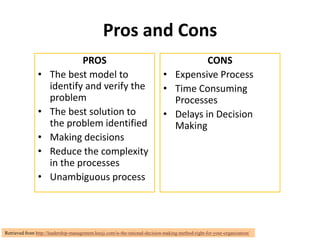
                              PROS                                                      CONS
                •     The best model to                                       • Expensive Process
                      identify and verify the                                 • Time Consuming
                      problem                                                   Processes
                •     The best solution to                                    • Delays in Decision
                      the problem identified                                    Making
                •     Making decisions
                •     Reduce the complexity
                      in the processes
                •     Unambiguous process


Retrieved from http://leadership-management.knoji.com/is-the-rational-decision-making-method-right-for-your-organization/
Example
                1) You wish to buy a new and expensive laptop and
                   trying to decide on a particular brand consults with
                   a number of friends and relatives.
                2) You decides to purchase ACER. While at the store,
                   the saleswoman, explains and proves to John that
                   he can do much better with his budget if he goes
                   for APPLE gives better value for money with respect
                   to cost, performance and fidelity, design, warranties
                   as well as style.
                3) You nevertheless, even if he would receive more
                   value for his money with APPLE being the rational
                   choice, opts for ACER.
Retrieved from http://suite101.com/article/bounded-rationality-a255278
Pros and Cons
         PROS
• Faster in making the
  decision
• The most satisfying
  decision making

        CONS
• Not the best
  solution
• Having flaw
INTUITION
               •     Intuitive Decision making;
                      – It’s making decision based on the basis of experience, feelings and
                          accumulated judgment.
               •     Decision making situations where intuitive approach can help most
                     include the following:
                      – Expedient decision making and rapid response are required.
                      – Fast paced change. The factors on which you base your analysis
                          change rapidly.
                      – The problem is poorly structured.
                      – The factors and rules that you need to take into account are hard
                          to articulate in an unambiguous way.
                      – You have to deal with ambiguous, incomplete, or conflicting
                          information.
                      – There is no precedent.


Retrieved from http://www.time-management-guide.com/intuition-decision-making.html
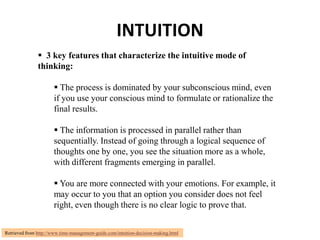
INTUITION
                3 key features that characterize the intuitive mode of
               thinking:

                        The process is dominated by your subconscious mind, even
                       if you use your conscious mind to formulate or rationalize the
                       final results.

                        The information is processed in parallel rather than
                       sequentially. Instead of going through a logical sequence of
                       thoughts one by one, you see the situation more as a whole,
                       with different fragments emerging in parallel.

                        You are more connected with your emotions. For example, it
                       may occur to you that an option you consider does not feel
                       right, even though there is no clear logic to prove that.


Retrieved from http://www.time-management-guide.com/intuition-decision-making.html
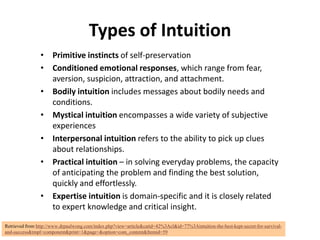
Types of Intuition
                • Primitive instincts of self-preservation
                • Conditioned emotional responses, which range from fear,
                  aversion, suspicion, attraction, and attachment.
                • Bodily intuition includes messages about bodily needs and
                  conditions.
                • Mystical intuition encompasses a wide variety of subjective
                  experiences
                • Interpersonal intuition refers to the ability to pick up clues
                  about relationships.
                • Practical intuition – in solving everyday problems, the capacity
                  of anticipating the problem and finding the best solution,
                  quickly and effortlessly.
                • Expertise intuition is domain-specific and it is closely related
                  to expert knowledge and critical insight.

Retrieved from http://www.drpaulwong.com/index.php?view=article&catid=42%3Acl&id=77%3Aintuition-the-best-kept-secret-for-survival-
and-success&tmpl=component&print=1&page=&option=com_content&Itemid=59
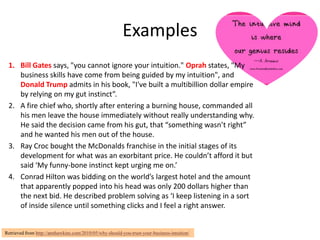
Examples
 1. Bill Gates says, "you cannot ignore your intuition." Oprah states, "My
    business skills have come from being guided by my intuition", and
    Donald Trump admits in his book, "I've built a multibillion dollar empire
    by relying on my gut instinct”.
 2. A fire chief who, shortly after entering a burning house, commanded all
    his men leave the house immediately without really understanding why.
    He said the decision came from his gut, that “something wasn’t right”
    and he wanted his men out of the house.
 3. Ray Croc bought the McDonalds franchise in the initial stages of its
    development for what was an exorbitant price. He couldn’t afford it but
    said ‘My funny-bone instinct kept urging me on.’
 4. Conrad Hilton was bidding on the world’s largest hotel and the amount
    that apparently popped into his head was only 200 dollars higher than
    the next bid. He described problem solving as ‘I keep listening in a sort
    of inside silence until something clicks and I feel a right answer.


Retrieved from http://annhawkins.com/2010/05/why-should-you-trust-your-business-intuition/
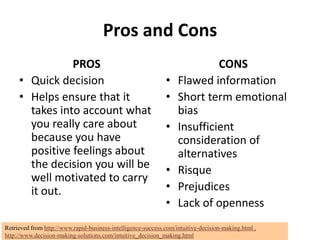
Pros and Cons
                PROS                                                        CONS
     • Quick decision                                         •    Flawed information
     • Helps ensure that it                                   •    Short term emotional
       takes into account what                                     bias
       you really care about                                  •    Insufficient
       because you have                                            consideration of
       positive feelings about                                     alternatives
       the decision you will be                               •    Risque
       well motivated to carry
       it out.                                                •    Prejudices
                                                              •    Lack of openness
Retrieved from http://www.rapid-business-intelligence-success.com/intuitive-decision-making.html ,
http://www.decision-making-solutions.com/intuitive_decision_making.html
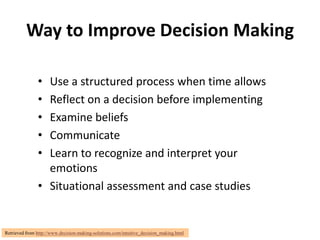
Way to Improve Decision Making

               • Use a structured process when time allows
               • Reflect on a decision before implementing
               • Examine beliefs
               • Communicate
               • Learn to recognize and interpret your
                 emotions
               • Situational assessment and case studies


Retrieved from http://www.decision-making-solutions.com/intuitive_decision_making.html

Decision Making 1

  • 1.
    Pros and Cons PROS CONS • The best model to • Expensive Process identify and verify the • Time Consuming problem Processes • The best solution to • Delays in Decision the problem identified Making • Making decisions • Reduce the complexity in the processes • Unambiguous process Retrieved from http://leadership-management.knoji.com/is-the-rational-decision-making-method-right-for-your-organization/
  • 2.
    Example 1) You wish to buy a new and expensive laptop and trying to decide on a particular brand consults with a number of friends and relatives. 2) You decides to purchase ACER. While at the store, the saleswoman, explains and proves to John that he can do much better with his budget if he goes for APPLE gives better value for money with respect to cost, performance and fidelity, design, warranties as well as style. 3) You nevertheless, even if he would receive more value for his money with APPLE being the rational choice, opts for ACER. Retrieved from http://suite101.com/article/bounded-rationality-a255278
  • 3.
    Pros and Cons PROS • Faster in making the decision • The most satisfying decision making CONS • Not the best solution • Having flaw
  • 4.
    INTUITION • Intuitive Decision making; – It’s making decision based on the basis of experience, feelings and accumulated judgment. • Decision making situations where intuitive approach can help most include the following: – Expedient decision making and rapid response are required. – Fast paced change. The factors on which you base your analysis change rapidly. – The problem is poorly structured. – The factors and rules that you need to take into account are hard to articulate in an unambiguous way. – You have to deal with ambiguous, incomplete, or conflicting information. – There is no precedent. Retrieved from http://www.time-management-guide.com/intuition-decision-making.html
  • 5.
    INTUITION  3 key features that characterize the intuitive mode of thinking:  The process is dominated by your subconscious mind, even if you use your conscious mind to formulate or rationalize the final results.  The information is processed in parallel rather than sequentially. Instead of going through a logical sequence of thoughts one by one, you see the situation more as a whole, with different fragments emerging in parallel.  You are more connected with your emotions. For example, it may occur to you that an option you consider does not feel right, even though there is no clear logic to prove that. Retrieved from http://www.time-management-guide.com/intuition-decision-making.html
  • 6.
    Types of Intuition • Primitive instincts of self-preservation • Conditioned emotional responses, which range from fear, aversion, suspicion, attraction, and attachment. • Bodily intuition includes messages about bodily needs and conditions. • Mystical intuition encompasses a wide variety of subjective experiences • Interpersonal intuition refers to the ability to pick up clues about relationships. • Practical intuition – in solving everyday problems, the capacity of anticipating the problem and finding the best solution, quickly and effortlessly. • Expertise intuition is domain-specific and it is closely related to expert knowledge and critical insight. Retrieved from http://www.drpaulwong.com/index.php?view=article&catid=42%3Acl&id=77%3Aintuition-the-best-kept-secret-for-survival- and-success&tmpl=component&print=1&page=&option=com_content&Itemid=59
  • 7.
    Examples 1. BillGates says, "you cannot ignore your intuition." Oprah states, "My business skills have come from being guided by my intuition", and Donald Trump admits in his book, "I've built a multibillion dollar empire by relying on my gut instinct”. 2. A fire chief who, shortly after entering a burning house, commanded all his men leave the house immediately without really understanding why. He said the decision came from his gut, that “something wasn’t right” and he wanted his men out of the house. 3. Ray Croc bought the McDonalds franchise in the initial stages of its development for what was an exorbitant price. He couldn’t afford it but said ‘My funny-bone instinct kept urging me on.’ 4. Conrad Hilton was bidding on the world’s largest hotel and the amount that apparently popped into his head was only 200 dollars higher than the next bid. He described problem solving as ‘I keep listening in a sort of inside silence until something clicks and I feel a right answer. Retrieved from http://annhawkins.com/2010/05/why-should-you-trust-your-business-intuition/
  • 8.
    Pros and Cons PROS CONS • Quick decision • Flawed information • Helps ensure that it • Short term emotional takes into account what bias you really care about • Insufficient because you have consideration of positive feelings about alternatives the decision you will be • Risque well motivated to carry it out. • Prejudices • Lack of openness Retrieved from http://www.rapid-business-intelligence-success.com/intuitive-decision-making.html , http://www.decision-making-solutions.com/intuitive_decision_making.html
  • 9.
    Way to ImproveDecision Making • Use a structured process when time allows • Reflect on a decision before implementing • Examine beliefs • Communicate • Learn to recognize and interpret your emotions • Situational assessment and case studies Retrieved from http://www.decision-making-solutions.com/intuitive_decision_making.html