Management
Fifteenth Edition, Global Edition
Chapter 2
Making Decisions
Copyright © 2021 Pearson Education Ltd.
Learning Objectives
2.1 Describe the eight steps in the decision-making process.
2.2 Explain the five approaches managers can use when
making decisions.
2.3 Classify decisions and decision-making styles.
2.4 Describe how biases affect decision making.
2.5 Identify cutting-edge approaches for improving decision
making.
Copyright © 2021 Pearson Education Ltd.
Be A Better Decision Maker
A key to success in management and in your career is
knowing how to be an effective decision maker.
Copyright © 2021 Pearson Education Ltd.
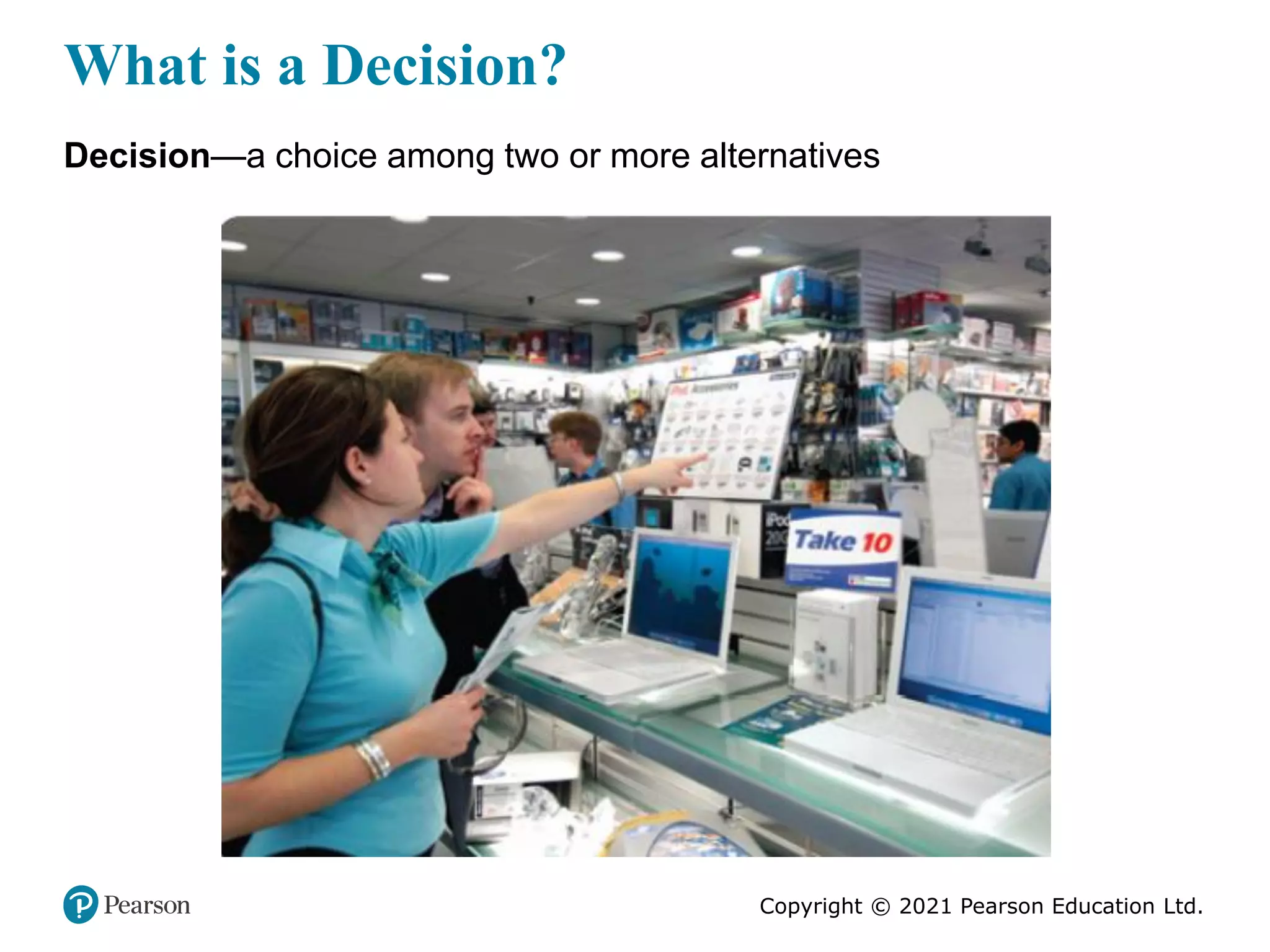
What is a Decision?
Decision—a choice among two or more alternatives
Copyright © 2021 Pearson Education Ltd.
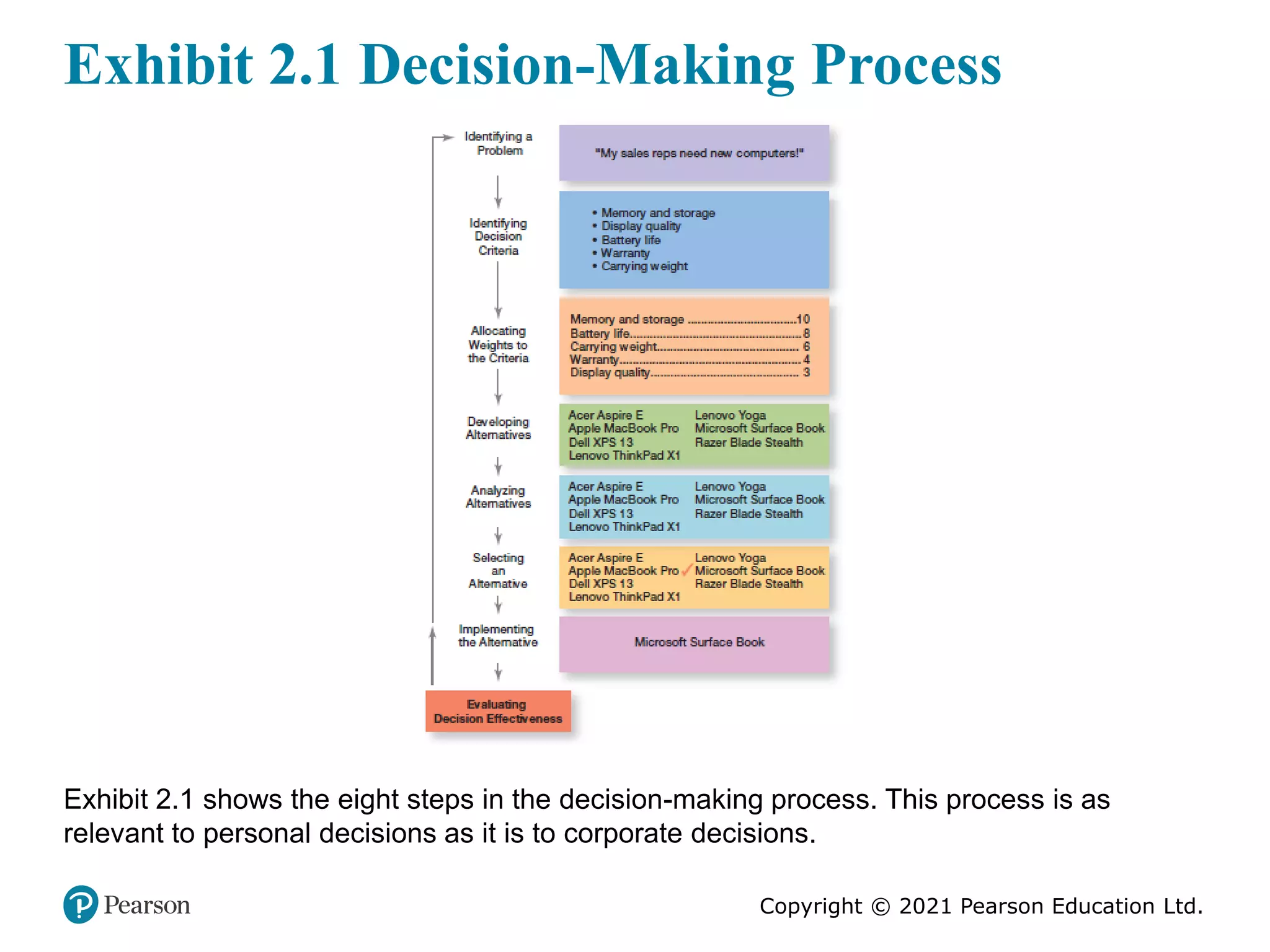
Exhibit 2.1 Decision-Making Process
Exhibit 2.1 shows the eight steps in the decision-making process. This process is as
relevant to personal decisions as it is to corporate decisions.
Copyright © 2021 Pearson Education Ltd.
Decision-Making Process Step 1: Identify a
Problem
• Problem: an obstacle that makes it difficult to achieve a
desired goal or purpose.
• Every decision starts with a problem, a discrepancy
between an existing and a desired condition.
• Example: Amanda is a sales manager whose reps need
new laptops.
Copyright © 2021 Pearson Education Ltd.
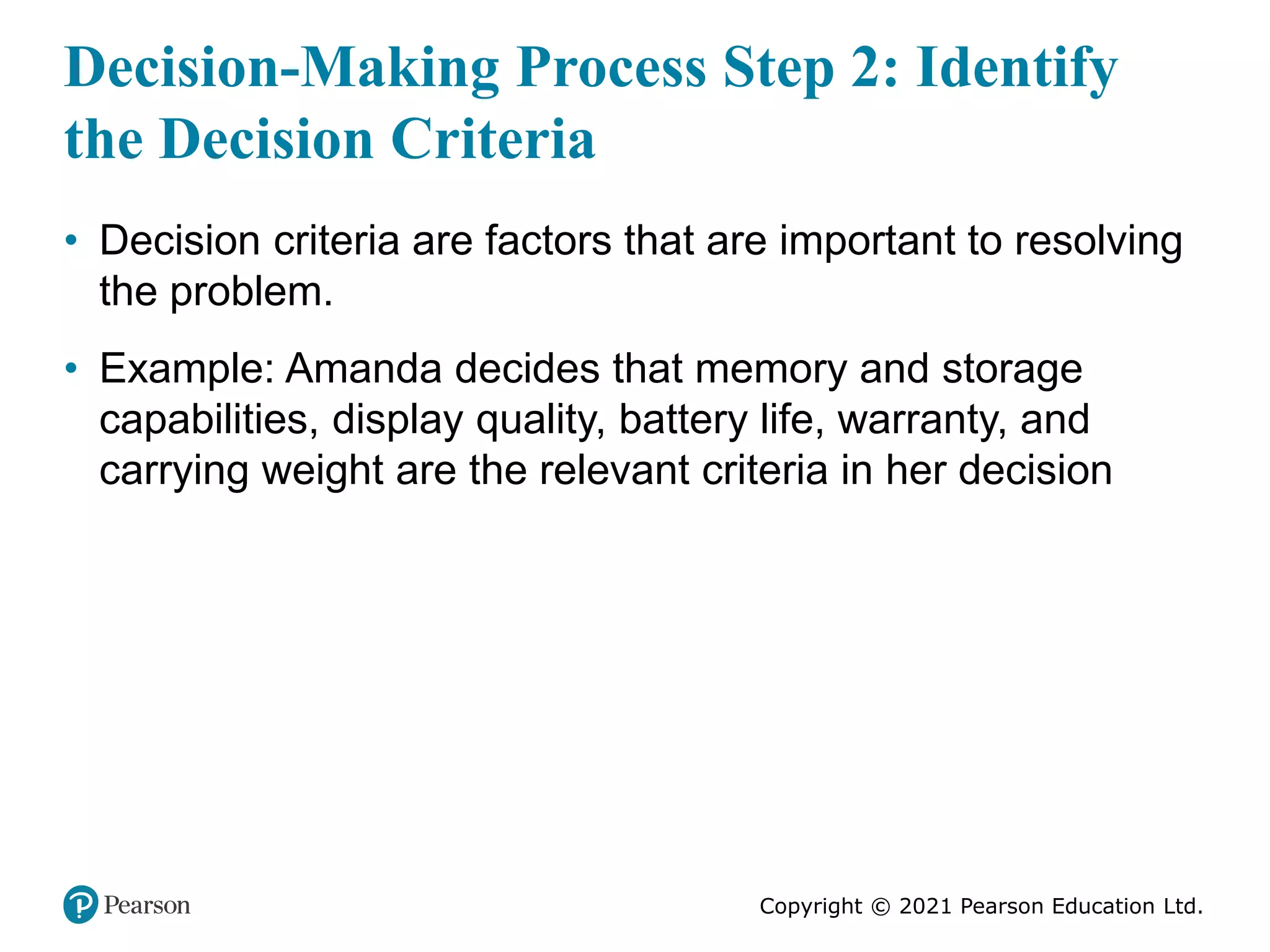
Decision-Making Process Step 2: Identify
the Decision Criteria
• Decision criteria are factors that are important to resolving
the problem.
• Example: Amanda decides that memory and storage
capabilities, display quality, battery life, warranty, and
carrying weight are the relevant criteria in her decision
Copyright © 2021 Pearson Education Ltd.
Decision-Making Process Step 3: Allocate
Weights to the Criteria
• If the relevant criteria aren’t equally important, the decision
maker must weight the items in order to give them the
correct priority in the decision.
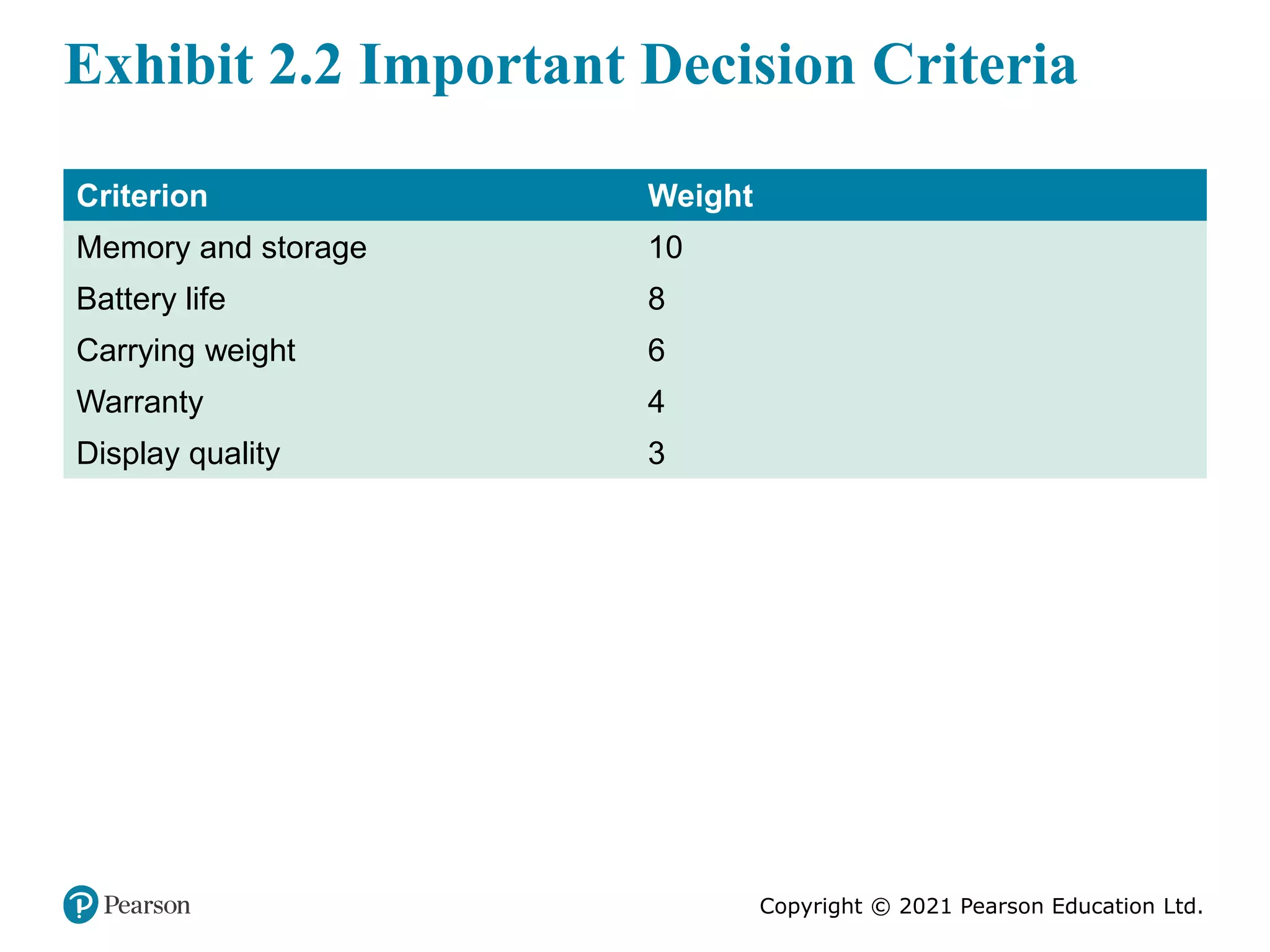
• Example: The weighted criteria for Amanda’s computer
purchase are shown in Exhibit 2.2.
Copyright © 2021 Pearson Education Ltd.
Exhibit 2.2 Important Decision Criteria
Criterion Weight
Memory and storage 10
Battery life 8
Carrying weight 6
Warranty 4
Display quality 3
Copyright © 2021 Pearson Education Ltd.
Decision-Making Process Step 4: Develop Alternatives
• List viable alternatives that could solve the problem.
• Example: Amanda identifies eight laptops as possible
choices (shown in Exhibit 2.3).
Copyright © 2021 Pearson Education Ltd.
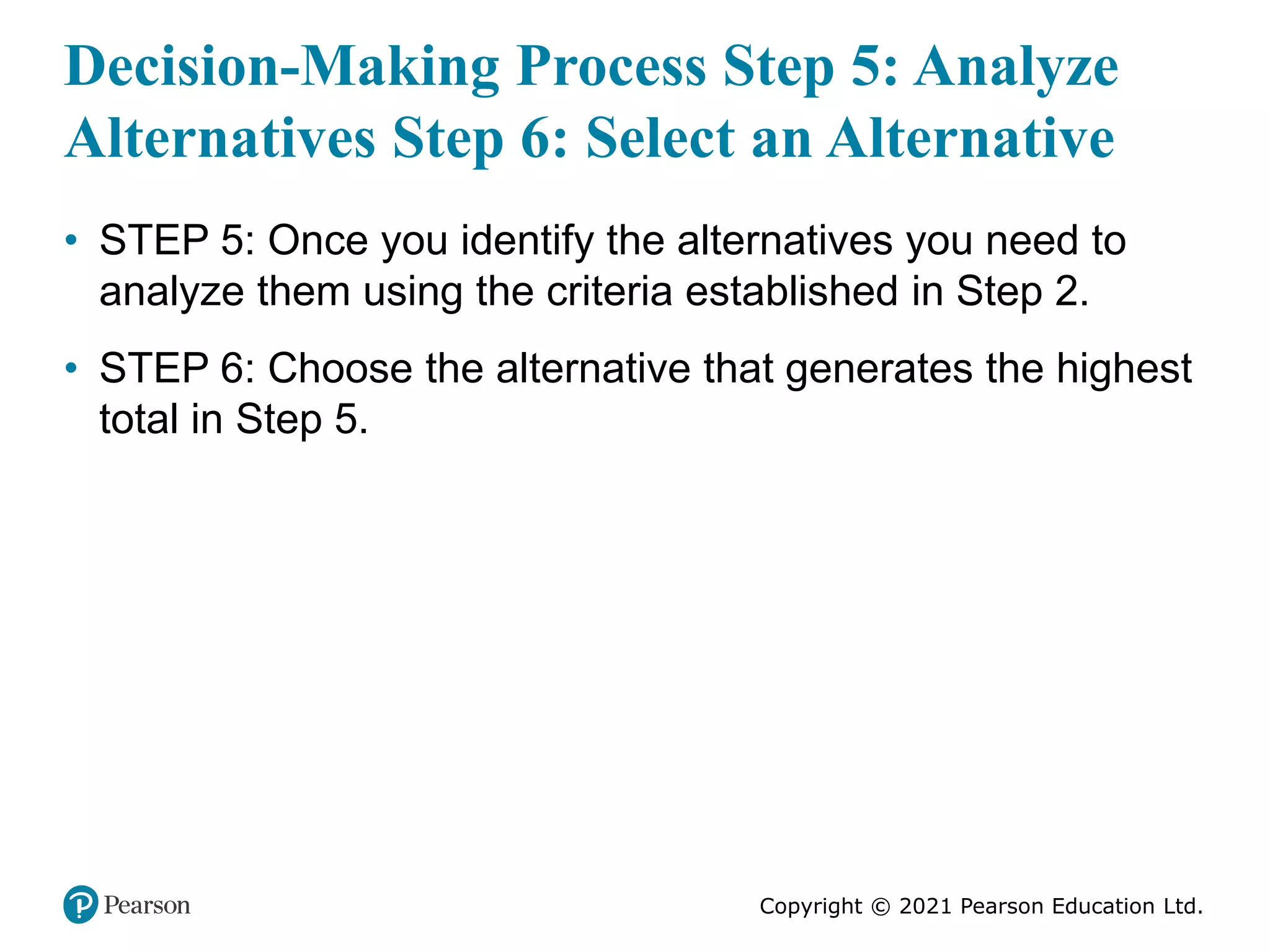
Decision-Making Process Step 5: Analyze
Alternatives Step 6: Select an Alternative
• STEP 5: Once you identify the alternatives you need to
analyze them using the criteria established in Step 2.
• STEP 6: Choose the alternative that generates the highest
total in Step 5.
Copyright © 2021 Pearson Education Ltd.
Decision-Making Process Step 7: Implement
the Alternative
• Put the chosen alternative into action.
• Convey the decision to those affected and get their
commitment to it.
Copyright © 2021 Pearson Education Ltd.
Decision-Making Process Step 8: Evaluate
Decision Effectiveness
• Evaluate the result or outcome of the decision to see if the
problem was resolved.
• If it wasn’t resolved, what went wrong?
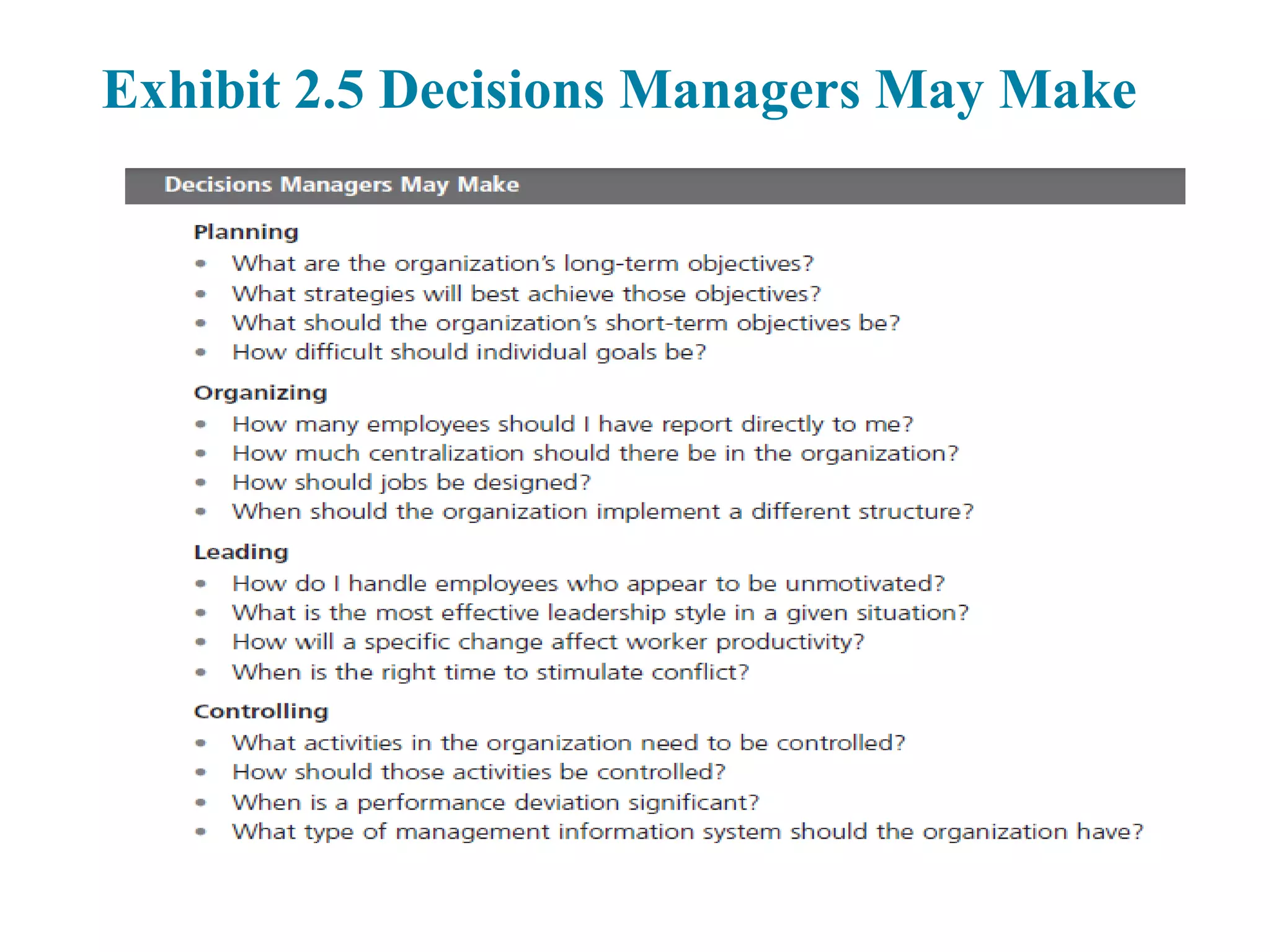
Exhibit 2.5 Decisions Managers May Make
Copyright © 2021 Pearson Education Ltd.
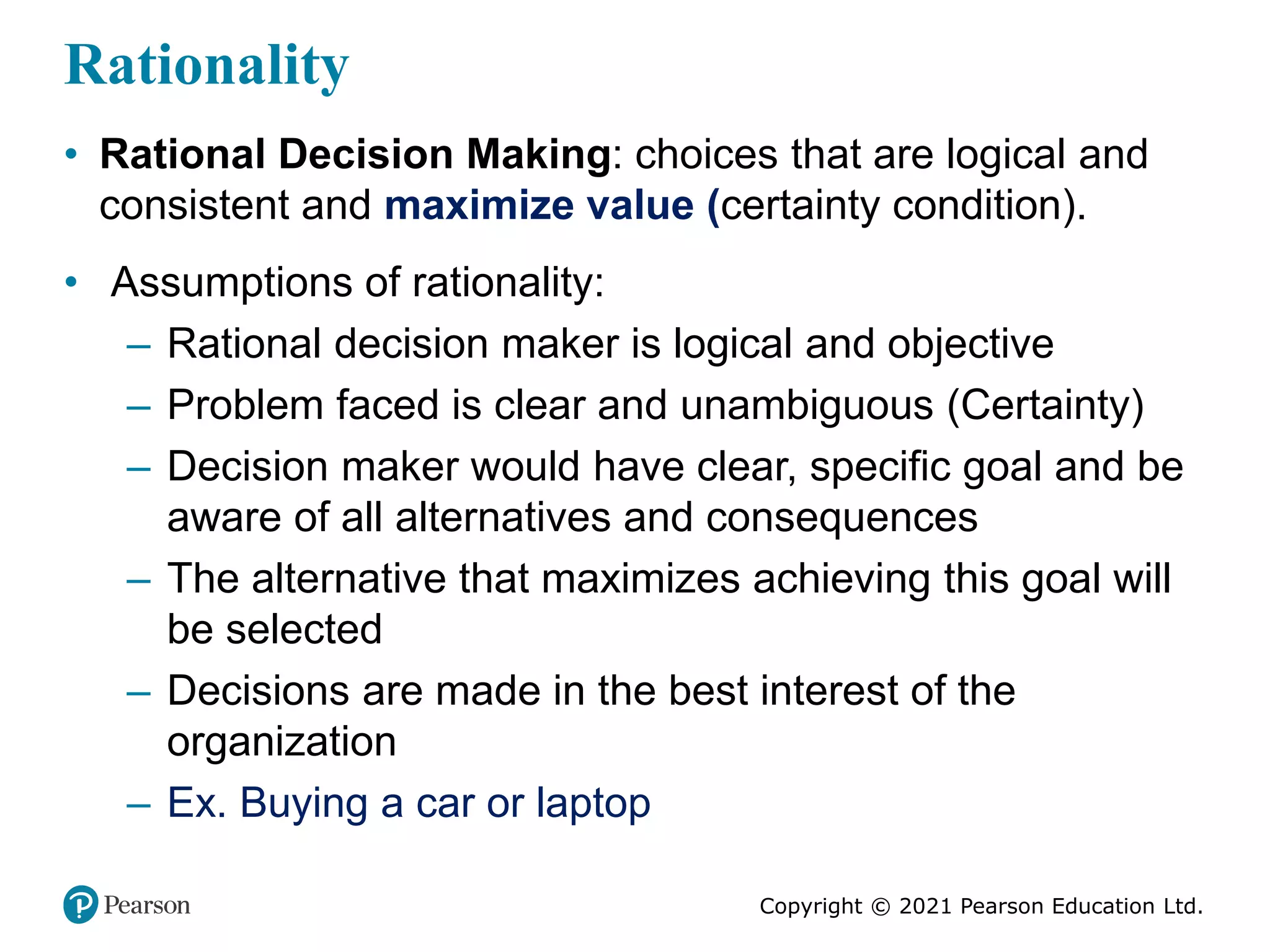
Rationality
• Rational Decision Making: choices that are logical and
consistent and maximize value (certainty condition).
• Assumptions of rationality:
– Rational decision maker is logical and objective
– Problem faced is clear and unambiguous (Certainty)
– Decision maker would have clear, specific goal and be
aware of all alternatives and consequences
– The alternative that maximizes achieving this goal will
be selected
– Decisions are made in the best interest of the
organization
– Ex. Buying a car or laptop
Copyright © 2021 Pearson Education Ltd.
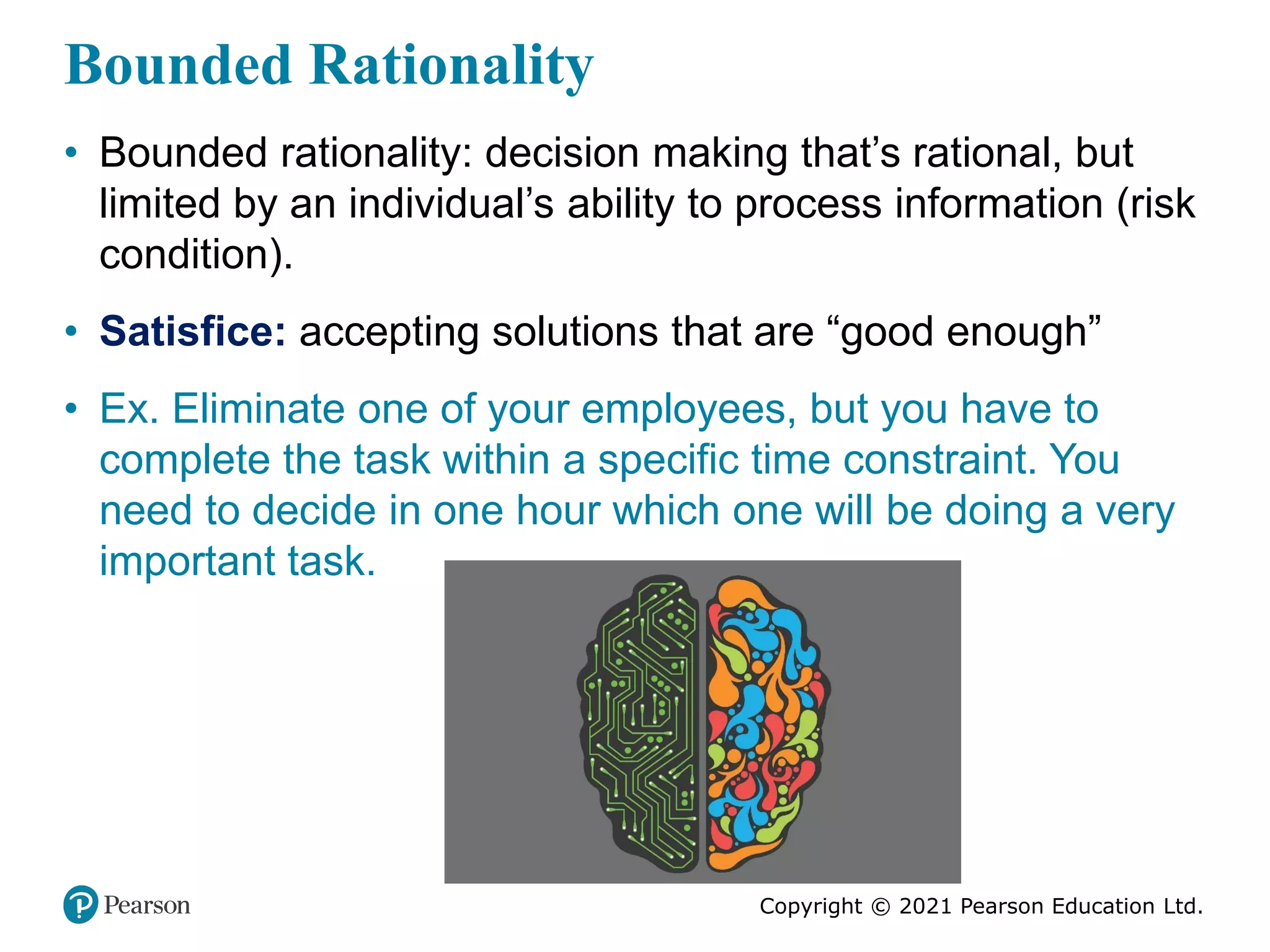
Bounded Rationality
• Bounded rationality: decision making that’s rational, but
limited by an individual’s ability to process information (risk
condition).
• Satisfice: accepting solutions that are “good enough”
• Ex. Eliminate one of your employees, but you have to
complete the task within a specific time constraint. You
need to decide in one hour which one will be doing a very
important task.
Copyright © 2021 Pearson Education Ltd.
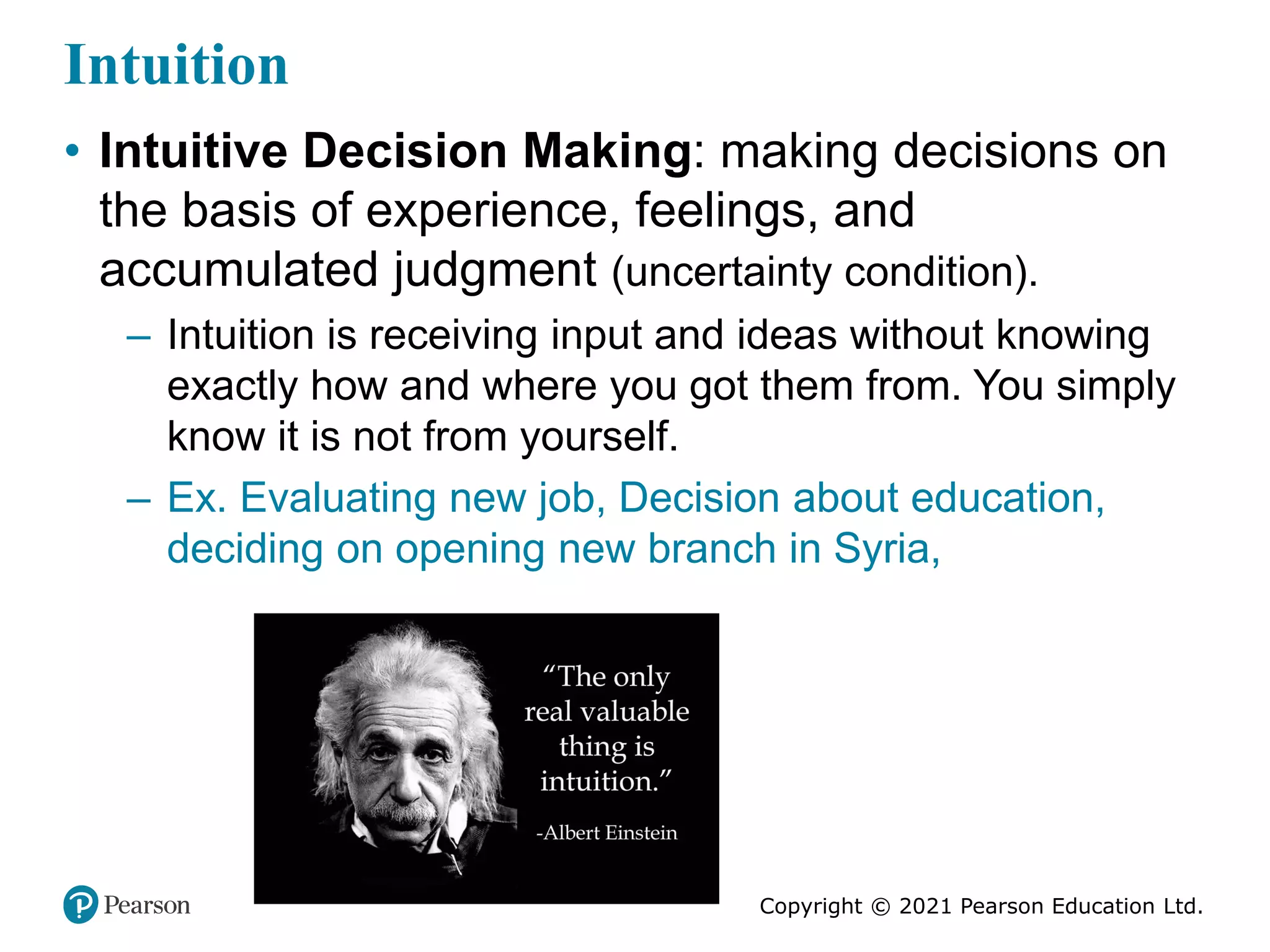
Intuition
• Intuitive Decision Making: making decisions on
the basis of experience, feelings, and
accumulated judgment (uncertainty condition).
– Intuition is receiving input and ideas without knowing
exactly how and where you got them from. You simply
know it is not from yourself.
– Ex. Evaluating new job, Decision about education,
deciding on opening new branch in Syria,
Copyright © 2021 Pearson Education Ltd.
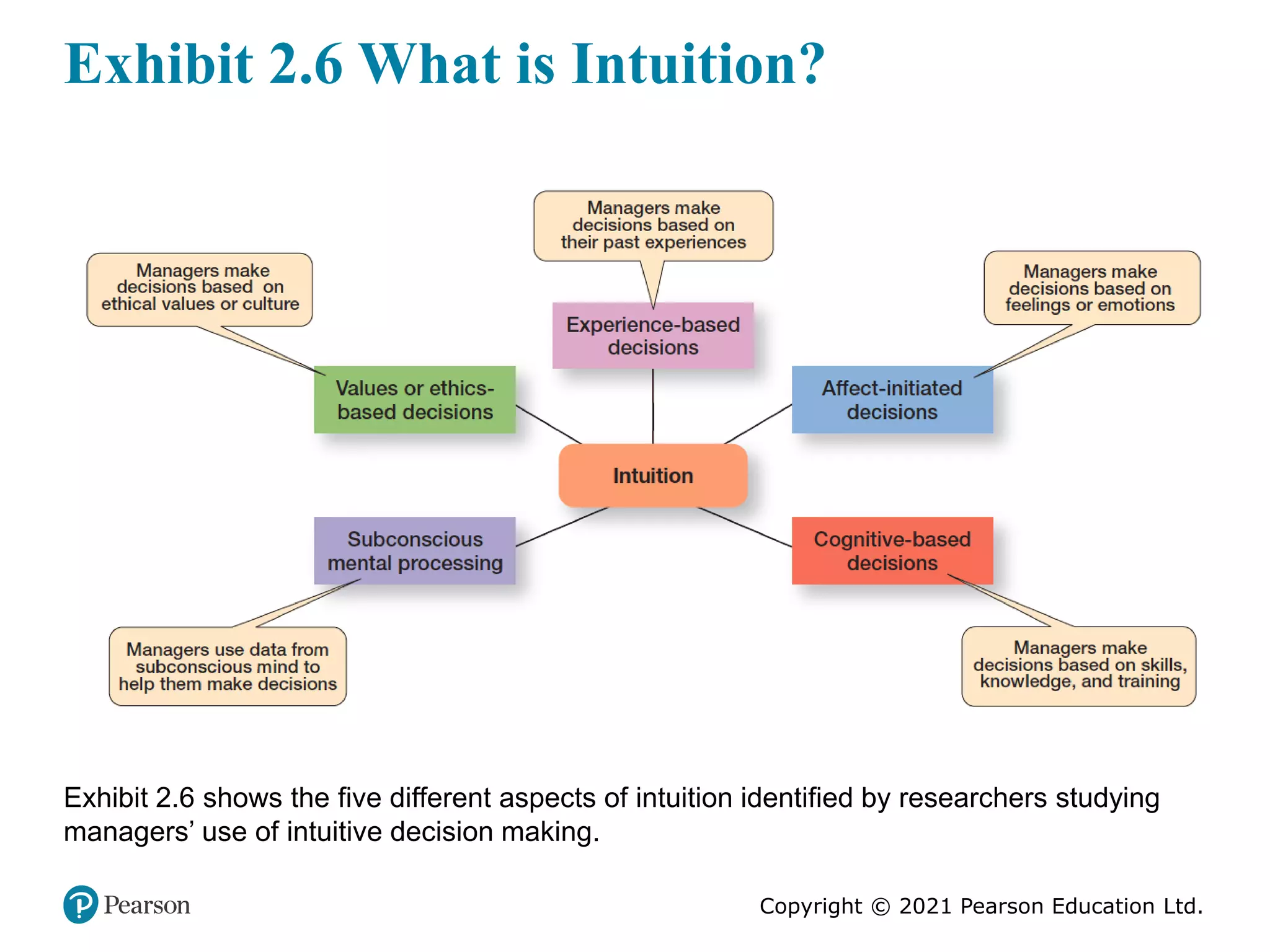
Exhibit 2.6 What is Intuition?
Exhibit 2.6 shows the five different aspects of intuition identified by researchers studying
managers’ use of intuitive decision making.
Copyright © 2021 Pearson Education Ltd.
Evidence-Based Management
• Evidence-based management (EBMgt): the practice of
identifying solutions and approaches that have a strong
empirical basis to improve management practice.
• To bring more scientific evidence into their decisions,
managers need to know how to look for studies in online
databases (or have staff who can), and learn how to
evaluate the validity and applicability of the studies found.
• For example:
1. Research supports that, heavily rewarding top management often
has a negative effect on productivity.
2. According to Sutton and Pfeffer, most mergers fail because business
cultures do not align and companies fail to follow an evidence-based
integration process.
Copyright © 2021 Pearson Education Ltd.
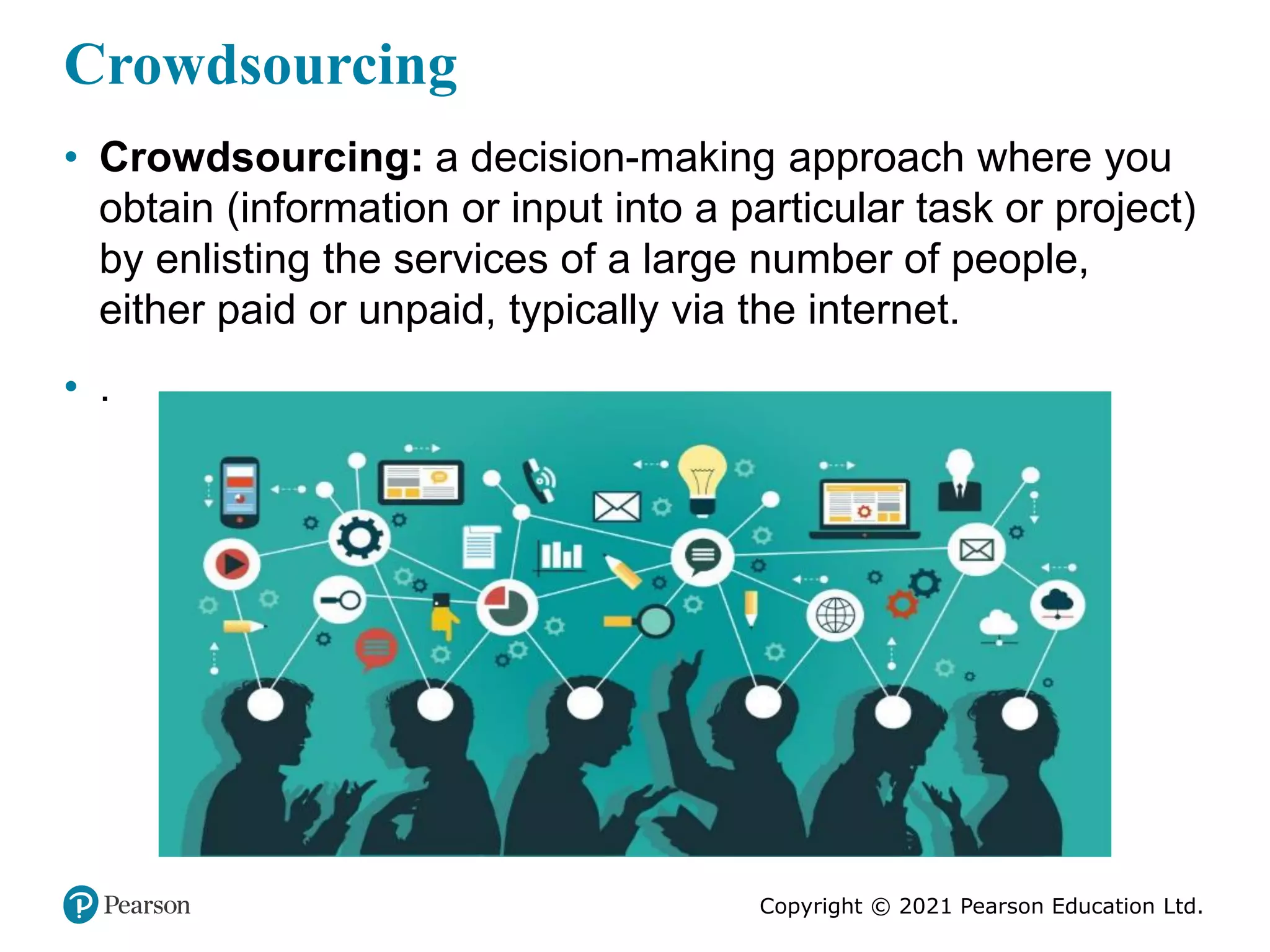
Crowdsourcing
• Crowdsourcing: a decision-making approach where you
obtain (information or input into a particular task or project)
by enlisting the services of a large number of people,
either paid or unpaid, typically via the internet.
• .
Copyright © 2021 Pearson Education Ltd.
Types of Decisions: Structured Problems
and Programmed Decisions
• Structured problems: straightforward, familiar, and easily
defined problems
• Programmed decisions: repetitive decisions that can be
handled by a routine approach
Copyright © 2021 Pearson Education Ltd.
Types of Programmed Decisions
• Procedure: a series of sequential steps used to respond
to a well-structured problem
• Rule: an explicit statement that tells managers what can or
cannot be done
• Policy: a guideline for making decisions
Copyright © 2021 Pearson Education Ltd.
Types of Decisions: Unstructured Problems
and Nonprogrammed Decisions
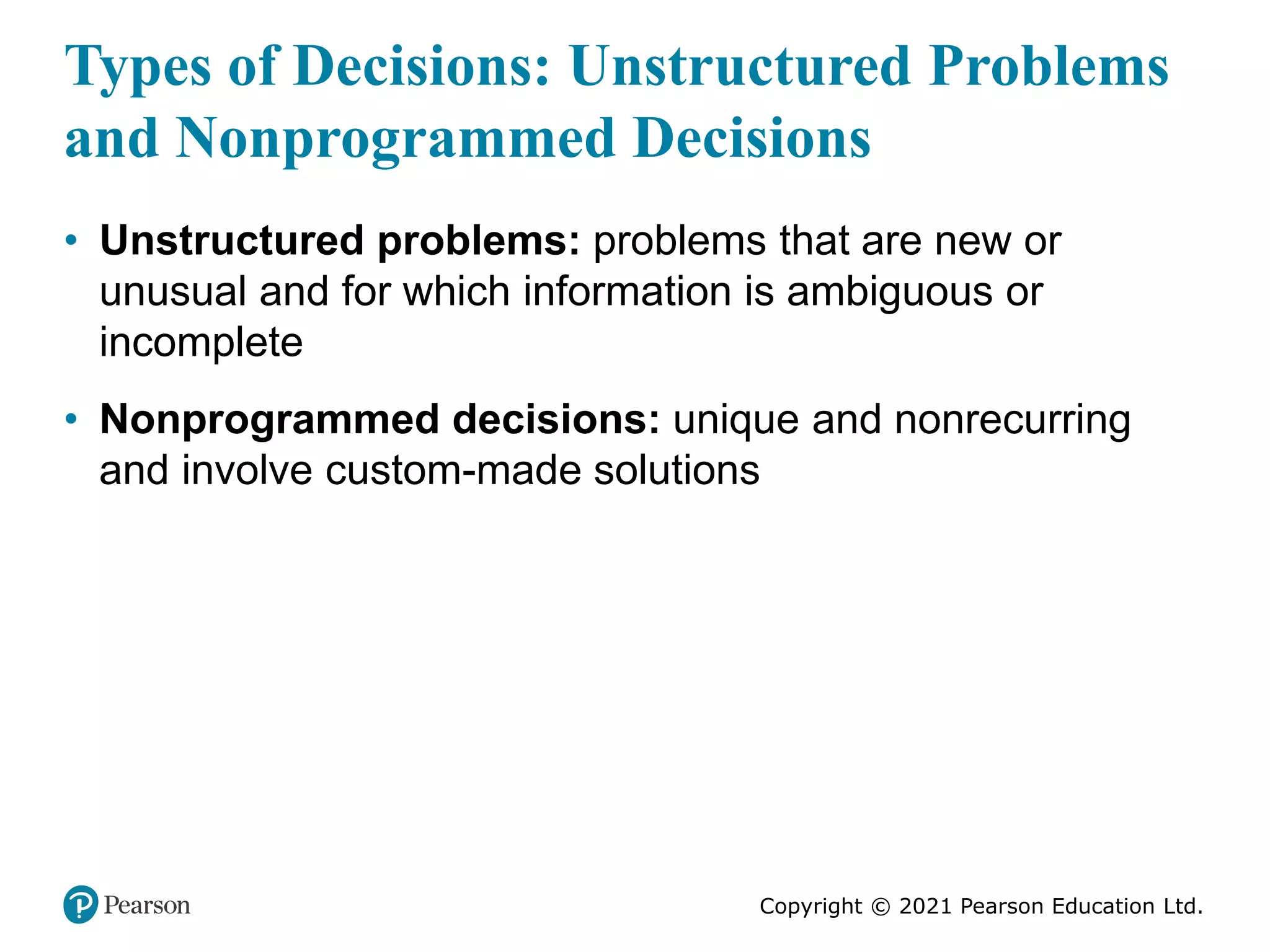
• Unstructured problems: problems that are new or
unusual and for which information is ambiguous or
incomplete
• Nonprogrammed decisions: unique and nonrecurring
and involve custom-made solutions
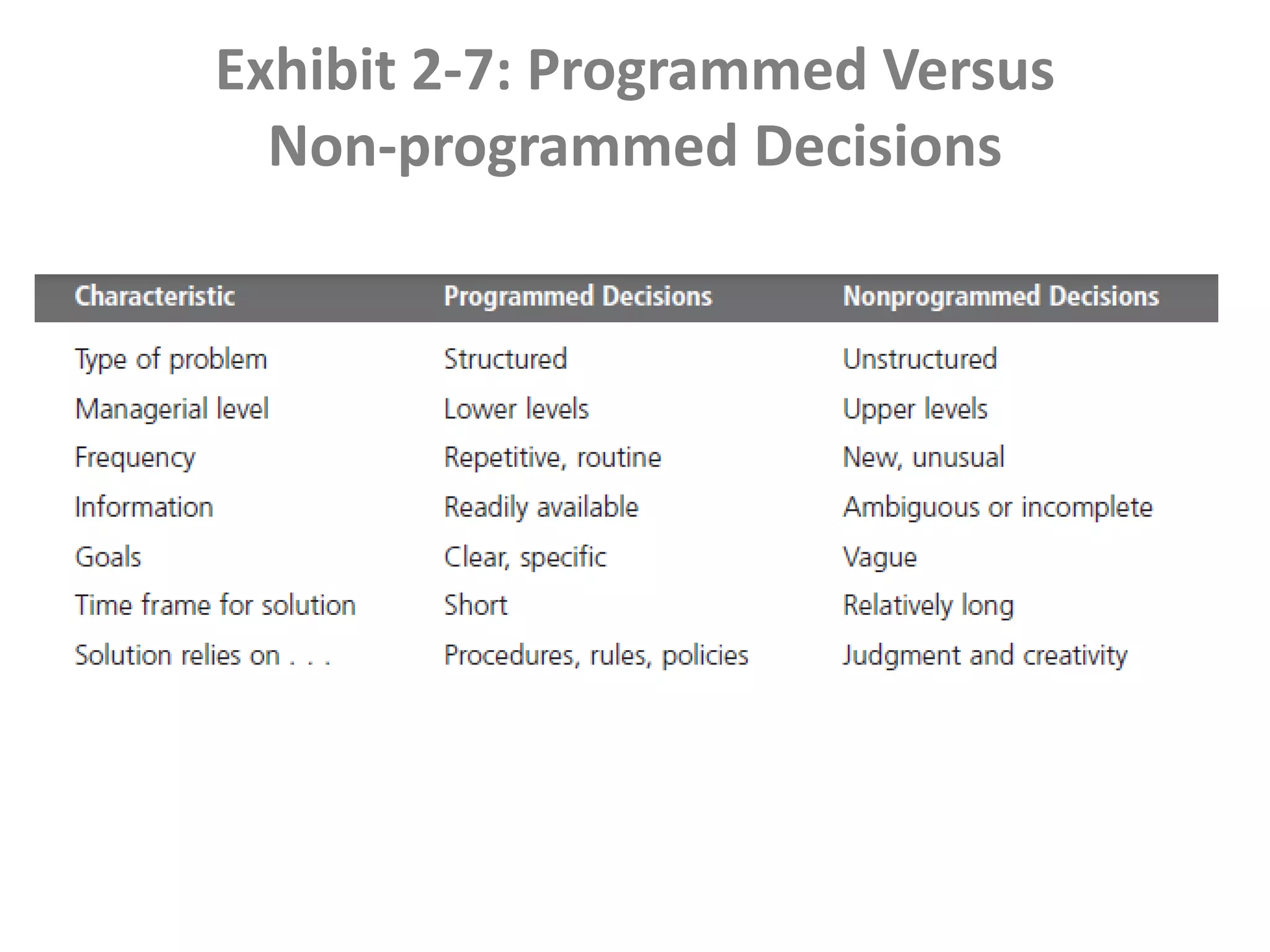
Exhibit 2-7: Programmed Versus
Non-programmed Decisions
Copyright © 2021 Pearson Education Ltd.
Copyright ©2011 Pearson Education, Inc.
publishing as Prentice Hall
Copyright © 2021 Pearson Education Ltd.
Decision-Making Styles
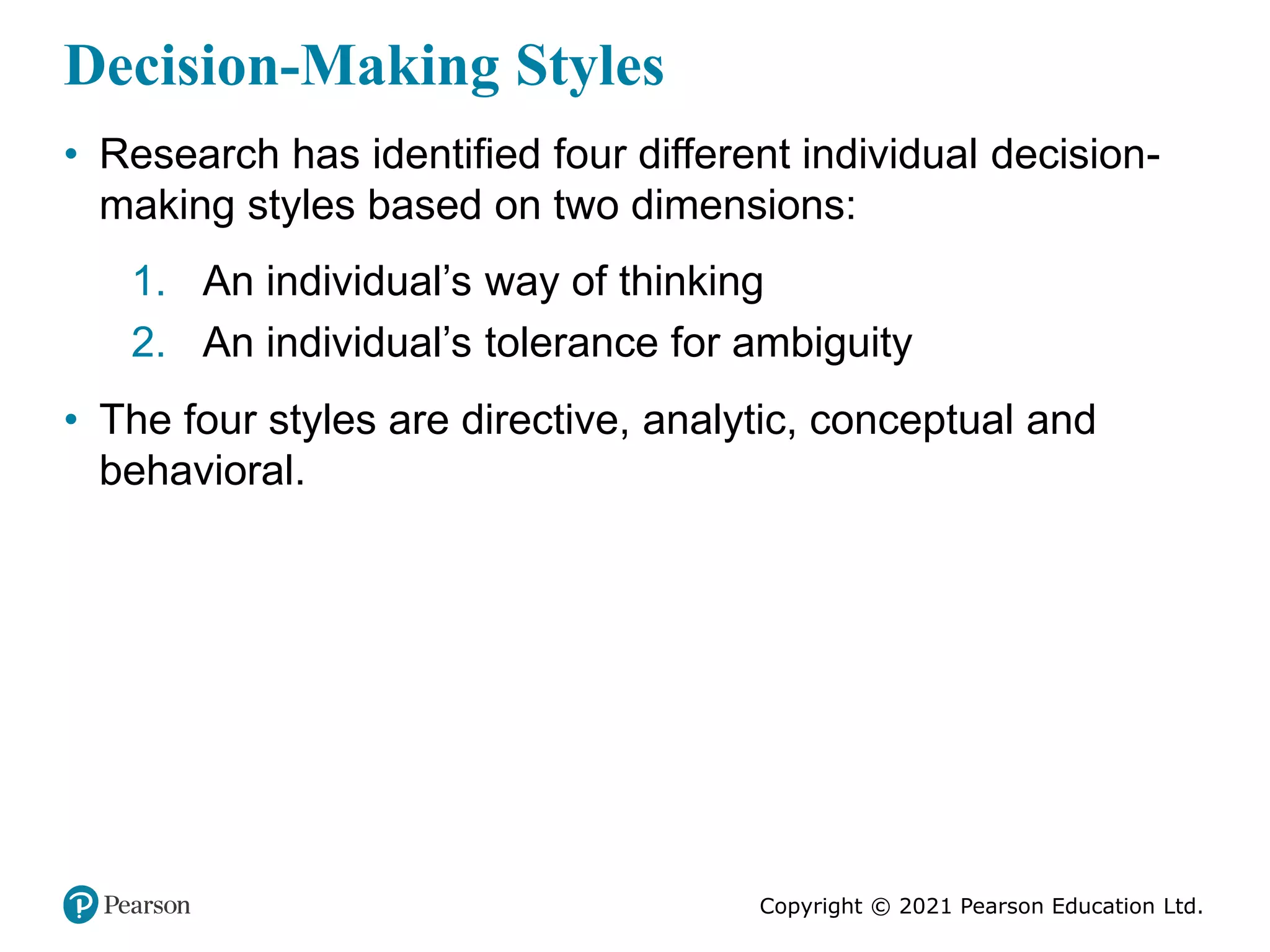
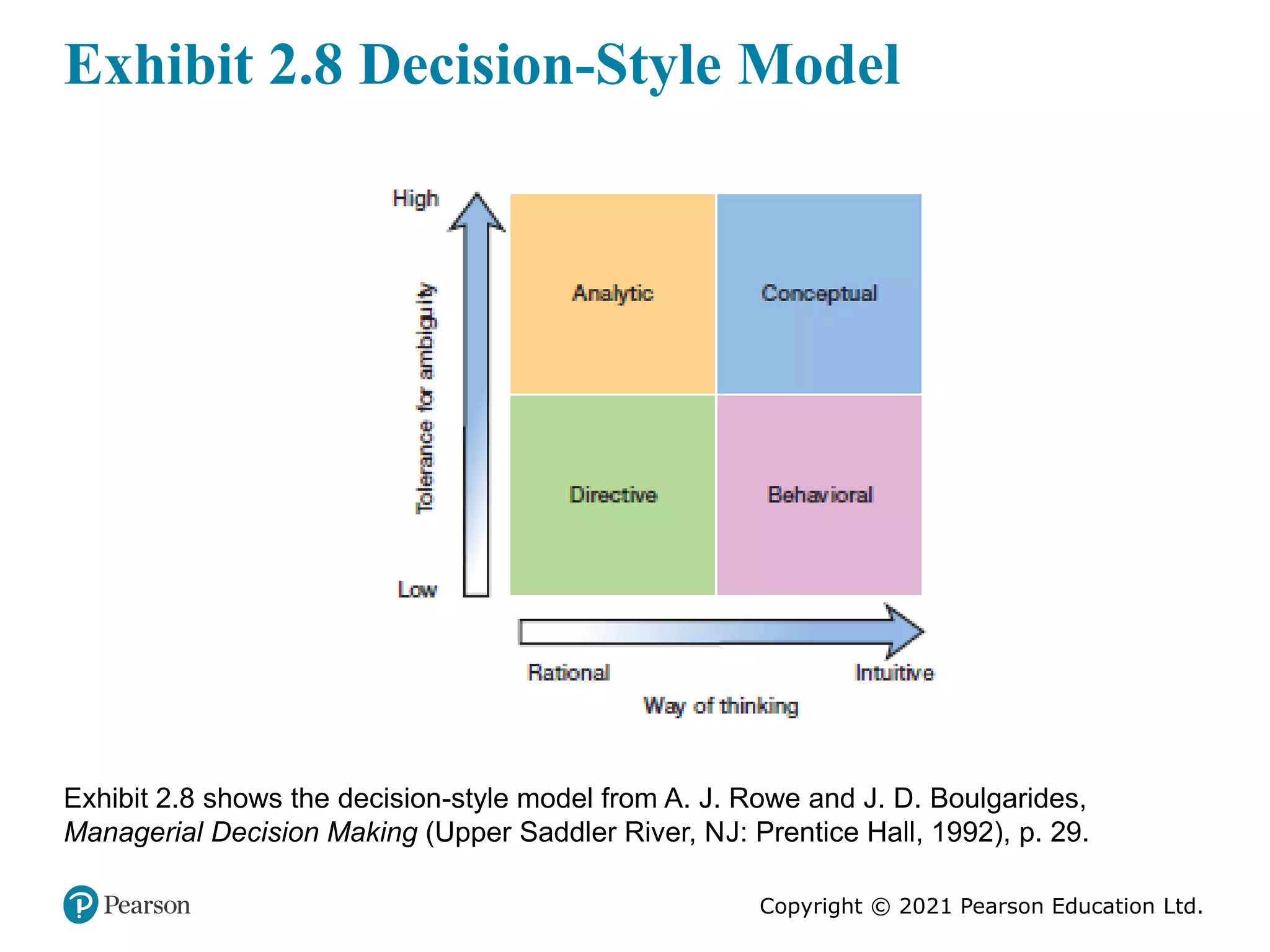
• Research has identified four different individual decision-
making styles based on two dimensions:
1. An individual’s way of thinking
2. An individual’s tolerance for ambiguity
• The four styles are directive, analytic, conceptual and
behavioral.
Copyright © 2021 Pearson Education Ltd.
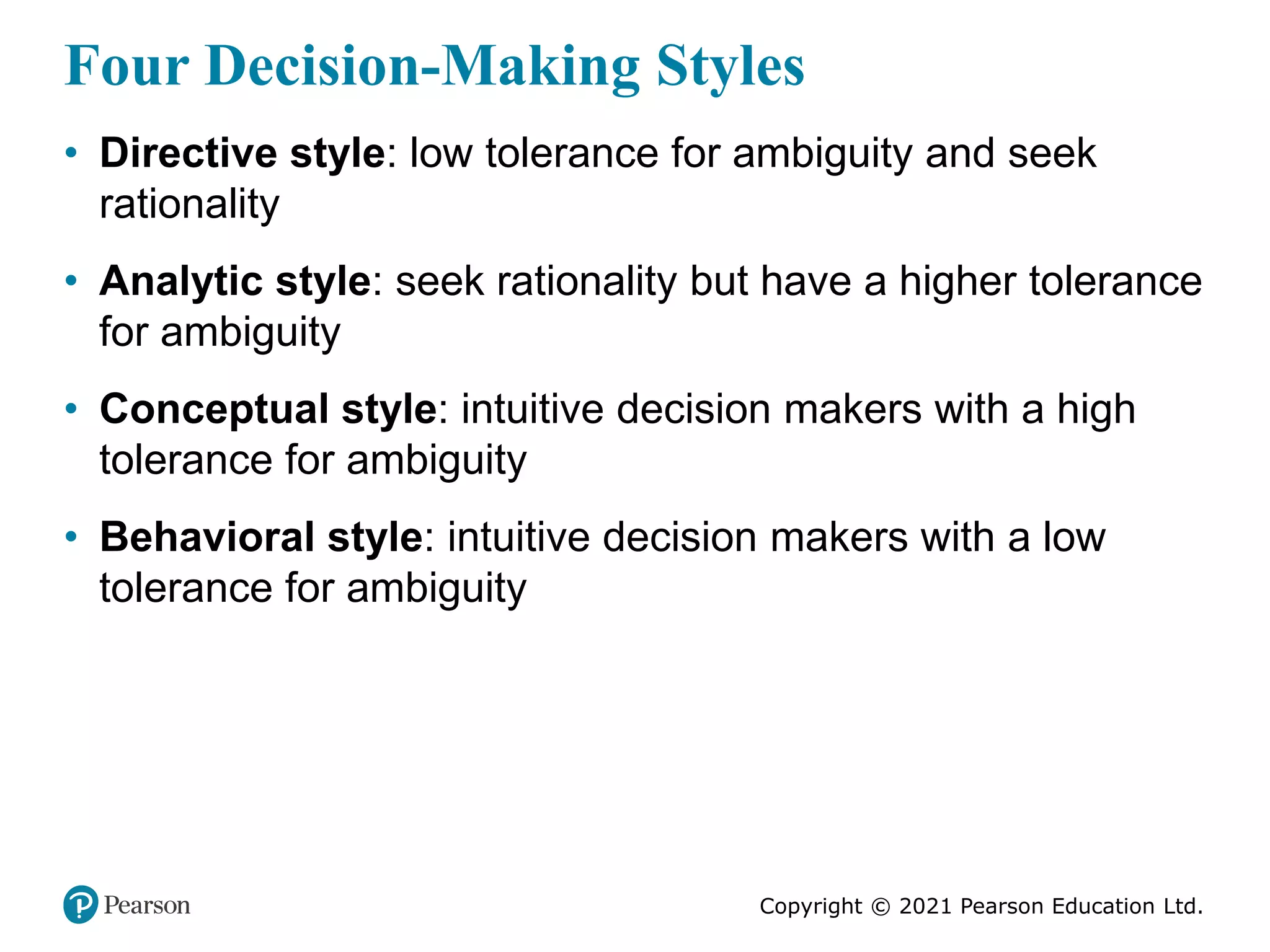
Four Decision-Making Styles
• Directive style: low tolerance for ambiguity and seek
rationality
• Analytic style: seek rationality but have a higher tolerance
for ambiguity
• Conceptual style: intuitive decision makers with a high
tolerance for ambiguity
• Behavioral style: intuitive decision makers with a low
tolerance for ambiguity
Copyright © 2021 Pearson Education Ltd.
Exhibit 2.8 Decision-Style Model
Exhibit 2.8 shows the decision-style model from A. J. Rowe and J. D. Boulgarides,
Managerial Decision Making (Upper Saddler River, NJ: Prentice Hall, 1992), p. 29.
Copyright © 2021 Pearson Education Ltd.
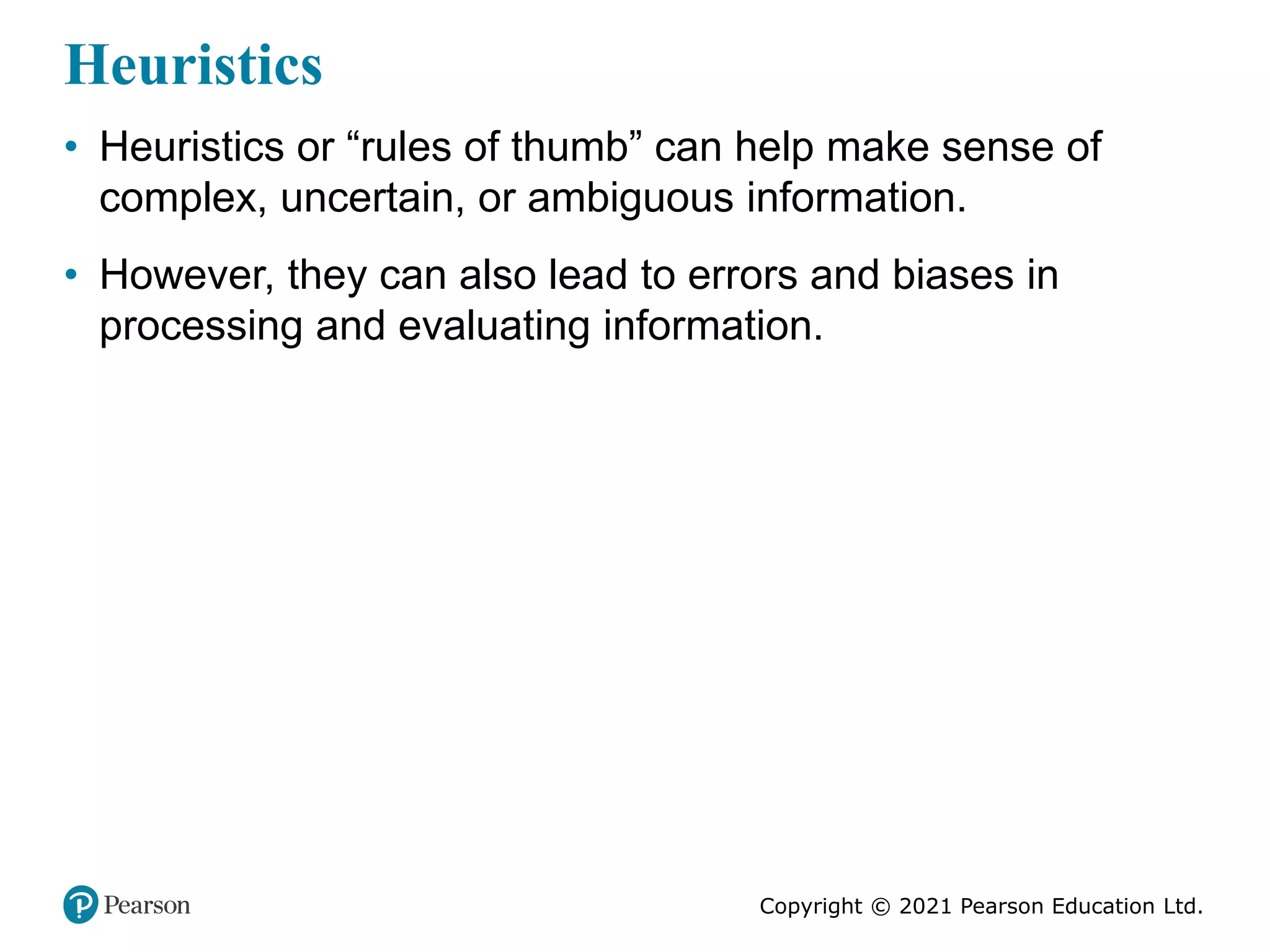
Heuristics
• Heuristics or “rules of thumb” can help make sense of
complex, uncertain, or ambiguous information.
• However, they can also lead to errors and biases in
processing and evaluating information.
Copyright © 2021 Pearson Education Ltd.
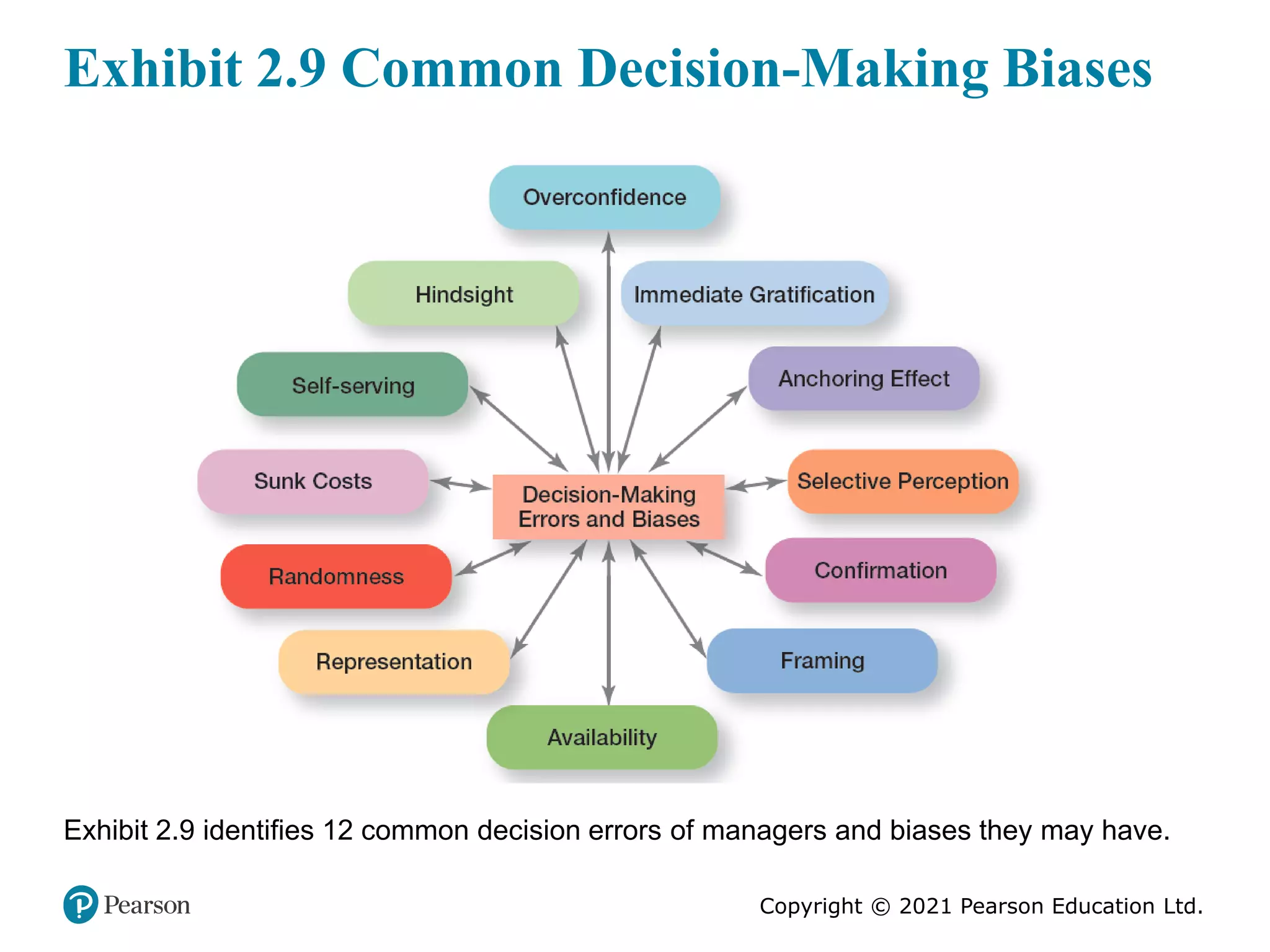
Exhibit 2.9 Common Decision-Making Biases
Exhibit 2.9 identifies 12 common decision errors of managers and biases they may have.
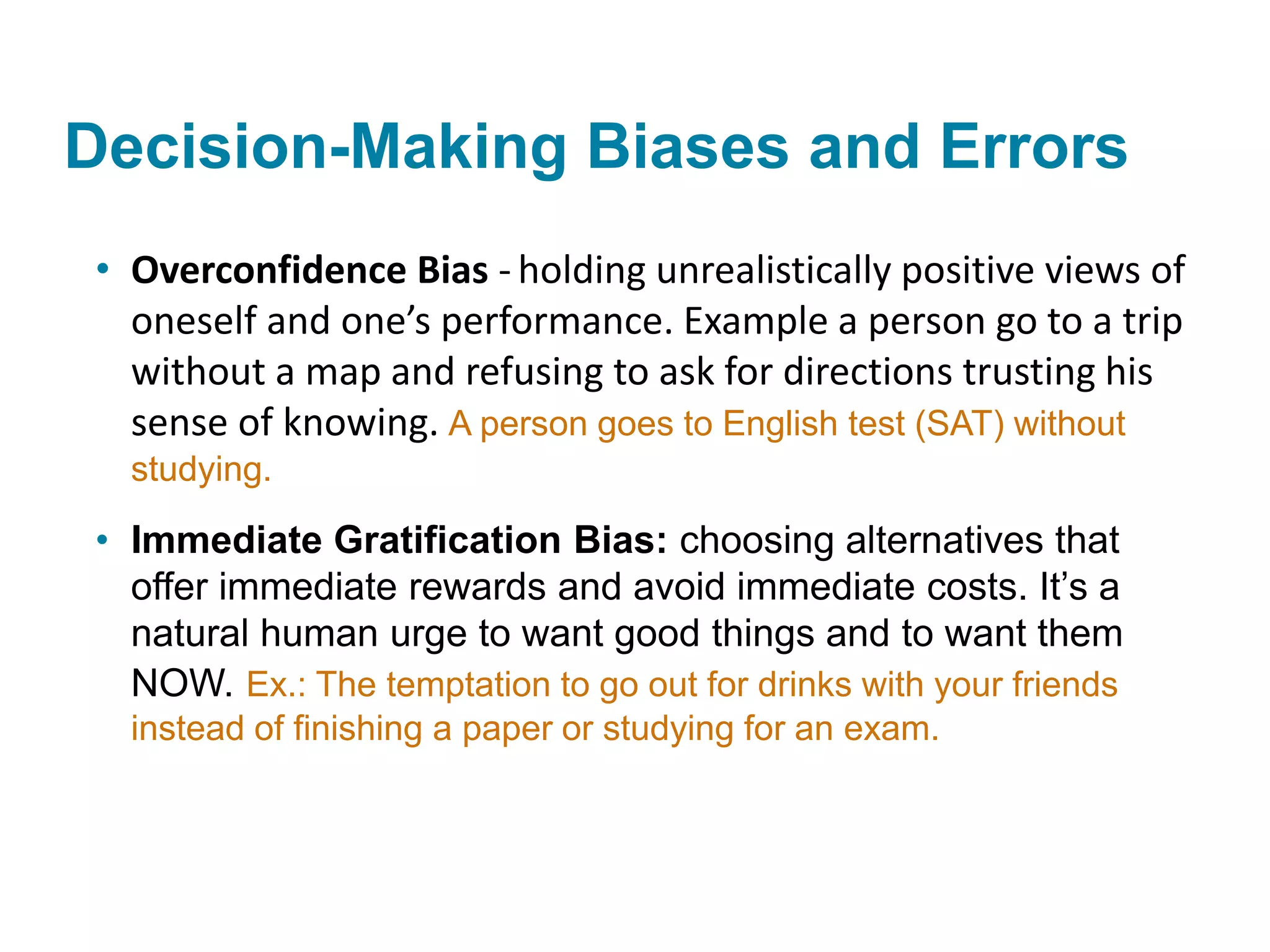
Decision-Making Biases and Errors
• Overconfidence Bias - holding unrealistically positive views of
oneself and one’s performance. Example a person go to a trip
without a map and refusing to ask for directions trusting his
sense of knowing. A person goes to English test (SAT) without
studying.
• Immediate Gratification Bias: choosing alternatives that
offer immediate rewards and avoid immediate costs. It’s a
natural human urge to want good things and to want them
NOW. Ex.: The temptation to go out for drinks with your friends
instead of finishing a paper or studying for an exam.
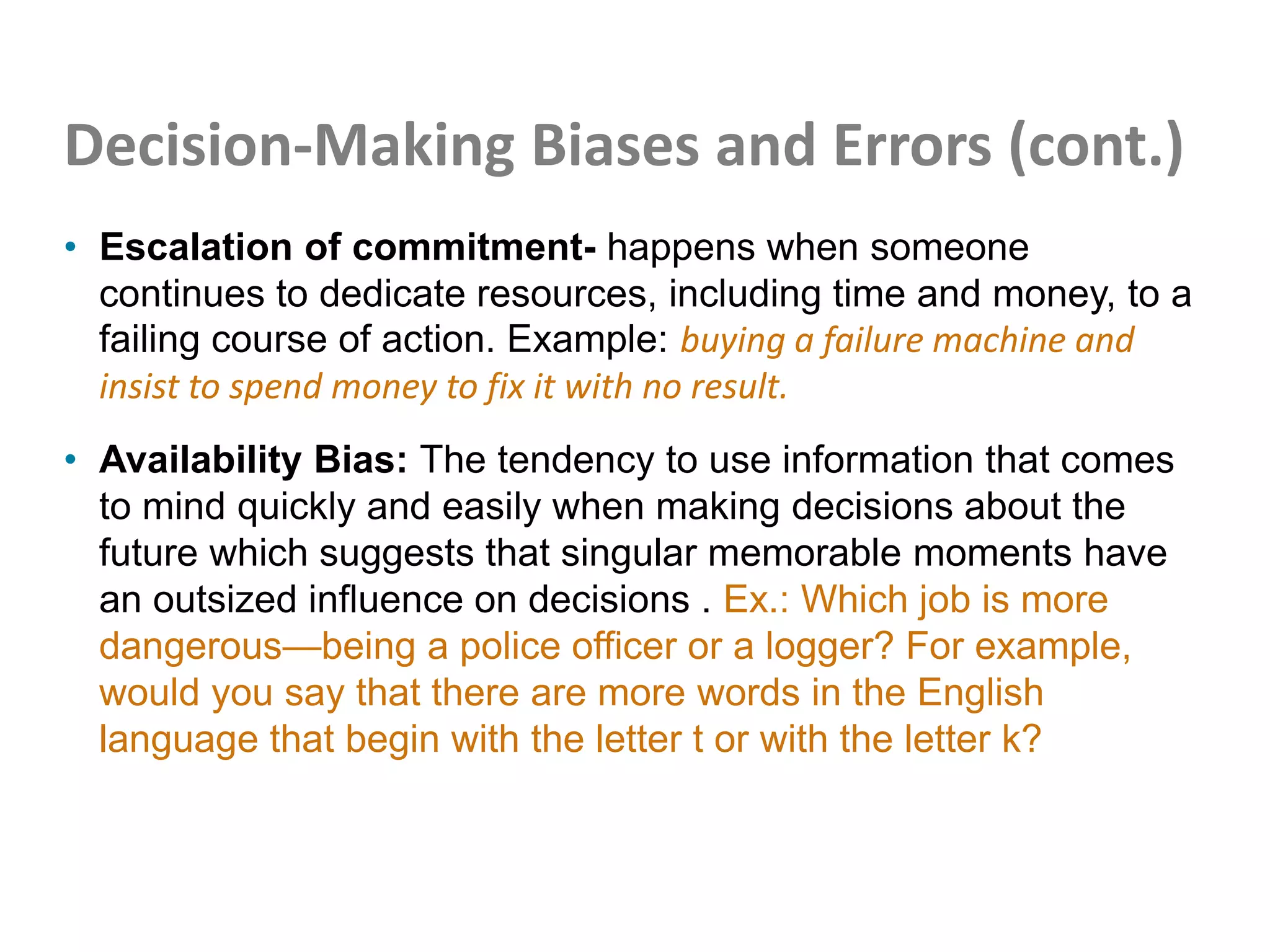
Decision-Making Biases and Errors (cont.)
• Escalation of commitment- happens when someone
continues to dedicate resources, including time and money, to a
failing course of action. Example: buying a failure machine and
insist to spend money to fix it with no result.
• Availability Bias: The tendency to use information that comes
to mind quickly and easily when making decisions about the
future which suggests that singular memorable moments have
an outsized influence on decisions . Ex.: Which job is more
dangerous—being a police officer or a logger? For example,
would you say that there are more words in the English
language that begin with the letter t or with the letter k?
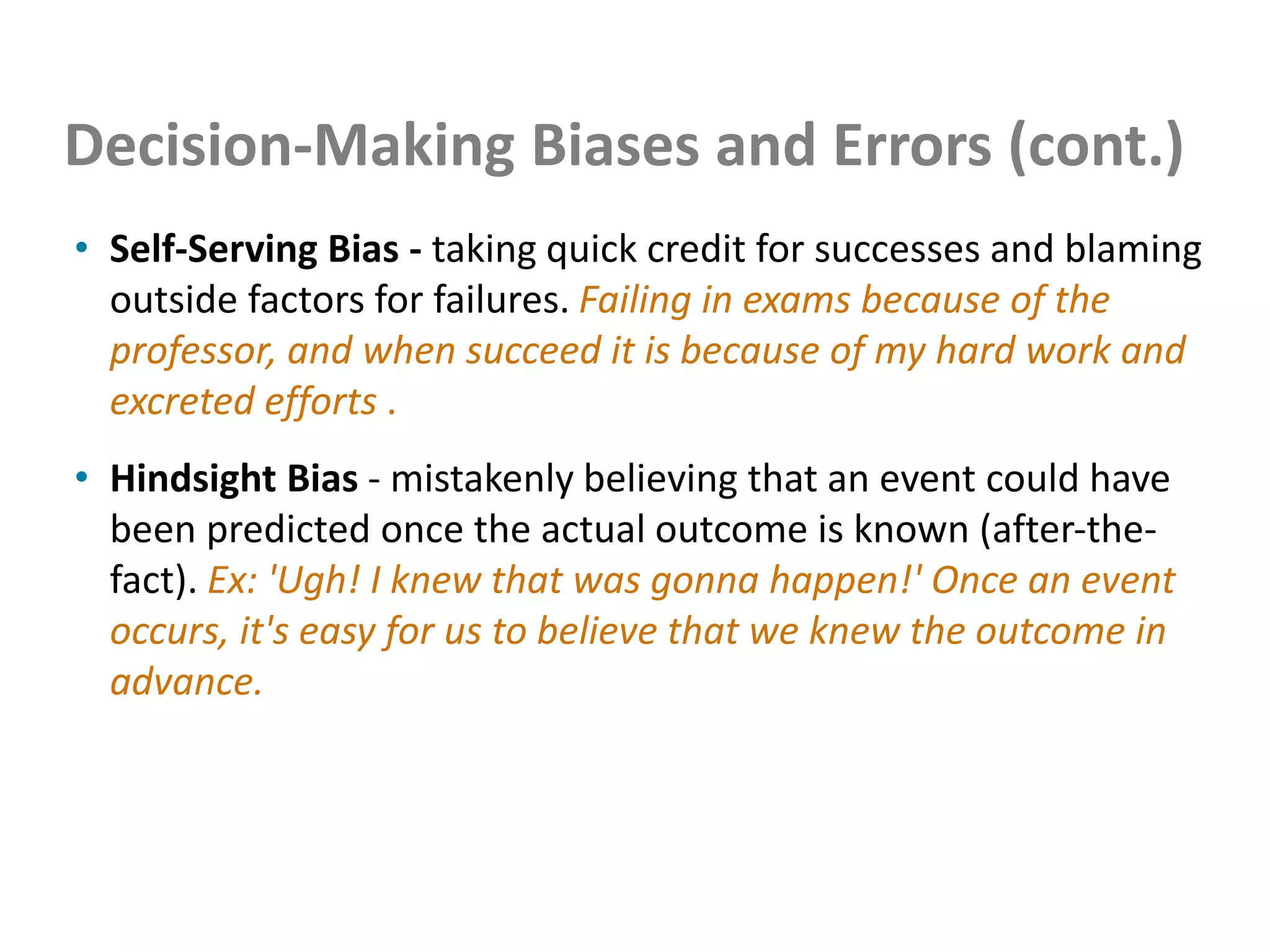
Decision-Making Biases and Errors (cont.)
• Self-Serving Bias - taking quick credit for successes and blaming
outside factors for failures. Failing in exams because of the
professor, and when succeed it is because of my hard work and
excreted efforts .
• Hindsight Bias - mistakenly believing that an event could have
been predicted once the actual outcome is known (after-the-
fact). Ex: 'Ugh! I knew that was gonna happen!' Once an event
occurs, it's easy for us to believe that we knew the outcome in
advance.
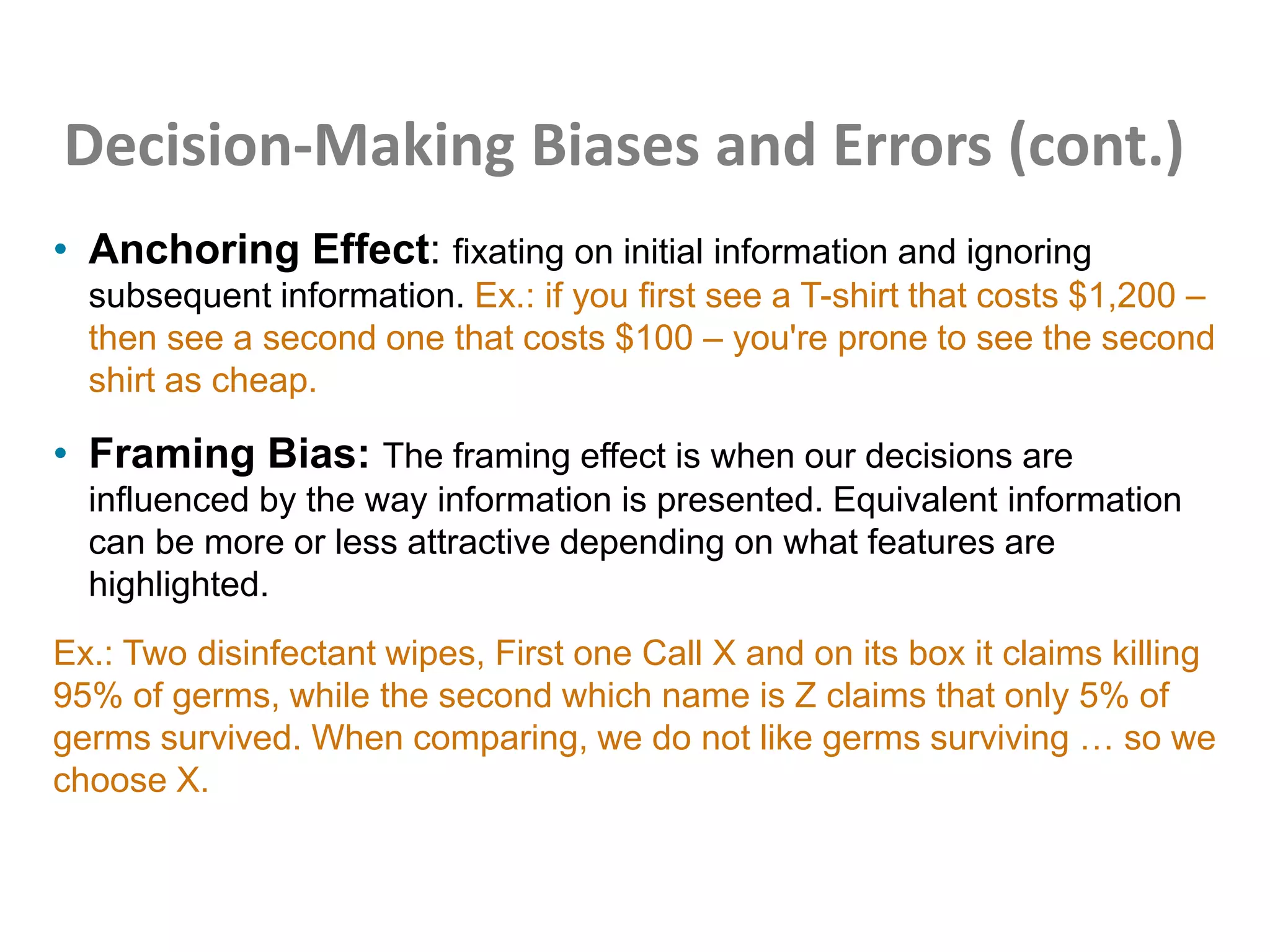
Decision-Making Biases and Errors (cont.)
• Anchoring Effect: fixating on initial information and ignoring
subsequent information. Ex.: if you first see a T-shirt that costs $1,200 –
then see a second one that costs $100 – you're prone to see the second
shirt as cheap.
• Framing Bias: The framing effect is when our decisions are
influenced by the way information is presented. Equivalent information
can be more or less attractive depending on what features are
highlighted.
Ex.: Two disinfectant wipes, First one Call X and on its box it claims killing
95% of germs, while the second which name is Z claims that only 5% of
germs survived. When comparing, we do not like germs surviving … so we
choose X.
Decision Making for Today’s World
• Guidelines for making effective decisions:
– Recognize and identify the situation that demands a
decision. ...
– Brainstorm lots of ideas. ...
– Gather as many facts and as much information as
possible. ...
– Think and plan ahead. ...
– Make a choice and take action. ...
– Evaluate the decision.
– Understand cultural differences
What will you do if you are the manager?
• You are a manager in a large commercial bank. You
discover that Monica, a loan officer who reports to you,
has forged an approval signature on a customer loan,
which requires signatures from two loan officers. When
you confront Monica with the forgery, she apologizes
profusely and says that her husband has been very ill.
The day she forged the signature, he was going into
surgery and she just did not have time to find another
loan officer to sign the authorization for the loan.
Monica has been with your bank for 15 years and has a
spotless record.
1-36
Case Answer
• This real case resulted in termination and caused a lot
of angst for the manager who had to do the firing. But,
this kind of behavior simply cannot be tolerated in a
financial institution. Forgery is one of the biggest "sins"
an employee can commit in a company, especially a
financial firm. Appeals would get an employee nowhere
in a situation like this one. Patricia could have avoided
the debacle by asking for help. If she had admitted to
her manager that she could not get the other signature,
he or she could have helped her. It is a sad case, but
there is really no excuse for her behavior.
1-37
REVIEW QUESTIONS
Copyright © 2021 Pearson Education Ltd.
Exercises –True or False
Copyright ©2011 Pearson Education
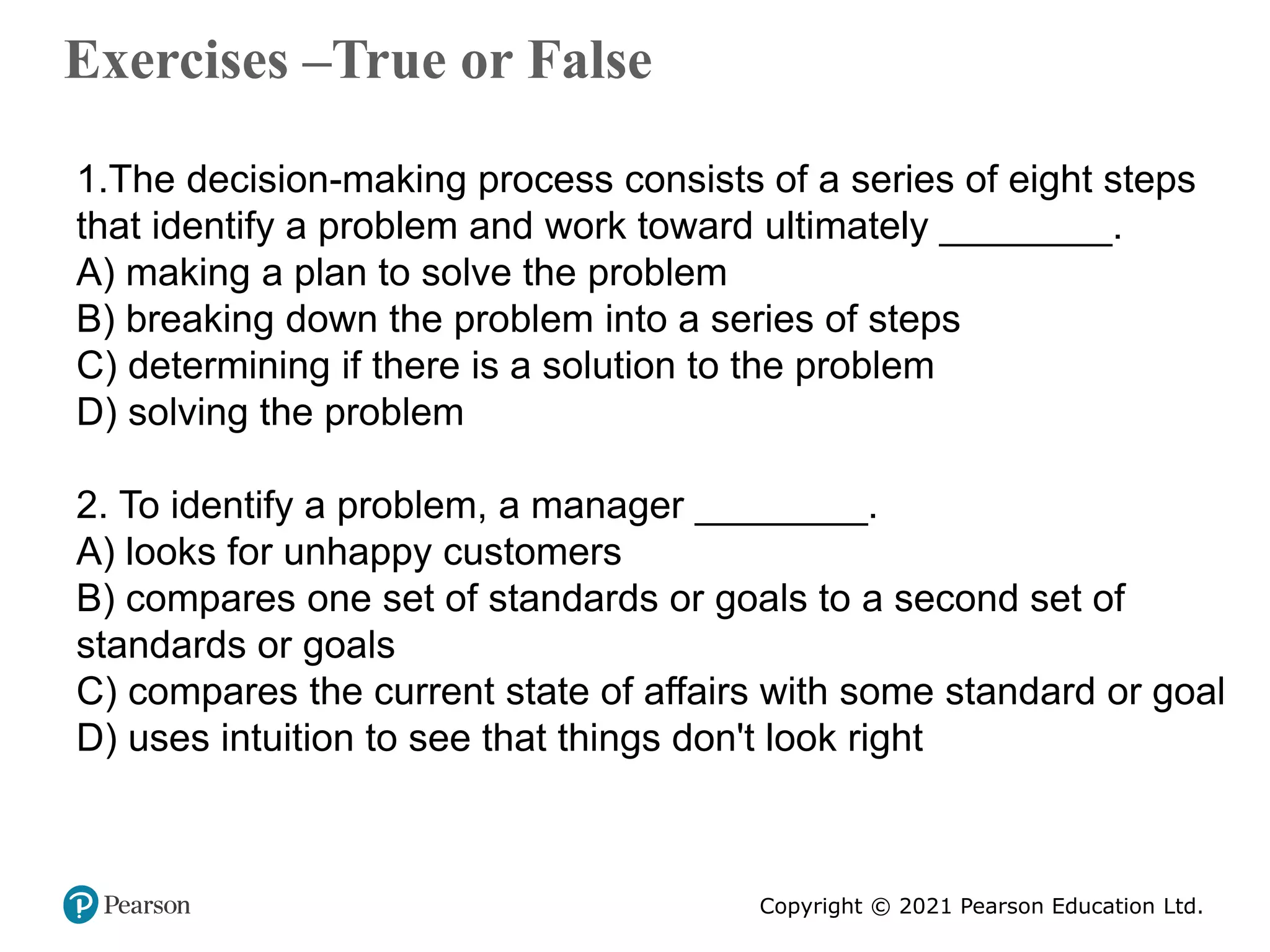
1.The decision-making process consists of a series of eight steps
that identify a problem and work toward ultimately ________.
A) making a plan to solve the problem
B) breaking down the problem into a series of steps
C) determining if there is a solution to the problem
D) solving the problem
2. To identify a problem, a manager ________.
A) looks for unhappy customers
B) compares one set of standards or goals to a second set of
standards or goals
C) compares the current state of affairs with some standard or goal
D) uses intuition to see that things don't look right
Copyright © 2021 Pearson Education Ltd.
Exercises –True or False
Copyright ©2011 Pearson Education
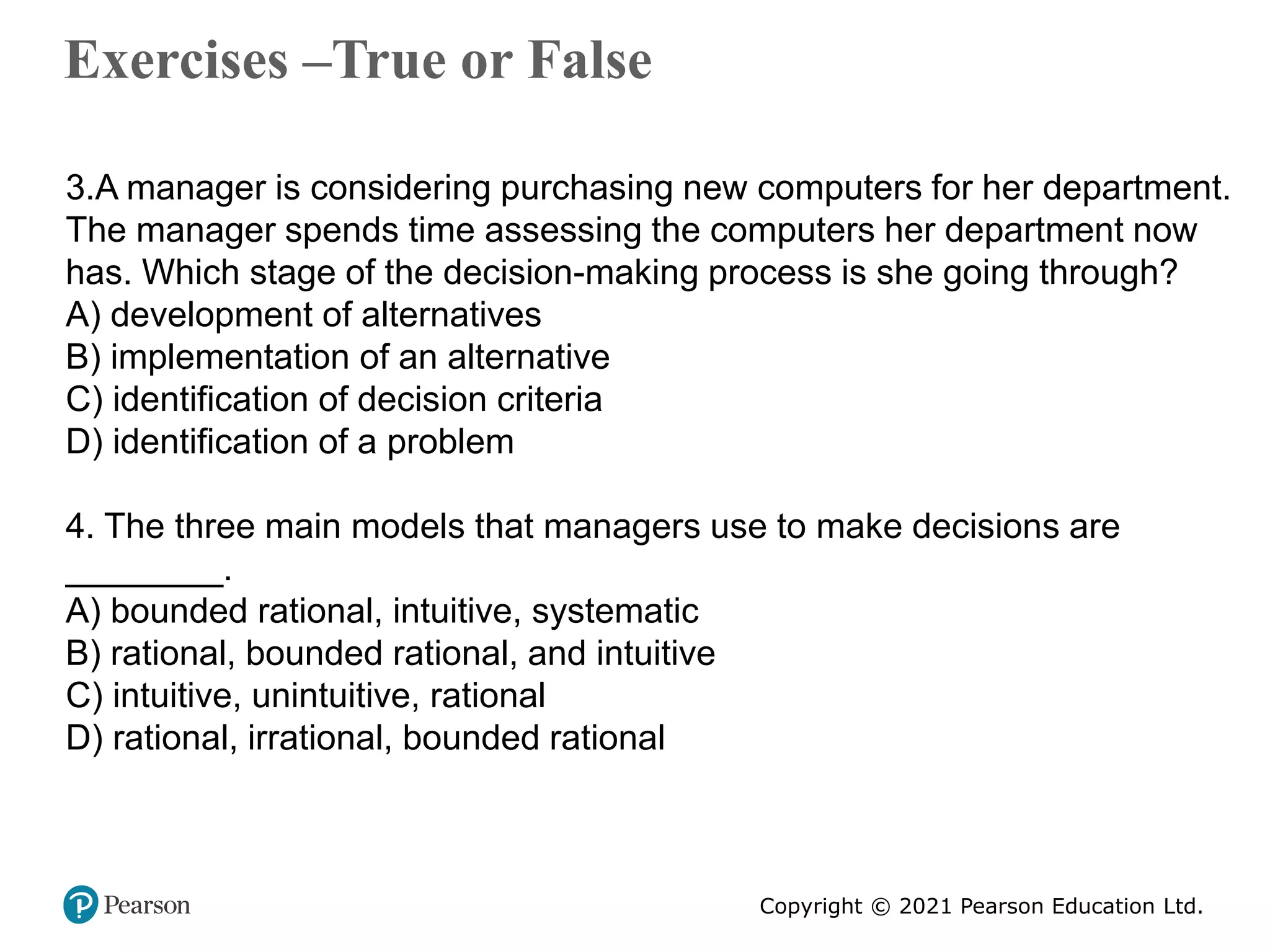
3.A manager is considering purchasing new computers for her department.
The manager spends time assessing the computers her department now
has. Which stage of the decision-making process is she going through?
A) development of alternatives
B) implementation of an alternative
C) identification of decision criteria
D) identification of a problem
4. The three main models that managers use to make decisions are
________.
A) bounded rational, intuitive, systematic
B) rational, bounded rational, and intuitive
C) intuitive, unintuitive, rational
D) rational, irrational, bounded rational
Copyright © 2021 Pearson Education Ltd.
Exercises –True or False
Copyright ©2011 Pearson Education
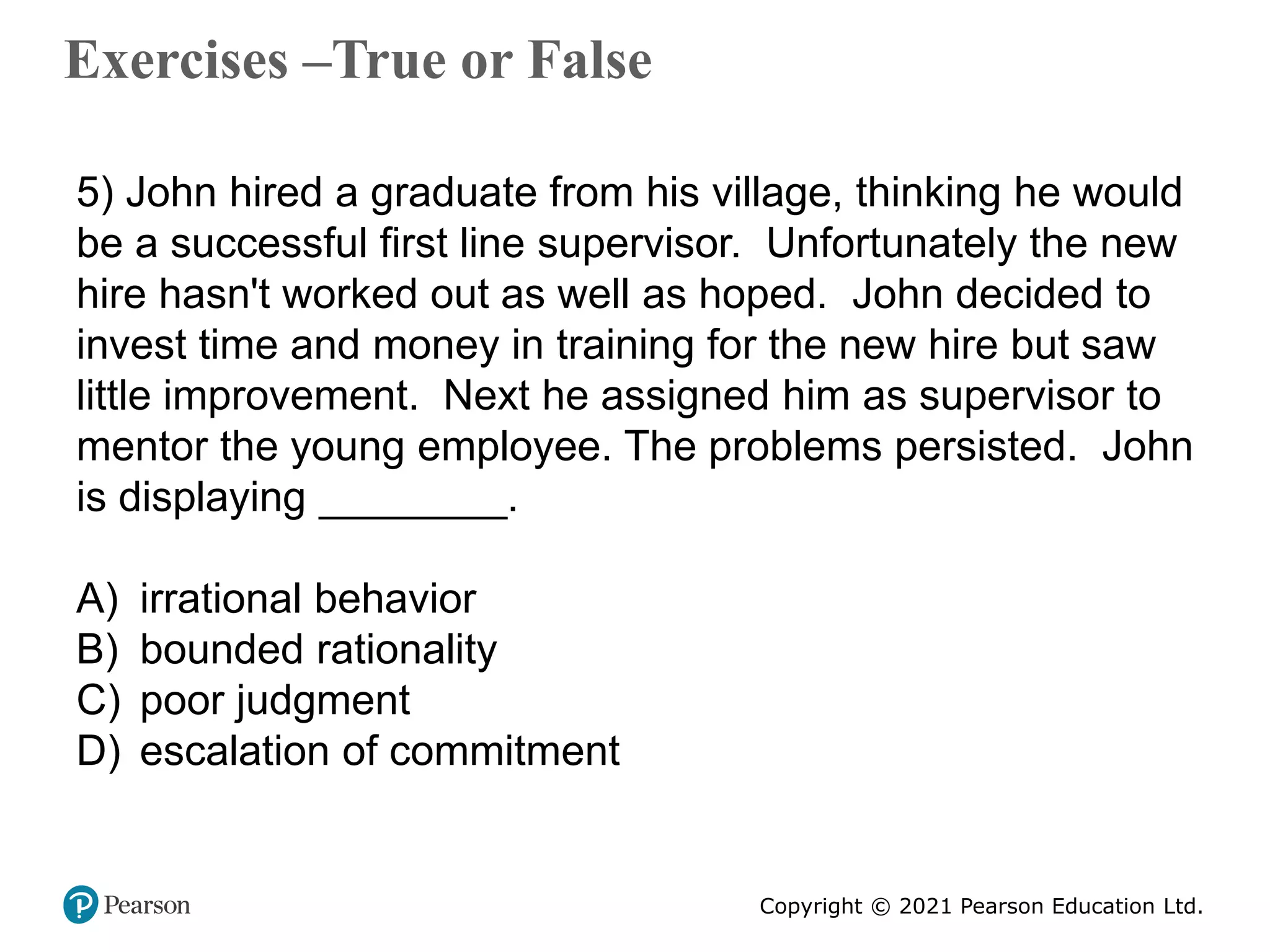
5) John hired a graduate from his village, thinking he would
be a successful first line supervisor. Unfortunately the new
hire hasn't worked out as well as hoped. John decided to
invest time and money in training for the new hire but saw
little improvement. Next he assigned him as supervisor to
mentor the young employee. The problems persisted. John
is displaying ________.
A) irrational behavior
B) bounded rationality
C) poor judgment
D) escalation of commitment
Copyright © 2021 Pearson Education Ltd.
Exercises –True or False
Copyright ©2011 Pearson Education
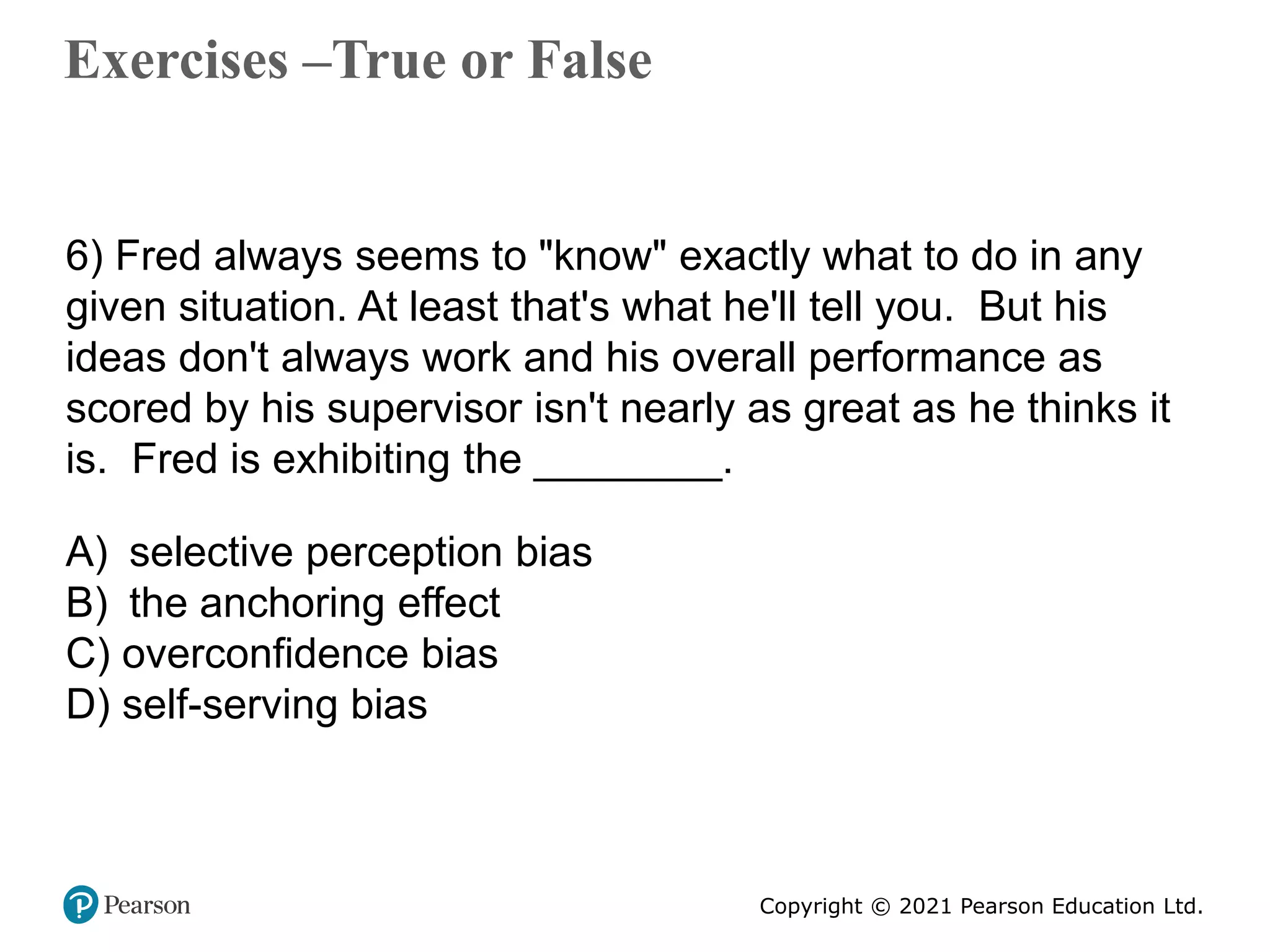
6) Fred always seems to "know" exactly what to do in any
given situation. At least that's what he'll tell you. But his
ideas don't always work and his overall performance as
scored by his supervisor isn't nearly as great as he thinks it
is. Fred is exhibiting the ________.
A) selective perception bias
B) the anchoring effect
C) overconfidence bias
D) self-serving bias
Copyright © 2021 Pearson Education Ltd.
Exercises –True or False
Copyright ©2011 Pearson Education
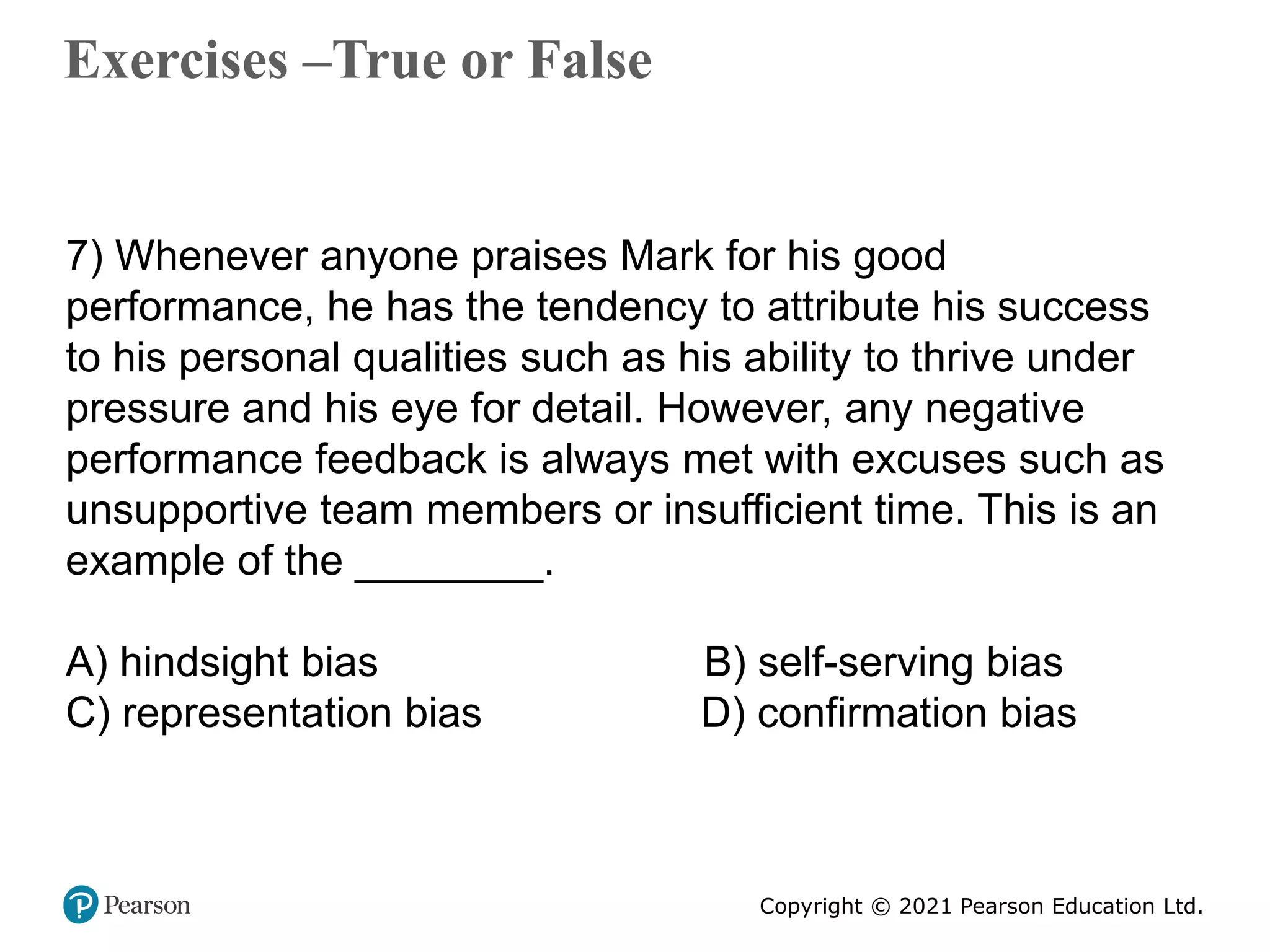
7) Whenever anyone praises Mark for his good
performance, he has the tendency to attribute his success
to his personal qualities such as his ability to thrive under
pressure and his eye for detail. However, any negative
performance feedback is always met with excuses such as
unsupportive team members or insufficient time. This is an
example of the ________.
A) hindsight bias B) self-serving bias
C) representation bias D) confirmation bias
Copyright © 2021 Pearson Education Ltd.
Exercises –True or False
Copyright ©2011 Pearson Education
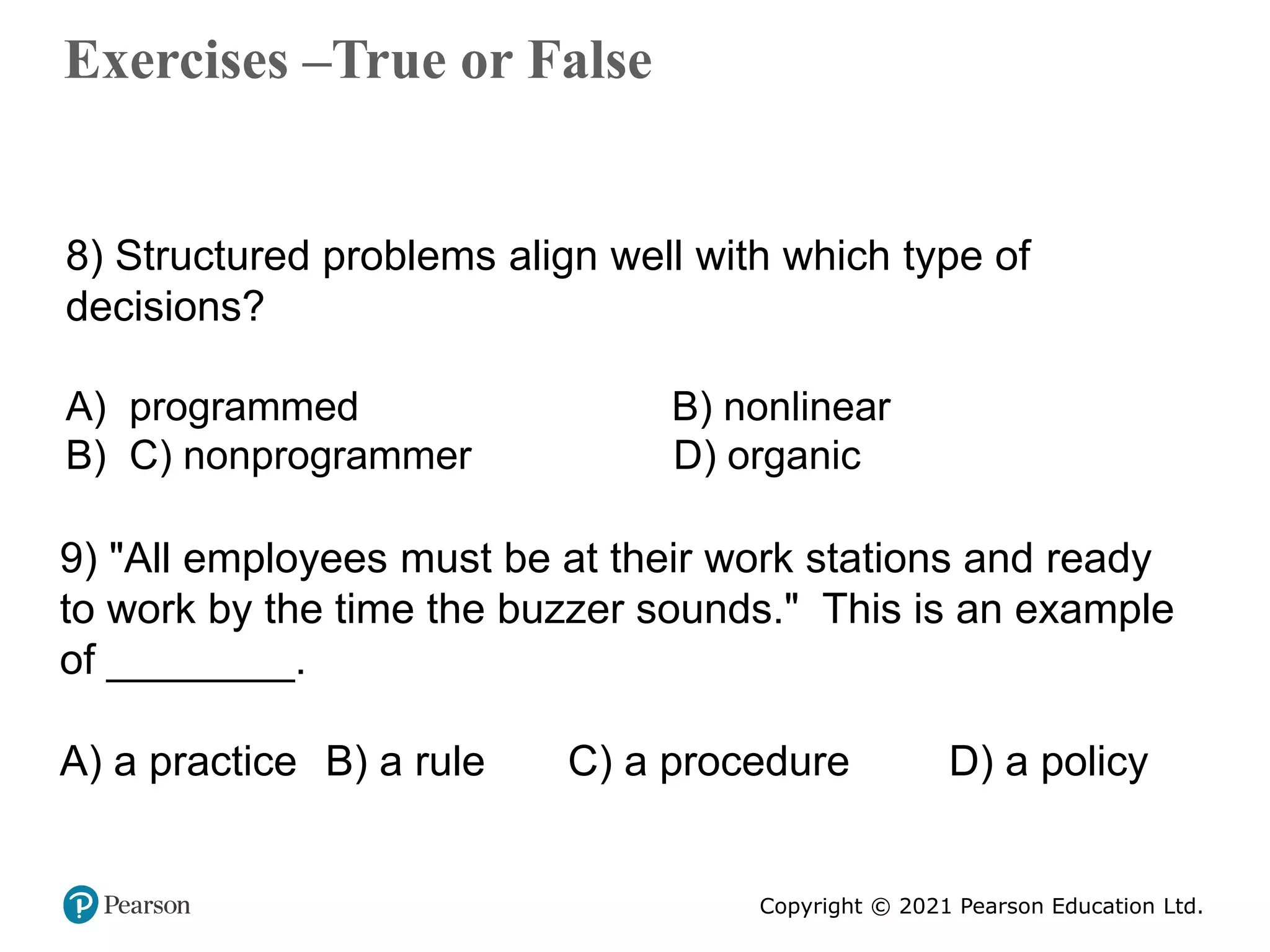
8) Structured problems align well with which type of
decisions?
A) programmed B) nonlinear
B) C) nonprogrammer D) organic
9) "All employees must be at their work stations and ready
to work by the time the buzzer sounds." This is an example
of ________.
A) a practice B) a rule C) a procedure D) a policy
Copyright © 2021 Pearson Education Ltd.
Exercises –True or False
Copyright ©2011 Pearson Education
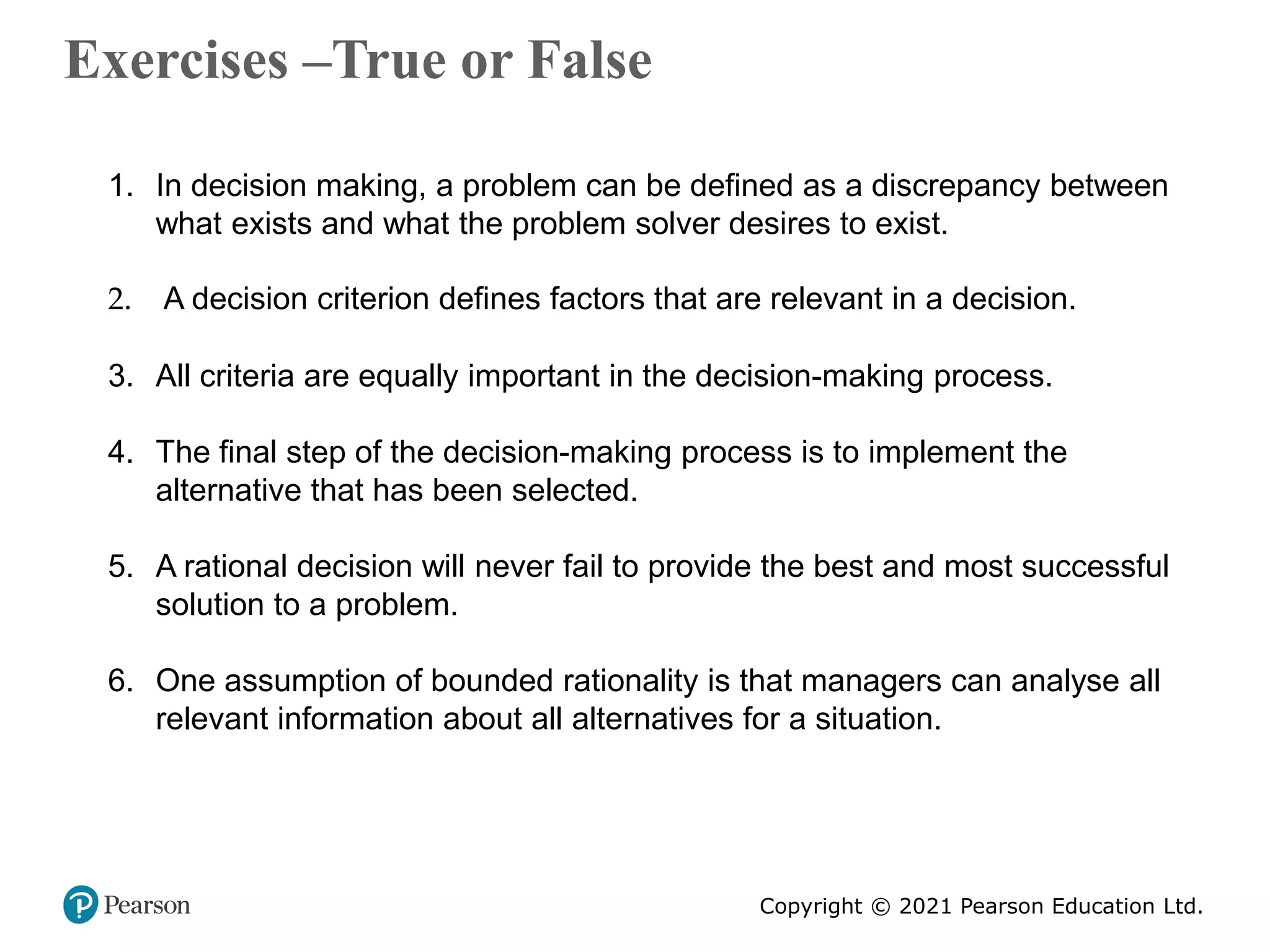
1. In decision making, a problem can be defined as a discrepancy between
what exists and what the problem solver desires to exist.
2. A decision criterion defines factors that are relevant in a decision.
3. All criteria are equally important in the decision-making process.
4. The final step of the decision-making process is to implement the
alternative that has been selected.
5. A rational decision will never fail to provide the best and most successful
solution to a problem.
6. One assumption of bounded rationality is that managers can analyse all
relevant information about all alternatives for a situation.
Copyright © 2021 Pearson Education Ltd.
Exercises –True or False
Copyright ©2011 Pearson Education
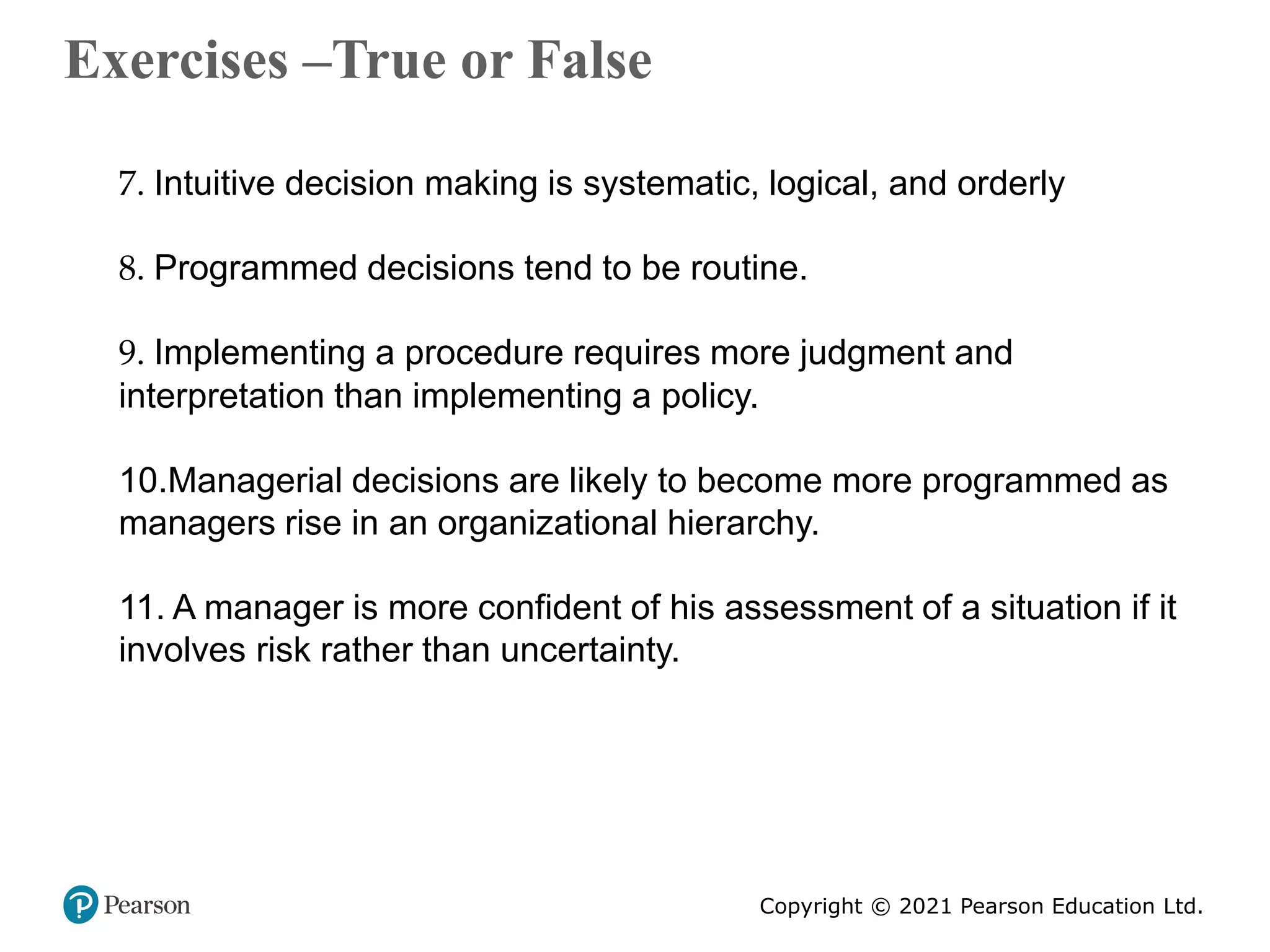
7. Intuitive decision making is systematic, logical, and orderly
8. Programmed decisions tend to be routine.
9. Implementing a procedure requires more judgment and
interpretation than implementing a policy.
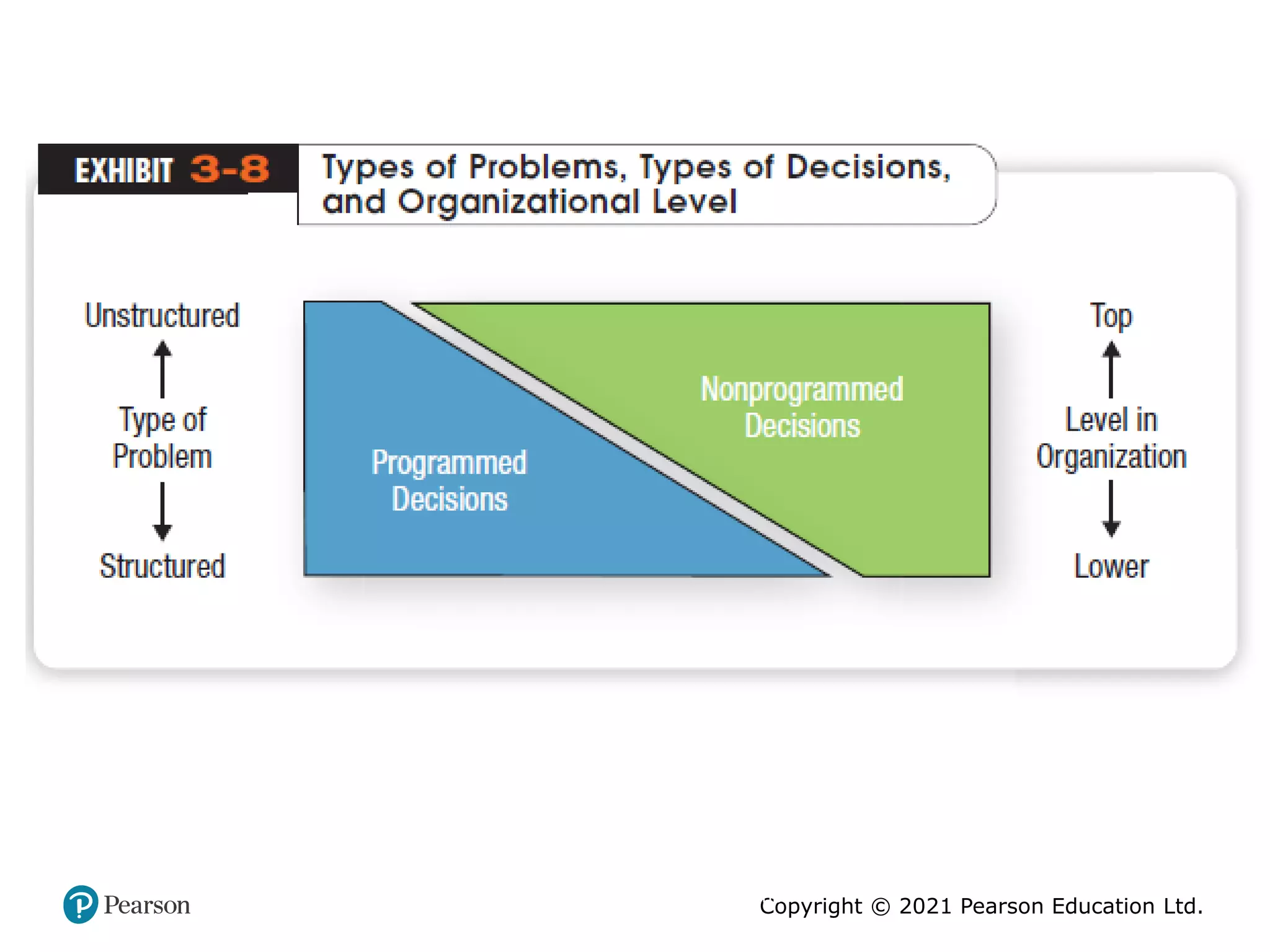
10.Managerial decisions are likely to become more programmed as
managers rise in an organizational hierarchy.
11. A manager is more confident of his assessment of a situation if it
involves risk rather than uncertainty.

4- Making Decisions ch2.pdf

  • 1.
    Management Fifteenth Edition, GlobalEdition Chapter 2 Making Decisions Copyright © 2021 Pearson Education Ltd.
  • 2.
    Copyright © 2021Pearson Education Ltd. Learning Objectives 2.1 Describe the eight steps in the decision-making process. 2.2 Explain the five approaches managers can use when making decisions. 2.3 Classify decisions and decision-making styles. 2.4 Describe how biases affect decision making. 2.5 Identify cutting-edge approaches for improving decision making.
  • 3.
    Copyright © 2021Pearson Education Ltd. Be A Better Decision Maker A key to success in management and in your career is knowing how to be an effective decision maker.
  • 4.
    Copyright © 2021Pearson Education Ltd. What is a Decision? Decision—a choice among two or more alternatives
  • 5.
    Copyright © 2021Pearson Education Ltd. Exhibit 2.1 Decision-Making Process Exhibit 2.1 shows the eight steps in the decision-making process. This process is as relevant to personal decisions as it is to corporate decisions.
  • 6.
    Copyright © 2021Pearson Education Ltd. Decision-Making Process Step 1: Identify a Problem • Problem: an obstacle that makes it difficult to achieve a desired goal or purpose. • Every decision starts with a problem, a discrepancy between an existing and a desired condition. • Example: Amanda is a sales manager whose reps need new laptops.
  • 7.
    Copyright © 2021Pearson Education Ltd. Decision-Making Process Step 2: Identify the Decision Criteria • Decision criteria are factors that are important to resolving the problem. • Example: Amanda decides that memory and storage capabilities, display quality, battery life, warranty, and carrying weight are the relevant criteria in her decision
  • 8.
    Copyright © 2021Pearson Education Ltd. Decision-Making Process Step 3: Allocate Weights to the Criteria • If the relevant criteria aren’t equally important, the decision maker must weight the items in order to give them the correct priority in the decision. • Example: The weighted criteria for Amanda’s computer purchase are shown in Exhibit 2.2.
  • 9.
    Copyright © 2021Pearson Education Ltd. Exhibit 2.2 Important Decision Criteria Criterion Weight Memory and storage 10 Battery life 8 Carrying weight 6 Warranty 4 Display quality 3
  • 10.
    Copyright © 2021Pearson Education Ltd. Decision-Making Process Step 4: Develop Alternatives • List viable alternatives that could solve the problem. • Example: Amanda identifies eight laptops as possible choices (shown in Exhibit 2.3).
  • 11.
    Copyright © 2021Pearson Education Ltd. Decision-Making Process Step 5: Analyze Alternatives Step 6: Select an Alternative • STEP 5: Once you identify the alternatives you need to analyze them using the criteria established in Step 2. • STEP 6: Choose the alternative that generates the highest total in Step 5.
  • 12.
    Copyright © 2021Pearson Education Ltd. Decision-Making Process Step 7: Implement the Alternative • Put the chosen alternative into action. • Convey the decision to those affected and get their commitment to it.
  • 13.
    Copyright © 2021Pearson Education Ltd. Decision-Making Process Step 8: Evaluate Decision Effectiveness • Evaluate the result or outcome of the decision to see if the problem was resolved. • If it wasn’t resolved, what went wrong?
  • 14.
    Exhibit 2.5 DecisionsManagers May Make
  • 15.
    Copyright © 2021Pearson Education Ltd. Rationality • Rational Decision Making: choices that are logical and consistent and maximize value (certainty condition). • Assumptions of rationality: – Rational decision maker is logical and objective – Problem faced is clear and unambiguous (Certainty) – Decision maker would have clear, specific goal and be aware of all alternatives and consequences – The alternative that maximizes achieving this goal will be selected – Decisions are made in the best interest of the organization – Ex. Buying a car or laptop
  • 16.
    Copyright © 2021Pearson Education Ltd. Bounded Rationality • Bounded rationality: decision making that’s rational, but limited by an individual’s ability to process information (risk condition). • Satisfice: accepting solutions that are “good enough” • Ex. Eliminate one of your employees, but you have to complete the task within a specific time constraint. You need to decide in one hour which one will be doing a very important task.
  • 17.
    Copyright © 2021Pearson Education Ltd. Intuition • Intuitive Decision Making: making decisions on the basis of experience, feelings, and accumulated judgment (uncertainty condition). – Intuition is receiving input and ideas without knowing exactly how and where you got them from. You simply know it is not from yourself. – Ex. Evaluating new job, Decision about education, deciding on opening new branch in Syria,
  • 18.
    Copyright © 2021Pearson Education Ltd. Exhibit 2.6 What is Intuition? Exhibit 2.6 shows the five different aspects of intuition identified by researchers studying managers’ use of intuitive decision making.
  • 19.
    Copyright © 2021Pearson Education Ltd. Evidence-Based Management • Evidence-based management (EBMgt): the practice of identifying solutions and approaches that have a strong empirical basis to improve management practice. • To bring more scientific evidence into their decisions, managers need to know how to look for studies in online databases (or have staff who can), and learn how to evaluate the validity and applicability of the studies found. • For example: 1. Research supports that, heavily rewarding top management often has a negative effect on productivity. 2. According to Sutton and Pfeffer, most mergers fail because business cultures do not align and companies fail to follow an evidence-based integration process.
  • 20.
    Copyright © 2021Pearson Education Ltd. Crowdsourcing • Crowdsourcing: a decision-making approach where you obtain (information or input into a particular task or project) by enlisting the services of a large number of people, either paid or unpaid, typically via the internet. • .
  • 21.
    Copyright © 2021Pearson Education Ltd. Types of Decisions: Structured Problems and Programmed Decisions • Structured problems: straightforward, familiar, and easily defined problems • Programmed decisions: repetitive decisions that can be handled by a routine approach
  • 22.
    Copyright © 2021Pearson Education Ltd. Types of Programmed Decisions • Procedure: a series of sequential steps used to respond to a well-structured problem • Rule: an explicit statement that tells managers what can or cannot be done • Policy: a guideline for making decisions
  • 23.
    Copyright © 2021Pearson Education Ltd. Types of Decisions: Unstructured Problems and Nonprogrammed Decisions • Unstructured problems: problems that are new or unusual and for which information is ambiguous or incomplete • Nonprogrammed decisions: unique and nonrecurring and involve custom-made solutions
  • 24.
    Exhibit 2-7: ProgrammedVersus Non-programmed Decisions
  • 25.
    Copyright © 2021Pearson Education Ltd. Copyright ©2011 Pearson Education, Inc. publishing as Prentice Hall
  • 26.
    Copyright © 2021Pearson Education Ltd. Decision-Making Styles • Research has identified four different individual decision- making styles based on two dimensions: 1. An individual’s way of thinking 2. An individual’s tolerance for ambiguity • The four styles are directive, analytic, conceptual and behavioral.
  • 27.
    Copyright © 2021Pearson Education Ltd. Four Decision-Making Styles • Directive style: low tolerance for ambiguity and seek rationality • Analytic style: seek rationality but have a higher tolerance for ambiguity • Conceptual style: intuitive decision makers with a high tolerance for ambiguity • Behavioral style: intuitive decision makers with a low tolerance for ambiguity
  • 28.
    Copyright © 2021Pearson Education Ltd. Exhibit 2.8 Decision-Style Model Exhibit 2.8 shows the decision-style model from A. J. Rowe and J. D. Boulgarides, Managerial Decision Making (Upper Saddler River, NJ: Prentice Hall, 1992), p. 29.
  • 29.
    Copyright © 2021Pearson Education Ltd. Heuristics • Heuristics or “rules of thumb” can help make sense of complex, uncertain, or ambiguous information. • However, they can also lead to errors and biases in processing and evaluating information.
  • 30.
    Copyright © 2021Pearson Education Ltd. Exhibit 2.9 Common Decision-Making Biases Exhibit 2.9 identifies 12 common decision errors of managers and biases they may have.
  • 31.
    Decision-Making Biases andErrors • Overconfidence Bias - holding unrealistically positive views of oneself and one’s performance. Example a person go to a trip without a map and refusing to ask for directions trusting his sense of knowing. A person goes to English test (SAT) without studying. • Immediate Gratification Bias: choosing alternatives that offer immediate rewards and avoid immediate costs. It’s a natural human urge to want good things and to want them NOW. Ex.: The temptation to go out for drinks with your friends instead of finishing a paper or studying for an exam.
  • 32.
    Decision-Making Biases andErrors (cont.) • Escalation of commitment- happens when someone continues to dedicate resources, including time and money, to a failing course of action. Example: buying a failure machine and insist to spend money to fix it with no result. • Availability Bias: The tendency to use information that comes to mind quickly and easily when making decisions about the future which suggests that singular memorable moments have an outsized influence on decisions . Ex.: Which job is more dangerous—being a police officer or a logger? For example, would you say that there are more words in the English language that begin with the letter t or with the letter k?
  • 33.
    Decision-Making Biases andErrors (cont.) • Self-Serving Bias - taking quick credit for successes and blaming outside factors for failures. Failing in exams because of the professor, and when succeed it is because of my hard work and excreted efforts . • Hindsight Bias - mistakenly believing that an event could have been predicted once the actual outcome is known (after-the- fact). Ex: 'Ugh! I knew that was gonna happen!' Once an event occurs, it's easy for us to believe that we knew the outcome in advance.
  • 34.
    Decision-Making Biases andErrors (cont.) • Anchoring Effect: fixating on initial information and ignoring subsequent information. Ex.: if you first see a T-shirt that costs $1,200 – then see a second one that costs $100 – you're prone to see the second shirt as cheap. • Framing Bias: The framing effect is when our decisions are influenced by the way information is presented. Equivalent information can be more or less attractive depending on what features are highlighted. Ex.: Two disinfectant wipes, First one Call X and on its box it claims killing 95% of germs, while the second which name is Z claims that only 5% of germs survived. When comparing, we do not like germs surviving … so we choose X.
  • 35.
    Decision Making forToday’s World • Guidelines for making effective decisions: – Recognize and identify the situation that demands a decision. ... – Brainstorm lots of ideas. ... – Gather as many facts and as much information as possible. ... – Think and plan ahead. ... – Make a choice and take action. ... – Evaluate the decision. – Understand cultural differences
  • 36.
    What will youdo if you are the manager? • You are a manager in a large commercial bank. You discover that Monica, a loan officer who reports to you, has forged an approval signature on a customer loan, which requires signatures from two loan officers. When you confront Monica with the forgery, she apologizes profusely and says that her husband has been very ill. The day she forged the signature, he was going into surgery and she just did not have time to find another loan officer to sign the authorization for the loan. Monica has been with your bank for 15 years and has a spotless record. 1-36
  • 37.
    Case Answer • Thisreal case resulted in termination and caused a lot of angst for the manager who had to do the firing. But, this kind of behavior simply cannot be tolerated in a financial institution. Forgery is one of the biggest "sins" an employee can commit in a company, especially a financial firm. Appeals would get an employee nowhere in a situation like this one. Patricia could have avoided the debacle by asking for help. If she had admitted to her manager that she could not get the other signature, he or she could have helped her. It is a sad case, but there is really no excuse for her behavior. 1-37
  • 38.
  • 39.
    Copyright © 2021Pearson Education Ltd. Exercises –True or False Copyright ©2011 Pearson Education 1.The decision-making process consists of a series of eight steps that identify a problem and work toward ultimately ________. A) making a plan to solve the problem B) breaking down the problem into a series of steps C) determining if there is a solution to the problem D) solving the problem 2. To identify a problem, a manager ________. A) looks for unhappy customers B) compares one set of standards or goals to a second set of standards or goals C) compares the current state of affairs with some standard or goal D) uses intuition to see that things don't look right
  • 40.
    Copyright © 2021Pearson Education Ltd. Exercises –True or False Copyright ©2011 Pearson Education 3.A manager is considering purchasing new computers for her department. The manager spends time assessing the computers her department now has. Which stage of the decision-making process is she going through? A) development of alternatives B) implementation of an alternative C) identification of decision criteria D) identification of a problem 4. The three main models that managers use to make decisions are ________. A) bounded rational, intuitive, systematic B) rational, bounded rational, and intuitive C) intuitive, unintuitive, rational D) rational, irrational, bounded rational
  • 41.
    Copyright © 2021Pearson Education Ltd. Exercises –True or False Copyright ©2011 Pearson Education 5) John hired a graduate from his village, thinking he would be a successful first line supervisor. Unfortunately the new hire hasn't worked out as well as hoped. John decided to invest time and money in training for the new hire but saw little improvement. Next he assigned him as supervisor to mentor the young employee. The problems persisted. John is displaying ________. A) irrational behavior B) bounded rationality C) poor judgment D) escalation of commitment
  • 42.
    Copyright © 2021Pearson Education Ltd. Exercises –True or False Copyright ©2011 Pearson Education 6) Fred always seems to "know" exactly what to do in any given situation. At least that's what he'll tell you. But his ideas don't always work and his overall performance as scored by his supervisor isn't nearly as great as he thinks it is. Fred is exhibiting the ________. A) selective perception bias B) the anchoring effect C) overconfidence bias D) self-serving bias
  • 43.
    Copyright © 2021Pearson Education Ltd. Exercises –True or False Copyright ©2011 Pearson Education 7) Whenever anyone praises Mark for his good performance, he has the tendency to attribute his success to his personal qualities such as his ability to thrive under pressure and his eye for detail. However, any negative performance feedback is always met with excuses such as unsupportive team members or insufficient time. This is an example of the ________. A) hindsight bias B) self-serving bias C) representation bias D) confirmation bias
  • 44.
    Copyright © 2021Pearson Education Ltd. Exercises –True or False Copyright ©2011 Pearson Education 8) Structured problems align well with which type of decisions? A) programmed B) nonlinear B) C) nonprogrammer D) organic 9) "All employees must be at their work stations and ready to work by the time the buzzer sounds." This is an example of ________. A) a practice B) a rule C) a procedure D) a policy
  • 45.
    Copyright © 2021Pearson Education Ltd. Exercises –True or False Copyright ©2011 Pearson Education 1. In decision making, a problem can be defined as a discrepancy between what exists and what the problem solver desires to exist. 2. A decision criterion defines factors that are relevant in a decision. 3. All criteria are equally important in the decision-making process. 4. The final step of the decision-making process is to implement the alternative that has been selected. 5. A rational decision will never fail to provide the best and most successful solution to a problem. 6. One assumption of bounded rationality is that managers can analyse all relevant information about all alternatives for a situation.
  • 46.
    Copyright © 2021Pearson Education Ltd. Exercises –True or False Copyright ©2011 Pearson Education 7. Intuitive decision making is systematic, logical, and orderly 8. Programmed decisions tend to be routine. 9. Implementing a procedure requires more judgment and interpretation than implementing a policy. 10.Managerial decisions are likely to become more programmed as managers rise in an organizational hierarchy. 11. A manager is more confident of his assessment of a situation if it involves risk rather than uncertainty.