Leadership Skills
Leadership: Theory and Practice:
Chapter 3 Skills Approach
Introduction to Leadership: Concepts and Practice:
Chapter 5 Developing Leadership Skills

© 2012 SAGE Publications, Inc.
Discussion Questions
What

skills do you think are most
important for leaders to possess?

Why

have traits of leaders historically
received more attention than leadership
skills?

© 2012 SAGE Publications, Inc.
What Are Leadership Skills?
Leadership

skills refer to learned
competencies that leaders are able to
demonstrate in performance.
Leadership skills:
Give people the capacity to influence others
o Are a critical component in successful leadership
o

© 2012 SAGE Publications, Inc.
What Are Leadership Skills?
Make a list of leadership skills.

© 2012 SAGE Publications, Inc.
Leadership Skills Approach - An Overview
http://www.youtube.com/watch?v=HWj-yEO9Qws

© 2012 SAGE Publications, Inc.
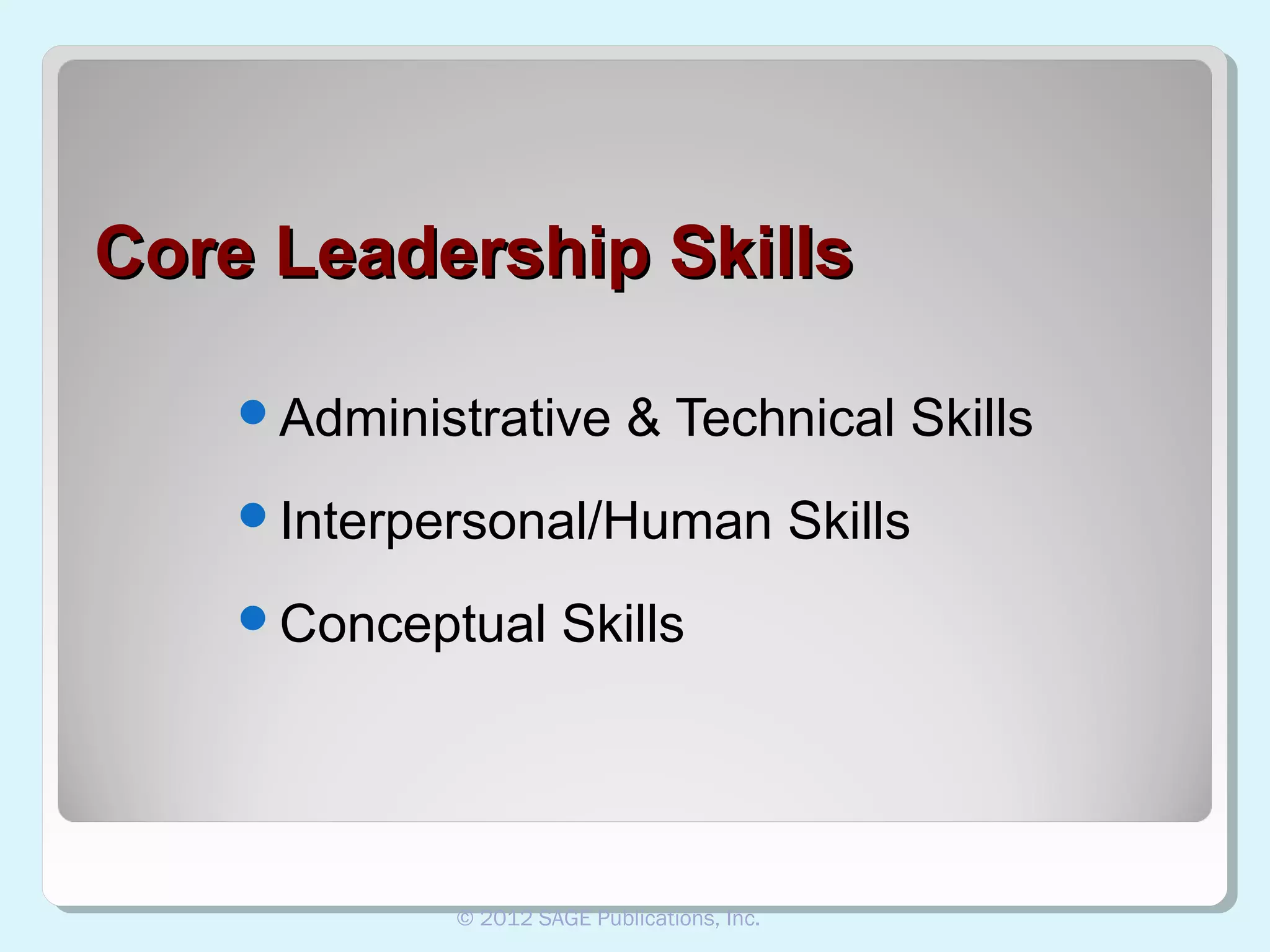
Core Leadership Skills
Administrative

& Technical Skills

Interpersonal/Human
Conceptual

Skills

© 2012 SAGE Publications, Inc.

Skills
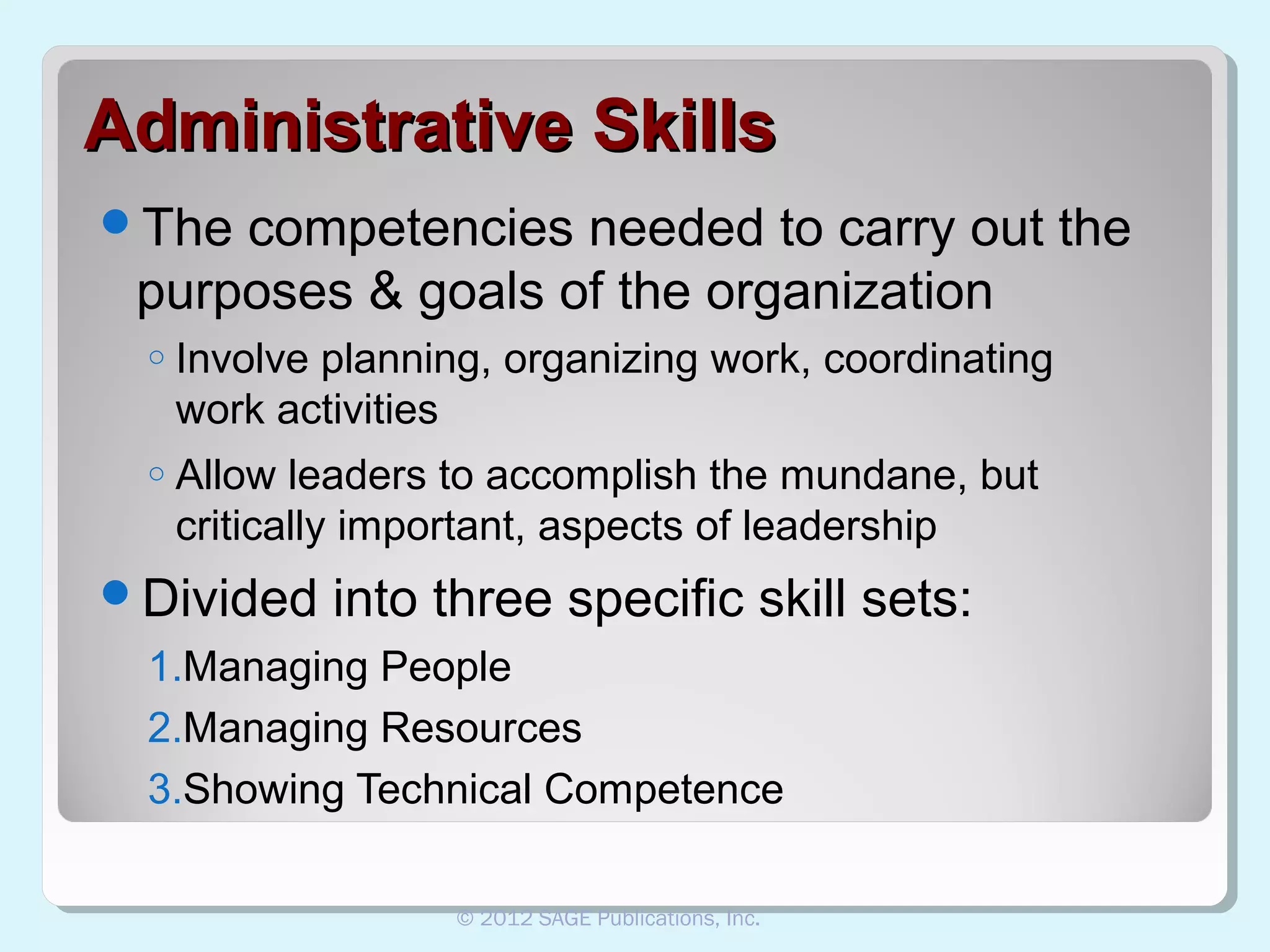
Administrative Skills
The

competencies needed to carry out the
purposes & goals of the organization
o

Involve planning, organizing work, coordinating
work activities

o

Allow leaders to accomplish the mundane, but
critically important, aspects of leadership

Divided

into three specific skill sets:

1.Managing People
2.Managing Resources
3.Showing Technical Competence
© 2012 SAGE Publications, Inc.
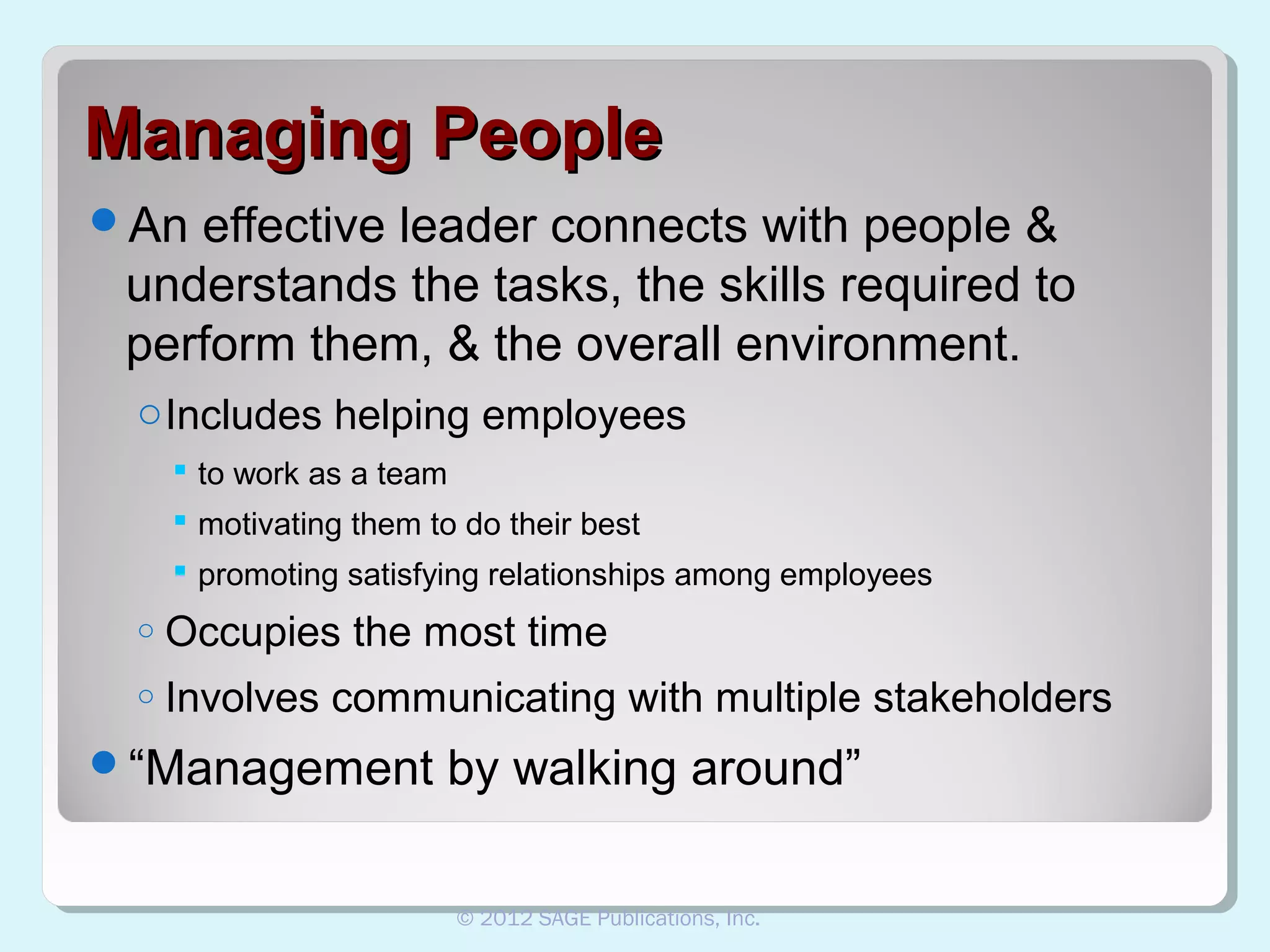
Managing People
An

effective leader connects with people &
understands the tasks, the skills required to
perform them, & the overall environment.
o Includes helping employees
 to work as a team
 motivating them to do their best
 promoting satisfying relationships among employees
o

Occupies the most time

o

Involves communicating with multiple stakeholders

“Management

by walking around”
© 2012 SAGE Publications, Inc.
Human Skills
Human

skills – having knowledge about and
being able to work with people.
◦ Being aware of one’s own perspective and others’
perspectives at the same time
◦ Assisting group members in working cooperatively to
achieve common goals
◦ Creating an atmosphere of trust and empowerment of
members
◦ Important at all levels of the organization

© 2012 SAGE Publications, Inc.
Human Skills
Examples of human (or people) skills:
 Assist

group members in working cooperatively as a

group to achieve common goals
 Adapt

your own ideas to those of others

 Create

an atmosphere of trust and comfort

 Encourage
 Being

involvement in planning

sensitive to the needs of others

 Motivating

others
© 2012 SAGE Publications, Inc.
Managing Resources
Resources

can be money, supplies, equipment,
space, etc., anything needed to operate an
organization.
Managing resources requires a leader to be
competent in both obtaining and allocating
resources. Ex.: cross-country coach buying new
uniforms for the team
The ultimate responsibility of resource management
rests on the leader.
© 2012 SAGE Publications, Inc.
Technical Competence
Technical

competence involves having
specialized knowledge about our work.
o

A leader with technical competence understands the
intricacies of how the organization functions.

o

A leader is more effective when he or she has
knowledge about the activities subordinates are
asked to perform.

o

A leader is not required to have technical competence
in every situation.

© 2012 SAGE Publications, Inc.
Technical Competence
 Technical

skill - having knowledge about and being proficient in a
specific type of work or activity.
◦ Specialized competencies
◦ Analytical ability
◦ Use of appropriate tools and techniques

 Technical
 Most

skills involve hands-on ability with a product or process

important at lower levels of management

© 2012 SAGE Publications, Inc.
Technical Skills
Examples of technical skills:
 Competent

in a specialized area, analytical ability, and the

ability to use appropriate tools and techniques
 Understanding

what is needed to get the job done;

understanding the physical operation
 Hands-on

activity with basic product or process knowledge;

producing the actual products a company is designed to
produce
© 2012 SAGE Publications, Inc.
Interpersonal Skills
http://www.youtube.com/watch?v=XU47Iz4vnlQ
People

skills—the abilities that help a
leader to work effectively with subordinates,
peers, & superiors, to accomplish the
organization’s goals

© 2012 SAGE Publications, Inc.
Interpersonal Skills
Divided

into three specific skill sets:

1. Being Socially Perceptive
2. Showing Emotional Intelligence
3. Managing Interpersonal Conflict

© 2012 SAGE Publications, Inc.
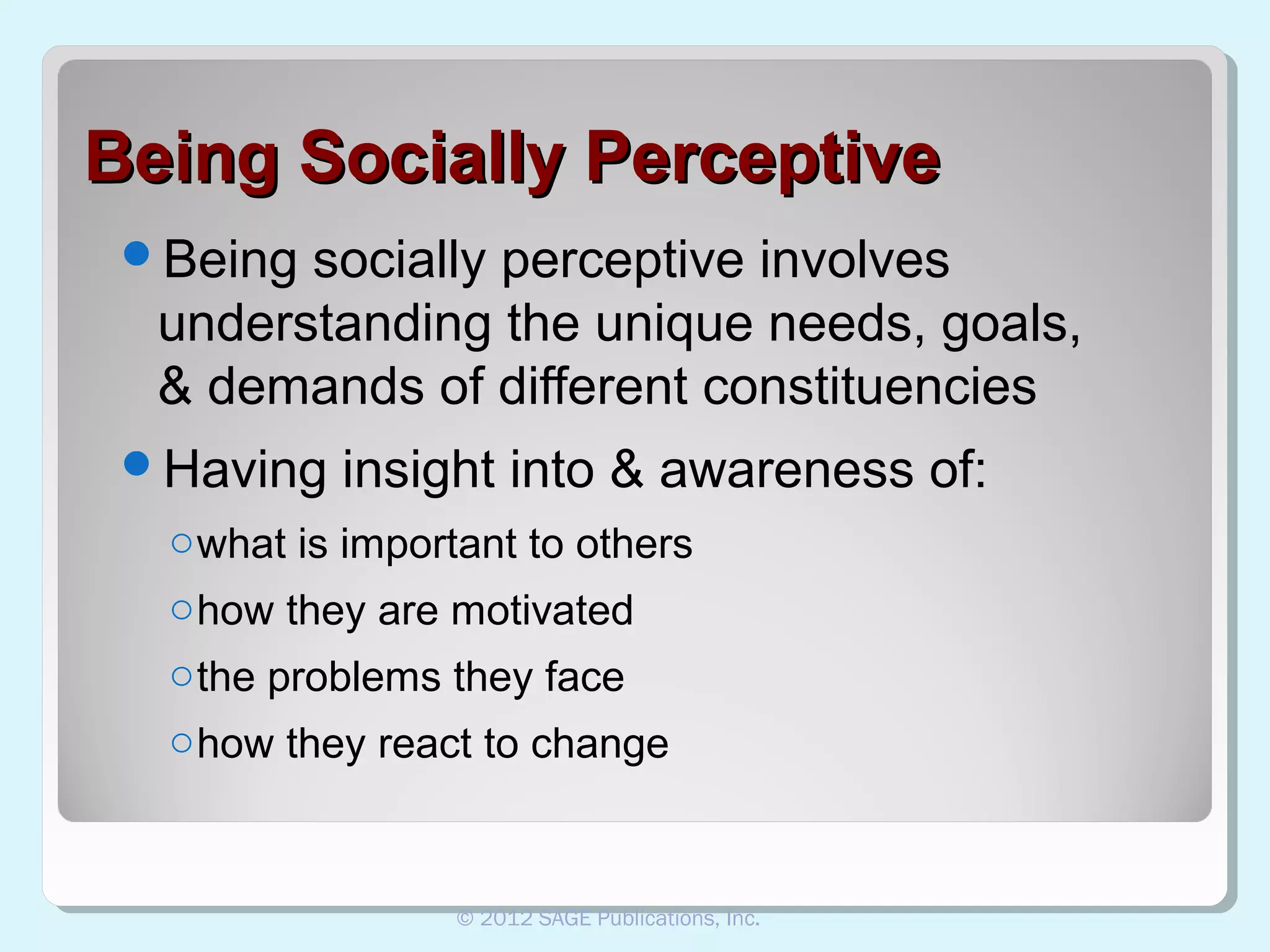
Being Socially Perceptive
Being

socially perceptive involves
understanding the unique needs, goals,
& demands of different constituencies

Having

insight into & awareness of:

o what is important to others
o how they are motivated
o the problems they face
o how they react to change

© 2012 SAGE Publications, Inc.
Showing Emotional Intelligence
Leadership tutorial: What is
emotional intelligence?
http://www.youtube.com/watch?v=6CYwG2YxFC8

© 2012 SAGE Publications, Inc.
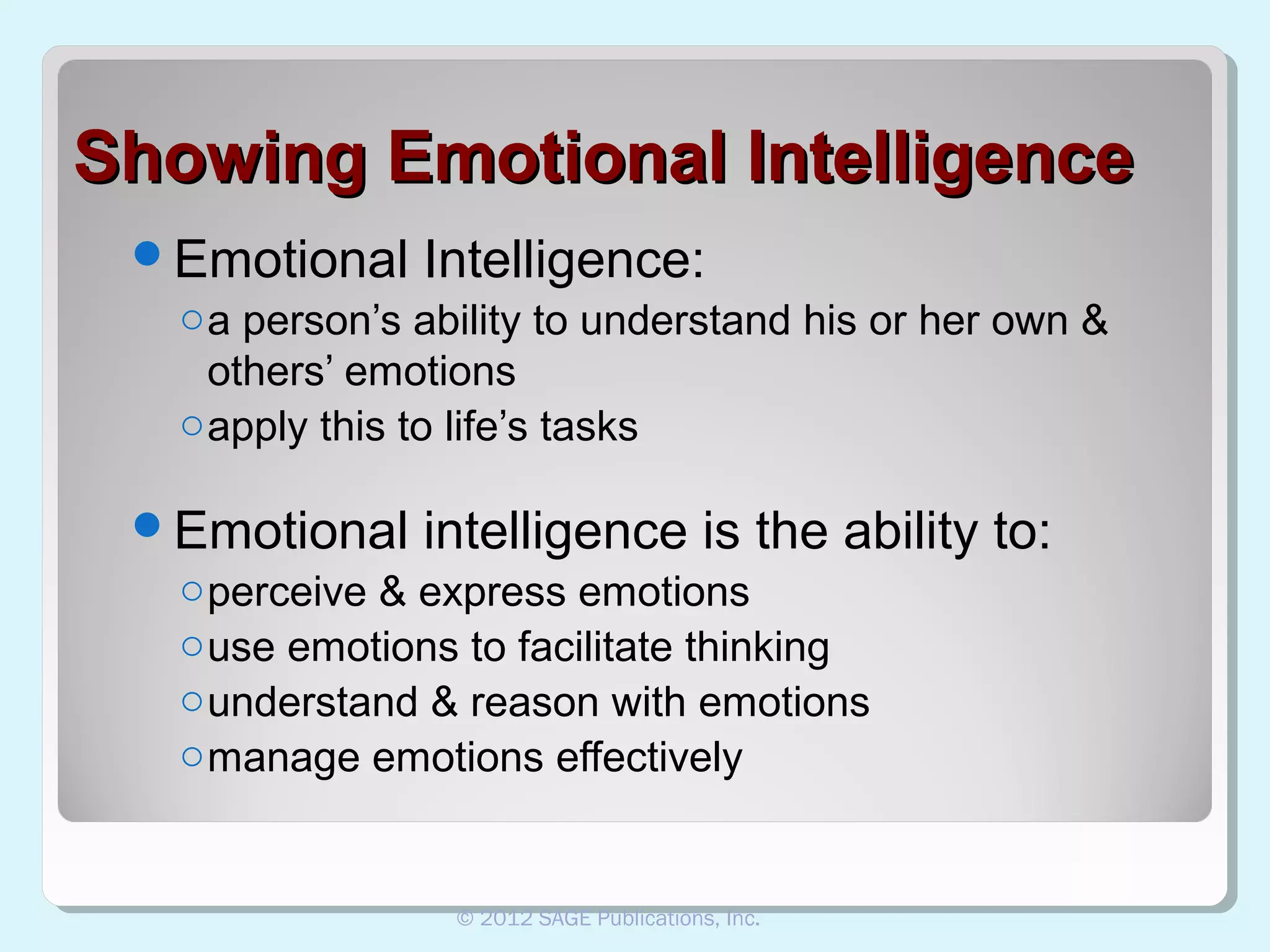
Showing Emotional Intelligence
Emotional Intelligence:
o a person’s ability to understand his or her own &
others’ emotions
o apply this to life’s tasks
Emotional intelligence is the ability
o perceive & express emotions
o use emotions to facilitate thinking
o understand & reason with emotions
o manage emotions effectively

© 2012 SAGE Publications, Inc.

to:
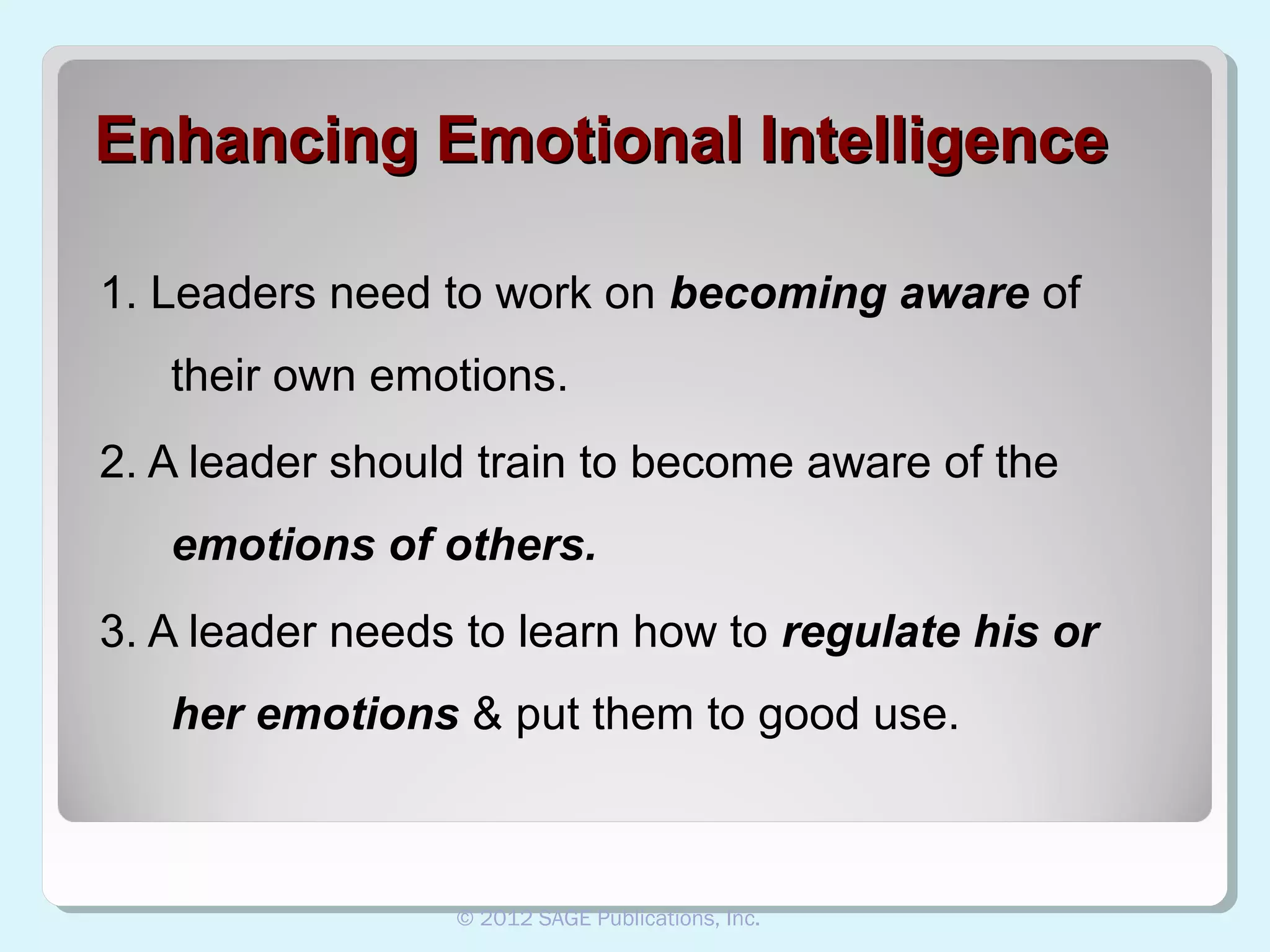
Enhancing Emotional Intelligence
1. Leaders need to work on becoming aware of
their own emotions.
2. A leader should train to become aware of the
emotions of others.
3. A leader needs to learn how to regulate his or
her emotions & put them to good use.

© 2012 SAGE Publications, Inc.
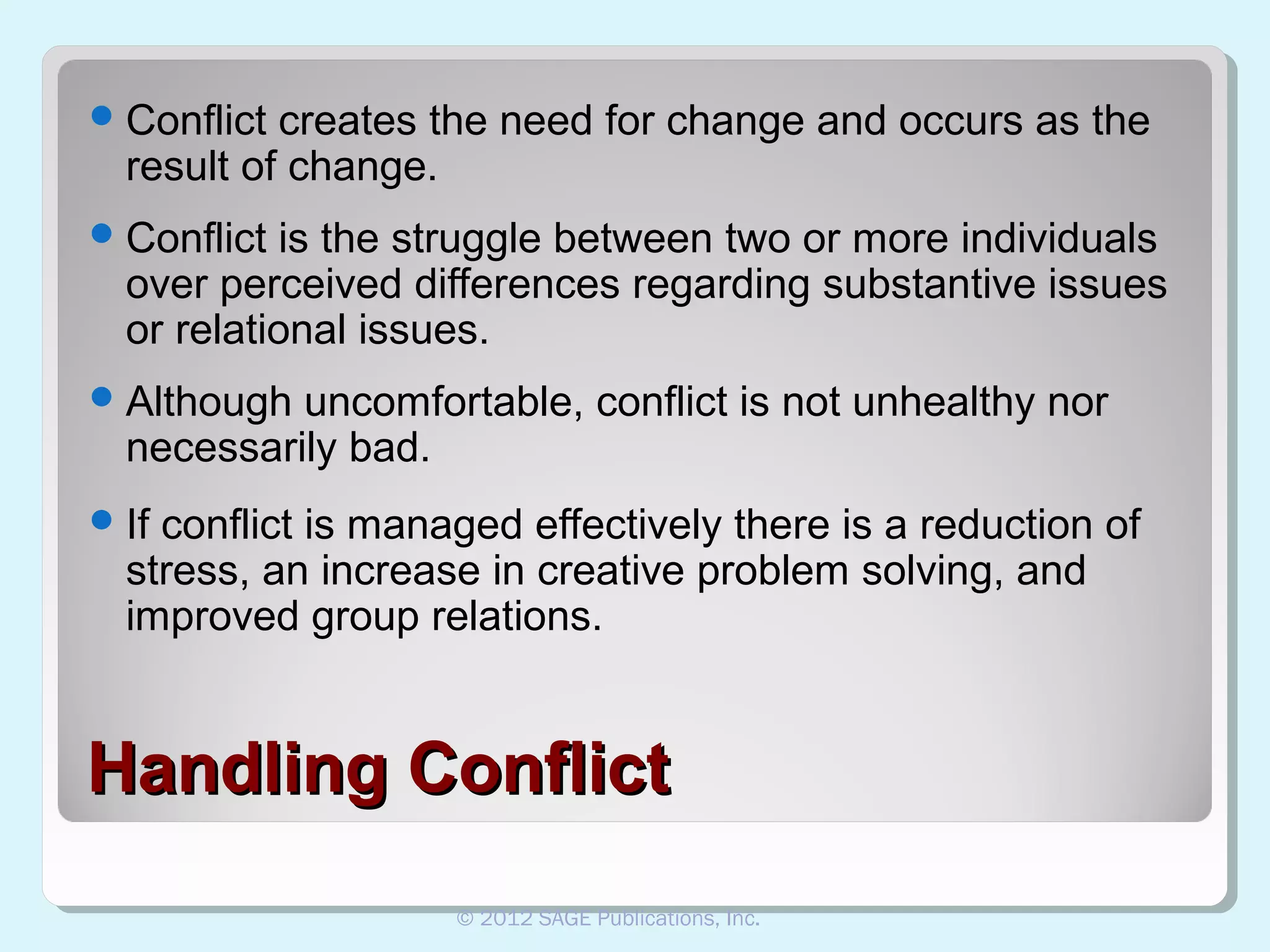
 Conflict

creates the need for change and occurs as the
result of change.

 Conflict

is the struggle between two or more individuals
over perceived differences regarding substantive issues
or relational issues.

 Although

uncomfortable, conflict is not unhealthy nor
necessarily bad.

 If

conflict is managed effectively there is a reduction of
stress, an increase in creative problem solving, and
improved group relations.

Handling Conflict
© 2012 SAGE Publications, Inc.
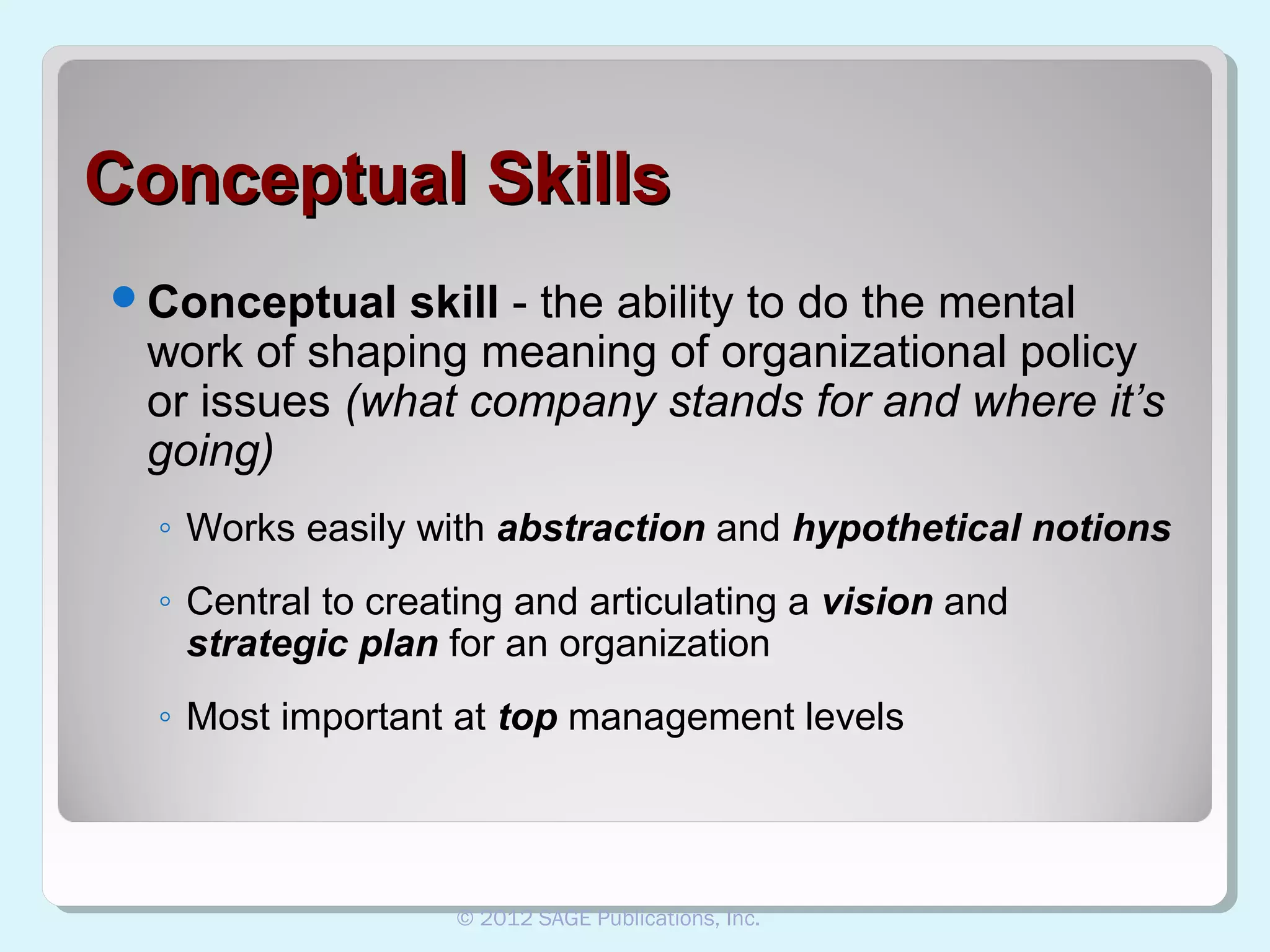
Conceptual Skills
Conceptual

skill - the ability to do the mental
work of shaping meaning of organizational policy
or issues (what company stands for and where it’s
going)
◦ Works easily with abstraction and hypothetical notions
◦ Central to creating and articulating a vision and
strategic plan for an organization
◦ Most important at top management levels

© 2012 SAGE Publications, Inc.
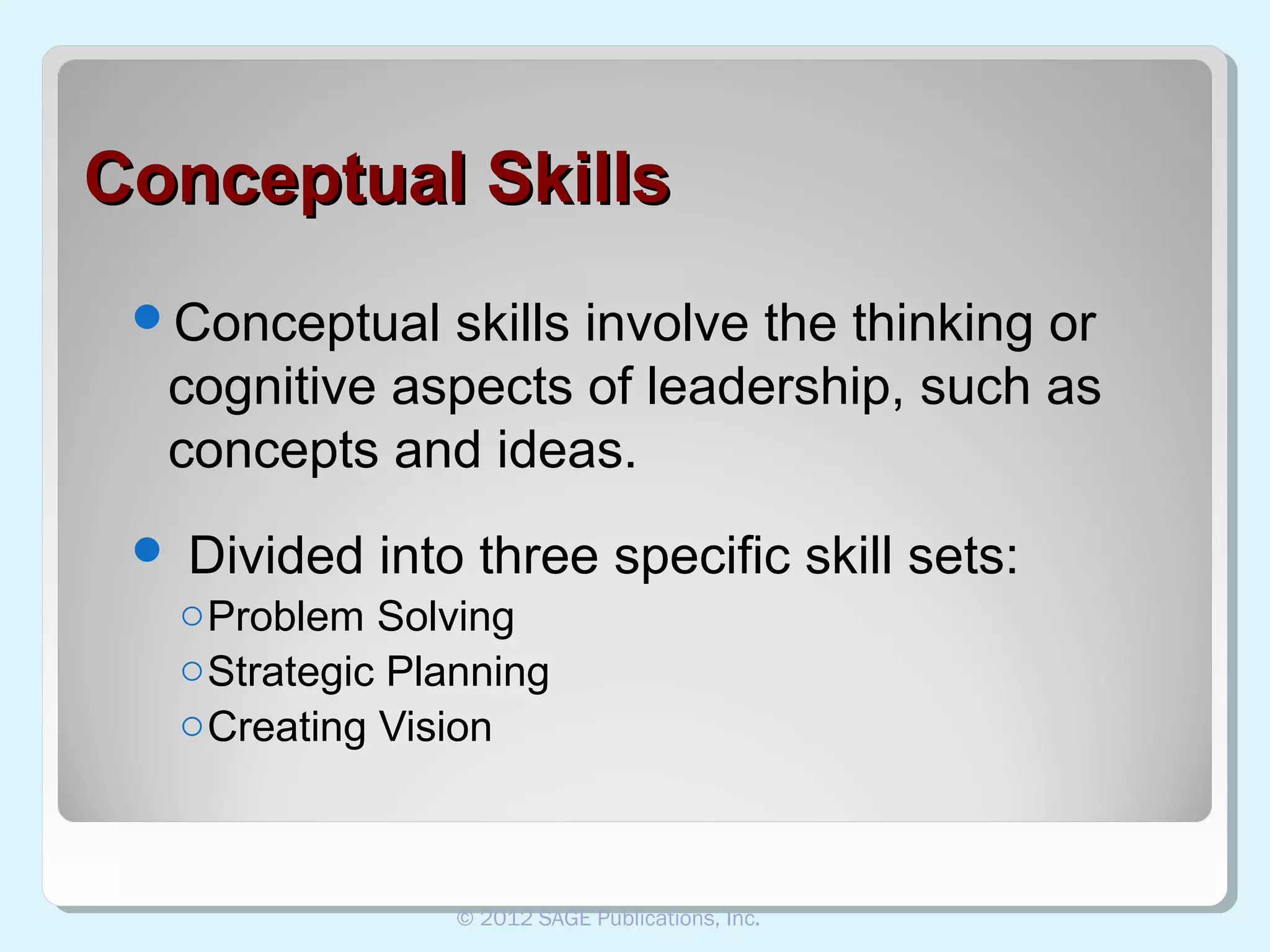
Conceptual Skills
Conceptual

skills involve the thinking or
cognitive aspects of leadership, such as
concepts and ideas.



Divided into three specific skill sets:
o Problem Solving
o Strategic Planning
o Creating Vision

© 2012 SAGE Publications, Inc.
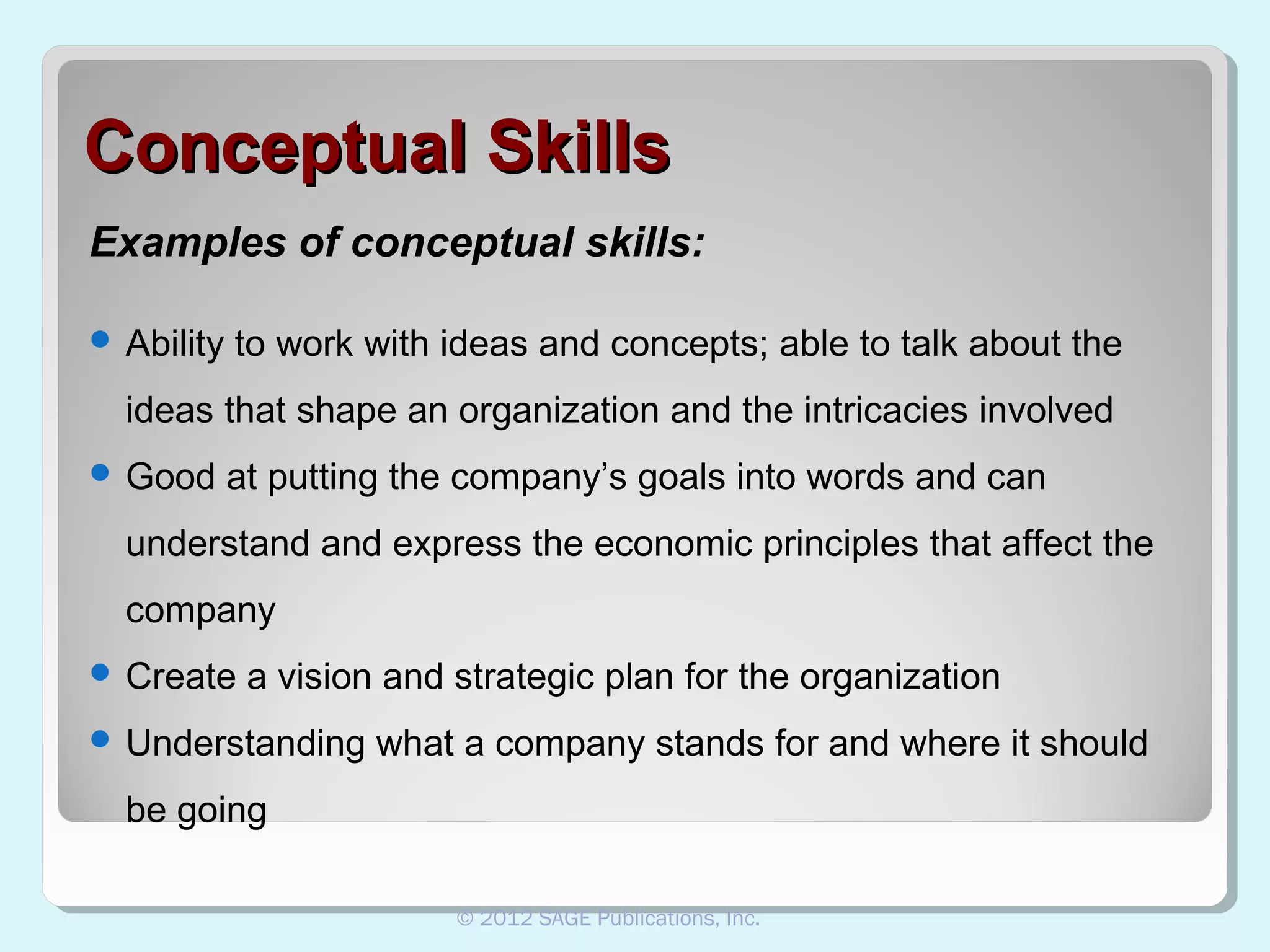
Conceptual Skills
Examples of conceptual skills:
 Ability

to work with ideas and concepts; able to talk about the

ideas that shape an organization and the intricacies involved
 Good

at putting the company’s goals into words and can

understand and express the economic principles that affect the
company
 Create

a vision and strategic plan for the organization

 Understanding

what a company stands for and where it should

be going
© 2012 SAGE Publications, Inc.
Problem Solving
Problem

Solving Skills are a leader’s cognitive
ability to take corrective action in a problem
situation to meet desired objectives.

Skills

include the following:

o identifying the problem
o generating alternative solutions
o selecting the best solution from among the alternatives
o implementing that solution

© 2012 SAGE Publications, Inc.
Strategic Planning
Strategic

planning requires developing careful plans
of action based on available resources & personnel
to achieve a goal

Boal

& Hooijberg (2000) suggest that strategic
leaders need to have:
o The ability to learn—capacity to absorb new information and
apply it towards new goals
o The capacity to adapt—being able to respond quickly to
changes in the environment
o Managerial wisdom—A deep understanding of people and the
environment in which they work

© 2012 SAGE Publications, Inc.
Creating Vision
Creating

vision requires the capacity to
challenge people with compelling visions of
the future.

To

create vision, a leader needs to:

o set forth a picture of a future that is better than the present
o move others toward a new set of ideals & values that will lead
to the future

A leader

must implement the vision & model
the principles set forth in the vision

© 2012 SAGE Publications, Inc.
Environmental Influences


Factors in a leader’s situation that lie outside
of his or her competencies, characteristics,
and experiences
– Internal environmental influences – Ex.
Outdated technology, skill level of
employees
– External environmental influences – Ex.
Economic, political or social issues, natural
disasters
© 2012 SAGE Publications, Inc.
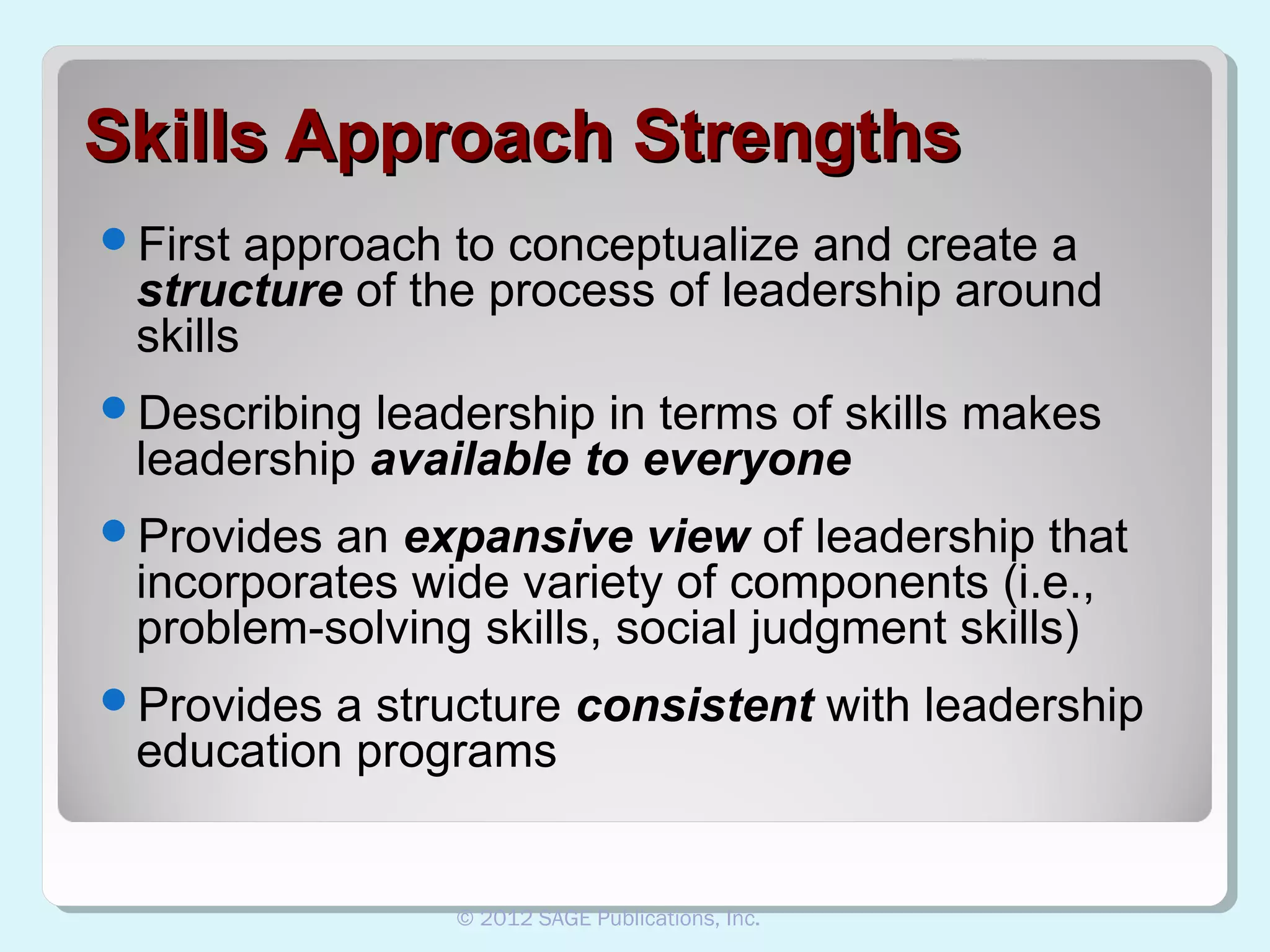
Skills Approach Strengths
First

approach to conceptualize and create a
structure of the process of leadership around
skills

Describing

leadership in terms of skills makes
leadership available to everyone

Provides

an expansive view of leadership that
incorporates wide variety of components (i.e.,
problem-solving skills, social judgment skills)

Provides

a structure consistent with leadership
education programs

© 2012 SAGE Publications, Inc.
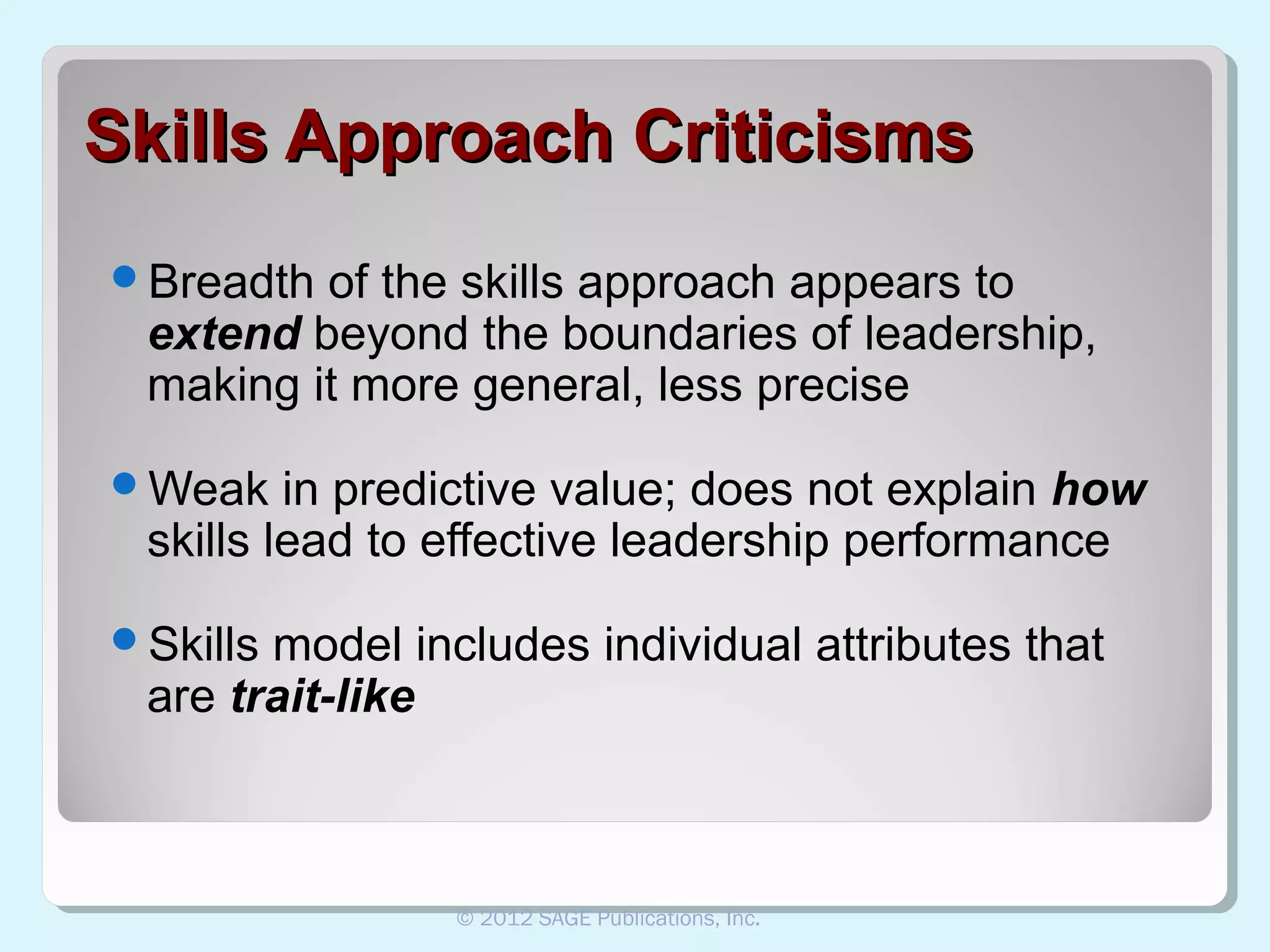
Skills Approach Criticisms
Breadth

of the skills approach appears to
extend beyond the boundaries of leadership,
making it more general, less precise

Weak

in predictive value; does not explain how
skills lead to effective leadership performance

Skills

model includes individual attributes that
are trait-like

© 2012 SAGE Publications, Inc.
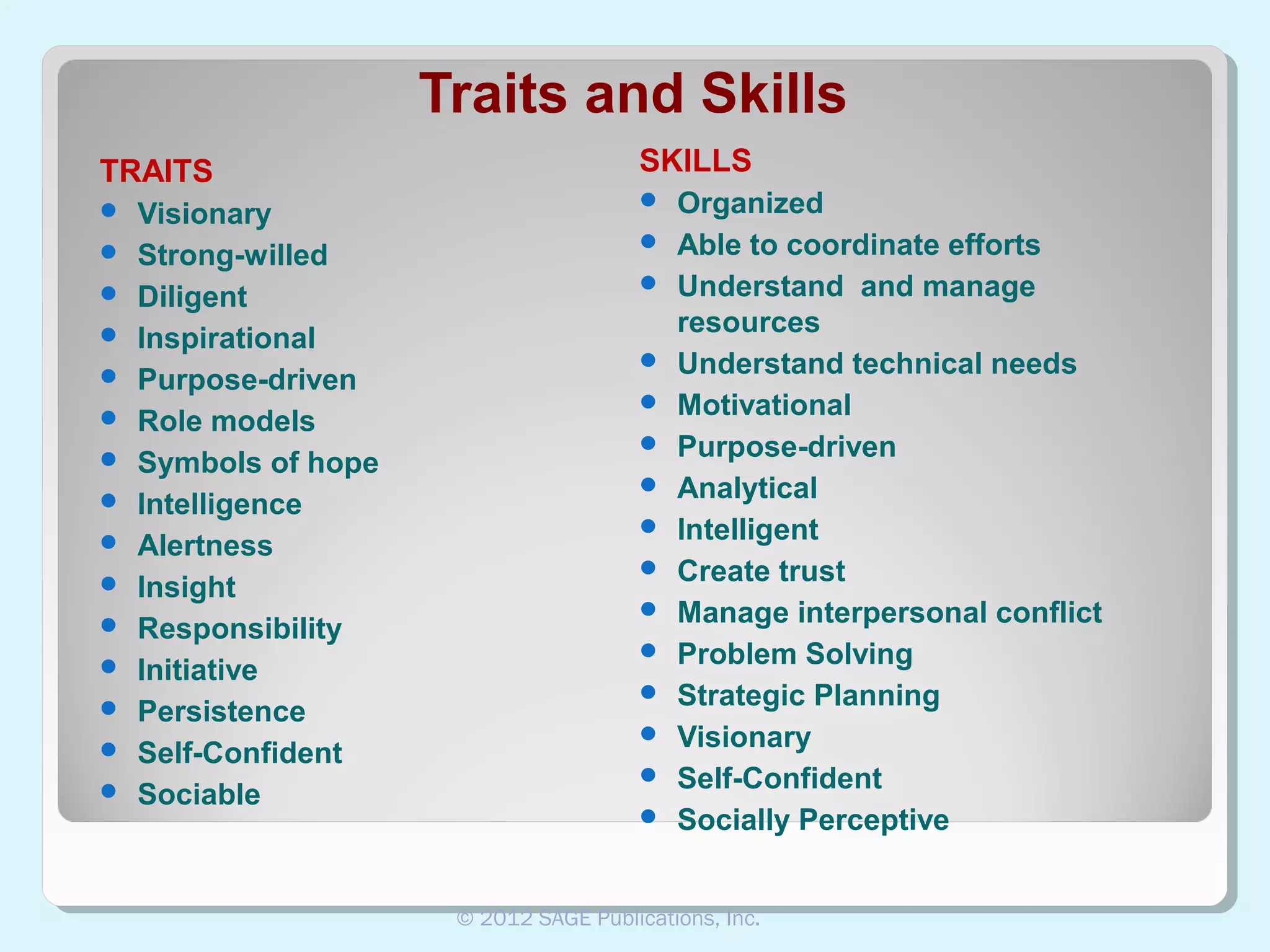
Traits and Skills
TRAITS
















Visionary
Strong-willed
Diligent
Inspirational
Purpose-driven
Role models
Symbols of hope
Intelligence
Alertness
Insight
Responsibility
Initiative
Persistence
Self-Confident
Sociable

SKILLS
















Organized
Able to coordinate efforts
Understand and manage
resources
Understand technical needs
Motivational
Purpose-driven
Analytical
Intelligent
Create trust
Manage interpersonal conflict
Problem Solving
Strategic Planning
Visionary
Self-Confident
Socially Perceptive

© 2012 SAGE Publications, Inc.
What is the Application of Skills
Approach?
The

Skills Approach provides a way to delineate
the skills of a leader

It

is applicable to leaders at all levels within the
organization

The

skills inventory can provide insights into the
individual’s leadership competencies

Test

scores allow leaders to learn about areas in
which they may wish to seek further training

© 2012 SAGE Publications, Inc.
Summary
Administrative,

interpersonal, & conceptual
skills play a major role in effective
leadership.

Through

practice & hard work, we can all
become better leaders by improving our
skills in each of these areas.

© 2012 SAGE Publications, Inc.
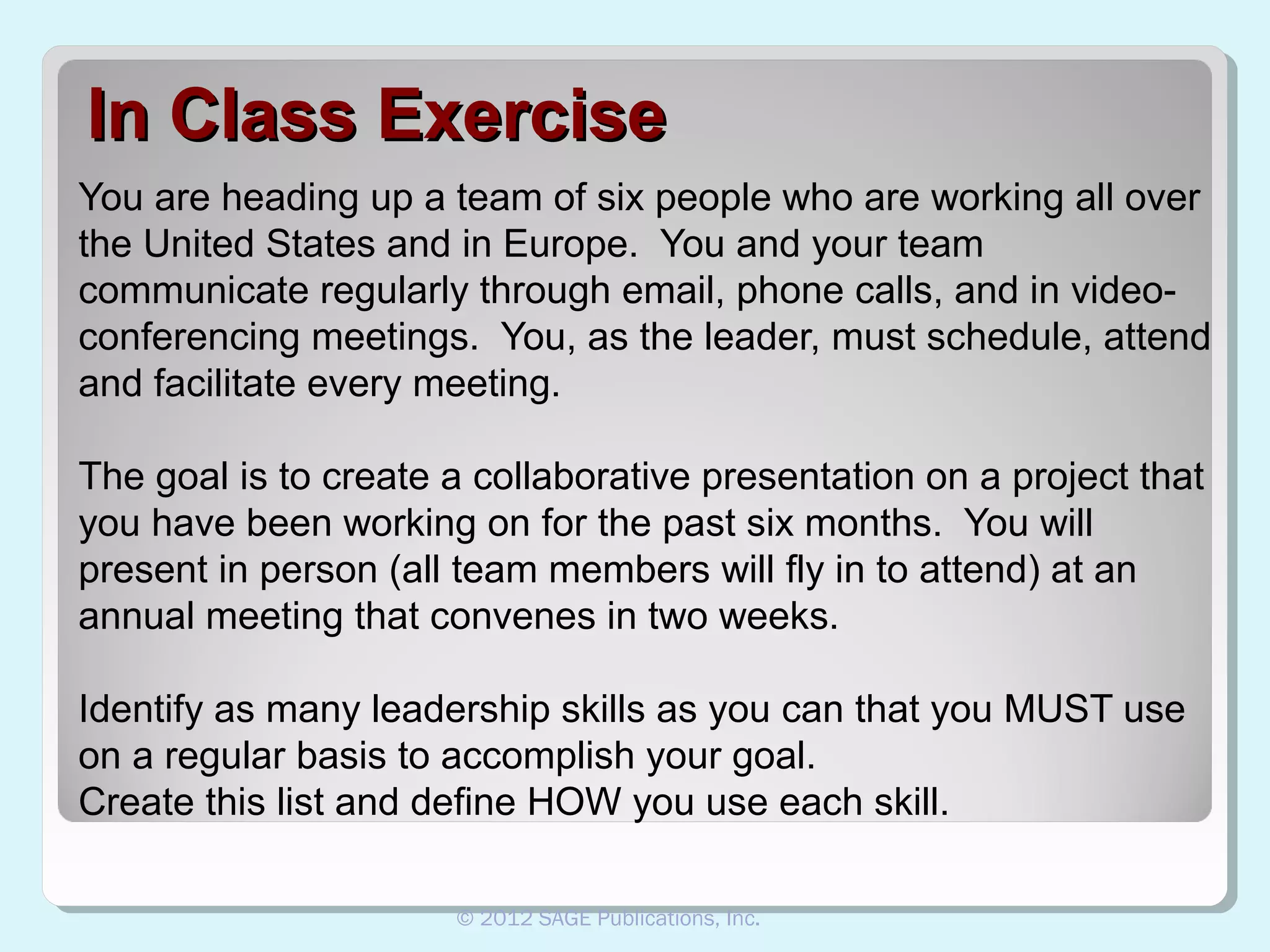
In Class Exercise
You are heading up a team of six people who are working all over
the United States and in Europe. You and your team
communicate regularly through email, phone calls, and in videoconferencing meetings. You, as the leader, must schedule, attend
and facilitate every meeting.
The goal is to create a collaborative presentation on a project that
you have been working on for the past six months. You will
present in person (all team members will fly in to attend) at an
annual meeting that convenes in two weeks.
Identify as many leadership skills as you can that you MUST use
on a regular basis to accomplish your goal.
Create this list and define HOW you use each skill.
© 2012 SAGE Publications, Inc.

2.4.14 lecture ppt leadership skills

  • 1.
    Leadership Skills Leadership: Theoryand Practice: Chapter 3 Skills Approach Introduction to Leadership: Concepts and Practice: Chapter 5 Developing Leadership Skills © 2012 SAGE Publications, Inc.
  • 2.
    Discussion Questions What skills doyou think are most important for leaders to possess? Why have traits of leaders historically received more attention than leadership skills? © 2012 SAGE Publications, Inc.
  • 3.
    What Are LeadershipSkills? Leadership skills refer to learned competencies that leaders are able to demonstrate in performance. Leadership skills: Give people the capacity to influence others o Are a critical component in successful leadership o © 2012 SAGE Publications, Inc.
  • 4.
    What Are LeadershipSkills? Make a list of leadership skills. © 2012 SAGE Publications, Inc.
  • 5.
    Leadership Skills Approach- An Overview http://www.youtube.com/watch?v=HWj-yEO9Qws © 2012 SAGE Publications, Inc.
  • 6.
    Core Leadership Skills Administrative &Technical Skills Interpersonal/Human Conceptual Skills © 2012 SAGE Publications, Inc. Skills
  • 7.
    Administrative Skills The competencies neededto carry out the purposes & goals of the organization o Involve planning, organizing work, coordinating work activities o Allow leaders to accomplish the mundane, but critically important, aspects of leadership Divided into three specific skill sets: 1.Managing People 2.Managing Resources 3.Showing Technical Competence © 2012 SAGE Publications, Inc.
  • 8.
    Managing People An effective leaderconnects with people & understands the tasks, the skills required to perform them, & the overall environment. o Includes helping employees  to work as a team  motivating them to do their best  promoting satisfying relationships among employees o Occupies the most time o Involves communicating with multiple stakeholders “Management by walking around” © 2012 SAGE Publications, Inc.
  • 9.
    Human Skills Human skills –having knowledge about and being able to work with people. ◦ Being aware of one’s own perspective and others’ perspectives at the same time ◦ Assisting group members in working cooperatively to achieve common goals ◦ Creating an atmosphere of trust and empowerment of members ◦ Important at all levels of the organization © 2012 SAGE Publications, Inc.
  • 10.
    Human Skills Examples ofhuman (or people) skills:  Assist group members in working cooperatively as a group to achieve common goals  Adapt your own ideas to those of others  Create an atmosphere of trust and comfort  Encourage  Being involvement in planning sensitive to the needs of others  Motivating others © 2012 SAGE Publications, Inc.
  • 11.
    Managing Resources Resources can bemoney, supplies, equipment, space, etc., anything needed to operate an organization. Managing resources requires a leader to be competent in both obtaining and allocating resources. Ex.: cross-country coach buying new uniforms for the team The ultimate responsibility of resource management rests on the leader. © 2012 SAGE Publications, Inc.
  • 12.
    Technical Competence Technical competence involveshaving specialized knowledge about our work. o A leader with technical competence understands the intricacies of how the organization functions. o A leader is more effective when he or she has knowledge about the activities subordinates are asked to perform. o A leader is not required to have technical competence in every situation. © 2012 SAGE Publications, Inc.
  • 13.
    Technical Competence  Technical skill- having knowledge about and being proficient in a specific type of work or activity. ◦ Specialized competencies ◦ Analytical ability ◦ Use of appropriate tools and techniques  Technical  Most skills involve hands-on ability with a product or process important at lower levels of management © 2012 SAGE Publications, Inc.
  • 14.
    Technical Skills Examples oftechnical skills:  Competent in a specialized area, analytical ability, and the ability to use appropriate tools and techniques  Understanding what is needed to get the job done; understanding the physical operation  Hands-on activity with basic product or process knowledge; producing the actual products a company is designed to produce © 2012 SAGE Publications, Inc.
  • 15.
    Interpersonal Skills Interpersonal Skills http://www.youtube.com/watch?v=XU47Iz4vnlQ People skills—theabilities that help a leader to work effectively with subordinates, peers, & superiors, to accomplish the organization’s goals © 2012 SAGE Publications, Inc.
  • 16.
    Interpersonal Skills Divided into threespecific skill sets: 1. Being Socially Perceptive 2. Showing Emotional Intelligence 3. Managing Interpersonal Conflict © 2012 SAGE Publications, Inc.
  • 17.
    Being Socially Perceptive Being sociallyperceptive involves understanding the unique needs, goals, & demands of different constituencies Having insight into & awareness of: o what is important to others o how they are motivated o the problems they face o how they react to change © 2012 SAGE Publications, Inc.
  • 18.
    Showing Emotional Intelligence Leadershiptutorial: What is emotional intelligence? http://www.youtube.com/watch?v=6CYwG2YxFC8 © 2012 SAGE Publications, Inc.
  • 19.
    Showing Emotional Intelligence EmotionalIntelligence: o a person’s ability to understand his or her own & others’ emotions o apply this to life’s tasks Emotional intelligence is the ability o perceive & express emotions o use emotions to facilitate thinking o understand & reason with emotions o manage emotions effectively © 2012 SAGE Publications, Inc. to:
  • 20.
    Enhancing Emotional Intelligence 1.Leaders need to work on becoming aware of their own emotions. 2. A leader should train to become aware of the emotions of others. 3. A leader needs to learn how to regulate his or her emotions & put them to good use. © 2012 SAGE Publications, Inc.
  • 21.
     Conflict creates theneed for change and occurs as the result of change.  Conflict is the struggle between two or more individuals over perceived differences regarding substantive issues or relational issues.  Although uncomfortable, conflict is not unhealthy nor necessarily bad.  If conflict is managed effectively there is a reduction of stress, an increase in creative problem solving, and improved group relations. Handling Conflict © 2012 SAGE Publications, Inc.
  • 22.
    Conceptual Skills Conceptual skill -the ability to do the mental work of shaping meaning of organizational policy or issues (what company stands for and where it’s going) ◦ Works easily with abstraction and hypothetical notions ◦ Central to creating and articulating a vision and strategic plan for an organization ◦ Most important at top management levels © 2012 SAGE Publications, Inc.
  • 23.
    Conceptual Skills Conceptual skills involvethe thinking or cognitive aspects of leadership, such as concepts and ideas.  Divided into three specific skill sets: o Problem Solving o Strategic Planning o Creating Vision © 2012 SAGE Publications, Inc.
  • 24.
    Conceptual Skills Examples ofconceptual skills:  Ability to work with ideas and concepts; able to talk about the ideas that shape an organization and the intricacies involved  Good at putting the company’s goals into words and can understand and express the economic principles that affect the company  Create a vision and strategic plan for the organization  Understanding what a company stands for and where it should be going © 2012 SAGE Publications, Inc.
  • 25.
    Problem Solving Problem Solving Skillsare a leader’s cognitive ability to take corrective action in a problem situation to meet desired objectives. Skills include the following: o identifying the problem o generating alternative solutions o selecting the best solution from among the alternatives o implementing that solution © 2012 SAGE Publications, Inc.
  • 26.
    Strategic Planning Strategic planning requiresdeveloping careful plans of action based on available resources & personnel to achieve a goal Boal & Hooijberg (2000) suggest that strategic leaders need to have: o The ability to learn—capacity to absorb new information and apply it towards new goals o The capacity to adapt—being able to respond quickly to changes in the environment o Managerial wisdom—A deep understanding of people and the environment in which they work © 2012 SAGE Publications, Inc.
  • 27.
    Creating Vision Creating vision requiresthe capacity to challenge people with compelling visions of the future. To create vision, a leader needs to: o set forth a picture of a future that is better than the present o move others toward a new set of ideals & values that will lead to the future A leader must implement the vision & model the principles set forth in the vision © 2012 SAGE Publications, Inc.
  • 28.
    Environmental Influences  Factors ina leader’s situation that lie outside of his or her competencies, characteristics, and experiences – Internal environmental influences – Ex. Outdated technology, skill level of employees – External environmental influences – Ex. Economic, political or social issues, natural disasters © 2012 SAGE Publications, Inc.
  • 29.
    Skills Approach Strengths First approachto conceptualize and create a structure of the process of leadership around skills Describing leadership in terms of skills makes leadership available to everyone Provides an expansive view of leadership that incorporates wide variety of components (i.e., problem-solving skills, social judgment skills) Provides a structure consistent with leadership education programs © 2012 SAGE Publications, Inc.
  • 30.
    Skills Approach Criticisms Breadth ofthe skills approach appears to extend beyond the boundaries of leadership, making it more general, less precise Weak in predictive value; does not explain how skills lead to effective leadership performance Skills model includes individual attributes that are trait-like © 2012 SAGE Publications, Inc.
  • 31.
    Traits and Skills TRAITS                Visionary Strong-willed Diligent Inspirational Purpose-driven Rolemodels Symbols of hope Intelligence Alertness Insight Responsibility Initiative Persistence Self-Confident Sociable SKILLS                Organized Able to coordinate efforts Understand and manage resources Understand technical needs Motivational Purpose-driven Analytical Intelligent Create trust Manage interpersonal conflict Problem Solving Strategic Planning Visionary Self-Confident Socially Perceptive © 2012 SAGE Publications, Inc.
  • 32.
    What is theApplication of Skills Approach? The Skills Approach provides a way to delineate the skills of a leader It is applicable to leaders at all levels within the organization The skills inventory can provide insights into the individual’s leadership competencies Test scores allow leaders to learn about areas in which they may wish to seek further training © 2012 SAGE Publications, Inc.
  • 33.
    Summary Administrative, interpersonal, & conceptual skillsplay a major role in effective leadership. Through practice & hard work, we can all become better leaders by improving our skills in each of these areas. © 2012 SAGE Publications, Inc.
  • 34.
    In Class Exercise Youare heading up a team of six people who are working all over the United States and in Europe. You and your team communicate regularly through email, phone calls, and in videoconferencing meetings. You, as the leader, must schedule, attend and facilitate every meeting. The goal is to create a collaborative presentation on a project that you have been working on for the past six months. You will present in person (all team members will fly in to attend) at an annual meeting that convenes in two weeks. Identify as many leadership skills as you can that you MUST use on a regular basis to accomplish your goal. Create this list and define HOW you use each skill. © 2012 SAGE Publications, Inc.