Decision-Making: The Essence of the Manager’s Job
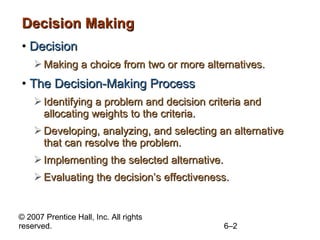
Decision Making Decision Making a choice from two or more alternatives. The Decision-Making Process Identifying a problem and decision criteria and allocating weights to the criteria. Developing, analyzing, and selecting an alternative that can resolve the problem. Implementing the selected alternative. Evaluating the decision’s effectiveness.
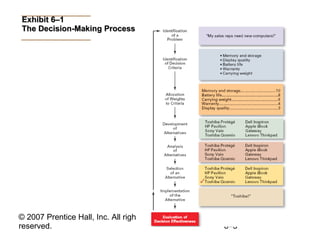
Exhibit 6–1 The Decision-Making Process
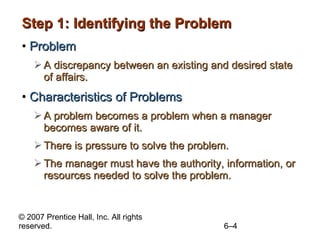
Step 1: Identifying the Problem Problem A discrepancy between an existing and desired state of affairs. Characteristics of Problems A problem becomes a problem when a manager becomes aware of it. There is pressure to solve the problem. The manager must have the authority, information, or resources needed to solve the problem.
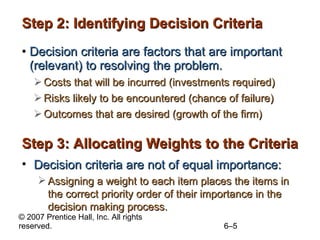
Step 2: Identifying Decision Criteria Decision criteria are factors that are important (relevant) to resolving the problem. Costs that will be incurred (investments required) Risks likely to be encountered (chance of failure) Outcomes that are desired (growth of the firm) Step 3: Allocating Weights to the Criteria Decision criteria are not of equal importance: Assigning a weight to each item places the items in the correct priority order of their importance in the decision making process.
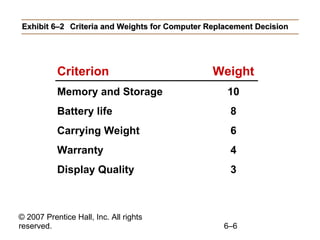
Exhibit 6–2 Criteria and Weights for Computer Replacement Decision Criterion  Weight Memory and Storage  10 Battery life  8 Carrying Weight  6 Warranty  4 Display Quality  3
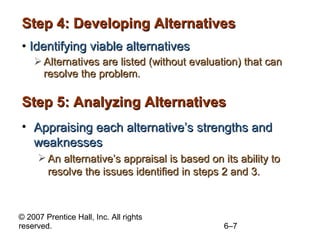
Step 4: Developing Alternatives Identifying viable alternatives Alternatives are listed (without evaluation) that can resolve the problem. Step 5: Analyzing Alternatives Appraising each alternative’s strengths and weaknesses An alternative’s appraisal is based on its ability to resolve the issues identified in steps 2 and 3.
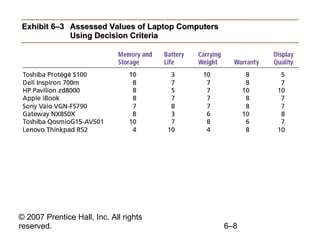
Exhibit 6–3 Assessed Values of Laptop Computers Using Decision Criteria
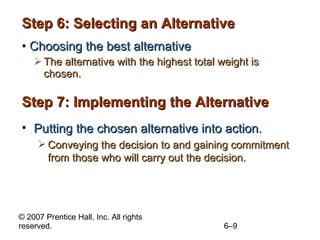
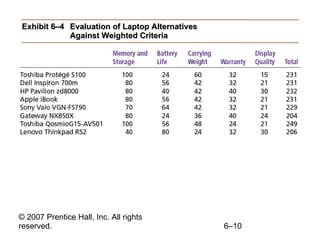
Step 6: Selecting an Alternative Choosing the best alternative The alternative with the highest total weight is chosen. Step 7: Implementing the Alternative Putting the chosen alternative into action. Conveying the decision to and gaining commitment from those who will carry out the decision.
Exhibit 6–4 Evaluation of Laptop Alternatives Against Weighted Criteria
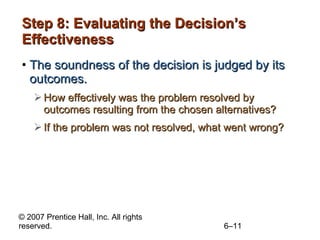
Step 8: Evaluating the Decision’s Effectiveness The soundness of the decision is judged by its outcomes. How effectively was the problem resolved by outcomes resulting from the chosen alternatives? If the problem was not resolved, what went wrong?
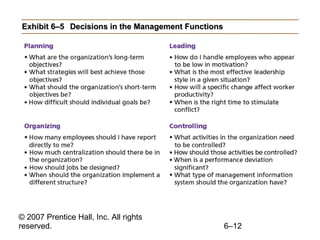
Exhibit 6–5 Decisions in the Management Functions
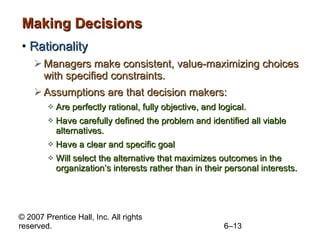
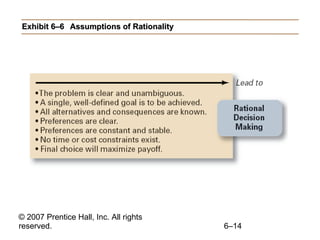
Making Decisions Rationality Managers make consistent, value-maximizing choices with specified constraints. Assumptions are that decision makers: Are perfectly rational, fully objective, and logical. Have carefully defined the problem and identified all viable alternatives. Have a clear and specific goal Will select the alternative that maximizes outcomes in the organization’s interests rather than in their personal interests.
Exhibit 6–6 Assumptions of Rationality
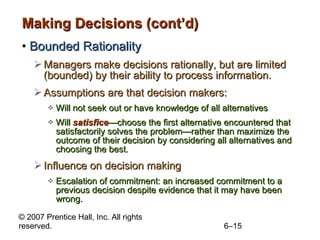
Making Decisions (cont’d) Bounded Rationality Managers make decisions rationally, but are limited (bounded) by their ability to process information. Assumptions are that decision makers: Will not seek out or have knowledge of all alternatives Will  satisfice —choose the first alternative encountered that satisfactorily solves the problem— rather than maximize the outcome of their decision by considering all alternatives and choosing the best. Influence on decision making Escalation of commitment: an increased commitment to a previous decision despite evidence that it may have been wrong.
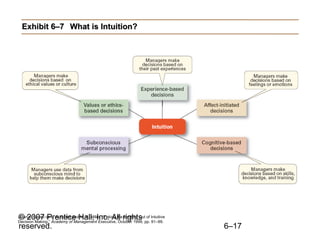
The Role of Intuition Intuitive decision making Making decisions on the basis of experience, feelings, and accumulated judgment.
Exhibit 6–7 What is Intuition? Source:  Based on L. A. Burke and M. K. Miller, “Taking the Mystery Out of Intuitive Decision Making,”  Academy of Management Executive , October 1999, pp. 91–99.
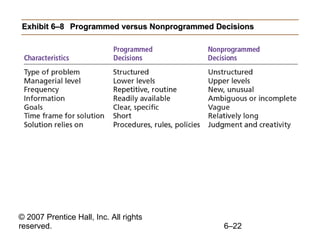
Types of Problems and Decisions Structured Problems Involve goals that clear. Are familiar (have occurred before). Are easily and completely defined —infor mation about the problem is available and complete. Programmed Decision A repetitive decision that can be handled by a routine approach.
Types of Programmed Decisions Policy A general guideline for making a decision about a structured problem. Procedure A series of interrelated steps that a manager can use to respond (applying a policy) to a structured problem. Rule An explicit statement that limits what a manager or employee can or cannot do.
Policy, Procedure, and Rule Examples Policy Accept all customer-returned merchandise. Procedure Follow all steps for completing merchandise return documentation. Rules Managers must approve all refunds over $50.00. No credit purchases are refunded for cash.
Problems and Decisions (cont’d) Unstructured Problems Problems that are new or unusual and for which information is ambiguous or incomplete. Problems that will require custom-made solutions. Nonprogrammed Decisions Decisions that are unique and nonrecurring. Decisions that generate unique responses.
Exhibit 6–8 Programmed versus Nonprogrammed Decisions
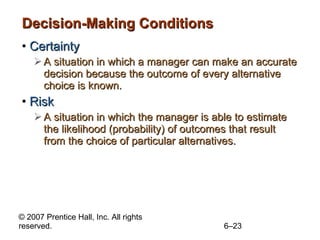
Decision-Making Conditions Certainty A situation in which a manager can make an accurate decision because the outcome of every alternative choice is known. Risk A situation in which the manager is able to estimate the likelihood (probability) of outcomes that result from the choice of particular alternatives.
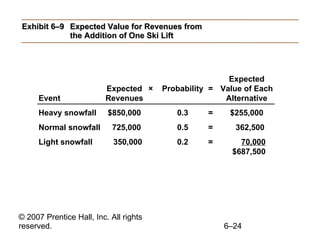
Exhibit 6–9 Expected Value for Revenues from the Addition of One Ski Lift Expected Expected × Probability = Value of Each Event Revenues Alternative Heavy snowfall  $850,000 0.3 = $255,000 Normal snowfall    725,000 0.5 =   362,500 Light snowfall    350,000 0.2 =   70,000   $687,500
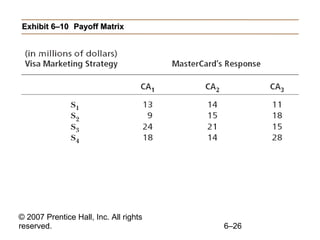
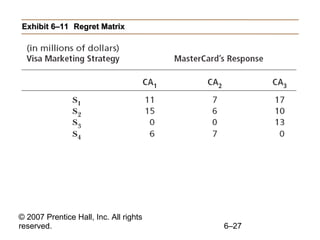
Decision-Making Conditions Uncertainty Limited information prevents estimation of outcome probabilities for alternatives associated with the problem and may force managers to rely on intuition, hunches, and “gut feelings”. Maximax:  the optimistic manager’s choice to maximize the maximum payoff Maximin:  the pessimistic manager’s choice to maximize the minimum payoff Minimax:  the manager’s choice to minimize maximum regret.
Exhibit 6–10 Payoff Matrix
Exhibit 6–11 Regret Matrix
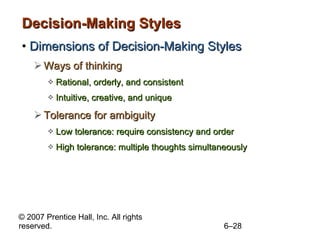
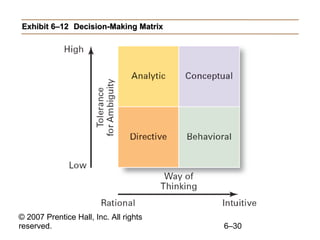
Decision-Making Styles Dimensions of Decision-Making Styles Ways of thinking Rational, orderly, and consistent Intuitive, creative, and unique Tolerance for ambiguity Low tolerance: require consistency and order High tolerance: multiple thoughts simultaneously
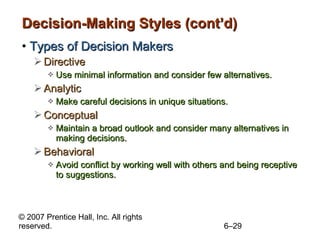
Decision-Making Styles (cont’d) Types of Decision Makers Directive Use minimal information and consider few alternatives. Analytic Make careful decisions in unique situations. Conceptual Maintain a broad outlook and consider many alternatives in making decisions. Behavioral Avoid conflict by working well with others and being receptive to suggestions.
Exhibit 6–12 Decision-Making Matrix
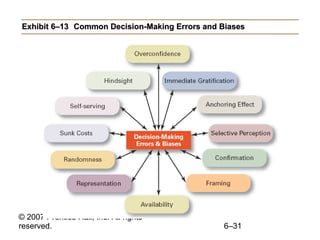
Exhibit 6–13 Common Decision-Making Errors and Biases
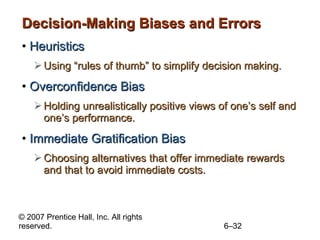
Decision-Making Biases and Errors Heuristics Using “rules of thumb” to simplify decision making. Overconfidence Bias Holding unrealistically positive views of one’s self and one’s performance. Immediate Gratification Bias Choosing alternatives that offer immediate rewards and that to avoid immediate costs.
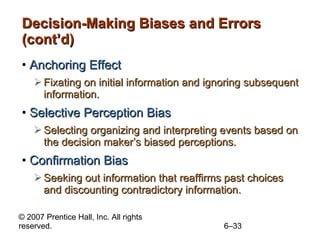
Decision-Making Biases and Errors (cont’d) Anchoring Effect Fixating on initial information and ignoring subsequent information. Selective Perception Bias Selecting organizing and interpreting events based on the decision maker’s biased perceptions. Confirmation Bias Seeking out information that reaffirms past choices and discounting contradictory information.
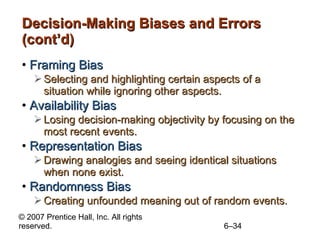
Decision-Making Biases and Errors (cont’d) Framing Bias Selecting and highlighting certain aspects of a situation while ignoring other aspects. Availability Bias Losing decision-making objectivity by focusing on the most recent events. Representation Bias Drawing analogies and seeing identical situations when none exist. Randomness Bias Creating unfounded meaning out of random events.
Decision-Making Biases and Errors (cont’d) Sunk Costs Errors Forgetting that current actions cannot influence past events and relate only to future consequences. Self-Serving Bias Taking quick credit for successes and blaming outside factors for failures. Hindsight Bias Mistakenly believing that an event could have been predicted once the actual outcome is known (after-the-fact).
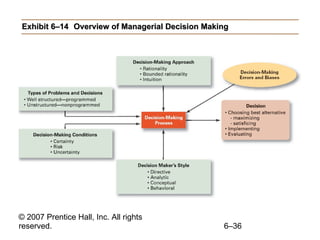
Exhibit 6–14 Overview of Managerial Decision Making
Decision Making for Today’s World Guidelines for making effective decisions: Understand cultural differences. Know when it’s time to call it quits. Use an effective decision-making process. Habits of highly reliable organizations (HROs) Are not tricked by their success. Defer to the experts on the front line. Let unexpected circumstances provide the solution. Embrace complexity. Anticipate, but also anticipate their limits.
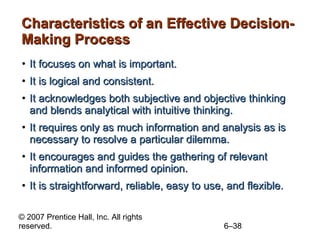
Characteristics of an Effective Decision-Making Process It focuses on what is important. It is logical and consistent. It acknowledges both subjective and objective thinking and blends analytical with intuitive thinking. It requires only as much information and analysis as is necessary to resolve a particular dilemma. It encourages and guides the gathering of relevant information and informed opinion. It is straightforward, reliable, easy to use, and flexible.
Terms to Know decision decision-making process problem decision criteria rational decision making bounded rationality satisficing escalation of commitment intuitive decision making structured problems programmed decision procedure rule policy unstructured problems nonprogrammed decisions certainty risk uncertainty directive style analytic style conceptual style behavioral style heuristics business performance management (BPM) software

Session 2

  • 1.
    Decision-Making: The Essenceof the Manager’s Job
  • 2.
    Decision Making DecisionMaking a choice from two or more alternatives. The Decision-Making Process Identifying a problem and decision criteria and allocating weights to the criteria. Developing, analyzing, and selecting an alternative that can resolve the problem. Implementing the selected alternative. Evaluating the decision’s effectiveness.
  • 3.
    Exhibit 6–1 TheDecision-Making Process
  • 4.
    Step 1: Identifyingthe Problem Problem A discrepancy between an existing and desired state of affairs. Characteristics of Problems A problem becomes a problem when a manager becomes aware of it. There is pressure to solve the problem. The manager must have the authority, information, or resources needed to solve the problem.
  • 5.
    Step 2: IdentifyingDecision Criteria Decision criteria are factors that are important (relevant) to resolving the problem. Costs that will be incurred (investments required) Risks likely to be encountered (chance of failure) Outcomes that are desired (growth of the firm) Step 3: Allocating Weights to the Criteria Decision criteria are not of equal importance: Assigning a weight to each item places the items in the correct priority order of their importance in the decision making process.
  • 6.
    Exhibit 6–2 Criteriaand Weights for Computer Replacement Decision Criterion Weight Memory and Storage 10 Battery life 8 Carrying Weight 6 Warranty 4 Display Quality 3
  • 7.
    Step 4: DevelopingAlternatives Identifying viable alternatives Alternatives are listed (without evaluation) that can resolve the problem. Step 5: Analyzing Alternatives Appraising each alternative’s strengths and weaknesses An alternative’s appraisal is based on its ability to resolve the issues identified in steps 2 and 3.
  • 8.
    Exhibit 6–3 AssessedValues of Laptop Computers Using Decision Criteria
  • 9.
    Step 6: Selectingan Alternative Choosing the best alternative The alternative with the highest total weight is chosen. Step 7: Implementing the Alternative Putting the chosen alternative into action. Conveying the decision to and gaining commitment from those who will carry out the decision.
  • 10.
    Exhibit 6–4 Evaluationof Laptop Alternatives Against Weighted Criteria
  • 11.
    Step 8: Evaluatingthe Decision’s Effectiveness The soundness of the decision is judged by its outcomes. How effectively was the problem resolved by outcomes resulting from the chosen alternatives? If the problem was not resolved, what went wrong?
  • 12.
    Exhibit 6–5 Decisionsin the Management Functions
  • 13.
    Making Decisions RationalityManagers make consistent, value-maximizing choices with specified constraints. Assumptions are that decision makers: Are perfectly rational, fully objective, and logical. Have carefully defined the problem and identified all viable alternatives. Have a clear and specific goal Will select the alternative that maximizes outcomes in the organization’s interests rather than in their personal interests.
  • 14.
  • 15.
    Making Decisions (cont’d)Bounded Rationality Managers make decisions rationally, but are limited (bounded) by their ability to process information. Assumptions are that decision makers: Will not seek out or have knowledge of all alternatives Will satisfice —choose the first alternative encountered that satisfactorily solves the problem— rather than maximize the outcome of their decision by considering all alternatives and choosing the best. Influence on decision making Escalation of commitment: an increased commitment to a previous decision despite evidence that it may have been wrong.
  • 16.
    The Role ofIntuition Intuitive decision making Making decisions on the basis of experience, feelings, and accumulated judgment.
  • 17.
    Exhibit 6–7 Whatis Intuition? Source: Based on L. A. Burke and M. K. Miller, “Taking the Mystery Out of Intuitive Decision Making,” Academy of Management Executive , October 1999, pp. 91–99.
  • 18.
    Types of Problemsand Decisions Structured Problems Involve goals that clear. Are familiar (have occurred before). Are easily and completely defined —infor mation about the problem is available and complete. Programmed Decision A repetitive decision that can be handled by a routine approach.
  • 19.
    Types of ProgrammedDecisions Policy A general guideline for making a decision about a structured problem. Procedure A series of interrelated steps that a manager can use to respond (applying a policy) to a structured problem. Rule An explicit statement that limits what a manager or employee can or cannot do.
  • 20.
    Policy, Procedure, andRule Examples Policy Accept all customer-returned merchandise. Procedure Follow all steps for completing merchandise return documentation. Rules Managers must approve all refunds over $50.00. No credit purchases are refunded for cash.
  • 21.
    Problems and Decisions(cont’d) Unstructured Problems Problems that are new or unusual and for which information is ambiguous or incomplete. Problems that will require custom-made solutions. Nonprogrammed Decisions Decisions that are unique and nonrecurring. Decisions that generate unique responses.
  • 22.
    Exhibit 6–8 Programmedversus Nonprogrammed Decisions
  • 23.
    Decision-Making Conditions CertaintyA situation in which a manager can make an accurate decision because the outcome of every alternative choice is known. Risk A situation in which the manager is able to estimate the likelihood (probability) of outcomes that result from the choice of particular alternatives.
  • 24.
    Exhibit 6–9 ExpectedValue for Revenues from the Addition of One Ski Lift Expected Expected × Probability = Value of Each Event Revenues Alternative Heavy snowfall $850,000 0.3 = $255,000 Normal snowfall 725,000 0.5 = 362,500 Light snowfall 350,000 0.2 = 70,000 $687,500
  • 25.
    Decision-Making Conditions UncertaintyLimited information prevents estimation of outcome probabilities for alternatives associated with the problem and may force managers to rely on intuition, hunches, and “gut feelings”. Maximax: the optimistic manager’s choice to maximize the maximum payoff Maximin: the pessimistic manager’s choice to maximize the minimum payoff Minimax: the manager’s choice to minimize maximum regret.
  • 26.
  • 27.
  • 28.
    Decision-Making Styles Dimensionsof Decision-Making Styles Ways of thinking Rational, orderly, and consistent Intuitive, creative, and unique Tolerance for ambiguity Low tolerance: require consistency and order High tolerance: multiple thoughts simultaneously
  • 29.
    Decision-Making Styles (cont’d)Types of Decision Makers Directive Use minimal information and consider few alternatives. Analytic Make careful decisions in unique situations. Conceptual Maintain a broad outlook and consider many alternatives in making decisions. Behavioral Avoid conflict by working well with others and being receptive to suggestions.
  • 30.
  • 31.
    Exhibit 6–13 CommonDecision-Making Errors and Biases
  • 32.
    Decision-Making Biases andErrors Heuristics Using “rules of thumb” to simplify decision making. Overconfidence Bias Holding unrealistically positive views of one’s self and one’s performance. Immediate Gratification Bias Choosing alternatives that offer immediate rewards and that to avoid immediate costs.
  • 33.
    Decision-Making Biases andErrors (cont’d) Anchoring Effect Fixating on initial information and ignoring subsequent information. Selective Perception Bias Selecting organizing and interpreting events based on the decision maker’s biased perceptions. Confirmation Bias Seeking out information that reaffirms past choices and discounting contradictory information.
  • 34.
    Decision-Making Biases andErrors (cont’d) Framing Bias Selecting and highlighting certain aspects of a situation while ignoring other aspects. Availability Bias Losing decision-making objectivity by focusing on the most recent events. Representation Bias Drawing analogies and seeing identical situations when none exist. Randomness Bias Creating unfounded meaning out of random events.
  • 35.
    Decision-Making Biases andErrors (cont’d) Sunk Costs Errors Forgetting that current actions cannot influence past events and relate only to future consequences. Self-Serving Bias Taking quick credit for successes and blaming outside factors for failures. Hindsight Bias Mistakenly believing that an event could have been predicted once the actual outcome is known (after-the-fact).
  • 36.
    Exhibit 6–14 Overviewof Managerial Decision Making
  • 37.
    Decision Making forToday’s World Guidelines for making effective decisions: Understand cultural differences. Know when it’s time to call it quits. Use an effective decision-making process. Habits of highly reliable organizations (HROs) Are not tricked by their success. Defer to the experts on the front line. Let unexpected circumstances provide the solution. Embrace complexity. Anticipate, but also anticipate their limits.
  • 38.
    Characteristics of anEffective Decision-Making Process It focuses on what is important. It is logical and consistent. It acknowledges both subjective and objective thinking and blends analytical with intuitive thinking. It requires only as much information and analysis as is necessary to resolve a particular dilemma. It encourages and guides the gathering of relevant information and informed opinion. It is straightforward, reliable, easy to use, and flexible.
  • 39.
    Terms to Knowdecision decision-making process problem decision criteria rational decision making bounded rationality satisficing escalation of commitment intuitive decision making structured problems programmed decision procedure rule policy unstructured problems nonprogrammed decisions certainty risk uncertainty directive style analytic style conceptual style behavioral style heuristics business performance management (BPM) software