Data Flow Diagram
Creating data flow diagrams to understand business processes
Prepared by
Mahmudur Rashid (PHP Developer)
Anowar Hossain (PHP Developer)
About this presentation
 In this presentation we are going to briefly
 Describe what is DFD.
 Why Should Use DFD ?
 Components of a generic DFD.
 Levels of DFD.
 DFD with an example (SMS Mela).
What Is DFD
 It’s a graphical representation of the "flow" of
data through an information system.
 Data flow diagrams show:
Data flowing through a system to or from
external entities.
The processes that transform the data.
The data stores that hold the data.
Why we should Use DFD?
 In describing the boundaries of the system.
 For communicating existing system knowledge to the
users.
 A straightforward graphical technique which is easy
to recognize.
 To understand detailed representation of system
components.
 Used as the part of system documentation file.
 Easier to understand by technical and nontechnical
audiences
 Finding out the logic behind the data flow within the
system.
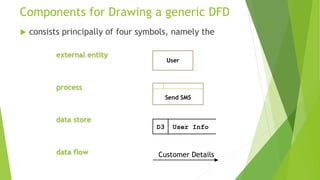
Components for Drawing a generic DFD
 consists principally of four symbols, namely the
external entity
process
data store
data flow
User
Send SMS
D3 User Info
Customer Details
Levels of DFD
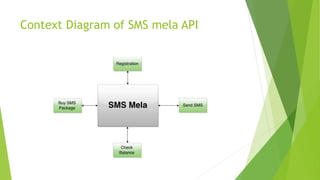
 Context Diagram:
Shows the context into which the business process
fits which shows overall business process as just one
process.
Shows the Shows all the outside entities that receive
information from or contribute information to the
system.
No data store.
Levels of DFD
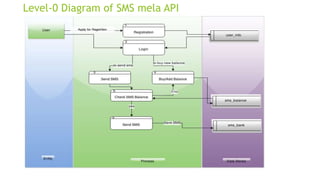
 Level 0 Diagram:
 Shows all the processes that comprise the overall
system
 Shows how information moves from and to each process
 Adds data stores
Levels of DFD
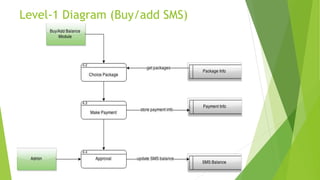
 Level 1 Diagrams
 Shows single process on the level 0 diagram
 Shows how information moves from and to each of
these processes.
 Shows in more detail the content of higher level
process.
 Level 1 diagrams may not be needed for all level 0
processes.
Then it may be Level-2 or 3 and so on ..(if required)
Next section will continued by:
Md. Anowar Hossian
A short brief about the proposed system
 Here we are going to create a DFD for SMS Mela.
 The core task of the proposed system that the system will used for:
 to register customer and store customer data
 buy and sell SMS packages.
 create user, packages, categories.
 send SMS via customer.
 manage user and customer.
 store SMS log and data.
As there may possible to produce a several no of DFD from the above
scenario here we only represent the DFD which describes user core tasks
with the system.
Context Diagram of SMS mela API
Level-0 Diagram of SMS mela API
Level-1 Diagram (Buy/add SMS)
Summary
 From the overall presentation we could make this decision that DFD could be
very beneficial in System development life cycle. Despite it may consume
some project time in the beginning of the project but will return benefits in
the long run. It is also very much handy for collecting user requirements. So
we should use DFD for our best purpose.
Thank You

Data Flow Diagram (DFD)

  • 1.
    Data Flow Diagram Creatingdata flow diagrams to understand business processes Prepared by Mahmudur Rashid (PHP Developer) Anowar Hossain (PHP Developer)
  • 2.
    About this presentation In this presentation we are going to briefly  Describe what is DFD.  Why Should Use DFD ?  Components of a generic DFD.  Levels of DFD.  DFD with an example (SMS Mela).
  • 3.
    What Is DFD It’s a graphical representation of the "flow" of data through an information system.  Data flow diagrams show: Data flowing through a system to or from external entities. The processes that transform the data. The data stores that hold the data.
  • 4.
    Why we shouldUse DFD?  In describing the boundaries of the system.  For communicating existing system knowledge to the users.  A straightforward graphical technique which is easy to recognize.  To understand detailed representation of system components.  Used as the part of system documentation file.  Easier to understand by technical and nontechnical audiences  Finding out the logic behind the data flow within the system.
  • 5.
    Components for Drawinga generic DFD  consists principally of four symbols, namely the external entity process data store data flow User Send SMS D3 User Info Customer Details
  • 6.
    Levels of DFD Context Diagram: Shows the context into which the business process fits which shows overall business process as just one process. Shows the Shows all the outside entities that receive information from or contribute information to the system. No data store.
  • 7.
    Levels of DFD Level 0 Diagram:  Shows all the processes that comprise the overall system  Shows how information moves from and to each process  Adds data stores
  • 8.
    Levels of DFD Level 1 Diagrams  Shows single process on the level 0 diagram  Shows how information moves from and to each of these processes.  Shows in more detail the content of higher level process.  Level 1 diagrams may not be needed for all level 0 processes. Then it may be Level-2 or 3 and so on ..(if required)
  • 9.
    Next section willcontinued by: Md. Anowar Hossian
  • 10.
    A short briefabout the proposed system  Here we are going to create a DFD for SMS Mela.  The core task of the proposed system that the system will used for:  to register customer and store customer data  buy and sell SMS packages.  create user, packages, categories.  send SMS via customer.  manage user and customer.  store SMS log and data. As there may possible to produce a several no of DFD from the above scenario here we only represent the DFD which describes user core tasks with the system.
  • 11.
    Context Diagram ofSMS mela API
  • 12.
    Level-0 Diagram ofSMS mela API
  • 13.
  • 14.
    Summary  From theoverall presentation we could make this decision that DFD could be very beneficial in System development life cycle. Despite it may consume some project time in the beginning of the project but will return benefits in the long run. It is also very much handy for collecting user requirements. So we should use DFD for our best purpose.
  • 15.