
Data Flow Diagrams
Prepared by: SARFARAZ
What are DFDs?
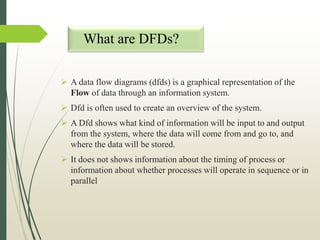
 A data flow diagrams (dfds) is a graphical representation of the
Flow of data through an information system.
 Dfd is often used to create an overview of the system.
 A Dfd shows what kind of information will be input to and output
from the system, where the data will come from and go to, and
where the data will be stored.
 It does not shows information about the timing of process or
information about whether processes will operate in sequence or in
parallel
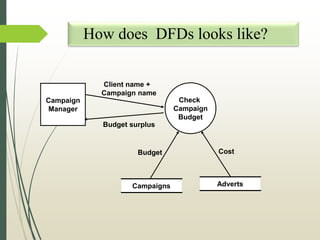
How does DFDs looks like?
Check
Campaign
Budget
Campaign
Manager
Client name +
Campaign name
Budget surplus
Campaigns Adverts
Budget Cost
Elements of DFDs
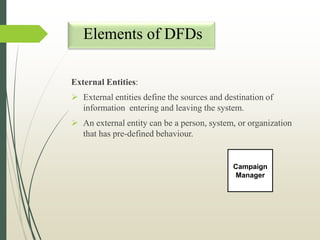
External Entities:
 External entities define the sources and destination of
information entering and leaving the system.
 An external entity can be a person, system, or organization
that has pre-defined behaviour.
Campaign
Manager
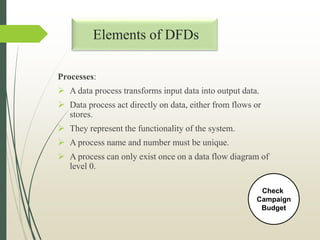
Processes:
 A data process transforms input data into output data.
 Data process act directly on data, either from flows or
stores.
 They represent the functionality of the system.
 A process name and number must be unique.
 A process can only exist once on a data flow diagram of
level 0.
Check
Campaign
Budget
Elements of DFDs
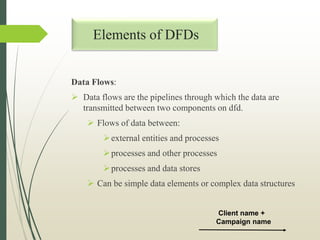
Data Flows:
 Data flows are the pipelines through which the data are
transmitted between two components on dfd.
 Flows of data between:
external entities and processes
processes and other processes
processes and data stores
 Can be simple data elements or complex data structures
Client name +
Campaign name
Elements of DFDs
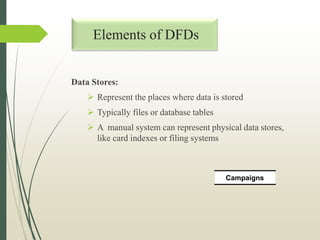
Data Stores:
 Represent the places where data is stored
 Typically files or database tables
 A manual system can represent physical data stores,
like card indexes or filing systems
Campaigns
Elements of DFDs
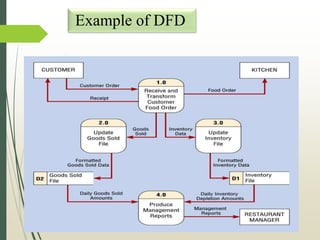
Example of DFD
Advantages of DFDs
 It is simple graphical technique which is easy to
understand.
 It is useful for communicating current system knowledge to
the user.
 It explains the logic behind the flow within the system.
Data flow Diagram (DFD)

Data flow Diagram (DFD)

  • 1.
  • 2.
    What are DFDs? A data flow diagrams (dfds) is a graphical representation of the Flow of data through an information system.  Dfd is often used to create an overview of the system.  A Dfd shows what kind of information will be input to and output from the system, where the data will come from and go to, and where the data will be stored.  It does not shows information about the timing of process or information about whether processes will operate in sequence or in parallel
  • 3.
    How does DFDslooks like? Check Campaign Budget Campaign Manager Client name + Campaign name Budget surplus Campaigns Adverts Budget Cost
  • 4.
    Elements of DFDs ExternalEntities:  External entities define the sources and destination of information entering and leaving the system.  An external entity can be a person, system, or organization that has pre-defined behaviour. Campaign Manager
  • 5.
    Processes:  A dataprocess transforms input data into output data.  Data process act directly on data, either from flows or stores.  They represent the functionality of the system.  A process name and number must be unique.  A process can only exist once on a data flow diagram of level 0. Check Campaign Budget Elements of DFDs
  • 6.
    Data Flows:  Dataflows are the pipelines through which the data are transmitted between two components on dfd.  Flows of data between: external entities and processes processes and other processes processes and data stores  Can be simple data elements or complex data structures Client name + Campaign name Elements of DFDs
  • 7.
    Data Stores:  Representthe places where data is stored  Typically files or database tables  A manual system can represent physical data stores, like card indexes or filing systems Campaigns Elements of DFDs
  • 8.
  • 9.
    Advantages of DFDs It is simple graphical technique which is easy to understand.  It is useful for communicating current system knowledge to the user.  It explains the logic behind the flow within the system.