Database Systems: Design,
Implementation, and
Management
Eighth Edition
Chapter 12
Distributed Database Management
Systems
Database Systems, 8th
Edition 2
Objectives
• In this chapter, you will learn:
– What a distributed database management
system (DDBMS) is and what its components
are
– How database implementation is affected by
different levels of data and process distribution
– How transactions are managed in a distributed
database environment
– How database design is affected by the
distributed database environment
Database Systems, 8th
Edition 3
The Evolution of Distributed Database
Management Systems
• Distributed database management system
(DDBMS)
– Governs storage and processing of logically
related data
– Interconnected computer systems
– Both data and processing functions are
distributed among several sites
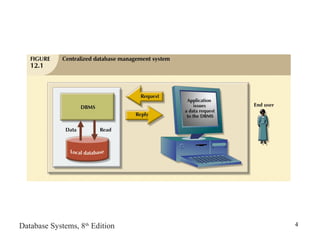
• Centralized database required that corporate
data be stored in a single central site
Database Systems, 8th
Edition 4
Database Systems, 8th
Edition 5
DDBMS Advantages and
Disadvantages
• Advantages:
– Data are located near “greatest demand” site
– Faster data access
– Faster data processing
– Growth facilitation
– Improved communications
– Reduced operating costs
– User-friendly interface
– Less danger of a single-point failure
– Processor independence
Database Systems, 8th
Edition 6
DDBMS Advantages and
Disadvantages (continued)
• Disadvantages:
– Complexity of management and control
– Security
– Lack of standards
– Increased storage requirements
– Increased training cost
Database Systems, 8th
Edition 7
Database Systems, 8th
Edition 8
Distributed Processing
and Distributed Databases
• Distributed processing
– Database’s logical processing is shared among
two or more physically independent sites
– Connected through a network
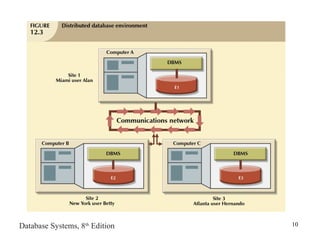
• Distributed database
– Stores logically related database over two or
more physically independent sites
– Database composed of database fragments
Database Systems, 8th
Edition 9
Database Systems, 8th
Edition 10
Database Systems, 8th
Edition 11
Characteristics of Distributed
Management Systems
• Application interface
• Validation
• Transformation
• Query optimization
• Mapping
• I/O interface
Database Systems, 8th
Edition 12
Characteristics of Distributed
Management Systems (continued)
• Formatting
• Security
• Backup and recovery
• DB administration
• Concurrency control
• Transaction management
Database Systems, 8th
Edition 13
Characteristics of Distributed
Management Systems (continued)
• Must perform all the functions of centralized
DBMS
• Must handle all necessary functions imposed
by distribution of data and processing
– Must perform these additional functions
transparently to the end user
Database Systems, 8th
Edition 14
Database Systems, 8th
Edition 15
DDBMS Components
• Must include (at least) the following
components:
– Computer workstations
– Network hardware and software
– Communications media
– Transaction processor (application
processor, transaction manager)
• Software component found in each computer that
requests data
Database Systems, 8th
Edition 16
DDBMS Components (continued)
• Must include (at least) the following
components: (continued)
– Data processor or data manager
• Software component residing on each computer
that stores and retrieves data located at the site
• May be a centralized DBMS
Database Systems, 8th
Edition 17
Database Systems, 8th
Edition 18
Levels of Data
and Process Distribution
• Current systems classified by how process
distribution and data distribution supported
Database Systems, 8th
Edition 19
Single-Site Processing,
Single-Site Data (SPSD)
• All processing is done on single CPU or host
computer (mainframe, midrange, or PC)
• All data are stored on host computer’s local
disk
• Processing cannot be done on end user’s side
of system
• Typical of most mainframe and midrange
computer DBMSs
• DBMS is located on host computer, which is
accessed by dumb terminals connected to it
Database Systems, 8th
Edition 20
Database Systems, 8th
Edition 21
Multiple-Site Processing,
Single-Site Data (MPSD)
• Multiple processes run on different computers
sharing single data repository
• MPSD scenario requires network file server
running conventional applications
– Accessed through LAN
• Many multiuser accounting applications,
running under personal computer network
Database Systems, 8th
Edition 22
Database Systems, 8th
Edition 23
Multiple-Site Processing,
Multiple-Site Data (MPMD)
• Fully distributed database management system
• Support for multiple data processors and
transaction processors at multiple sites
• Classified as either homogeneous or
heterogeneous
• Homogeneous DDBMSs
– Integrate only one type of centralized DBMS
over a network
Database Systems, 8th
Edition 24
Multiple-Site Processing,
Multiple-Site Data (MPMD) (continued)
• Heterogeneous DDBMSs
– Integrate different types of centralized DBMSs
over a network
• Fully heterogeneous DDBMSs
– Support different DBMSs
– Support different data models (relational,
hierarchical, or network)
– Different computer systems, such as
mainframes and microcomputers
Database Systems, 8th
Edition 25
Database Systems, 8th
Edition 26
Distributed Database
Transparency Features
• Allow end user to feel like database’s only user
• Features include:
– Distribution transparency
– Transaction transparency
– Failure transparency
– Performance transparency
– Heterogeneity transparency
Database Systems, 8th
Edition 27
Distribution Transparency
• Allows management of physically dispersed
database as if centralized
• Three levels of distribution transparency:
– Fragmentation transparency
– Location transparency
– Local mapping transparency
Database Systems, 8th
Edition 28
Database Systems, 8th
Edition 29
Transaction Transparency
• Ensures database transactions will maintain
distributed database’s integrity and consistency
• Ensures transaction completed only when all
database sites involved complete their part
• Distributed database systems require complex
mechanisms to manage transactions
– To ensure consistency and integrity
Database Systems, 8th
Edition 30
Distributed Requests and Distributed
Transactions
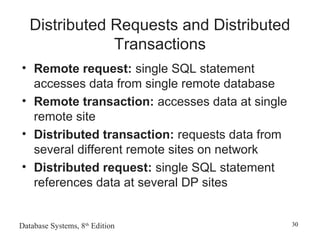
• Remote request: single SQL statement
accesses data from single remote database
• Remote transaction: accesses data at single
remote site
• Distributed transaction: requests data from
several different remote sites on network
• Distributed request: single SQL statement
references data at several DP sites
Database Systems, 8th
Edition 31
Distributed Concurrency Control
• Concurrency control important in distributed
environment
– Multisite multiple-process operations create
inconsistencies and deadlocked transactions
Database Systems, 8th
Edition 32
Database Systems, 8th
Edition 33
Two-Phase Commit Protocol
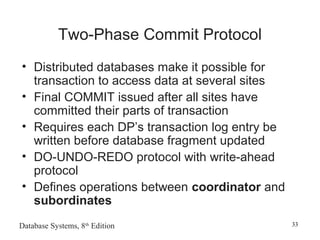
• Distributed databases make it possible for
transaction to access data at several sites
• Final COMMIT issued after all sites have
committed their parts of transaction
• Requires each DP’s transaction log entry be
written before database fragment updated
• DO-UNDO-REDO protocol with write-ahead
protocol
• Defines operations between coordinator and
subordinates
Database Systems, 8th
Edition 34
Performance Transparency
and Query Optimization
• Query optimization routine minimizes total
cost of request
• Costs a function of:
– Access time (I/O) cost
– Communication cost
– CPU time cost
• Must provide distribution transparency as well
as replica transparency
Database Systems, 8th
Edition 35
Performance Transparency
and Query Optimization (continued)
• Replica transparency
– DDBMS’s ability to hide existence of multiple
copies of data from user
• Query optimization:
– Manual or automatic
– Static or dynamic
– Statistically based or rule-based algorithms
Database Systems, 8th
Edition 36
Distributed Database Design
• Data fragmentation
– How to partition database into fragments
• Data replication
– Which fragments to replicate
• Data allocation
– Where to locate those fragments and replicas
Database Systems, 8th
Edition 37
Data Fragmentation
• Breaks single object into two or more segments
or fragments
• Each fragment can be stored at any site over
computer network
• Information stored in distributed data catalog
(DDC)
– Accessed by TP to process user requests
Database Systems, 8th
Edition 38
Data Fragmentation (continued)
• Strategies
– Horizontal fragmentation
• Division of a relation into subsets (fragments) of
tuples (rows)
– Vertical fragmentation
• Division of a relation into attribute (column)
subsets
– Mixed fragmentation
• Combination of horizontal and vertical strategies
Database Systems, 8th
Edition 39
Data Replication
• Data copies stored at multiple sites served by
computer network
• Fragment copies stored at several sites to
serve specific information requirements
– Enhance data availability and response time
– Reduce communication and total query costs
• Mutual consistency rule: all copies of data
fragments must be identical
Database Systems, 8th
Edition 40
Data Replication (continued)
• Fully replicated database
– Stores multiple copies of each database
fragment at multiple sites
– Can be impractical due to amount of overhead
• Partially replicated database
– Stores multiple copies of some database
fragments at multiple sites
• Unreplicated database
– Stores each database fragment at single site
– No duplicate database fragments
Database Systems, 8th
Edition 41
Data Allocation
• Deciding where to locate data
– Centralized data allocation
• Entire database is stored at one site
– Partitioned data allocation
• Database is divided into several disjointed parts
(fragments) and stored at several sites
– Replicated data allocation
• Copies of one or more database fragments are
stored at several sites
Database Systems, 8th
Edition 42
Client/Server vs. DDBMS
• Way in which computers interact to form
system
• Features user of resources, or client, and
provider of resources, or server
• Can be used to implement a DBMS in which
client is the TP and server is the DP
Database Systems, 8th
Edition 43
Client/Server vs. DDBMS (continued)
• Client/server advantages
– Less expensive than alternate minicomputer or
mainframe solutions
– Allows end user to use microcomputer’s GUI,
thereby improving functionality and simplicity
– More people in job market have PC skills than
mainframe skills
– PC is well established in workplace
Database Systems, 8th
Edition 44
Client/Server vs. DDBMS (continued)
• Client/server advantages (continued)
– Data analysis and query tools facilitate
interaction with DBMSs
– Considerable cost advantage to offloading
applications development to PCs
Database Systems, 8th
Edition 45
Client/Server vs. DDBMS (continued)
• Client/server disadvantages
– More complex environment
– Increase in number of users and processing
sites causes security problems
– Possible to spread data access to much wider
circle of users
• Increases demand for people with broad
knowledge of computers and software
• Increases burden of training and cost of
maintaining the environment
Database Systems, 8th
Edition 46
C. J. Date’s Twelve Commandments
for Distributed Databases
• Local site independence
• Central site independence
• Failure independence
• Location transparency
• Fragmentation transparency
• Replication transparency
Database Systems, 8th
Edition 47
C. J. Date’s Twelve Commandments
for Distributed Databases (continued)
• Distributed query processing
• Distributed transaction processing
• Hardware independence
• Operating system independence
• Network independence
• Database independence
Database Systems, 8th
Edition 48
Summary
• Distributed database: logically related data in
two or more physically independent sites
– Connected via computer network
• Distributed processing: division of logical
database processing among network nodes
• Distributed databases require distributed
processing
• Main components of DDBMS are transaction
processor and data processor
Database Systems, 8th
Edition 49
Summary (continued)
• Current database systems:
– Homogeneous distributed database system
• Integrates one type of DBMS over computer
network
– Heterogeneous distributed database system
• Integrates several types of DBMS over computer
network
Database Systems, 8th
Edition 50
Summary (continued)
• DDBMS characteristics are a set of
transparencies
• Transaction is formed by one or more database
requests
• Distributed concurrency control is required in
network of distributed databases
• Distributed DBMS evaluates every data request
– Finds optimum access path in distributed
database
Database Systems, 8th
Edition 51
Summary (continued)
• The design of distributed database must
consider fragmentation and replication of data
• Database can be replicated over several
different sites on computer network
• Client/server architecture: two computers
interact over a network to form a system

Distributed database management systems

  • 1.
    Database Systems: Design, Implementation,and Management Eighth Edition Chapter 12 Distributed Database Management Systems
  • 2.
    Database Systems, 8th Edition2 Objectives • In this chapter, you will learn: – What a distributed database management system (DDBMS) is and what its components are – How database implementation is affected by different levels of data and process distribution – How transactions are managed in a distributed database environment – How database design is affected by the distributed database environment
  • 3.
    Database Systems, 8th Edition3 The Evolution of Distributed Database Management Systems • Distributed database management system (DDBMS) – Governs storage and processing of logically related data – Interconnected computer systems – Both data and processing functions are distributed among several sites • Centralized database required that corporate data be stored in a single central site
  • 4.
  • 5.
    Database Systems, 8th Edition5 DDBMS Advantages and Disadvantages • Advantages: – Data are located near “greatest demand” site – Faster data access – Faster data processing – Growth facilitation – Improved communications – Reduced operating costs – User-friendly interface – Less danger of a single-point failure – Processor independence
  • 6.
    Database Systems, 8th Edition6 DDBMS Advantages and Disadvantages (continued) • Disadvantages: – Complexity of management and control – Security – Lack of standards – Increased storage requirements – Increased training cost
  • 7.
  • 8.
    Database Systems, 8th Edition8 Distributed Processing and Distributed Databases • Distributed processing – Database’s logical processing is shared among two or more physically independent sites – Connected through a network • Distributed database – Stores logically related database over two or more physically independent sites – Database composed of database fragments
  • 9.
  • 10.
  • 11.
    Database Systems, 8th Edition11 Characteristics of Distributed Management Systems • Application interface • Validation • Transformation • Query optimization • Mapping • I/O interface
  • 12.
    Database Systems, 8th Edition12 Characteristics of Distributed Management Systems (continued) • Formatting • Security • Backup and recovery • DB administration • Concurrency control • Transaction management
  • 13.
    Database Systems, 8th Edition13 Characteristics of Distributed Management Systems (continued) • Must perform all the functions of centralized DBMS • Must handle all necessary functions imposed by distribution of data and processing – Must perform these additional functions transparently to the end user
  • 14.
  • 15.
    Database Systems, 8th Edition15 DDBMS Components • Must include (at least) the following components: – Computer workstations – Network hardware and software – Communications media – Transaction processor (application processor, transaction manager) • Software component found in each computer that requests data
  • 16.
    Database Systems, 8th Edition16 DDBMS Components (continued) • Must include (at least) the following components: (continued) – Data processor or data manager • Software component residing on each computer that stores and retrieves data located at the site • May be a centralized DBMS
  • 17.
  • 18.
    Database Systems, 8th Edition18 Levels of Data and Process Distribution • Current systems classified by how process distribution and data distribution supported
  • 19.
    Database Systems, 8th Edition19 Single-Site Processing, Single-Site Data (SPSD) • All processing is done on single CPU or host computer (mainframe, midrange, or PC) • All data are stored on host computer’s local disk • Processing cannot be done on end user’s side of system • Typical of most mainframe and midrange computer DBMSs • DBMS is located on host computer, which is accessed by dumb terminals connected to it
  • 20.
  • 21.
    Database Systems, 8th Edition21 Multiple-Site Processing, Single-Site Data (MPSD) • Multiple processes run on different computers sharing single data repository • MPSD scenario requires network file server running conventional applications – Accessed through LAN • Many multiuser accounting applications, running under personal computer network
  • 22.
  • 23.
    Database Systems, 8th Edition23 Multiple-Site Processing, Multiple-Site Data (MPMD) • Fully distributed database management system • Support for multiple data processors and transaction processors at multiple sites • Classified as either homogeneous or heterogeneous • Homogeneous DDBMSs – Integrate only one type of centralized DBMS over a network
  • 24.
    Database Systems, 8th Edition24 Multiple-Site Processing, Multiple-Site Data (MPMD) (continued) • Heterogeneous DDBMSs – Integrate different types of centralized DBMSs over a network • Fully heterogeneous DDBMSs – Support different DBMSs – Support different data models (relational, hierarchical, or network) – Different computer systems, such as mainframes and microcomputers
  • 25.
  • 26.
    Database Systems, 8th Edition26 Distributed Database Transparency Features • Allow end user to feel like database’s only user • Features include: – Distribution transparency – Transaction transparency – Failure transparency – Performance transparency – Heterogeneity transparency
  • 27.
    Database Systems, 8th Edition27 Distribution Transparency • Allows management of physically dispersed database as if centralized • Three levels of distribution transparency: – Fragmentation transparency – Location transparency – Local mapping transparency
  • 28.
  • 29.
    Database Systems, 8th Edition29 Transaction Transparency • Ensures database transactions will maintain distributed database’s integrity and consistency • Ensures transaction completed only when all database sites involved complete their part • Distributed database systems require complex mechanisms to manage transactions – To ensure consistency and integrity
  • 30.
    Database Systems, 8th Edition30 Distributed Requests and Distributed Transactions • Remote request: single SQL statement accesses data from single remote database • Remote transaction: accesses data at single remote site • Distributed transaction: requests data from several different remote sites on network • Distributed request: single SQL statement references data at several DP sites
  • 31.
    Database Systems, 8th Edition31 Distributed Concurrency Control • Concurrency control important in distributed environment – Multisite multiple-process operations create inconsistencies and deadlocked transactions
  • 32.
  • 33.
    Database Systems, 8th Edition33 Two-Phase Commit Protocol • Distributed databases make it possible for transaction to access data at several sites • Final COMMIT issued after all sites have committed their parts of transaction • Requires each DP’s transaction log entry be written before database fragment updated • DO-UNDO-REDO protocol with write-ahead protocol • Defines operations between coordinator and subordinates
  • 34.
    Database Systems, 8th Edition34 Performance Transparency and Query Optimization • Query optimization routine minimizes total cost of request • Costs a function of: – Access time (I/O) cost – Communication cost – CPU time cost • Must provide distribution transparency as well as replica transparency
  • 35.
    Database Systems, 8th Edition35 Performance Transparency and Query Optimization (continued) • Replica transparency – DDBMS’s ability to hide existence of multiple copies of data from user • Query optimization: – Manual or automatic – Static or dynamic – Statistically based or rule-based algorithms
  • 36.
    Database Systems, 8th Edition36 Distributed Database Design • Data fragmentation – How to partition database into fragments • Data replication – Which fragments to replicate • Data allocation – Where to locate those fragments and replicas
  • 37.
    Database Systems, 8th Edition37 Data Fragmentation • Breaks single object into two or more segments or fragments • Each fragment can be stored at any site over computer network • Information stored in distributed data catalog (DDC) – Accessed by TP to process user requests
  • 38.
    Database Systems, 8th Edition38 Data Fragmentation (continued) • Strategies – Horizontal fragmentation • Division of a relation into subsets (fragments) of tuples (rows) – Vertical fragmentation • Division of a relation into attribute (column) subsets – Mixed fragmentation • Combination of horizontal and vertical strategies
  • 39.
    Database Systems, 8th Edition39 Data Replication • Data copies stored at multiple sites served by computer network • Fragment copies stored at several sites to serve specific information requirements – Enhance data availability and response time – Reduce communication and total query costs • Mutual consistency rule: all copies of data fragments must be identical
  • 40.
    Database Systems, 8th Edition40 Data Replication (continued) • Fully replicated database – Stores multiple copies of each database fragment at multiple sites – Can be impractical due to amount of overhead • Partially replicated database – Stores multiple copies of some database fragments at multiple sites • Unreplicated database – Stores each database fragment at single site – No duplicate database fragments
  • 41.
    Database Systems, 8th Edition41 Data Allocation • Deciding where to locate data – Centralized data allocation • Entire database is stored at one site – Partitioned data allocation • Database is divided into several disjointed parts (fragments) and stored at several sites – Replicated data allocation • Copies of one or more database fragments are stored at several sites
  • 42.
    Database Systems, 8th Edition42 Client/Server vs. DDBMS • Way in which computers interact to form system • Features user of resources, or client, and provider of resources, or server • Can be used to implement a DBMS in which client is the TP and server is the DP
  • 43.
    Database Systems, 8th Edition43 Client/Server vs. DDBMS (continued) • Client/server advantages – Less expensive than alternate minicomputer or mainframe solutions – Allows end user to use microcomputer’s GUI, thereby improving functionality and simplicity – More people in job market have PC skills than mainframe skills – PC is well established in workplace
  • 44.
    Database Systems, 8th Edition44 Client/Server vs. DDBMS (continued) • Client/server advantages (continued) – Data analysis and query tools facilitate interaction with DBMSs – Considerable cost advantage to offloading applications development to PCs
  • 45.
    Database Systems, 8th Edition45 Client/Server vs. DDBMS (continued) • Client/server disadvantages – More complex environment – Increase in number of users and processing sites causes security problems – Possible to spread data access to much wider circle of users • Increases demand for people with broad knowledge of computers and software • Increases burden of training and cost of maintaining the environment
  • 46.
    Database Systems, 8th Edition46 C. J. Date’s Twelve Commandments for Distributed Databases • Local site independence • Central site independence • Failure independence • Location transparency • Fragmentation transparency • Replication transparency
  • 47.
    Database Systems, 8th Edition47 C. J. Date’s Twelve Commandments for Distributed Databases (continued) • Distributed query processing • Distributed transaction processing • Hardware independence • Operating system independence • Network independence • Database independence
  • 48.
    Database Systems, 8th Edition48 Summary • Distributed database: logically related data in two or more physically independent sites – Connected via computer network • Distributed processing: division of logical database processing among network nodes • Distributed databases require distributed processing • Main components of DDBMS are transaction processor and data processor
  • 49.
    Database Systems, 8th Edition49 Summary (continued) • Current database systems: – Homogeneous distributed database system • Integrates one type of DBMS over computer network – Heterogeneous distributed database system • Integrates several types of DBMS over computer network
  • 50.
    Database Systems, 8th Edition50 Summary (continued) • DDBMS characteristics are a set of transparencies • Transaction is formed by one or more database requests • Distributed concurrency control is required in network of distributed databases • Distributed DBMS evaluates every data request – Finds optimum access path in distributed database
  • 51.
    Database Systems, 8th Edition51 Summary (continued) • The design of distributed database must consider fragmentation and replication of data • Database can be replicated over several different sites on computer network • Client/server architecture: two computers interact over a network to form a system