Data Encryption Standard (DES)
Prof. Neeraj Bhargava
Kapil Chauhan
Department of Computer Science
School of Engineering & Systems Sciences
MDS University, Ajmer
INTRODUCTION
• The Data Encryption Standard (DES) is a symmetric-
key block cipher .
• Published by the National Institute of Standards and
Technology (NIST).
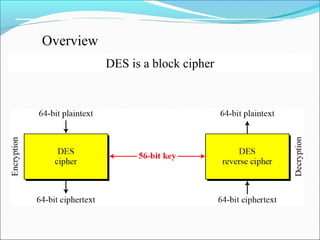
DES is a block cipher
Overview
DES STRUCTURE
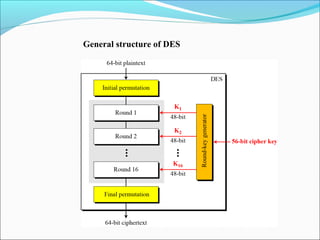
The encryption process is made of two permutations
(P-boxes), which we call initial and final
permutations, and sixteen Feistel rounds.
General structure of DES
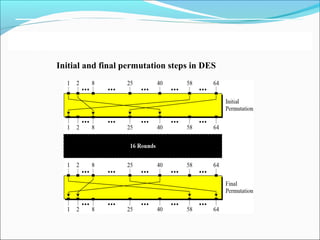
Initial and final permutation steps in DES
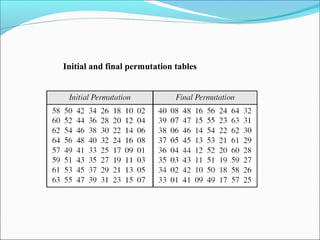
Initial and final permutation tables
Using mixers and swappers, we can create the cipher and
reverse cipher, each having 16 rounds.
Cipher and Reverse Cipher
First Approach
To achieve this goal, one approach is to make the last
round (round 16) different from the others; it has only a
mixer and no swapper.
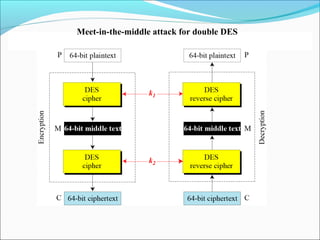
Meet-in-the-middle attack for double DES
Triple DES
Triple DES with Three Keys
The possibility of known-plaintext attacks on triple DES
with two keys has enticed some applications to use triple
DES with three keys. Triple DES with three keys is used
by many applications such as PGP .

Data encryption standard

  • 1.
    Data Encryption Standard(DES) Prof. Neeraj Bhargava Kapil Chauhan Department of Computer Science School of Engineering & Systems Sciences MDS University, Ajmer
  • 2.
    INTRODUCTION • The DataEncryption Standard (DES) is a symmetric- key block cipher . • Published by the National Institute of Standards and Technology (NIST).
  • 3.
    DES is ablock cipher Overview
  • 4.
    DES STRUCTURE The encryptionprocess is made of two permutations (P-boxes), which we call initial and final permutations, and sixteen Feistel rounds.
  • 5.
  • 6.
    Initial and finalpermutation steps in DES
  • 7.
    Initial and finalpermutation tables
  • 8.
    Using mixers andswappers, we can create the cipher and reverse cipher, each having 16 rounds. Cipher and Reverse Cipher First Approach To achieve this goal, one approach is to make the last round (round 16) different from the others; it has only a mixer and no swapper.
  • 9.
  • 10.
    Triple DES Triple DESwith Three Keys The possibility of known-plaintext attacks on triple DES with two keys has enticed some applications to use triple DES with three keys. Triple DES with three keys is used by many applications such as PGP .