MD5
(message digest 5)
Content:
 What is MD5?
 Facts about MD5
 MD5 hashes
 How MD5 works?
 MD5 versus MD4
 MD5 algorithm’s strength
 MD5 security
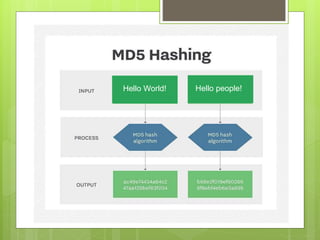
Hello World! Hello people!
What is MD5?
 The MD5 hashing algorithm is a one-way cryptographic function that
accepts a message of any length as input and returns as output a fixed-
length digest value (128-bit) to be used for authenticating the original
message.
 The MD5 hash function was originally designed for use as a secure
cryptographic hash algorithm for authenticating digital signatures.
 MD5 has been deprecated for uses other than as a non-
cryptographic checksum to verify data integrity and detect
unintentional data corruption.
 Although originally designed as a cryptographic message authentication
code algorithm for use on the internet, MD5 hashing is no longer
considered reliable for use as a cryptographic checksum because
researchers have demonstrated techniques capable of easily generating
MD5 collisions on commercial off-the-shelf computers.
 Ronald Rivest, founder of RSA Data Security and Institute professor at
MIT, designed MD5 in 1991 as an improvement to a prior message digest
algorithm, MD4.
 Ronald Rivest wrote: The algorithm takes as input a message of arbitrary
length and produces as output a 128-bit 'message digest' of the input. It is
conjectured that it is computationally infeasible to produce two messages
having the same message digest, or to produce any message having a given
pre-specified target message digest. The MD5 algorithm is intended for
digital signature applications, where a large file must be 'compressed' in a
secure manner before being encrypted with a private (secret) key under a
public-key cryptosystem such as RSA.
 The IETF suggests MD5 hashing can still be used for integrity protection,
noting "Where the MD5 checksum is used inline with the protocol solely to
protect against errors, an MD5 checksum is still an acceptable use."
Facts about MD5:
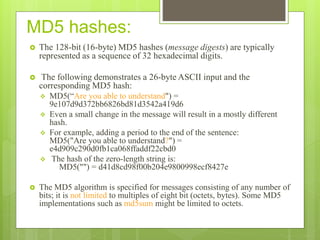
MD5 hashes:
 The 128-bit (16-byte) MD5 hashes (message digests) are typically
represented as a sequence of 32 hexadecimal digits.
 The following demonstrates a 26-byte ASCII input and the
corresponding MD5 hash:
 MD5(“Are you able to understand") =
9e107d9d372bb6826bd81d3542a419d6
 Even a small change in the message will result in a mostly different
hash.
 For example, adding a period to the end of the sentence:
MD5("Are you able to understand?") =
e4d909c290d0fb1ca068ffaddf22cbd0
 The hash of the zero-length string is:
MD5("") = d41d8cd98f00b204e9800998ecf8427e
 The MD5 algorithm is specified for messages consisting of any number of
bits; it is not limited to multiples of eight bit (octets, bytes). Some MD5
implementations such as md5sum might be limited to octets.
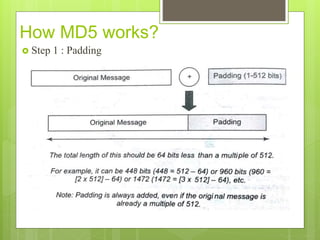
How MD5 works?
 Step 1 : Padding
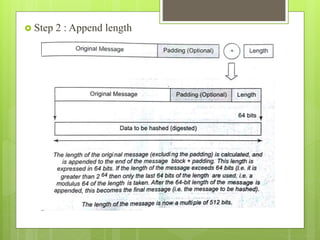
 Step 2 : Append length
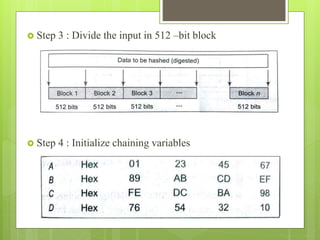
 Step 3 : Divide the input in 512 –bit block
 Step 4 : Initialize chaining variables
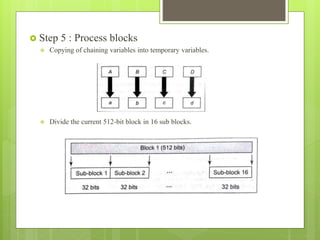
 Step 5 : Process blocks
 Copying of chaining variables into temporary variables.
 Divide the current 512-bit block in 16 sub blocks.
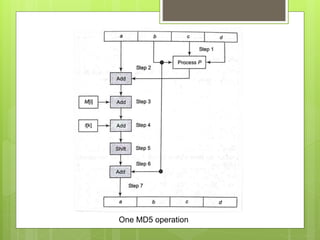
 Conceptual process within a round.
 We can mathematically express a single MD5 operation as follows:
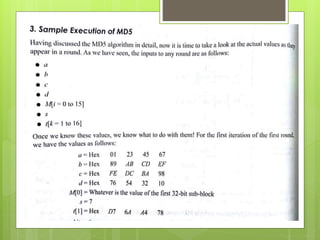
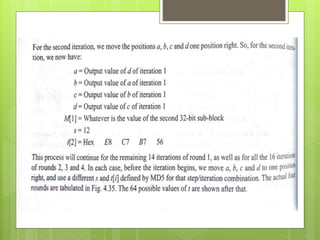
a = b+((a + Process P (b,c,d)+M[i]+t[k])<<<s)
where,
a,b,c,d = Chaining variable
Process P = A non-linear operation
M[i] = M[q*16+i],which is the ith 32-bit word in the
qth 512-bit block of the message
t[k] = A constant
<<<s = Circular shift by s bits
One MD5 operation
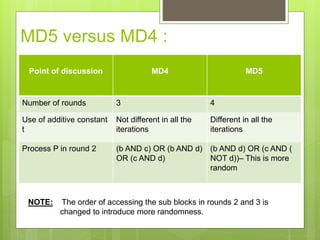
MD5 versus MD4 :
Point of discussion MD4 MD5
Number of rounds 3 4
Use of additive constant
t
Not different in all the
iterations
Different in all the
iterations
Process P in round 2 (b AND c) OR (b AND d)
OR (c AND d)
(b AND d) OR (c AND (
NOT d))– This is more
random
NOTE: The order of accessing the sub blocks in rounds 2 and 3 is
changed to introduce more randomness.
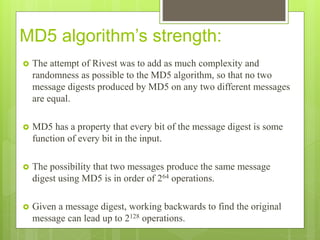
MD5 algorithm’s strength:
 The attempt of Rivest was to add as much complexity and
randomness as possible to the MD5 algorithm, so that no two
message digests produced by MD5 on any two different messages
are equal.
 MD5 has a property that every bit of the message digest is some
function of every bit in the input.
 The possibility that two messages produce the same message
digest using MD5 is in order of 264 operations.
 Given a message digest, working backwards to find the original
message can lead up to 2128 operations.
MD5 security:
 The goal of any message digest function is to produce digests that
appear to be random.
 To be considered cryptographically secure, the hash function should
meet two requirements:
 It is impossible for an attacker to generate a message matching a specific
hash value.
 It is impossible for an attacker to create two messages that produce the same
hash value.
 MD5 hashes are no longer considered cryptographically secure, and
they should not be used for cryptographic authentication.
 In 2011, the IETF published, "Updated Security Considerations for the
MD5 Algorithms" which cited a number of recent attacks against MD5
hashes, especially one that generated hash collisions in a minute or less
on a standard notebook. As a result, the IETF suggested that new
protocol designs should not use MD5 at all.
Thank you

Message digest 5

  • 1.
  • 2.
    Content:  What isMD5?  Facts about MD5  MD5 hashes  How MD5 works?  MD5 versus MD4  MD5 algorithm’s strength  MD5 security
  • 3.
  • 4.
    What is MD5? The MD5 hashing algorithm is a one-way cryptographic function that accepts a message of any length as input and returns as output a fixed- length digest value (128-bit) to be used for authenticating the original message.  The MD5 hash function was originally designed for use as a secure cryptographic hash algorithm for authenticating digital signatures.  MD5 has been deprecated for uses other than as a non- cryptographic checksum to verify data integrity and detect unintentional data corruption.  Although originally designed as a cryptographic message authentication code algorithm for use on the internet, MD5 hashing is no longer considered reliable for use as a cryptographic checksum because researchers have demonstrated techniques capable of easily generating MD5 collisions on commercial off-the-shelf computers.
  • 5.
     Ronald Rivest,founder of RSA Data Security and Institute professor at MIT, designed MD5 in 1991 as an improvement to a prior message digest algorithm, MD4.  Ronald Rivest wrote: The algorithm takes as input a message of arbitrary length and produces as output a 128-bit 'message digest' of the input. It is conjectured that it is computationally infeasible to produce two messages having the same message digest, or to produce any message having a given pre-specified target message digest. The MD5 algorithm is intended for digital signature applications, where a large file must be 'compressed' in a secure manner before being encrypted with a private (secret) key under a public-key cryptosystem such as RSA.  The IETF suggests MD5 hashing can still be used for integrity protection, noting "Where the MD5 checksum is used inline with the protocol solely to protect against errors, an MD5 checksum is still an acceptable use." Facts about MD5:
  • 6.
    MD5 hashes:  The128-bit (16-byte) MD5 hashes (message digests) are typically represented as a sequence of 32 hexadecimal digits.  The following demonstrates a 26-byte ASCII input and the corresponding MD5 hash:  MD5(“Are you able to understand") = 9e107d9d372bb6826bd81d3542a419d6  Even a small change in the message will result in a mostly different hash.  For example, adding a period to the end of the sentence: MD5("Are you able to understand?") = e4d909c290d0fb1ca068ffaddf22cbd0  The hash of the zero-length string is: MD5("") = d41d8cd98f00b204e9800998ecf8427e  The MD5 algorithm is specified for messages consisting of any number of bits; it is not limited to multiples of eight bit (octets, bytes). Some MD5 implementations such as md5sum might be limited to octets.
  • 7.
    How MD5 works? Step 1 : Padding
  • 8.
     Step 2: Append length
  • 9.
     Step 3: Divide the input in 512 –bit block  Step 4 : Initialize chaining variables
  • 10.
     Step 5: Process blocks  Copying of chaining variables into temporary variables.  Divide the current 512-bit block in 16 sub blocks.
  • 11.
     Conceptual processwithin a round.  We can mathematically express a single MD5 operation as follows: a = b+((a + Process P (b,c,d)+M[i]+t[k])<<<s) where, a,b,c,d = Chaining variable Process P = A non-linear operation M[i] = M[q*16+i],which is the ith 32-bit word in the qth 512-bit block of the message t[k] = A constant <<<s = Circular shift by s bits
  • 12.
  • 17.
    MD5 versus MD4: Point of discussion MD4 MD5 Number of rounds 3 4 Use of additive constant t Not different in all the iterations Different in all the iterations Process P in round 2 (b AND c) OR (b AND d) OR (c AND d) (b AND d) OR (c AND ( NOT d))– This is more random NOTE: The order of accessing the sub blocks in rounds 2 and 3 is changed to introduce more randomness.
  • 18.
    MD5 algorithm’s strength: The attempt of Rivest was to add as much complexity and randomness as possible to the MD5 algorithm, so that no two message digests produced by MD5 on any two different messages are equal.  MD5 has a property that every bit of the message digest is some function of every bit in the input.  The possibility that two messages produce the same message digest using MD5 is in order of 264 operations.  Given a message digest, working backwards to find the original message can lead up to 2128 operations.
  • 19.
    MD5 security:  Thegoal of any message digest function is to produce digests that appear to be random.  To be considered cryptographically secure, the hash function should meet two requirements:  It is impossible for an attacker to generate a message matching a specific hash value.  It is impossible for an attacker to create two messages that produce the same hash value.  MD5 hashes are no longer considered cryptographically secure, and they should not be used for cryptographic authentication.  In 2011, the IETF published, "Updated Security Considerations for the MD5 Algorithms" which cited a number of recent attacks against MD5 hashes, especially one that generated hash collisions in a minute or less on a standard notebook. As a result, the IETF suggested that new protocol designs should not use MD5 at all.
  • 20.

Editor's Notes

  • #5 digital signature is a mathematical scheme for presenting the authenticity of digital messages or documents.
  • #6 Internet Engineering Task Force:::a public-key cryptosystem such as RSA:::In a public key encryption system, any person can encrypt a message using the receiver's public key. That encrypted message can only be decrypted with the receiver's private key.