Pattern Matching Dr. Andrew Davison WiG Lab (teachers room) , CoE [email_address] .psu.ac.th 240-301, Computer Engineering Lab III (Software) T: P: Semester 1, 200 6 -200 7
Overview 1.  What is Pattern Matching? 2.  The Brute Force Algorithm 3.  The Boyer-Moore Algorithm 4.  The Knuth-Morris-Pratt Algorithm 5.  More Information
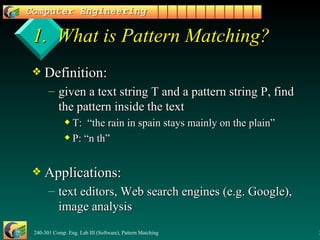
1.  What is Pattern Matching? Definition: given a text string T and a pattern string P, find the pattern inside the text T:  “the rain in spain stays mainly on the plain” P: “n th” Applications: text editors, Web search engines (e.g. Google), image analysis
String Concepts Assume S is a string of size m. A  substring  S[i .. j] of S is the string fragment between indexes i and j. A  prefix  of S is a substring S[0 .. i] A  suffix  of S is a substring S[i .. m-1] i is any index between 0 and m-1
Examples Substring S[1..3] == "ndr" All possible prefixes of S: "andrew", "andre", "andr", "and", "an”, "a" All possible suffixes of S: "andrew", "ndrew", "drew", "rew", "ew", "w" a n d r e w S 0 5
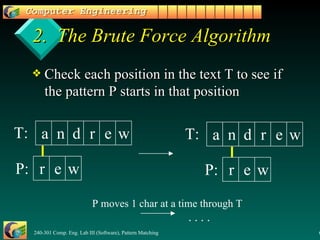
2.  The Brute Force Algorithm Check each position in the text T to see if the pattern P starts in that position a n d r e w T: r e w P: a n d r e w T: r e w P: . . . . P moves 1 char at a time through T
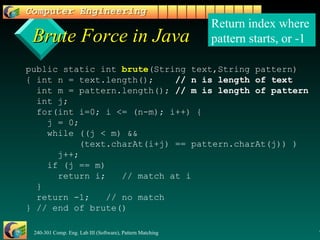
Brute Force in Java public static int  brute (String text,String pattern)  { int n = text.length();  // n is length of text   int m = pattern.length();  // m is length of pattern   int j;   for(int i=0; i <= (n-m); i++) {   j = 0;   while ((j < m) &&    (text.charAt(i+j) == pattern.charAt(j)) )   j++;   if (j == m)   return i;  // match at i   }   return -1;  // no match } // end of brute() Return index where  pattern starts, or -1
Usage public static void main(String args[]) { if (args.length != 2) {   System.out.println(&quot;Usage: java BruteSearch    <text> <pattern>&quot;);   System.exit(0);   }   System.out.println(&quot;Text: &quot; + args[0]);   System.out.println(&quot;Pattern: &quot; + args[1]);   int posn =  brute (args[0], args[1]);   if (posn == -1)   System.out.println(&quot;Pattern not found&quot;);   else    System.out.println(&quot;Pattern starts at posn &quot;  + posn); }
Analysis Brute force pattern matching runs in time O(mn) in the worst case. But most searches of ordinary text take  O(m+n), which is very quick.  continued
The brute force algorithm is fast when the alphabet of the text is large  e.g.  A..Z, a..z, 1..9, etc. It is slower when the alphabet is small e.g. 0, 1 (as in binary files, image files, etc.) continued
Example of a worst case: T: &quot;aaaaaaaaaaaaaaaaaaaaaaaaaah&quot; P: &quot;aaah&quot; Example of a more average case: T: &quot;a string searching example is standard&quot; P: &quot;store&quot;
3.  The Boyer-Moore Algorithm The Boyer-Moore pattern matching algorithm is based on two techniques. 1.  The  looking-glass  technique find P in T by moving  backwards  through P, starting at its end
2. The  character-jump  technique when a mismatch occurs at T[i] == x the character in pattern P[j] is not the  same as T[i] There are 3 possible  cases, tried in order. x a T i b a P j
Case 1 If P contains x somewhere, then try to  shift P  right to align the last occurrence  of x in P with T[i]. x a T i b a P j x c x a T i new b a P j new x c ? ? and  move i and  j right, so j at end
Case 2 If P contains x somewhere, but a shift right to the last occurrence is  not  possible, then shift P  right by 1 character to T[i+1]. a x T i a x P j c w a x T i new a x P j new c w ? and  move i and  j right, so j at end x x is after  j position x
Case 3 If cases 1 and 2 do not apply, then  shift  P to align P[0] with T[i+1]. x a T i b a P j d c x a T i new b a P j new d c ? ? and  move i and  j right, so j at end No x in P ? 0
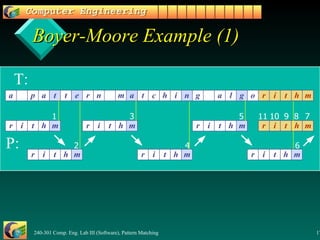
Boyer-Moore Example (1) T: P:
Last Occurrence Function Boyer-Moore’s algorithm preprocesses the pattern P and the alphabet A to build a last occurrence function L() L() maps all the letters in A to integers L(x) is defined as: // x is a letter in A the largest index i such that P[i] == x, or -1 if no such index exists
L() Example A = {a, b, c, d} P: &quot;abacab&quot; -1 3 5 4 L ( x ) d c b a x a b a c a b 0 1 2 3 4 5 P L() stores indexes into P[]
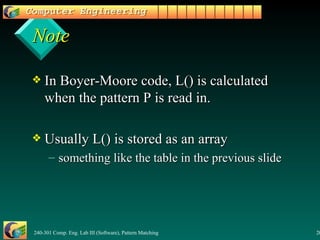
Note In Boyer-Moore code, L() is calculated when the pattern P is read in. Usually L() is stored as an array something like the table in the previous slide
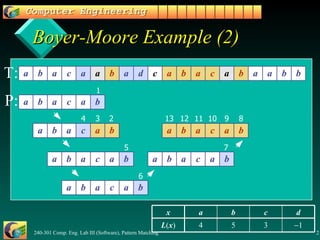
Boyer-Moore Example (2) T: P:  1 3 5 4 L ( x ) d c b a x
Boyer-Moore in Java   public static int  bmMatch (String text,    String pattern)    {   int last[] =  buildLast (pattern);   int n = text.length();   int m = pattern.length();   int i = m-1;   if (i > n-1)   return -1; // no match if pattern is    // longer than text   : Return index where  pattern starts, or -1
  int j = m-1;   do {   if (pattern.charAt(j) == text.charAt(i))   if (j == 0)   return i; // match   else {  // looking-glass technique   i--;   j--;   }   else {  // character jump technique   int lo = last[text.charAt(i)];  //last occ    i = i + m - Math.min(j, 1+lo);   j = m - 1;   }   } while (i <= n-1);   return -1; // no match   } // end of bmMatch()
  public static int[]  buildLast (String pattern)    /* Return array storing index of  last   occurrence  of each ASCII char in pattern. */   {   int last[] = new int[128]; // ASCII char set   for(int i=0; i < 128; i++)   last[i] = -1; // initialize array   for (int i = 0; i < pattern.length(); i++)   last[pattern.charAt(i)] = i;    return last;   } // end of buildLast()
Usage   public static void main(String args[])   { if (args.length != 2) {   System.out.println(&quot;Usage: java BmSearch    <text> <pattern>&quot;);   System.exit(0);   }   System.out.println(&quot;Text: &quot; + args[0]);   System.out.println(&quot;Pattern: &quot; + args[1]);   int posn =  bmMatch (args[0], args[1]);   if (posn == -1)   System.out.println(&quot;Pattern not found&quot;);   else    System.out.println(&quot;Pattern starts at posn &quot;    + posn);   }
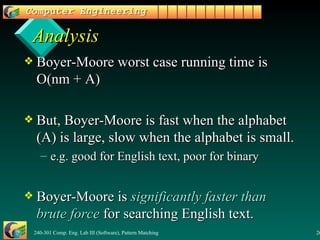
Analysis Boyer-Moore worst case running time is  O(nm + A) But, Boyer-Moore is fast when the alphabet (A) is large, slow when the alphabet is small. e.g. good for English text, poor for binary Boyer-Moore is  significantly faster than brute force  for searching English text.
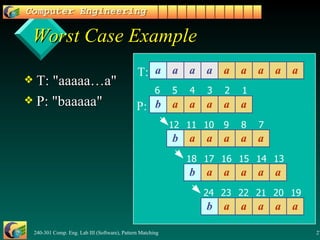
Worst Case Example T: &quot;aaaaa…a&quot; P: &quot;baaaaa&quot; T: P:
4.  The KMP Algorithm The Knuth-Morris-Pratt (KMP) algorithm looks for the pattern in the text in a  left-to-right  order (like the brute force algorithm). But it shifts the pattern more intelligently than the brute force algorithm. continued
If a mismatch occurs between the text and pattern P at P[j], what is the  most  we can shift the pattern to avoid wasteful comparisons? Answer : the largest prefix of P[0 .. j-1] that is a suffix of P[1 .. j-1]
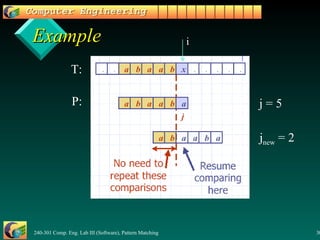
Example T: P: j new  = 2 j = 5 i
Why Find largest prefix (start) of: &quot;a b a a b&quot; ( P[0..j-1] ) which is suffix (end) of: &quot;b a a b&quot; ( p[1 .. j-1] ) Answer: &quot;a b&quot; Set j = 2  // the new j value j == 5
KMP Failure Function KMP preprocesses the pattern to find matches of prefixes of the pattern with the pattern itself. j = mismatch position in P[] k = position before the mismatch (k = j-1). The  failure function  F(k) is defined as the  size  of the largest prefix of P[0..k] that is also a suffix of P[1..k].
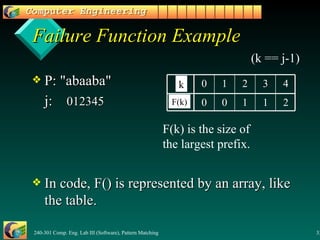
P: &quot;abaaba&quot; j:  012345 In code, F() is represented by an array, like the table. Failure Function Example F(k) is the size of  the largest prefix. (k == j-1) 1 3 2 4 2 1 0 j 1 0 0 F ( j ) k F(k)
Why is F(4) == 2? F(4) means find the size of the largest prefix of P[0..4] that is also a suffix of P[1..4] = find the size largest prefix of &quot;abaab&quot; that  is also a suffix of &quot;baab&quot; = find the size of &quot;ab&quot; = 2 P: &quot;abaaba&quot;
Knuth-Morris-Pratt’s algorithm modifies the brute-force algorithm. if a mismatch occurs at P[j]  (i.e. P[j] != T[i]), then    k = j-1;   j = F(k);  // obtain the new j  Using the Failure Function
KMP in Java   public static int  kmpMatch (String text,  String pattern)    {   int n = text.length();   int m = pattern.length();   int fail[] =  computeFail (pattern);   int i=0;   int j=0;   : Return index where  pattern starts, or -1
  while (i < n) {   if (pattern.charAt(j) == text.charAt(i)) {   if (j == m - 1)   return i - m + 1; // match   i++;   j++;   }   else if (j > 0)   j = fail[j-1];   else   i++;   }    return -1; // no match   } // end of kmpMatch()
  public static int[]  computeFail ( String pattern)    {   int fail[] = new int[pattern.length()];    fail[0] = 0;   int m = pattern.length();   int j = 0;   int i = 1;   :
  while (i < m) {   if  (pattern.charAt(j) ==    pattern.charAt(i)) {  //j+1 chars match   fail[i] = j + 1;   i++;   j++;   }   else if (j > 0) // j follows matching prefix   j = fail[j-1];   else {  // no match   fail[i] = 0;   i++;   }   }   return fail;   } // end of computeFail() Similar code to kmpMatch()
Usage   public static void main(String args[])   { if (args.length != 2) {   System.out.println(&quot;Usage: java KmpSearch    <text> <pattern>&quot;);   System.exit(0);   }   System.out.println(&quot;Text: &quot; + args[0]);   System.out.println(&quot;Pattern: &quot; + args[1]);   int posn =  kmpMatch (args[0], args[1]);   if (posn == -1)   System.out.println(&quot;Pattern not found&quot;);   else    System.out.println(&quot;Pattern starts at posn &quot;    + posn);   }
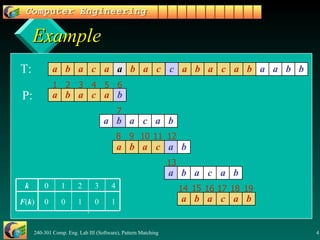
Example 0 3 1 4 2 1 0 k 1 0 0 F ( k ) T: P:
Why is F(4) == 1? F(4) means find the size of the largest prefix of P[0..4] that is also a suffix of P[1..4] = find the size largest prefix of &quot;abaca&quot; that  is also a suffix of &quot;baca&quot; = find the size of &quot;a&quot; = 1 P: &quot;abacab&quot;
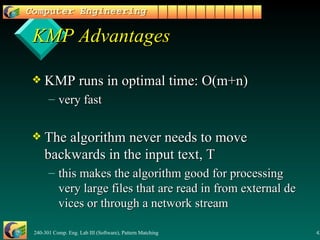
KMP Advantages KMP runs in optimal time: O(m+n) very fast The algorithm never needs to move backwards in the input text, T this makes the algorithm good for processing very large files that are read in from external devices or through a network stream
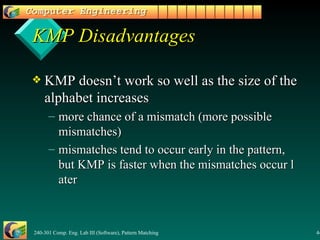
KMP Disadvantages KMP doesn’t work so well as the size of the alphabet increases more chance of a mismatch (more possible mismatches) mismatches tend to occur early in the pattern, but KMP is faster when the mismatches occur later
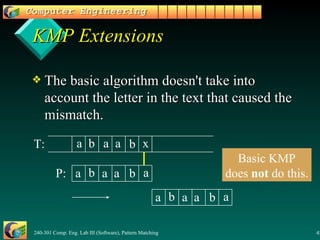
KMP Extensions The basic algorithm doesn't take into account the letter in the text that caused the mismatch. a a a b b x T: P: Basic KMP does  not  do this. a a a b b a a a a b b a
5.  More Information Algorithms in C++ Robert Sedgewick Addison-Wesley, 1992 chapter 19, String Searching Online Animated Algorithms: http :// www . ics . uci . edu / ~goodrich / dsa /   11strings / demos / pattern / http://www-sr.informatik.uni-tuebingen.de/ ~buehler/BM/BM1.html http://www-igm.univ-mlv.fr/~lecroq/string/ This book is in the CoE library.

Pattern matching

  • 1.
    Pattern Matching Dr.Andrew Davison WiG Lab (teachers room) , CoE [email_address] .psu.ac.th 240-301, Computer Engineering Lab III (Software) T: P: Semester 1, 200 6 -200 7
  • 2.
    Overview 1. What is Pattern Matching? 2. The Brute Force Algorithm 3. The Boyer-Moore Algorithm 4. The Knuth-Morris-Pratt Algorithm 5. More Information
  • 3.
    1. Whatis Pattern Matching? Definition: given a text string T and a pattern string P, find the pattern inside the text T: “the rain in spain stays mainly on the plain” P: “n th” Applications: text editors, Web search engines (e.g. Google), image analysis
  • 4.
    String Concepts AssumeS is a string of size m. A substring S[i .. j] of S is the string fragment between indexes i and j. A prefix of S is a substring S[0 .. i] A suffix of S is a substring S[i .. m-1] i is any index between 0 and m-1
  • 5.
    Examples Substring S[1..3]== &quot;ndr&quot; All possible prefixes of S: &quot;andrew&quot;, &quot;andre&quot;, &quot;andr&quot;, &quot;and&quot;, &quot;an”, &quot;a&quot; All possible suffixes of S: &quot;andrew&quot;, &quot;ndrew&quot;, &quot;drew&quot;, &quot;rew&quot;, &quot;ew&quot;, &quot;w&quot; a n d r e w S 0 5
  • 6.
    2. TheBrute Force Algorithm Check each position in the text T to see if the pattern P starts in that position a n d r e w T: r e w P: a n d r e w T: r e w P: . . . . P moves 1 char at a time through T
  • 7.
    Brute Force inJava public static int brute (String text,String pattern) { int n = text.length(); // n is length of text int m = pattern.length(); // m is length of pattern int j; for(int i=0; i <= (n-m); i++) { j = 0; while ((j < m) && (text.charAt(i+j) == pattern.charAt(j)) ) j++; if (j == m) return i; // match at i } return -1; // no match } // end of brute() Return index where pattern starts, or -1
  • 8.
    Usage public staticvoid main(String args[]) { if (args.length != 2) { System.out.println(&quot;Usage: java BruteSearch <text> <pattern>&quot;); System.exit(0); } System.out.println(&quot;Text: &quot; + args[0]); System.out.println(&quot;Pattern: &quot; + args[1]); int posn = brute (args[0], args[1]); if (posn == -1) System.out.println(&quot;Pattern not found&quot;); else System.out.println(&quot;Pattern starts at posn &quot; + posn); }
  • 9.
    Analysis Brute forcepattern matching runs in time O(mn) in the worst case. But most searches of ordinary text take O(m+n), which is very quick. continued
  • 10.
    The brute forcealgorithm is fast when the alphabet of the text is large e.g. A..Z, a..z, 1..9, etc. It is slower when the alphabet is small e.g. 0, 1 (as in binary files, image files, etc.) continued
  • 11.
    Example of aworst case: T: &quot;aaaaaaaaaaaaaaaaaaaaaaaaaah&quot; P: &quot;aaah&quot; Example of a more average case: T: &quot;a string searching example is standard&quot; P: &quot;store&quot;
  • 12.
    3. TheBoyer-Moore Algorithm The Boyer-Moore pattern matching algorithm is based on two techniques. 1. The looking-glass technique find P in T by moving backwards through P, starting at its end
  • 13.
    2. The character-jump technique when a mismatch occurs at T[i] == x the character in pattern P[j] is not the same as T[i] There are 3 possible cases, tried in order. x a T i b a P j
  • 14.
    Case 1 IfP contains x somewhere, then try to shift P right to align the last occurrence of x in P with T[i]. x a T i b a P j x c x a T i new b a P j new x c ? ? and move i and j right, so j at end
  • 15.
    Case 2 IfP contains x somewhere, but a shift right to the last occurrence is not possible, then shift P right by 1 character to T[i+1]. a x T i a x P j c w a x T i new a x P j new c w ? and move i and j right, so j at end x x is after j position x
  • 16.
    Case 3 Ifcases 1 and 2 do not apply, then shift P to align P[0] with T[i+1]. x a T i b a P j d c x a T i new b a P j new d c ? ? and move i and j right, so j at end No x in P ? 0
  • 17.
  • 18.
    Last Occurrence FunctionBoyer-Moore’s algorithm preprocesses the pattern P and the alphabet A to build a last occurrence function L() L() maps all the letters in A to integers L(x) is defined as: // x is a letter in A the largest index i such that P[i] == x, or -1 if no such index exists
  • 19.
    L() Example A= {a, b, c, d} P: &quot;abacab&quot; -1 3 5 4 L ( x ) d c b a x a b a c a b 0 1 2 3 4 5 P L() stores indexes into P[]
  • 20.
    Note In Boyer-Moorecode, L() is calculated when the pattern P is read in. Usually L() is stored as an array something like the table in the previous slide
  • 21.
    Boyer-Moore Example (2)T: P:  1 3 5 4 L ( x ) d c b a x
  • 22.
    Boyer-Moore in Java public static int bmMatch (String text, String pattern) { int last[] = buildLast (pattern); int n = text.length(); int m = pattern.length(); int i = m-1; if (i > n-1) return -1; // no match if pattern is // longer than text : Return index where pattern starts, or -1
  • 23.
    intj = m-1; do { if (pattern.charAt(j) == text.charAt(i)) if (j == 0) return i; // match else { // looking-glass technique i--; j--; } else { // character jump technique int lo = last[text.charAt(i)]; //last occ i = i + m - Math.min(j, 1+lo); j = m - 1; } } while (i <= n-1); return -1; // no match } // end of bmMatch()
  • 24.
    publicstatic int[] buildLast (String pattern) /* Return array storing index of last occurrence of each ASCII char in pattern. */ { int last[] = new int[128]; // ASCII char set for(int i=0; i < 128; i++) last[i] = -1; // initialize array for (int i = 0; i < pattern.length(); i++) last[pattern.charAt(i)] = i; return last; } // end of buildLast()
  • 25.
    Usage public static void main(String args[]) { if (args.length != 2) { System.out.println(&quot;Usage: java BmSearch <text> <pattern>&quot;); System.exit(0); } System.out.println(&quot;Text: &quot; + args[0]); System.out.println(&quot;Pattern: &quot; + args[1]); int posn = bmMatch (args[0], args[1]); if (posn == -1) System.out.println(&quot;Pattern not found&quot;); else System.out.println(&quot;Pattern starts at posn &quot; + posn); }
  • 26.
    Analysis Boyer-Moore worstcase running time is O(nm + A) But, Boyer-Moore is fast when the alphabet (A) is large, slow when the alphabet is small. e.g. good for English text, poor for binary Boyer-Moore is significantly faster than brute force for searching English text.
  • 27.
    Worst Case ExampleT: &quot;aaaaa…a&quot; P: &quot;baaaaa&quot; T: P:
  • 28.
    4. TheKMP Algorithm The Knuth-Morris-Pratt (KMP) algorithm looks for the pattern in the text in a left-to-right order (like the brute force algorithm). But it shifts the pattern more intelligently than the brute force algorithm. continued
  • 29.
    If a mismatchoccurs between the text and pattern P at P[j], what is the most we can shift the pattern to avoid wasteful comparisons? Answer : the largest prefix of P[0 .. j-1] that is a suffix of P[1 .. j-1]
  • 30.
    Example T: P:j new = 2 j = 5 i
  • 31.
    Why Find largestprefix (start) of: &quot;a b a a b&quot; ( P[0..j-1] ) which is suffix (end) of: &quot;b a a b&quot; ( p[1 .. j-1] ) Answer: &quot;a b&quot; Set j = 2 // the new j value j == 5
  • 32.
    KMP Failure FunctionKMP preprocesses the pattern to find matches of prefixes of the pattern with the pattern itself. j = mismatch position in P[] k = position before the mismatch (k = j-1). The failure function F(k) is defined as the size of the largest prefix of P[0..k] that is also a suffix of P[1..k].
  • 33.
    P: &quot;abaaba&quot; j: 012345 In code, F() is represented by an array, like the table. Failure Function Example F(k) is the size of the largest prefix. (k == j-1) 1 3 2 4 2 1 0 j 1 0 0 F ( j ) k F(k)
  • 34.
    Why is F(4)== 2? F(4) means find the size of the largest prefix of P[0..4] that is also a suffix of P[1..4] = find the size largest prefix of &quot;abaab&quot; that is also a suffix of &quot;baab&quot; = find the size of &quot;ab&quot; = 2 P: &quot;abaaba&quot;
  • 35.
    Knuth-Morris-Pratt’s algorithm modifiesthe brute-force algorithm. if a mismatch occurs at P[j] (i.e. P[j] != T[i]), then k = j-1; j = F(k); // obtain the new j Using the Failure Function
  • 36.
    KMP in Java public static int kmpMatch (String text, String pattern) { int n = text.length(); int m = pattern.length(); int fail[] = computeFail (pattern); int i=0; int j=0; : Return index where pattern starts, or -1
  • 37.
    while(i < n) { if (pattern.charAt(j) == text.charAt(i)) { if (j == m - 1) return i - m + 1; // match i++; j++; } else if (j > 0) j = fail[j-1]; else i++; } return -1; // no match } // end of kmpMatch()
  • 38.
    publicstatic int[] computeFail ( String pattern) { int fail[] = new int[pattern.length()]; fail[0] = 0; int m = pattern.length(); int j = 0; int i = 1; :
  • 39.
    while(i < m) { if (pattern.charAt(j) == pattern.charAt(i)) { //j+1 chars match fail[i] = j + 1; i++; j++; } else if (j > 0) // j follows matching prefix j = fail[j-1]; else { // no match fail[i] = 0; i++; } } return fail; } // end of computeFail() Similar code to kmpMatch()
  • 40.
    Usage public static void main(String args[]) { if (args.length != 2) { System.out.println(&quot;Usage: java KmpSearch <text> <pattern>&quot;); System.exit(0); } System.out.println(&quot;Text: &quot; + args[0]); System.out.println(&quot;Pattern: &quot; + args[1]); int posn = kmpMatch (args[0], args[1]); if (posn == -1) System.out.println(&quot;Pattern not found&quot;); else System.out.println(&quot;Pattern starts at posn &quot; + posn); }
  • 41.
    Example 0 31 4 2 1 0 k 1 0 0 F ( k ) T: P:
  • 42.
    Why is F(4)== 1? F(4) means find the size of the largest prefix of P[0..4] that is also a suffix of P[1..4] = find the size largest prefix of &quot;abaca&quot; that is also a suffix of &quot;baca&quot; = find the size of &quot;a&quot; = 1 P: &quot;abacab&quot;
  • 43.
    KMP Advantages KMPruns in optimal time: O(m+n) very fast The algorithm never needs to move backwards in the input text, T this makes the algorithm good for processing very large files that are read in from external devices or through a network stream
  • 44.
    KMP Disadvantages KMPdoesn’t work so well as the size of the alphabet increases more chance of a mismatch (more possible mismatches) mismatches tend to occur early in the pattern, but KMP is faster when the mismatches occur later
  • 45.
    KMP Extensions Thebasic algorithm doesn't take into account the letter in the text that caused the mismatch. a a a b b x T: P: Basic KMP does not do this. a a a b b a a a a b b a
  • 46.
    5. MoreInformation Algorithms in C++ Robert Sedgewick Addison-Wesley, 1992 chapter 19, String Searching Online Animated Algorithms: http :// www . ics . uci . edu / ~goodrich / dsa / 11strings / demos / pattern / http://www-sr.informatik.uni-tuebingen.de/ ~buehler/BM/BM1.html http://www-igm.univ-mlv.fr/~lecroq/string/ This book is in the CoE library.