Bayesian probabilistic interference
Prof. Neeraj Bhargava
Kapil Chauhan
Department of Computer Science
School of Engineering & Systems Sciences
MDS University, Ajmer
Outline
 What is a Bayesian network?
 Why Bayesian networks are useful?
 Why learn a Bayesian network?
 Semanitcs
 What is probabilities
 Types of probabilities
 More probabilities
What is a Bayesian network?
 A simple, graphical notation for conditional independence
assertions and hence for compact specification of full joint
distributions
 Syntax:
 a set of nodes, one per variable

 a directed, acyclic graph (link ≈ "directly influences")
 a conditional distribution for each node given its parents:
P (Xi | Parents (Xi))
 In the simplest case, conditional distribution represented
as a conditional probability table (CPT) giving the
distribution over Xi for each combination of parent values
Example
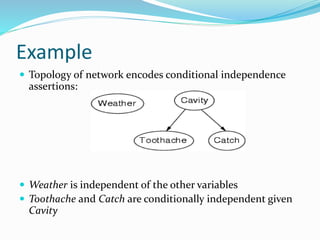
 Topology of network encodes conditional independence
assertions:
 Weather is independent of the other variables
 Toothache and Catch are conditionally independent given
Cavity
Why is a Bayesian network?
 Expressive language
 Finite mixture models, Factor analysis, Kalman filter,…
 Intuitive language
 Can utilize causal knowledge in constructing models
 Domain experts comfortable building a network
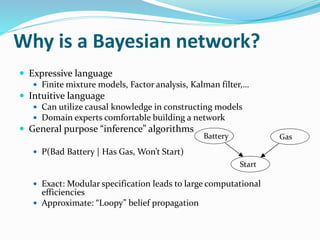
 General purpose “inference” algorithms
 P(Bad Battery | Has Gas, Won’t Start)
 Exact: Modular specification leads to large computational
efficiencies
 Approximate: “Loopy” belief propagation
Gas
Start
Battery
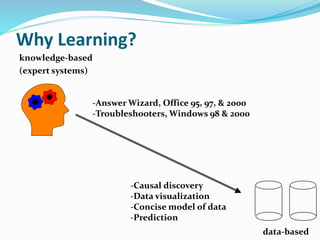
Why Learning?
data-based
-Answer Wizard, Office 95, 97, & 2000
-Troubleshooters, Windows 98 & 2000
-Causal discovery
-Data visualization
-Concise model of data
-Prediction
knowledge-based
(expert systems)
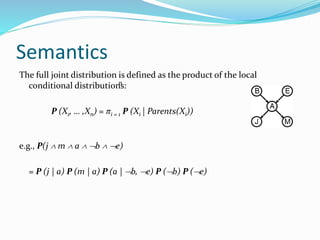
Semantics
The full joint distribution is defined as the product of the local
conditional distributions:
P (X1, … ,Xn) = πi = 1 P (Xi | Parents(Xi))
e.g., P(j  m  a  b  e)
= P (j | a) P (m | a) P (a | b, e) P (b) P (e)
n
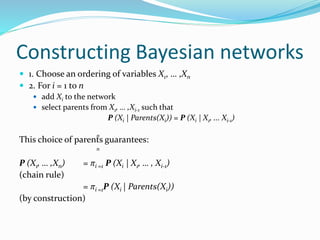
Constructing Bayesian networks
 1. Choose an ordering of variables X1, … ,Xn
 2. For i = 1 to n
 add Xi to the network
 select parents from X1, … ,Xi-1 such that
P (Xi | Parents(Xi)) = P (Xi | X1, ... Xi-1)
This choice of parents guarantees:
P (X1, … ,Xn) = πi =1 P (Xi | X1, … , Xi-1)
(chain rule)
= πi =1P (Xi | Parents(Xi))
(by construction)
n
n
Assignment
 Explain Bayesian probabilistic interference with
example.

Bayesian probabilistic interference

  • 1.
    Bayesian probabilistic interference Prof.Neeraj Bhargava Kapil Chauhan Department of Computer Science School of Engineering & Systems Sciences MDS University, Ajmer
  • 2.
    Outline  What isa Bayesian network?  Why Bayesian networks are useful?  Why learn a Bayesian network?  Semanitcs  What is probabilities  Types of probabilities  More probabilities
  • 3.
    What is aBayesian network?  A simple, graphical notation for conditional independence assertions and hence for compact specification of full joint distributions  Syntax:  a set of nodes, one per variable   a directed, acyclic graph (link ≈ "directly influences")  a conditional distribution for each node given its parents: P (Xi | Parents (Xi))  In the simplest case, conditional distribution represented as a conditional probability table (CPT) giving the distribution over Xi for each combination of parent values
  • 4.
    Example  Topology ofnetwork encodes conditional independence assertions:  Weather is independent of the other variables  Toothache and Catch are conditionally independent given Cavity
  • 5.
    Why is aBayesian network?  Expressive language  Finite mixture models, Factor analysis, Kalman filter,…  Intuitive language  Can utilize causal knowledge in constructing models  Domain experts comfortable building a network  General purpose “inference” algorithms  P(Bad Battery | Has Gas, Won’t Start)  Exact: Modular specification leads to large computational efficiencies  Approximate: “Loopy” belief propagation Gas Start Battery
  • 6.
    Why Learning? data-based -Answer Wizard,Office 95, 97, & 2000 -Troubleshooters, Windows 98 & 2000 -Causal discovery -Data visualization -Concise model of data -Prediction knowledge-based (expert systems)
  • 7.
    Semantics The full jointdistribution is defined as the product of the local conditional distributions: P (X1, … ,Xn) = πi = 1 P (Xi | Parents(Xi)) e.g., P(j  m  a  b  e) = P (j | a) P (m | a) P (a | b, e) P (b) P (e) n
  • 8.
    Constructing Bayesian networks 1. Choose an ordering of variables X1, … ,Xn  2. For i = 1 to n  add Xi to the network  select parents from X1, … ,Xi-1 such that P (Xi | Parents(Xi)) = P (Xi | X1, ... Xi-1) This choice of parents guarantees: P (X1, … ,Xn) = πi =1 P (Xi | X1, … , Xi-1) (chain rule) = πi =1P (Xi | Parents(Xi)) (by construction) n n
  • 9.
    Assignment  Explain Bayesianprobabilistic interference with example.