TRIES
AN EXCELLENT DATA
STRUCTURE FOR
STRINGS
Tries
 Instructor
Md. Shamsujjoha
Senior Lecturer
Department of CSE
East West University
 Presented by:
Md. Naim Khan
Id :2014-2-60-092
Md. Riad Khan
Id :2014-1-60-040
Slide
2
Overview
 History & Definition
 Types of Tries
Standard Tries
Compressed Tries
Suffix Tries
 Conclusion
Slide
3
History
 The term trie comes from retrieval.
 This term was coined by Edward Fredkin, who
pronounce it tri as in the word retrieval.
Slide
4
Definition of Tries
 A data structure for representing a collection of
strings.
 In computer science, a trie, also called digital tree
and sometimes radix tree or prefix tree.
Tries support fast pattern matching.
Slide
5
Properties of a tries
 A multi-way tree.
 Each node has from 1 to n children.
 Each edge of the tree is labeled with a character.
 Each leaf nodes corresponds to the stored string,
which is a concatenation of characters on a path
from the root to this node.
Slide
6
Standard Trie
 The standard trie for a set of strings S is an ordered
tree such that:
*Each node but the root is labeled with a character.
*The children of a node are alphabetically ordered.
*The paths from the external nodes to the root yield
the strings of S.
Slide
7
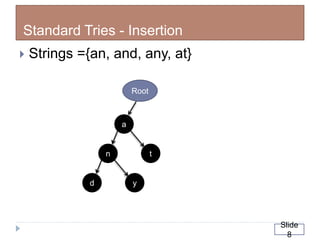
Standard Tries - Insertion
 Strings ={an, and, any, at}
n
a
d
t
y
Root
Slide
8
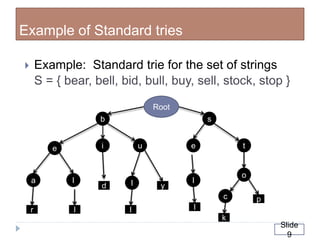
Example of Standard tries
 Example: Standard trie for the set of strings
S = { bear, bell, bid, bull, buy, sell, stock, stop }
te
s
uie
b
o
llla
d y
c
k
p
lllr
Root
Slide
9
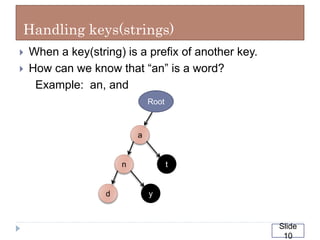
Handling keys(strings)
 When a key(string) is a prefix of another key.
 How can we know that “an” is a word?
Example: an, and
n
a
d
t
y
Root
Slide
10
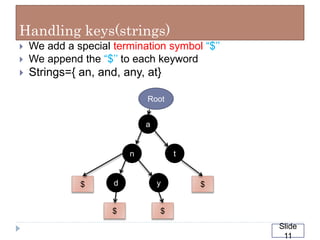
Handling keys(strings)
 We add a special termination symbol “$’’
 We append the “$’’ to each keyword
 Strings={ an, and, any, at}
n
a
d
t
y
Root
$
$ $
$
Slide
11
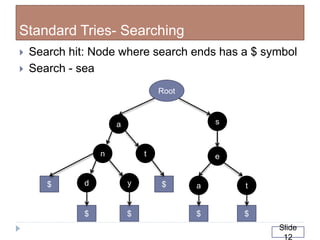
Standard Tries- Searching
 Search hit: Node where search ends has a $ symbol
 Search - sea
n
a
d
t
y
Root
a t
e
s
$
$$
$
$ $
Slide
12
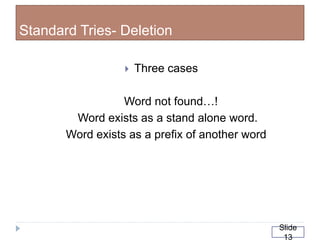
Standard Tries- Deletion
 Three cases
Word not found…!
Word exists as a stand alone word.
Word exists as a prefix of another word
Slide
13
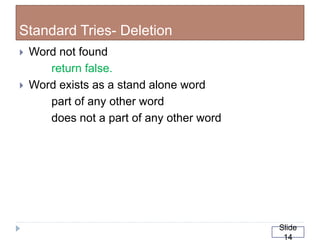
Standard Tries- Deletion
 Word not found
return false.
 Word exists as a stand alone word
part of any other word
does not a part of any other word
Slide
14
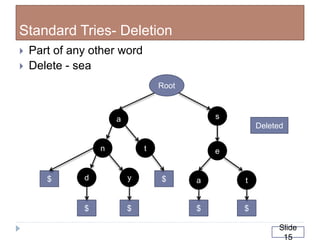
Standard Tries- Deletion
 Part of any other word
 Delete - sea
n
a
d
t
y
Root
a t
e
s
$
$$
$
$ $
Slide
15
Deleted
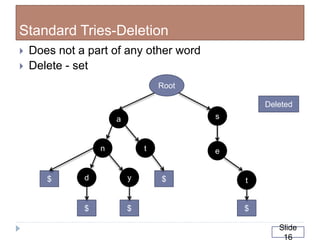
Standard Tries-Deletion
 Does not a part of any other word
 Delete - set
n
a
d
t
y
Root
t
e
s
$
$
$
$ $
Slide
16
Deleted
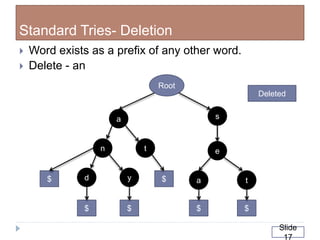
Standard Tries- Deletion
 Word exists as a prefix of any other word.
 Delete - an
n
a
d
t
y
Root
a t
e
s
$
$$
$
$ $
Slide
17
Deleted
Compressd Tries
 Tries with nodes of degree at least 2
 Obtained by standard tries by compressing
chains of redundant nodes
Slide
18
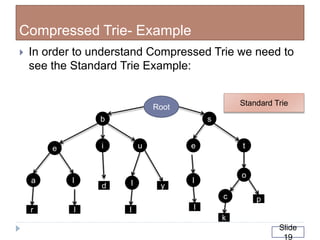
Compressed Trie- Example
 In order to understand Compressed Trie we need to
see the Standard Trie Example:
te
s
uie
b
o
llla
d y
c
k
p
lllr
Root
Standard Trie
Slide
19
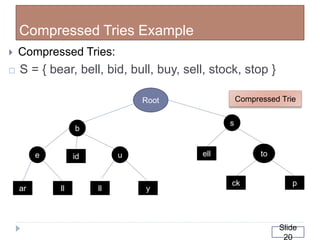
Compressed Tries Example
 Compressed Tries:
 S = { bear, bell, bid, bull, buy, sell, stock, stop }
b
s
e u toid ell
llar ll y
ck p
Root Compressed Trie
Slide
20
Suffix Tries
 A suffix trie is a compressed trie for all the suffixes of
a text.
 Suffix trie are a space-efficient data structure to store
a string that allows many kinds of queries to be
answered quickly.
Slide
21
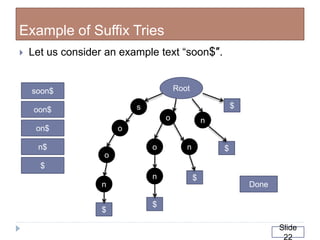
Example of Suffix Tries
 Let us consider an example text “soon$″.
Root
s
o
o
n
o
o
n
n
n
$
$
$
$
$
Slide
22
soon$
oon$
$
n$
on$
Done
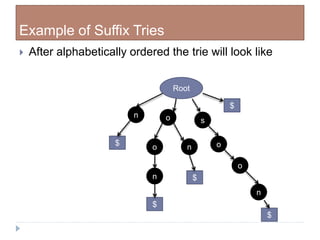
 After alphabetically ordered the trie will look like
Root
s
o
o
n
o
o
n
n
n
$
$
$
$
$
Example of Suffix Tries
Understanding Requirements
 Insertion is faster as compared to the Hash Table
 Lookup is much more faster than Hash Table
implementations
 There are no collision of different keys in tries
Slide
23
References
Web pages
 http://www.mathcs.emory.edu/~cheung/Courses/323/Syll
abus/Text/trie01.html
 http://fbim.fh-
regensburg.de/~saj39122/sal/skript/progr/pr45102/Tries.p
df
 http://www.ideserve.co.in/learn/trie-delete
 http://algs4.cs.princeton.edu/lectures/52Tries.pdf
Book
 Data Structure and Algorithm
by Alfred V. Aho
Jeffery D. Ullman
John E.HopcroftJohn
Slide
24
Questions or Suggestions
Slide
25
Thank you
Slide
26
Inquiry
riadmrk.khan@gmail.com
naim1248@gmail.com

Data structure tries

  • 1.
  • 2.
    Tries  Instructor Md. Shamsujjoha SeniorLecturer Department of CSE East West University  Presented by: Md. Naim Khan Id :2014-2-60-092 Md. Riad Khan Id :2014-1-60-040 Slide 2
  • 3.
    Overview  History &Definition  Types of Tries Standard Tries Compressed Tries Suffix Tries  Conclusion Slide 3
  • 4.
    History  The termtrie comes from retrieval.  This term was coined by Edward Fredkin, who pronounce it tri as in the word retrieval. Slide 4
  • 5.
    Definition of Tries A data structure for representing a collection of strings.  In computer science, a trie, also called digital tree and sometimes radix tree or prefix tree. Tries support fast pattern matching. Slide 5
  • 6.
    Properties of atries  A multi-way tree.  Each node has from 1 to n children.  Each edge of the tree is labeled with a character.  Each leaf nodes corresponds to the stored string, which is a concatenation of characters on a path from the root to this node. Slide 6
  • 7.
    Standard Trie  Thestandard trie for a set of strings S is an ordered tree such that: *Each node but the root is labeled with a character. *The children of a node are alphabetically ordered. *The paths from the external nodes to the root yield the strings of S. Slide 7
  • 8.
    Standard Tries -Insertion  Strings ={an, and, any, at} n a d t y Root Slide 8
  • 9.
    Example of Standardtries  Example: Standard trie for the set of strings S = { bear, bell, bid, bull, buy, sell, stock, stop } te s uie b o llla d y c k p lllr Root Slide 9
  • 10.
    Handling keys(strings)  Whena key(string) is a prefix of another key.  How can we know that “an” is a word? Example: an, and n a d t y Root Slide 10
  • 11.
    Handling keys(strings)  Weadd a special termination symbol “$’’  We append the “$’’ to each keyword  Strings={ an, and, any, at} n a d t y Root $ $ $ $ Slide 11
  • 12.
    Standard Tries- Searching Search hit: Node where search ends has a $ symbol  Search - sea n a d t y Root a t e s $ $$ $ $ $ Slide 12
  • 13.
    Standard Tries- Deletion Three cases Word not found…! Word exists as a stand alone word. Word exists as a prefix of another word Slide 13
  • 14.
    Standard Tries- Deletion Word not found return false.  Word exists as a stand alone word part of any other word does not a part of any other word Slide 14
  • 15.
    Standard Tries- Deletion Part of any other word  Delete - sea n a d t y Root a t e s $ $$ $ $ $ Slide 15 Deleted
  • 16.
    Standard Tries-Deletion  Doesnot a part of any other word  Delete - set n a d t y Root t e s $ $ $ $ $ Slide 16 Deleted
  • 17.
    Standard Tries- Deletion Word exists as a prefix of any other word.  Delete - an n a d t y Root a t e s $ $$ $ $ $ Slide 17 Deleted
  • 18.
    Compressd Tries  Trieswith nodes of degree at least 2  Obtained by standard tries by compressing chains of redundant nodes Slide 18
  • 19.
    Compressed Trie- Example In order to understand Compressed Trie we need to see the Standard Trie Example: te s uie b o llla d y c k p lllr Root Standard Trie Slide 19
  • 20.
    Compressed Tries Example Compressed Tries:  S = { bear, bell, bid, bull, buy, sell, stock, stop } b s e u toid ell llar ll y ck p Root Compressed Trie Slide 20
  • 21.
    Suffix Tries  Asuffix trie is a compressed trie for all the suffixes of a text.  Suffix trie are a space-efficient data structure to store a string that allows many kinds of queries to be answered quickly. Slide 21
  • 22.
    Example of SuffixTries  Let us consider an example text “soon$″. Root s o o n o o n n n $ $ $ $ $ Slide 22 soon$ oon$ $ n$ on$ Done
  • 23.
     After alphabeticallyordered the trie will look like Root s o o n o o n n n $ $ $ $ $ Example of Suffix Tries
  • 24.
    Understanding Requirements  Insertionis faster as compared to the Hash Table  Lookup is much more faster than Hash Table implementations  There are no collision of different keys in tries Slide 23
  • 25.
    References Web pages  http://www.mathcs.emory.edu/~cheung/Courses/323/Syll abus/Text/trie01.html http://fbim.fh- regensburg.de/~saj39122/sal/skript/progr/pr45102/Tries.p df  http://www.ideserve.co.in/learn/trie-delete  http://algs4.cs.princeton.edu/lectures/52Tries.pdf Book  Data Structure and Algorithm by Alfred V. Aho Jeffery D. Ullman John E.HopcroftJohn Slide 24
  • 26.
  • 27.