
Introduction
• Naturally occurring organic compounds
• Found in both plants and animals
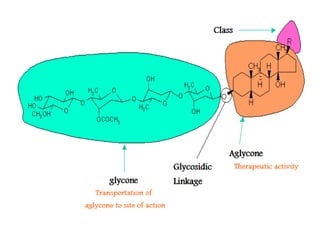
• On hydrolysis (by acids or enzymatic) gives one
or more sugar moiety (glycone) and non-sugar
moiety (aglycone).
• Non-sugar (aglycon) called genin.
• The pharmacological acivity is due to the
presence of genin part.
• Glycone part facilitates the transportation of
genin to the site of action.
Glycosides
Definition
These are the organic compounds obtained
from the plants or animals sources which on
enzymatic or acid hydrolysis gives one or
more sugar moieties along with non-sugar
moiety.
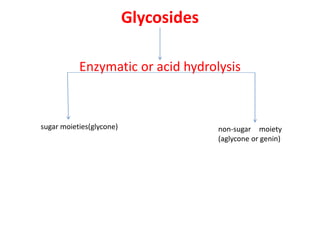
Glycosides
Enzymatic or acid hydrolysis
sugar moieties(glycone) non-sugar moiety
(aglycone or genin)
• The sugar involved in glycosides are of
different types, but most commonly, it is β-D
glucose. Other are galactose, mannose,
rhamnose, digitoxose, cymarose, etc.
• The linkage between alycone & aglycone is
called glycosidic linkage.
Types
1. Based on atoms involved in glycosidic linkage
• O- glycosides
• C- glycosides
• S- glycosides
• N- glycosides
2. According to chemical nature of aglycone part
• Cardiac/sterol glycosides-Digitalis, indian squill, strophanthus,
• Anthracene(Anthraqunone) glycosides-Senna, rhubarb,aloe,
cascara
• Cyanogenetic glycosides-Bitter almond, white cherry bark,
• Saponin glycosides-Dioscorea, liquorice, Ginseng,sersaparilla
• Isothiocynate glycosides-Black mustard
1. According to linkage existing b/w
the glycone and aglycone
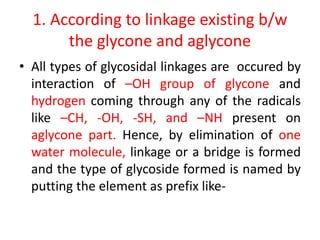
• All types of glycosidal linkages are occured by
interaction of –OH group of glycone and
hydrogen coming through any of the radicals
like –CH, -OH, -SH, and –NH present on
aglycone part. Hence, by elimination of one
water molecule, linkage or a bridge is formed
and the type of glycoside formed is named by
putting the element as prefix like-
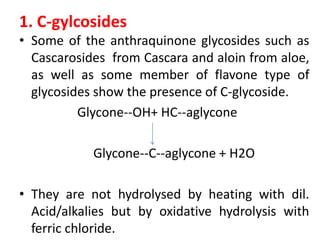
1. C-gylcosides
• Some of the anthraquinone glycosides such as
Cascarosides from Cascara and aloin from aloe,
as well as some member of flavone type of
glycosides show the presence of C-glycoside.
Glycone--OH+ HC--aglycone
Glycone--C--aglycone + H2O
• They are not hydrolysed by heating with dil.
Acid/alkalies but by oxidative hydrolysis with
ferric chloride.
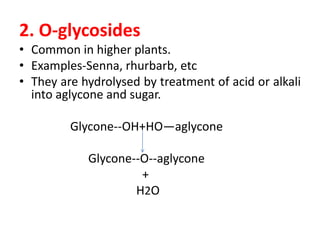
2. O-glycosides
• Common in higher plants.
• Examples-Senna, rhurbarb, etc
• They are hydrolysed by treatment of acid or alkali
into aglycone and sugar.
Glycone--OH+HO—aglycone
Glycone--O--aglycone
+
H2O
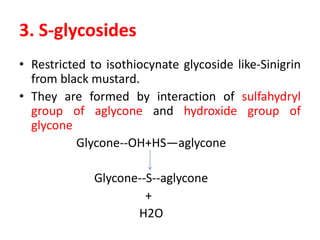
3. S-glycosides
• Restricted to isothiocynate glycoside like-Sinigrin
from black mustard.
• They are formed by interaction of sulfahydryl
group of aglycone and hydroxide group of
glycone
Glycone--OH+HS—aglycone
Glycone--S--aglycone
+
H2O
4. N-glycosides
• N-glycosides are nucleosides.
• The glycosides contain sugar but still the physical,
chemical and therapeutic properties are given by
aglycone part.
• Examples-Adenosine-antiarrythmic, yeast nucleic
acid- brewer's yeast(nutrient supplement)
Glycone--OH+HN--aglycone
Glycone--N--aglycone
+
H2O
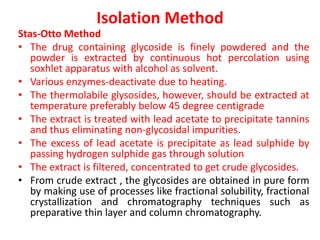
Isolation Method
Stas-Otto Method
• The drug containing glycoside is finely powdered and the
powder is extracted by continuous hot percolation using
soxhlet apparatus with alcohol as solvent.
• Various enzymes-deactivate due to heating.
• The thermolabile glysosides, however, should be extracted at
temperature preferably below 45 degree centigrade
• The extract is treated with lead acetate to precipitate tannins
and thus eliminating non-glycosidal impurities.
• The excess of lead acetate is precipitate as lead sulphide by
passing hydrogen sulphide gas through solution
• The extract is filtered, concentrated to get crude glycosides.
• From crude extract , the glycosides are obtained in pure form
by making use of processes like fractional solubility, fractional
crystallization and chromatography techniques such as
preparative thin layer and column chromatography.
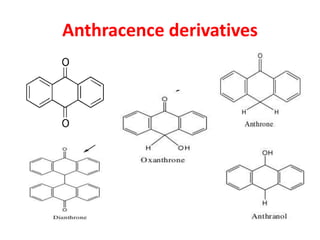
Anthracene Glycosides
• These constitute a major class of glycoside.
• They are mainly found in the dicot plant and
families like-Euphorbiaceae, Ericaceae,
Polygonaceae, Rhamnoceae, Rubiaceae,
leguminosae, Verbenaceae, etc.
• This group of glycosides comprises of different
aglycosides moieties like-anthraquione,
anthrone, anthranol, dianthranol and
dianthrone.
Anthracence derivatives
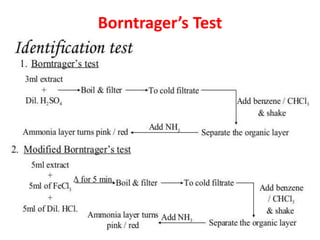
Borntrager’s Test
Glycosides containing crude drugs
• Cardiac glycoside-Digitalis,
• Saponins glycoside-Liquorice, Brahmi, Senega,
Ginseng
• Anthracene(Anthraqunone) glycosides-Aloe,
Rhubarb, Senna,
• Cascara
• Indian squill
• Strophanthus
• Dioscorea
• Gymnema
Digitalis
• Synonym-Digitalis leaves, foxglove leaves.
• Biological source- It consists of dried leaves of
Digitalis purpurea belonging to the family
Scrophulariaceae. The leaves should contain
not more than 5% of moisture.
• Geographical source- England, Europe, United
states & India.
Cultivation & collection
• It is biennial or perennial herb of about 1-2
meters in height
• It is propagated by seeds of selected strain,
containing high glycosidal content
• It needs calcarious, sandy, light soil with traces
of manganese
• The soil is sterilised by steam before sowing
• They grow in an altitude of 1600-3000m
• The seeds are mixed with fine sand and sown
in the nursery beds in March/April
• The young seedlings are transplanted in the
Sept. and Nov
• The crop is manured properly and kept free of
weed
• The plantation is done twice a year. In first
year, the plant bears rosette leaves and in the
second year sessile leaves
• The leaves are picked up in the afternoon
during Aug and Sept.
• The discoloured leaves are rejected
Preparation for market
• After the plucking the leaves are immediately
brought to drying centre and are dried in
vacuum driers at 60°C.
• The dried leaves(containing not more than 5%
of moisture) are packed into air tight
containers containing suitable dehydrating
agents.
Organoleptic characters
• Colour- dark greyish-green
• Odour-slight
• Taste-bitter
• Size-10-40cm long, 4-20cm width
• Shape-ovate-lanceolate to broadly ovate,
irregular margin.
Leaf morphology
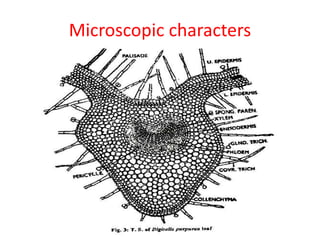
Microscopic characters
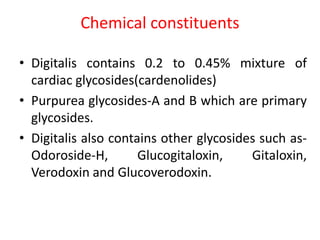
Chemical constituents
• Digitalis contains 0.2 to 0.45% mixture of
cardiac glycosides(cardenolides)
• Purpurea glycosides-A and B which are primary
glycosides.
• Digitalis also contains other glycosides such as-
Odoroside-H, Glucogitaloxin, Gitaloxin,
Verodoxin and Glucoverodoxin.
Purpurea-A
Enzymatic hydrolysis
Digitoxin+ glucose
Hydrolysis
Digitoxigenin + digitoxin
Purpurea-B
Enzymatic hydrolysis
Gitoxin + glucose
Hydrolysis
Gitoxingenin + digitoxose
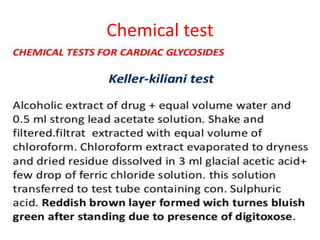
Chemical test
Uses
• Treatment of congestive cardiac failure
• It has a diuretic action
• Substitutes/adulterants:
-Leaves of Verbascum thapsus
-the primrose leaves
-comfrey leaves
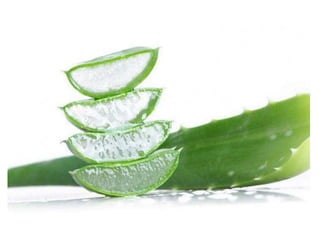
Aloe
• Synonym-Aloe, kumari, musabbar, barbedense
• Biological source-Aloe is the dried latex of leaves
of various species of Aloes, Viz-
Aloe barbadensis, Aloe ferox, Aloe perryi, Aloe
africana belonging to the family Liliaceae
• Geographical source-West Indian island, cape
town, Europe, North-east Himalayan region in
India
Preparation
• The juice which exudes on cutting the leaves is
collected in goat or sheep skin. It is allowed to
evaporate spontaneously for a month. It
becomes a pasty mass.
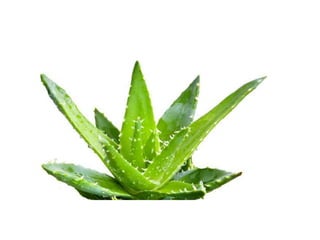
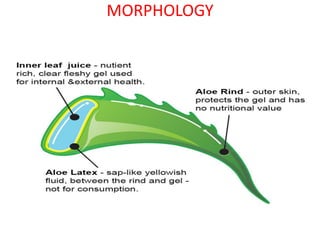
MORPHOLOGY
Microscopic characters
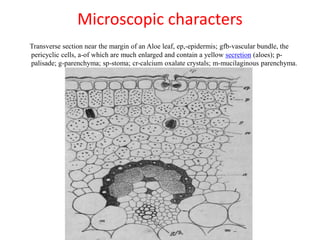
Transverse section near the margin of an Aloe leaf, ep,-epidermis; gfb-vascular bundle, the
pericyclic cells, a-of which are much enlarged and contain a yellow secretion (aloes); p-
palisade; g-parenchyma; sp-stoma; cr-calcium oxalate crystals; m-mucilaginous parenchyma.
Chemical constituents
• Aloin A & B, D-glucoside, Aloe resin is a
mixture of three isomers- Barbaloin, β-
barbaloin & iso-barbaloin.
Identification test
• Preparation of test solution-
1g of aloe is boiled with 100ml of water and
cooled. Then 1g of Kieselghur is added, stirred
and filtered. This filtrate is used for the
following tests-
i) Schonteten’s test (borex test)- 0.5g of borex is
added to test solution and heated. This
solution when diluted produces a green
fluorescence.
ii) Bromine test- an equal volumn of test
solution and bromine solution are heated. A
pale yellow precipitate of tetrabromaloin is
produced.
iii) Nitro acid test- To 5ml of test aloe, add
crystals of sodium nitrate and acetic acid, it
gives pink colour
Uses
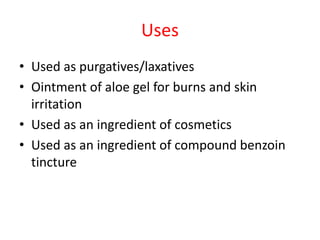
• Used as purgatives/laxatives
• Ointment of aloe gel for burns and skin
irritation
• Used as an ingredient of cosmetics
• Used as an ingredient of compound benzoin
tincture
• Substitutes/adulterants-
-Native aloes obtained from Aloe
candelabrum, mocha aloes, Jafferabed aloes.
Glycosides

Glycosides

  • 1.
    Introduction • Naturally occurringorganic compounds • Found in both plants and animals • On hydrolysis (by acids or enzymatic) gives one or more sugar moiety (glycone) and non-sugar moiety (aglycone). • Non-sugar (aglycon) called genin. • The pharmacological acivity is due to the presence of genin part. • Glycone part facilitates the transportation of genin to the site of action.
  • 2.
    Glycosides Definition These are theorganic compounds obtained from the plants or animals sources which on enzymatic or acid hydrolysis gives one or more sugar moieties along with non-sugar moiety.
  • 3.
    Glycosides Enzymatic or acidhydrolysis sugar moieties(glycone) non-sugar moiety (aglycone or genin)
  • 5.
    • The sugarinvolved in glycosides are of different types, but most commonly, it is β-D glucose. Other are galactose, mannose, rhamnose, digitoxose, cymarose, etc. • The linkage between alycone & aglycone is called glycosidic linkage.
  • 6.
    Types 1. Based onatoms involved in glycosidic linkage • O- glycosides • C- glycosides • S- glycosides • N- glycosides 2. According to chemical nature of aglycone part • Cardiac/sterol glycosides-Digitalis, indian squill, strophanthus, • Anthracene(Anthraqunone) glycosides-Senna, rhubarb,aloe, cascara • Cyanogenetic glycosides-Bitter almond, white cherry bark, • Saponin glycosides-Dioscorea, liquorice, Ginseng,sersaparilla • Isothiocynate glycosides-Black mustard
  • 7.
    1. According tolinkage existing b/w the glycone and aglycone • All types of glycosidal linkages are occured by interaction of –OH group of glycone and hydrogen coming through any of the radicals like –CH, -OH, -SH, and –NH present on aglycone part. Hence, by elimination of one water molecule, linkage or a bridge is formed and the type of glycoside formed is named by putting the element as prefix like-
  • 8.
    1. C-gylcosides • Someof the anthraquinone glycosides such as Cascarosides from Cascara and aloin from aloe, as well as some member of flavone type of glycosides show the presence of C-glycoside. Glycone--OH+ HC--aglycone Glycone--C--aglycone + H2O • They are not hydrolysed by heating with dil. Acid/alkalies but by oxidative hydrolysis with ferric chloride.
  • 9.
    2. O-glycosides • Commonin higher plants. • Examples-Senna, rhurbarb, etc • They are hydrolysed by treatment of acid or alkali into aglycone and sugar. Glycone--OH+HO—aglycone Glycone--O--aglycone + H2O
  • 10.
    3. S-glycosides • Restrictedto isothiocynate glycoside like-Sinigrin from black mustard. • They are formed by interaction of sulfahydryl group of aglycone and hydroxide group of glycone Glycone--OH+HS—aglycone Glycone--S--aglycone + H2O
  • 11.
    4. N-glycosides • N-glycosidesare nucleosides. • The glycosides contain sugar but still the physical, chemical and therapeutic properties are given by aglycone part. • Examples-Adenosine-antiarrythmic, yeast nucleic acid- brewer's yeast(nutrient supplement) Glycone--OH+HN--aglycone Glycone--N--aglycone + H2O
  • 12.
    Isolation Method Stas-Otto Method •The drug containing glycoside is finely powdered and the powder is extracted by continuous hot percolation using soxhlet apparatus with alcohol as solvent. • Various enzymes-deactivate due to heating. • The thermolabile glysosides, however, should be extracted at temperature preferably below 45 degree centigrade • The extract is treated with lead acetate to precipitate tannins and thus eliminating non-glycosidal impurities. • The excess of lead acetate is precipitate as lead sulphide by passing hydrogen sulphide gas through solution • The extract is filtered, concentrated to get crude glycosides. • From crude extract , the glycosides are obtained in pure form by making use of processes like fractional solubility, fractional crystallization and chromatography techniques such as preparative thin layer and column chromatography.
  • 13.
    Anthracene Glycosides • Theseconstitute a major class of glycoside. • They are mainly found in the dicot plant and families like-Euphorbiaceae, Ericaceae, Polygonaceae, Rhamnoceae, Rubiaceae, leguminosae, Verbenaceae, etc. • This group of glycosides comprises of different aglycosides moieties like-anthraquione, anthrone, anthranol, dianthranol and dianthrone.
  • 14.
  • 15.
  • 16.
    Glycosides containing crudedrugs • Cardiac glycoside-Digitalis, • Saponins glycoside-Liquorice, Brahmi, Senega, Ginseng • Anthracene(Anthraqunone) glycosides-Aloe, Rhubarb, Senna, • Cascara • Indian squill • Strophanthus • Dioscorea • Gymnema
  • 17.
    Digitalis • Synonym-Digitalis leaves,foxglove leaves. • Biological source- It consists of dried leaves of Digitalis purpurea belonging to the family Scrophulariaceae. The leaves should contain not more than 5% of moisture. • Geographical source- England, Europe, United states & India.
  • 20.
    Cultivation & collection •It is biennial or perennial herb of about 1-2 meters in height • It is propagated by seeds of selected strain, containing high glycosidal content • It needs calcarious, sandy, light soil with traces of manganese • The soil is sterilised by steam before sowing • They grow in an altitude of 1600-3000m • The seeds are mixed with fine sand and sown in the nursery beds in March/April
  • 21.
    • The youngseedlings are transplanted in the Sept. and Nov • The crop is manured properly and kept free of weed • The plantation is done twice a year. In first year, the plant bears rosette leaves and in the second year sessile leaves • The leaves are picked up in the afternoon during Aug and Sept. • The discoloured leaves are rejected
  • 22.
    Preparation for market •After the plucking the leaves are immediately brought to drying centre and are dried in vacuum driers at 60°C. • The dried leaves(containing not more than 5% of moisture) are packed into air tight containers containing suitable dehydrating agents.
  • 23.
    Organoleptic characters • Colour-dark greyish-green • Odour-slight • Taste-bitter • Size-10-40cm long, 4-20cm width • Shape-ovate-lanceolate to broadly ovate, irregular margin.
  • 24.
  • 25.
  • 26.
    Chemical constituents • Digitaliscontains 0.2 to 0.45% mixture of cardiac glycosides(cardenolides) • Purpurea glycosides-A and B which are primary glycosides. • Digitalis also contains other glycosides such as- Odoroside-H, Glucogitaloxin, Gitaloxin, Verodoxin and Glucoverodoxin.
  • 27.
    Purpurea-A Enzymatic hydrolysis Digitoxin+ glucose Hydrolysis Digitoxigenin+ digitoxin Purpurea-B Enzymatic hydrolysis Gitoxin + glucose Hydrolysis Gitoxingenin + digitoxose
  • 28.
  • 29.
    Uses • Treatment ofcongestive cardiac failure • It has a diuretic action • Substitutes/adulterants: -Leaves of Verbascum thapsus -the primrose leaves -comfrey leaves
  • 30.
    Aloe • Synonym-Aloe, kumari,musabbar, barbedense • Biological source-Aloe is the dried latex of leaves of various species of Aloes, Viz- Aloe barbadensis, Aloe ferox, Aloe perryi, Aloe africana belonging to the family Liliaceae • Geographical source-West Indian island, cape town, Europe, North-east Himalayan region in India
  • 33.
    Preparation • The juicewhich exudes on cutting the leaves is collected in goat or sheep skin. It is allowed to evaporate spontaneously for a month. It becomes a pasty mass.
  • 34.
  • 35.
    Microscopic characters Transverse sectionnear the margin of an Aloe leaf, ep,-epidermis; gfb-vascular bundle, the pericyclic cells, a-of which are much enlarged and contain a yellow secretion (aloes); p- palisade; g-parenchyma; sp-stoma; cr-calcium oxalate crystals; m-mucilaginous parenchyma.
  • 37.
    Chemical constituents • AloinA & B, D-glucoside, Aloe resin is a mixture of three isomers- Barbaloin, β- barbaloin & iso-barbaloin.
  • 38.
    Identification test • Preparationof test solution- 1g of aloe is boiled with 100ml of water and cooled. Then 1g of Kieselghur is added, stirred and filtered. This filtrate is used for the following tests- i) Schonteten’s test (borex test)- 0.5g of borex is added to test solution and heated. This solution when diluted produces a green fluorescence.
  • 39.
    ii) Bromine test-an equal volumn of test solution and bromine solution are heated. A pale yellow precipitate of tetrabromaloin is produced. iii) Nitro acid test- To 5ml of test aloe, add crystals of sodium nitrate and acetic acid, it gives pink colour
  • 40.
    Uses • Used aspurgatives/laxatives • Ointment of aloe gel for burns and skin irritation • Used as an ingredient of cosmetics • Used as an ingredient of compound benzoin tincture
  • 41.
    • Substitutes/adulterants- -Native aloesobtained from Aloe candelabrum, mocha aloes, Jafferabed aloes.