Chemistry of Natural Products
GLYCOSIDES
Presented to: Dr. Syeda Abida Ejaz
Presented by : Aamna Khatoon
M.Phil pharmaceutical Chemistry
1st Semester Spring 2021-2023
.
Glycosides
• These are organic natural compounds present in a lot of
plants and animals, these compounds upon hydrolysis give
one or more sugars (glycone) β_form and non
sugar(aglycone) also called as genin
• Glycosides are compounds formed by ether linkage or an
oxygen bridge between a sugar or non sugar compound
• Pharmacological activity is because of aglycone part
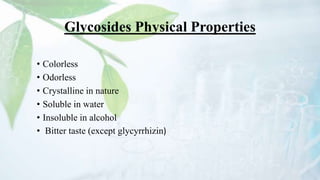
Glycosides Physical Properties
• Colorless
• Odorless
• Crystalline in nature
• Soluble in water
• Insoluble in alcohol
• Bitter taste (except glycyrrhizin)
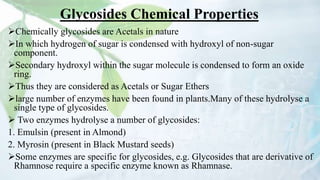
Glycosides Chemical Properties
Chemically glycosides are Acetals in nature
In which hydrogen of sugar is condensed with hydroxyl of non-sugar
component.
Secondary hydroxyl within the sugar molecule is condensed to form an oxide
ring.
Thus they are considered as Acetals or Sugar Ethers
large number of enzymes have been found in plants.Many of these hydrolyse a
single type of glycosides.
 Two enzymes hydrolyse a number of glycosides:
1. Emulsin (present in Almond)
2. Myrosin (present in Black Mustard seeds)
Some enzymes are specific for glycosides, e.g. Glycosides that are derivative of
Rhamnose require a specific enzyme known as Rhamnase.
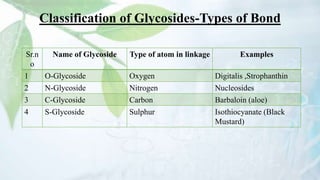
Classification of Glycosides-Types of Bond
Sr.n
o
Name of Glycoside Type of atom in linkage Examples
1 O-Glycoside Oxygen Digitalis ,Strophanthin
2 N-Glycoside Nitrogen Nucleosides
3 C-Glycoside Carbon Barbaloin (aloe)
4 S-Glycoside Sulphur Isothiocyanate (Black
Mustard)
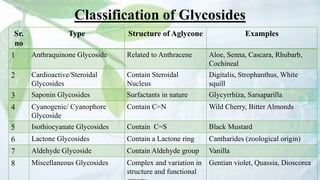
Classification of Glycosides
Sr.
no
Type Structure of Aglycone Examples
1 Anthraquinone Glycoside Related to Anthracene Aloe, Senna, Cascara, Rhubarb,
Cochineal
2 Cardioactive/Steroidal
Glycosides
Contain Steroidal
Nucleus
Digitalis, Strophanthus, White
squill
3 Saponin Glycosides Surfactants in nature Glycyrrhiza, Sarsaparilla
4 Cyanogenic/ Cyanophore
Glycoside
Contain C=N Wild Cherry, Bitter Almonds
5 Isothiocyanate Glycosides Contain C=S Black Mustard
6 Lactone Glycosides Contain a Lactone ring Cantharides (zoological origin)
7 Aldehyde Glycoside Contain Aldehyde group Vanilla
8 Miscellaneous Glycosides Complex and variation in
structure and functional
Gentian violet, Quassia, Dioscorea
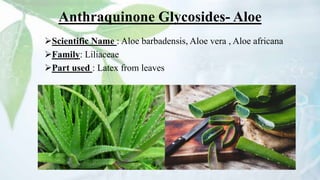
Anthraquinone Glycosides- Aloe
Scientific Name : Aloe barbadensis, Aloe vera , Aloe africana
Family: Liliaceae
Part used : Latex from leaves
Anthraquinone Glycosides- Aloe
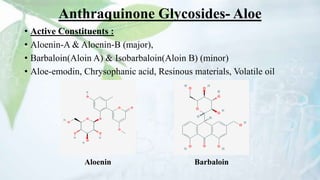
• Active Constituents :
• Aloenin-A & Aloenin-B (major),
• Barbaloin(Aloin A) & Isobarbaloin(Aloin B) (minor)
• Aloe-emodin, Chrysophanic acid, Resinous materials, Volatile oil
Aloenin Barbaloin
Anthraquinone Glycosides- Aloe
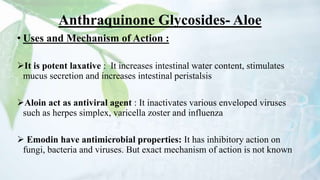
• Uses and Mechanism of Action :
It is potent laxative : It increases intestinal water content, stimulates
mucus secretion and increases intestinal peristalsis
Aloin act as antiviral agent : It inactivates various enveloped viruses
such as herpes simplex, varicella zoster and influenza
 Emodin have antimicrobial properties: It has inhibitory action on
fungi, bacteria and viruses. But exact mechanism of action is not known
Cardioactive Glycosides- Digitalis
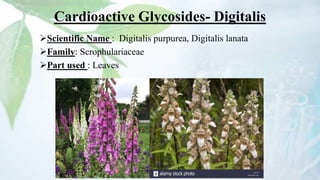
Scientific Name : Digitalis purpurea, Digitalis lanata
Family: Scrophulariaceae
Part used : Leaves
Cardioactive Glycosides- Digitalis
• Active Constituents :
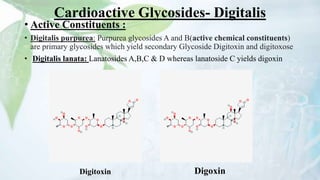
• Digitalis purpurea: Purpurea glycosides A and B(active chemical constituents)
are primary glycosides which yield secondary Glycoside Digitoxin and digitoxose
• Digitalis lanata: Lanatosides A,B,C & D whereas lanatoside C yields digoxin
Digitoxin Digoxin
Cardioactive Glycosides- Digitalis
• Mechanism of Action :
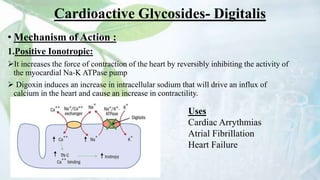
1.Positive Ionotropic:
It increases the force of contraction of the heart by reversibly inhibiting the activity of
the myocardial Na-K ATPase pump
 Digoxin induces an increase in intracellular sodium that will drive an influx of
calcium in the heart and cause an increase in contractility.
Uses
Cardiac Arrythmias
Atrial Fibrillation
Heart Failure
Cardioactive Glycosides- Digitalis
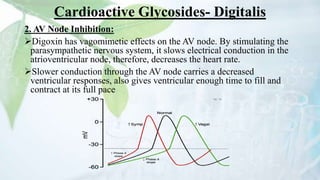
2. AV Node Inhibition:
Digoxin has vagomimetic effects on the AV node. By stimulating the
parasympathetic nervous system, it slows electrical conduction in the
atrioventricular node, therefore, decreases the heart rate.
Slower conduction through the AV node carries a decreased
ventricular responses, also gives ventricular enough time to fill and
contract at its full pace
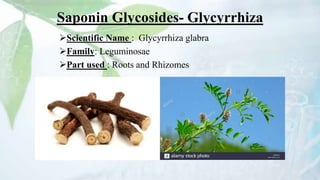
Saponin Glycosides- Glycyrrhiza
Scientific Name : Glycyrrhiza glabra
Family: Leguminosae
Part used : Roots and Rhizomes
Saponin Glycosides- Glycyrrhiza
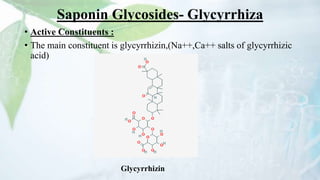
• Active Constituents :
• The main constituent is glycyrrhizin,(Na++,Ca++ salts of glycyrrhizic
acid)
Glycyrrhizin
Saponin Glycosides- Glycyrrhiza
• Uses and Mechanism of Action :
Glycyrrhizin is has been used in traditional medicine to alleviate
bronchitis, gastritis, and jaundice. .
It has been reported that glycyrrhizin possesses anti-inflammatory and
antioxidant activities and can stimulate endogenous production of
interferons.
It also has been shown to downregulate proinflammatory mediators in
CCl4-induced hepatotoxicity.
Glycyrrhizin produced an inhibitory effect on HBeAg secretion that
imparts anti-HBV activity. Antifibrotic activity of glycyrrhizin could
be attributed to its inhibitory activity on NF-κB.
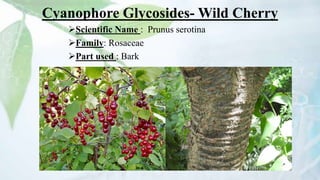
Cyanophore Glycosides- Wild Cherry
Scientific Name : Prunus serotina
Family: Rosaceae
Part used : Bark
Cyanophore Glycosides- Wild Cherry
• Active Constituents:
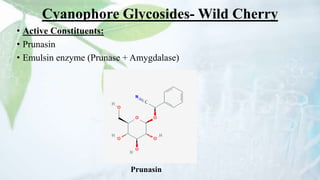
• Prunasin
• Emulsin enzyme (Prunase + Amygdalase)
Prunasin
Cyanophore Glycosides- Wild Cherry
• Uses and Mechanism of Action :
Used in cough syrups as flavoring agent and also act as Sedative
expectorant
It is toxic in high doses, Cytochrome oxidase irreversible binding of
Cyanide.
It is hydrolyzed into benzaldehyde and Hydrocyanic Acid.
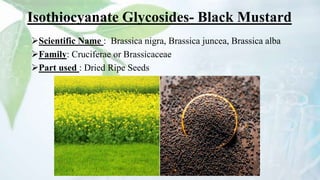
Isothiocyanate Glycosides- Black Mustard
Scientific Name : Brassica nigra, Brassica juncea, Brassica alba
Family: Cruciferae or Brassicaceae
Part used : Dried Ripe Seeds
Isothiocyanate Glycosides- Black Mustard
• Active constituents :
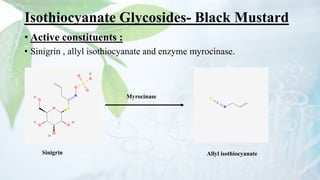
• Sinigrin , allyl isothiocyanate and enzyme myrocinase.
Sinigrin Allyl isothiocyanate
Myrocinase
Isothiocyanate Glycosides- Black Mustard
• Uses and Mechanism of Action :
Medicinal properties are due to allyl isothiocynate, which is a local
irritant and emetic.
If applied externally, it is rubefacient and vasicant.
 Sinigrin exerts various biological effects and also has a vital role in the
prevention of cancer and DNA damage caused by carcinogens(induction
of glutathione-S-transferase, apoptosis of cancerous cells)
Sinigrin showed to reduce the level of plasma triglyceride could be an
encouraging agent to prevent postprandial hypertriglyceridemia
Lactone Glycosides- Cantharides
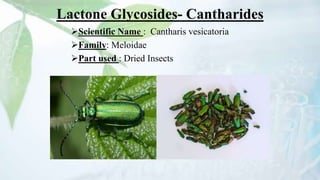
Scientific Name : Cantharis vesicatoria
Family: Meloidae
Part used : Dried Insects
Lactone Glycosides- Cantharides
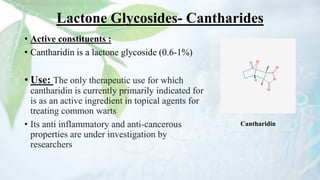
• Active constituents :
• Cantharidin is a lactone glycoside (0.6-1%)
• Use: The only therapeutic use for which
cantharidin is currently primarily indicated for
is as an active ingredient in topical agents for
treating common warts
• Its anti inflammatory and anti-cancerous
properties are under investigation by
researchers
Cantharidin
Aldehyde Glycosides- Vanilla
Scientific Name : Vanilla planifolia, Vanilla tehitensis
Family: Orchidaceae
Part used : Cured dried fully grown unripe fruit
Aldehyde Glycosides- Vanilla
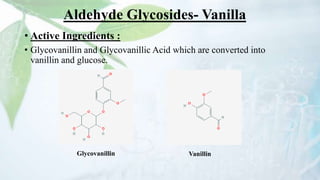
• Active Ingredients :
• Glycovanillin and Glycovanillic Acid which are converted into
vanillin and glucose.
Glycovanillin Vanillin
Aldehyde Glycosides- Vanilla
Uses
Widely used as flavoring agent in food industry
Vanillin is an acid in solution and may be irritating to the eyes
and mucous membranes of the respiratory tract.
It also has medicinal uses as an anticlastogenic and antimicrobial
agent.
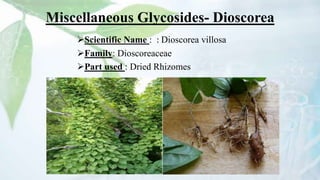
Miscellaneous Glycosides- Dioscorea
Scientific Name : : Dioscorea villosa
Family: Dioscoreaceae
Part used : Dried Rhizomes
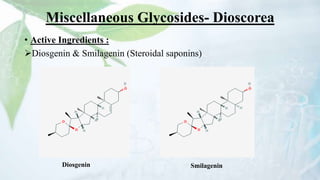
Miscellaneous Glycosides- Dioscorea
• Active Ingredients :
Diosgenin & Smilagenin (Steroidal saponins)
Diosgenin Smilagenin
Miscellaneous Glycosides- Dioscorea
• Uses and Mechanism of action :
Diosgenin exhibits anticancer properties, It interferes with cell
death pathways and their regulators to induce apoptosis, follows STAT
3 pathway.
 It improves antioxidant status and inhibits lipid peroxidation.
 Its anti-inflammatory activity is through inhibiting production of
pro-inflammatory cytokines, enzymes and adhesion molecules.
 Estrogenic: It drives cellular growth/differentiation through the
estrogen receptor (ER) cascade and transcriptional factor PPARγ.
Miscellaneous Glycosides- Dioscorea
• Uses and Mechanism of action :
Smilagenin is a neurotrophic factor inducer
It readily reverses free radical neurotoxicity produced by 1-ethyl-4-
phenylpyridium (MPP+) in dopaminergic neurones and reverses the
decrease of neuronal growth factors and dopamine receptors in the
brain.
Further research indicated that it has antidiabetic properties.
 Traditionally, plant was used for the preparation of steroids
Was also used to treat different hormonal disorders
Glycosides
Glycosides

Glycosides

  • 2.
    Chemistry of NaturalProducts GLYCOSIDES Presented to: Dr. Syeda Abida Ejaz Presented by : Aamna Khatoon M.Phil pharmaceutical Chemistry 1st Semester Spring 2021-2023 .
  • 3.
    Glycosides • These areorganic natural compounds present in a lot of plants and animals, these compounds upon hydrolysis give one or more sugars (glycone) β_form and non sugar(aglycone) also called as genin • Glycosides are compounds formed by ether linkage or an oxygen bridge between a sugar or non sugar compound • Pharmacological activity is because of aglycone part
  • 4.
    Glycosides Physical Properties •Colorless • Odorless • Crystalline in nature • Soluble in water • Insoluble in alcohol • Bitter taste (except glycyrrhizin)
  • 5.
    Glycosides Chemical Properties Chemicallyglycosides are Acetals in nature In which hydrogen of sugar is condensed with hydroxyl of non-sugar component. Secondary hydroxyl within the sugar molecule is condensed to form an oxide ring. Thus they are considered as Acetals or Sugar Ethers large number of enzymes have been found in plants.Many of these hydrolyse a single type of glycosides.  Two enzymes hydrolyse a number of glycosides: 1. Emulsin (present in Almond) 2. Myrosin (present in Black Mustard seeds) Some enzymes are specific for glycosides, e.g. Glycosides that are derivative of Rhamnose require a specific enzyme known as Rhamnase.
  • 6.
    Classification of Glycosides-Typesof Bond Sr.n o Name of Glycoside Type of atom in linkage Examples 1 O-Glycoside Oxygen Digitalis ,Strophanthin 2 N-Glycoside Nitrogen Nucleosides 3 C-Glycoside Carbon Barbaloin (aloe) 4 S-Glycoside Sulphur Isothiocyanate (Black Mustard)
  • 7.
    Classification of Glycosides Sr. no TypeStructure of Aglycone Examples 1 Anthraquinone Glycoside Related to Anthracene Aloe, Senna, Cascara, Rhubarb, Cochineal 2 Cardioactive/Steroidal Glycosides Contain Steroidal Nucleus Digitalis, Strophanthus, White squill 3 Saponin Glycosides Surfactants in nature Glycyrrhiza, Sarsaparilla 4 Cyanogenic/ Cyanophore Glycoside Contain C=N Wild Cherry, Bitter Almonds 5 Isothiocyanate Glycosides Contain C=S Black Mustard 6 Lactone Glycosides Contain a Lactone ring Cantharides (zoological origin) 7 Aldehyde Glycoside Contain Aldehyde group Vanilla 8 Miscellaneous Glycosides Complex and variation in structure and functional Gentian violet, Quassia, Dioscorea
  • 8.
    Anthraquinone Glycosides- Aloe ScientificName : Aloe barbadensis, Aloe vera , Aloe africana Family: Liliaceae Part used : Latex from leaves
  • 9.
    Anthraquinone Glycosides- Aloe •Active Constituents : • Aloenin-A & Aloenin-B (major), • Barbaloin(Aloin A) & Isobarbaloin(Aloin B) (minor) • Aloe-emodin, Chrysophanic acid, Resinous materials, Volatile oil Aloenin Barbaloin
  • 10.
    Anthraquinone Glycosides- Aloe •Uses and Mechanism of Action : It is potent laxative : It increases intestinal water content, stimulates mucus secretion and increases intestinal peristalsis Aloin act as antiviral agent : It inactivates various enveloped viruses such as herpes simplex, varicella zoster and influenza  Emodin have antimicrobial properties: It has inhibitory action on fungi, bacteria and viruses. But exact mechanism of action is not known
  • 11.
    Cardioactive Glycosides- Digitalis ScientificName : Digitalis purpurea, Digitalis lanata Family: Scrophulariaceae Part used : Leaves
  • 12.
    Cardioactive Glycosides- Digitalis •Active Constituents : • Digitalis purpurea: Purpurea glycosides A and B(active chemical constituents) are primary glycosides which yield secondary Glycoside Digitoxin and digitoxose • Digitalis lanata: Lanatosides A,B,C & D whereas lanatoside C yields digoxin Digitoxin Digoxin
  • 13.
    Cardioactive Glycosides- Digitalis •Mechanism of Action : 1.Positive Ionotropic: It increases the force of contraction of the heart by reversibly inhibiting the activity of the myocardial Na-K ATPase pump  Digoxin induces an increase in intracellular sodium that will drive an influx of calcium in the heart and cause an increase in contractility. Uses Cardiac Arrythmias Atrial Fibrillation Heart Failure
  • 14.
    Cardioactive Glycosides- Digitalis 2.AV Node Inhibition: Digoxin has vagomimetic effects on the AV node. By stimulating the parasympathetic nervous system, it slows electrical conduction in the atrioventricular node, therefore, decreases the heart rate. Slower conduction through the AV node carries a decreased ventricular responses, also gives ventricular enough time to fill and contract at its full pace
  • 15.
    Saponin Glycosides- Glycyrrhiza ScientificName : Glycyrrhiza glabra Family: Leguminosae Part used : Roots and Rhizomes
  • 16.
    Saponin Glycosides- Glycyrrhiza •Active Constituents : • The main constituent is glycyrrhizin,(Na++,Ca++ salts of glycyrrhizic acid) Glycyrrhizin
  • 17.
    Saponin Glycosides- Glycyrrhiza •Uses and Mechanism of Action : Glycyrrhizin is has been used in traditional medicine to alleviate bronchitis, gastritis, and jaundice. . It has been reported that glycyrrhizin possesses anti-inflammatory and antioxidant activities and can stimulate endogenous production of interferons. It also has been shown to downregulate proinflammatory mediators in CCl4-induced hepatotoxicity. Glycyrrhizin produced an inhibitory effect on HBeAg secretion that imparts anti-HBV activity. Antifibrotic activity of glycyrrhizin could be attributed to its inhibitory activity on NF-κB.
  • 18.
    Cyanophore Glycosides- WildCherry Scientific Name : Prunus serotina Family: Rosaceae Part used : Bark
  • 19.
    Cyanophore Glycosides- WildCherry • Active Constituents: • Prunasin • Emulsin enzyme (Prunase + Amygdalase) Prunasin
  • 20.
    Cyanophore Glycosides- WildCherry • Uses and Mechanism of Action : Used in cough syrups as flavoring agent and also act as Sedative expectorant It is toxic in high doses, Cytochrome oxidase irreversible binding of Cyanide. It is hydrolyzed into benzaldehyde and Hydrocyanic Acid.
  • 21.
    Isothiocyanate Glycosides- BlackMustard Scientific Name : Brassica nigra, Brassica juncea, Brassica alba Family: Cruciferae or Brassicaceae Part used : Dried Ripe Seeds
  • 22.
    Isothiocyanate Glycosides- BlackMustard • Active constituents : • Sinigrin , allyl isothiocyanate and enzyme myrocinase. Sinigrin Allyl isothiocyanate Myrocinase
  • 23.
    Isothiocyanate Glycosides- BlackMustard • Uses and Mechanism of Action : Medicinal properties are due to allyl isothiocynate, which is a local irritant and emetic. If applied externally, it is rubefacient and vasicant.  Sinigrin exerts various biological effects and also has a vital role in the prevention of cancer and DNA damage caused by carcinogens(induction of glutathione-S-transferase, apoptosis of cancerous cells) Sinigrin showed to reduce the level of plasma triglyceride could be an encouraging agent to prevent postprandial hypertriglyceridemia
  • 24.
    Lactone Glycosides- Cantharides ScientificName : Cantharis vesicatoria Family: Meloidae Part used : Dried Insects
  • 25.
    Lactone Glycosides- Cantharides •Active constituents : • Cantharidin is a lactone glycoside (0.6-1%) • Use: The only therapeutic use for which cantharidin is currently primarily indicated for is as an active ingredient in topical agents for treating common warts • Its anti inflammatory and anti-cancerous properties are under investigation by researchers Cantharidin
  • 26.
    Aldehyde Glycosides- Vanilla ScientificName : Vanilla planifolia, Vanilla tehitensis Family: Orchidaceae Part used : Cured dried fully grown unripe fruit
  • 27.
    Aldehyde Glycosides- Vanilla •Active Ingredients : • Glycovanillin and Glycovanillic Acid which are converted into vanillin and glucose. Glycovanillin Vanillin
  • 28.
    Aldehyde Glycosides- Vanilla Uses Widelyused as flavoring agent in food industry Vanillin is an acid in solution and may be irritating to the eyes and mucous membranes of the respiratory tract. It also has medicinal uses as an anticlastogenic and antimicrobial agent.
  • 29.
    Miscellaneous Glycosides- Dioscorea ScientificName : : Dioscorea villosa Family: Dioscoreaceae Part used : Dried Rhizomes
  • 30.
    Miscellaneous Glycosides- Dioscorea •Active Ingredients : Diosgenin & Smilagenin (Steroidal saponins) Diosgenin Smilagenin
  • 31.
    Miscellaneous Glycosides- Dioscorea •Uses and Mechanism of action : Diosgenin exhibits anticancer properties, It interferes with cell death pathways and their regulators to induce apoptosis, follows STAT 3 pathway.  It improves antioxidant status and inhibits lipid peroxidation.  Its anti-inflammatory activity is through inhibiting production of pro-inflammatory cytokines, enzymes and adhesion molecules.  Estrogenic: It drives cellular growth/differentiation through the estrogen receptor (ER) cascade and transcriptional factor PPARγ.
  • 32.
    Miscellaneous Glycosides- Dioscorea •Uses and Mechanism of action : Smilagenin is a neurotrophic factor inducer It readily reverses free radical neurotoxicity produced by 1-ethyl-4- phenylpyridium (MPP+) in dopaminergic neurones and reverses the decrease of neuronal growth factors and dopamine receptors in the brain. Further research indicated that it has antidiabetic properties.  Traditionally, plant was used for the preparation of steroids Was also used to treat different hormonal disorders