
BRIEF OUTLINE OF ALKALOIDS,
GLYCOSIDES & TANNINS
Archana B Chavhan
M.Pharm (QA)
KYDSCT’s College of Pharmacy Sakegaon
Bhusawal
ALKALOIDS
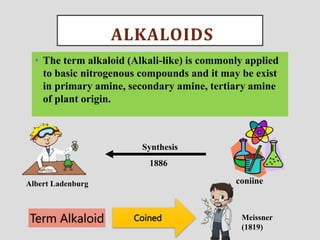
• The term alkaloid (Alkali-like) is commonly applied
to basic nitrogenous compounds and it may be exist
in primary amine, secondary amine, tertiary amine
of plant origin.
Synthesis
1886
Albert Ladenburg coniine
Term Alkaloid Coined Meissner
(1819)
TYPES OF ALKALOIDS
• True alkaloids : are derive from amino acid and share a
heterocyclic ring with nitrogen.
• The primary precursors of true alkaloids are such amino acids
as L-ornithine, L-lysine, L-tryptophan and L-histidine.
• Examples: Cocaine, quinine, and morphine.
• Proto/Amino alkaloids : Proto alkaloids are compounds, in
which the N atom derived from an amino acid is not a part of
the heterocyclic.
• Example- Hordenine, mescaline and yohimbine.
• Pseudo alkaloids : the basic carbon skeletons of which are
not derived from amino acids.
• Example- coniine, capsaicin, ephedrine,, caffeine and
theobromine
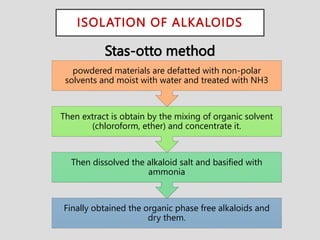
ISOLATION OF ALKALOIDS
Finally obtained the organic phase free alkaloids and
dry them.
Then dissolved the alkaloid salt and basified with
ammonia
Then extract is obtain by the mixing of organic solvent
(chloroform, ether) and concentrate it.
powdered materials are defatted with non-polar
solvents and moist with water and treated with NH3
Stas-otto method
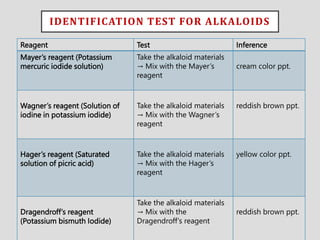
IDENTIFICATION TEST FOR ALKALOIDS
Reagent Test Inference
Mayer’s reagent (Potassium
mercuric iodide solution)
Take the alkaloid materials
→ Mix with the Mayer’s
reagent
cream color ppt.
Wagner’s reagent (Solution of
iodine in potassium iodide)
Take the alkaloid materials
→ Mix with the Wagner’s
reagent
reddish brown ppt.
Hager’s reagent (Saturated
solution of picric acid)
Take the alkaloid materials
→ Mix with the Hager’s
reagent
yellow color ppt.
Dragendroff’s reagent
(Potassium bismuth Iodide)
Take the alkaloid materials
→ Mix with the
Dragendroff’s reagent
reddish brown ppt.
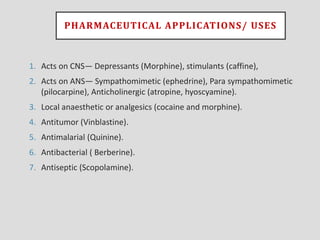
PHARMACEUTICAL APPLICATIONS/ USES
1. Acts on CNS— Depressants (Morphine), stimulants (caffine),
2. Acts on ANS— Sympathomimetic (ephedrine), Para sympathomimetic
(pilocarpine), Anticholinergic (atropine, hyoscyamine).
3. Local anaesthetic or analgesics (cocaine and morphine).
4. Antitumor (Vinblastine).
5. Antimalarial (Quinine).
6. Antibacterial ( Berberine).
7. Antiseptic (Scopolamine).
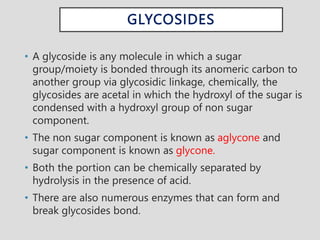
GLYCOSIDES
• A glycoside is any molecule in which a sugar
group/moiety is bonded through its anomeric carbon to
another group via glycosidic linkage, chemically, the
glycosides are acetal in which the hydroxyl of the sugar is
condensed with a hydroxyl group of non sugar
component.
• The non sugar component is known as aglycone and
sugar component is known as glycone.
• Both the portion can be chemically separated by
hydrolysis in the presence of acid.
• There are also numerous enzymes that can form and
break glycosides bond.
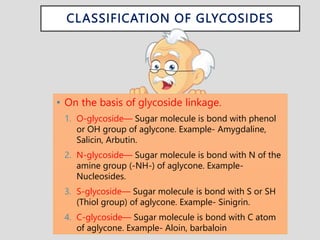
CLASSIFICATION OF GLYCOSIDES
• On the basis of glycoside linkage.
1. O-glycoside— Sugar molecule is bond with phenol
or OH group of aglycone. Example- Amygdaline,
Salicin, Arbutin.
2. N-glycoside— Sugar molecule is bond with N of the
amine group (-NH-) of aglycone. Example-
Nucleosides.
3. S-glycoside— Sugar molecule is bond with S or SH
(Thiol group) of aglycone. Example- Sinigrin.
4. C-glycoside— Sugar molecule is bond with C atom
of aglycone. Example- Aloin, barbaloin
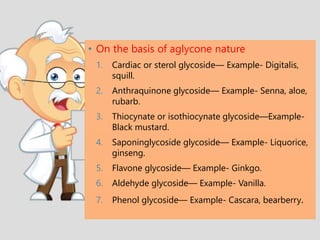
• On the basis of aglycone nature
1. Cardiac or sterol glycoside— Example- Digitalis,
squill.
2. Anthraquinone glycoside— Example- Senna, aloe,
rubarb.
3. Thiocynate or isothiocynate glycoside—Example-
Black mustard.
4. Saponinglycoside glycoside— Example- Liquorice,
ginseng.
5. Flavone glycoside— Example- Ginkgo.
6. Aldehyde glycoside— Example- Vanilla.
7. Phenol glycoside— Example- Cascara, bearberry.
OCCURRENCE AND DISTRIBUTION
OF GLYCOSIDES
 Pharmaceutically important glycosides are obtained
from the vegetable source.
 They occur in various parts of plant like fruits, seeds,
leaves, and barks.
 Most commonly occurring sugars as a product of
hydrolysis of glycosides are glucose, mannose, and
galactose.
 Glycosides are colorless, crystalline, non-reducing,
optically active compounds usually levo-rotatory
molecule.
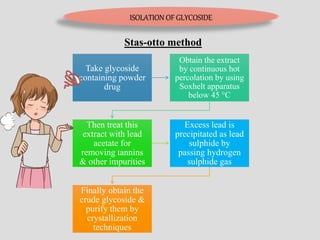
ISOLATION OF GLYCOSIDE
Stas-otto method
Take glycoside
containing powder
drug
Obtain the extract
by continuous hot
percolation by using
Soxhelt apparatus
below 45 °C
Then treat this
extract with lead
acetate for
removing tannins
& other impurities
Excess lead is
precipitated as lead
sulphide by
passing hydrogen
sulphide gas
Finally obtain the
crude glycoside &
purify them by
crystallization
techniques
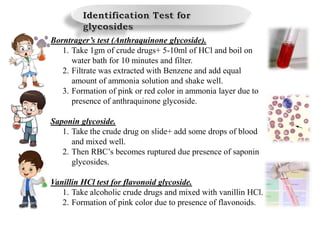
Borntrager’s test (Anthraquinone glycoside).
1. Take 1gm of crude drugs+ 5-10ml of HCl and boil on
water bath for 10 minutes and filter.
2. Filtrate was extracted with Benzene and add equal
amount of ammonia solution and shake well.
3. Formation of pink or red color in ammonia layer due to
presence of anthraquinone glycoside.
Saponin glycoside.
1. Take the crude drug on slide+ add some drops of blood
and mixed well.
2. Then RBC’s becomes ruptured due presence of saponin
glycosides.
Vanillin HCl test for flavonoid glycoside.
1. Take alcoholic crude drugs and mixed with vanillin HCl.
2. Formation of pink color due to presence of flavonoids.
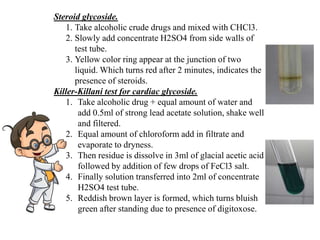
Steroid glycoside.
1. Take alcoholic crude drugs and mixed with CHCl3.
2. Slowly add concentrate H2SO4 from side walls of
test tube.
3. Yellow color ring appear at the junction of two
liquid. Which turns red after 2 minutes, indicates the
presence of steroids.
Killer-Killani test for cardiac glycoside.
1. Take alcoholic drug + equal amount of water and
add 0.5ml of strong lead acetate solution, shake well
and filtered.
2. Equal amount of chloroform add in filtrate and
evaporate to dryness.
3. Then residue is dissolve in 3ml of glacial acetic acid
followed by addition of few drops of FeCl3 salt.
4. Finally solution transferred into 2ml of concentrate
H2SO4 test tube.
5. Reddish brown layer is formed, which turns bluish
green after standing due to presence of digitoxose.
THERAPEUTIC APPLICATIONS OF GLYCOSIDE
1. Senna leaves are used as laxative.
2. The drug Aloes is one of the safest and
stimulating purgatives,
3. Digitalis leaves has a profound tonic effect
upon a diseased heart,
4. Bitter almond used as sedative
VOLATILE OILS AND TERPENOIDS
• Volatile oils are the odorous chemical substances which are
easily evaporate when exposed to air at ordinary
temperature.
• These represent essence of active constituents of the plants
and hence also known as essential oil.
• They differ entirely in both chemical and physical properties
from fixed oils. Volatile oils are freely soluble in ether and in
chloroform and fairly soluble in alcohol and insoluble in
water.
• Their density is lower than water with the exception (clove
and cinnamon) heavier than water.
• They possess characteristics odor, have high refractive index
and most of them are optically active.
• Volatile oils are colorless liquid, but when exposed to air and
CLASSIFICATION OF THE VOLATILE OILS
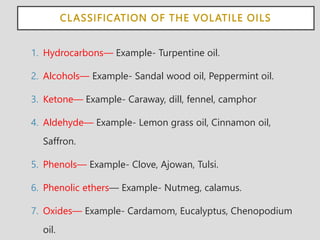
1. Hydrocarbons— Example- Turpentine oil.
2. Alcohols— Example- Sandal wood oil, Peppermint oil.
3. Ketone— Example- Caraway, dill, fennel, camphor
4. Aldehyde— Example- Lemon grass oil, Cinnamon oil,
Saffron.
5. Phenols— Example- Clove, Ajowan, Tulsi.
6. Phenolic ethers— Example- Nutmeg, calamus.
7. Oxides— Example- Cardamom, Eucalyptus, Chenopodium
oil.
TERPENOIDS
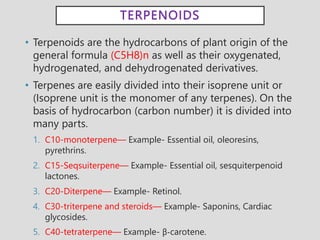
• Terpenoids are the hydrocarbons of plant origin of the
general formula (C5H8)n as well as their oxygenated,
hydrogenated, and dehydrogenated derivatives.
• Terpenes are easily divided into their isoprene unit or
(Isoprene unit is the monomer of any terpenes). On the
basis of hydrocarbon (carbon number) it is divided into
many parts.
1. C10-monoterpene— Example- Essential oil, oleoresins,
pyrethrins.
2. C15-Seqsuiterpene— Example- Essential oil, sesquiterpenoid
lactones.
3. C20-Diterpene— Example- Retinol.
4. C30-triterpene and steroids— Example- Saponins, Cardiac
glycosides.
5. C40-tetraterpene— Example- β-carotene.
VOLATILE OILS ARE EXTRACTED BY THE
MANY PLANTS
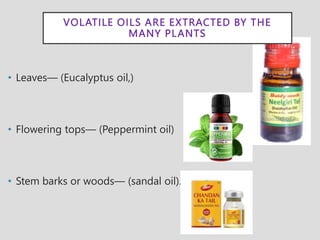
• Leaves— (Eucalyptus oil,)
• Flowering tops— (Peppermint oil)
• Stem barks or woods— (sandal oil).
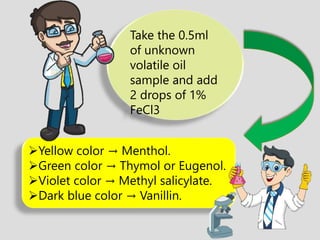
Take the 0.5ml
of unknown
volatile oil
sample and add
2 drops of 1%
FeCl3
Yellow color → Menthol.
Green color → Thymol or Eugenol.
Violet color → Methyl salicylate.
Dark blue color → Vanillin.
THERAPEUTIC APPLICATION OF VOLATILE
OIL/TERPENOIDS
1. In the pharmaceutical formulation it is used as an
flavoring agent and perfuming agent for masking the
unpleasant odor of the drugs.
2. It is also used in the foods, beverages, and in cosmetic
industries.
3. It shows more therapeutic values— Carminative
(Umbelliferous fruits), Irritant (Turpentine and oil of
wintergreen), Local anaesthetics (Clove), Sedative
(Jatamansi), Anthelmintics (Chenopodium oil).
TANNINS
• Tannins are secondary metabolites complex organic, non-
nitrogenous, phenolic, plant products, which generally
have astringent properties.
• Classification of tannin compounds
1. Pseudo tannins
2. True tannins
• Identification Test for tannins
Gold beater's skin test.
Phenazone test.
Gelatin test.
Test of catechin (Match stick test).
Test for chlorogenic acid.
 Vanillin hydrochloric acid test.
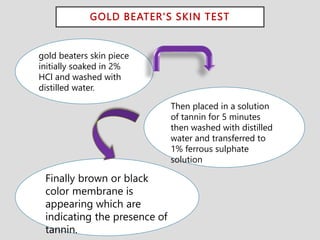
GOLD BEATER'S SKIN TEST
gold beaters skin piece
initially soaked in 2%
HCl and washed with
distilled water.
Then placed in a solution
of tannin for 5 minutes
then washed with distilled
water and transferred to
1% ferrous sulphate
solution
Finally brown or black
color membrane is
appearing which are
indicating the presence of
tannin.
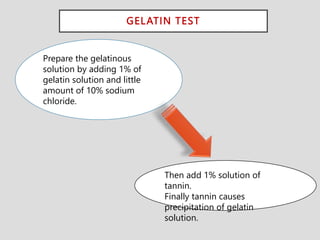
GELATIN TEST
Prepare the gelatinous
solution by adding 1% of
gelatin solution and little
amount of 10% sodium
chloride.
Then add 1% solution of
tannin.
Finally tannin causes
precipitation of gelatin
solution.
THERAPEUTIC APPLICATIONS OF TANNINS
1. Medically tannins show astringents properties and
promote rapid healing and the formation of new tissue.
2. Tannins are also used for treating wounds and inflamed
mucosa.
3. Tannins are used in the treatment of various ulcers,
hemorrhoids, minor burns frostbite etc.
4. Recently tannins should antiviral activities and used for
treatment of viral diseases including AIDS.
RESINS
• Resin can be defined as the complex
amorphous chemical of more or less solid
characteristics. Which on heating, initially they
soften and finally melt.
• They are insoluble in water and petroleum spirit
but dissolve in more or less completely in
alcohol, chloroform, and ether.
THERAPEUTIC APPLICATIONS OF RESINS
1. local irritant,
2. local cathartic
3. Anticancer
4. as mild antiseptic in the form of tinctures
alkaloids.pptx

alkaloids.pptx

  • 1.
    BRIEF OUTLINE OFALKALOIDS, GLYCOSIDES & TANNINS Archana B Chavhan M.Pharm (QA) KYDSCT’s College of Pharmacy Sakegaon Bhusawal
  • 2.
    ALKALOIDS • The termalkaloid (Alkali-like) is commonly applied to basic nitrogenous compounds and it may be exist in primary amine, secondary amine, tertiary amine of plant origin. Synthesis 1886 Albert Ladenburg coniine Term Alkaloid Coined Meissner (1819)
  • 3.
    TYPES OF ALKALOIDS •True alkaloids : are derive from amino acid and share a heterocyclic ring with nitrogen. • The primary precursors of true alkaloids are such amino acids as L-ornithine, L-lysine, L-tryptophan and L-histidine. • Examples: Cocaine, quinine, and morphine. • Proto/Amino alkaloids : Proto alkaloids are compounds, in which the N atom derived from an amino acid is not a part of the heterocyclic. • Example- Hordenine, mescaline and yohimbine. • Pseudo alkaloids : the basic carbon skeletons of which are not derived from amino acids. • Example- coniine, capsaicin, ephedrine,, caffeine and theobromine
  • 4.
    ISOLATION OF ALKALOIDS Finallyobtained the organic phase free alkaloids and dry them. Then dissolved the alkaloid salt and basified with ammonia Then extract is obtain by the mixing of organic solvent (chloroform, ether) and concentrate it. powdered materials are defatted with non-polar solvents and moist with water and treated with NH3 Stas-otto method
  • 5.
    IDENTIFICATION TEST FORALKALOIDS Reagent Test Inference Mayer’s reagent (Potassium mercuric iodide solution) Take the alkaloid materials → Mix with the Mayer’s reagent cream color ppt. Wagner’s reagent (Solution of iodine in potassium iodide) Take the alkaloid materials → Mix with the Wagner’s reagent reddish brown ppt. Hager’s reagent (Saturated solution of picric acid) Take the alkaloid materials → Mix with the Hager’s reagent yellow color ppt. Dragendroff’s reagent (Potassium bismuth Iodide) Take the alkaloid materials → Mix with the Dragendroff’s reagent reddish brown ppt.
  • 6.
    PHARMACEUTICAL APPLICATIONS/ USES 1.Acts on CNS— Depressants (Morphine), stimulants (caffine), 2. Acts on ANS— Sympathomimetic (ephedrine), Para sympathomimetic (pilocarpine), Anticholinergic (atropine, hyoscyamine). 3. Local anaesthetic or analgesics (cocaine and morphine). 4. Antitumor (Vinblastine). 5. Antimalarial (Quinine). 6. Antibacterial ( Berberine). 7. Antiseptic (Scopolamine).
  • 7.
    GLYCOSIDES • A glycosideis any molecule in which a sugar group/moiety is bonded through its anomeric carbon to another group via glycosidic linkage, chemically, the glycosides are acetal in which the hydroxyl of the sugar is condensed with a hydroxyl group of non sugar component. • The non sugar component is known as aglycone and sugar component is known as glycone. • Both the portion can be chemically separated by hydrolysis in the presence of acid. • There are also numerous enzymes that can form and break glycosides bond.
  • 8.
    CLASSIFICATION OF GLYCOSIDES •On the basis of glycoside linkage. 1. O-glycoside— Sugar molecule is bond with phenol or OH group of aglycone. Example- Amygdaline, Salicin, Arbutin. 2. N-glycoside— Sugar molecule is bond with N of the amine group (-NH-) of aglycone. Example- Nucleosides. 3. S-glycoside— Sugar molecule is bond with S or SH (Thiol group) of aglycone. Example- Sinigrin. 4. C-glycoside— Sugar molecule is bond with C atom of aglycone. Example- Aloin, barbaloin
  • 9.
    • On thebasis of aglycone nature 1. Cardiac or sterol glycoside— Example- Digitalis, squill. 2. Anthraquinone glycoside— Example- Senna, aloe, rubarb. 3. Thiocynate or isothiocynate glycoside—Example- Black mustard. 4. Saponinglycoside glycoside— Example- Liquorice, ginseng. 5. Flavone glycoside— Example- Ginkgo. 6. Aldehyde glycoside— Example- Vanilla. 7. Phenol glycoside— Example- Cascara, bearberry.
  • 10.
    OCCURRENCE AND DISTRIBUTION OFGLYCOSIDES  Pharmaceutically important glycosides are obtained from the vegetable source.  They occur in various parts of plant like fruits, seeds, leaves, and barks.  Most commonly occurring sugars as a product of hydrolysis of glycosides are glucose, mannose, and galactose.  Glycosides are colorless, crystalline, non-reducing, optically active compounds usually levo-rotatory molecule.
  • 11.
    ISOLATION OF GLYCOSIDE Stas-ottomethod Take glycoside containing powder drug Obtain the extract by continuous hot percolation by using Soxhelt apparatus below 45 °C Then treat this extract with lead acetate for removing tannins & other impurities Excess lead is precipitated as lead sulphide by passing hydrogen sulphide gas Finally obtain the crude glycoside & purify them by crystallization techniques
  • 12.
    Borntrager’s test (Anthraquinoneglycoside). 1. Take 1gm of crude drugs+ 5-10ml of HCl and boil on water bath for 10 minutes and filter. 2. Filtrate was extracted with Benzene and add equal amount of ammonia solution and shake well. 3. Formation of pink or red color in ammonia layer due to presence of anthraquinone glycoside. Saponin glycoside. 1. Take the crude drug on slide+ add some drops of blood and mixed well. 2. Then RBC’s becomes ruptured due presence of saponin glycosides. Vanillin HCl test for flavonoid glycoside. 1. Take alcoholic crude drugs and mixed with vanillin HCl. 2. Formation of pink color due to presence of flavonoids.
  • 13.
    Steroid glycoside. 1. Takealcoholic crude drugs and mixed with CHCl3. 2. Slowly add concentrate H2SO4 from side walls of test tube. 3. Yellow color ring appear at the junction of two liquid. Which turns red after 2 minutes, indicates the presence of steroids. Killer-Killani test for cardiac glycoside. 1. Take alcoholic drug + equal amount of water and add 0.5ml of strong lead acetate solution, shake well and filtered. 2. Equal amount of chloroform add in filtrate and evaporate to dryness. 3. Then residue is dissolve in 3ml of glacial acetic acid followed by addition of few drops of FeCl3 salt. 4. Finally solution transferred into 2ml of concentrate H2SO4 test tube. 5. Reddish brown layer is formed, which turns bluish green after standing due to presence of digitoxose.
  • 14.
    THERAPEUTIC APPLICATIONS OFGLYCOSIDE 1. Senna leaves are used as laxative. 2. The drug Aloes is one of the safest and stimulating purgatives, 3. Digitalis leaves has a profound tonic effect upon a diseased heart, 4. Bitter almond used as sedative
  • 15.
    VOLATILE OILS ANDTERPENOIDS • Volatile oils are the odorous chemical substances which are easily evaporate when exposed to air at ordinary temperature. • These represent essence of active constituents of the plants and hence also known as essential oil. • They differ entirely in both chemical and physical properties from fixed oils. Volatile oils are freely soluble in ether and in chloroform and fairly soluble in alcohol and insoluble in water. • Their density is lower than water with the exception (clove and cinnamon) heavier than water. • They possess characteristics odor, have high refractive index and most of them are optically active. • Volatile oils are colorless liquid, but when exposed to air and
  • 16.
    CLASSIFICATION OF THEVOLATILE OILS 1. Hydrocarbons— Example- Turpentine oil. 2. Alcohols— Example- Sandal wood oil, Peppermint oil. 3. Ketone— Example- Caraway, dill, fennel, camphor 4. Aldehyde— Example- Lemon grass oil, Cinnamon oil, Saffron. 5. Phenols— Example- Clove, Ajowan, Tulsi. 6. Phenolic ethers— Example- Nutmeg, calamus. 7. Oxides— Example- Cardamom, Eucalyptus, Chenopodium oil.
  • 17.
    TERPENOIDS • Terpenoids arethe hydrocarbons of plant origin of the general formula (C5H8)n as well as their oxygenated, hydrogenated, and dehydrogenated derivatives. • Terpenes are easily divided into their isoprene unit or (Isoprene unit is the monomer of any terpenes). On the basis of hydrocarbon (carbon number) it is divided into many parts. 1. C10-monoterpene— Example- Essential oil, oleoresins, pyrethrins. 2. C15-Seqsuiterpene— Example- Essential oil, sesquiterpenoid lactones. 3. C20-Diterpene— Example- Retinol. 4. C30-triterpene and steroids— Example- Saponins, Cardiac glycosides. 5. C40-tetraterpene— Example- β-carotene.
  • 18.
    VOLATILE OILS AREEXTRACTED BY THE MANY PLANTS • Leaves— (Eucalyptus oil,) • Flowering tops— (Peppermint oil) • Stem barks or woods— (sandal oil).
  • 19.
    Take the 0.5ml ofunknown volatile oil sample and add 2 drops of 1% FeCl3 Yellow color → Menthol. Green color → Thymol or Eugenol. Violet color → Methyl salicylate. Dark blue color → Vanillin.
  • 20.
    THERAPEUTIC APPLICATION OFVOLATILE OIL/TERPENOIDS 1. In the pharmaceutical formulation it is used as an flavoring agent and perfuming agent for masking the unpleasant odor of the drugs. 2. It is also used in the foods, beverages, and in cosmetic industries. 3. It shows more therapeutic values— Carminative (Umbelliferous fruits), Irritant (Turpentine and oil of wintergreen), Local anaesthetics (Clove), Sedative (Jatamansi), Anthelmintics (Chenopodium oil).
  • 21.
    TANNINS • Tannins aresecondary metabolites complex organic, non- nitrogenous, phenolic, plant products, which generally have astringent properties. • Classification of tannin compounds 1. Pseudo tannins 2. True tannins • Identification Test for tannins Gold beater's skin test. Phenazone test. Gelatin test. Test of catechin (Match stick test). Test for chlorogenic acid.  Vanillin hydrochloric acid test.
  • 22.
    GOLD BEATER'S SKINTEST gold beaters skin piece initially soaked in 2% HCl and washed with distilled water. Then placed in a solution of tannin for 5 minutes then washed with distilled water and transferred to 1% ferrous sulphate solution Finally brown or black color membrane is appearing which are indicating the presence of tannin.
  • 23.
    GELATIN TEST Prepare thegelatinous solution by adding 1% of gelatin solution and little amount of 10% sodium chloride. Then add 1% solution of tannin. Finally tannin causes precipitation of gelatin solution.
  • 24.
    THERAPEUTIC APPLICATIONS OFTANNINS 1. Medically tannins show astringents properties and promote rapid healing and the formation of new tissue. 2. Tannins are also used for treating wounds and inflamed mucosa. 3. Tannins are used in the treatment of various ulcers, hemorrhoids, minor burns frostbite etc. 4. Recently tannins should antiviral activities and used for treatment of viral diseases including AIDS.
  • 25.
    RESINS • Resin canbe defined as the complex amorphous chemical of more or less solid characteristics. Which on heating, initially they soften and finally melt. • They are insoluble in water and petroleum spirit but dissolve in more or less completely in alcohol, chloroform, and ether.
  • 26.
    THERAPEUTIC APPLICATIONS OFRESINS 1. local irritant, 2. local cathartic 3. Anticancer 4. as mild antiseptic in the form of tinctures