1
AUTOMOBILE BASICS
By Kushal Kumar Sarkar
2
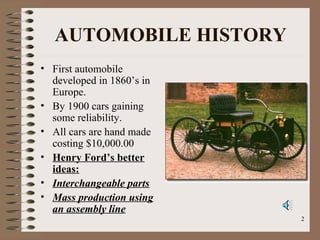
AUTOMOBILE HISTORY
• First automobile
developed in 1860’s in
Europe.
• By 1900 cars gaining
some reliability.
• All cars are hand made
costing $10,000.00
• Henry Ford’s better
ideas:
• Interchangeable parts
• Mass production using
an assembly line
3
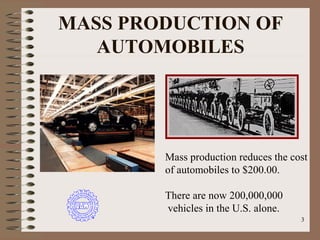
MASS PRODUCTION OF
AUTOMOBILES
Mass production reduces the cost
of automobiles to $200.00.
There are now 200,000,000
vehicles in the U.S. alone.
4
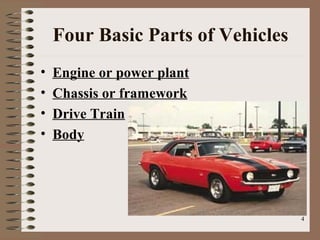
Four Basic Parts of Vehicles
• Engine or power plant
• Chassis or framework
• Drive Train
• Body
5
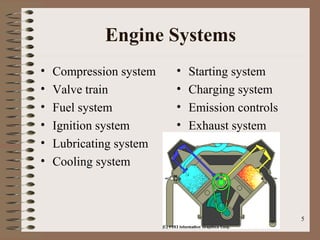
Engine Systems
• Compression system
• Valve train
• Fuel system
• Ignition system
• Lubricating system
• Cooling system
• Starting system
• Charging system
• Emission controls
• Exhaust system
6
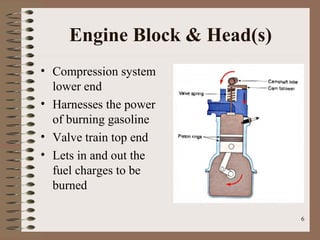
Engine Block & Head(s)
• Compression system
lower end
• Harnesses the power
of burning gasoline
• Valve train top end
• Lets in and out the
fuel charges to be
burned
7
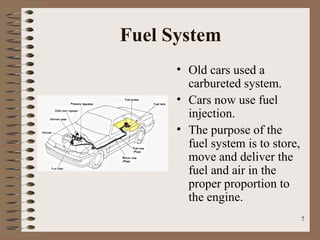
Fuel System
• Old cars used a
carbureted system.
• Cars now use fuel
injection.
• The purpose of the
fuel system is to store,
move and deliver the
fuel and air in the
proper proportion to
the engine.
8
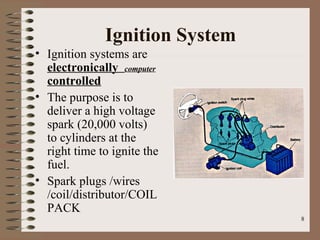
Ignition System
• Ignition systems are
electronically computer
controlled
• The purpose is to
deliver a high voltage
spark (20,000 volts)
to cylinders at the
right time to ignite the
fuel.
• Spark plugs /wires
/coil/distributor/COIL
PACK
9
Computer
• Recent innovation
• Controls
– Fuel,
– ignition,
– Emission
– suspension
10
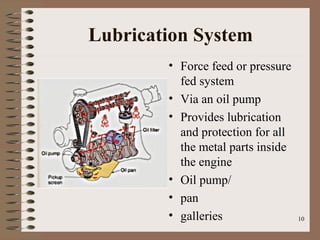
Lubrication System
• Force feed or pressure
fed system
• Via an oil pump
• Provides lubrication
and protection for all
the metal parts inside
the engine
• Oil pump/
• pan
• galleries
11
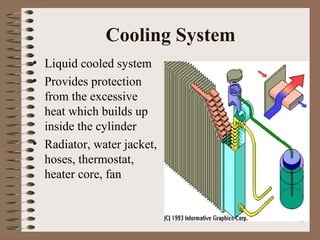
Cooling System
• Liquid cooled system
• Provides protection
from the excessive
heat which builds up
inside the cylinder
• Radiator, water jacket,
hoses, thermostat,
heater core, fan
12
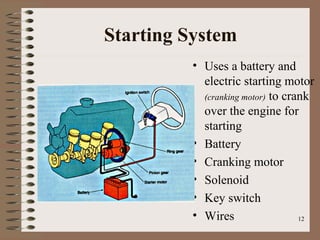
Starting System
• Uses a battery and
electric starting motor
(cranking motor) to crank
over the engine for
starting
• Battery
• Cranking motor
• Solenoid
• Key switch
• Wires
13
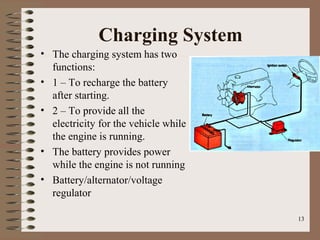
Charging System
• The charging system has two
functions:
• 1 – To recharge the battery
after starting.
• 2 – To provide all the
electricity for the vehicle while
the engine is running.
• The battery provides power
while the engine is not running
• Battery/alternator/voltage
regulator
14
Exhaust System
• Removes gases from engine
• Quiets vehicle
• Provides back pressure
• Exhaust manifold
• Crossover
• Tail pipe
• Muffler
• Resonator
15
Emission Controls
• To clean up the air pollution caused by the
automobile.
• Capture any vapor which might escape the
the fuel tank and engines crankcase.
• Clean up exhaust for any un burnt fuel,
carbon monoxide, or oxides of nitrogen.
• Many types of devices are employed.
• PCV/Catalytic convertor/gas cap/EGR
16
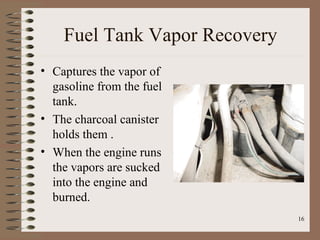
Fuel Tank Vapor Recovery
• Captures the vapor of
gasoline from the fuel
tank.
• The charcoal canister
holds them .
• When the engine runs
the vapors are sucked
into the engine and
burned.
17
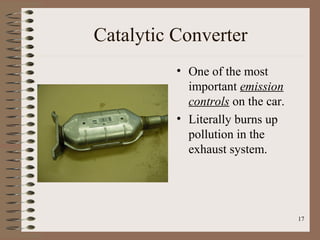
Catalytic Converter
• One of the most
important emission
controls on the car.
• Literally burns up
pollution in the
exhaust system.
18
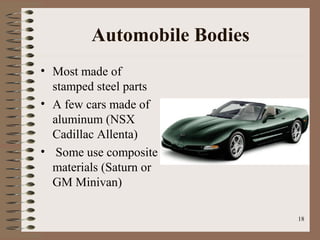
Automobile Bodies
• Most made of
stamped steel parts
• A few cars made of
aluminum (NSX
Cadillac Allenta)
• Some use composite
materials (Saturn or
GM Minivan)
19
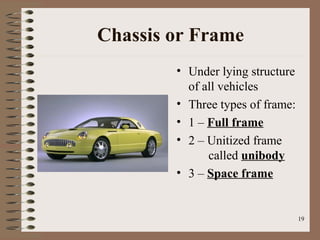
Chassis or Frame
• Under lying structure
of all vehicles
• Three types of frame:
• 1 – Full frame
• 2 – Unitized frame
called unibody
• 3 – Space frame
20
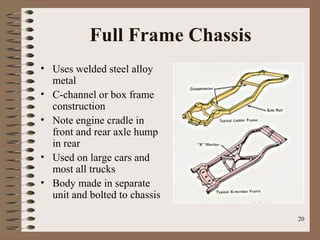
Full Frame Chassis
• Uses welded steel alloy
metal
• C-channel or box frame
construction
• Note engine cradle in
front and rear axle hump
in rear
• Used on large cars and
most all trucks
• Body made in separate
unit and bolted to chassis
21
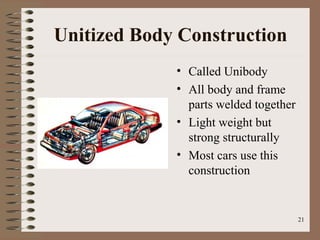
Unitized Body Construction
• Called Unibody
• All body and frame
parts welded together
• Light weight but
strong structurally
• Most cars use this
construction
22
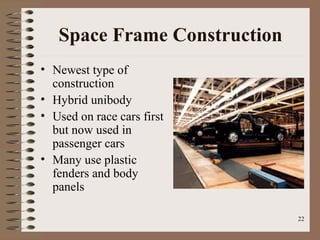
Space Frame Construction
• Newest type of
construction
• Hybrid unibody
• Used on race cars first
but now used in
passenger cars
• Many use plastic
fenders and body
panels
23
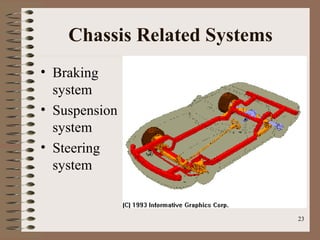
Chassis Related Systems
• Braking
system
• Suspension
system
• Steering
system
24
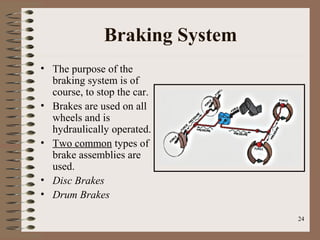
Braking System
• The purpose of the
braking system is of
course, to stop the car.
• Brakes are used on all
wheels and is
hydraulically operated.
• Two common types of
brake assemblies are
used.
• Disc Brakes
• Drum Brakes
25
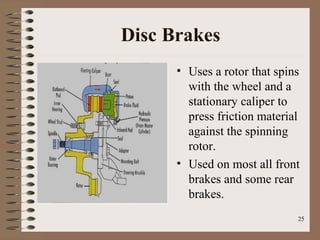
Disc Brakes
• Uses a rotor that spins
with the wheel and a
stationary caliper to
press friction material
against the spinning
rotor.
• Used on most all front
brakes and some rear
brakes.
26
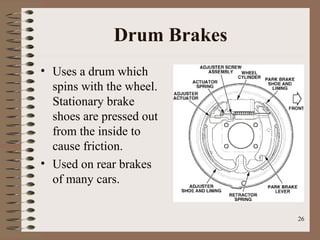
Drum Brakes
• Uses a drum which
spins with the wheel.
Stationary brake
shoes are pressed out
from the inside to
cause friction.
• Used on rear brakes
of many cars.
27
ABS Anti-Lock Braking System
• Helps driver stop under
control
• Keeps brakes from
locking up
• Pulses brakes
• Enables car to be turned
• *Does not replace
hydraulic brakes
• Does not make
vehicle stop faster
• Does not work if
brake petal is pumped
28
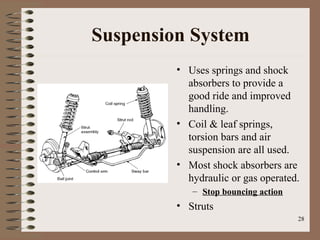
Suspension System
• Uses springs and shock
absorbers to provide a
good ride and improved
handling.
• Coil & leaf springs,
torsion bars and air
suspension are all used.
• Most shock absorbers are
hydraulic or gas operated.
– Stop bouncing action
• Struts
29
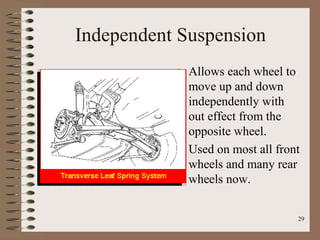
Independent Suspension
• Allows each wheel to
move up and down
independently with
out effect from the
opposite wheel.
• Used on most all front
wheels and many rear
wheels now.
30
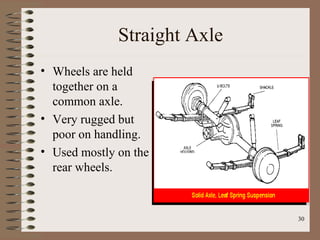
Straight Axle
• Wheels are held
together on a
common axle.
• Very rugged but
poor on handling.
• Used mostly on the
rear wheels.
31
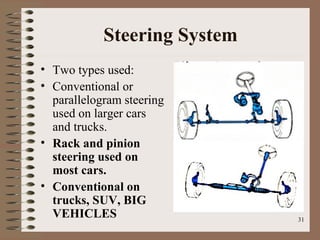
Steering System
• Two types used:
• Conventional or
parallelogram steering
used on larger cars
and trucks.
• Rack and pinion
steering used on
most cars.
• Conventional on
trucks, SUV, BIG
VEHICLES
32
Drive train
• Takes the engines torque and sends to the
drive wheels.
• Major types are: front wheel drive, rear
wheel drive, four wheel drive and all wheel
drive.
• Major components of all drive trains:
clutch, transmission, differential, and drive
shaft(s).
33
Drive Train Components
• Basic purpose is to get the engines torque
to the wheels.
• Clutches used with manual transmissions a
torque converter used with automatics.
– Disconnects engine from transmission
• Transmission/transaxle
• Drive shafts and drive axles.
• Differentials
34
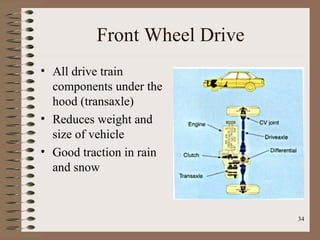
Front Wheel Drive
• All drive train
components under the
hood (transaxle)
• Reduces weight and
size of vehicle
• Good traction in rain
and snow
35
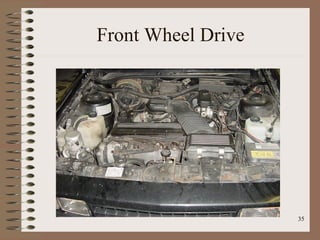
Front Wheel Drive
36
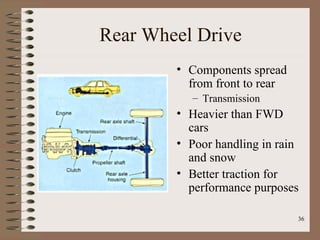
Rear Wheel Drive
• Components spread
from front to rear
– Transmission
• Heavier than FWD
cars
• Poor handling in rain
and snow
• Better traction for
performance purposes
37
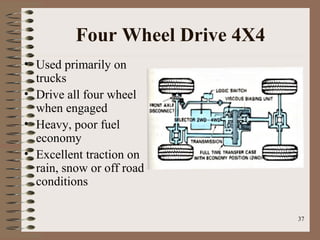
Four Wheel Drive 4X4
• Used primarily on
trucks
• Drive all four wheel
when engaged
• Heavy, poor fuel
economy
• Excellent traction on
rain, snow or off road
conditions
38
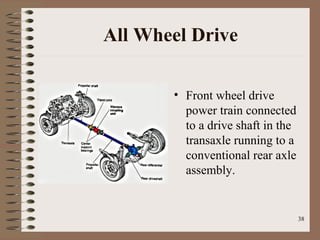
All Wheel Drive
• Front wheel drive
power train connected
to a drive shaft in the
transaxle running to a
conventional rear axle
assembly.
39
Identifying Vehicles
• Reading the V.I.N.
• 17 digit code located at the lower left
corner of the windshield.
• On Firewall
40
Thank You

Automobile Basics

  • 1.
  • 2.
    2 AUTOMOBILE HISTORY • Firstautomobile developed in 1860’s in Europe. • By 1900 cars gaining some reliability. • All cars are hand made costing $10,000.00 • Henry Ford’s better ideas: • Interchangeable parts • Mass production using an assembly line
  • 3.
    3 MASS PRODUCTION OF AUTOMOBILES Massproduction reduces the cost of automobiles to $200.00. There are now 200,000,000 vehicles in the U.S. alone.
  • 4.
    4 Four Basic Partsof Vehicles • Engine or power plant • Chassis or framework • Drive Train • Body
  • 5.
    5 Engine Systems • Compressionsystem • Valve train • Fuel system • Ignition system • Lubricating system • Cooling system • Starting system • Charging system • Emission controls • Exhaust system
  • 6.
    6 Engine Block &Head(s) • Compression system lower end • Harnesses the power of burning gasoline • Valve train top end • Lets in and out the fuel charges to be burned
  • 7.
    7 Fuel System • Oldcars used a carbureted system. • Cars now use fuel injection. • The purpose of the fuel system is to store, move and deliver the fuel and air in the proper proportion to the engine.
  • 8.
    8 Ignition System • Ignitionsystems are electronically computer controlled • The purpose is to deliver a high voltage spark (20,000 volts) to cylinders at the right time to ignite the fuel. • Spark plugs /wires /coil/distributor/COIL PACK
  • 9.
    9 Computer • Recent innovation •Controls – Fuel, – ignition, – Emission – suspension
  • 10.
    10 Lubrication System • Forcefeed or pressure fed system • Via an oil pump • Provides lubrication and protection for all the metal parts inside the engine • Oil pump/ • pan • galleries
  • 11.
    11 Cooling System • Liquidcooled system • Provides protection from the excessive heat which builds up inside the cylinder • Radiator, water jacket, hoses, thermostat, heater core, fan
  • 12.
    12 Starting System • Usesa battery and electric starting motor (cranking motor) to crank over the engine for starting • Battery • Cranking motor • Solenoid • Key switch • Wires
  • 13.
    13 Charging System • Thecharging system has two functions: • 1 – To recharge the battery after starting. • 2 – To provide all the electricity for the vehicle while the engine is running. • The battery provides power while the engine is not running • Battery/alternator/voltage regulator
  • 14.
    14 Exhaust System • Removesgases from engine • Quiets vehicle • Provides back pressure • Exhaust manifold • Crossover • Tail pipe • Muffler • Resonator
  • 15.
    15 Emission Controls • Toclean up the air pollution caused by the automobile. • Capture any vapor which might escape the the fuel tank and engines crankcase. • Clean up exhaust for any un burnt fuel, carbon monoxide, or oxides of nitrogen. • Many types of devices are employed. • PCV/Catalytic convertor/gas cap/EGR
  • 16.
    16 Fuel Tank VaporRecovery • Captures the vapor of gasoline from the fuel tank. • The charcoal canister holds them . • When the engine runs the vapors are sucked into the engine and burned.
  • 17.
    17 Catalytic Converter • Oneof the most important emission controls on the car. • Literally burns up pollution in the exhaust system.
  • 18.
    18 Automobile Bodies • Mostmade of stamped steel parts • A few cars made of aluminum (NSX Cadillac Allenta) • Some use composite materials (Saturn or GM Minivan)
  • 19.
    19 Chassis or Frame •Under lying structure of all vehicles • Three types of frame: • 1 – Full frame • 2 – Unitized frame called unibody • 3 – Space frame
  • 20.
    20 Full Frame Chassis •Uses welded steel alloy metal • C-channel or box frame construction • Note engine cradle in front and rear axle hump in rear • Used on large cars and most all trucks • Body made in separate unit and bolted to chassis
  • 21.
    21 Unitized Body Construction •Called Unibody • All body and frame parts welded together • Light weight but strong structurally • Most cars use this construction
  • 22.
    22 Space Frame Construction •Newest type of construction • Hybrid unibody • Used on race cars first but now used in passenger cars • Many use plastic fenders and body panels
  • 23.
    23 Chassis Related Systems •Braking system • Suspension system • Steering system
  • 24.
    24 Braking System • Thepurpose of the braking system is of course, to stop the car. • Brakes are used on all wheels and is hydraulically operated. • Two common types of brake assemblies are used. • Disc Brakes • Drum Brakes
  • 25.
    25 Disc Brakes • Usesa rotor that spins with the wheel and a stationary caliper to press friction material against the spinning rotor. • Used on most all front brakes and some rear brakes.
  • 26.
    26 Drum Brakes • Usesa drum which spins with the wheel. Stationary brake shoes are pressed out from the inside to cause friction. • Used on rear brakes of many cars.
  • 27.
    27 ABS Anti-Lock BrakingSystem • Helps driver stop under control • Keeps brakes from locking up • Pulses brakes • Enables car to be turned • *Does not replace hydraulic brakes • Does not make vehicle stop faster • Does not work if brake petal is pumped
  • 28.
    28 Suspension System • Usessprings and shock absorbers to provide a good ride and improved handling. • Coil & leaf springs, torsion bars and air suspension are all used. • Most shock absorbers are hydraulic or gas operated. – Stop bouncing action • Struts
  • 29.
    29 Independent Suspension • Allowseach wheel to move up and down independently with out effect from the opposite wheel. • Used on most all front wheels and many rear wheels now.
  • 30.
    30 Straight Axle • Wheelsare held together on a common axle. • Very rugged but poor on handling. • Used mostly on the rear wheels.
  • 31.
    31 Steering System • Twotypes used: • Conventional or parallelogram steering used on larger cars and trucks. • Rack and pinion steering used on most cars. • Conventional on trucks, SUV, BIG VEHICLES
  • 32.
    32 Drive train • Takesthe engines torque and sends to the drive wheels. • Major types are: front wheel drive, rear wheel drive, four wheel drive and all wheel drive. • Major components of all drive trains: clutch, transmission, differential, and drive shaft(s).
  • 33.
    33 Drive Train Components •Basic purpose is to get the engines torque to the wheels. • Clutches used with manual transmissions a torque converter used with automatics. – Disconnects engine from transmission • Transmission/transaxle • Drive shafts and drive axles. • Differentials
  • 34.
    34 Front Wheel Drive •All drive train components under the hood (transaxle) • Reduces weight and size of vehicle • Good traction in rain and snow
  • 35.
  • 36.
    36 Rear Wheel Drive •Components spread from front to rear – Transmission • Heavier than FWD cars • Poor handling in rain and snow • Better traction for performance purposes
  • 37.
    37 Four Wheel Drive4X4 • Used primarily on trucks • Drive all four wheel when engaged • Heavy, poor fuel economy • Excellent traction on rain, snow or off road conditions
  • 38.
    38 All Wheel Drive •Front wheel drive power train connected to a drive shaft in the transaxle running to a conventional rear axle assembly.
  • 39.
    39 Identifying Vehicles • Readingthe V.I.N. • 17 digit code located at the lower left corner of the windshield. • On Firewall
  • 40.