
CURRICULUM PLANNING AND IMPLEMENTATION
BASED ON THEORIES
BY
ARUN.M
PART I- CURRICULUM PLANNING
• 1)INTRODUCTION
• Nursing theory is the term given to the body of knowledge
that is used to support nursing practice.
• In professional education nurses will study a range of
interconnected subjects which can be applied to the
practice setting.
• This knowledge may be derived from experiential
learning, from formal sources such as nursing research
and non-nursing sources.
• To speak of nursing theory is often difficult. Nursing is
many things to many people.
• Most universally agreed upon is that Nursing is a
science involving people, environment and process
fueled by a vision of transcendence in the context of
healthcare.
• It is interesting to note that 90% of all Nursing theories
have been generated in the last 20 years.
2)Need for theory based curriculum
• Models of nursing have always been accused of being
"out of touch" with the harsh reality of patient care, and
creating yet more unnecessary paperwork for nurses to
complete.
• Lack of confidence among nurses to utilize the theory.
• Ambigious openion among nurse educators in selection
of theory and bringing into practice level.
• Nursing students are uncertain about the concept clarity
in theory based nursing
• Many schools encourage students to formulate theories
of Nursing as part of their curriculum.
3)SOLUTION TO USE THEORIES WITH
CONFIDENCE;
• THEORIES CAN BE USED IN ALL THE
ASPECTS ON NURSING EDUCATION,
SUCH AS PLANNING, IMPLEMENTIG AND
EVALUATING CURRICULAM
4) Curriculum can be based on the following
five principles:
• i)Theory-based reasoning and analytical
thinking :
• Role of teacher- create a learning
environment/situation and guide the learners to
think towards the concept and solution/decision
• Role of student- learn how to think and
reasoning, perceive the given situation and
develop clear concept in their own way.
• 5) ii)Practical relevance becoming an
effective nurse/ leader
• Role of teacher: Guide them to assess,
plan, implement and evaluate theory
based practice
• Role of student: Choose appropriate
theories, and follow evidence based
practice
• 6) iii) Becoming an effective national/
international team member
• Developing and utilizing networks to share
theoretical knowledge.
• initiate formulating theory: A carefully planned
and executed theories project under the
supervision of a qualified faculty member is
the culminating requirement.
• 6A) SELECTION AND PLACEMENT OF
STUDENT AND FACULTY BASED ON
ROY’S ADAPTATION MODEL
• PHISIOLOGICAL MODE :
Medical fitness
• SELF CONCEPT: Interview technique
used to assess
• The Interest in Teaching/learning Nursing
and patient care.
• Strength and weakness.
• ROLE FUNCTION: Pre placement
orientation to the roles in the institution.
Primary role- Teaching faculty/Student
– Roles and responsibilities
– Orientation to policies, physical infra structure,
– Organization chart, Line of authority
– Uniform/dress code
• Punctuality and discipline etc
• Secondary role- extended role as
• -SNA advisor/member;
• -NSS officer/ member
• -Workshop
coordinator/participant etc
• Tertiary role- Member of an professional
organization/ Editor in a journal,
State/National level SNA advisor/ member
etc
• CURRICULUM PLANNING USING THE
TEACHING- LEARNING THEORIES.
• 1)OREM’S SELF CARE THEORY: Facilitate the
new faculty/student to develop confident and
independence from fully dependence. The head
of the institution /HOD plays vital role in it. This
requires ongoing periodical assessment of the
independent ability and appropriate guidance
when ever necessary.
• Example: NOTES MAKING/ASSIGNMENT
WRITTING
• 2)MASLOW’S NEED/MOTIVATION THEORY:
Facilitate the faculty/teacher to accept and adapt
to new environment as a basic need / security /
self actualization. Further the revenue,
working/learning environment, promotion,
reward and punishment methods acts as a glue
to work together for the common purpose.
• Example: PASSING THE COURSE WITH
SECOND CLASS TO DISTINCTION WITH
UNIVERSITY RANK.
• 3)JOHNSON’S BEHAVIOURAL SYSTEM:
Facilitate the faculty / student to orient to the
importance of being a member of the institution,
their role is restoration of system as a whole,
• to work together. Failed in which discrepancy,
incompatibility, insufficiency and dominance will
arise between systems.
• Example: BALANCED AND RESPONSIBLE
INDIVIDUAL IN THE CLASS, COLLEGE,
HOSTEL, HOSPITAL, FAMILY AND SOCIETY.
• 4)ROCHNSTOCK’S HEALTH BELIEF MODEL:
• In nursing education for the topics requiring behavioral
changes or life style modification, HBM can be used. It is
• applicable from the beginning to the end of curriculum, in
teaching learning activities and staff management.
• Example:
• THREAT– FEAR OF FAILING IN THE EXAMINATION.
• VARIABLES-RELATED TO STUDENT/TEACHING/INSTITUTION ETC
• CUE TO ACTION- INDIVIDUAL GUIDANCE TO STUDENT.
• -REPEATED TEACHING/TEST
• -PEER ADVICE
• BARRIERS- RELATED TO STUDENT/TEACHING/INSTITUTION
• ETC
• DESIARABLE ACTION- LEARN WITH STANDARD AND PASS THE
EXAMINATION.
• 5)ROBERT R. CARKHUFF’S HELPING AND
HUMANRELATIONSHIP MODEL
• Facilitate therapeutic human relationships
through communicative interaction. The
teacher/student using information, influence,
comforting, relational and identity the therapeutic
communication developed, maintained and
terminated.
• Example:
• Non attending – Attending – Responding –
Personalizing -Initiating.
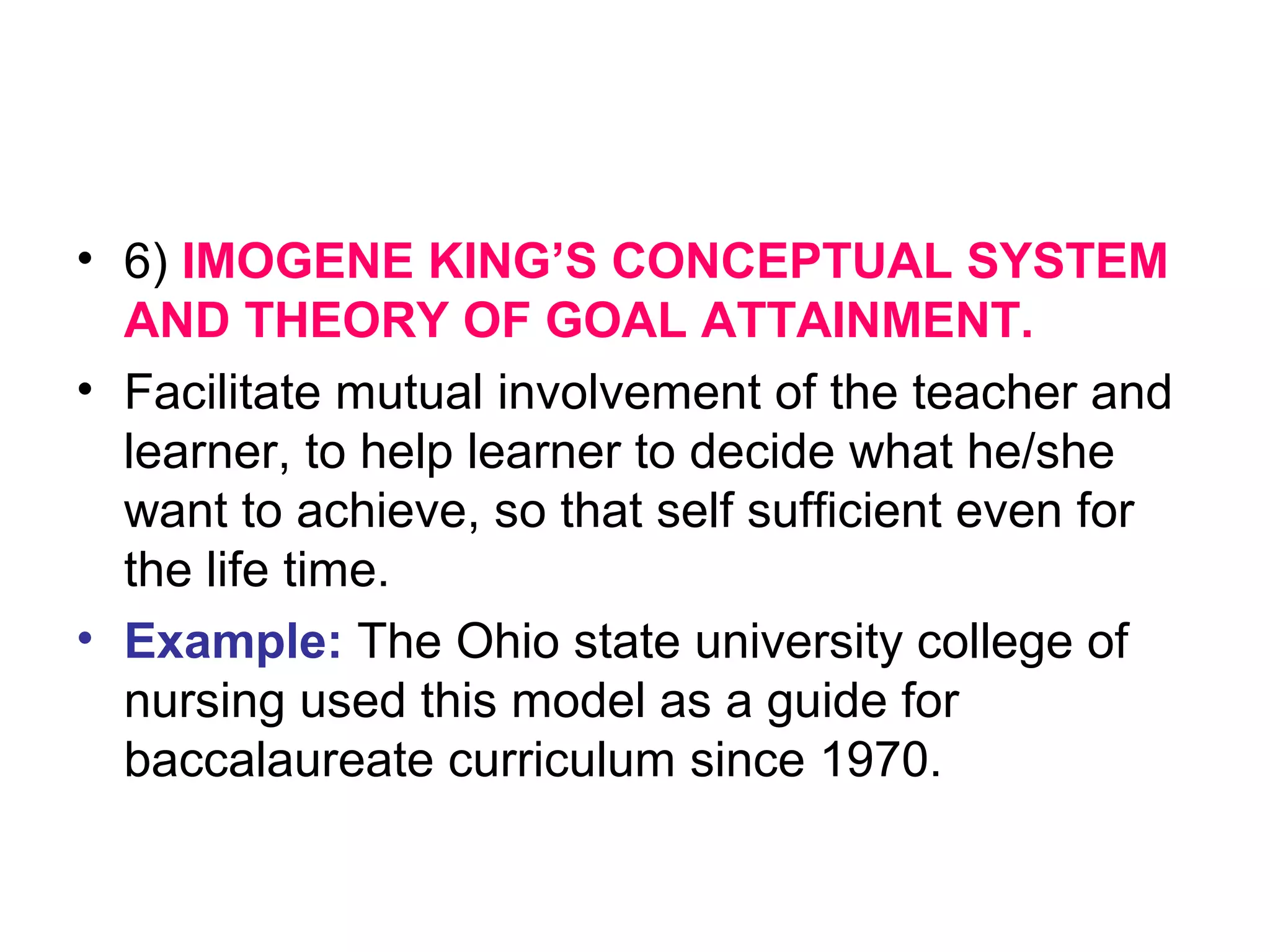
• 6) IMOGENE KING’S CONCEPTUAL SYSTEM
AND THEORY OF GOAL ATTAINMENT.
• Facilitate mutual involvement of the teacher and
learner, to help learner to decide what he/she
want to achieve, so that self sufficient even for
the life time.
• Example: The Ohio state university college of
nursing used this model as a guide for
baccalaureate curriculum since 1970.
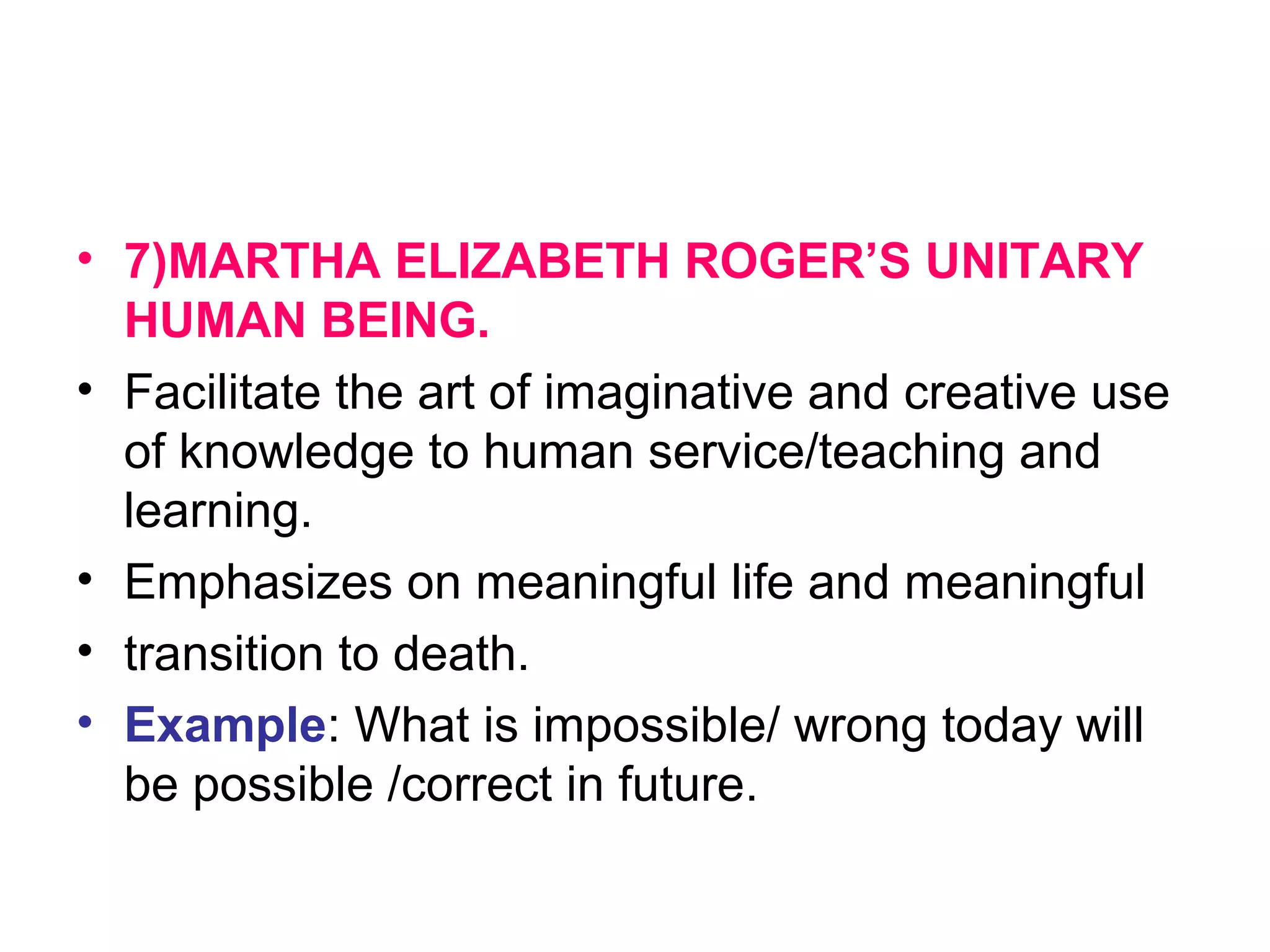
• 7)MARTHA ELIZABETH ROGER’S UNITARY
HUMAN BEING.
• Facilitate the art of imaginative and creative use
of knowledge to human service/teaching and
learning.
• Emphasizes on meaningful life and meaningful
• transition to death.
• Example: What is impossible/ wrong today will
be possible /correct in future.
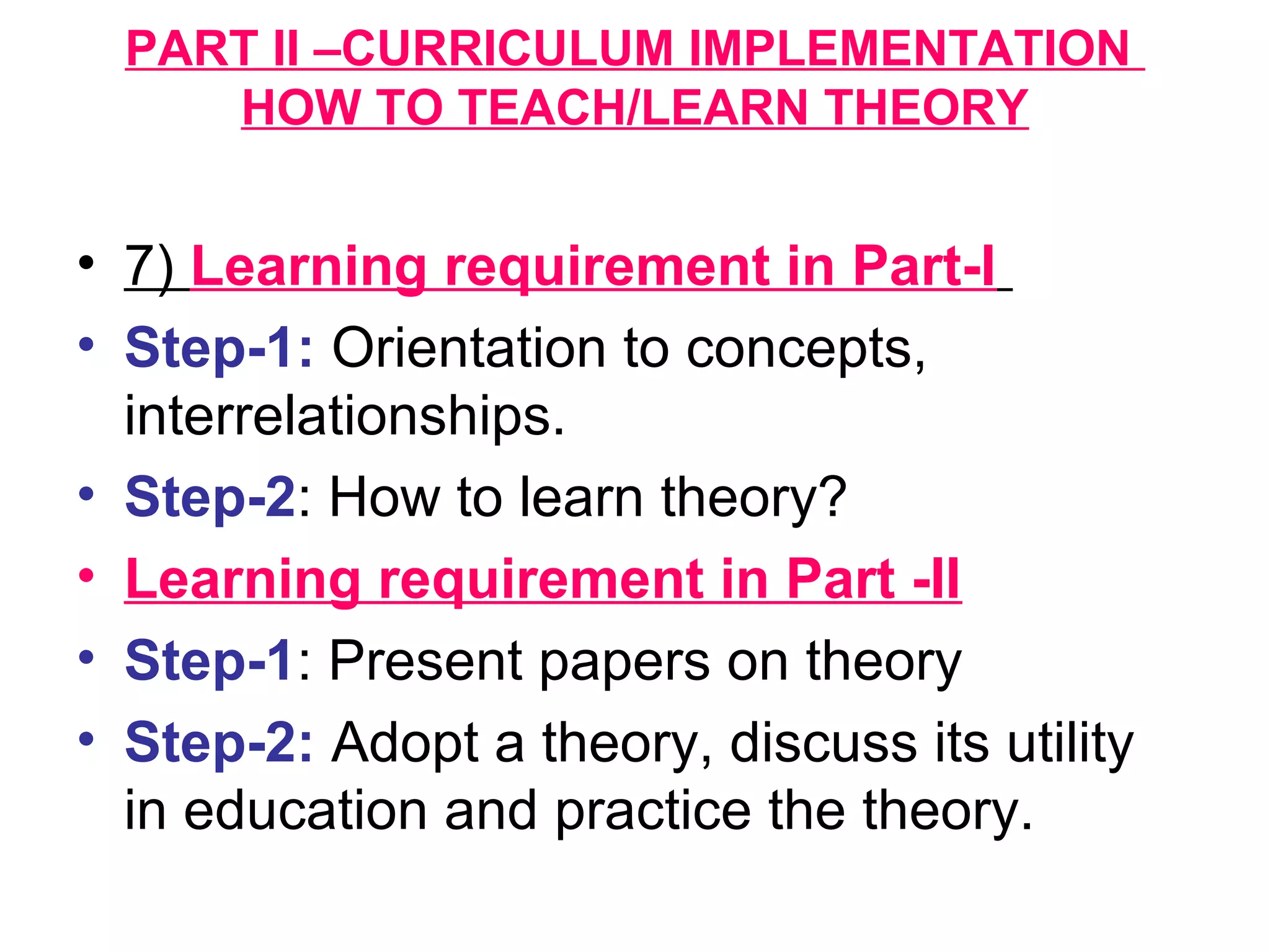
PART II –CURRICULUM IMPLEMENTATION
HOW TO TEACH/LEARN THEORY
• 7) Learning requirement in Part-I
• Step-1: Orientation to concepts,
interrelationships.
• Step-2: How to learn theory?
• Learning requirement in Part -II
• Step-1: Present papers on theory
• Step-2: Adopt a theory, discuss its utility
in education and practice the theory.
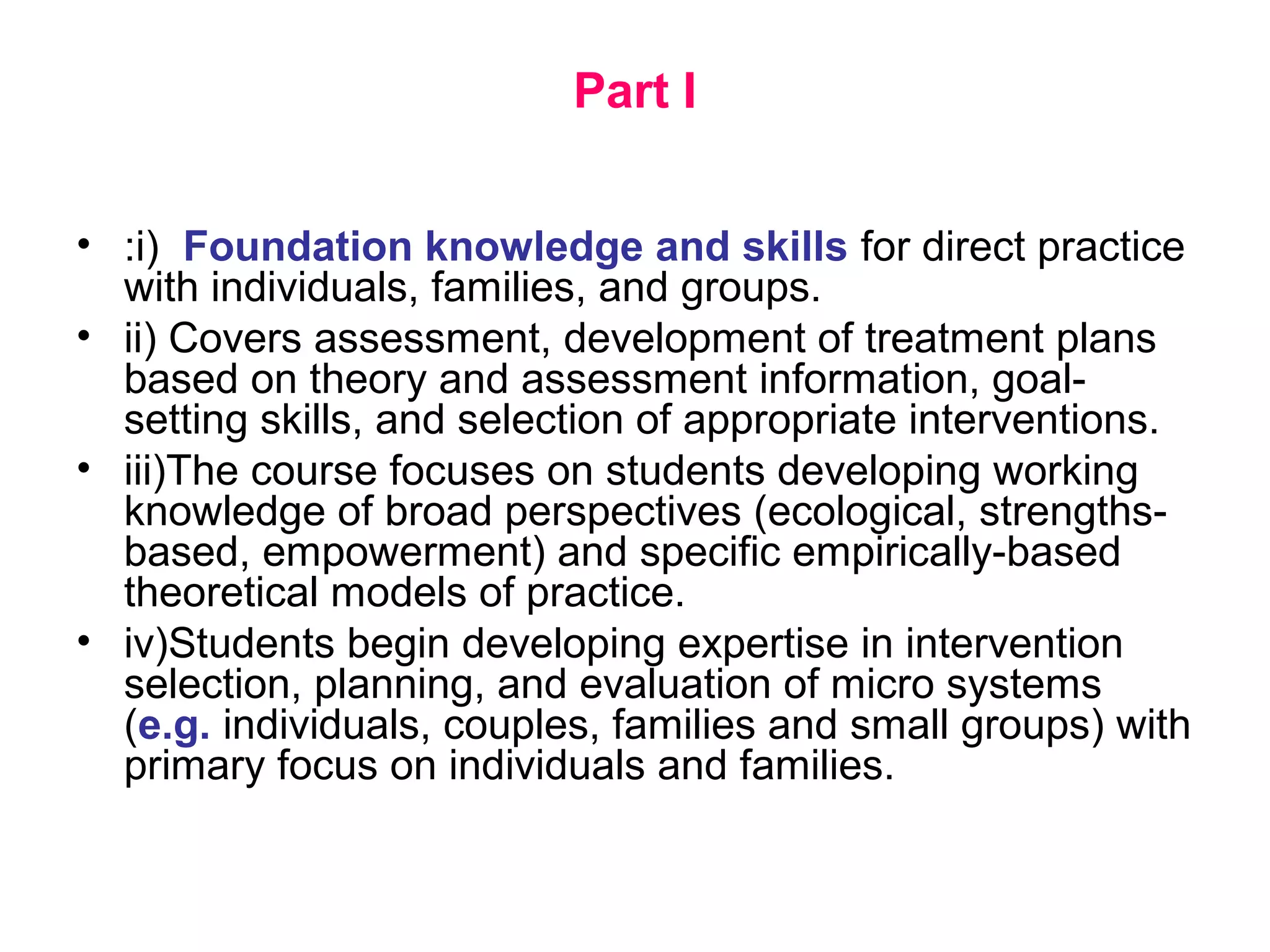
Part I
• :i) Foundation knowledge and skills for direct practice
with individuals, families, and groups.
• ii) Covers assessment, development of treatment plans
based on theory and assessment information, goal-
setting skills, and selection of appropriate interventions.
• iii)The course focuses on students developing working
knowledge of broad perspectives (ecological, strengths-
based, empowerment) and specific empirically-based
theoretical models of practice.
• iv)Students begin developing expertise in intervention
selection, planning, and evaluation of micro systems
(e.g. individuals, couples, families and small groups) with
primary focus on individuals and families.
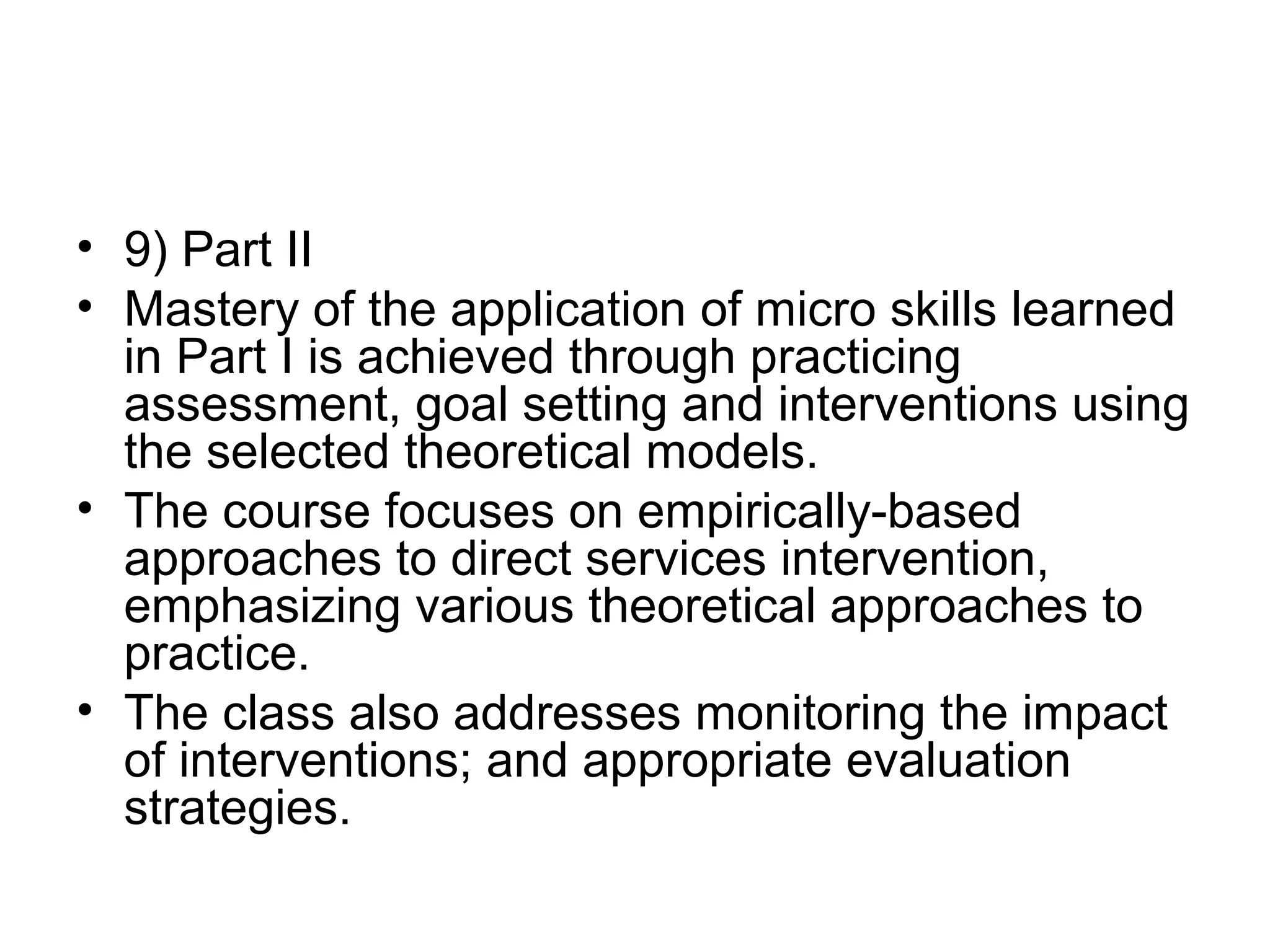
• 9) Part II
• Mastery of the application of micro skills learned
in Part I is achieved through practicing
assessment, goal setting and interventions using
the selected theoretical models.
• The course focuses on empirically-based
approaches to direct services intervention,
emphasizing various theoretical approaches to
practice.
• The class also addresses monitoring the impact
of interventions; and appropriate evaluation
strategies.
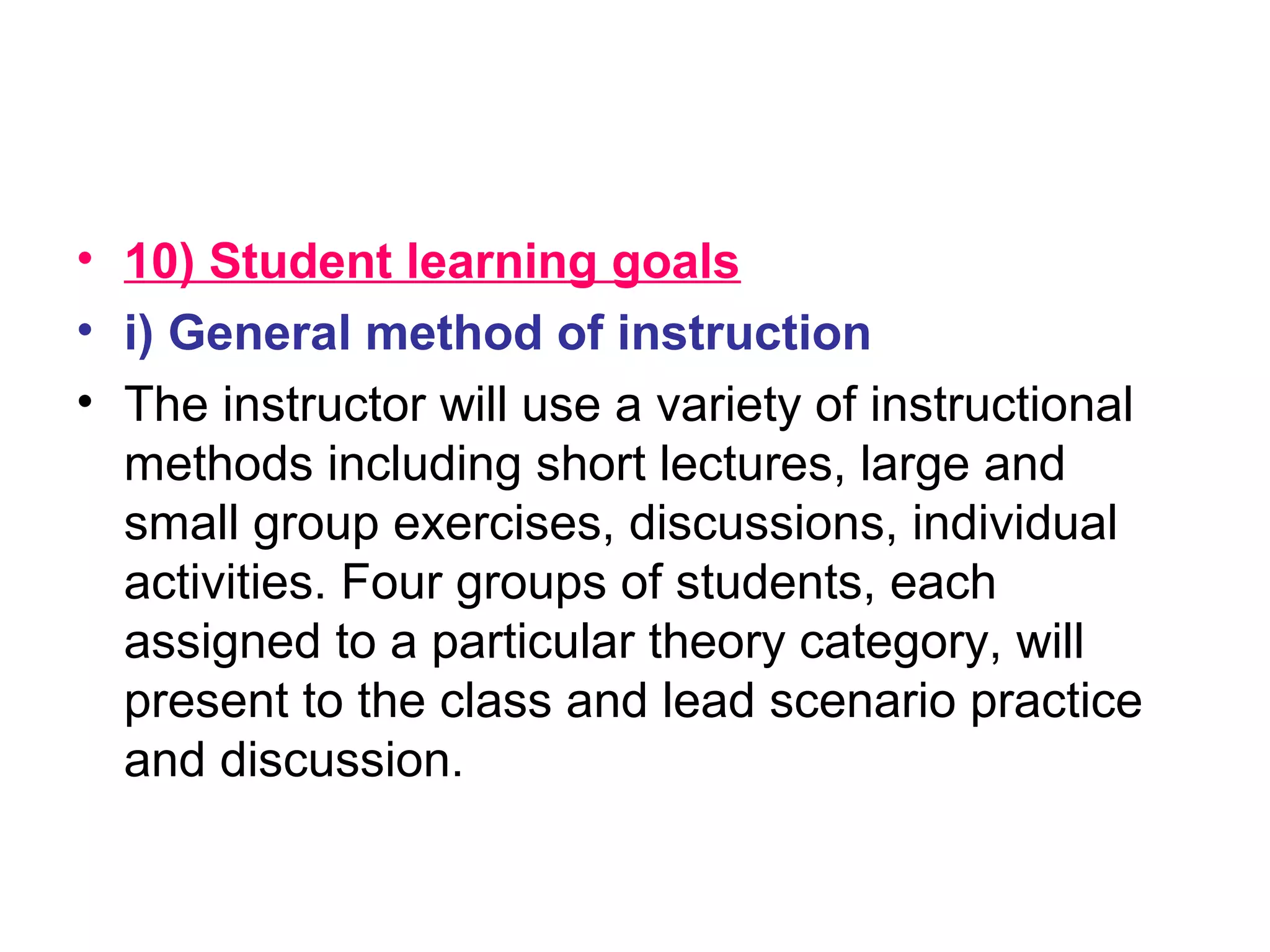
• 10) Student learning goals
• i) General method of instruction
• The instructor will use a variety of instructional
methods including short lectures, large and
small group exercises, discussions, individual
activities. Four groups of students, each
assigned to a particular theory category, will
present to the class and lead scenario practice
and discussion.
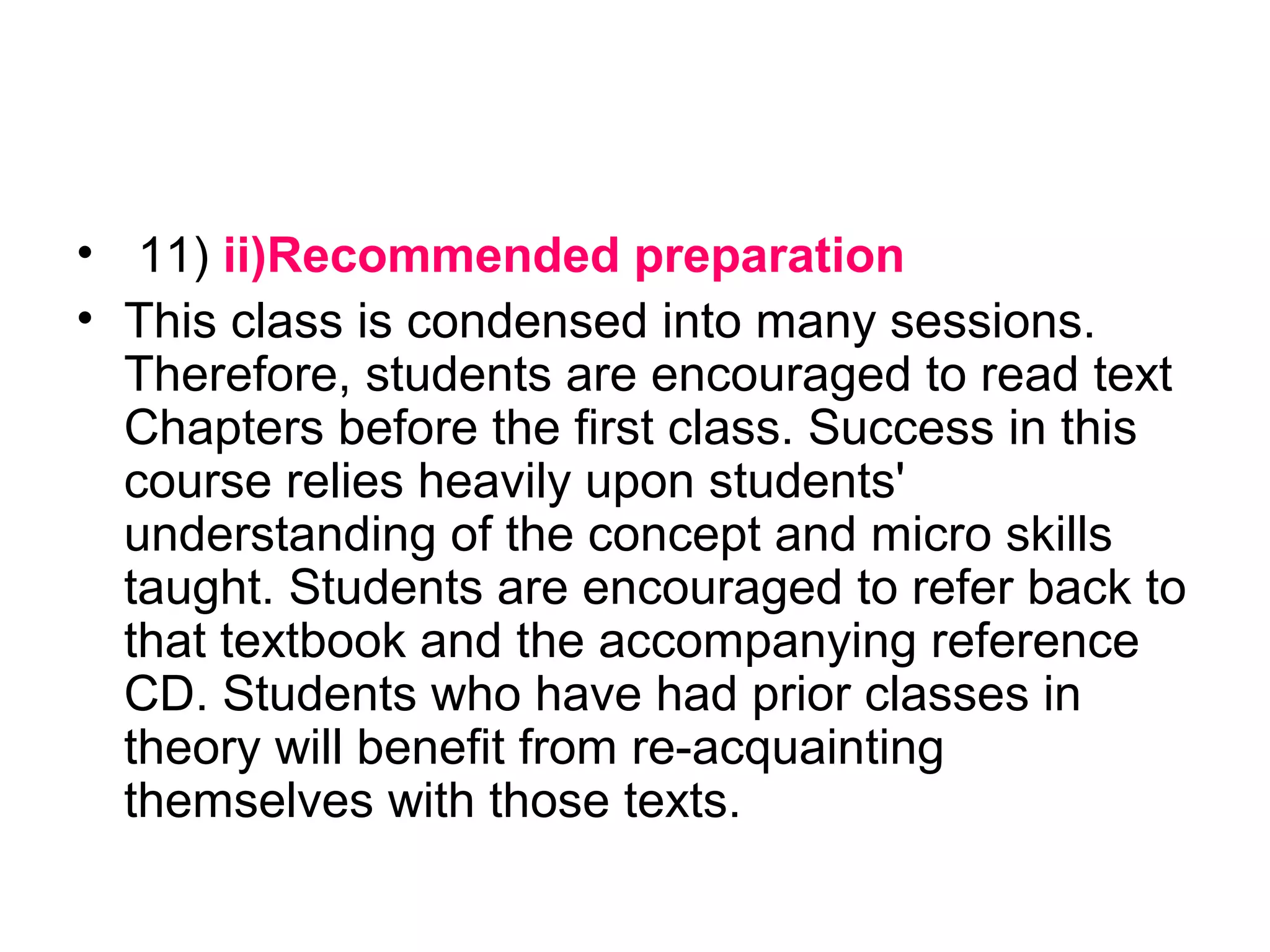
• 11) ii)Recommended preparation
• This class is condensed into many sessions.
Therefore, students are encouraged to read text
Chapters before the first class. Success in this
course relies heavily upon students'
understanding of the concept and micro skills
taught. Students are encouraged to refer back to
that textbook and the accompanying reference
CD. Students who have had prior classes in
theory will benefit from re-acquainting
themselves with those texts.
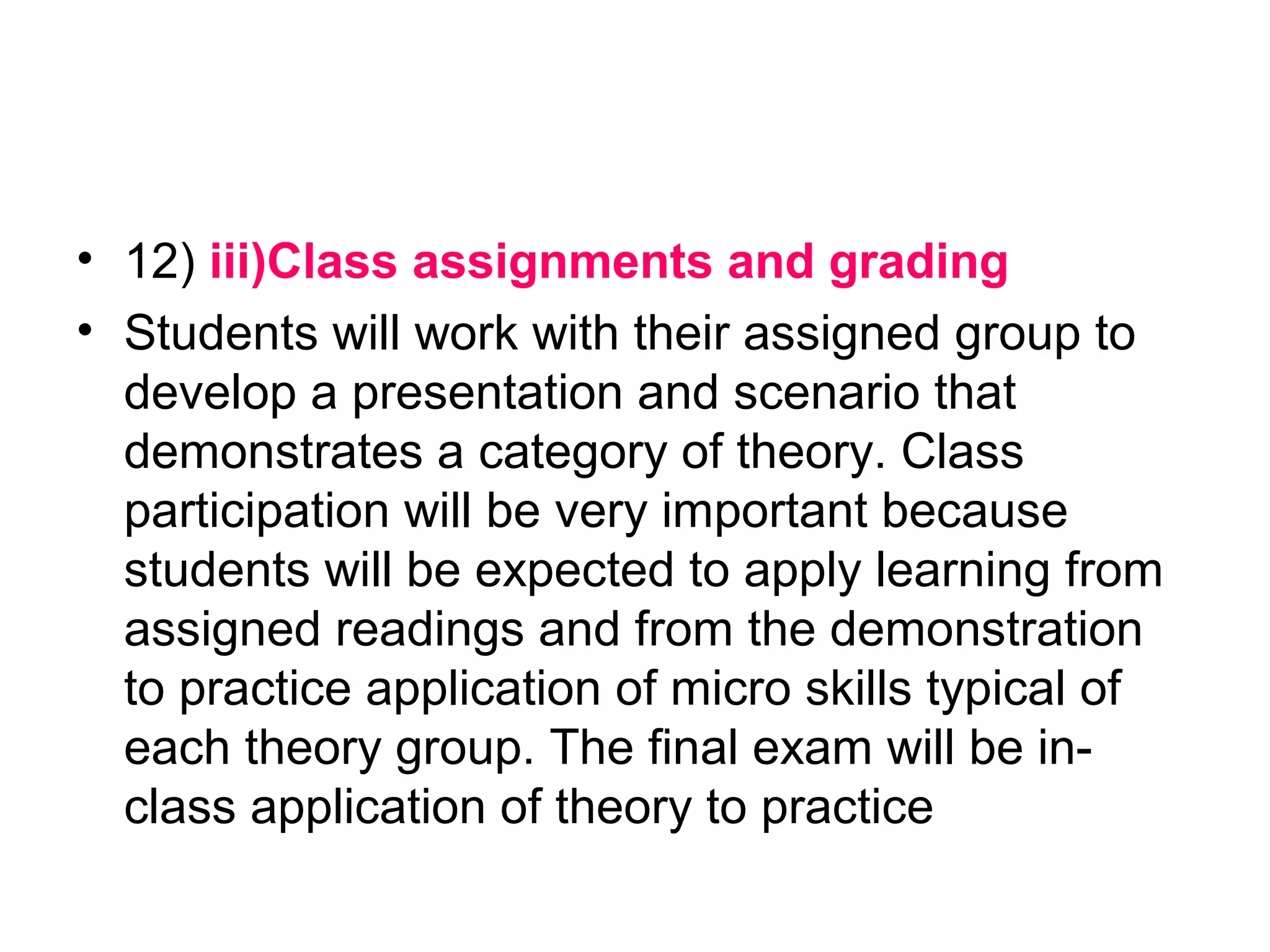
• 12) iii)Class assignments and grading
• Students will work with their assigned group to
develop a presentation and scenario that
demonstrates a category of theory. Class
participation will be very important because
students will be expected to apply learning from
assigned readings and from the demonstration
to practice application of micro skills typical of
each theory group. The final exam will be in-
class application of theory to practice
13) Evaluation and Feedback Systems
What students will learn can be evaluated through
4 papers that they will be asked to submit.
These papers can be as follows:
• Synthesis of what they learned about their personal self (20 %)
1. Personality preferences;
2. Ineffective behavior patterns;
3. Major life events that shaped the present self;
4. Direction of personal growth;
5. Emotional quotient.
• 14)ii Synthesis of what they learned
about interpersonal effectiveness
(20%);
• Elements of effective collaborations;
• Factors that block effective
communication;
• The nature of effective feedback;
• Differences in cultural patterns.
• Written Analysis of a Case (WAC) on
THEORY (30%);
• Using evaluation guidelines, the care provided
based on theory will be compared and
evaluated.
•
• And
• Synthesis of what they learned in the whole
course about Theory (30%)
• Summative evaluation of the course about
theory
• CONCLUTION:
• Emerging from a theory based
education, provides a challenging
framework for nurse educators/learners
to provide nursing care. It requires
education and willingness to let go the
traditional and an ability to perceive
world in a new and creative way.
Curriculum planning and implementation based on theories

Curriculum planning and implementation based on theories

  • 1.
    CURRICULUM PLANNING ANDIMPLEMENTATION BASED ON THEORIES BY ARUN.M
  • 2.
    PART I- CURRICULUMPLANNING • 1)INTRODUCTION • Nursing theory is the term given to the body of knowledge that is used to support nursing practice. • In professional education nurses will study a range of interconnected subjects which can be applied to the practice setting. • This knowledge may be derived from experiential learning, from formal sources such as nursing research and non-nursing sources. • To speak of nursing theory is often difficult. Nursing is many things to many people. • Most universally agreed upon is that Nursing is a science involving people, environment and process fueled by a vision of transcendence in the context of healthcare. • It is interesting to note that 90% of all Nursing theories have been generated in the last 20 years.
  • 3.
    2)Need for theorybased curriculum • Models of nursing have always been accused of being "out of touch" with the harsh reality of patient care, and creating yet more unnecessary paperwork for nurses to complete. • Lack of confidence among nurses to utilize the theory. • Ambigious openion among nurse educators in selection of theory and bringing into practice level. • Nursing students are uncertain about the concept clarity in theory based nursing • Many schools encourage students to formulate theories of Nursing as part of their curriculum.
  • 4.
    3)SOLUTION TO USETHEORIES WITH CONFIDENCE; • THEORIES CAN BE USED IN ALL THE ASPECTS ON NURSING EDUCATION, SUCH AS PLANNING, IMPLEMENTIG AND EVALUATING CURRICULAM
  • 5.
    4) Curriculum canbe based on the following five principles: • i)Theory-based reasoning and analytical thinking : • Role of teacher- create a learning environment/situation and guide the learners to think towards the concept and solution/decision • Role of student- learn how to think and reasoning, perceive the given situation and develop clear concept in their own way.
  • 6.
    • 5) ii)Practicalrelevance becoming an effective nurse/ leader • Role of teacher: Guide them to assess, plan, implement and evaluate theory based practice • Role of student: Choose appropriate theories, and follow evidence based practice
  • 7.
    • 6) iii)Becoming an effective national/ international team member • Developing and utilizing networks to share theoretical knowledge. • initiate formulating theory: A carefully planned and executed theories project under the supervision of a qualified faculty member is the culminating requirement.
  • 8.
    • 6A) SELECTIONAND PLACEMENT OF STUDENT AND FACULTY BASED ON ROY’S ADAPTATION MODEL • PHISIOLOGICAL MODE : Medical fitness
  • 9.
    • SELF CONCEPT:Interview technique used to assess • The Interest in Teaching/learning Nursing and patient care. • Strength and weakness.
  • 10.
    • ROLE FUNCTION:Pre placement orientation to the roles in the institution. Primary role- Teaching faculty/Student – Roles and responsibilities – Orientation to policies, physical infra structure, – Organization chart, Line of authority – Uniform/dress code • Punctuality and discipline etc
  • 11.
    • Secondary role-extended role as • -SNA advisor/member; • -NSS officer/ member • -Workshop coordinator/participant etc • Tertiary role- Member of an professional organization/ Editor in a journal, State/National level SNA advisor/ member etc
  • 12.
    • CURRICULUM PLANNINGUSING THE TEACHING- LEARNING THEORIES. • 1)OREM’S SELF CARE THEORY: Facilitate the new faculty/student to develop confident and independence from fully dependence. The head of the institution /HOD plays vital role in it. This requires ongoing periodical assessment of the independent ability and appropriate guidance when ever necessary. • Example: NOTES MAKING/ASSIGNMENT WRITTING
  • 13.
    • 2)MASLOW’S NEED/MOTIVATIONTHEORY: Facilitate the faculty/teacher to accept and adapt to new environment as a basic need / security / self actualization. Further the revenue, working/learning environment, promotion, reward and punishment methods acts as a glue to work together for the common purpose. • Example: PASSING THE COURSE WITH SECOND CLASS TO DISTINCTION WITH UNIVERSITY RANK.
  • 14.
    • 3)JOHNSON’S BEHAVIOURALSYSTEM: Facilitate the faculty / student to orient to the importance of being a member of the institution, their role is restoration of system as a whole, • to work together. Failed in which discrepancy, incompatibility, insufficiency and dominance will arise between systems. • Example: BALANCED AND RESPONSIBLE INDIVIDUAL IN THE CLASS, COLLEGE, HOSTEL, HOSPITAL, FAMILY AND SOCIETY.
  • 15.
    • 4)ROCHNSTOCK’S HEALTHBELIEF MODEL: • In nursing education for the topics requiring behavioral changes or life style modification, HBM can be used. It is • applicable from the beginning to the end of curriculum, in teaching learning activities and staff management. • Example: • THREAT– FEAR OF FAILING IN THE EXAMINATION. • VARIABLES-RELATED TO STUDENT/TEACHING/INSTITUTION ETC • CUE TO ACTION- INDIVIDUAL GUIDANCE TO STUDENT. • -REPEATED TEACHING/TEST • -PEER ADVICE • BARRIERS- RELATED TO STUDENT/TEACHING/INSTITUTION • ETC • DESIARABLE ACTION- LEARN WITH STANDARD AND PASS THE EXAMINATION.
  • 16.
    • 5)ROBERT R.CARKHUFF’S HELPING AND HUMANRELATIONSHIP MODEL • Facilitate therapeutic human relationships through communicative interaction. The teacher/student using information, influence, comforting, relational and identity the therapeutic communication developed, maintained and terminated. • Example: • Non attending – Attending – Responding – Personalizing -Initiating.
  • 17.
    • 6) IMOGENEKING’S CONCEPTUAL SYSTEM AND THEORY OF GOAL ATTAINMENT. • Facilitate mutual involvement of the teacher and learner, to help learner to decide what he/she want to achieve, so that self sufficient even for the life time. • Example: The Ohio state university college of nursing used this model as a guide for baccalaureate curriculum since 1970.
  • 18.
    • 7)MARTHA ELIZABETHROGER’S UNITARY HUMAN BEING. • Facilitate the art of imaginative and creative use of knowledge to human service/teaching and learning. • Emphasizes on meaningful life and meaningful • transition to death. • Example: What is impossible/ wrong today will be possible /correct in future.
  • 19.
    PART II –CURRICULUMIMPLEMENTATION HOW TO TEACH/LEARN THEORY • 7) Learning requirement in Part-I • Step-1: Orientation to concepts, interrelationships. • Step-2: How to learn theory? • Learning requirement in Part -II • Step-1: Present papers on theory • Step-2: Adopt a theory, discuss its utility in education and practice the theory.
  • 20.
    Part I • :i)Foundation knowledge and skills for direct practice with individuals, families, and groups. • ii) Covers assessment, development of treatment plans based on theory and assessment information, goal- setting skills, and selection of appropriate interventions. • iii)The course focuses on students developing working knowledge of broad perspectives (ecological, strengths- based, empowerment) and specific empirically-based theoretical models of practice. • iv)Students begin developing expertise in intervention selection, planning, and evaluation of micro systems (e.g. individuals, couples, families and small groups) with primary focus on individuals and families.
  • 21.
    • 9) PartII • Mastery of the application of micro skills learned in Part I is achieved through practicing assessment, goal setting and interventions using the selected theoretical models. • The course focuses on empirically-based approaches to direct services intervention, emphasizing various theoretical approaches to practice. • The class also addresses monitoring the impact of interventions; and appropriate evaluation strategies.
  • 22.
    • 10) Studentlearning goals • i) General method of instruction • The instructor will use a variety of instructional methods including short lectures, large and small group exercises, discussions, individual activities. Four groups of students, each assigned to a particular theory category, will present to the class and lead scenario practice and discussion.
  • 23.
    • 11) ii)Recommendedpreparation • This class is condensed into many sessions. Therefore, students are encouraged to read text Chapters before the first class. Success in this course relies heavily upon students' understanding of the concept and micro skills taught. Students are encouraged to refer back to that textbook and the accompanying reference CD. Students who have had prior classes in theory will benefit from re-acquainting themselves with those texts.
  • 24.
    • 12) iii)Classassignments and grading • Students will work with their assigned group to develop a presentation and scenario that demonstrates a category of theory. Class participation will be very important because students will be expected to apply learning from assigned readings and from the demonstration to practice application of micro skills typical of each theory group. The final exam will be in- class application of theory to practice
  • 25.
    13) Evaluation andFeedback Systems What students will learn can be evaluated through 4 papers that they will be asked to submit. These papers can be as follows: • Synthesis of what they learned about their personal self (20 %) 1. Personality preferences; 2. Ineffective behavior patterns; 3. Major life events that shaped the present self; 4. Direction of personal growth; 5. Emotional quotient.
  • 26.
    • 14)ii Synthesisof what they learned about interpersonal effectiveness (20%); • Elements of effective collaborations; • Factors that block effective communication; • The nature of effective feedback; • Differences in cultural patterns.
  • 27.
    • Written Analysisof a Case (WAC) on THEORY (30%); • Using evaluation guidelines, the care provided based on theory will be compared and evaluated. • • And • Synthesis of what they learned in the whole course about Theory (30%) • Summative evaluation of the course about theory
  • 28.
    • CONCLUTION: • Emergingfrom a theory based education, provides a challenging framework for nurse educators/learners to provide nursing care. It requires education and willingness to let go the traditional and an ability to perceive world in a new and creative way.