Clinical Teaching
PURPOSE OF CLINICAL
TEACHING
Purpose of Clinical Laboratory
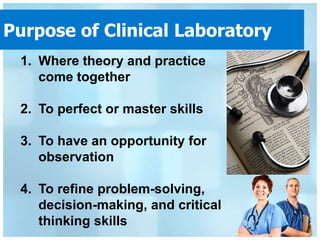
 1. Where theory and practice
    come together

 2. To perfect or master skills

 3. To have an opportunity for
    observation

 4. To refine problem-solving,
    decision-making, and critical
    thinking skills
Purpose of Clinical Laboratory
 5. To gain organization and
    time management skills

 6. To develop cultural
    competence

 7. To become socialized in
    the clinical laboratory
Misuse of the Clinical Laboratory
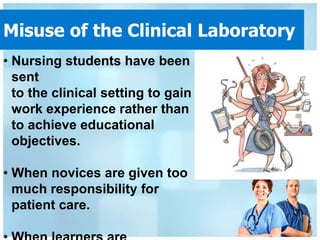
• Nursing students have been
  sent
  to the clinical setting to gain
  work experience rather than
  to achieve educational
  objectives.

• When novices are given too
  much responsibility for
  patient care.
MODELS OF CLINICAL
TEACHING
Models of Clinical Teaching
1.Traditional method
 – Instructors accompany groups (8-12 learners) to a
   clinical agency and assign them to patients

2. Relies heavily on keeping nursing
   students in a skills laboratory until they
   are proficient with skills

3. More information about clinical practice
   should be taught in the classroom before
   learners go
Preceptorship Models
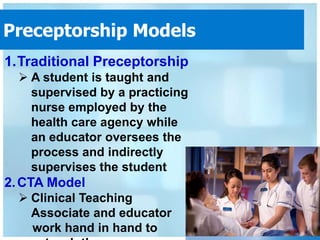
1.Traditional Preceptorship
   A student is taught and
    supervised by a practicing
    nurse employed by the
    health care agency while
    an educator oversees the
    process and indirectly
    supervises the student
2. CTA Model
   Clinical Teaching
    Associate and educator
    work hand in hand to
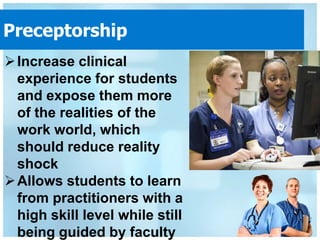
Preceptorship
 Increase clinical
  experience for students
  and expose them more
  of the realities of the
  work world, which
  should reduce reality
  shock
 Allows students to learn
  from practitioners with a
  high skill level while still
  being guided by faculty
PREPARING FOR CLINICAL
INSTRUCTION
Preparing for Clinical Instruction
• Clinical agency sites must
  be chosen

• Clinical units within the
  agency must still be
  identified

• There should be enough role
  models for learners

• Contracts must be drawn up
Preparing for Clinical Instruction
• Educator should set up a
  meeting with the agency
  staff who will be involved
  with the education process

• Making specific
  arrangements for learners
  on a weekly or daily basis
  (for duty or actual patient
  care)
CONDUCTING A CLINICAL
LABORATORY SESSION
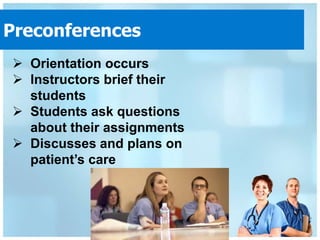
Preconferences
 Orientation occurs
 Instructors brief their
  students
 Students ask questions
  about their assignments
 Discusses and plans on
  patient’s care
Practice Session
  Follows the preconference
  Combinations of strategies
   such as return
   demonstration with
   explanation, asking and
   answering questions, and
   coaching techniques are
   used
  Like a checklist
Effective Teaching Techniques
for Clinical Settings
1. Observation Assignments
  Supported by Social Cognitive
   Theory
  Observing nurses as they
   perform skills they usually
   cannot perform

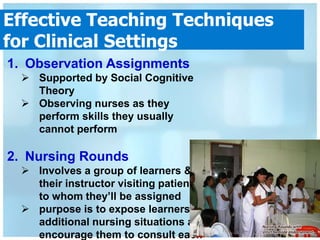
2. Nursing Rounds
  Involves a group of learners &
   their instructor visiting patients
   to whom they’ll be assigned
  purpose is to expose learners to
   additional nursing situations and
   encourage them to consult each
Effective Teaching Techniques
for Clinical Settings
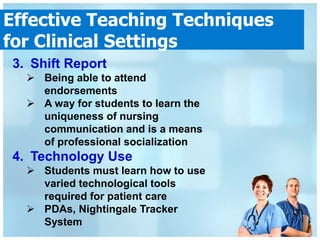
3. Shift Report
   Being able to attend
    endorsements
   A way for students to learn the
    uniqueness of nursing
    communication and is a means
    of professional socialization
4. Technology Use
   Students must learn how to use
    varied technological tools
    required for patient care
   PDAs, Nightingale Tracker
    System
Effective Teaching Techniques
for Clinical Settings
5. Learning Contracts
   A written agreement
    between instructor and a
    learner, spelling out the
    learner’s outcome objectives

6. Journal Writing
   Clinical journals promote
    active learning and reflective
    practice and are built on the
    theory of Constructivism.
Postconferences
Ideal opportunity for:
 pointing out applications of
   theory to practice,
 analyzing the different ways
   that patients with similar
   illness differ in their
   response to nursing care
   and treatment
 Group solving
 Evaluating nursing care
 Learners to report what they
Postconferences
Challenges:
 It is often unstructured that
  allow for creativity but can
  dissolve into meaninglessness
 It is usually held at the end of a
  physically and emotionally
  draining practice session
 Few learners seem to believed
  that they learned everything
  they could have learned during
  their practice time
 Learners thought
EVALUATING LEARNER
PROGRESS
Why is Evaluation needed?
 Learners need to hear the
  feedback and judgment of
  their work.
 They need to know how they
  are doing at one level before
  progressing to the next.
 To determine how well the
  objectives are met.
Choices to be Made Regarding
Evaluation
Formative and Summative
  Evaluation
 Formative
  ...is the ongoing feedback given to the
   learner throughout the learning
   experience
   ...helps identify strengths and
   weaknesses
   ...prevents learners from being
   surprised at the end with the judgment
   of their performance

 Summative
Choices to be Made Regarding
Evaluation
Norm-Referenced and Criterion-
Referenced Evaluation
 Norm-referenced
  ...learner is compared to a reference
   group of learners, therefore, evaluation
   and grading are relative to the
   performance of the group

 Criterion-referenced
  ...compares the learner with well-
   defined performance criteria rather
   than comparing him/her with other
   learners
Choices to be Made Regarding
Evaluation
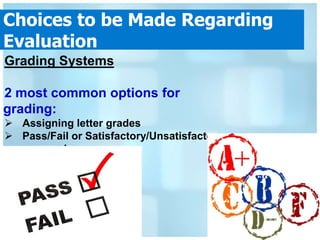
Grading Systems

2 most common options for
grading:
 Assigning letter grades
 Pass/Fail or Satisfactory/Unsatisfactory
  approach
Behaviors to be Evaluated

 Use of the nursing process
 Use of health-promoting
  strategies
 Psychomotor skills
 Organization of care
 Maintaining patient safety
 Ability to provide rationale for
  nursing care
 Ability to individualize care
  planning and intervention
Behaviors to be Evaluated

 Therapeutic communication
 Ability to work with a
  professional team
 Professional behaviors
 Written documentations of
  care
Sources of Evaluation Data

 Direct observation
 Broad questions asked to the
  patients
 Learner self-evaluation
 Agency staff
 Written work and college
  laboratory work performed by
  the learner
CLINICAL EVALUATION
TOOLS
Clinical Evaluation Tools
 1. The items should derive
    from the course or unit
    objectives
 2. The items must be
    measurable in some way
 3. The items and instructions
    for use should be clear to all
    who must use the tool
 4. The tool should be practical
    in design and length
 5. The tool must be valid and
THE END

Clinical Teaching

  • 1.
  • 2.
  • 3.
    Purpose of ClinicalLaboratory 1. Where theory and practice come together 2. To perfect or master skills 3. To have an opportunity for observation 4. To refine problem-solving, decision-making, and critical thinking skills
  • 4.
    Purpose of ClinicalLaboratory 5. To gain organization and time management skills 6. To develop cultural competence 7. To become socialized in the clinical laboratory
  • 5.
    Misuse of theClinical Laboratory • Nursing students have been sent to the clinical setting to gain work experience rather than to achieve educational objectives. • When novices are given too much responsibility for patient care.
  • 6.
  • 7.
    Models of ClinicalTeaching 1.Traditional method – Instructors accompany groups (8-12 learners) to a clinical agency and assign them to patients 2. Relies heavily on keeping nursing students in a skills laboratory until they are proficient with skills 3. More information about clinical practice should be taught in the classroom before learners go
  • 8.
    Preceptorship Models 1.Traditional Preceptorship  A student is taught and supervised by a practicing nurse employed by the health care agency while an educator oversees the process and indirectly supervises the student 2. CTA Model  Clinical Teaching Associate and educator work hand in hand to
  • 9.
    Preceptorship  Increase clinical experience for students and expose them more of the realities of the work world, which should reduce reality shock  Allows students to learn from practitioners with a high skill level while still being guided by faculty
  • 10.
  • 11.
    Preparing for ClinicalInstruction • Clinical agency sites must be chosen • Clinical units within the agency must still be identified • There should be enough role models for learners • Contracts must be drawn up
  • 12.
    Preparing for ClinicalInstruction • Educator should set up a meeting with the agency staff who will be involved with the education process • Making specific arrangements for learners on a weekly or daily basis (for duty or actual patient care)
  • 13.
  • 14.
    Preconferences  Orientation occurs Instructors brief their students  Students ask questions about their assignments  Discusses and plans on patient’s care
  • 15.
    Practice Session Follows the preconference  Combinations of strategies such as return demonstration with explanation, asking and answering questions, and coaching techniques are used  Like a checklist
  • 16.
    Effective Teaching Techniques forClinical Settings 1. Observation Assignments  Supported by Social Cognitive Theory  Observing nurses as they perform skills they usually cannot perform 2. Nursing Rounds  Involves a group of learners & their instructor visiting patients to whom they’ll be assigned  purpose is to expose learners to additional nursing situations and encourage them to consult each
  • 17.
    Effective Teaching Techniques forClinical Settings 3. Shift Report  Being able to attend endorsements  A way for students to learn the uniqueness of nursing communication and is a means of professional socialization 4. Technology Use  Students must learn how to use varied technological tools required for patient care  PDAs, Nightingale Tracker System
  • 18.
    Effective Teaching Techniques forClinical Settings 5. Learning Contracts  A written agreement between instructor and a learner, spelling out the learner’s outcome objectives 6. Journal Writing  Clinical journals promote active learning and reflective practice and are built on the theory of Constructivism.
  • 19.
    Postconferences Ideal opportunity for: pointing out applications of theory to practice,  analyzing the different ways that patients with similar illness differ in their response to nursing care and treatment  Group solving  Evaluating nursing care  Learners to report what they
  • 20.
    Postconferences Challenges:  It isoften unstructured that allow for creativity but can dissolve into meaninglessness  It is usually held at the end of a physically and emotionally draining practice session  Few learners seem to believed that they learned everything they could have learned during their practice time  Learners thought
  • 21.
  • 22.
    Why is Evaluationneeded?  Learners need to hear the feedback and judgment of their work.  They need to know how they are doing at one level before progressing to the next.  To determine how well the objectives are met.
  • 23.
    Choices to beMade Regarding Evaluation Formative and Summative Evaluation  Formative ...is the ongoing feedback given to the learner throughout the learning experience ...helps identify strengths and weaknesses ...prevents learners from being surprised at the end with the judgment of their performance  Summative
  • 24.
    Choices to beMade Regarding Evaluation Norm-Referenced and Criterion- Referenced Evaluation  Norm-referenced ...learner is compared to a reference group of learners, therefore, evaluation and grading are relative to the performance of the group  Criterion-referenced ...compares the learner with well- defined performance criteria rather than comparing him/her with other learners
  • 25.
    Choices to beMade Regarding Evaluation Grading Systems 2 most common options for grading:  Assigning letter grades  Pass/Fail or Satisfactory/Unsatisfactory approach
  • 26.
    Behaviors to beEvaluated  Use of the nursing process  Use of health-promoting strategies  Psychomotor skills  Organization of care  Maintaining patient safety  Ability to provide rationale for nursing care  Ability to individualize care planning and intervention
  • 27.
    Behaviors to beEvaluated  Therapeutic communication  Ability to work with a professional team  Professional behaviors  Written documentations of care
  • 28.
    Sources of EvaluationData  Direct observation  Broad questions asked to the patients  Learner self-evaluation  Agency staff  Written work and college laboratory work performed by the learner
  • 29.
  • 30.
    Clinical Evaluation Tools 1. The items should derive from the course or unit objectives 2. The items must be measurable in some way 3. The items and instructions for use should be clear to all who must use the tool 4. The tool should be practical in design and length 5. The tool must be valid and
  • 31.