



DEVELOPMENT AND CLASSIFICATION
OF
NURSING THEORIES
Presented by
ARUN.M
THEORIES ARE NOT
DISCOVERED IN NATURE
BUT ARE HUMAN INVENTIONS
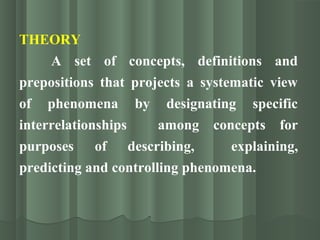
THEORY
A set of concepts, definitions and
prepositions that projects a systematic view
of phenomena by designating specific
interrelationships among concepts for
purposes of describing, explaining,
predicting and controlling phenomena.
NURSING THEORY
Conceptualization of some aspect
of nursing communicated for the
purpose of describing phenomena
explaining relationships between
phenomena predicting consequences or
prescribing nursing care.
PHILOSOPHYPHILOSOPHY
Concerned with the values and beliefs of aConcerned with the values and beliefs of a
discipline and with the values and beliefsdiscipline and with the values and beliefs
heldheld by members of the discipline.by members of the discipline.
CONCEPTCONCEPT
Complex mental formulation of anComplex mental formulation of an
object, property or event that is derivedobject, property or event that is derived fromfrom
individual perceptual experience. It isindividual perceptual experience. It is anan
idea, a mental image oridea, a mental image or generalization formedgeneralization formed
and developed inand developed in the mind.the mind.
CONCEPTUAL MODELCONCEPTUAL MODEL
A set of relatively abstract andA set of relatively abstract and
general concepts and the propositionsgeneral concepts and the propositions
that describe or link those concepts.that describe or link those concepts.
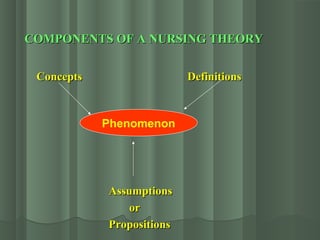
COMPONENTS OF A NURSING THEORYCOMPONENTS OF A NURSING THEORY
ConceptsConcepts DefinitionsDefinitions
AssumptionsAssumptions
oror
PropositionsPropositions
Phenomenon
CONCEPTSCONCEPTS
 Theory consists of inter related conceptsTheory consists of inter related concepts
 Concepts are ideas, mental imagesConcepts are ideas, mental images
 They help to describe or label phenomenaThey help to describe or label phenomena
 They are mental formulations of an object or eventThey are mental formulations of an object or event
that come from individual perceptual experiencethat come from individual perceptual experience
DEFINITIONSDEFINITIONS
 Convey the general meaning of the concepts in aConvey the general meaning of the concepts in a
manner that fits the theory.manner that fits the theory.
 Describe the activity necessary to measure theDescribe the activity necessary to measure the
constructs, relationships or variables within aconstructs, relationships or variables within a
theory.theory.
ASSUMPTIONSASSUMPTIONS
 Statements that describe concepts or connect twoStatements that describe concepts or connect two
conceptsconcepts
 They are the “taken for granted” statements thatThey are the “taken for granted” statements that
determine the nature of the concepts, definitions,determine the nature of the concepts, definitions,
purpose, relationships and structure of the theory.purpose, relationships and structure of the theory.
PHENOMENONPHENOMENON
 An aspect of reality that can beAn aspect of reality that can be consciouslyconsciously
sensed orsensed or experiencedexperienced
 Nursing theories focus on the phenomena ofNursing theories focus on the phenomena of
nursingnursing
 In nursing, phenomena reflect the domain ofIn nursing, phenomena reflect the domain of
nursing practicenursing practice
CHARACTERISTICS OF A THEORYCHARACTERISTICS OF A THEORY
1) Interrelate concepts in such a way as to create1) Interrelate concepts in such a way as to create
a different way of looking at a particulara different way of looking at a particular
phenomenon.phenomenon.
2) Must be logical in nature2) Must be logical in nature
3) Should be relatively simple yet generalizable3) Should be relatively simple yet generalizable
4) The bases for hypothesis that can4) The bases for hypothesis that can be tested orbe tested or
for theory to be expandedfor theory to be expanded
...continued.....continued..
6)6)Contribute to and assist in increasing theContribute to and assist in increasing the
general body of knowledge within thegeneral body of knowledge within the
discipline through the research implementeddiscipline through the research implemented
to validate them.to validate them.
7) Used by practitioners to guide and7) Used by practitioners to guide and improveimprove
their practice.their practice.
8)8) Consistent with other validated theories,Consistent with other validated theories,
laws, and principles but will leave openlaws, and principles but will leave open
unanswered questions that need to beunanswered questions that need to be
investigated.investigated.
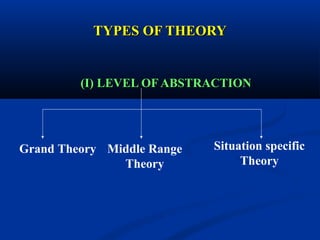
TYPES OF THEORYTYPES OF THEORY
(I) LEVEL OF ABSTRACTION(I) LEVEL OF ABSTRACTION
Grand Theory Middle Range
Theory
Situation specific
Theory
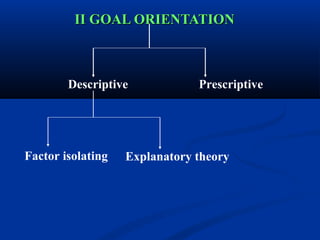
II GOAL ORIENTATIONII GOAL ORIENTATION
Descriptive Prescriptive
Factor isolating Explanatory theory
GRAND THEORIES
 Systematic constructions of the nature of
nursing, the mission of nursing and the
goals of nursing care.
 Broad in scope and complex
 Require further specification through
research before they can be fully tested.
 Concepts are abstract
 Not easily empirically tested.
MIDDLE RANGE THEORIES
 Limited scope
 Less abstract concepts
 Address specific phenomena or concepts
 Reflect practice (Administration, clinical
or teaching)
 Increased theory-based research and
nursing practice strategies
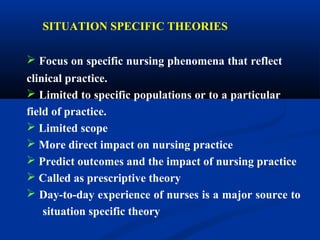
SITUATION SPECIFIC THEORIES
 Focus on specific nursing phenomena that reflect
clinical practice.
 Limited to specific populations or to a particular
field of practice.
 Limited scope
 More direct impact on nursing practice
 Predict outcomes and the impact of nursing practice
 Called as prescriptive theory
 Day-to-day experience of nurses is a major source to
situation specific theory
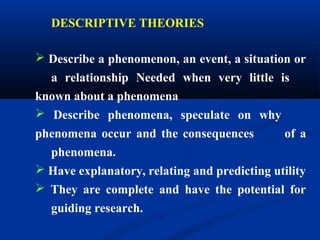
DESCRIPTIVE THEORIES
 Describe a phenomenon, an event, a situation or
a relationship Needed when very little is
known about a phenomena
 Describe phenomena, speculate on why
phenomena occur and the consequences of a
phenomena.
 Have explanatory, relating and predicting utility
 They are complete and have the potential for
guiding research.
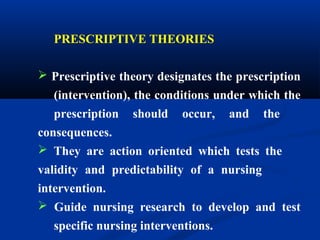
PRESCRIPTIVE THEORIES
 Prescriptive theory designates the prescription
(intervention), the conditions under which the
prescription should occur, and the
consequences.
 They are action oriented which tests the
validity and predictability of a nursing
intervention.
 Guide nursing research to develop and test
specific nursing interventions.
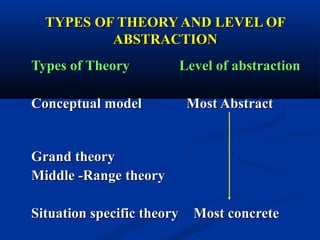
TYPES OF THEORY AND LEVEL OFTYPES OF THEORY AND LEVEL OF
ABSTRACTIONABSTRACTION
Types of TheoryTypes of Theory Level of abstractionLevel of abstraction
Conceptual modelConceptual model Most AbstractMost Abstract
Grand theoryGrand theory
Middle -Range theoryMiddle -Range theory
Situation specific theorySituation specific theory Most concreteMost concrete
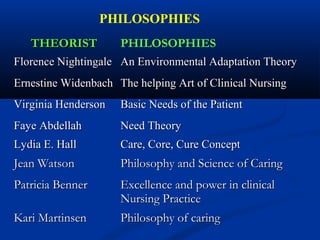
THEORISTTHEORIST PHILOSOPHIES
Florence NightingaleFlorence Nightingale An Environmental Adaptation TheoryAn Environmental Adaptation Theory
Ernestine WidenbachErnestine Widenbach The helping Art of Clinical NursingThe helping Art of Clinical Nursing
Virginia HendersonVirginia Henderson Basic Needs of the PatientBasic Needs of the Patient
Faye AbdellahFaye Abdellah Need TheoryNeed Theory
Lydia E. HallLydia E. Hall Care, Core, Cure ConceptCare, Core, Cure Concept
Jean WatsonJean Watson Philosophy and Science of CaringPhilosophy and Science of Caring
Patricia BennerPatricia Benner Excellence and power in clinicalExcellence and power in clinical
Nursing PracticeNursing Practice
Kari MartinsenKari Martinsen Philosophy of caringPhilosophy of caring
PHILOSOPHIES
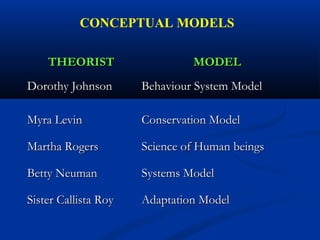
CONCEPTUAL MODELS
THEORISTTHEORIST MODELMODEL
Dorothy JohnsonDorothy Johnson Behaviour System ModelBehaviour System Model
Myra LevinMyra Levin Conservation ModelConservation Model
Martha RogersMartha Rogers Science of Human beingsScience of Human beings
Betty NeumanBetty Neuman Systems ModelSystems Model
Sister Callista RoySister Callista Roy Adaptation ModelAdaptation Model
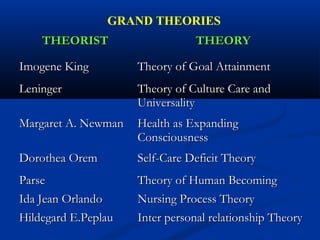
GRAND THEORIES
THEORISTTHEORIST THEORYTHEORY
Imogene KingImogene King Theory of Goal AttainmentTheory of Goal Attainment
LeningerLeninger Theory of Culture Care andTheory of Culture Care and
UniversalityUniversality
Margaret A. NewmanMargaret A. Newman Health as ExpandingHealth as Expanding
ConsciousnessConsciousness
Dorothea OremDorothea Orem Self-Care Deficit TheorySelf-Care Deficit Theory
ParseParse Theory of Human BecomingTheory of Human Becoming
Ida Jean OrlandoIda Jean Orlando Nursing Process TheoryNursing Process Theory
Hildegard E.PeplauHildegard E.Peplau Inter personal relationship TheoryInter personal relationship Theory
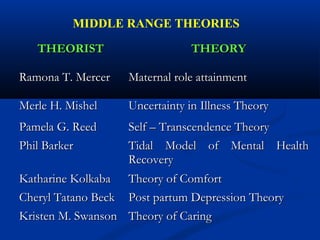
MIDDLE RANGE THEORIES
THEORISTTHEORIST THEORYTHEORY
Ramona T. MercerRamona T. Mercer Maternal role attainmentMaternal role attainment
Merle H. MishelMerle H. Mishel Uncertainty in Illness TheoryUncertainty in Illness Theory
Pamela G. ReedPamela G. Reed Self – Transcendence TheorySelf – Transcendence Theory
Phil BarkerPhil Barker Tidal Model of Mental HealthTidal Model of Mental Health
RecoveryRecovery
Katharine KolkabaKatharine Kolkaba Theory of ComfortTheory of Comfort
Cheryl Tatano BeckCheryl Tatano Beck Post partum Depression TheoryPost partum Depression Theory
Kristen M. SwansonKristen M. Swanson Theory of CaringTheory of Caring
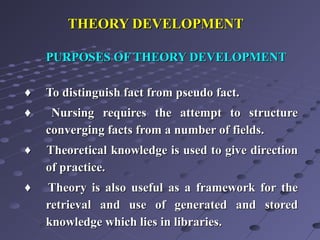
THEORY DEVELOPMENTTHEORY DEVELOPMENT
PURPOSES OF THEORY DEVELOPMENTPURPOSES OF THEORY DEVELOPMENT
♦♦ To distinguish fact from pseudo fact.To distinguish fact from pseudo fact.
♦♦ Nursing requires the attempt to structureNursing requires the attempt to structure
converging facts from a number of fields.converging facts from a number of fields.
♦♦ Theoretical knowledge is used to give directionTheoretical knowledge is used to give direction
of practice.of practice.
♦♦ Theory is also useful as a framework for theTheory is also useful as a framework for the
retrieval and use of generated and storedretrieval and use of generated and stored
knowledge which lies in libraries.knowledge which lies in libraries.
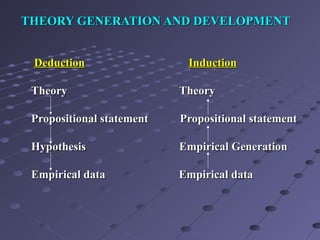
THEORY GENERATION AND DEVELOPMENTTHEORY GENERATION AND DEVELOPMENT
DeductionDeduction InductionInduction
TheoryTheory TheoryTheory
Propositional statement Propositional statementPropositional statement Propositional statement
HypothesisHypothesis Empirical GenerationEmpirical Generation
Empirical dataEmpirical data Empirical dataEmpirical data
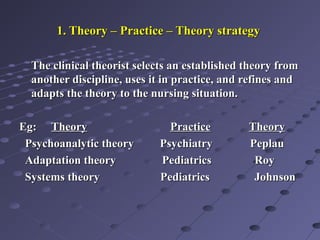
1. Theory – Practice – Theory strategy1. Theory – Practice – Theory strategy
The clinical theorist selects an established theory fromThe clinical theorist selects an established theory from
another discipline, uses it in practice, and refines andanother discipline, uses it in practice, and refines and
adapts the theory to the nursing situation.adapts the theory to the nursing situation.
Eg:Eg: TheoryTheory PracticePractice TheoryTheory
Psychoanalytic theory Psychiatry PeplauPsychoanalytic theory Psychiatry Peplau
Adaptation theory Pediatrics RoyAdaptation theory Pediatrics Roy
Systems theory PediatricsSystems theory Pediatrics JohnsonJohnson
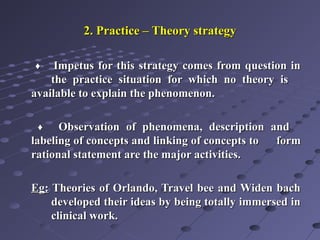
2. Practice – Theory strategy2. Practice – Theory strategy
♦♦ Impetus for this strategy comes from question inImpetus for this strategy comes from question in
the practice situation for which no theory isthe practice situation for which no theory is
available to explain the phenomenon.available to explain the phenomenon.
♦♦ Observation of phenomena, description andObservation of phenomena, description and
labeling of concepts and linking of concepts tolabeling of concepts and linking of concepts to formform
rational statement are the major activities.rational statement are the major activities.
Eg:Eg: Theories of Orlando, Travel bee and Widen bachTheories of Orlando, Travel bee and Widen bach
developed their ideas by being totally immersed indeveloped their ideas by being totally immersed in
clinical work.clinical work.
3. Research – Theory strategy3. Research – Theory strategy
Characteristics of a selected phenomena areCharacteristics of a selected phenomena are
measured in a variety of situations and thenmeasured in a variety of situations and then
analyzed for existence of significant patterns thatanalyzed for existence of significant patterns that
are formalized into theoretical proposition.are formalized into theoretical proposition.
Eg: Johnson’s behavior system model, Barnard’sEg: Johnson’s behavior system model, Barnard’s
parent- child interaction theory.parent- child interaction theory.
4. Theory – Research – Theory strategy4. Theory – Research – Theory strategy
 In this strategy, theory derives the researchIn this strategy, theory derives the research
questions and the results that answer thesequestions and the results that answer these
research questions inform and modify theresearch questions inform and modify the
theory.theory.
 Theorists begin the research by defining a theoryTheorists begin the research by defining a theory
and determining propositions for testing and thenand determining propositions for testing and then
further modify and develop the original theories.further modify and develop the original theories.
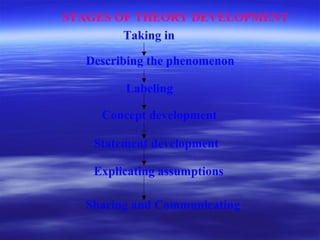
STAGES OF THEORY DEVELOPMENT
Taking in
Describing the phenomenon
Labeling
Concept development
Statement development
Explicating assumptions
Sharing and Communicating
STAGES OF THEORY DEVELOPMENT
1. Taking in
A process of sizing up a situation that has
attracted our attention for whatever reason. A
phenomenon may attract and hold the attention of
the observer making her pause to think about it or
reflect on its nature.
2. Describing the phenomenon
Cognitive, intuitive or inferential
interpretation of the phenomenon is made to
describe and delineate the phenomena.
3. Labeling
Labeling is defining the concept ranging
from dictionary definition to a more complex
definition that takes the perspective of the theorist
in consideration
 Defining
 Differentiating
 Delineating antecedents
 Delineating consequences
 Modeling
 Analyzing
 Synthesizing
4. Concept development
5. Statement development
Explanations related to the phenomenon
that link the concepts, antecedents,
consequences and assumptions are provided.
6. Explicating assumptions
Analysis of one’s views, beliefs and
theoretical underpinnings will help delineate
assumptions of the developing theory.
7. Sharing and Communicating
Sharing and communicating goes beyond
writing and publication. Clinical conferences
may be redefined to include a theoretical
journal sharing hour. Faculty meeting time
must be re-organized to permit discussion for
evolving concepts or statement.
BARRIERS TO THEORY DEVELOPMENT
1. Human barriers
(i) Nurses as Nurses:
• Nurses looked nursing as an occupation rather
than profession with theoretical foundations.
• Nursing is service oriented rather than
profession orientation
• Theory creation is an active process but early
research characterized nurses as passive
• Nurses were taught intellectual subordination.
• Critical thinking skills were not taught to
(ii) Nurses as women:
• Theory development is a laborious process
whereas nurses as women were hard
working person whose energies should
be for rearing children and caring for a family
• Nurses as women are considered to be more
affective, more subordinate,more emotional,
less achievement oriented and generally
expected to apply rather than to create.
• Women are conditioned to consider
professional career as secondary to
family and home.
(iii) Nurses as Theorists:
Nurses have been harsh in critiquing nursing
theories because
•Theories did not appear to evolve from an
empirical base.
•Theories were developed by women.
•Theories in itself were not able to describe
and predict all nursing phenomena.
2. Knowledge barriers:
• Theories used knowledge developed by other
disciplines.
• Reluctance of the members of the discipline to
use nursing theory developed within the
discipline.
• Knowledge of nursing theory is not useful in
practice.
3. Conceptual barriers:
Conceptual blocks are those closed gates
that prevent nurses from previewing of
developing nursing phenomena beyond the
immediate problem solving need.
Development and classification

Development and classification

  • 1.
    DEVELOPMENT AND CLASSIFICATION OF NURSINGTHEORIES Presented by ARUN.M
  • 2.
    THEORIES ARE NOT DISCOVEREDIN NATURE BUT ARE HUMAN INVENTIONS
  • 3.
    THEORY A set ofconcepts, definitions and prepositions that projects a systematic view of phenomena by designating specific interrelationships among concepts for purposes of describing, explaining, predicting and controlling phenomena.
  • 4.
    NURSING THEORY Conceptualization ofsome aspect of nursing communicated for the purpose of describing phenomena explaining relationships between phenomena predicting consequences or prescribing nursing care.
  • 5.
    PHILOSOPHYPHILOSOPHY Concerned with thevalues and beliefs of aConcerned with the values and beliefs of a discipline and with the values and beliefsdiscipline and with the values and beliefs heldheld by members of the discipline.by members of the discipline. CONCEPTCONCEPT Complex mental formulation of anComplex mental formulation of an object, property or event that is derivedobject, property or event that is derived fromfrom individual perceptual experience. It isindividual perceptual experience. It is anan idea, a mental image oridea, a mental image or generalization formedgeneralization formed and developed inand developed in the mind.the mind.
  • 6.
    CONCEPTUAL MODELCONCEPTUAL MODEL Aset of relatively abstract andA set of relatively abstract and general concepts and the propositionsgeneral concepts and the propositions that describe or link those concepts.that describe or link those concepts.
  • 7.
    COMPONENTS OF ANURSING THEORYCOMPONENTS OF A NURSING THEORY ConceptsConcepts DefinitionsDefinitions AssumptionsAssumptions oror PropositionsPropositions Phenomenon
  • 8.
    CONCEPTSCONCEPTS  Theory consistsof inter related conceptsTheory consists of inter related concepts  Concepts are ideas, mental imagesConcepts are ideas, mental images  They help to describe or label phenomenaThey help to describe or label phenomena  They are mental formulations of an object or eventThey are mental formulations of an object or event that come from individual perceptual experiencethat come from individual perceptual experience DEFINITIONSDEFINITIONS  Convey the general meaning of the concepts in aConvey the general meaning of the concepts in a manner that fits the theory.manner that fits the theory.  Describe the activity necessary to measure theDescribe the activity necessary to measure the constructs, relationships or variables within aconstructs, relationships or variables within a theory.theory.
  • 9.
    ASSUMPTIONSASSUMPTIONS  Statements thatdescribe concepts or connect twoStatements that describe concepts or connect two conceptsconcepts  They are the “taken for granted” statements thatThey are the “taken for granted” statements that determine the nature of the concepts, definitions,determine the nature of the concepts, definitions, purpose, relationships and structure of the theory.purpose, relationships and structure of the theory. PHENOMENONPHENOMENON  An aspect of reality that can beAn aspect of reality that can be consciouslyconsciously sensed orsensed or experiencedexperienced  Nursing theories focus on the phenomena ofNursing theories focus on the phenomena of nursingnursing  In nursing, phenomena reflect the domain ofIn nursing, phenomena reflect the domain of nursing practicenursing practice
  • 10.
    CHARACTERISTICS OF ATHEORYCHARACTERISTICS OF A THEORY 1) Interrelate concepts in such a way as to create1) Interrelate concepts in such a way as to create a different way of looking at a particulara different way of looking at a particular phenomenon.phenomenon. 2) Must be logical in nature2) Must be logical in nature 3) Should be relatively simple yet generalizable3) Should be relatively simple yet generalizable 4) The bases for hypothesis that can4) The bases for hypothesis that can be tested orbe tested or for theory to be expandedfor theory to be expanded ...continued.....continued..
  • 11.
    6)6)Contribute to andassist in increasing theContribute to and assist in increasing the general body of knowledge within thegeneral body of knowledge within the discipline through the research implementeddiscipline through the research implemented to validate them.to validate them. 7) Used by practitioners to guide and7) Used by practitioners to guide and improveimprove their practice.their practice. 8)8) Consistent with other validated theories,Consistent with other validated theories, laws, and principles but will leave openlaws, and principles but will leave open unanswered questions that need to beunanswered questions that need to be investigated.investigated.
  • 12.
    TYPES OF THEORYTYPESOF THEORY (I) LEVEL OF ABSTRACTION(I) LEVEL OF ABSTRACTION Grand Theory Middle Range Theory Situation specific Theory
  • 13.
    II GOAL ORIENTATIONIIGOAL ORIENTATION Descriptive Prescriptive Factor isolating Explanatory theory
  • 14.
    GRAND THEORIES  Systematicconstructions of the nature of nursing, the mission of nursing and the goals of nursing care.  Broad in scope and complex  Require further specification through research before they can be fully tested.  Concepts are abstract  Not easily empirically tested.
  • 15.
    MIDDLE RANGE THEORIES Limited scope  Less abstract concepts  Address specific phenomena or concepts  Reflect practice (Administration, clinical or teaching)  Increased theory-based research and nursing practice strategies
  • 16.
    SITUATION SPECIFIC THEORIES Focus on specific nursing phenomena that reflect clinical practice.  Limited to specific populations or to a particular field of practice.  Limited scope  More direct impact on nursing practice  Predict outcomes and the impact of nursing practice  Called as prescriptive theory  Day-to-day experience of nurses is a major source to situation specific theory
  • 17.
    DESCRIPTIVE THEORIES  Describea phenomenon, an event, a situation or a relationship Needed when very little is known about a phenomena  Describe phenomena, speculate on why phenomena occur and the consequences of a phenomena.  Have explanatory, relating and predicting utility  They are complete and have the potential for guiding research.
  • 18.
    PRESCRIPTIVE THEORIES  Prescriptivetheory designates the prescription (intervention), the conditions under which the prescription should occur, and the consequences.  They are action oriented which tests the validity and predictability of a nursing intervention.  Guide nursing research to develop and test specific nursing interventions.
  • 19.
    TYPES OF THEORYAND LEVEL OFTYPES OF THEORY AND LEVEL OF ABSTRACTIONABSTRACTION Types of TheoryTypes of Theory Level of abstractionLevel of abstraction Conceptual modelConceptual model Most AbstractMost Abstract Grand theoryGrand theory Middle -Range theoryMiddle -Range theory Situation specific theorySituation specific theory Most concreteMost concrete
  • 20.
    THEORISTTHEORIST PHILOSOPHIES Florence NightingaleFlorenceNightingale An Environmental Adaptation TheoryAn Environmental Adaptation Theory Ernestine WidenbachErnestine Widenbach The helping Art of Clinical NursingThe helping Art of Clinical Nursing Virginia HendersonVirginia Henderson Basic Needs of the PatientBasic Needs of the Patient Faye AbdellahFaye Abdellah Need TheoryNeed Theory Lydia E. HallLydia E. Hall Care, Core, Cure ConceptCare, Core, Cure Concept Jean WatsonJean Watson Philosophy and Science of CaringPhilosophy and Science of Caring Patricia BennerPatricia Benner Excellence and power in clinicalExcellence and power in clinical Nursing PracticeNursing Practice Kari MartinsenKari Martinsen Philosophy of caringPhilosophy of caring PHILOSOPHIES
  • 21.
    CONCEPTUAL MODELS THEORISTTHEORIST MODELMODEL DorothyJohnsonDorothy Johnson Behaviour System ModelBehaviour System Model Myra LevinMyra Levin Conservation ModelConservation Model Martha RogersMartha Rogers Science of Human beingsScience of Human beings Betty NeumanBetty Neuman Systems ModelSystems Model Sister Callista RoySister Callista Roy Adaptation ModelAdaptation Model
  • 22.
    GRAND THEORIES THEORISTTHEORIST THEORYTHEORY ImogeneKingImogene King Theory of Goal AttainmentTheory of Goal Attainment LeningerLeninger Theory of Culture Care andTheory of Culture Care and UniversalityUniversality Margaret A. NewmanMargaret A. Newman Health as ExpandingHealth as Expanding ConsciousnessConsciousness Dorothea OremDorothea Orem Self-Care Deficit TheorySelf-Care Deficit Theory ParseParse Theory of Human BecomingTheory of Human Becoming Ida Jean OrlandoIda Jean Orlando Nursing Process TheoryNursing Process Theory Hildegard E.PeplauHildegard E.Peplau Inter personal relationship TheoryInter personal relationship Theory
  • 23.
    MIDDLE RANGE THEORIES THEORISTTHEORISTTHEORYTHEORY Ramona T. MercerRamona T. Mercer Maternal role attainmentMaternal role attainment Merle H. MishelMerle H. Mishel Uncertainty in Illness TheoryUncertainty in Illness Theory Pamela G. ReedPamela G. Reed Self – Transcendence TheorySelf – Transcendence Theory Phil BarkerPhil Barker Tidal Model of Mental HealthTidal Model of Mental Health RecoveryRecovery Katharine KolkabaKatharine Kolkaba Theory of ComfortTheory of Comfort Cheryl Tatano BeckCheryl Tatano Beck Post partum Depression TheoryPost partum Depression Theory Kristen M. SwansonKristen M. Swanson Theory of CaringTheory of Caring
  • 24.
    THEORY DEVELOPMENTTHEORY DEVELOPMENT PURPOSESOF THEORY DEVELOPMENTPURPOSES OF THEORY DEVELOPMENT ♦♦ To distinguish fact from pseudo fact.To distinguish fact from pseudo fact. ♦♦ Nursing requires the attempt to structureNursing requires the attempt to structure converging facts from a number of fields.converging facts from a number of fields. ♦♦ Theoretical knowledge is used to give directionTheoretical knowledge is used to give direction of practice.of practice. ♦♦ Theory is also useful as a framework for theTheory is also useful as a framework for the retrieval and use of generated and storedretrieval and use of generated and stored knowledge which lies in libraries.knowledge which lies in libraries.
  • 25.
    THEORY GENERATION ANDDEVELOPMENTTHEORY GENERATION AND DEVELOPMENT DeductionDeduction InductionInduction TheoryTheory TheoryTheory Propositional statement Propositional statementPropositional statement Propositional statement HypothesisHypothesis Empirical GenerationEmpirical Generation Empirical dataEmpirical data Empirical dataEmpirical data
  • 26.
    1. Theory –Practice – Theory strategy1. Theory – Practice – Theory strategy The clinical theorist selects an established theory fromThe clinical theorist selects an established theory from another discipline, uses it in practice, and refines andanother discipline, uses it in practice, and refines and adapts the theory to the nursing situation.adapts the theory to the nursing situation. Eg:Eg: TheoryTheory PracticePractice TheoryTheory Psychoanalytic theory Psychiatry PeplauPsychoanalytic theory Psychiatry Peplau Adaptation theory Pediatrics RoyAdaptation theory Pediatrics Roy Systems theory PediatricsSystems theory Pediatrics JohnsonJohnson
  • 27.
    2. Practice –Theory strategy2. Practice – Theory strategy ♦♦ Impetus for this strategy comes from question inImpetus for this strategy comes from question in the practice situation for which no theory isthe practice situation for which no theory is available to explain the phenomenon.available to explain the phenomenon. ♦♦ Observation of phenomena, description andObservation of phenomena, description and labeling of concepts and linking of concepts tolabeling of concepts and linking of concepts to formform rational statement are the major activities.rational statement are the major activities. Eg:Eg: Theories of Orlando, Travel bee and Widen bachTheories of Orlando, Travel bee and Widen bach developed their ideas by being totally immersed indeveloped their ideas by being totally immersed in clinical work.clinical work.
  • 28.
    3. Research –Theory strategy3. Research – Theory strategy Characteristics of a selected phenomena areCharacteristics of a selected phenomena are measured in a variety of situations and thenmeasured in a variety of situations and then analyzed for existence of significant patterns thatanalyzed for existence of significant patterns that are formalized into theoretical proposition.are formalized into theoretical proposition. Eg: Johnson’s behavior system model, Barnard’sEg: Johnson’s behavior system model, Barnard’s parent- child interaction theory.parent- child interaction theory.
  • 29.
    4. Theory –Research – Theory strategy4. Theory – Research – Theory strategy  In this strategy, theory derives the researchIn this strategy, theory derives the research questions and the results that answer thesequestions and the results that answer these research questions inform and modify theresearch questions inform and modify the theory.theory.  Theorists begin the research by defining a theoryTheorists begin the research by defining a theory and determining propositions for testing and thenand determining propositions for testing and then further modify and develop the original theories.further modify and develop the original theories.
  • 30.
    STAGES OF THEORYDEVELOPMENT Taking in Describing the phenomenon Labeling Concept development Statement development Explicating assumptions Sharing and Communicating
  • 31.
    STAGES OF THEORYDEVELOPMENT 1. Taking in A process of sizing up a situation that has attracted our attention for whatever reason. A phenomenon may attract and hold the attention of the observer making her pause to think about it or reflect on its nature. 2. Describing the phenomenon Cognitive, intuitive or inferential interpretation of the phenomenon is made to describe and delineate the phenomena.
  • 32.
    3. Labeling Labeling isdefining the concept ranging from dictionary definition to a more complex definition that takes the perspective of the theorist in consideration  Defining  Differentiating  Delineating antecedents  Delineating consequences  Modeling  Analyzing  Synthesizing 4. Concept development
  • 33.
    5. Statement development Explanationsrelated to the phenomenon that link the concepts, antecedents, consequences and assumptions are provided. 6. Explicating assumptions Analysis of one’s views, beliefs and theoretical underpinnings will help delineate assumptions of the developing theory.
  • 34.
    7. Sharing andCommunicating Sharing and communicating goes beyond writing and publication. Clinical conferences may be redefined to include a theoretical journal sharing hour. Faculty meeting time must be re-organized to permit discussion for evolving concepts or statement.
  • 35.
    BARRIERS TO THEORYDEVELOPMENT 1. Human barriers (i) Nurses as Nurses: • Nurses looked nursing as an occupation rather than profession with theoretical foundations. • Nursing is service oriented rather than profession orientation • Theory creation is an active process but early research characterized nurses as passive • Nurses were taught intellectual subordination. • Critical thinking skills were not taught to
  • 36.
    (ii) Nurses aswomen: • Theory development is a laborious process whereas nurses as women were hard working person whose energies should be for rearing children and caring for a family • Nurses as women are considered to be more affective, more subordinate,more emotional, less achievement oriented and generally expected to apply rather than to create. • Women are conditioned to consider professional career as secondary to family and home.
  • 37.
    (iii) Nurses asTheorists: Nurses have been harsh in critiquing nursing theories because •Theories did not appear to evolve from an empirical base. •Theories were developed by women. •Theories in itself were not able to describe and predict all nursing phenomena.
  • 38.
    2. Knowledge barriers: •Theories used knowledge developed by other disciplines. • Reluctance of the members of the discipline to use nursing theory developed within the discipline. • Knowledge of nursing theory is not useful in practice. 3. Conceptual barriers: Conceptual blocks are those closed gates that prevent nurses from previewing of developing nursing phenomena beyond the immediate problem solving need.