Curriculum Development in
Islamic Perspective
Islamic Concept of Curriculum
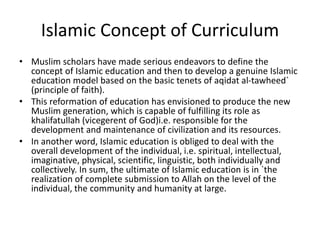
• Muslim scholars have made serious endeavors to define the
concept of Islamic education and then to develop a genuine Islamic
education model based on the basic tenets of aqidat al-tawheed`
(principle of faith).
• This reformation of education has envisioned to produce the new
Muslim generation, which is capable of fulfilling its role as
khalifatullah (vicegerent of God)i.e. responsible for the
development and maintenance of civilization and its resources.
• In another word, Islamic education is obliged to deal with the
overall development of the individual, i.e. spiritual, intellectual,
imaginative, physical, scientific, linguistic, both individually and
collectively. In sum, the ultimate of Islamic education is in `the
realization of complete submission to Allah on the level of the
individual, the community and humanity at large.
Islamic Concept of Curriculum
• A newly integrated Islamic curriculum and subject
matter for contemporary Islamic schools need to
be devised to promote Islamic Identity solidarity
for the Ummah.
• It is for the need of the young generations to be
instilled with pure Islamic values and beliefs from
the beginning in a very comprehensive, critical
and creative manner by using newly revised
integrated and dynamic approach to education.
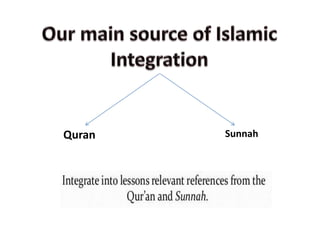
Quran Sunnah
Islamic religious curricular history
• Islamic religious curricular has gone through four distinct periods in
Islamic history.
• The first period is the period of development which started with the
resurgence of the Prophet Muhammad (S.A.W.W) in Makkah until the end
of Umayyad period. The main characteristics of religious curriculum of this
period are:
• purely Arabic in nature
• strengthening the basis of Islamic religion and spreading its teaching
• based on religious sciences and Arabic grammar
• concentrate more on study of Hadith and jurisprudence
• concentrate more on Arabic grammar and literature
• the initial study of foreign languages
During this period, the mosque was the centre of activities of the Islamic
society and education was the important part of those activities.
Contin.....
• The second period is the flourishing period of
education starting in the East with the emergence of
Abbasid dynasty until the downfall by Tartar in
659H/1258 M whereas in the Western part of Islamic
Empire the important centre is Andalusia, especially
under the rules of Umayyad Khaliphate. During this
period the curriculum was expanded to include non
religious sciences as well as the centre also expanded
to include Makkah, AlMadinah in Hijaz; Basrah and
Kufah in Iraq; Damascus in Sham (Syria); Cairo in
Eygpt and Granada and Svilla in Andalusia.
Contin.....
• The third period was the period of weaknesses and
decadence which started in the East and North Africa
with the resurgence of Ottoman Empire which lasted
until the independence of Muslim countries. The most
important characteristics of this period are:
• the entire curriculum was based on the transmitted
knowledge
• the decline of the Arabic language
• the method was based on memorization
• the deterioration of scientific research and thinking
process
• the spread of the method of summarization and
repetition of what was made by early scholars.
Contin......
The fourth period is known as the period of revival,
awakening and rebuilding education in Muslim countries which
started subsequent to the independence these countries. This
process is still going on to the present time. The most important
characteristics of religious education during this period are as
follows:
• adoption of Western educational system
• increasing concern on natural as well as human sciences
• penetration of Western culture
• an attempt toward eliminating dualism between modern
education and religious education
Aims and Objective of Islamic Education At Different Level
of Schooling
• Aims and objectives are constructed before hand to
know the behavioural outcome of the Muslim
learners. For the purpose of teaching Islamic
education in the formal system of education, the
teacher has to formulate beforehand the aims and
objectives of Islamic education at different level of
schooling.
At Nursery and Primary level
Salahuddin Yusuf (1991) in his article titled,
“Islamization of knowledge: A work Plan for
Islamic Nursery Education” suggested that, the
objectives of Islamic nursery education should
include the following:
(i) To develop the intellectual, physical, moral,
aesthetic and spiritual potentialities of the
children for the purpose of Ibadah.
At Secondary Level
• (i) To provide such education as will develop
mental, moral and physical
• aspects of a child’s personality in the light of
Islam.
• (ii) To make learner realize that physical
strength and energy is properly
• used only when it resists evil and upholds
virtue in the society.
Aims of Islamic Education At The University Level
• Sharif, Hadi (1983) formulated the aims of Islamic
education at the University level as follows:
• (a) “To speak of Islam is to speak of Truth or
Reality, of the hierarchy of Reality and of virtues.
Consequently, the fundamental goal and the
main function of Islamic education and teaching
system at the University level consists in
awakening the spiritual insight and the
intellectual ability in the human receptacle.
Construction of Objectives of Islamic Education in Muslim
School Curriculum:
In totality we can classify different educational
objectives into following seven broad categories:
1. Knowledge level
2. Understanding level
3. Application level
4. Skill level
5. Values level
6. Interest level
7. Attitude level
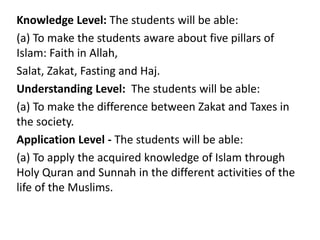
Knowledge Level: The students will be able:
(a) To make the students aware about five pillars of
Islam: Faith in Allah,
Salat, Zakat, Fasting and Haj.
Understanding Level: The students will be able:
(a) To make the difference between Zakat and Taxes in
the society.
Application Level - The students will be able:
(a) To apply the acquired knowledge of Islam through
Holy Quran and Sunnah in the different activities of the
life of the Muslims.
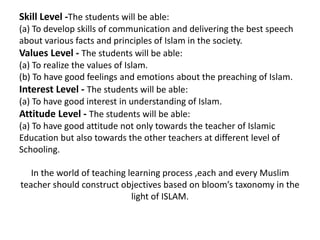
Skill Level -The students will be able:
(a) To develop skills of communication and delivering the best speech
about various facts and principles of Islam in the society.
Values Level - The students will be able:
(a) To realize the values of Islam.
(b) To have good feelings and emotions about the preaching of Islam.
Interest Level - The students will be able:
(a) To have good interest in understanding of Islam.
Attitude Level - The students will be able:
(a) To have good attitude not only towards the teacher of Islamic
Education but also towards the other teachers at different level of
Schooling.
In the world of teaching learning process ,each and every Muslim
teacher should construct objectives based on bloom’s taxonomy in the
light of ISLAM.
REFRENCES:
 Abdul Wafa al Chunemi-al Taftazani (1986): Islamic Education: Its Principle
and Aims, Muslim Education Quarterly, Vol. 4, No. l,pp. 66-75.
 Ahmad, Manzoor (1990), Islamic Education : Redefinition of Aims and
Methodology, Quazi Publishers and Distributors,Vateg Building,
Nizamuddin West, New Delhi
 Al-Attas, Syed Mohammad Al Naquib (1979). Aims and Objectives of
Islamic Education, Hodder and Stoughton King Abdul Aziz university
Curriculum development in Islamic perspective

Curriculum development in Islamic perspective

  • 1.
  • 2.
    Islamic Concept ofCurriculum • Muslim scholars have made serious endeavors to define the concept of Islamic education and then to develop a genuine Islamic education model based on the basic tenets of aqidat al-tawheed` (principle of faith). • This reformation of education has envisioned to produce the new Muslim generation, which is capable of fulfilling its role as khalifatullah (vicegerent of God)i.e. responsible for the development and maintenance of civilization and its resources. • In another word, Islamic education is obliged to deal with the overall development of the individual, i.e. spiritual, intellectual, imaginative, physical, scientific, linguistic, both individually and collectively. In sum, the ultimate of Islamic education is in `the realization of complete submission to Allah on the level of the individual, the community and humanity at large.
  • 3.
    Islamic Concept ofCurriculum • A newly integrated Islamic curriculum and subject matter for contemporary Islamic schools need to be devised to promote Islamic Identity solidarity for the Ummah. • It is for the need of the young generations to be instilled with pure Islamic values and beliefs from the beginning in a very comprehensive, critical and creative manner by using newly revised integrated and dynamic approach to education.
  • 5.
  • 6.
    Islamic religious curricularhistory • Islamic religious curricular has gone through four distinct periods in Islamic history. • The first period is the period of development which started with the resurgence of the Prophet Muhammad (S.A.W.W) in Makkah until the end of Umayyad period. The main characteristics of religious curriculum of this period are: • purely Arabic in nature • strengthening the basis of Islamic religion and spreading its teaching • based on religious sciences and Arabic grammar • concentrate more on study of Hadith and jurisprudence • concentrate more on Arabic grammar and literature • the initial study of foreign languages During this period, the mosque was the centre of activities of the Islamic society and education was the important part of those activities.
  • 7.
    Contin..... • The secondperiod is the flourishing period of education starting in the East with the emergence of Abbasid dynasty until the downfall by Tartar in 659H/1258 M whereas in the Western part of Islamic Empire the important centre is Andalusia, especially under the rules of Umayyad Khaliphate. During this period the curriculum was expanded to include non religious sciences as well as the centre also expanded to include Makkah, AlMadinah in Hijaz; Basrah and Kufah in Iraq; Damascus in Sham (Syria); Cairo in Eygpt and Granada and Svilla in Andalusia.
  • 8.
    Contin..... • The thirdperiod was the period of weaknesses and decadence which started in the East and North Africa with the resurgence of Ottoman Empire which lasted until the independence of Muslim countries. The most important characteristics of this period are: • the entire curriculum was based on the transmitted knowledge • the decline of the Arabic language • the method was based on memorization • the deterioration of scientific research and thinking process • the spread of the method of summarization and repetition of what was made by early scholars.
  • 9.
    Contin...... The fourth periodis known as the period of revival, awakening and rebuilding education in Muslim countries which started subsequent to the independence these countries. This process is still going on to the present time. The most important characteristics of religious education during this period are as follows: • adoption of Western educational system • increasing concern on natural as well as human sciences • penetration of Western culture • an attempt toward eliminating dualism between modern education and religious education
  • 10.
    Aims and Objectiveof Islamic Education At Different Level of Schooling • Aims and objectives are constructed before hand to know the behavioural outcome of the Muslim learners. For the purpose of teaching Islamic education in the formal system of education, the teacher has to formulate beforehand the aims and objectives of Islamic education at different level of schooling.
  • 11.
    At Nursery andPrimary level Salahuddin Yusuf (1991) in his article titled, “Islamization of knowledge: A work Plan for Islamic Nursery Education” suggested that, the objectives of Islamic nursery education should include the following: (i) To develop the intellectual, physical, moral, aesthetic and spiritual potentialities of the children for the purpose of Ibadah.
  • 12.
    At Secondary Level •(i) To provide such education as will develop mental, moral and physical • aspects of a child’s personality in the light of Islam. • (ii) To make learner realize that physical strength and energy is properly • used only when it resists evil and upholds virtue in the society.
  • 13.
    Aims of IslamicEducation At The University Level • Sharif, Hadi (1983) formulated the aims of Islamic education at the University level as follows: • (a) “To speak of Islam is to speak of Truth or Reality, of the hierarchy of Reality and of virtues. Consequently, the fundamental goal and the main function of Islamic education and teaching system at the University level consists in awakening the spiritual insight and the intellectual ability in the human receptacle.
  • 14.
    Construction of Objectivesof Islamic Education in Muslim School Curriculum: In totality we can classify different educational objectives into following seven broad categories: 1. Knowledge level 2. Understanding level 3. Application level 4. Skill level 5. Values level 6. Interest level 7. Attitude level
  • 15.
    Knowledge Level: Thestudents will be able: (a) To make the students aware about five pillars of Islam: Faith in Allah, Salat, Zakat, Fasting and Haj. Understanding Level: The students will be able: (a) To make the difference between Zakat and Taxes in the society. Application Level - The students will be able: (a) To apply the acquired knowledge of Islam through Holy Quran and Sunnah in the different activities of the life of the Muslims.
  • 16.
    Skill Level -Thestudents will be able: (a) To develop skills of communication and delivering the best speech about various facts and principles of Islam in the society. Values Level - The students will be able: (a) To realize the values of Islam. (b) To have good feelings and emotions about the preaching of Islam. Interest Level - The students will be able: (a) To have good interest in understanding of Islam. Attitude Level - The students will be able: (a) To have good attitude not only towards the teacher of Islamic Education but also towards the other teachers at different level of Schooling. In the world of teaching learning process ,each and every Muslim teacher should construct objectives based on bloom’s taxonomy in the light of ISLAM.
  • 17.
    REFRENCES:  Abdul Wafaal Chunemi-al Taftazani (1986): Islamic Education: Its Principle and Aims, Muslim Education Quarterly, Vol. 4, No. l,pp. 66-75.  Ahmad, Manzoor (1990), Islamic Education : Redefinition of Aims and Methodology, Quazi Publishers and Distributors,Vateg Building, Nizamuddin West, New Delhi  Al-Attas, Syed Mohammad Al Naquib (1979). Aims and Objectives of Islamic Education, Hodder and Stoughton King Abdul Aziz university