ISLAMIC SYSTEM OF EDUCATION
COURSE CODE: 6505
UNIT NO. 5 -
Administration and Supervision in Islamic System
Dr. Daniyal Mushtaq
Content List
 Objectives
 Concept and meaning of „Administration and
Supervision‟
 Basis of administration and supervision
 Principles of Islamic administration and
supervision
 Qualities of administrators
 Inter-relationships
3
Objectives
•After intensive study of this unit,
Student will be able to:
1. Describe the concept of administration and
supervision in Islamic perspective.
2. Understand the basis of administration and
supervision.
3. Get the perception about the principles of Islamic
administration and supervision.
4. Identify and discuss different qualities of
administrator
5. Well aware about relationship among administrator,
teacher, student an society under Islamic vision. 4
Concept and meaning of ‘Administration and
Supervision’
• Administration----------The English verb ‘to
administrate’ comes from the Latin verb
‘Administrate’---to care for.
o E. N. Gladden, “To care for or to look after
people, to manage affaire”
oPfiffner, “getting the work of government
done by coordinating the efforts of people so
they can work together to accomplished their
said tasks.
5
Concept and meaning of ‘Administration
and Supervision’ (Cont.)
 Supervision-------Etymological meaning
“super”- “vision” for those who supervises. It
actually implies “a forward look” or broad look” for
professional growth of teachers.
 Burton and Bruedener, (1995) “supervision is based
on systematic study and analysis of entire situation,
utilizing a carefully planned program that has been
cooperatively derived from the situation and which is
adopted to the need of those students in it.
6
Concepts and meaning of Administration
and Supervision
• Islamic concept
 Islamic administration and supervision centers on
the concepts of probity, piety, justice, equality and
social equity.
 In Islam administration have to be intermingled
with religion, values and ethics.
 From Islamic perspective, it is a most onerous task
and challenging function that places enormous
responsibility on its chief executive.
 In Islamic system of education administrator plans
and set his administration to established Islam as
the only way of life in educational institution. 8
Basis of administration and
supervision
• Quran, Sari’ah, practice life of Holy
prophet and four Caliph’s style of
government provides great and strong
basis for administration and
supervision.
9
 Islamic Sari‟ah lays down the principles and fundamentals
for the orientation of governmental affairs and the
construction of “good” and ethical administration.
 Prophet (PBUH) important characteristic of administration
and supervision is simplicity and ease with the
administrative affairs.
 He (PBUH) appointed a “WALI” to educate the people
and teach them and for administration of justice.
 He (PBUH) appointed a “qadi” to each province, along
with governor and tax collector.
Basis of administration and
supervision---Caliphs
(Cont.)
– Hazrat Abu Bakar (RA) followed Our Prophet’s
(HAZRAT MUHAMMAD PBUH) pattern appointed
Hazarat Umar (RA) as Chief justice and in-charge of
distributing the poor tax.
– Hazrat Umar (RA) considered the great grandfather
of Islamic administration and supervision. Founded
early Islamic state and build Islamic civilization provide
the concept of Islamic administration as public service.
He initiate democratic methods in Islamic
Administration and supervision of government.
– Hazrat Usman (RA) and Hazarat Ali (RA) followed
11
the footsteps of Hazrat Umar (RA)
Principles of Islamic Administration
and Supervision
 Principles of Honesty
 Principles of Justice
 Principles of Veracity
 Principles of Courage
 Principles of Politeness
 Principles of Forgiveness
 Principles of Patience
 Principles of Peacefulness
 Principles of Accessibility
 Principles of Tolerance 12
Qualities of Administrator
 Consciousness (Taqwa--- ‫یو‬
‫ق‬
‫ت‬ )
 Sincerity
 Responsibility
 Integrity
 Honesty, truthfulness, keeping of commitments, fair
dealing
 Discipline and self-control
 Humanity, patience,
endurance, courage, thankfulness
 Dignity, honor, self-respect 13
Qualities of Administrator
(Cont…)
 Purity, modesty and chastity
 Kindness, helpfulness, cooperation
 Politeness, consideration and good manner
 Brotherliness
 Warmth and lovingness
 Striving, hard work
and planning
 Justice
14
Inter-relationships
Characteristics of good relationship
–Controlling Anger
–Politeness
–Goodness
–Muslim is mirror of his brother
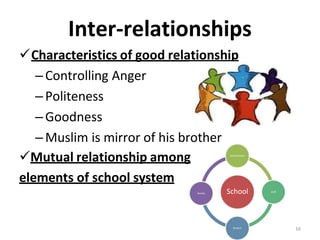
Mutual relationship among
elements of school system
16
School
Administrator
staff
Student
Society
Inter-relationships
Summary
• Administration is to do with teachers as well as with
the system of education and supervision is a planned
program for the improvement of instructions.
⦁ In Islamic system of education administrator plans
and set his administration to established Islam as the
only way of life in educational institution.
• Quran, Sari‟ah, practice life of Holy prophet
and four Caliph‟s style of government provides
great and strong basis for administration and
supervision.
18
Summary (Cont...)
Islam says in connection of relationship that all human beings
are brother and sisters in humanity. Islam expected from a
Muslim administrator to be sympathetic towards staff, he
should also be a well wisher of pupils. From teachers
perspective he is considered as hub of a wheel from which
radiate relationship with students, specialist, community and
parents. He should do something to meet the needs of the
students and use constructive influence to help, modify,
control or eliminate destructive forces. He should be kind and
sympathetic towards students and student have to show high
degree of respect and insist on an attitude of deep reverence
on the part of students.
19
Administration and Supervision in Islamic System

Administration and Supervision in Islamic System

  • 2.
    ISLAMIC SYSTEM OFEDUCATION COURSE CODE: 6505 UNIT NO. 5 - Administration and Supervision in Islamic System Dr. Daniyal Mushtaq
  • 3.
    Content List  Objectives Concept and meaning of „Administration and Supervision‟  Basis of administration and supervision  Principles of Islamic administration and supervision  Qualities of administrators  Inter-relationships 3
  • 4.
    Objectives •After intensive studyof this unit, Student will be able to: 1. Describe the concept of administration and supervision in Islamic perspective. 2. Understand the basis of administration and supervision. 3. Get the perception about the principles of Islamic administration and supervision. 4. Identify and discuss different qualities of administrator 5. Well aware about relationship among administrator, teacher, student an society under Islamic vision. 4
  • 5.
    Concept and meaningof ‘Administration and Supervision’ • Administration----------The English verb ‘to administrate’ comes from the Latin verb ‘Administrate’---to care for. o E. N. Gladden, “To care for or to look after people, to manage affaire” oPfiffner, “getting the work of government done by coordinating the efforts of people so they can work together to accomplished their said tasks. 5
  • 6.
    Concept and meaningof ‘Administration and Supervision’ (Cont.)  Supervision-------Etymological meaning “super”- “vision” for those who supervises. It actually implies “a forward look” or broad look” for professional growth of teachers.  Burton and Bruedener, (1995) “supervision is based on systematic study and analysis of entire situation, utilizing a carefully planned program that has been cooperatively derived from the situation and which is adopted to the need of those students in it. 6
  • 8.
    Concepts and meaningof Administration and Supervision • Islamic concept  Islamic administration and supervision centers on the concepts of probity, piety, justice, equality and social equity.  In Islam administration have to be intermingled with religion, values and ethics.  From Islamic perspective, it is a most onerous task and challenging function that places enormous responsibility on its chief executive.  In Islamic system of education administrator plans and set his administration to established Islam as the only way of life in educational institution. 8
  • 9.
    Basis of administrationand supervision • Quran, Sari’ah, practice life of Holy prophet and four Caliph’s style of government provides great and strong basis for administration and supervision. 9
  • 10.
     Islamic Sari‟ahlays down the principles and fundamentals for the orientation of governmental affairs and the construction of “good” and ethical administration.  Prophet (PBUH) important characteristic of administration and supervision is simplicity and ease with the administrative affairs.  He (PBUH) appointed a “WALI” to educate the people and teach them and for administration of justice.  He (PBUH) appointed a “qadi” to each province, along with governor and tax collector.
  • 11.
    Basis of administrationand supervision---Caliphs (Cont.) – Hazrat Abu Bakar (RA) followed Our Prophet’s (HAZRAT MUHAMMAD PBUH) pattern appointed Hazarat Umar (RA) as Chief justice and in-charge of distributing the poor tax. – Hazrat Umar (RA) considered the great grandfather of Islamic administration and supervision. Founded early Islamic state and build Islamic civilization provide the concept of Islamic administration as public service. He initiate democratic methods in Islamic Administration and supervision of government. – Hazrat Usman (RA) and Hazarat Ali (RA) followed 11 the footsteps of Hazrat Umar (RA)
  • 12.
    Principles of IslamicAdministration and Supervision  Principles of Honesty  Principles of Justice  Principles of Veracity  Principles of Courage  Principles of Politeness  Principles of Forgiveness  Principles of Patience  Principles of Peacefulness  Principles of Accessibility  Principles of Tolerance 12
  • 13.
    Qualities of Administrator Consciousness (Taqwa--- ‫یو‬ ‫ق‬ ‫ت‬ )  Sincerity  Responsibility  Integrity  Honesty, truthfulness, keeping of commitments, fair dealing  Discipline and self-control  Humanity, patience, endurance, courage, thankfulness  Dignity, honor, self-respect 13
  • 14.
    Qualities of Administrator (Cont…) Purity, modesty and chastity  Kindness, helpfulness, cooperation  Politeness, consideration and good manner  Brotherliness  Warmth and lovingness  Striving, hard work and planning  Justice 14
  • 16.
    Inter-relationships Characteristics of goodrelationship –Controlling Anger –Politeness –Goodness –Muslim is mirror of his brother Mutual relationship among elements of school system 16 School Administrator staff Student Society
  • 17.
  • 18.
    Summary • Administration isto do with teachers as well as with the system of education and supervision is a planned program for the improvement of instructions. ⦁ In Islamic system of education administrator plans and set his administration to established Islam as the only way of life in educational institution. • Quran, Sari‟ah, practice life of Holy prophet and four Caliph‟s style of government provides great and strong basis for administration and supervision. 18
  • 19.
    Summary (Cont...) Islam saysin connection of relationship that all human beings are brother and sisters in humanity. Islam expected from a Muslim administrator to be sympathetic towards staff, he should also be a well wisher of pupils. From teachers perspective he is considered as hub of a wheel from which radiate relationship with students, specialist, community and parents. He should do something to meet the needs of the students and use constructive influence to help, modify, control or eliminate destructive forces. He should be kind and sympathetic towards students and student have to show high degree of respect and insist on an attitude of deep reverence on the part of students. 19