(NAMESOFSTUDENTS)
GROUP F
(PRESENTATION )
PLATO
DEPARTMENT OF HUMAN NUTRITION & DIETETICS
1. HADIYA QADEER
2. SAMAVIA NADEEM
3. AFRA ASHRAF
4. AQSA BIBI
5. SANA SHAHID
CONTENT LIST
1.INTRODUCTION OF PLATO
2.MAJOR THEME ABOUT CRITICAL THINKING
3.FAMOUS SAYING
4.PLATO PHILOSPHY AND NOBLE PRIZE
5.CONCLUSION
6.REFRENCES
 PLATO
INTRODUCTION OF PLATO
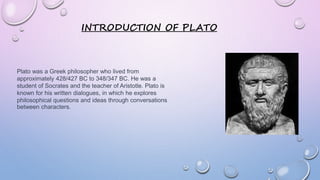
Plato was a Greek philosopher who lived from
approximately 428/427 BC to 348/347 BC. He was a
student of Socrates and the teacher of Aristotle. Plato is
known for his written dialogues, in which he explores
philosophical questions and ideas through conversations
between characters.
MAJOR THEME ABOUT CRITICAL THINKING
Plato's major theme about critical thinking can be seen
throughout his philosophical dialogues. He believed that
critical thinking was essential for arriving at truth
and understanding.
 One of Plato's main ideas about critical thinking
is the importance of examining one's own
beliefs and assumptions.
Overall, Plato's philosophy emphasizes the
importance of questioning and critical thinking
as a means of arriving at truth, understanding,
and wise decision-making.
FAMOUS SAYING
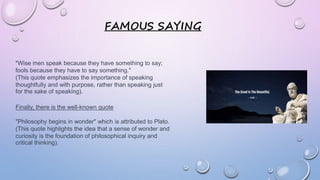
"Wise men speak because they have something to say;
fools because they have to say something."
(This quote emphasizes the importance of speaking
thoughtfully and with purpose, rather than speaking just
for the sake of speaking).
Finally, there is the well-known quote
"Philosophy begins in wonder" which is attributed to Plato.
(This quote highlights the idea that a sense of wonder and
curiosity is the foundation of philosophical inquiry and
critical thinking).
PLATO PHILOSOPHY AND NOBLE PRIZE
Plato's philosophy is characterized by his emphasis on the
importance of reason, critical thinking, and the pursuit of
knowledge and virtue as a means of achieving a good and
fulfilling life.
Plato, being a philosopher who lived over 2000 years ago,
could not have won a Nobel Prize, as the first Nobel
Prizes were awarded in 1901, long after Plato's time.
NOBLE PRIZE
However, many scholars and thinkers throughout history
have been inspired and influenced by Plato's ideas
PHILOSOPH
Y
BOOKS OF PLATO
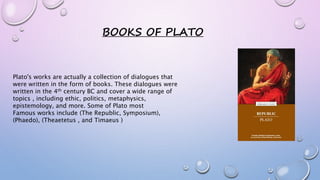
Plato's works are actually a collection of dialogues that
were written in the form of books. These dialogues were
written in the 4th century BC and cover a wide range of
topics , including ethic, politics, metaphysics,
epistemology, and more. Some of Plato most
Famous works include (The Republic, Symposium),
(Phaedo), (Theaetetus , and Timaeus )
CONCLUSION
Plato was a Greek philosopher who emphasized the
importance of reason, critical thinking, and the pursuit
of knowledge and virtue. His philosophy covers a wide
range of topics, including metaphysics, ethics, politics,
epistemology, and aesthetics. Plato's ideas have had a
significant impact on Western philosophy and continue
to be influential today.
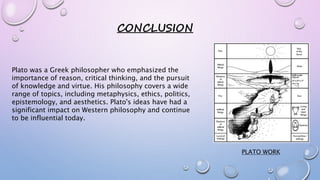
PLATO WORK
REFRENCES
1. Stanford Encyclopedia of Philosophy - This is a
comprehensive online encyclopedia of philosophy, which
has a detailed entry on Plato and his philosophy.
https://plato.stanford.edu/entries/plato/
2. Internet Encyclopedia of Philosophy - Another
comprehensive online encyclopedia of philosophy, with an
extensive entry on Plato and his ideas.
https://iep.utm.edu/plato/
3. The Plato Project - A website dedicated to promoting the
study and understanding of Plato's philosophy. It includes
articles, resources, and online courses.
https://www.platoproject.org/
THANK YOU !

PLATO.pptx

  • 1.
    (NAMESOFSTUDENTS) GROUP F (PRESENTATION ) PLATO DEPARTMENTOF HUMAN NUTRITION & DIETETICS 1. HADIYA QADEER 2. SAMAVIA NADEEM 3. AFRA ASHRAF 4. AQSA BIBI 5. SANA SHAHID
  • 2.
    CONTENT LIST 1.INTRODUCTION OFPLATO 2.MAJOR THEME ABOUT CRITICAL THINKING 3.FAMOUS SAYING 4.PLATO PHILOSPHY AND NOBLE PRIZE 5.CONCLUSION 6.REFRENCES  PLATO
  • 3.
    INTRODUCTION OF PLATO Platowas a Greek philosopher who lived from approximately 428/427 BC to 348/347 BC. He was a student of Socrates and the teacher of Aristotle. Plato is known for his written dialogues, in which he explores philosophical questions and ideas through conversations between characters.
  • 4.
    MAJOR THEME ABOUTCRITICAL THINKING Plato's major theme about critical thinking can be seen throughout his philosophical dialogues. He believed that critical thinking was essential for arriving at truth and understanding.  One of Plato's main ideas about critical thinking is the importance of examining one's own beliefs and assumptions. Overall, Plato's philosophy emphasizes the importance of questioning and critical thinking as a means of arriving at truth, understanding, and wise decision-making.
  • 5.
    FAMOUS SAYING "Wise menspeak because they have something to say; fools because they have to say something." (This quote emphasizes the importance of speaking thoughtfully and with purpose, rather than speaking just for the sake of speaking). Finally, there is the well-known quote "Philosophy begins in wonder" which is attributed to Plato. (This quote highlights the idea that a sense of wonder and curiosity is the foundation of philosophical inquiry and critical thinking).
  • 6.
    PLATO PHILOSOPHY ANDNOBLE PRIZE Plato's philosophy is characterized by his emphasis on the importance of reason, critical thinking, and the pursuit of knowledge and virtue as a means of achieving a good and fulfilling life. Plato, being a philosopher who lived over 2000 years ago, could not have won a Nobel Prize, as the first Nobel Prizes were awarded in 1901, long after Plato's time. NOBLE PRIZE However, many scholars and thinkers throughout history have been inspired and influenced by Plato's ideas PHILOSOPH Y
  • 7.
    BOOKS OF PLATO Plato'sworks are actually a collection of dialogues that were written in the form of books. These dialogues were written in the 4th century BC and cover a wide range of topics , including ethic, politics, metaphysics, epistemology, and more. Some of Plato most Famous works include (The Republic, Symposium), (Phaedo), (Theaetetus , and Timaeus )
  • 8.
    CONCLUSION Plato was aGreek philosopher who emphasized the importance of reason, critical thinking, and the pursuit of knowledge and virtue. His philosophy covers a wide range of topics, including metaphysics, ethics, politics, epistemology, and aesthetics. Plato's ideas have had a significant impact on Western philosophy and continue to be influential today. PLATO WORK
  • 9.
    REFRENCES 1. Stanford Encyclopediaof Philosophy - This is a comprehensive online encyclopedia of philosophy, which has a detailed entry on Plato and his philosophy. https://plato.stanford.edu/entries/plato/ 2. Internet Encyclopedia of Philosophy - Another comprehensive online encyclopedia of philosophy, with an extensive entry on Plato and his ideas. https://iep.utm.edu/plato/ 3. The Plato Project - A website dedicated to promoting the study and understanding of Plato's philosophy. It includes articles, resources, and online courses. https://www.platoproject.org/
  • 10.