LET’S KNOW EACH OTHER
SESSION OBJECTIVES
1. Know about Islamisation.
2. Reasons to Islamise the curriculum
3. Methodology of Islamising the
curriculum.
4. Common difficulties faced by schools.
5. Ways to overcome the difficulties.
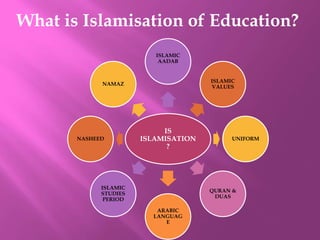
IS
ISLAMISATION
?
ISLAMIC
AADAB
ISLAMIC
VALUES
UNIFORM
QURAN &
DUAS
ARABIC
LANGUAG
E
ISLAMIC
STUDIES
PERIOD
NASHEED
NAMAZ
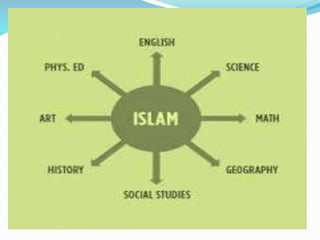
What is Islamisation of Education?
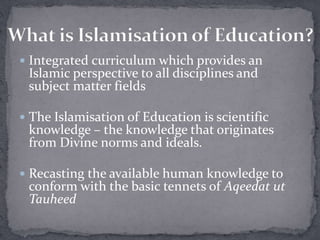
 Integrated curriculum which provides an
Islamic perspective to all disciplines and
subject matter fields
 The Islamisation of Education is scientific
knowledge – the knowledge that originates
from Divine norms and ideals.
 Recasting the available human knowledge to
conform with the basic tennets of Aqeedat ut
Tauheed
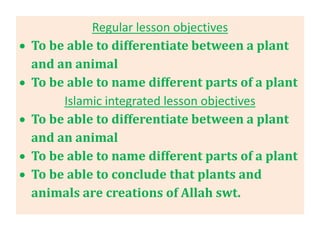
Regular lesson objectives Islamic integrated lesson objectives
 To be able to differentiate between a plant and
an animal
 To be able to name different parts of a plant
 To be able to differentiate between a plant and an animal
 To be able to name different parts of a plant
 To be able to conclude that plants and animals are creations
of Allah swt.
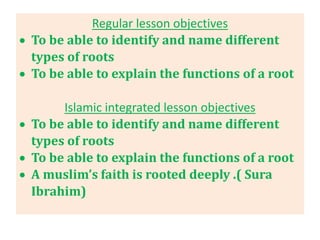
 To be able to identify and name different types
of roots
 To be able to explain the functions of a root
 To be able to identify and name different types of roots
 To be able to explain the functions of a root
 A muslim’s faith is rooted deeply .( Sura Ibrahim)
 To be able to list the functions of a stem
 To be able to describe parts of a leaf
 To be able to explain the functions of a leaf
 To be able to list the functions of a stem
 To be able to describe parts of a leaf
 A muslim’s good deeds branch out to the sky.( Sura Ibrahim)
 To be able to elucidate how flowers grow into
fruits
 To be able to explain the functions of a leaf
 To be able to elucidate how flowers grow into fruits
 To learn about the flowers and fruits of jannah.
 To be able to illustrate how seeds grow into
new plants
 To be able to illustrate how seeds grow into new plants
 To be able to talk about what the Quran says about the
splitting of seed.
What else needs Islamisation?
Displays
Assessments
Activities
Presentations
Projects
Tours and trips
History of Islamisation
 The recent Islamisation movement had its
earliest beginnings in the 14th century
 The First World Conference on Islamic
Education held in Makka in 1397 AH/1977
AD was a major event in the Islamisation
movement.
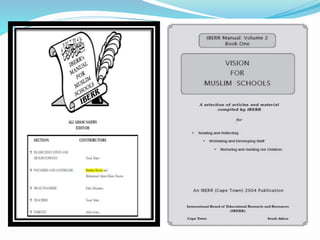
 Thereafter, IBERR (International Board of
Research and Resources) came up with a
complete manual for Islamic schools.
The comparison of
secular and Islamic
education?
Secular curriculum
The purpose of secular curriculum is based on five core
principles:
1. The sovereignty of man, as though supreme.
2. Basing all knowledge on human reasoning and
experience
3. Unrestricted freedom of thought and expression
4. Unwillingness to accept 'spiritual' truths
(naturalism)
5. Individualism, relativism and materialism
Islamic curriculum
By contrast, the purpose of an Islamic curriculum is:
1. To include an Islamic perspective in the curriculum,
which reflects the contribution of Islam and Muslims
to civilization
2. To ensure that all students gain knowledge and
understanding of the Islamic legacy
3. To unify the educational system by removing "the
dualism of sacred and secular from education"
4. To prevent Muslims being influenced by "Godless
ideologies".
5. To emphasize that Islamic teaching is relevant to
every aspect of life and every ‘subject’ of the
curriculum.
Benefits of Islamisation
 Prepares the future generation to work as agents of Allah.
 Inculcates in the child the sense of; humility, equity, integrity,
justice and other values based on Islamic ethics.
 Develops in the child a spirit of enquiry and creativity through
the exploration of nature.
 Makes him conscious of his responsibility to develop himself and
his environment for the benefit of human race and his
consequent accountability in the next world.
 Produces a conducive Islamic environment for the proper
upbringing of the child and the development of his faculties
 All round development of the child, spiritual, moral, physical,
mental, cultural in preparation for the adult life.
SWOT Analysis
AS A SCHOOL
 What are your strengths which you can use to bring a
change in the style of education
 What are your weaknesses that you need to over come
in order to change in the style of education
 What opportunities does your school enjoy which can
be utilised to change in the style of education
 What threats do you foresee that might hinder the
change you want to bring in the style of education
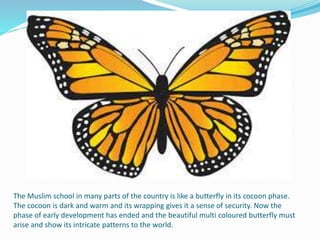
The Muslim school in many parts of the country is like a butterfly in its cocoon phase.
The cocoon is dark and warm and its wrapping gives it a sense of security. Now the
phase of early development has ended and the beautiful multi coloured butterfly must
arise and show its intricate patterns to the world.
What to Islamise?
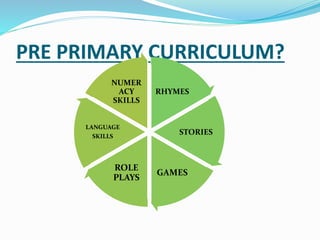
PRE PRIMARY CURRICULUM?
RHYMES
STORIES
GAMES
ROLE
PLAYS
LANGUAGE
SKILLS
NUMER
ACY
SKILLS
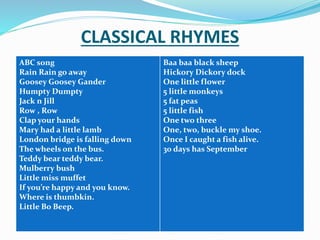
CLASSICAL RHYMES
ABC song
Rain Rain go away
Goosey Goosey Gander
Humpty Dumpty
Jack n Jill
Row , Row
Clap your hands
Mary had a little lamb
London bridge is falling down
The wheels on the bus.
Teddy bear teddy bear.
Mulberry bush
Little miss muffet
If you’re happy and you know.
Where is thumbkin.
Little Bo Beep.
Baa baa black sheep
Hickory Dickory dock
One little flower
5 little monkeys
5 fat peas
5 little fish
One two three
One, two, buckle my shoe.
Once I caught a fish alive.
30 days has September
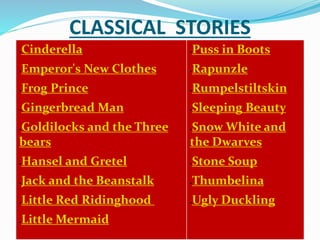
CLASSICAL STORIES
Cinderella
Emperor's New Clothes
Frog Prince
Gingerbread Man
Goldilocks and the Three
bears
Hansel and Gretel
Jack and the Beanstalk
Little Red Ridinghood
Little Mermaid
Puss in Boots
Rapunzle
Rumpelstiltskin
Sleeping Beauty
Snow White and
the Dwarves
Stone Soup
Thumbelina
Ugly Duckling
The following is the order of
priority for discipline-reform:
natural sciences,
social sciences,
humanities,
applied sciences and technology,
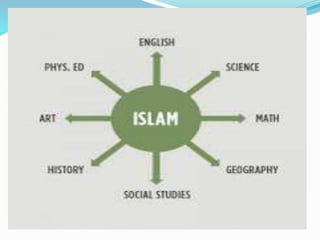
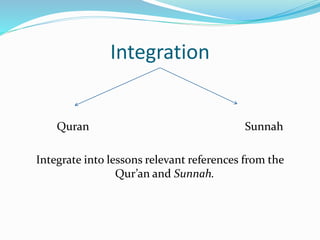
Integration
Quran Sunnah
Integrate into lessons relevant references from the
Qur’an and Sunnah.
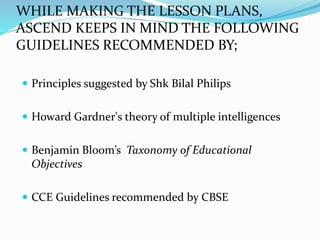
WHILE MAKING THE LESSON PLANS,
ASCEND KEEPS IN MIND THE FOLLOWING
GUIDELINES RECOMMENDED BY;
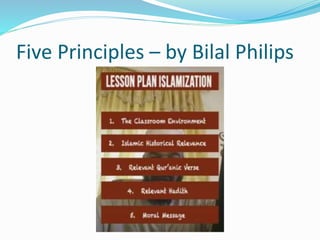
 Principles suggested by Shk Bilal Philips
 Howard Gardner's theory of multiple intelligences
 Benjamin Bloom’s Taxonomy of Educational
Objectives
 CCE Guidelines recommended by CBSE
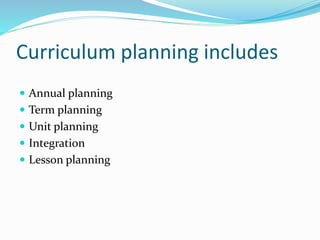
Curriculum planning includes
 Annual planning
 Term planning
 Unit planning
 Integration
 Lesson planning
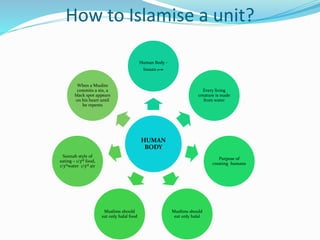
How to Islamise a unit?
HUMAN
BODY
Human Body -
Insaan ‫جسم‬
Every living
creature is made
from water
Purpose of
creating humans
Muslims should
eat only halal
Muslims should
eat only halal food
Sunnah style of
eating – 1/3rd food,
1/3rdwater 1/3rd air
When a Muslim
commits a sin, a
black spot appears
on his heart until
he repents
The importance of converting a
unit plan into a detailed
daily lesson plan.
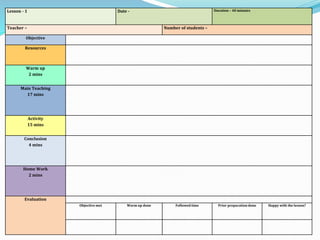
Lesson - 1 Date - Duration – 40 minutes
Teacher – Number of students –
Objective
Resources
Warm up
2 mins
Main Teaching
17 mins
Activity
15 mins
Conclusion
4 mins
Home Work
2 mins
Evaluation
Objective met Warm up done Followed time Prior preparation done Happy with the lesson?
How to Islamise
our lesson plans?
Five Principles – by Bilal Philips
Regular lesson objectives
 To be able to differentiate between a plant
and an animal
 To be able to name different parts of a plant
Islamic integrated lesson objectives
 To be able to differentiate between a plant
and an animal
 To be able to name different parts of a plant
 To be able to conclude that plants and
animals are creations of Allah swt.
Regular lesson objectives
 To be able to identify and name different
types of roots
 To be able to explain the functions of a root
Islamic integrated lesson objectives
 To be able to identify and name different
types of roots
 To be able to explain the functions of a root
 A muslim’s faith is rooted deeply .( Sura
Ibrahim)
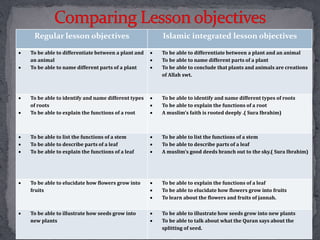
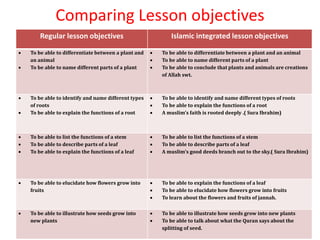
Comparing Lesson objectives
Regular lesson objectives Islamic integrated lesson objectives
 To be able to differentiate between a plant and
an animal
 To be able to name different parts of a plant
 To be able to differentiate between a plant and an animal
 To be able to name different parts of a plant
 To be able to conclude that plants and animals are creations
of Allah swt.
 To be able to identify and name different types
of roots
 To be able to explain the functions of a root
 To be able to identify and name different types of roots
 To be able to explain the functions of a root
 A muslim’s faith is rooted deeply .( Sura Ibrahim)
 To be able to list the functions of a stem
 To be able to describe parts of a leaf
 To be able to explain the functions of a leaf
 To be able to list the functions of a stem
 To be able to describe parts of a leaf
 A muslim’s good deeds branch out to the sky.( Sura Ibrahim)
 To be able to elucidate how flowers grow into
fruits
 To be able to explain the functions of a leaf
 To be able to elucidate how flowers grow into fruits
 To learn about the flowers and fruits of jannah.
 To be able to illustrate how seeds grow into
new plants
 To be able to illustrate how seeds grow into new plants
 To be able to talk about what the Quran says about the
splitting of seed.
Importance of age appropriate integration
SECONDARY CLASSES
ACTIVITY TIME
 Group Activity
 Topic – BIRDS
 Part 1 - Think of 5-6 Islamic points from Quran and
Sunnah that can be used for Islamic integration.(5mins )
 Part 2 -
WHO CAN WORK ON INTEGRATION?
Wrong practices in integrating
 Teachers put too much of Islamic content
 Teachers put too little of Islamic content
 Teachers don’t use reliable resources.
Difficulties in integrating
 No particular book or website.
How readymade lps help?
 Sets a standard in the school
 Helps school which are still unclear about the Islamisation
concept.
 Helps the muslim school teachers who are not proficient
in Islamic traditional sciences and the Arabic Language,
both of which are crucial for effective lesson planning.
 Reduces teachers planning time and gives more time to
focus on students performance.
 Helps reduce the Principal’s lesson plan checking time.
 Helps in inspection, evaluation and suggestion of further
improvements.
Danger of readymade lps
 Limits the creativity
 Produces laid back teachers.
1. From what age should schools starts Islamising
their curriculum?
2. What help is available for pre primary?
3. What help is for secondary schools?
4. What sources do we use in our lesson plans?
5. Does the textbook syllabus get effected?
6. How much time does Islamisation take of the
teaching period?
1. Our teachers are not trained in the field of
integration.
2. I have non muslim teachers at my school.
3. Is this the first time you will be doing this?
4. What other subjects integration will be
provided?
5. What else comes with lesson plans?
6. Is there any training for the teachers?
7. What type of training will the teachers receive?
8. How many training sessions will be provided?
 What is the follow up procedure?
 What if we need help?
 Is anyone else providing this solution to schools?
 Can you not provide us topic based integration?
Q & A
SESSION OUTCOMES
1. Discussed Islamisation.
2. Need to Islamise the curriculum
3. Methodology of Islamising the
curriculum.
4. Common difficulties faced by schools.
5. Ways to overcome the difficulties.
 Knowledge of Islam is the key to success in this world and
especially in the Hereafter. Abu Hurairah (may Allah be
pleased with him) related that the Prophet (PBUH) said,
“After the death of a person, his actions stop, except three
things that he leaves behind: first continuous charity,
second knowledge from which some benefit may be
obtained, and then a virtuous son who prays for him.”
(Muslim) The best gift parents and teachers can leave
behind after they pass away is the knowledge of Islam they
have taught to their children. When these children grow
up, they can repeat the tradition of their parents and
teachers. This way the link of Islamic knowledge becomes
perpetual and continues until the Last Day.

Islamisation of education

  • 3.
  • 4.
    SESSION OBJECTIVES 1. Knowabout Islamisation. 2. Reasons to Islamise the curriculum 3. Methodology of Islamising the curriculum. 4. Common difficulties faced by schools. 5. Ways to overcome the difficulties.
  • 5.
  • 6.
     Integrated curriculumwhich provides an Islamic perspective to all disciplines and subject matter fields  The Islamisation of Education is scientific knowledge – the knowledge that originates from Divine norms and ideals.  Recasting the available human knowledge to conform with the basic tennets of Aqeedat ut Tauheed
  • 7.
    Regular lesson objectivesIslamic integrated lesson objectives  To be able to differentiate between a plant and an animal  To be able to name different parts of a plant  To be able to differentiate between a plant and an animal  To be able to name different parts of a plant  To be able to conclude that plants and animals are creations of Allah swt.  To be able to identify and name different types of roots  To be able to explain the functions of a root  To be able to identify and name different types of roots  To be able to explain the functions of a root  A muslim’s faith is rooted deeply .( Sura Ibrahim)  To be able to list the functions of a stem  To be able to describe parts of a leaf  To be able to explain the functions of a leaf  To be able to list the functions of a stem  To be able to describe parts of a leaf  A muslim’s good deeds branch out to the sky.( Sura Ibrahim)  To be able to elucidate how flowers grow into fruits  To be able to explain the functions of a leaf  To be able to elucidate how flowers grow into fruits  To learn about the flowers and fruits of jannah.  To be able to illustrate how seeds grow into new plants  To be able to illustrate how seeds grow into new plants  To be able to talk about what the Quran says about the splitting of seed.
  • 9.
    What else needsIslamisation? Displays Assessments Activities Presentations Projects Tours and trips
  • 10.
    History of Islamisation The recent Islamisation movement had its earliest beginnings in the 14th century  The First World Conference on Islamic Education held in Makka in 1397 AH/1977 AD was a major event in the Islamisation movement.  Thereafter, IBERR (International Board of Research and Resources) came up with a complete manual for Islamic schools.
  • 12.
    The comparison of secularand Islamic education?
  • 13.
    Secular curriculum The purposeof secular curriculum is based on five core principles: 1. The sovereignty of man, as though supreme. 2. Basing all knowledge on human reasoning and experience 3. Unrestricted freedom of thought and expression 4. Unwillingness to accept 'spiritual' truths (naturalism) 5. Individualism, relativism and materialism
  • 14.
    Islamic curriculum By contrast,the purpose of an Islamic curriculum is: 1. To include an Islamic perspective in the curriculum, which reflects the contribution of Islam and Muslims to civilization 2. To ensure that all students gain knowledge and understanding of the Islamic legacy 3. To unify the educational system by removing "the dualism of sacred and secular from education" 4. To prevent Muslims being influenced by "Godless ideologies". 5. To emphasize that Islamic teaching is relevant to every aspect of life and every ‘subject’ of the curriculum.
  • 15.
    Benefits of Islamisation Prepares the future generation to work as agents of Allah.  Inculcates in the child the sense of; humility, equity, integrity, justice and other values based on Islamic ethics.  Develops in the child a spirit of enquiry and creativity through the exploration of nature.  Makes him conscious of his responsibility to develop himself and his environment for the benefit of human race and his consequent accountability in the next world.  Produces a conducive Islamic environment for the proper upbringing of the child and the development of his faculties  All round development of the child, spiritual, moral, physical, mental, cultural in preparation for the adult life.
  • 17.
    SWOT Analysis AS ASCHOOL  What are your strengths which you can use to bring a change in the style of education  What are your weaknesses that you need to over come in order to change in the style of education  What opportunities does your school enjoy which can be utilised to change in the style of education  What threats do you foresee that might hinder the change you want to bring in the style of education
  • 19.
    The Muslim schoolin many parts of the country is like a butterfly in its cocoon phase. The cocoon is dark and warm and its wrapping gives it a sense of security. Now the phase of early development has ended and the beautiful multi coloured butterfly must arise and show its intricate patterns to the world.
  • 20.
  • 21.
  • 22.
    CLASSICAL RHYMES ABC song RainRain go away Goosey Goosey Gander Humpty Dumpty Jack n Jill Row , Row Clap your hands Mary had a little lamb London bridge is falling down The wheels on the bus. Teddy bear teddy bear. Mulberry bush Little miss muffet If you’re happy and you know. Where is thumbkin. Little Bo Beep. Baa baa black sheep Hickory Dickory dock One little flower 5 little monkeys 5 fat peas 5 little fish One two three One, two, buckle my shoe. Once I caught a fish alive. 30 days has September
  • 23.
    CLASSICAL STORIES Cinderella Emperor's NewClothes Frog Prince Gingerbread Man Goldilocks and the Three bears Hansel and Gretel Jack and the Beanstalk Little Red Ridinghood Little Mermaid Puss in Boots Rapunzle Rumpelstiltskin Sleeping Beauty Snow White and the Dwarves Stone Soup Thumbelina Ugly Duckling
  • 25.
    The following isthe order of priority for discipline-reform: natural sciences, social sciences, humanities, applied sciences and technology,
  • 26.
    Integration Quran Sunnah Integrate intolessons relevant references from the Qur’an and Sunnah.
  • 27.
    WHILE MAKING THELESSON PLANS, ASCEND KEEPS IN MIND THE FOLLOWING GUIDELINES RECOMMENDED BY;  Principles suggested by Shk Bilal Philips  Howard Gardner's theory of multiple intelligences  Benjamin Bloom’s Taxonomy of Educational Objectives  CCE Guidelines recommended by CBSE
  • 28.
    Curriculum planning includes Annual planning  Term planning  Unit planning  Integration  Lesson planning
  • 29.
    How to Islamisea unit? HUMAN BODY Human Body - Insaan ‫جسم‬ Every living creature is made from water Purpose of creating humans Muslims should eat only halal Muslims should eat only halal food Sunnah style of eating – 1/3rd food, 1/3rdwater 1/3rd air When a Muslim commits a sin, a black spot appears on his heart until he repents
  • 30.
    The importance ofconverting a unit plan into a detailed daily lesson plan.
  • 31.
    Lesson - 1Date - Duration – 40 minutes Teacher – Number of students – Objective Resources Warm up 2 mins Main Teaching 17 mins Activity 15 mins Conclusion 4 mins Home Work 2 mins Evaluation Objective met Warm up done Followed time Prior preparation done Happy with the lesson?
  • 32.
    How to Islamise ourlesson plans?
  • 33.
    Five Principles –by Bilal Philips
  • 34.
    Regular lesson objectives To be able to differentiate between a plant and an animal  To be able to name different parts of a plant Islamic integrated lesson objectives  To be able to differentiate between a plant and an animal  To be able to name different parts of a plant  To be able to conclude that plants and animals are creations of Allah swt.
  • 35.
    Regular lesson objectives To be able to identify and name different types of roots  To be able to explain the functions of a root Islamic integrated lesson objectives  To be able to identify and name different types of roots  To be able to explain the functions of a root  A muslim’s faith is rooted deeply .( Sura Ibrahim)
  • 36.
    Comparing Lesson objectives Regularlesson objectives Islamic integrated lesson objectives  To be able to differentiate between a plant and an animal  To be able to name different parts of a plant  To be able to differentiate between a plant and an animal  To be able to name different parts of a plant  To be able to conclude that plants and animals are creations of Allah swt.  To be able to identify and name different types of roots  To be able to explain the functions of a root  To be able to identify and name different types of roots  To be able to explain the functions of a root  A muslim’s faith is rooted deeply .( Sura Ibrahim)  To be able to list the functions of a stem  To be able to describe parts of a leaf  To be able to explain the functions of a leaf  To be able to list the functions of a stem  To be able to describe parts of a leaf  A muslim’s good deeds branch out to the sky.( Sura Ibrahim)  To be able to elucidate how flowers grow into fruits  To be able to explain the functions of a leaf  To be able to elucidate how flowers grow into fruits  To learn about the flowers and fruits of jannah.  To be able to illustrate how seeds grow into new plants  To be able to illustrate how seeds grow into new plants  To be able to talk about what the Quran says about the splitting of seed.
  • 37.
    Importance of ageappropriate integration
  • 38.
  • 39.
    ACTIVITY TIME  GroupActivity  Topic – BIRDS  Part 1 - Think of 5-6 Islamic points from Quran and Sunnah that can be used for Islamic integration.(5mins )  Part 2 -
  • 40.
    WHO CAN WORKON INTEGRATION?
  • 41.
    Wrong practices inintegrating  Teachers put too much of Islamic content  Teachers put too little of Islamic content  Teachers don’t use reliable resources.
  • 42.
    Difficulties in integrating No particular book or website.
  • 43.
    How readymade lpshelp?  Sets a standard in the school  Helps school which are still unclear about the Islamisation concept.  Helps the muslim school teachers who are not proficient in Islamic traditional sciences and the Arabic Language, both of which are crucial for effective lesson planning.  Reduces teachers planning time and gives more time to focus on students performance.  Helps reduce the Principal’s lesson plan checking time.  Helps in inspection, evaluation and suggestion of further improvements.
  • 44.
    Danger of readymadelps  Limits the creativity  Produces laid back teachers.
  • 45.
    1. From whatage should schools starts Islamising their curriculum? 2. What help is available for pre primary? 3. What help is for secondary schools? 4. What sources do we use in our lesson plans? 5. Does the textbook syllabus get effected? 6. How much time does Islamisation take of the teaching period?
  • 46.
    1. Our teachersare not trained in the field of integration. 2. I have non muslim teachers at my school. 3. Is this the first time you will be doing this? 4. What other subjects integration will be provided? 5. What else comes with lesson plans? 6. Is there any training for the teachers? 7. What type of training will the teachers receive? 8. How many training sessions will be provided?
  • 47.
     What isthe follow up procedure?  What if we need help?  Is anyone else providing this solution to schools?  Can you not provide us topic based integration?
  • 48.
  • 49.
    SESSION OUTCOMES 1. DiscussedIslamisation. 2. Need to Islamise the curriculum 3. Methodology of Islamising the curriculum. 4. Common difficulties faced by schools. 5. Ways to overcome the difficulties.
  • 50.
     Knowledge ofIslam is the key to success in this world and especially in the Hereafter. Abu Hurairah (may Allah be pleased with him) related that the Prophet (PBUH) said, “After the death of a person, his actions stop, except three things that he leaves behind: first continuous charity, second knowledge from which some benefit may be obtained, and then a virtuous son who prays for him.” (Muslim) The best gift parents and teachers can leave behind after they pass away is the knowledge of Islam they have taught to their children. When these children grow up, they can repeat the tradition of their parents and teachers. This way the link of Islamic knowledge becomes perpetual and continues until the Last Day.

Editor's Notes

  • #22 WHAT IS THE CURRENT PRACTICE. (1) THE BOOKS PROVIDED BY THE PUBLISHER ARE TAUGHT AS IT IS. (2) SCHOOLS WISH FOR A COMPLETE ISLAMIC TEXTBOOK, WHICH IS HAPPENING AT SOME PLACES BUT NOT ACCEPTED OR AVAILABLE BY MAJORITY OF THE MUSLIM SCHOOLS, BECAUSE OF ITS QUALITY OR BRAND. SO WHAT IS THE SOLUTION? I PERSONALLY FEEL, WE SHOULD LET OUR CHILDREN KNOW THE CLASSIC AESOP’S TALES. BUT … WE NEED TO INTEGRATE ISLAMIC VLUES INTO THESE STORIES, SO THAT WHEN EVER CHILDREN REMEMBER OR SHARE THIS STORY THEY AUTOMATICALLY ADD WHAT IS THE TAKE FOR A MUSLIM FROM THESE STORIES.
  • #23 Lets see how can these rhymes be islamised? Same can be done during colouring activity .
  • #24 ACTIVITY TIME. HERE ARE A FEW STORIES. HOW CAN WE ISLAMISE THEM?
  • #39 By this stage if the foundations are given strong, then children do not need much of help I integration. They themselves will see everything that they learn through the islamic perspective. And as life goes on, and as they go into further studeis, they will always see Allah’s wisdom and might in every creation. Let it be medicine or engineering or banking or politics. They will always be reminded of their creator.