Current and Charge
1.What is meant by an object moving at constant speed?
2. Describe what the area represents under a acceleration-time graph, with a non-
constant gradient, and how you would measure it.
3. State Newton’s 2nd
law.
4. Under what conditions could you experience weightlessness in a moving lift.
5. Why are cars designed to crumple in collisions?
6. Describe what energy change takes place when an object is allowed to fall.
7. Explain why a 100W bulb is more powerful than a 40W bulb.
8. State the physical significance of having a high Young Modulus.
2.
Current and Charge
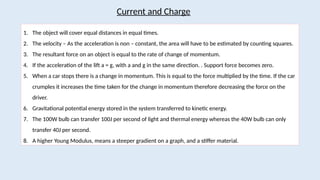
1.The object will cover equal distances in equal times.
2. The velocity – As the acceleration is non – constant, the area will have to be estimated by counting squares.
3. The resultant force on an object is equal to the rate of change of momentum.
4. If the acceleration of the lift a = g, with a and g in the same direction. . Support force becomes zero.
5. When a car stops there is a change in momentum. This is equal to the force multiplied by the time. If the car
crumples it increases the time taken for the change in momentum therefore decreasing the force on the
driver.
6. Gravitational potential energy stored in the system transferred to kinetic energy.
7. The 100W bulb can transfer 100J per second of light and thermal energy whereas the 40W bulb can only
transfer 40J per second.
8. A higher Young Modulus, means a steeper gradient on a graph, and a stiffer material.
3.
Electrical conduction
𝐸𝑝= h
𝑚𝑔
•On the water wheel above there is a
gravitational potential difference across it.
• The wheel turns as work is being done on it
• Work done =
• On the lamp in the circuit above there is an
electrical potential difference across it.
• The lamp glows as work is being done on it
• Work done =
𝐸𝑝=𝑉𝑞
4.
Electrical conduction
Electric current(I) – The rate of flow of charge
For electrical current to flow around a circuit, there must be
• A complete circuit
• A source of potential difference (voltage) e.g. a battery
The unit for current is the ampere (A), which is defined in
terms of the magnetic force between two parallel wires,
when they carry the same current.
𝐼=
∆ 𝑄
∆ 𝑡
Charge carriers (Q) - Charged particles moving through an electrical circuit
Current is due to charge carriers moving around the circuit
• In metals, the charge carriers are conduction electrons. They move through the metal surface colliding
with other electrons and fixed positive ions.
• In salt solutions or molten ionic compounds, the charge carriers are ions, which are charged atoms or
molecules
∆𝑄=𝐼 ∆𝑡
5.
Conventional electric current
Theconvention for the direction of current in a circuit
is from (+) to (-) This convention was agree upon
before the discovery of the electron.
It was known at the time that something, they called
charge, was flowing around a circuit , however, they
didn’t know whether this charge was positive (flowing
+ to - ) or negative (flowing ( - to + ).
It was a 50/50 guess, and they guessed wrong.
But even after the electron was discovered and everyone realised their mistake, the
convention of drawing current flowing from ( + to - ) stuck as everybody was used to it, and
it made no difference to calculations in an electrical circuit.
6.
Example
Calculate i) thecharge flow and ii) the number of electrons, moving through a circuit of a current in 2 minutes
if the current is measured to be 4A.
𝑖 ¿ ∆ 𝑄=𝐼 ∆ 𝑡
∆ 𝑄=4 𝑥(2 𝑥60)
∆ 𝑄=480 𝐶
𝐼=
∆ 𝑄
∆ 𝑡
7.
Practice
Calculate i) thecharge flow and ii) the number of electrons moving through the circuit per second, when
a) A current of 54A flows for 150s.
b) A buzzer sounds for 3 minutes with a current of 9mA running through it.
c) A motor running for 0.43 hours has a current of 8.75µA passing through it.
a) i)
a) ii)
b) i)
b) ii)
c) i)
c) ii)
8.
Practice
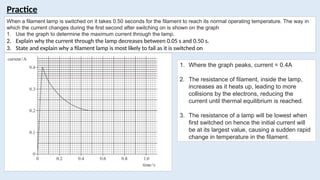
When a filamentlamp is switched on it takes 0.50 seconds for the filament to reach its normal operating temperature. The way in
which the current changes during the first second after switching on is shown on the graph
1. Use the graph to determine the maximum current through the lamp.
2. Explain why the current through the lamp decreases between 0.05 s and 0.50 s.
3. State and explain why a filament lamp is most likely to fail as it is switched on
1. Where the graph peaks, current = 0.4A
2. The resistance of filament, inside the lamp,
increases as it heats up, leading to more
collisions by the electrons, reducing the
current until thermal equilibrium is reached.
3. The resistance of a lamp will be lowest when
first switched on hence the initial current will
be at its largest value, causing a sudden rapid
change in temperature in the filament.
9.
Charge carriers
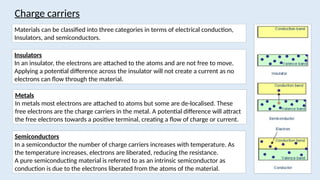
Materials canbe classified into three categories in terms of electrical conduction,
Insulators, and semiconductors.
Metals
In metals most electrons are attached to atoms but some are de-localised. These
free electrons are the charge carriers in the metal. A potential difference will attract
the free electrons towards a positive terminal, creating a flow of charge or current.
Insulators
In an insulator, the electrons are attached to the atoms and are not free to move.
Applying a potential difference across the insulator will not create a current as no
electrons can flow through the material.
Semiconductors
In a semiconductor the number of charge carriers increases with temperature. As
the temperature increases, electrons are liberated, reducing the resistance.
A pure semiconducting material is referred to as an intrinsic semiconductor as
conduction is due to the electrons liberated from the atoms of the material.






![Human Reproduction [ Reproductive System ] Notes @irfanullah_mehar Irfanullah...](https://cdn.slidesharecdn.com/ss_thumbnails/humanreproductionreproductivesystemnotesirfanullahmeharirfanullahmeharjanantantra-260111172350-56e85778-thumbnail.jpg?width=640&height=640&fit=bounds)


